Further development of the web user self
efficacy scale (WUSE)
Eachus, P, Hogg, P and Cassidy, SF
Title Further development of the web user selfefficacy scale (WUSE) Authors Eachus, P, Hogg, P and Cassidy, SF
Type Conference or Workshop Item
URL This version is available at: http://usir.salford.ac.uk/1171/ Published Date 2006
USIR is a digital collection of the research output of the University of Salford. Where copyright permits, full text material held in the repository is made freely available online and can be read, downloaded and copied for noncommercial private study or research purposes. Please check the manuscript for any further copyright restrictions.
Further Development of the Web User Self-Efficacy Scale
(WUSE)
Peter Eachus, [email protected] Simon Cassidy, [email protected]
Peter Hogg, [email protected]
Abstract
The aim of this research was to develop a short version of the WUSE scale (Eachus and Cassidy, 2004) without compromising its psychometric properties. Using item analysis the original 40-item WUSE scale was reduced to 20 items, which were then incorporated into a questionnaire, which was used in a survey of students in higher education.
Extensive testing of the new scale used a diverse sample in order to further refine the scale and establish a comprehensive bank of normative data. The results of this survey suggest that the scale has acceptable standards of reliability and validity and should therefore have wide utility in higher education.
Introduction
In their exploration of factors affecting the success of online learning, Blocher, Sujo de Momtes, Willis & Tucker (2002) considered whether online learners need specific skills and strategies to be successful. They examined factors including cognitive and metacognitive learning strategies and motivation and found that the online programme included in their study tended to attract students who were young and who were confident in their technology skills. Cassidy & Eachus (2002) have also identified confidence, or self-efficacy, as a pertinent factor in the context of computer use, with higher levels of computer user self-efficacy associated with greater self-rated computer competency and experience. Computer user self-efficacy relates specifically to an individual’s judgement of their capabilities to use computers and is derived from Bandura’s (1986) social cognitive theory in which he defines the general construct of self-efficacy as “peoples judgements of their capabilities to organize and execute courses of action required to attain designated types of performances. It is concerned not with the skills one has but with the judgements of what one can do with whatever skills one possesses” (p.391). Simplified, self-efficacy represents an individual’s beliefs regarding their perceived capability to successfully complete a particular behaviour or task. The impact of positive and negative self-efficacy beliefs has been demonstrated in a range of contexts including academic achievement (Eachus, 1993; Eachus and Cassidy, 1997; Cassidy & Eachus, 2000), health behaviour (Bandura, 1986; Schwarzer, 1992), stock market investment (Eachus, 1994) as well as more recently computer use (Cassidy & Eachus, 2002).
According to Bandura (1986), self-efficacy beliefs develop in response to four sources of information: previous experience (success and failure), vicarious experience; (observing others successes and failures); verbal persuasion (from peers, colleagues, relatives); and affective state (emotional arousal, e.g. anxiety). Because self-efficacy is based on self-perceptions regarding particular behaviours, the construct is considered to be situation specific or domain sensitive (Cassidy and Eachus, 2002). To illustrate domain sensitivity Cassidy & Eachus (2002) provide the example of an individual who may exhibit high levels of self-efficacy (indicating a high level of confidence) within one domain, for example sport, whilst simultaneously exhibiting low levels of self-efficacy within another domain such as academic ability. Bandura (1986) suggests that the perception that one has the capabilities to perform a task will increase the likelihood that the task will be completed successfully.
It is within the specific context of information and communication technologies and e-learning that the current paper examines self-efficacy beliefs, with specific reference to Internet or web-based resources. We are amidst a revolution involving virtual learning environments and identifying, measuring and manipulating any factor which might impede our access to, utilisation of, or success with virtual learning should be a principal concern of educational research and pedagogical practice.
There are many reasons or factors which make both access to, and utilisation of the Internet both desirable and necessary. Its ubiquitous nature has deemed access to and familiarity with the Internet an assumption of the modern age; not using the net may even be, as suggested by Wolfinbarger, Gilly & Schau (2005), socially undesirable. However, although the human computer interface is becoming increasingly intuitive, for inexperienced users there are still formidable problems. The Internet has the potential to impact on many facets of our daily lives, but for many people the ability to exert that power is limited by an inability to control that potential. This inability may be real – in that the individual genuinely may not have the necessary skills or abilities – or it may simply be a belief which results in incapacity and poor motivation, as in the case of self-efficacy expectations (Cassidy & Eachus, 2002). In their study examining internet usage in older individuals, Wolfinbarger et al. (2005) have already demonstrated the effect of self-efficacy beliefs in determining propensity and intensity of internet use, with positive beliefs associated with earlier adoption of and increased use of the Internet.
The nature of self-efficacy as an ego-centric construct demands that it be measured directly, rather than indirectly and for this reason self-efficacy is usually measured using self-report scales (Cassidy & Eachus, 2002). Over the past decade a number of scales have been developed to measure various aspects of Internet self-efficacy. The early measures tended to focus on a few specific types of Internet behaviour, for example creating bookmarks or entering the address of a web page correctly (Nahl, 1996). Similarly Ren (1999) reports on a self-efficacy scale designed to evaluate searches for government information. A more general measure of Internet self-efficacy was developed by Eastin and LaRose (2000) and although the psychometric properties of this scale were adequate, the domain of behaviours examined was very limited and the scale itself only contained 8 items.
Cassidy, 2004), and to evaluate its properties across a wide range of students. The final scale will assist academics in evaluating student beliefs in their capabilities of benefiting from online learning resources. Thus it should be possible for tutors (and students) to use this scale to identify those who might usefully gain from additional support. It is suggested that this will help to alleviate the frustrations that can result when students attempt to learn using resources for which they are inadequately prepared.
Method
The 40 item WUSE scale samples across four components of web based self-efficacy, Information Retrieval, Information Provision, Communication, and Internet Technology, 10 items for each component. These four components represented the starting point for the new scale and item analysis was used to select the 5 items from each component that would make up the new shorter, 20 item scale. A five point Likert scale ranging from strong disagreement through to strong agreement was used for participant responses. To control for affirmation bias, half the items were worded positively and half negatively. In addition to the main scale, data was also gathered on age, gender, course of study, Internet experience and expertise, and finally Internet accessibility, i.e. from where the participant was most likely to access the Internet. This data was used in the validation studies.
Sampling
The participants in this study were all students at the University of Salford studying a variety of courses across the four faculties of the University. Convenience sampling was used with the aim of achieving a sample with a wide age range, adequate gender representation, and a good cross section of courses from across the University. It was anticipated that this would also result in a wide range of computer and Internet capabilities.
Procedure
The Scale
The 20 items of the revised scale are shown below. For clarity the 5 point Likert scale is only shown on the first item.
1. I wouldn't have any problems creating a simple web page.
Strongly disagree 1 2 3 4 5 Strongly agree 2. I find using email easy...
3. I am not really sure what a modem does...
4. I know how to use software (e.g. Dreamweaver or Frontpage) for creating web pages...
5. I would never try to download files from the Internet, that would be too complicated... 6. Using messenger software, like MSN or ICQ always cause me some problems... 7. Finding my way around web sites is usually easy for me...
8. I much prefer using letters or the telephone to communicate with people, rather than the Internet...
9. I wouldn't know how to capture pictures from the Internet... 10. Adding an image to a web page would be very difficult for me... 11. I know how to test my computer for the presence of spyware...
12. Adding hypertext links to an image (i.e. an image map) is quite straightforward... 13. If my computer became infected with a virus, I wouldn't know how to get rid of it... 14. Using the Internet makes it much easier to keep in contact with people...
15. Using ftp to upload web pages to a server is too complicated for me... 16. I sometimes "get lost" when trying to navigate through the Internet... 17. I regularly exchange music and/or video files with friends...
18. I have no security worries when it comes to buying things over the Internet...
19. I know how to deal with annoying advertisements that appear while I'm using the Internet...
Results
The findings reported below represent data gathered to date as part of an ongoing survey. 302 participants have completed the scale, 99 male and 200 female, mean age 22 years with a range of 18 – 53 years. This data is sufficient to analyse the psychometric properties of the scale and report on validity and reliability. The additional data still to be gathered will allow a wider cross section of students to be represented but it is not anticipated that the psychometric properties of the scale will be significantly changed.
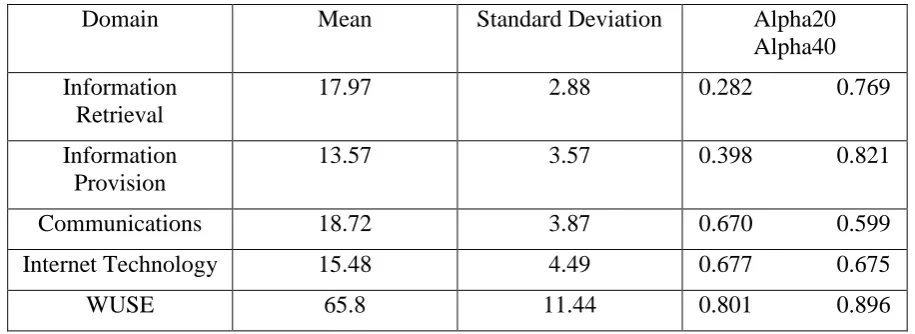
[image:6.595.90.548.307.474.2]Each of the four components of the scale has five items scored on a five point Likert scale. Thus the minimum that can be scored on any of the components is five and the maximum is 25. For the WUSE scale in total, this would be 20 and 100 respectively. Table 1 shows the means, standard deviations for each of the four components and the total self-efficacy score (WUSE). Reliability, measured using Cronbach’s Alpha is also shown for both the 20 item and 40 item versions of the scale.
Table 1. Web User Self-Efficacy Scores
Domain Mean Standard Deviation Alpha20 Alpha40 Information
Retrieval
17.97 2.88 0.282 0.769 Information
Provision
13.57 3.57 0.398 0.821 Communications 18.72 3.87 0.670 0.599 Internet Technology 15.48 4.49 0.677 0.675 WUSE 65.8 11.44 0.801 0.896
As can be seen from Table 1, for the revised 20 item scale the reliability of the individual components is low, though that of the WUSE scale as a whole does reach acceptable levels. To some extent this decrease in reliability is to be expected since the number of items in each of the four components has been halved and this will usually reduce reliability to some extent.
The validity of the scale was initially assessed by correlating the total WUSE score with age (r = -.246), hours per week spent on the Internet (r = .392), length of time a regular Internet user (r = .405), and self rated level of expertise (r = .590). All these correlations were statistically significant (p<0.01) in the directions predicted. Age is negatively correlated with self-efficacy indicating that older people are less confident in their Internet expertise.Hours per week and length of time as a regular user of the Internet were positively correlated indicating that the more experienced Internet users have a stronger sense of self-efficacy. Similarly those people who rate their own level of expertise as high, also score more highly on the WUSE scale.
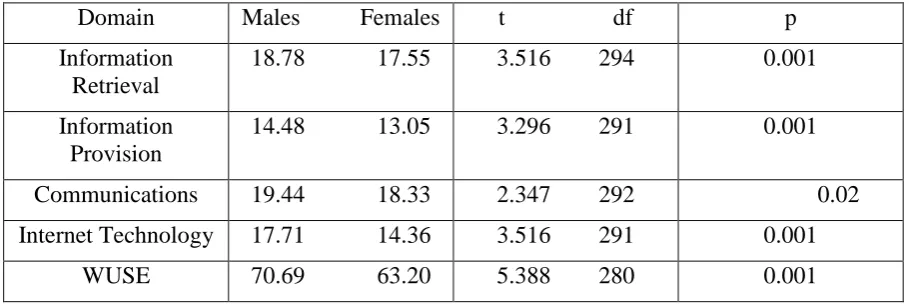
would score more highly on measures of Internet self-efficacy. This was confirmed by the data, which shows that on all four components and on the WUSE in total, males score significantly higher than females (see Table 2).
Table 2 Gender differences in WUSE scores
Domain Males Females t df p Information
Retrieval
18.78 17.55 3.516 294 0.001 Information
Provision
14.48 13.05 3.296 291 0.001 Communications 19.44 18.33 2.347 292 0.02 Internet Technology 17.71 14.36 3.516 291 0.001
WUSE 70.69 63.20 5.388 280 0.001
The validity of the scale is also supported when differences between Faculties is examined. Data from three faculties have been obtained to date, Health and Social Care, Business and Informatics, and Arts Media and Social Sciences. Intuitively we would predict that Business and Informatics students, who are often studying computing as part of their courses, would score more highly than students from the other two faculties. A one way ANOVA showed that this was indeed the case. The mean WUSE total scores were 63.37, 72.02, and 70.45 for the faculties of Health and Social Care, Business and Informatics, and Arts Media and Social Sciences, respectively (F = 15.563, p < 0.001).
Conclusion
References
Bandura, A. (1986) Social Foundations of Thought and Action: A Social Cognitive Theory; Englewood Cliffs, NJ:Prentice Hall.
Eachus, P. (1993) Development of the Health Student Self-Efficacy Scale. Perceptual and Motor Skills, 77,670
Eachus, P. (1994) Locus of Control, Self-Efficacy and Attributional Style of Investment Professionals. Unpublished PhD Thesis. Manchester Metropolitan University.
Eachus, P. and Cassidy, S (1997) Self-Efficacy, Locus of Control and Styles of Learning as Contributing Factors in the Academic Performance of Student Health Professionals. Proceedings of First Regional Congress of Psychology for Professionals in the Americas - Interfacing the Science and Practice of Psychology, July 27-August 2, 1997, Mexico City, Mexico
Cassidy, S and Eachus, P. (2002) Developing the computer user self-efficacy (CUSE) scale: Investigating the relationship between computer self-efficacy, gender and experience with computers. Journal of Educational Computing Research, Vol 26(2), 169-189, 2002.
Eachus, P. and Cassidy, S. (2004) Development of the Web Users Self-Efficacy Scale (WUSE). Proceedings of the 2nd Education in a Changing Environment Conference, University of Salford, September 2004.