Improved Dynamic Harmony Search Optimization for
Economic Dispatch Problems with Higher Order
Cost Functions
Boudjella Houari
1,*, Laouer Mohammed
2, Bouzeboudja Hamid
1, Ayad Ahmed Nour El Islam
3,
Mkattiri Sara
4, Saad Abdallah
41Department of Electrical Engineering, University of Sciences and Technology of Oran-M ohamed-Boudiaf (USTO-M B), Algeria 2
Department of Science and Technology, SALHI Ahmed University Centre, Algeria
3
Department of Electrical Engineering, KASDI M erbah University, Algeria
4Department of Electrical Engineering, National School of Electricity and M echanics, Hassan II University, M orocco *
Corresponding Author: [email protected]
Received August 25, 2019; Revised November 4, 2019; Accepted November 15, 2019
Copyright©2019 by authors, all rights reserved. Authors agree that this article re ma ins permanently open access under the terms of the Creative Commons Attribution License 4.0 International License
Abstract
This paper presents a modified harmony search algorithm with dynamica lly varying bandwidth, named improved dynamic harmony search algorithm (IDHSA) for economic load dispatch (ELD) proble ms with higher cost functions. The economic load dispatch problem aims to schedule power outputs of the generating units to meet the system load demand at min imu m cost while satisfying the equality and inequality constraints. In the IDHS a lgorith m, the key diffe rence fro m the conventional HS a lgorith m is that bandwidth (BW) operator changes dynamica lly at every iterat ion. The IDHS algorith m is tested with two different cases of power systems without and with transmission losses. The obtained results prove the accuracy and the effectiveness of the IDHS algorithm in determining the best solution compared than other optimization methods recently published in the literature.Keywords
Economic Dispatch, Cubic Cost Function, Power System Control, Harmony Search Algorithm1. Introduction
An electric power system consists of generation, transmission and distribution utilities to enhance electrical power to the consumers. Economic dispatch is the short-term determination of the optima l output power of generators to meet the system load and operate the generators at the lowest fuel cost [1]. The solution accuracy of economic dispatch problems is associated with the precision of the fue l cost curve para meters [2]. In the classical ED proble m, the cost function of active power
generation is approximated presented as a second-order polynomia l. But because of the high nonlinearity and non-smooth of the real input-output characteristics of the generating units, another cost function model is used by applying cubic cost function in wh ich outputs enter linearly, as quadratics, and to the third degree [3]. This type of function is the most correct because it yie lds appropriately shaped average and margina l cost curves [4]. A third-order polynomia l model is mo re p recisely to reflect the real response of therma l generators [5]. Several kinds of research prove that cubic cost function is more practical than a quadratic cost function to express the operating cost [6]. In the recent years, the solution of ED proble m with higher-order cost function has captured the attention of various researchers using diverse algorithms include various mathe matical procedures such as PSO algorithm suggested in [5], genetic algorithm (GA) in [6]. Al-suma it et al. imp le mented a pattern search (PS) a lgorith m in literature [7] to solve ED proble ms with a cubic fue l cost function. In re ference [8], a fire fly algorith m (FA) is applied to solve ED proble ms with CCF. Simu lated Annealing algorith m (SA) is proposed in [9], Quantum-PSO developed by F. Parvez Mahdi et al. in [10], a novel MVM OS technique in [11], Grasshopper Optimization Algorithm (GOA) is proposed in [12]. Modified Fire fly Algorith m with Levy Flights and Derived Mutation (MFA-LF-DM) in [13] is developed to solve single-objective dynamic ED with CCF. Artific ia l Bee Colony (A BC) [14] is imp le mented for co mbined economic and e mission dispatch problems. Gravitational Search Algorith m is provided in [15] to solve a multi-objective dispatch problem.
Gee m et a l [16], wh ich draws inspiration fro m the musical process to attain an agreeable harmony. HS takes some ma jor advantages compared with other metaheuristics, such as EP, GA, DE and tabu search (TS), wh ich is simple in concept and structure, converges quickly to the optimu m and easy to imple ment on optimizat ion proble ms [17, 18]. In the last decade, the harmony search algorith m (HSA) has wide ly used to solve kinds of optimization proble ms [19, 20]. In this work, to prove the effectiveness and the robustness of the proposed method, the cubic cost function economic d ispatch problems (CCFED) of two d ifferent cases grouped as lossless and lossy test systems have been solving and the results have been compared with some other optimization techniques reported in recent literature. The re ma inder o f the paper is organized as fo llo ws: Section. 2 provides descriptions and formulat ions of ELD proble ms with cubic fuel cost functions. Whereas the harmony search algorithm is briefly discussed in section. 3. Sect ion. 4 includes an introduction to the IDHS a lgorith m and its imple mentation to CCFED proble ms. Simu lation, results, and analysis of the findings are presented in section.5. Finally, the conclusion of the work done in the paper is given in section 6.
2. Descriptions and Formulations of
CCFED Problems
In the CCFED we seek
a) to min imize the total cost of generating real power, which is written as [2, 22]:
[1, N]
i P F F min N 1 i ii (1)
where
i i i i i i i ii P a P b P c P d
F 3 2 (2)
Where, Pi is the real power generation of unit i in (MW),
N nu mber of generators in the network, ai, bi, ci and di are
the fuel cost coefficients of the unit i. b) To minimize the transmission losses
N
i i i
N
i N
j i ij j
L PB P B P B
P min
1 0 00
1 1 (3)
Equation (2) is subject to the equality and inequality constraints.
A. Equality constraints
0
D LT
P
P
P
(4) Where PT, PD and PL are the total power generated,power system demand and total power loss respectively. B. Inequality constraints
The output power produced by generators has particularly limited by lower and higher powers. Equation
(5) shows the relation of inequality constraint.
N i
P P
Pimin i imax 1,2,..., (5)
3. Basic Harmony Search Algorithm
HSA
The basic HS algorithm works as follows [16-18]: Step 1. (Init ialization). Set para meters of HS, The main parameters of the HS method include [16]:
Harmony me mory size (HMS), where the population is memorized.
Pitch adjusting rate (PAR) for a new generated harmony, where PAR[0, 1],
Harmony me mory considering rate (HMCR), where HMCR[0, 1],
Bandwidth (BW) for pitch adjustment, nu mber of improvisations (NI) and nu mber of ma ximu m iterations (Nmax).
x fMinimize (6) Subject to
]
,
1
[
N
i
UB
x
LB
i
i
i
(7) Where f(x) is the objective function, xi is the solution vector of the HMS, LBi and UBi are the lowe r and uppervalues of xi.
Step 2. Ha rmony me mory in itia lizat ion. HM is a set of decision variables [17], the init ial harmony me mory is randomly generated by using (8):
i i
i j
i
LB
rand
UB
LB
x
()
(8)Where j= 1, 2, ..., HMS and rand () is random nu mber, uniformly distributed within the range [0, 1].
Mathematically, the HM matrix can be represented by the following expression:
HMS
HMS HMS N HMS N HMS HMS HMS N HMS N HMS HMS N N N N x f x f x f x f x x x x x x x x x x x x x x x x HM 1 2 1 1 2 1 1 1 1 1 2 1 1 2 2 1 2 2 2 1 1 1 1 1 2 1 1 . . . . . . . . . . . . . . . . . . . . . . . . . . . . . . . . . . . (9) Step 3. Improvise a new harmony as follows:
A novel solution vector xinew(x1new,2new,,Nnew) is generated based on the main HS operators HMCR, PAR and BW. Such operators are considered in production of a new harmony as the following [18]:
N i
o th erw ise X
x
Pitch adjusting decision:
) 1
( PAR
y p ro b a b ilit with
No
PAR y p ro b a b ilit with
Yes
x
i
new
(11)A new solution vector xi based on the disturbance principle can be generated as follows:
BW BW rand
x
xi new inew2. () (12)
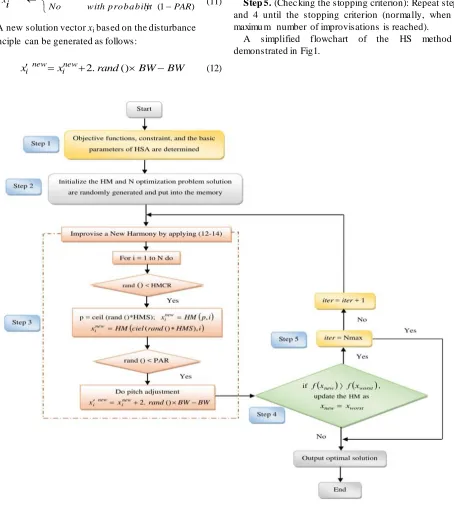
Step 4. Update the HM vector,xinew(x1new,2new,,xNnew) as xworst= xnew if f (xnew) < f (xworst).
Step 5. (Chec king the stopping criterion): Repeat steps 3 and 4 until the stopping criterion (norma lly, when the maximu m number of improvisations is reached).
A simplified flowchart of the HS method is demonstrated in Fig1.
[image:3.596.71.525.111.619.2]4. Improved Dynamic Harmony
Search Algorithms (IDHSA)
4.1. The Motivation of the IDHS Algorithm
To enhance the behavior and the convergence speed of the original HSA, many variants of the HS method based on parameters setting have been studied with incorporating some modifications to the main operators of HSA (i.e., PAR, HM CR, and BW), such as the variations proposed in the literature [25-29]. The PAR and BW para meters, deciding the precision of the solution. If we choose a small BW and low PAR va lues, the convergence speed of HSA becomes slowly and the fine-tuning of solution vectors will increase. Furthermore, if we choose a bigger PAR value with a wide BW value in the early generation, HSA will converge quickly to the best solution. Therefore, is very necessary that PAR and BW were dynamically adjusting at every iteration.
In [30], Ka livarapu et a l have developed a new modification of harmony search algorith m, with bandwidth varying dynamically at every iteration to improve the performance and co mp le xity of e xisting HSA. The princ iple behind th is idea is to use a wider BW to search in the entire doma in and dynamica lly adjust the BW towards the optimal solution.
4.2. New Parameter of BW
In this subsection, the modified HS a lgorith m with dynamic BW operator will be studied. Dynamic BW (DBW) is represented as a decreasing function of the current generation and number of ma ximu m ite rations specified for the problem, i.e . in the initia l stages of this algorith m, BW is dynamically mod ified by ma intaining a higher value and gradually decreasing by a low value to ensure close convergence of the optimal solution [30].
The selection of termination condition depends on the desired precision leve l of solution [31]. According to the criteria mentioned above, we find that the equation of a low-pass filter is approximately close to the requirement.
The new BW equation can be expressed as follows:
max . 1 ) ( N i h i BW (13)
Where, h and γ a re the constant parameters depend on the limit va lues of BW. To satisfy the above-mentioned criteria, the e xponent α must be greater than 1. 'i' and 'Nma x' are the current iteration and total number of iterations.
According to [30], a reasonably fair result can be obtained when minimu m va lue of BW (BW min) should be very sma ll, generally ~ 0.1% of the range of decision variables. While , BW ma x is assumed to 5~10% of the
range of decision variables. The constant γ is eva luated with the logarithmic decremental function as follow [30]:
min 2 max 1 ln BW b BW b
(14)Where b1 and b2 are the constants and their numerical
values are experimentally evaluated in [30, 31], the best values of b1 and b2 that gives a minimu m BW value
ensures precise and fast convergence towards the optimal solution are considered to be 50 and 100, respectively (best values).
For the problems having low decision variables (≤ 8 variables), Eq. (13) is more effic ient to compute dynamic BW. For highly co mple x optimizat ion problems, the best solution is found by modified (13) to a discontinuous adaptative dynamic BW function [30]. The proposed DADBW function is expressed as:
pivot i BW pivot i N i h i BW i BW ; ; . 1 ) ( ) ( min max
(15)
Where, ‘pivot’ decides the optimu m point where the BW changes (generally Nmax/2).
4.3. Implementation of IDHSA to CCFED Problems
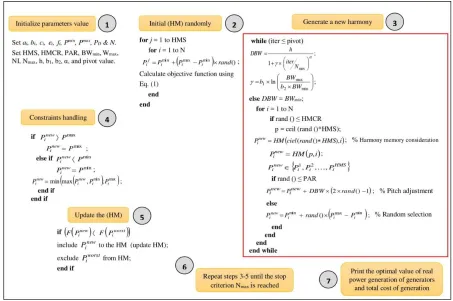
Based on the corresponding improvement methods, the proposed IDHS algorithm process is shows below:
Step 1. Specify the generator cost coefficients (ai, bi, ci
and di,), total number of generator units (N), specify Pmax
and Pmin of all generators and load demand PD.
Initia lize the parameters of IDHS a lgorith m (HMS, HMCR, PAR, BWmax, BWmin, NI, Nmax and Pivot).
Step 2. In itia lize HM matrix with size (HMS × N). The initial HM is randomly generating as follow:
for j=1 to HMS do for i=1 to N do
max min
min
()
)
,
(
i i ij
i
P
rand
P
P
P
j
i
HM
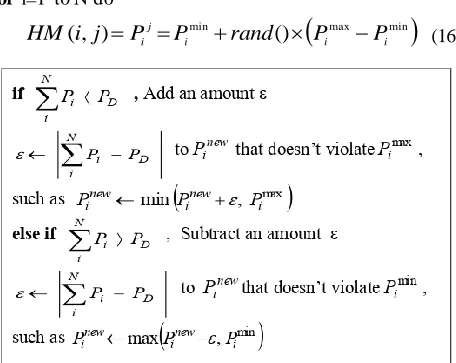
(16) [image:4.596.309.537.556.738.2]To not violate the generator limits and not to work at the prohibited zone after the generation of each solution vector, the total generation of units is compared to load demand. Fig. 2 shows the process of verifying the equality constraint used in the IDHS algorithm. Th is process is iterated for other units until the ε is zero.
Step 3. Ca lculate the fitness value for each harmony vector in the HM matrix using (5). The HM matrix is represented as follow:
HMS
G HMS G G G HMS N G HMS N G HMS G HMS G HMS N G HMS N G HMS G HMS G N G N G G G N G N G G G P f P f P f P f P P P P P P P P P P P P P P P P HM 1 2 1 1 2 1 1 1 1 1 2 1 1 2 2 1 2 2 2 1 1 1 1 1 2 1 1 . . . . . . . . . . . . . . . . . . . . . . . . . . . . . . . . . . . (17)
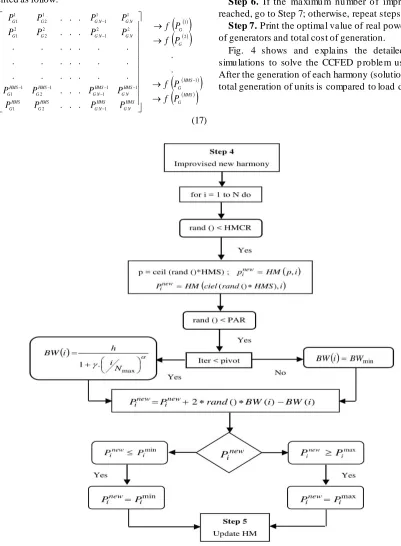
Step 4. Generate a new harmony solution as described in step 3 (section 3), with bandwidth (BW) is dynamica lly updating using (15). The new harmony imp rovisation process is depicted by the flowchart shown in Fig.3.
Step 5. Update the HM vector and calculate the fitness value f(PG), ( , , , )
2
1new new Nnew new
i P P P
P a worst
i new
i P
P if f
(Pinew) < f (Piworst), exclude Piworst.
Step 6. If the ma ximu m nu mber o f improvisations is reached, go to Step 7; otherwise, repeat steps 4-5.
Step 7. Print the optima l va lue of real power generation of generators and total cost of generation.
Fig. 4 shows and e xpla ins the detailed phases of simu lations to solve the CCFED p roble m using IDHSA. After the generation of each harmony (solution vector), the total generation of units is compared to load demand PD.
[image:5.596.86.487.182.728.2]Figure 4. Pseudo code of IDHS algorithm to CCFED problems
5. Results and Discussion
To evaluate the efficiency of the proposed IDHS algorith m, the above algorith m is first applied to a CCFED problem with a 3-units system (Wollenberg’s power network) [32] and 5-units systems [5] and then to Liang’s power network [24]. It should be noted that the tow test systems are lossless in the first case while the power losses are considered in the second case. For both grouped cases studied, the algorithm of IDHS is run 20 independent trials; the software proposed was imp le mented in Matlab (R2017a) and e xecuted on a PC with an Intel (R) Core i3-3110 CPU processor (2.40 GHz), 4 Go RAM and MS Windows 10. For conducting the test, the parameters of IDHS algorithm for a ll test systems are given as fo llo ws: HMS = 5, HM CR = 0.85, PAR = 0.3, BW min=0.01, BW ma x = 0.5, NI = 50 and the ma x tries (Nma x) is set at 3x10⁴. The required data with cubic cost function coeffic ients of all test systems are given in Tables 1, 2 and 3.
Table 1. Data Parameters of 3 units System (Wollenberg's Network) [5, 32]
Unit ai bi ci di Pmin Pmax
1 1.27e-07 9.68e-04 6.950 749.55 320 800
2 6.45e-08 7.375e-04 7.051 1285 300 1200
3 9.98e-08 1.04e-03 6.531 1531 275 1100
Table 2. Data Parameters of 5 units System [5]
Unit ai bi ci di Pmin Pmax
1 1.27e-07 9.68e-04 6.950 749.55 320 800
2 6.45e-08 7.375e-04 7.051 1285 300 1200
3 9.98e-08 1.04e-03 6.531 1531 275 1100
4 1.27e-07 9.68e-04 6.950 749.55 320 800
5 6.45e-08 7.375e-04 7.051 1285 300 1200
Table 3. Data Parameters of 3 units system (Liang’s network) [24]
Unit ai bi ci di Pmin Pmax
1 3.33e-6 -2.6429e-3 5.10238 11.2 100 500
2 3.33e-5 -3.0571e-2 13.01 -632 100 500
3 -1.77e-7 3.0845e-4 4.28997 147.144 200 1000
5.1. Case 1: Lossless Test Systems
The IDHS a lgorithm is applied to solve the CCFED problem with 3-generator [32] and 5-generator systems [5] for the load power system respectively as 2500 (MW) and 1800 (MW).
[image:6.596.71.524.80.381.2]The best generation schedule of 3 generating units along with the total cost obtained by proposed IDHS over 20 runs are co mpared with GA [5], PSO [5], SA [9], and FA [8] in Table 4.
[image:6.596.307.536.426.516.2] [image:6.596.306.538.537.596.2] [image:6.596.59.288.683.744.2]without losses are compared with as seen from table 4, that the proposed IDHS is better co mpared to GA [5], PSO [5] and SA [9] in terms of provided better solution, with the e xception of FA [8] generated the best solution of 22728 $/h. The computational time of IDHSA is faster (0.258 s).
Fig. 5 shows the convergence speed of the IDHS algorith m to CCFED minimizat ion for Wollenberg's power system [32]. IDHS has been trapped into local optimu m at about 349 iterations.
Table 4. Comparison of CCFED results for 3-units system [23]
Unit GA [5] PSO [5] SA [9] FA [8] Proposed
IDHSA
1 725.02 724.99 725.01284 729.0682 724.97925
2 910.19 910.15 910.18417 906.8021 910.17743
3 864.88 864.85 864.80299 864.1315 864.84330
T otal Power (MW) 2500 2500 2500 2500 2500
T otal Cost ($/h) 22730.14 22729.35 22729.32458 22728 22729.301959
CPU T ime (sec) - - - - 0.258
Figure 5. Convergence property of CCFED minimization for Wollenberg's Network [5, 32] using IDHSA with PD = 2500 MW
[image:7.596.72.524.153.488.2] [image:7.596.191.404.522.742.2]The loss coefficient matrix B for the Liang’s network system [24] is:
45 . 0 10 . 0 075 . 0
10 . 0 15 . 0 05 . 0
075 . 0 05 . 0 75 . 0 4 1e B
The optima l power output of three generating units obtained by each algorithm is offered in Fig. 6. The best
dispatch and best fuel cost solution obtained by IDHS are compared with those given by GA [5], PSO [5], and FA [8] in Table 5. Notably, the optimal cost value obtained is 18610 $/h, it is achieved by FA [8], wh ile the best cost obtained by the IDHS algorith m is 18610.375 $/h, which is the comparatively less than other methods. Also, the computational time of IDHSA is very fast (0.2736 s).
Table 5. Comparison of CCFED results for 5-units system [5]
Unit GA [5] PSO [5] FA [8] Proposed IDHSA
1 320.00 320.00 327.8004 320.00
2 343.74 343.70 341.9890 343.71005
3 472.60 472.60 460.4127 472.57991
4 320.00 320.00 327.8004 320.00
5 343.70 343.70 341.9890 343.71003
T otal Power (MW) 1800 1800 1800 1800
T otal Cost ($/h) 18611.07 18610.40 18610 18610.3755
CPU T ime (sec) - - - 0.2736
Figure 7. Convergence property of CCFED minimization for 5 units system [4] using IDHSA with PD = 1800 MW
[image:8.596.72.528.197.514.2] [image:8.596.122.469.528.691.2]Fig. 7 shows the behavior of the IDHSA convergence visualized in terms of fuel cost against 3.104 generations for the load demand of 1800 MW. The IDHS algorithm converges quickly to the best cost value; at about 813 iterations. The best generation schedule of five generating units obtained by every algorithm is illustrated in Fig. 8. 5.2. Case 2: Lossless Test Systems
The second case study covers three therma l units [24] with an overall load de mand of 1400 MW, with considering transmission losses. In case, the IDHS algorith m is applied to solve the CCFED proble m for Liang’s network system [24].
The obtained results with losses by the proposed IDHS algorith m are co mpared with the best solutions of SA [9], DP [24] and TLBO [33] methods in Table 6. We can see fro m Tab le 6 that the min imu m fuel cost of the proposed IDHS (6640.2776 $/h) is co mparatively lower than any other methods except for the TLBO [33] (6639.13 $/h) performs significantly better than IDHS, but the results are competitive. IDHS a lgorith m gives less power losses (43.3984 MW) co mpared to the mentioned methods while satisfying the equality and inequality constraints. The computational time g ives by the IDHS algorithm is
(17.9345 s).
Table 6. Comparison of CCFED results for Liang’s network system [24] for PD = 1400 MW
Unit SA [9] DP [24] T LBO [33]
Proposed IDHSA
1 359.7034 360.2 362.830 359.9849
2 406.5985 406.4 100.000 407.4036
3 677.1375 676.8 1000.000 676.0100
T otal Power
MW) 1400 1400 1400 1400
Power loss
(MW) 43.4395 43.4000 62.83 43.3984
T otal Cost
($/h) 6642.6628 6642.26 6639.13 6640.2776 CPU T ime
(sec) - - - 17.9345
As observed from Tables 4-6, the power output of each unit lies within the min imu m and ma ximu m generator capacity limits and satisfies the power balance constraint.
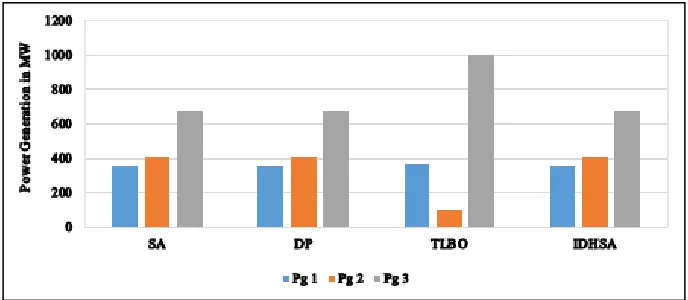
Fig. 9 shows the best generation schedule of three generating units [24] obtained by comparative algorith ms. Fig. 10 c learly shows that power losses represent only 3.0998% of the total power generation as with the cost of losses.
Figure 9. Best generation schedule of three generating units obtained by comparative methods for PD = 1400 MW
[image:9.596.307.536.122.269.2] [image:9.596.126.470.382.532.2] [image:9.596.198.399.563.735.2]6. Conclusions
In this paper we have introduces a new approach to solve CCFED p roble ms based on the modified ha rmony search algorith m applied in two different cases as lossless and lossy test systems. The proposed IDHS a lgorithm has justified its robustness, versatility and high probability for CCFED proble ms; IDHSA has also achieved the best total cost with high feasibility and effic iency for 3-units [23], 5-units systems [4] and Liang’s network system [15] for the load power system respectively as 2500 (MW), 1800 (MW) and 1400 (MW). The co mparison of simu lation results with those obtained by other methods such as DP, GA , PSO, SA, FA, and TLBO, prove the superiority of the IDHSA over the m. The nume rica l findings confirm that the IDHS algorith m can provide better solutions with the lowest computation time than other different metaheuristic methods, and successfully imp rove the effic iency of the CCFED problems.
In the future, the authors plan to introduce it to other kinds of optimization issues, such as multi-objective ED problems with valve point loading effect and many comple x constraints, dynamic ED proble ms, la rge-scale ELD problems integrated renewable energy sources.
Acknowledgements
This work was partially supported by the laboratory of sustainable development of electrical energy, University of science and technology Mohamed Boudiaf, (USTO-M B) Oran, A lgeria with the cooperation of laboratory of energy and electrica l systems, national school of electricity and mechanics, Hassan II University, Casablanca, Morocco.
REFERENCES
S. Krishnamurthy, Development of decomposition methods [1]
for solution of a multiarea power dispatch optimization problem, thesis, Cape Peninsula University of Technology, 2013.
J. Wood. Allen, F. Bruce. Wollenberg, and G.B Sheblé, [2]
Power Generation, Operation and Control. 3rd ed. United States: Wiley-Interscience, 2013.
M . Greer, The Theory of Natural M onopoly, Chapter 2 in [3]
Electricity Cost M odeling Calculations, pp. 17-42, 2011.
M . Greer, Cost M odels, chapter 5 in Electricity M arginal [4]
Cost Pricing, pp. 133-190, 2012.
T. Adhinarayanan and M . Sydulu, Particle Swarm [5]
Optimization for Economic Dispatch with Cubic Fuel Cost Function, Proceedings of IEEE TENCON, pp. 1-4, 14-17 Nov. 2006.
G. Kumaran and V.S.R.K M ouly, Using Evolutionary [6]
Computation to Solve the Economic Load Dispatch
Problem, Proceedings of IEEE Congress on Evolutionary Computation, Vol. 1, pp. 296-301, 27-30 M ay 2001.
J. S. Al-sumait, J. K. Sykulski and A. K. Alothman, Solution [7]
of Different Types of Economic Load Dispatch Problems Using a Pattern Search M ethod, Electric Power Components and Systems, Vol. 36, No. 3, pp. 250-265, 2008.
N.A Amoli, S. Jadid, H.A. Shayanfar, F. Barzinpour, [8]
Solving economic dispatch problem with cubic fuel cost function by firefly algorithm, 8th International Conference on Technical and Physical Problems of Power Engineering, Fredrikstad, Norway, 5-7 September 2012.
I. Ziane, F. Benhamida, Solving the Generation Scheduling [9]
with Cubic Fuel Cost Function using Simulated Annealing, International Journal of Energy, Information and Communications, 7(2), pp.1-8, 2016.
F. P. M ahdi, P. V, M . Abdullah-Al-Wadud, J. Watada, V. [10]
Kallimani and P. Y. Siew Fai, Quantum particle swarm optimization for economic dispatch problem using cubic function considering power loss constraint, International Journal of GEOM ATE, Vol. 13 (37), pp. 44-50, 2017. K. H. Truong, P. Vasant, M . S. Balbir Sing and D. N. Vo, [11]
Swarm Based M ean-Variance M apping Optimization for Solving Economic Dispatch with Cubic Fuel Cost Function, N.T. Nguyen et al. (Eds.): ACIIDS 2015, Part II, LNAI 9012, pp. 3-12, 2015.
R. Karthikeyan, S. Subramanian, E.B. Elanchezhian, [12]
Solution of Economic Power Dispatch with Cubic Cost Functions using Grasshopper Optimization Algorithm, International Journal of Applied Engineering Research, vol. 13, no. 22 pp. 15672-15678, 2018.
M .P. M usau, N.O. Abungu, C.W. Wekesa, Single Objective [13]
Dynamic Economic Dispatch with Cubic Cost Functions using a Hybrid of Modified Firefly Algorithm with Levy Flights and Derived M utations, International Journal of Engineering Research & Technology (IJERT), vol. 5, no. 5, M ay-2016.
G.P. Dixit, H. M . Dubey, M . Pandit and B.K. Panigrahi, [14]
Artificial Bee Colony Optimization for Combined Economic and Emission Dispatch, International Conference on Sustainable Energy and Intelligent System, IEEE Conference, pp. 340-345, 2011.
U. Guvenc, Y. Sonmez, S. Duman and N. Yoruderen., [15]
Combined Economic and Emission Dispatch solution using gravitational search algorithm, Turkey: Science Iranica, vol. 19, no. 6, pp. 1754-1762, 2012.
Z.W. Geem, J.H. Kim, G.V. Loganathan, A new heuristic [16]
optimization algorithm: Harmony search, Simulation, vol. 76, no. 2, pp. 60-68, 2001.
Z.W. Geem, M usic-Inspired Harmony Search Algorithm: [17]
Theory and Applications, Studies in Computational Intelligence (Ed.) Springer-Verlag Berlin 191, pp 1-14, 2009.
T. Zhang, Z.W. Geem, Review of harmony search with [18]
respect to algorithm structure, Swarm and Evolutionary Computation, vol. 48, pp. 31-43, 2019.
A.A Al-Omoush, A.A Alsewari, H.S Alamri, and K.Z Zamli, [19]
Harmony Search Algorithm and Its Applications, IEEE Access, vol. 7, pp. 1-13, 2019.
J. Yi, C. Lu, and G.M. Li, A literature review on latest [20]
developments of Harmony Search and its applications to intelligent manufacturing, M athematical Biosciences and Engineering, vol. 16, no. 4, pp. 2086-2117, 2019.
N.H. M orteza, M.I. Behnam, S. Asadi, J.H. Kim, and Z.W. [21]
Geem, Harmony search algorithm for energy system applications: an updated review and analysis", Journal of Experimental & Theoretical Artificial Intelligence, vol. 31, no. 5, 2019.
D. Das, “Electrical Power System”. [22]
F.D. Ochieng, Economic load dispatch using high order cost [23]
functions using dynamic programming, Bachelor of Science in EEE, University of Nairobi, 24 April 2015. Z.X. Liang, J.D. Glover, A zoom feature for a dynamic [24]
programming solution to economic dispatch including transmission losses, IEEE Trans. Power Syst., vol. 7, pp. 544–550, 1992.
M .A. Al-Betar, M.A. Awadallah, A. Tajudin Khader, A. [25]
La’aro Bolaji, and A. Almomani, Economic load dispatch problems with valve-point loading using natural updated harmony search, Neural Computing and Applications, Springer, 2016.
J. Chen, Q.K. Pan and J. Q. Li, Harmony search algorithm [26]
with dynamic control parameters, Applied M athematics and Computation 219 pp 592-604, 2012.
X. Wan-li., A. M ei-qing, L. Yin-zhen, H. Rui-chun and Z. [27]
Jing-fang, An improved global-best harmony search algorithm for faster optimization, Expert Systems with Applications Elsevier Ltd 41, pp 5788-5803, 2014. M . Karthikeyan, R.R.T. Sree, Dynamic Harmony Search [28]
with Polynomial M utation Algorithm for Valve-Point Economic Load Dispatch, The Scientific World Journal (Hindawi), 2015.
C. Peraza, F. Valdez, O. Castillo, Fuzzy Harmony Search [29]
Algorithm Using an Interval Type-2 Fuzzy Logic Applied to Benchmark M athematical Functions, In: Hadjiski M ., Atanassov K. (eds) Intuitionistic Fuzziness and Other Intelligent Theories and Their Applications. Studies in Computational Intelligence, vol. 757, 2019, Springer, Cham.
Kalivarapu. J, Jain. S, Bag. S, An improved harmony search [30]
algorithm with dynamically varying bandwidth, Engineering Optimization, vol.48, no.7, pp. 1091-1108. 2016.
Ashu. V, Arjun. T, Ram. K, Optimal Allocation of [31]
Distributed Solar Photovoltaic Generation in Electrical Distribution System under Uncertainties, Journal of Electrical Engineering Technology, vol.12, no.4, pp. 1386-1396. 2017.
A. J. Wood, B.F Wollenberg, Power Generation, Operation, [32]
and Control, New York, U.S.A.: John Wiley and Sons Inc, 1984.
E.B. Elanchezhian, S. Subramanian, and S. Ganesan, [33]
![Figure 5. Convergence property of CCFED minimization for Wollenberg's Network [5, 32] using IDHSA with PD = 2500 MW](https://thumb-us.123doks.com/thumbv2/123dok_us/8753525.892429/7.596.191.404.522.742/figure-convergence-property-ccfed-minimization-wollenberg-network-idhsa.webp)
![Table 5. Comparison of CCFED results for 5-units system [5]](https://thumb-us.123doks.com/thumbv2/123dok_us/8753525.892429/8.596.72.528.197.514/table-comparison-ccfed-results-units.webp)