Campylobacter jejuni
Isolates from Human Infections in Three
Districts during a Seasonal Peak in Finland
Sara M. Kovanen,aRauni I. Kivistö,aMirko Rossi,aThomas Schott,bUlla-Maija Kärkkäinen,cTamara Tuuminen,d,eJaakko Uksila,f,g Hilpi Rautelin,h,iMarja-Liisa Hänninena
Department of Food Hygiene and Environmental Health, University of Helsinki, Helsinki, Finlanda; Biology Oceanography, Leibniz Institute for Baltic Sea Research, Rostock-Warnemünde, Germanyb; Eastern Finland Laboratory Centre Joint Authority Enterprise (ISLAB), Kuopio District Laboratory, Kuopio, Finlandc; Eastern Finland Laboratory Centre Joint Authority Enterprise (ISLAB), Mikkeli District Laboratory, Mikkeli, Finlandd; University of Helsinki, Department of Bacteriology and Immunology, Helsinki, Finlande; Keslab Laboratory, Department of Clinical Microbiology, Central Finland Health Care District, Jyväskylä, Finlandf; Fimlab Laboratories, Ltd., Jyväskylä, Finlandg; Department of Medical Sciences, Clinical Microbiology, Uppsala University, Uppsala, Swedenh; Department of Bacteriology and Immunology, Haartman Institute, University of Helsinki, Helsinki, Finlandi
A total of 95 humanCampylobacter jejuniisolates acquired from domestic infections and collected from three districts in Fin-land during the seasonal peak (June to September) in 2012 were analyzed by PCR-based multilocus sequence typing (MLST) and by whole-genome sequencing (WGS). Four predominant sequence types (STs) were detected among the isolates: ST-45 (21%) and ST-230 (14%, ST-45 clonal complex [CC]), ST-267 (21%, ST-283 CC), and ST-677 (19%, ST-677 CC). In districts 1 and 3, most of the infections occurred from early July to the middle of August, with a peak at weeks 29 to 31, but in district 2, the infec-tions were dispersed more evenly throughout 3 months (June to August). WGS data were used for further whole-genome MLST (wgMLST) analyses of the isolates representing the four common STs. Shared loci of the isolates within each ST were analyzed as distance matrices of allelic profiles by the neighbor-net algorithm. The highest allelic variations (>400 different alleles) were detected between different clusters of ST-45 isolates (1,121 shared loci), while ST-230 (1,264 shared loci), ST-677 (1,169 shared loci), and ST-267 isolates (1,217 shared loci) were less diverse with the clusters differing by<40 alleles. Closely related isolates showing no allelic variation (subclusters) were detected among all four major STs. In some cases, they originated from different districts, suggesting that isolates can be epidemiologically connected and may have the same infection source despite being origi-nally identified as sporadic infections.
C
ampylobacterspecies, especiallyCampylobacter jejuni, are themost commonly reported causes of bacterial gastroenteritis in both developed and developing countries (http://www.who.int /mediacentre/factsheets/fs255/en/) with an estimate of 8.4% of the total burden of diarrheal diseases (1) and with⬎190,000 cases reported annually in the European Union (EU) and costs of around €2.4 billion per year (http://www.efsa.europa.eu/en /topics/topic/campylobacter.htm). In Finland,⬎4,000
Campylo-bacterinfections are registered annually (4,251 cases in 2012), and
the overall incidence for the whole population in 2012 was 78/ 100,000 (www.thl.fi). Most infections are sporadic and associated with foreign traveling. In areas with a colder climate, like North-ern Europe, a distinct peak in the frequency ofCampylobacter
infections occurs during the summer months, from June to Au-gust (2,3). The seasonal peak is probably associated with summer activities, including increased outdoor exposures like contacts with animals and soil, barbecuing, consumption of water from private wells, and swimming in natural waters (4, 5). On the whole, poultry and poultry products have been shown to be a major source ofC. jejuniinfections in humans (6–9).
In Finland, since 1994, clinical laboratories have reported all culture-positive Campylobacter findings to the National Infec-tious Diseases Register (NIDR), without, however, distinguishing domestic and imported infections (10). In our previous studies concerning theC. jejunipopulation structure and molecular epi-demiology in Finland, large numbers of humanC. jejuniisolates of domestic origin have been collected mainly from the Helsinki
metropolitan area (11,12). In this study,Campylobacterisolates were collected from domestically acquired infections in three midsized districts located outside the metropolitan area. Earlier studies have shown that risk factors and incidences of
Campylo-bacterinfections may vary in different geographical areas (6,13).
Molecular typing methods, especially the widely used multilo-cus sequence typing (MLST), have been an essential tool in studies
ofC. jejuni(9,14,15). However, MLST, where sequences from
seven housekeeping genes are defined as sequence types (STs) and clonal complexes (CCs) (16), has limited ability to further dis-criminate genetically related isolates within STs. Recently, whole-genome sequencing (WGS) has become increasingly affordable, and it provides information about the bacterial genomes with a much higher resolution than MLST (17–20). Whole-genome MLST (wgMLST) analyses enable the recognition of genetic
rela-Received11 July 2014 Returned for modification18 August 2014
Accepted5 September 2014
Published ahead of print17 September 2014
Editor:Y.-W. Tang
Address correspondence to Marja-Liisa Hänninen, [email protected].
Supplemental material for this article may be found athttp://dx.doi.org/10.1128 /JCM.01959-14.
Copyright © 2014, American Society for Microbiology. All Rights Reserved.
doi:10.1128/JCM.01959-14
on May 16, 2020 by guest
http://jcm.asm.org/
tionships between epidemiologically associated isolates and iso-lates that potentially have the same infection source. Gene loci and allele numbers can be determined using the publicly available Bac-terial Isolate Genome Sequence Database (BIGSdb) on the pub-MLST.org/campylobacter web page (21).
The aims of this study were (i) to explore the MLST of human
C. jejuniisolates and their spatial and temporal distributions in
three districts during the seasonal peak in 2012, (ii) to compare the MLST data from this study to data collected previously from clin-ical isolates from the Helsinki metropolitan area in Finland, and (iii) to further recognize the genetically related isolates within STs using wgMLST and to analyze their associations in relation to their isolation site and time.
MATERIALS AND METHODS
Bacterial isolates.Campylobacterisolates were collected from patients with domestically acquired enteric infections in June to September 2012. Isolates were collected by the local clinical laboratories of four hospital districts located in central and eastern Finland (see Fig. S1 in the supple-mental material). Samples for districts 1 and 3 were each collected from one hospital district (hospital districts 13 and 14, respectively) (see Fig. S1 in the supplemental material), but for convenience in district 2, two sparsely populated hospital districts were pooled into one (hospital dis-tricts 10 and 11) (see Fig. S1 in the supplemental material). The numbers of inhabitants in the three districts were 279,000 (district 1), 121,000 (dis-trict 2), and 265,000 (dis(dis-trict 3). Infections were defined as domestic when the patient had not traveled abroad within 2 weeks of the onset of symp-toms. One isolate from the primary culture of each patient was used for the study. The isolates were stored in skim milk at⫺70°C prior to further molecular investigations. Of the total of 109 isolates, isolates that did not grow after primary isolation (13 isolates) or were confirmed as Campylo-bacter coli(1 isolate) by species-specific PCR (22) were excluded, resulting in a total of 95C. jejuniisolates that were included in the MLST and WGS analyses in this study. Isolates were numbered and marked with a letter indicating the district from which they were collected (K1, K2, etc. for district 1, M1, M2, etc. for district 2, and J1, J2, etc. for district 3).
DNA extraction and PCR.DNA was extracted using the Wizard genomic DNA purification kit (Promega, Mannheim, Germany), and the DNA concentrations were measured using a Nanodrop ND-1000 spectro-photometer (Thermo Scientific, Waltham, MA) and a Qubit fluorometer (Life Technologies; Invitrogen, CA). The DNA was stored at⫺20°C prior to WGS or PCR.
MLST and wgMLST.Twenty-one human isolates were analyzed by PCR-based MLST only. PCRs and sequencing of the seven MLST loci were performed as described in previous studies (12,23). Briefly, sequencing was carried out by BigDye Terminator v. 3.1 chemistry (Applied Biosys-tems, Foster City, CA), and sequencing products were run on an ABI Prism 3130XL genetic analyzer or an ABI 3730 DNA analyzer (Applied Biosystems). Furthermore, WGS was performed on 74 human isolates. Genome sequences were determined using Illumina HiSeq sequencing technology (100 cycles, paired-end library,⬎200⫻coverage; performed by FIMM [Institute for Molecular Medicine], Helsinki, Finland). The reads were filtered using the ConDeTri Perl script (default settings, min-imum read length of 75 nucleotides), and only sequences passing the quality threshold in both paired reads were assembled into contigs using ABySS 1.3.5.
Data analysis.MLST sequences were analyzed using BioNumerics v. 5.1 (Applied Maths, Kortijk, Belgium). Different alleles, STs, and CCs were assigned using theCampylobacterMLST database (pubMLST.org/ campylobacter/). Assembled contigs of the whole-genome sequences were uploaded to the pubMLST.org/campylobacter website, which then auto-matically annotated all loci and numbered alleles currently available in the Bacterial Isolate Genome Sequence Database (BIGSdb). The results were processed in Excel (Microsoft Excel 2010), separately for each ST, to
in-clude only the shared loci of the isolates under the analysis. The neighbor-net algorithm, based on the allelic distance matrix of the shared loci of the isolates, was used to construct phylogenetic networks. Neighbor-net net-works were constructed on each ST and visualized using SplitsTree soft-ware (24) implemented on the pubMLST.org website. Allelic differences among the isolates of the clusters were defined using the BIGSdb and Excel (see Table S3 in the supplemental material). Isolates that had identical alleles among all shared loci (subclusters) (seeFig. 3) were further ana-lyzed as a new study population by investigating new sets of shared loci and defining the allelic differences as described above (seeTable 2). The clonal genealogy of the strains based on the whole-genome sequences was estimated using a model-based approach to determine bacterial micro-evolution implemented in ClonalFrame (24). Genomes were aligned us-ing progressiveMauve (25), and collinear blocks bigger than 500 bp were filtered using the Perl script stripSubsetLCBs (25). Then, ClonalFrame was run with 30,000 burn-in iterations followed by 30,000 data collection iterations. The strict consensus tree representing the combined data from three independent runs was exported as a Newick file and labeled using CorelDRAW X5 (see Fig. S2 in the supplemental material).
Statistical analysis.Statistical tests were performed using SPSS soft-ware (IBM SPSS Statistics 21). The frequencies of the clonal complexes in each district were compared to our previous data collected in 1996, 1999, 2002, 2003, and 2006 from the Helsinki metropolitan area (11,12). The Pearson chi-square and Fisher’s exact tests were carried out by cross-tabulations for each CC in districts 1, 2, and 3. Differences in frequencies were considered statistically significant forPvalues of⬍0.05.
RESULTS
Distribution and characteristics of human isolates.Forty-three isolates were obtained from district 1 (⬃279,000 inhabitants; in-cidence, 15.4/100,000), 25 from district 2 (⬃121,000 inhabitants; incidence, 20.6/100,000), and 41 from district 3 (⬃265,000 inhab-itants; incidence, 15.5/100,000). More than half of the patients (55% in district 1 and 63% in districts 2 and 3) were men. The proportions of patients older than 60 years in the three districts were 40%, 42%, and 34%, respectively. In addition, 29% of the patients in district 3 were 51 to 60 years old. Only three cases, one in each district, were observed in children aged 10 years or less (4, 1, and 9 years).
MLST ofC. jejuniisolates.MLST from 95C. jejuniisolates revealed a total of 23 STs, with 15 of them assigned to CCs (Table 1). The most frequent STs of the human isolates were ST-45 (21%, ST-45 CC), ST-230 (14%, ST-45 CC), ST-267 (21%, ST-283 CC), and ST-677 (19%, ST-677 CC). The frequencies of the CCs de-tected from the three different districts are shown inFig. 1. Isolates that belonged to ST-45 CC covered 39% and 49% of the isolates in districts 1 and 3, respectively, while ST-677 CC was the most com-mon CC (40% of isolates) in district 2 (Fig. 1). Compared to our previousC. jejuniMLST data, collected from 1996 to 2006 from domestically infected patients living in the Helsinki metropolitan area (11,12), the frequencies of the two major clonal complexes (ST-45 CC and ST-677 CC) were in line with those of districts 1 and 3. However, in district 2, ST-45 CC was not so common, and ST-677 CC, in turn, was overrepresented (P⬍0.05) compared to that in other districts and our previous data (Fig. 1). Furthermore, the frequencies of ST-283 CC were higher (P⬍0.05) in all three districts than in our previous data (Fig. 1). Interestingly, ST-50 (ST-21 CC), a common ST among human isolates of the metro-politan area for several years (11), was not detected among the isolates of this study, and isolates of ST-21 CC, in general, were detected in only one district (Table 1).
Temporal distribution of STs.Most of the infections,
on May 16, 2020 by guest
http://jcm.asm.org/
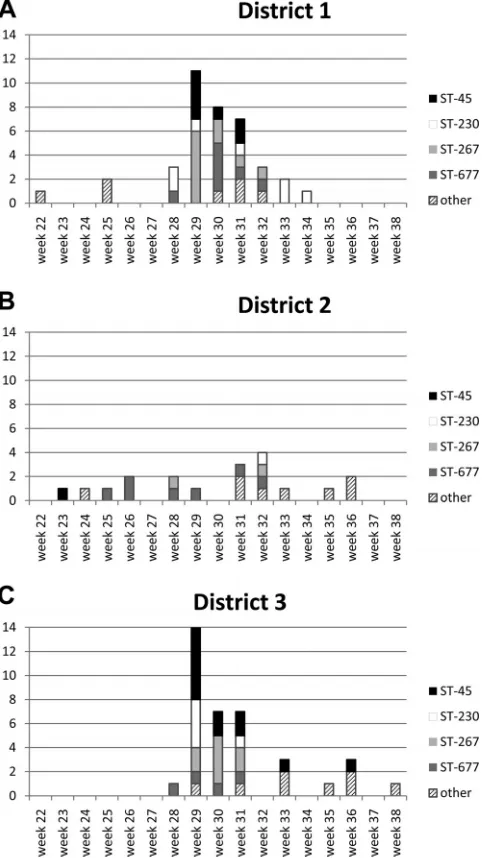
cially those caused by the major STs (ST-45, ST-230, ST-267, and ST-677), were seen in early July to the middle of August in districts 1 and 3 (weeks 28 to 34) (Fig. 2AandC). However, peaks among the infections (districts 1 and 3) occurred in weeks 29 to 31 (Fig. 2AandC). In contrast, in district 2, where ST-677 was strongly represented, the infections were dispersed evenly among the 3 months (weeks 23 to 36), and none of the STs showed a distinct peak (Fig. 2B).
Genetic relationships among isolates within the same ST. Isolates of the four most common STs (ST-45, ST-230, ST-267, and ST-677) were further analyzed and compared at the whole-genome level. Various sets of shared loci were analyzed using the neighbor-net algorithm. The number of shared loci varied from
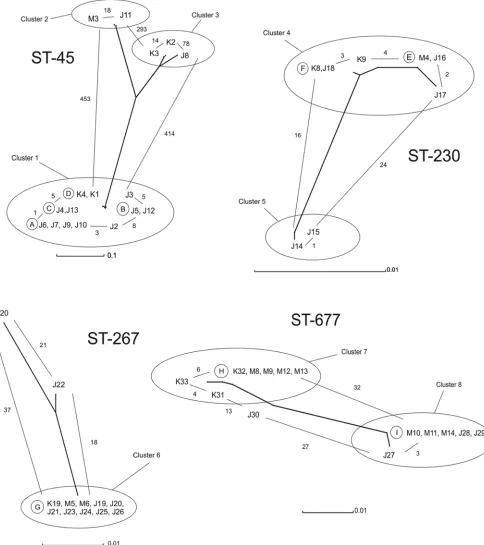
1,121 (ST-45) to 1,264 (ST-230). ST-45 isolates formed three clus-ters that differed by 293 to 453 alleles from each other (Fig. 3). Isolates of cluster 1 differed by 1 to 8 alleles from each other (Fig. 3), and four subclusters that had identical alleles in all 1,121 loci were detected (subclusters A to D) (Fig. 3). Two subclusters were detected among ST-230 isolates in cluster 4 with identical alleles in 1,264 loci (subclusters E and F) (Fig. 3). Similarly, two subclusters were detected among ST-677 isolates (subclusters H and I) (Fig. 3). A cluster of 10 ST-267 isolates had identical alleles in all shared 1,217 loci (cluster 6, subcluster G) (Fig. 3), and only two isolates (ST-267, K20 and J22) (Fig. 3) were distinguished. The allelic vari-ations for isolates forming clusters with less than 10 allele differ-ences (cluster 1, clusters 4 and 5, cluster 6, and clusters 7 and 8) are shown in detail in Table S3 in the supplemental material.
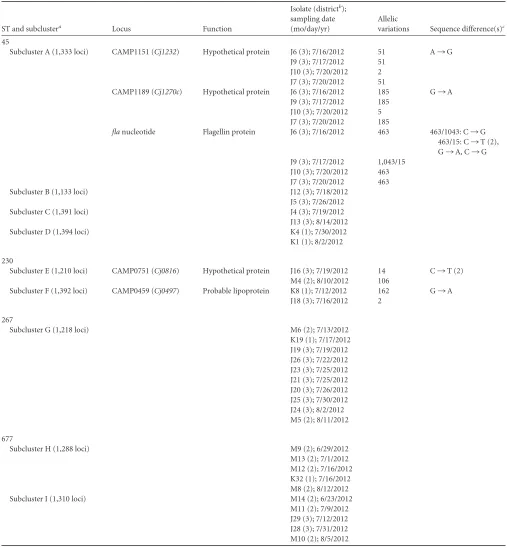
Closely related isolates of the subclusters (identical alleles in all shared loci) were further analyzed for new sets of shared loci, and the allelic differences were defined (Table 2). Four ST-45 isolates of subcluster A (Fig. 3;Table 2), all isolated from district 3 during a 5-day period in July, had two different alleles (single nucleotide polymorphisms [SNPs]) in three genes (Cj1232,Cj1270c, andfla
nucleotide) (Table 2). In contrast, no allelic variation was ob-served in isolates of subclusters B and C, originating from district 3 and isolated in weeks 29 and 31 and 29 and 33, respectively, and subcluster D from district 1, isolated in week 31 (Fig. 3;Table 2). ST-230 isolates of both subclusters E and F (Fig. 3;Table 2) had a one allelic difference among their shared loci (Cj0816andCj0497, respectively) (Table 2). No allelic variations were observed among the 10 ST-267 isolates of subcluster G that originated from all three districts and were isolated during a 5-week period (subclus-ter G) (Fig. 3;Table 2). Also, the two subclusters of ST-677, each containing five isolates (Fig. 3;Table 2), originated from different districts and had no allelic variation (subclusters H and I) (Fig. 3;
Table 2).
To evaluate the phylogenetic networks of genetically related isolates obtained by the neighbor-net algorithm, ClonalFrame phylogenetic trees were constructed from the same sets of isolates representing the four STs (see Fig. S2 in the supplemental mate-rial). The ClonalFrame genealogies showed parallel genetic rela-tionships between the isolates, supporting the results of the neigh-bor-net analysis.
DISCUSSION
Although the epidemiology of humanCampylobacterinfections has been investigated for more than 35 years (26), a better under-standing of the transmission of infections to humans is needed (27). Most infections are apparently sporadic and occur in pa-tients of all ages and socioeconomic backgrounds, and detection of the sources of sporadic infections remains unclear. In this study, we collected 109Campylobacterisolates from human pa-tients with domestically acquired infections during the seasonal peak in summer 2012 in Finland. More than half of the patients in all three districts were male, and more than one-third of the infec-tions occurred in patients older than 60 years. These findings are consistent with those of our previous study of Finnish patients with domestic infections in 1999 (10), revealing that a high repre-sentation of older patients is typical for the summer peak in Fin-land, which may indicate some common behavior and impaired immune defense associated with the increased risk observed in this age group. According to the NIDR, which contains records from both imported and domestic infections, the overall
inci-TABLE 1MLST of domestically acquired humanC. jejuniisolates from
three districts in Finland in 2012
CC and ST Isolatesa Districtb
21
19 2 2
45
11 1 2
45 20 1, 2, 3
230 13 1, 2, 3
538 1 1
61
61 2 1
283
267 20 1, 2, 3
383 1 2
677
677 18 1, 2, 3
794 2 1, 2
690
991 1 2
952
3492 1 3
5987 1 3
1287
945 1 1
1332
1276 1 2
UA
951 1 2
1030 1 3
1080 2 1, 3
1365 2 2, 3
2068 1 1
6591 1 3
6626 1 3
7007c 1 2
aNumber of isolates with the indicated ST. A total of 95 humanC. jejuniisolates were
included.
bDistricts in which the STs were detected. c
Novel ST.
on May 16, 2020 by guest
http://jcm.asm.org/
dence rates during the seasonal peak in 2012 were 39.1 (district 1), 30.2 (district 2), and 40.4 (district 3) per 100,000 inhabitants (www.thl.fi). In our present study, the incidence rates were 15.4, 20.6, and 15.5 per 100,000 inhabitants in districts 1, 2, and 3, respectively, suggesting that infections from domestic sources covered approximately half of the total number of registered in-fections. The higher incidence in district 2 (composed of two sparsely populated hospital districts) may be explained by struc-tural differences in the region: the number of summer cottages is higher and the number of people living in the population center is lower than those in districts 1 and 3 (www.tilastokeskus.fi). In our previous study (10), incidence rates covering only domestic infec-tions during the seasonal peak in 1999 (July to September) were higher in districts 1 and 3 (74.1 and 36.9 per 100,000 inhabitants) and similar in district 2 (20.6 per 100,000 inhabitants).
Eighty percent of allC. jejuniisolates in the present study were associated with three clonal complexes, ST-45 CC, ST-283 CC, and ST-677 CC, which were mainly represented by four STs (ST-45, ST-230, ST-267, and ST-677). When we compared the MLST data from our previous study (11), in which humanC. jejuni iso-lates from 1996 to 2006 from the Helsinki metropolitan area were investigated, the frequencies of the two major CCs (ST-45 CC and ST-677 CC) were in accord with those in our present study. How-ever, the frequencies of STs in district 2 differed significantly from our earlier data. Interestingly, in general, isolates belonging to the ST-21 CC and especially to the ST-50 CC were detected every year in our previous study from the Helsinki metropolitan area (11), but in this study, only two uncommon ST-19 isolates (ST-21 CC) were detected. There are a limited number of studies concerning the MLST ofC. jejunifrom human patients from different parts of the world, but the predominant MLST lineages seem to have re-gional differences. In the study by McCarthy et al. (28), the MLST from Finnish patients differed significantly from the types of the patients from the United Kingdom, Australia, and New Zealand. Further, in a Swiss study (29),⬎60% of the humanC. jejuni iso-lates belonged to ST-21 CC, ST-48 CC, and ST-257 CC, while ST-45 CC covered⬍2% of the isolates. However, isolates belong-ing to ST-45 and ST-283 CCs were shown to be more common during the summer in previous studies from the United Kingdom (28,30). In our study, infections caused by the four most com-monly detected STs were mostly detected during 7 weeks, from FIG 2Distribution of the infections caused by differentC. jejuniSTs from June
to September (weeks 22 to 38) in three districts (according to the sampling date).
FIG 1Frequencies (%) of the clonal complexes (CCs) among Finnish humanC. jejuniisolates in three districts (columns 1, 2, and 3) and among human isolates
(n⫽454) collected from the Helsinki metropolitan area in Finland from 1996 to 2006 (column 4) (10). *CCs in which the difference in frequency in the district relative to the metropolitan area is statistically significant (P⬍0.05).
on May 16, 2020 by guest
http://jcm.asm.org/
[image:4.585.138.452.66.218.2] [image:4.585.44.287.264.693.2]early July to late August. The highest peak in infections occurred during weeks 29 to 31 in both districts 1 and 3, where ST-45, ST-230 and ST-267 isolates in particular were strongly accumu-lated, suggesting a potential point source of infections. However, in district 2, infections were evenly dispersed, and no peak that
may indicate different or more long-term continuous sources of infections was observed.
In addition to MLST, whole-genome sequencing has become a popular method for studying the molecular epidemiology ofC.
jejuni(17,20). Sequence data based on whole genomes and
wg-FIG 3The neighbor-net networks of theC. jejuniisolates of the four common STs (ST-45, ST-230, ST-267, and ST-677). Allelic differences are shown with Arabic
numerals. Networks were drawn from the shared loci of each set of isolates: ST-45 (1,121 loci), ST-230 (1,264 loci), ST-267 (1,217 loci), and ST-677 (1,169 loci). Isolates clustering together are indicated with ellipses (clusters 1 to 8), and isolates with identical alleles are indicated with capital letters (subclusters A to I).
on May 16, 2020 by guest
http://jcm.asm.org/
[image:5.585.50.534.69.614.2]MLST analysis allow genome comparisons and recognition of ge-netically related isolates within the STs, supporting the tracing of potential sources and identifying outbreaks (17,31).
This study is the first to explore the molecular epidemiology at both the MLST and whole-genome levels amongC. jejuniisolates
[image:6.585.39.546.76.624.2]from patients living outside the Helsinki metropolitan area in Fin-land. wgMLST and the neighbor-net algorithm resulted in only a limited number of allelic differences (16 to 37) between the clus-ters within ST-230, ST-267, and ST-677 isolates, suggesting high intrinsic genetic similarity within these STs. In contrast, for ST-45,
TABLE 2Isolate information and allelic variation of the isolates of subclusters A to I of the four STs (ST-45, ST-230, ST-267, and ST-677)
ST and subclustera Locus Function
Isolate (districtb);
sampling date (mo/day/yr)
Allelic
variations Sequence difference(s)c
45
Subcluster A (1,333 loci) CAMP1151 (Cj1232) Hypothetical protein J6 (3); 7/16/2012 51 A¡G
J9 (3); 7/17/2012 51
J10 (3); 7/20/2012 2
J7 (3); 7/20/2012 51
CAMP1189 (Cj1270c) Hypothetical protein J6 (3); 7/16/2012 185 G¡A
J9 (3); 7/17/2012 185
J10 (3); 7/20/2012 5
J7 (3); 7/20/2012 185
flanucleotide Flagellin protein J6 (3); 7/16/2012 463 463/1043: C¡G
463/15: C¡T (2),
G¡A, C¡G
J9 (3); 7/17/2012 1,043/15
J10 (3); 7/20/2012 463
J7 (3); 7/20/2012 463
Subcluster B (1,133 loci) J12 (3); 7/18/2012
J5 (3); 7/26/2012
Subcluster C (1,391 loci) J4 (3); 7/19/2012
J13 (3); 8/14/2012
Subcluster D (1,394 loci) K4 (1); 7/30/2012
K1 (1); 8/2/2012
230
Subcluster E (1,210 loci) CAMP0751 (Cj0816) Hypothetical protein J16 (3); 7/19/2012 14 C¡T (2)
M4 (2); 8/10/2012 106
Subcluster F (1,392 loci) CAMP0459 (Cj0497) Probable lipoprotein K8 (1); 7/12/2012 162 G¡A
J18 (3); 7/16/2012 2
267
Subcluster G (1,218 loci) M6 (2); 7/13/2012
K19 (1); 7/17/2012 J19 (3); 7/19/2012 J26 (3); 7/22/2012 J23 (3); 7/25/2012 J21 (3); 7/25/2012 J20 (3); 7/26/2012 J25 (3); 7/30/2012 J24 (3); 8/2/2012 M5 (2); 8/11/2012
677
Subcluster H (1,288 loci) M9 (2); 6/29/2012
M13 (2); 7/1/2012 M12 (2); 7/16/2012 K32 (1); 7/16/2012 M8 (2); 8/12/2012
Subcluster I (1,310 loci) M14 (2); 6/23/2012
M11 (2); 7/9/2012 J29 (3); 7/12/2012 J28 (3); 7/31/2012 M10 (2); 8/5/2012
a
The number of shared loci of the subcluster is shown in parentheses.
bThe district (1, 2, or 3) in which the isolate was collected is shown in parentheses. c
SNPs that occurred more than once are indicated by a number in parentheses.
on May 16, 2020 by guest
http://jcm.asm.org/
known to be a multihost ST, hundreds of allelic differences (293 to 453) emerged between different clusters of isolates. In a recent study by Cody et al. (17), wgMLST analyses resulted in hundreds of allelic differences between groups comprising 10 ST-50 isolates and in dozens of allelic differences among a highly related group of five ST-50 isolates. In our study, the isolates in highly related sub-clusters had no or only a few allelic differences in their shared loci. These isolates, collected within a short-term period, may indicate close genetic relationships and potentially the same infection source despite originating from different districts. However, only shared loci among the studied groups of isolates were included, and truncated and/or low-quality sequences were excluded, re-sulting in a decreased number of loci evaluated. ClonalFrame ge-nealogies supported the findings but also showed that sequence variation occurs among isolates with no allelic variation in neigh-bor-net networks.
In conclusion, the predominant STs detected in the three dis-tricts were similar to those yielded earlier by MLST for the Hel-sinki metropolitan area, indicating that major STs, with few ex-ceptions, remain the same or persist during the seasonal peak irrespective of the year or the site of sample collection. However, due to the diverse nature and wide distribution ofC. jejuniand the limitations of MLST, WGS provides a useful new approach for investigating the molecular epidemiology ofC. jejuniinfections. wgMLST analysis resulted in recognition of genetically closely re-lated isolates within the STs, suggesting that sporadic infections may sometimes have a common infection source.
ACKNOWLEDGMENTS
We thank the infectious diseases specialists of all four hospital districts for their collaboration.
This study was funded by the Academy of Finland with grants on behalf of CoE-MiFoSa (grant 11411405) and the Ministry of Agriculture and Forestry (grant 4770091).
This publication made use of the pubMLST.org/campylobacter web-site (21).
REFERENCES
1.World Health Organization.2012. The global view of
campylobacterio-sis: report of an expert consultation. World Health Organization, Utrecht, Netherlands.
2.Nylen G, Dunstan F, Palmer SR, Andersson Y, Bager F, Cowden J, Feierl
G, Galloway Y, Kapperud G, Megraud F, Molbak K, Petersen LR, Ruutu P.
2002. The seasonal distribution ofCampylobacterinfection in nine Euro-pean countries and New Zealand. Epidemiol. Infect.128:383–390.http: //dx.doi.org/10.1017/S0950268802006830.
3.de Haan CPA, Kivistö RI, Rautelin H, Hänninen M.2014. How
molec-ular typing has changed our understanding on sources and transmission routes of campylobacteriosis in Finland, p 241.InSheppard SK (ed), Cam-pylobacter ecology and evolution. Caister Academic Press, Swansea, United Kingdom.
4.Jore S, Viljugrein H, Brun E, Heier BT, Borck B, Ethelberg S, Hakkinen
M, Kuusi M, Reiersen J, Hansson I, Engvall EO, Lofdahl M, Wagenaar
JA, van Pelt W, Hofshagen M.2010. Trends inCampylobacterincidence
in broilers and humans in six European countries, 1997-2007. Prev. Vet. Med.93:33– 41.http://dx.doi.org/10.1016/j.prevetmed.2009.09.015.
5.Schönberg-Norio D, Takkinen J, Hanninen ML, Katila ML,
Kauko-ranta SS, Mattila L, Rautelin H.2004. Swimming andCampylobacter
infections. Emerg. Infect. Dis.10:1474 –1477.http://dx.doi.org/10.3201 /eid1008.030924.
6.Lévesque S, Fournier E, Carrier N, Frost E, Arbeit DR, Michaud S.
2013. Campylobacteriosis in urban versus rural areas: a case-case study integrated with molecular typing to validate risk factors and to attribute sources of infection. PLoS One 8:e83731. http://dx.doi.org/10.1371 /journal.pone.0083731.
7.Hermans D, Pasmans F, Messens W, Martel A, Van Immerseel F,
Rasschaert G, Heyndrickx M, Van Deun K, Haesebrouck F. 2012.
Poultry as a host for the zoonotic pathogencampylobacter jejuni. Vector Borne Zoonotic Dis.12:89 –98.http://dx.doi.org/10.1089/vbz.2011.0676.
8.Nauta M, Hill A, Rosenquist H, Brynestad S, Fetsch A, van der Logt P,
Fazil A, Christensen B, Katsma E, Borck B, Havelaar A. 2009. A
comparison of risk assessments onCampylobacterin broiler meat. Int. J. Food Microbiol. 129:107–123. http://dx.doi.org/10.1016/j.ijfoodmicro .2008.12.001.
9.Sheppard SK, Dallas JF, MacRae M, McCarthy ND, Sproston EL,
Gormley FJ, Strachan NJC, Ogden ID, Maiden MCJ, Forbes KJ.2009.
Campylobactergenotypes from food animals, environmental sources and clinical disease in Scotland 2005/6. Int. J. Food Microbiol.134:96 –103.
http://dx.doi.org/10.1016/j.ijfoodmicro.2009.02.010.
10. Vierikko A, Hänninen M-L, Siitonen A, Ruutu P, Rautelin H.2004.
Domestically acquiredCampylobacterinfections in Finland. Emerg. In-fect. Dis.10:127–130.http://dx.doi.org/10.3201/eid1001.020636.
11. de Haan CPA, Kivistö R, Hakkinen M, Rautelin H, Hänninen M-L.
2010. Decreasing trend of overlapping multilocus sequence types between human and chickenCampylobacter jejuniisolates over a decade in Finland. Appl. Environ. Microbiol.76:5228 –5236.http://dx.doi.org/10.1128/AEM .00581-10.
12. Kärenlampi R, Rautelin H, Schönberg-Norio D, Paulin L, Hänninen M-L.
2007. Longitudinal study of FinnishCampylobacter jejuniandC. coliisolates from humans, using multilocus sequence typing, including comparison with epidemiological data and isolates from poultry and cattle. Appl. Environ. Mi-crobiol.73:148 –155.http://dx.doi.org/10.1128/AEM.01488-06.
13. Schönberg-Norio D, Sarna S, Hänninen M-L, Katila ML, Kaukoranta
SS, Rautelin H.2006. Strain and host characteristics ofCampylobacter
jejuniinfections in Finland. Clin. Microbiol. Infect.12:754 –760.http://dx .doi.org/10.1111/j.1469-0691.2006.01501.x.
14. de Haan CPA, Lampen K, Corander J, Hänninen M-L.2013. Multilocus
sequence types of environmentalCampylobacter jejuniisolates and their similarities to those of human, poultry and bovineC. jejuniisolates. Zoo-noses Public Health60:125–133.http://dx.doi.org/10.1111/j.1863-2378 .2012.01525.x.
15. Bessell PR, Rotariu O, Innocent GT, Smith-Palmer A, Strachan NJC,
Forbes KJ, Cowden JM, Reid SWJ, Matthews L.2012. Using sequence
data to identify alternative routes and risk of infection: a case-study of Campylobacterin Scotland. BMC Infect. Dis.12:80.http://dx.doi.org/10 .1186/1471-2334-12-80.
16. Dingle KE, Colles FM, Wareing DRA, Ure R, Fox AJ, Bolton FE,
Bootsma HJ, Willems RJL, Urwin R, Maiden MCJ.2001. Multilocus
sequence typing system forCampylobacter jejuni. J. Clin. Microbiol.39:
14 –23.http://dx.doi.org/10.1128/JCM.39.1.14-23.2001.
17. Cody AJ, McCarthy ND, Van Rensburg MJ, Isinkaye T, Bentley SD,
Parkhill J, Dingle KE, Bowler ICJW, Jolley KA, Maiden MCJ.2013.
Real-time genomic epidemiological evaluation of humanCampylobacter isolates by use of whole-genome multilocus sequence typing. J. Clin. Mi-crobiol.51:2526 –2534.http://dx.doi.org/10.1128/JCM.00066-13.
18. Sheppard SK, Jolley KA, Maiden MCJ.2012. A gene-by-gene approach
to bacterial population genomics: whole genome MLST ofCampylobacter. Genes3:261–277.http://dx.doi.org/10.3390/genes3020261.
19. Carrillo CD, Kruczkiewicz P, Mutschall S, Tudor A, Clark C, Taboada
EN.2012. A framework for assessing the concordance of molecular typing methods and the true strain phylogeny ofCampylobacter jejuniandC. coli using draft genome sequence data. Front. Cell. Infect. Microbiol.2:57.
http://dx.doi.org/10.1101/gr.074492.107.
20. Gripp E, Hlahla D, Didelot X, Kops F, Maurischat S, Tedin K, Alter T,
Ellerbroek L, Schreiber K, Schomburg D, Janssen T, Bartholomaus P, Hofreuter D, Woltemate S, Uhr M, Brenneke B, Gruning P, Gerlach G,
Wieler L, Suerbaum S, Josenhans C.2011. Closely relatedCampylobacter
jejunistrains from different sources reveal a generalist rather than a spe-cialist lifestyle. BMC Genomics12:584.http://dx.doi.org/10.1186/1471 -2164-12-584.
21. Jolley KA, Maiden MC.2010. BIGSdb: scalable analysis of bacterial
ge-nome variation at the population level. BMC Bioinformatics11:595.http: //dx.doi.org/10.1186/1471-2105-11-595.
22. Denis M, Soumet C, Rivoal K, Ermel G, Blivet D, Salvat G, Colin P.
1999. Development of a m-PCR assay for simultaneous identification of Campylobacter jejuniandC. coli. Lett. Appl. Microbiol.29:406 – 410.http: //dx.doi.org/10.1046/j.1472-765X.1999.00658.x.
23. Korczak BM, Zurfluh M, Emler S, Kuhn-Oertli J, Kuhnert P. 2009.
on May 16, 2020 by guest
http://jcm.asm.org/
Multiplex strategy for multilocus sequence typing,flatyping, and genetic determination of antimicrobial resistance ofCampylobacter jejuniand Campylobacter coliisolates collected in Switzerland. J. Clin. Microbiol.
47:1996 –2007.http://dx.doi.org/10.1128/JCM.00237-09.
24. Huson DH, Bryant D.2006. Application of phylogenetic networks in
evolutionary studies. Mol. Biol. Evol.23:254 –267.http://dx.doi.org/10 .1093/molbev/msj030.
25. Darling AE, Mau B, Perna NT.2010. progressiveMauve: multiple
ge-nome alignment with gene gain, loss and rearrangement. PLoS One
5:e11147.http://dx.doi.org/10.1371/journal.pone.0011147.
26. Skirrow MB.1977.Campylobacterenteritis: a “new” disease. Br. Med. J.
2:9 –11.http://dx.doi.org/10.1136/bmj.2.6078.9.
27. Colles FM, Maiden MC.2012.Campylobactersequence typing databases:
applications and future prospects. Microbiology158:2695–2709.http://dx .doi.org/10.1099/mic.0.062000-0.
28. McCarthy ND, Gillespie IA, Lawson AJ, Richardson J, Neal KR, Hawtin
PR, Maiden MC, O’Brien SJ.2012. Molecular epidemiology of human
Campylobacter jejunishows association between seasonal and interna-tional patterns of disease. Epidemiol. Infect.140:2247–2255.http://dx.doi .org/10.1017/S0950268812000192.
29. Niederer L, Kuhnert P, Egger R, Buttner S, Hachler H, Korczak BM.
2012. Genotypes and antibiotic resistances ofCampylobacter jejuniand Campylobacter coliisolates from domestic and travel-associated human cases. Appl. Environ. Microbiol.78:288 –291.http://dx.doi.org/10.1128 /AEM.06194-11.
30. Cody AJ, McCarthy NM, Wimalarathna HL, Colles FM, Clark L,
Bowler IC, Maiden MC, Dingle KE.2012. A longitudinal 6-year study of
the molecular epidemiology of clinicalCampylobacterisolates in Oxford-shire, United Kingdom. J. Clin. Microbiol.50:3193–3201.http://dx.doi .org/10.1128/JCM.01086-12.
31. Revez J, Zhang J, Schott T, Kivistö R, Rossi M, Hänninen M-L.2014.
Genomic variation between milkborne outbreak-associated Campylobac-ter jejuniisolates. J. Clin. Microbiol.52:2782–2786.http://dx.doi.org/10 .1128/JCM.00931-14.