0095-1137/10/$12.00 doi:10.1128/JCM.02516-09
Copyright © 2010, American Society for Microbiology. All Rights Reserved.
POINT-COUNTERPOINT
To Screen or Not To Screen for Methicillin-Resistant
Staphylococcus aureus
䌤There are few more compelling questions in clinical microbiology today than the issue of whether or not to screen for the presence of methicillin-resistantStaphylococcus aureus(MRSA), with the results being used to institute infection control interventions aimed at preventing transmission of MRSA in health care environ-ments. Numerous different matters must be addressed when considering a screening program. Who is to be screened, what method is to be employed to detect MRSA, and what sites should be sampled? When and how often should the screening be performed? Who is going to pay for the screening, and, finally and perhaps most importantly, how are screening results to be communicated to health care providers and what kind of inter-ventions are best undertaken based on the results? Numerous governmental agencies have mandated MRSA screening programs, and yet several authorities in infection control organizations have questioned the appro-priateness of mandated screening.
In this Point-Counterpoint feature, Dr. Lance Peterson of Evanston Hospital (Evanston, IL) offers his perspective on why screening for MRSA is to be encouraged. Dr. Daniel Diekema of the University of Iowa Carver College of Medicine (Iowa City, IA) offers an opposing view.
POINT
The issue as to whether or not U.S. health care orga-nizations should aggressively deploy programs to control MRSA hinges on three critical questions. First, is the burden of MRSA disease sufficiently high so that human effort and financial resources should be directed toward this problem? If the answer is yes, then the second ques-tion is this: how do the policymakers in a health care organization decide whether MRSA is a problem for its patients? The last question, then, involves implementa-tion: what type of MRSA control program is likely to reduce disease cost effectively?
There is considerable literature assessing MRSA dis-ease burden across the United States. Delorme and
col-leagues measured the change in the incidence ofS.
au-reus disease between 2006 and 2007 in northeast Ohio
(2). They found an overall 77% increase in infections (59% MRSA); a 58% disease increase for outpatients, a 43% increase for hospital inpatients, and a 183% in-crease in residents of long-term care facilities (2). The overall burden of disease was 589/100,000 inhabitants, and for 66% of the affected persons, there were no risk factors for staphylococcal infection (2). A similar burden of disease was reported in a prevalence survey done during 2004 and 2005 in San Francisco, CA; there were 347 MRSA disease cases/100,000 population (13). To place these numbers in context, in 2007 the United States had a reported total of 13,293 tuberculosis (TB)
cases, which translates to a rate of 4.4 cases/100,000 population (1); thus, the MRSA burden of disease is approximately 100-fold that of TB. Another pivotal study on MRSA was the 2005 prospective surveillance investigation of invasive disease reported by Klevens and colleagues, who found that 77% of MRSA health care-associated infections consisted of cases of bacteremia—a doubling in 6 years (12). They discovered a disease rate of 31.8/100,000 population, with an annual mortality of 20% (18,650 deaths), representing more deaths than those due to HIV-AIDS (12). If one assumes that a disease burden 100-fold higher than that of TB and with an annual mortality rate exceeding that of HIV-AIDS is a significant illness for the United States, then the an-swer to the first question is yes.
The response to the second question is also straight-forward. The Joint Commission requires infection con-trol personnel at each health care organization to per-form an annual risk assessment to determine the key health problems (22). For MRSA, as well as for any multidrug-resistant organism, the Centers for Disease Control and Prevention (CDC) recommend that all health care organizations assess their rate of multidrug-resistant organism infections and demonstrate that the rate is actually diminishing over time or, if not, to im-plement additional (Tier 2) disease control measures (20). One of the most important Tier 2 measures is active surveillance (20). For a laboratory to assist in this assessment, one appropriate approach is to determine the number of organisms (e.g., MRSA) recovered from clinical specimens and to track the change in the rate
䌤Published ahead of print on 13 January 2010.
683
on May 16, 2020 by guest
http://jcm.asm.org/
(per 1,000 admissions or 1,000 patient days) over time. While this method may detect some colonization as well as disease, such an approach has been shown to
accu-rately identify 77.1% of actual S. aureus infections (5)
and to provide significant changes in disease rates much faster than when only bacteremia rates are measured (24). Another useful tool to assess MRSA risk for pa-tients is to perform a point prevalence survey for MRSA (nasal) colonization. We found this undertaking enlight-ening for both infection control and senior management when 8.5% of our inpatients showed nasal MRSA colo-nization (18), a rate which was some threefold higher than the 2.7% reported by Jernigan and colleagues from an admission MRSA prevalence survey done 6 years earlier (10). These data led to institution-wide recogni-tion that there was a high level of MRSA colonizarecogni-tion in our patient population and facilitated deployment of an aggressive MRSA control program. Once a local prob-lem has been shown to exist, the next step is to design an intervention that is likely to succeed in lowering MRSA infection—remembering that the most expensive pro-gram, no matter how much or how little is done, is one that does not reduce MRSA disease.
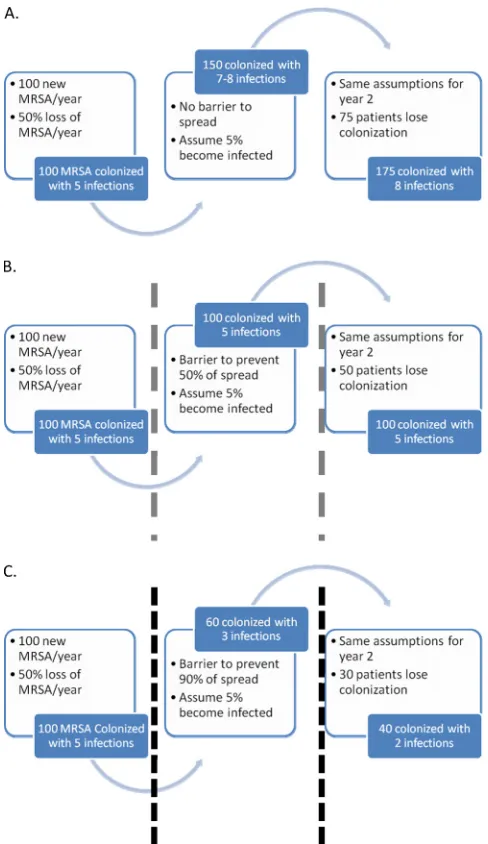
A key to reducing MRSA dissemination and subse-quent disease is the need to enhance practices that re-duce spread; those practices are currently considered to be barrier precautions or contact isolation. Figure 1 il-lustrates how this can be effective. In each pictured sce-nario, there is a constant influx of new MRSA carriers (due to person-to-person spread); in the first scenario (Fig. 1A), the rates of both colonization and eventual disease rise until a higher plateau is reached. Only when 90% of disease spread has been blocked (as illustrated in the third scenario [Fig. 1C]) are there actual reductions in both colonization and infection. The required level of detection (via surveillance through screening for MRSA) to reduce MRSA spread varies with the preva-lence of colonization and disease. For any given MRSA prevalence rate, the factor that seems most crucial in reducing spread is the percentage of potential isolation days captured for patients admitted who are infected or colonized with this pathogen. The influential operational processes are (i) the sensitivity of the screening test, (ii) the speed with which newly detected positive patients are reported to the nursing unit (assuming that pre-emptive isolation is not employed), and (iii) the selec-tion of patient populaselec-tion(s) who are to undergo surveil-lance.
The utility of various testing approaches for MRSA surveillance has recently been investigated by meta-anal-ysis (21), and the conclusion of the authors was that surveillance for MRSA colonization was beneficial in reducing disease. However, they also concluded that rapid testing had not been proven to be superior to culture-based methods. A lapse in their analysis was that
the authors did not investigate the effect of the levels of sensitivity and speed of reporting on the success or fail-ure of MRSA control programs in the reviewed articles (21). Several recent publications give insights into this critical aspect of laboratory practice when dealing with a population with modest (5 to 7%) MRSA colonization prevalence (6, 7, 8, 11, 19). In a report by Robicsek and colleagues, the authors suggest that the capture of po-tential MRSA isolation days has the greatest effect on whether or not a MRSA control program exerts a sig-nificant impact on disease reduction (19). They reported that admissions policies that omitted active MRSA sur-veillance (capturing only those persons who had given MRSA-positive results in the past) placed admitted
pa-FIG. 1. Representation of the impact of barriers (contact isolation) on MRSA. Each “boxed” segment represents 1 year of time, with panels A, B, and C representing three levels of effective barrier precautions (no prevention of spread, 50% prevention, and 90% prevention).
on May 16, 2020 by guest
http://jcm.asm.org/
[image:2.585.299.543.67.489.2]tients into appropriate isolation for approximately 18% of their inpatient days and that adding active surveil-lance for intensive care unit (ICU)-admitted patients increased that to 33% of inpatient days, with neither approach having any impact on MRSA disease control over sequential 12-month periods of time (19). Only when all admission active surveillance was implemented using a test that was 98% sensitive and had a reporting
time of ⱕ15 h was there capture of 85% of potential
inpatient MRSA isolation days; this led to a significant
(⬎70%) reduction in MRSA infection (19).
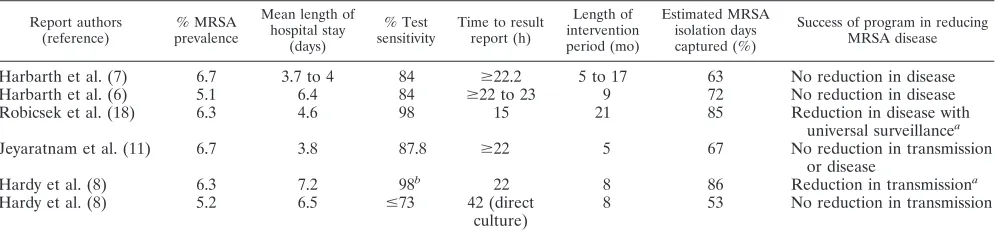
The relevant articles and important characteristics lead-ing to the estimation of captured MRSA isolation days are presented in Table 1. For each of these reports, one can calculate the approximate percentage of captured potential MRSA isolation days based on test sensitivity, time to reporting, and length of hospital stay. As can be seen in these reports, no success was recognized in re-duction of either MRSA transmission or infection dur-ing the relatively brief intervention periods until the estimated captured MRSA isolation days exceeded 80%. Thus, it appears that if a relatively short period of time
(⬍1 year) is used to evaluate a MRSA control program,
then a very aggressive, broadly directed surveillance pro-gram is required. Importantly for the laboratory, the shorter reporting time and lower sensitivity of culture for MRSA detection can influence the percentage MRSA isolation days captured (15), which implies that the ac-tual assay selection is critical to the outcome of any intervention and that only a rapid test with high sensi-tivity may provide a satisfactory programmatic result.
While there has been success in lowering the incidence of MRSA disease without the use of active surveillance, these interventions have been in the setting of very high infection prevalence. For example, Grayson and col-leagues reported on the reduction of the rate of recovery of monthly MRSA clinical isolates by their laboratory from 1.39 to 0.73 per 100 discharges, a change which was considered to have been associated with an
improve-ment of hand hygiene compliance from 21% to 48% over 2 years (4). Monthly bacteremia rates also fell from 0.05 to 0.02 per 100 discharges (4). Similarly, Edmond and colleagues reported a significant reduction in device-related MRSA infection from 2.9 to 0.76 infections per 1,000 patient-days over 4 years of multiple interventions (3). However, the ending infection rates for both studies at the conclusion of their interventions were higher than the initial disease rate found by Robicsek et al. (19), suggesting that in a very high prevalence setting nearly any interven-tion can be beneficial but that at some point active surveil-lance must be undertaken. In support of this concept, Huang and colleagues reported on sequential ICU inter-ventions aimed at lowering MRSA blood stream infection rates (9). They serially introduced maximally sterile central venous catheter placement, an alcohol hand rub, a hand hygiene campaign, and ICU MRSA surveillance; the only intervention that had a sustained impact on lowering the incidence of MRSA bacteremia was active surveillance (9). Finally, there is the question of cost-effectiveness for any program designed to reduce the spread of MRSA coloni-zation and disease. As noted earlier, the program that is most costly in human and financial resources is one that has no measurable beneficial impact over the time allotted for assessment. We have previously reported using a very conservative model that each patient developing a health care-associated MRSA infection has an excess medical cost of nearly $24,000 (18). On 31 July 2009, we completed the first 4 years of our MRSA program at NorthShore Univer-sity HealthSystem; by that time, there had been (compared to baseline) 406 MRSA infections avoided, with an $8.8 million excess that had not needed to be spent for this preventable illness (17). Importantly, using the mortality estimate of Klevens and colleagues (12), we had avoided 72 deaths from invasive MRSA disease (17).
[image:3.585.44.542.90.208.2]In conclusion, the available data indicate that MRSA infection is a serious health risk for the U.S. population. It is also likely that MRSA infection is a problem for most health care organizations and that assessing that
TABLE 1. Summary of published reports that illustrate the impact of different levels of test sensitivity and time to reporting of results on the reduction of MRSA in the involved population
Report authors (reference)
% MRSA prevalence
Mean length of hospital stay
(days)
% Test sensitivity
Time to result report (h)
Length of intervention period (mo)
Estimated MRSA isolation days captured (%)
Success of program in reducing MRSA disease
Harbarth et al. (7) 6.7 3.7 to 4 84 ⱖ22.2 5 to 17 63 No reduction in disease
Harbarth et al. (6) 5.1 6.4 84 ⱖ22 to 23 9 72 No reduction in disease
Robicsek et al. (18) 6.3 4.6 98 15 21 85 Reduction in disease with
universal surveillancea
Jeyaratnam et al. (11) 6.7 3.8 87.8 ⱖ22 5 67 No reduction in transmission or disease
Hardy et al. (8) 6.3 7.2 98b 22 8 86 Reduction in transmissiona
Hardy et al. (8) 5.2 6.5 ⱕ73 42 (direct culture)
8 53 No reduction in transmission
aResults represented statistically significant reductions.
bSensitivity data were calculated based on the methods presented in reference 14.
on May 16, 2020 by guest
http://jcm.asm.org/
risk can be done with minimal time and financial resources. Finally, active surveillance for this pathogen can reduce disease, both locally and nationally (19, 23). Arguments against such programs for MRSA control typically hinge on statistical methods and adverse effects of isolation and fo-cus on a single problem, but these concerns stand on very little evidence (16). The appropriate prevention and con-trol of MRSA colonization and disease remains achievable, saves lives, and is cost-beneficial.
NorthShore University HealthSystem supported this work. I thank LoAnn C. Peterson and Donna M. Hacek for critical review and comments on this work.
L. R. Peterson has received research support from Cepheid, ENH, Excelsior, GeneOhm, MicroPhage, Nanaosphere, NAIAD, Roche, 3M, Washington Square Health Foundation, Wyeth, and Merck and has served as a consultant for Cephied, GeneOhm, MicroPhage, Nanosphere, Roche, and 3M.
REFERENCES
1.Centers for Disease Control and Prevention.5 December 2009, accession date. Trends in tuberculosis—United States, 2007. Centers for Disease Control and Prevention, Atlanta, GA. http://www.cdc.gov/mmwr/preview /mmwrhtml/mm5711a2.htm.
2.Delorme, T., S. Rose, J. Senita, C. Callahan, and P. Nasr.2009. Epidemi-ology and susceptibilities of methicillin-resistantStaphylococcus aureusin northeastern Ohio. Am. J. Clin. Pathol.132:668–677.
3.Edmond, M. B., J. F. Ober, and G. Bearman.2008. Active surveillance cultures are not required to control MRSA infections in the critical care setting. Am. J. Infect. Control36:461–463.
4.Grayson, M. L., L. J. Jarvie, R. Martin, P. D. Johnson, M. E. Jodoin, C. McMullan, R. H. Gregory, K. Bellis, K. Cunnington, F. L. Wilson, D. Quin, A. M. Kelly, and the Hand Hygiene Study Group and Hand Hygiene State-wide Roll-out Group, Victorian Quality Council.2008. Significant reductions in methicillin-resistantStaphylococcus aureusbacteraemia and clinical iso-lates associated with a multisite, hand hygiene culture-change program and subsequent successful statewide roll-out. Med. J. Aust.188:633–640. 5.Hacek, D. M., S. M. Paule, R. B. Thomson, Jr., A. Robicsek, and L. R.
Peterson. 2009. Implementation of a universal admission surveillance and decolonization program for methicillin-resistantStaphylococcus aureus
(MRSA) reduces the number of MRSA and totalS. aureusisolates reported by the clinical laboratory. J. Clin. Microbiol.47:3749–3752.
6.Harbarth, S., C. Fankhauser, J. Schrenzel, J. Christenson, P. Gervaz, C. Bandiera-Clerc, G. Renzi, N. Vernaz, H. Sax, and D. Pittet.2008. Universal screening for methicillin-resistantStaphylococcus aureusat hospital admis-sion and nosocomial infection in surgical patients. JAMA299:1149–1157. 7.Harbarth, S., C. Masuet-Aumatell, J. Schrenzel, P. Francois, C. Akakpo, G.
Renzi, J. Pugin, B. Ricou, and D. Pittet.2006. Evaluation of rapid screening and pre-emptive contact isolation for detecting and controlling methicillin-resistant Staphylococcus aureusin critical care: an interventional cohort study. Crit. Care10:R25.
8.Hardy, K., C. Price, A. Szczepura, S. Gossain, R. Davies, N. Stallard, S. Shabir, C. McMurray, A. Bradbury, and P. M. Hawkey.20 July 2009, posting date. Reduction in the rate of methicillin-resistantStaphylococcus aureus
acquisition in surgical wards by rapid screening for colonization: a prospec-tive, cross-over study. Clin. Microbiol. Infect. [Epub ahead of print]. 9.Huang, S. S., D. S. Yokoe, V. L. Hinrichsen, L. S. Spurchise, R. Datta, I.
Miroshnik, and R. Platt.2006. Impact of routine intensive care unit surveil-lance cultures and resultant barrier precautions on hospital-wide methicillin-resistantStaphylococcus aureusbacteremia. Clin. Infect. Dis.43:971–978. 10.Jernigan, J. A., A. L. Pullen, L. Flowers, M. Bell, and W. R. Jarvis.2003.
Prevalence of and risk factors for colonization with methicillin-resistant
Staphylococcus aureus at the time of hospital admission. Infect. Control Hosp. Epidemiol.24:409–414.
11.Jeyaratnam, D., C. J. Whitty, K. Phillips, D. Liu, C. Orezzi, U. Ajoku, and G. L. French.2008. Impact of rapid screening tests on acquisition of methi-cillin resistant Staphylococcus aureus: cluster randomized crossover trial. BMJ336:927–930.
12.Klevens, R. M., M. A. Morrison, J. Nadle, S. Petit, K. Gershman, S. Ray, L. H. Harrison, R. Lynfield, G. Dumyati, J. M. Townes, A. S. Craig, E. R. Zell, G. E. Fosheim, L. K. McDougal, R. B. Carey, S. K. Fridkin, and the Active Bacterial Core surveillance (ABCs) MRSA Investigators.2007. Inva-sive methicillin-resistant Staphylococcus aureus infections in the United States. JAMA298:1763–1771.
13.Liu, C., C. J. Graber, M. Karr, B. A. Diep, L. Basuino, B. S. Schwartz, M. C. Enright, S. J. O’Hanlon, J. C. Thomas, F. Perdreau-Remington, S. Gordon,
H. Gunthorpe, R. Jacobs, P. Jensen, G. Leoung, J. S. Rumack, and H. F. Chambers.2008. A population-based study of the incidence and molecular epidemiology of methicillin-resistantStaphylococcus aureusdisease in San Francisco, 2004–2005. Clin. Infect. Dis.46:1637–1646.
14.Paule, S. M., D. M. Hacek, B. Kufner, K. Truchon, R. B. Thomson, Jr., K. L. Kaul, A. Robicsek, and L. R. Peterson.2007. Performance of the BD GeneOhm methicillin-resistant Staphylococcus aureus test before and during high-volume clinical use. J. Clin. Microbiol.45:2993–2998. 15.Paule, S. M., M. Mehta, D. M. Hacek, T. M. Gonzalzles, A. Robicsek, and
L. R. Peterson.2009. Chromogenic media versus real-time PCR for nasal surveillance of methicillin-resistantStaphylococcus aureus: impact on detec-tion of MRSA-positive persons. Am. J. Clin. Pathol.131:532–539. 16.Peterson, L. R., J. L. Beaumont, and A. Robicsek.2008. Benefits and
draw-backs of universal surveillance of methicillin-resistantStaphylococcus aureus. Ann. Intern. Med.149:68–69.
17.Peterson, L. R., D. M. Hacek, J. L. Beaumont, S. Boehm, T.-M. Gonzalzles, N. Gocht, and A. Robicsek.Impact of a 4-year universal surveillance and decolo-nization program to control methicillin-resistant Staphylococcus aureus
(MRSA). Abstr. 5th Decenn. Internat. Conf. Healthcare-Ass. Infect., abstr. 73, in press.
18.Peterson, L. R., D. M. Hacek, and A. Robicsek.2007. 5 Million Lives cam-paign. Case study: an MRSA intervention at Evanston Northwestern Health-care. Jt. Comm. J. Qual. Patient Saf.33:732–738.
19.Robicsek, A., J. L. Beaumont, S. M. Paule, D. M. Hacek, R. B. Thomson, Jr., K. L. Kaul, P. King, and L. R. Peterson.2008. Universal surveillance for methicillin-resistantStaphylococcus aureusin 3 affiliated hospitals. Ann. In-tern. Med.148:409–418.
20.Siegel, J. D., E. Rhinehart, M. Jackson, L. Chiarello, and the Healthcare Infection Control Practices Advisory Committee.5 December 2009, acces-sion date. Management of multidrug-resistant organisms in healthcare set-tings. Centers for Disease Control and Prevention, Atlanta, GA. http://www .cdc.gov/ncidod/dhqp/pdf/ar/mdroGuideline2006.pdf.
21.Tacconelli, E., G. De Angelis, C. de Waure, M. A. Cataldo, G. La Torre, and R. Cauda.2009. Rapid screening tests for methicillin-resistant Staphylococ-cus aureusat hospital admission: systematic review and meta-analysis. Lancet Infect. Dis.9:546–554.
22.The Joint Commission.5 December 2009, accession date. Accreditation pro-gram: hospital. National patient safety goals. The Joint Commission, Oak-brook Terrace, IL. http://www.jointcommission.org/NR/rdonlyres/31666E86 -E7F4-423E-9BE8-F05BD1CB0AA8/0/HAP_NPSG.pdf.
23.Vandenbroucke-Grauls, C. M.1996. Methicillin-resistantStaphylococcus au-reuscontrol in hospitals: the Dutch experience. Infect. Control Hosp. Epi-demiol.17:512–513.
24.Walker, S., T. E. A. Peto, L. O’Connor, D. W. Crook, and D. Wyllie.2008. Are there better methods of monitoring MRSA control than bacterae-mia surveillance? An observational database study. PLoS 3:e2378. doi:10.1371/journal.pone.0002378.
Lance R. Peterson
NorthShore University HealthSystem
Department of Laboratory Medicine and Pathology 2650 Ridge Avenue, Walgreen Bldg., SB525 Evanston, IL 60201
Phone: (847) 570-1637 Fax: (847) 733-5093
E-mail: [email protected]
COUNTERPOINT
I begin by emphasizing two points upon which Dr.
Peterson and I agree. First, methicillin-resistant
Staphy-lococcus aureus(MRSA) is an important cause of mor-bidity and mortality and should be a focus of infection prevention efforts. Second, there is a role for “active detection and isolation” (ADI) in the control of multi-drug-resistant organisms (MDROs), including MRSA. As outlined by the Centers for Disease Control and Prevention guidelines, ADI is one of several “second tier” interventions that should be considered when “first tier” infection prevention measures fail to prevent MDRO transmission (e.g. during outbreaks) (16).
on May 16, 2020 by guest
http://jcm.asm.org/
The question I will address is whether universal ADI should be implemented as a routine MRSA infection prevention measure. In other words, should all hospitals screen newly admitted patients for MRSA? My answer to this question is no, for the reasons I outline below.
The effectiveness of ADI remains in question. The effectiveness of ADI for MRSA infection prevention has
been arguedad nauseamin the infection control
litera-ture, so in the interest of conserving space I refer the reader to two recent systematic reviews (2, 13), to the CDC MDRO guidelines (16), and to a joint statement issued by the two major U.S. infection prevention pro-fessional societies (the Society for Healthcare Epidemi-ology of America and the Association for Professionals in Infection Control) (19). These publications summa-rize the state of the literature on ADI for MRSA control and present conclusions indicating that the existing evi-dence is not strong enough to support adoption of MRSA ADI as a routine infection prevention measure. Why? Be-cause almost all the published studies are of limited quality, in most cases due to an observational, before-and-after study design, the absence of concurrent control groups, and the inclusion of multiple interventions, making it difficult to determine the contribution of ADI to the observed MRSA reductions (2, 13). For example, the most widely cited re-cent study of universal ADI lacked a control group and included interventions other than ADI (e.g., widespread decolonization) (15). By contrast, the largest-ever con-trolled trial of universal ADI to reduce MRSA infections demonstrated no difference in MRSA infection rates asso-ciated with ADI use (8).
ADI interventions are complex and resource inten-sive.The reader is referred to our more comprehensive guidance for details (3), but in brief, the implementation of ADI is a resource-intensive, multidisciplinary effort. In addition to the cost of the screening test itself (up to $25 to $45 per test for the commercial PCR tests), there are costs associated with sample acquisition and trans-port, laboratory validation and reporting, process and outcome monitoring, personal protective equipment, bed management, and patient/family education (3). The argument that these costs are offset by savings from MRSA infection prevention assumes that MRSA infec-tions cannot be prevented using measures other than ADI—a flawed assumption.
Importantly, the resources invested in MRSA ADI are designed to prevent only MRSA infections. Indeed, MRSA ADI papers frequently cite the failure of MRSA ADI to impact non-MRSA infection rates as evidence in support of the specificity of the intervention (15). Infec-tion prevenInfec-tion programs obviously must focus on sev-eral problems at once. However, resources are not infi-nite, and every dollar spent on an MRSA-specific ADI intervention is a dollar not available for
population-based interventions designed to prevent both MRSA and all other health care-associated infections (20).
ADI may have unintended adverse consequences. A premise of ADI is that there are many asymptomatic carriers of MRSA, each of whom serves as a reservoir for nosocomial transmission unless detected and placed in isolation. Therefore, any comprehensive ADI pro-gram will significantly increase the number of patients being cared for under conditions of contact precautions (3). Unfortunately, several studies have demonstrated adverse consequences for patients under those condi-tions, including fewer health care worker visits, more noninfectious adverse events (missed medication doses, falls, decubitus ulcers, electrolyte disorders), more de-pression and anxiety, and lower satisfaction with hospital care (14, 17).
While it may be possible for some hospitals to imple-ment ADI and protect patients from unintended adverse consequences of contact precautions, there is an urgent need for more research in this area. A limitation of the ADI literature is that it focuses narrowly on infection out-comes and ignores noninfectious adverse outout-comes and overall patient satisfaction with respect to care (3, 5).
Given its uncertain effectiveness, the potential for harm, and the existence of alternative interventions for MRSA prevention, it is appropriate to examine the eth-ical implications of implementing universal MRSA ADI. Due to space limitations, the reader is referred to a previously published detailed ethical assessment of ADI for MDRO prevention (5).
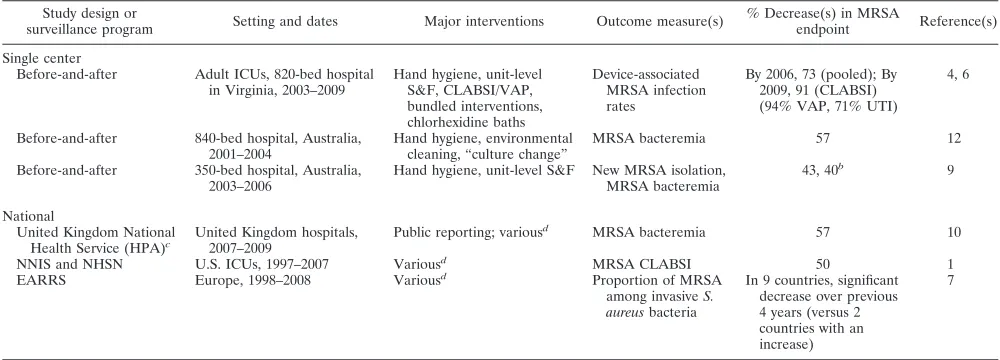
ADI is not necessary for MRSA prevention.The stron-gest argument against routine, universal ADI is that it is not necessary for MRSA prevention. Several hospitals have reported significant reductions in MRSA infection or transmission by the use of approaches that do not include ADI (4, 9, 12). While these studies share the flaws of studies supporting MRSA ADI (e.g., before-after design and absence of control groups), the MRSA outcome reductions have been of similar or greater mag-nitude (see Table 1). For example, the most recent such report presents findings showing a 73% reduction in device-associated MRSA infection rates in all adult in-tensive care units over a 4-year period and indicates that the reduction was associated with broad-based infection control strategies (e.g. hand hygiene and implementa-tion of bundled intervenimplementa-tions to reduce device-associ-ated infections) (4). This hospital, after adding chlo-rhexidine body washes for all ICU patients, has more recently reported even greater reductions in MRSA in-fection rates (6). In the medical ICU of my own hospital, we are entering our fifth consecutive month with no device-associated infections of any kind, MRSA or other. We attribute this success to sustained hand hy-giene adherence of 70 to 90% and bundled interventions
on May 16, 2020 by guest
http://jcm.asm.org/
to prevent device-associated infections. We do not prac-tice MRSA ADI.
In addition to individual hospital reports of reduc-tions of rates of MRSA infection without ADI, there are several lines of evidence indicating that health care-associated MRSA infection rates are declining as increased attention is paid to basic hospital infection prevention. Catheter-associated bloodstream infec-tions due to MRSA have declined by over 50% in U.S. ICUs since 2001 without widespread use of ADI (1). The United Kingdom successfully reduced MRSA blood-stream infections by 57% from 2007 to 2009 without adoption of universal ADI (a mandatory ADI program for elective admissions was not introduced in the United Kingdom until April 2009) (10). Finally, the European Antimicrobial Resistance Surveillance System now has more countries with decreasing trends in MRSA rates as opposed to increasing trends, and most participating countries do not perform universal MRSA ADI (7).
ADI is a flawed infection prevention approach. Infec-tion prevenInfec-tion practices are designed to prevent pa-tients from becoming infected with their own flora or with flora from other persons or the hospital environ-ment. This applies to all potential microbial pathogens and not just MRSA. Universal ADI interventions as-sume that we cannot prevent MRSA infections without knowing exactly who carries the organism. If this is to be our new paradigm—that MDRO infections can be pre-vented only if we know who carries each MDRO—then the path ahead will be extremely difficult. For as much attention as MRSA receives, it accounts for only 8% of all health care-associated bacterial infections in the United
States (11) and only 10% of ICU infections worldwide (18). What organisms make up the remaining 90%? Among them are a stunning array of multiply resistant Gram-neg-ative rods. Compared with the emerging multiply resis-tant Gram-negative rods, MRSA is a relatively simple pathogen—one major resistance mechanism and one
gene (mecA) to detect, with abundant data on human
carriage patterns available. Applying ADI to multiply
resistantAcinetobacter,Pseudomonas, and
Stenotropho-monasorganisms, and to the multiplicity of extended-spectrum-beta-lactamase and carbapenemase produc-ers, will be a much greater challenge.
Alternatively, we could devote our full attention, and our resources, to strengthening broad-based infection prevention programs designed to eliminate all health care-associated bacterial infections, those due to MRSA included (20).
In the past 12 months, D. Diekema has received research funding from Astellas, bioMe´rieux, Merck, Pfizer, and Schering.
REFERENCES
1.Burton, D. C., J. R. Edwards, T. C. Horan, J. A. Jernigan, and S. K. Fridkin.
2009. Methicillin-resistant Staphylococcus aureus central-line associated bloodstream infections in U.S. intensive care units, 1997–2007. JAMA301:
727–736.
2.Cooper, B. S., S. P. Stone, C. C. Kibbler, B. D. Cookson, J. A. Roberts, G. F. Medley, et al.2003. Systematic review of isolation policies in the hospital management of methicillin-resistantStaphylococcus aureus: a review of the literature with epidemiological and economic modeling. Health Technol. Assess.7:1–194.
3.Diekema, D. J., and M. B. Edmond.2007. Look before you leap: Active sur-veillance for multidrug-resistant organisms. Clin. Infect. Dis.44:1101–1107. 4.Edmond, M. B., J. F. Ober, and G. Bearman.2008. Active surveillance
cultures are not required to control MRSA infections in the critical care setting. Am. J. Infect. Control36:461–463.
[image:6.585.42.542.81.261.2]5.Edmond, M. B., L. Lyckholm, and D. J. Diekema.2008. Ethical implications of active surveillance cultures and contact precautions for controlling multidrug resistant organisms in the hospital setting. Public Health Ethics1:235–245.
TABLE 1. Examples of declining MRSA infection rates without the use of universal ADIa
Study design or
surveillance program Setting and dates Major interventions Outcome measure(s)
% Decrease(s) in MRSA
endpoint Reference(s) Single center
Before-and-after Adult ICUs, 820-bed hospital in Virginia, 2003–2009
Hand hygiene, unit-level S&F, CLABSI/VAP, bundled interventions, chlorhexidine baths
Device-associated MRSA infection rates
By 2006, 73 (pooled); By 2009, 91 (CLABSI) (94% VAP, 71% UTI)
4, 6
Before-and-after 840-bed hospital, Australia, 2001–2004
Hand hygiene, environmental cleaning, “culture change”
MRSA bacteremia 57 12 Before-and-after 350-bed hospital, Australia,
2003–2006
Hand hygiene, unit-level S&F New MRSA isolation, MRSA bacteremia
43, 40b 9
National
United Kingdom National
Health Service (HPA)c United Kingdom hospitals,
2007–2009
Public reporting; variousd
MRSA bacteremia 57 10 NNIS and NHSN U.S. ICUs, 1997–2007 Variousd
MRSA CLABSI 50 1 EARRS Europe, 1998–2008 Variousd
Proportion of MRSA among invasiveS. aureusbacteria
In 9 countries, significant decrease over previous 4 years (versus 2 countries with an increase)
7
aS&F, surveillance and feedback of infection rates to each unit; CLABSI, central line-associated bloodstream infection; VAP, ventilator-associated pneumonia; UTI,
urinary tract infection; HPA, Health Protection Agency; NNIS, National Nosocomial Infection Surveillance System; NHSN, National Healthcare Safety Network; EARSS, European Antimicrobial Resistance Surveillance System.
bValues refer to percent decrease in new MRSA isolation and MRSA bacteremia, respectively.
cThe Health Protection Agency in the United Kingdom has mandated reporting of MRSA bloodstream infection since 2001.
dUniversal ADI was not practiced across these surveillance programs. Because each program represents hundreds of hospitals, it is not possible to list all
interventions that were performed.
on May 16, 2020 by guest
http://jcm.asm.org/
6.Edmond, M. B., J. F. Ober, T. M. Duane, and G. M. L. Bearman.The demise of MRSA at an academic medical center. Fifth Decennial International Conference on Healthcare Associated Infections, Atlanta, GA, in press. 7.European Antimicrobial Resistance Surveillance System. 20 December
2009, accession date. European Antimicrobial Resistance Surveillance Sys-tem (EARSS) Annual Report 2008. National Institute for Public Health and the Environment, Bilthoven, The Netherlands. http://www.rivm.nl/earss /result/Monitoring_reports/.
8.Harbath, S., C. Fankhauser, J. Schrenzel, J. Christenson, P. Gervaz, C. Bandiera-Clerc, et al. 2008. Universal screening for methicillin-resistant
Staphylococcus aureus at hospital admission and nosocomial infection in surgical patients. JAMA299:1149–1157.
9.Harrington, G., K. Watson, M. Bailey, G. Land, S. Borrell, L. Houston, et al.
2007. Reduction in hospitalwide incidence of infection or colonization with methicillin-resistantStaphylococcus aureuswith use of antimicrobial hand-hygiene and statistical process control chart. Infect. Cont. Hosp. Epidemiol.
28:837–844.
10.Health Protection Agency.20 December 2009, accession date. Quarterly analyses: mandatory MRSA bacteraemia andClostridium difficileinfections (July 2007—September 2009). Health Protection Agency, London, UK. http: //www.hpa.org.uk/web/HPAwebFile/HPAweb_C/1259152023516.
11.Hidron, A. I., J. R. Edwards, J. Patel, T. C. Horan, D. M. Sievert, D. A. Pollock, S. K. Fridkin, et al.2008. Antimicrobial-resistant pathogens asso-ciated with healthcaassoasso-ciated infections: annual summary of data re-ported to the National Healthcare Safety Network at the Centers for Disease Control and Prevention, 2006–2007. Infect. Control Hosp. Epidemiol.29:
996–1011.
12.Johnson, P. D., R. Martin, L. J. Burrell, E. A. Brabsch, S. W. Kirsa, J. O’Keefe, et al.2005. Efficacy of an alcohol/chlorhexidine hand hygiene pro-gram in a hospital with high rates of nosocomial methicillin-resistant Staph-ylococcus aureusinfection. Med. J. Aust.183:509–514.
13.McGinigle, K. L., M. L. Gourlay, and I. B. Buchanan.2008. The use of active surveillance cultures in adult ICUs to reduce methicillin-resistant Staphylo-coccus aureus-related morbidity, mortality and costs: a systematic review. Clin. Infect. Dis.46:1717–1725.
14.Morgan, D. J., D. J. Diekema, K. Sepkowitz, and E. N. Perencevich.2009.
Adverse outcomes associated with contact precautions: a review of the lit-erature. Am. J. Infect. Control37:85–93.
15.Robicsek, A., J. L. Beaumont, S. M. Paule, D. M. Hacek, R. B. Thomson Jr., K. L. Kaul, et al.2008. Universal surveillance for methicillin-resistant
Staphylococcus aureusin 3 affiliated hospitals. Ann. Intern. Med. 148:
409–418.
16.Siegel, J. D., E. Rhinehart, M. Jackson, L. Chiarello, and the Healthcare Infection Control Practices Advisory Committee.20 December 2009, acces-sion date. Management of multidrug-resistant organisms in healthcare set-tings, 2006. Centers for Disease Control and Prevention, Atlanta, GA. http: //www.cdc.gov/ncidod/dhqp/pdf/ar/mdroGuideline2006.pdf.
17.Stelfox, H. T., D. W. Bates, and D. A. Redelmeier.2003. Safety of patients isolated for infection control. JAMA290:1899–1905.
18.Vincent, J. L., J. Rello, J. Marshall, E. Silva, A. Anzueto, C. D. Martin, et al.
2009. International study of the prevalence and outcomes of infection in intensive care units. JAMA302:2323–2329.
19.Weber, S. G., S. S. Huang, S. Oriola, W. C. Huskins, G. A. Noskin, K. Harriman, et al.2007. Legislative mandates for use of active surveillance cultures to screen for methicillin-resistantStaphylococcus aureusand vanco-mycin-resistant enterococci: position statement from the joint SHEA and APIC Task Force. Infect. Control Hosp. Epidemiol.28:249–260. 20.Wenzel, R. P., G. Bearman, and M. B. Edmond.Screening for MRSA: a
flawed hospital infection control intervention. Infect. Control Hosp. Epide-miol.29:1012–1018.
Daniel J. Diekema
University of Iowa Carver College of Medicine 200 Hawkins Drive
Iowa City, IA
Phone: (319) 356–7740 Fax: (319) 356–4916
E-mail: [email protected]
SUMMARY
In this Point-Counterpoint feature, Dr. Peterson presents a compelling case in favor of active, broad-based, patient-directed surveillance of both colonization and infection with MRSA linked to aggressive infection control intervention as a means of reducing the burden of MRSA disease in acute care hospitals. He cites the results of three published studies (Robicsek et al., Harrington et al., and Huang et al.) as supporting a comprehensive screening program and argues that such screening can result in lower MRSA infection rates and institutional cost savings. Dr. Peterson emphasizes the need for using molecular methods characterized by high detection sensitivity and same-day provision of test results when screening for MRSA and asserts that only whenⱖ90% of transmission is blocked can there be a meaningful reduction is infection rates. He also elucidates the concept of “captured MRSA isolation days” and points out that only when this value exceeds 80% can an MRSA screening program be expected to have a measurable positive impact.
Dr. Diekema presents an equally compelling case for not performing routine comprehensive MRSA surveillance. First, Dr. Diekema elucidates many of the design shortcomings in the studies used to justify MRSA screening linked to infection control interventions. He also points out that in the largest published study to date assessing the value of MRSA screening, no impact on infection rates was observed. He states that two major concerns with any compre-hensive MRSA screening program are the associated costs, some of which are hidden and therefore often not taken into account when performing economic analyses, and the increase in numbers of patients being cared for under conditions of contact precautions, with the resulting potentially negative impact of these precautions on patient care and patient well-being. And finally and importantly, Dr. Diekema makes the point, based on three published studies, that decreases in MRSA infection rates can be achieved using methods other than comprehensive MRSA surveillance (Edmond et al., Harrington et al., Johnson et al.).
I would like to thank both Lance Peterson and Daniel Diekema for their most insightful discussions of this very complex matter. The fact that two experienced authorities in this area can have such different views underscores the complex nature of the many issues surrounding MRSA screening. Their commentaries provide an important platform for further discussion, debate, and study of those factors that can lead to a reasoned and coherent approach for decreasing the burden of MRSA infections.
Gary V. Doern
Editor in chief,Journal of Clinical Microbiology
The views expressed in this feature do not necessarily represent the views of the journal or of ASM.