ISBN: 978-1-60595-457-8
Maritime Emergency Rescue Capability Evaluation
Based on Fuzzy Network Analysis
Wei-hao MA, Tian-yu MAO, Tian-fu LU, Xiao-liang FANG,
Xiao-chun WU
*and Zhao LI
Wuhan University of Technology, China
*
Corresponding author
Keywords: Analytic network process, Fuzzy comprehensive evaluation, Maritime rescue capability evaluation.
Abstract. Maritime emergency rescue operations are complex and random, it leads to the complexity of the evaluation of maritime emergency rescue capability. In this paper, we considered the relationship between the evaluation indexes of maritime emergency rescue capability, used Analytic Network Process to determine the weight of each index, took into account the feedback relationship between indicators to determine the index weight, improved the scientific and reliability of the model, and combined with fuzzy comprehensive evaluation to evaluate the rescue capability. According to the evaluation results which combined with the index weight, maritime sector can propose a targeted improvement measures to effectively improve maritime emergency rescue capability.
Introduction
With the vigorous development of the international shipping, maritime transport occupies a more and more important place in the development of economic globalization. In order to improve maritime emergency rescue capability, it is very important to evaluate the ability of maritime emergency rescue, point out the problems contrapuntally and put forward the corresponding solution. If the establishment of risk control system according to the existing problems and the corresponding solutions will be able to effectively promote maritime emergency rescue capability, reduce the maritime accident losses, but also can avoid resource waste in the process of maritime emergency rescue capability.
For the evaluation of emergency rescue capability in disaster,scholars at home and abroad have also done a lot of research. Yang Li and others used the improved AHP, entropy weight method and fuzzy comprehensive evaluation method to establish the evaluation model of coal mine emergency rescue capability[1]. Duan Zongtao and others used the analytic hierarchy process and fuzzy comprehensive evaluation method to establish the evaluation index system of expressway emergency rescue ability, designed the calculation model of evaluation results[2]. Miao ChengLin et al divided accidents into three links in advance, matter and afterwards to research the ability of prevention, detection, control, recovery, etc[3]. Daniel da Silva Avanzi et al used multi-criteria decision analysis (MCDA) to establish a applied in disaster management (DM) to assist the evaluation system[4].
rescue capability evaluation index, we can find out the weakness of the rescue capability, it provides an accurate and effective reference for further improving maritime SAR capability.
Maritime Rescue Capability Evaluation Model
Rescue Capability Evaluation Index System
Maritime rescue capability evaluation index system is composed of each index and the relationship between them.
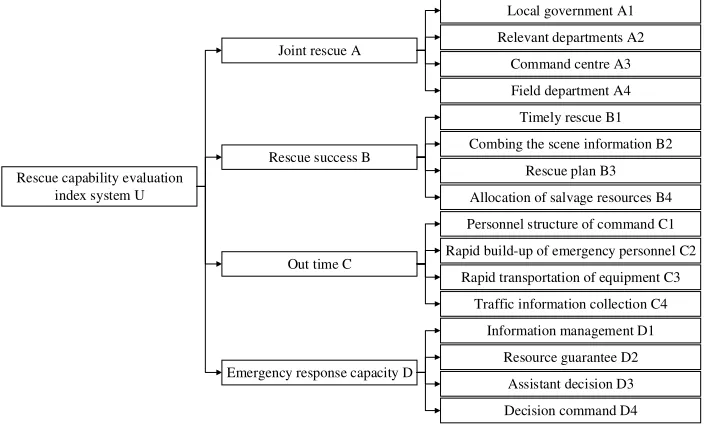
Maritime Rescue Capability Index. Through the analysis of the existing research results and the actual rescue case, we summed up the upper and lower two levels of maritime rescue capability evaluation index as shown in figure 1.
Rescue capability evaluation index system U
Command centre A3 Relevant departments A2
Local government A1
Timely rescue B1 Combing the scene information B2
Personnel structure of command C1 Rescue plan B3 Allocation of salvage resources B4
Traffic information collection C4 Rapid build-up of emergency personnel C2
Rapid transportation of equipment C3
Information management D1 Resource guarantee D2
Assistant decision D3 Decision command D4 Joint rescue A
Rescue success B
Out time C
Emergency response capacity D
[image:2.612.130.483.229.442.2]Field department A4
Figure 1. Assessment indexes of maritime rescue capability.
Importance Ranking of Rescue Capability Evaluation Index
Identifying and strengthening the construction of relative important indicators can help the maritime sector to effectively improve the maritime emergency rescue capability. We use the Analytic Network Process (ANP) which takes into account the relationship between the indicators to sort the emergency rescue capability index[5].
The Network Structure of Maritime Rescue Capability Evaluation. The feedback relationship between the evaluation indexes of maritime rescue capability is mainly based on practical experience and expert opinion, determined the network structure of maritime rescue capability evaluation, figure 2.
Rescue capability evaluation index system U
Joint rescue A Rescue success B Out time C Emergency response capacityD
Control layer
Network layer A1
A2 A3
B1
B2 B3
B4 C1
C2 C3
C4 D1
D2 D3 D4
[image:2.612.164.446.609.703.2]independent of each other, the corresponding weights can be determined by the traditional AHP method. Indicators are determined according to the 1~9 scale table, and the Delphi method is used to reciprocally compare index of the degree of relative importance, so as to construct paired comparison matrix B. Table 1 is the criterion layer index of paired comparison matrix and the weight vector of matrix B.
Table 1. criterion layer index of paired comparison matrix and the weight vector of matrix B.
Criterion
layer A B C D
Weight value w1
A 1 1/2 1 3 0.2109
B 2 1 1 5 0.3388
C 2 1 1 5 0.3388
D 1/3 1/5 1/5 1 0.0647
We tested the consistency of the results, random consistency ratio CR=0.08643 < 0.1, it passed the consistency test.
Importance Ranking of Network Layer Indexes. There are several criteria for evaluating the network structure of maritime emergency rescue, in order to rank the importance of network layer metrics, first of all, we need to determine the unweighted super matrix of subordinate indexes of each criterion. By researching and analyzing the joint rescue principles, combined with the Delphi method to determine the judgment matrix of reciprocally compare index.
(1) Determination of unweighted super matrix W
According to figure 2, the lower element A of joint rescue principles, local government A1 as the criterion, comparison of the relative importance of the criteria A1 according to the relevant departments A2, command center A3 and field A4, the sorting vector (ω11(11),ω(11)12 ,ω(11) T13 ) is obtained by combining the characteristic root method. Then took the relevant departments A2, command center A3 and field Department A4 as criteria, repeated the steps above, the corresponding sort vectors are obtained, and the vector matrix W is integrated. 11
(11) (12) (13) (14) 11 11 11 11 (11) (12) (13) (14) 12 12 12 12 11 (11) (11) (13) (14)
13 13 13 13 (11) (12) (13) (14) 14 14 14 14
1 1 1 1
ω ω ω ω
3 5 5
ω ω ω ω 1 1
3 1
W = =
3 5
ω ω ω ω
5 3 1 1
ω ω ω ω
5 3 1 1
(1)
Similarly, the vector matrix W of the lower level element set of other criterion layer is obtained, ij
and then they were integrated, we established the unweighted super matrix W.
11 12 12 14
21 22 23 24
31 32 33 34
41 42 43 44
W W W W 0.0679 0.1524 0.3899 0.3899
W W W W 0.5261 0.0872 0.2042 0.1826
W = =
W W W W 0.1322 0.4165 0.3829 0.0673
0.0712 0.3174 0.2358 0.3756
W W W W
(2)
(2) Set weight matrix a
11 12 13 14
21 22 23 24 T
34 31 32 33
44 41 42 43
a a a a
a a a a
a = W =
a
a a a
a
a a a
(3)
In the formula: a = 0 expresses the indicator i does not affect the index j, the sum of the ij
elements of the matrix A is 1. (3) Set weighted super matrix W
The weighted matrix a multiplied by the unweighted super matrix W could be calculated from the weighted super matrix W , Each column vector element of W represents the size of the impact on column index affect by the corresponding network layer index, if there is no influence, it will be 0.
T
W = a W = W× ×W (4)
(4) The limit of weighted matrix W
Due to the relationship between feedback and negative feedback in the network of maritime rescue capability evaluation, the two indicators could be compared directly and indirectly, thus increasing the complexity of determining index priority. Therefore, in order to determine the priority of the stability index, the limit W of weighted super matrix W was found out: l
t l
t W = lim W
0.0046 0.0801 0.0519 0.0278
0.0801 0.0076 0.0850 0.0579 =
0.0519 0.0850 0.1466 0.0159
0.0278 0.0579 0.0159 0.1411
→∞
(5)
The first line represents the weight W2 of the corresponding network layer under the criterion A,
and so on, the last line represents the weight W5 of the corresponding network layer under the
[image:4.612.86.532.516.585.2]criterion D. Thus we got the criterion layer index and its corresponding weight and index layer index and its corresponding final weight as shown in Table 2:
Table 2. Criterion layer index and its corresponding weight ,index layer index and its corresponding final weight.
Criterion layer index and its weight A 0.2109 B 0.3388 C 0.3388 D 0.0647
Index level index and corresponding final weight
A1 0.0046 B1 0.0801 C1 0.0519 D1 0.0278
A2 0.0801 B2 0.0076 C2 0.0850 D2 0.0579
A3 0.0519 B3 0.0850 C3 0.1466 D3 0.0159
A4 0.0278 B4 0.0579 C4 0.0159 D4 0.1411
Fuzzy Comprehensive Evaluation
The maritime emergency rescue work involves multi departmental joint decision-making and coordinated implementation; therefore, the evaluation of maritime emergency rescue capability is a complex fuzzy problem that needs fuzzy comprehensive evaluation method to evaluate the emergency rescue capability of the maritime sector.
(1)Set index set and comment set
According to the established emergency rescue capability evaluation system, set up the first level index set U and the second index set U1, U2, U3, U4:
it was divided into five qualitative levels:
V = {excellent, good, medium, qualified, poor} (7)
Excellent index indicates that the indicator can greatly improve the ability of maritime emergency rescue, and so on; poor index indicates that the index will deteriorate the maritime emergency rescue capability.
According to the establishment of the evaluation index of maritime emergency rescue capability system, we determined the weights of indicators at all levels through ANP, combined with fuzzy evaluation model which based on membership function, comprehensively evaluated a particular Marine emergency rescue unit ability of emergency rescue. The synthetic algorithm of fuzzy comprehensive evaluation is shown in formula (8):
B = W o R (8) In the formula: ANP is the weight vector of the index weight of the maritime emergency rescue capability index determined by W; R is a fuzzy relation matrix; B represents the fuzzy comprehensive evaluation matrix of this level; “” is a composition operator which is M( , )• ⊕ :•is
defined asa b• =a b = ab× ;⊕ •is defined asa⊕b=(a+b) 1∧ .
The Way to Determine the Membership Degree of Each Index. For a certain evaluation index of the evaluation set partitioning with membership function description which is describe by isosceles triangle membership function. The mathematical description of the membership function of the i index is shown in figure (9):
i k
k i k k k
k i
i k k i k
i k
s m
m s n
n m
p s
r (v ) n s h
s n
0 other
−
≤ ≤
−
−
= ≤ ≤ −
(9)
In the formula m , k n , k p are the corresponding constants of the t th rating, for the k standardized indicators, corresponding comment to the 5 levels are n1=0, n2=0.25, n3=0.5, n4=0.75,
n5=1, in order to ensure that each index can get at least 4 comment, isosceles triangle bottom is 1.6.
Comprehensive Evaluation Results of Marine Emergency Rescue Capability. After determining the membership of each index, According to the basic principle of fuzzy comprehensive evaluation, the comprehensive evaluation results of maritime emergency rescue capability are obtained as shown in formula (10):
T
1 2 2 3 3 4 4 5 5 1 2 3 4 5
B= WoR = w o[w oR,w oR,w oR,w oR ] = (b ,b ,b ,b ,b ) (10)
Case Study
Table 3. Indicators scoring about the emergency rescue abilities assessment.
evaluating
indicator A1 A2 A3 A4 B1 B2 B3 B4 C1 C2 C3 C4 D1 D2 D3 D
4 score 76 68 78 85 73 83 67 55 96 88 82 54 53 49 80 57
Classification of the indicators at all levels of the score using min-max method for normalization; the standard evaluation matrix '
i
C is obtained as shown in formula (11):
ij imax '
ij
imax imin C - C C =
C - C (11)
In the formula, C represents ij j th indicators in the i level, Ciminand Cimaxrepresent the
lowest and highest score in the i level.
On the basis of the Analytic Network Process, we can get the weight of each index and rank weight.According to the formula (10), the result of fuzzy calculation is:
B=[0.1075 0.1466 0.1508 0.1193 0.0836] (12)
Thus, the rescue ability of the maritime emergency rescue unit is qualified. It is able to take appropriate rescue action within a certain period of time, meet the requirements of general emergency rescue. For further optimization, according to the index score and the importance index of ANP, we can analyze the corresponding index gradually, then targeted to improve. According to table 6 and table 4, the attributes of relevant departments A2, resource protection D2 and decision command D4 are slightly poor, and the index weight is highly more important, therefore, the department needs to strengthen contact with relevant departments, increase the reserve of rescue resources and optimize command decision method.
Conclusion
In this paper, we considered the relationship between the indexes of maritime rescue capability, used ANP instead of AHP to determine the weight of each index, combined with isosceles triangle membership function, used fuzzy comprehensive evaluation to make the evaluation result of maritime rescue capability, it can improve the reliability of evaluation results. Rescue departments can understand their own defects by this method, and can contrapuntally improve relevant index according to index attributes and weights, and then it can effectively improve the capability of maritime rescue with smaller inputs.
Acknowledgement
This research was financially supported by the Wuhan University of Technology independent innovation research fund (2017-HY-B1-06).
References
[1] Yang Li, Liu Chengcheng, Song Li, et al. Evaluation of Coal Mine Emergency Rescue Capability Based on Entropy Weight Method[J]. China soft science magazine, 2013(11):185-192.
[2] Duan Zongtao, Zheng Xibin, Li Ying, et al. Expressway emergency rescue capability evaluation system[J]. Journal of transportation information and safety, 2014(3):94-98.
interoperability assessment in crisis management[J]. Journal of Industrial Information Integration, 2017.