ISBN: 978-1-60595-458-5
Linear Pre-coding Base on Imperfect CSI in Massive MIMO
Jun WANG
1, Jian-xin DAI
1, Chong-hu CHENG
1and Zhi-liang HUANG
21Nanjing University of Posts and Telecommunications, Nanjing, Jiangsu, China 2Zhejiang Normal University, Nanjing, Jiangsu, China
Keywords: Large scale MIMO, Imperfect CSI, Pre-coding algorithm, Mean square error.
Abstract. The estimation of channel state information at the base station in large scale MIMO system directly affects the design of downlink pre-coding matrix and affects the performance of the system. Aiming at the problem of Rayleigh fading channel and Rician Fading Channel estimation error, this paper firstly studies the influence of channel estimation error on the system, and then designs the pre-coding matrix based on the minimum mean square error criterion. The simulation results show that the proposed algorithm is superior to the traditional pre-coding algorithm.
Introduction
Large scale multiple-input multiple-output is one of the key technologies for the next generation mobile communication, which can be used to assemble hundreds of antennas at the base station side and to serve multiple users, which greatly improves the communication speed and quality of service [1-4]. However, due to the service’s users become more, it results in the user's interference has become large. At present, one of the ways to eliminate the interference among users is to use pre-coding technology in the base station [5].
The design of pre-coding matrix is depend on the CSI and the estimation of channel state information at the base station in large scale MIMO system directly affects the design of downlink pre-coding [6]. Because there are many fading channels model from the base station to the user, such as Rayleigh fading channel and Rician fading Channel [7]. So for different fading channel, channel matrix is also different. In this paper, based on the Rayleigh fading channel and Rician the fading channel, the pre-coding matrix is designed by using the least mean square error criterion when the CSI error is present in the base station.
The organization structure of this paper is as follows: the system model is introduced and the influence of estimation error on CSI is analyzed in section II. In section III, we introduce the closed form solution of the pre-coding matrix based on the minimum mean square error criterion. In section IV, simulation results are showed. Conclusions are drawn in section V.
Notations: ( )A T , ( )A H represent the matrix transpose and conjugate transpose; tr{ }A ,
{ H }
F tr
A A A represent matrix trace and the Frobenius norm respectively. E{ } denote expectation.
System Model
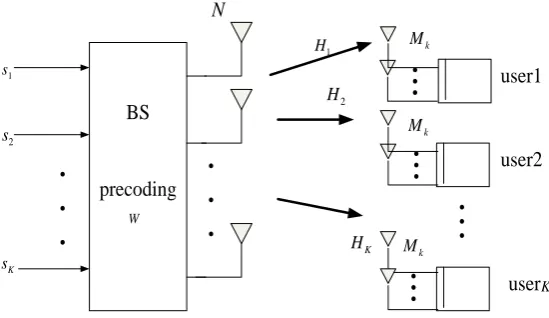
This paper mainly studies on the single cell scenario, which the central base station service K users. The base station is equipped with N N( 100) antennas, and the k-th user is equipped with
k
M antennas. Define M
Kk1Mk as the total number of antennas at all the users. The base stationBS
precoding
W
.
.
.
Nuser1
1
H
2
H
K
H
1
s
2
s
K
s
.
.
.
.
.
.
k
M
..
.
..
.
user2..
.
userk
M
k
M
[image:2.595.158.433.73.232.2]K
Figure 1. System model.
Rayleigh Distribution
The Rayleigh distribution is usually used to simulate the scattering signal at the receiving end through a variety of paths, which is a special case of the Weibull distribution. The probability density function of Weibull distribution is
( ) 1
( | ) , 0
x
f x b x e x
(1)
where when 2 and 2b , Weibull distribution is the Rayleigh distribution, and its probability density function is as follows
2 2
( ) 2 2 ( | )
x x f x b e
b
(2)
Rician Distribution
Rician distribution refers to the base station to a receiving end of line of sight propagation signal. Due to at the massive MIMO system, with the increasing number of mobile users, which make distance of the base station to the user continues to decrease, and thus reached the line of sight of the signal propagation. The probability density function of Les distribution is
2 2 2
( )
2 0
2 2
( ) ( )
x c b
x xc
f x e I
b b
(3)
Where I0( ) is the zero order Bessel function, which is the first kind. And cis the Rician factor, which determines the Rician distribution. When the Rician factor is closed to zero, Rician distribution tends to infinite Rayleigh distribution. Rician distribution tends to Gauss distribution when the Les factor approaches infinity. b is the scale parameter.
Due to the existence of delay and other factors, these results in the estimation error of CSI at base station. we can know that the base station estimates the channel matrix for the k-th user is expressed as
ˆ
k k k
H = H E (4)
Where Hˆk and Hk are the estimated channel matrix and actual channel matrix of the k-th
The pre-coding matrix is design by the estimated channel matrix at the base station. when the presence of channel estimation errors, it will affect the design of pre-coding matrix design. During the base station send the signal to user, the actual channel is different from the estimation’s .So except for interference between users, but also the interference caused by the estimation error. Finally, it has a greater impact on the performance of the system. We can get the signal from the
k-th user:
1,
K
k k k k k i i k
i i k
y H W s H W s n (5)
Where Mk N
k
W is the k-th user’s pre-coding matrix which is designed by the estimation channel matrix, and the noise vector at the user is defined as nk, which have identically Gaussian distribution with zero mean and variance n2. It is assumed that the signal vectors of different users are independent each other, that is k j, {s sk jH}0 and { }
k
H
k k L
s s I . is the power factor, which meet E{W sk k 2}Pk and Pk is the k-th user’s transmit power.
Theoretical Analysis
At the section, we design the pre-coding matrix by minimizing the mean square error criterion, when the channel estimation error exists at base station. At the same time, the signal leakage is used to replace the interface between users. Finally, we can get pre-coding matrix of the closed form solution through a non iterative method.
From (5), the cost function of the pre-coding matrix is given by
1 2
2 2
min
.
k k k
k k
E
s t P
W y s
W
(6)
so the key to obtain the pre-coding matrix is to solve the (6) . From the (5), we can get
1 2
2 2 2 1, k k K
k k k k i i k k
i i k
E E
y sH W s H W x s n
(7)
We suppose Wk[ ,W W1 2, ,Wk1,Wk1, ,WK], [ 1, 2, , k1, k1, , K]
T T T T T T
k
s s s s s s , so the (7) is given by
2 2 2 1, 2 { [( )( ) ]} k K
k k k k i i k k
i i k
H H H H
k k k k M k k k k
H k n H
k k k k k k k k
k E
tr
M
E tr tr
P
H W s H W x s n
W H H W I H W W H
H W s H W s W W
(8)
The second represents the power on the interference caused by the interference. The k-th user receive other users signal to produce interference, which is the equivalent of the k-th user power leaked to other users, so we can use { [( )( ) ]}H
k k k k k k
E tr H W s H W s ,
1,
K
k i
i i k
2
2 22
[
]
k
k k k k k k k k n
H H H H
k k k k k k k k M
H H k n H
k k k k k k
k
tr
E M
M
P
H W s H W s s
W H H W W H H W I
H W W H W W
(9)
To get Wk, we assume that Wk and H k
W are independent of each other, and
2 ( )
k
H H H H
k k k k k k k k k
H H k n H
M k k k k k k
k
f
M P
W W H H W W H H W
I H W W H W W (10)
In order to get Wk, we derive the first order derivatives of f(Wk) on Wk yields
1 2 1
ˆ ˆ ˆ
( ) ( )
K
H H k n H
k i i i i k k
i k
M P
W H H E E H E (11)
So far, we get pre-coding matrix through the minimization squared error criterion. We can know that the pre-coding matrix is related to channel estimation error; power and the number of receive antennas. In the next section, we will verify this algorithm by simulation.
Numerical Results
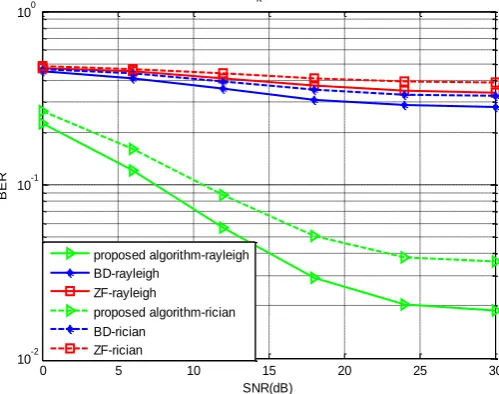
In this section, the performance of the proposed algorithm is verified by simulation and compared with the ZF, RZF and BD pre-coding algorithm, when the base station side has the channel estimation error. In this paper, there are K 50 users, each user is equipped with Mk 2 antennas,
signal-noise-ratio (SNR) is defined as 2
k k n
P
M , and noise variance and channel estimation error are set to
2 1 n
and 2
0.02 e
respectively, the Rician factor c1 and the scale parameter b1, bit error ratio (BER) is calculated based on quadrate phase shift keying (QPSK) modulation.
0 5 10 15 20 25 30
10-2 10-1 100
SNR(dB)
BER
NxMxM
k=100x50x2
proposed algorithm-rayleigh BD-rayleigh
ZF-rayleigh
proposed algorithm-rician BD-rician
[image:4.595.90.501.399.671.2]ZF-rician
Figure 2. Comparison of different pre-coding algorithms on BER in the Rayleigh and Rice channel.
[image:4.595.168.418.477.674.2]the same time, we can also see that the Rician channel fading greater than Rayleigh.
Summary
Aiming at the problem of non-ideal Rician fading channel and Rayleigh fading channel, this paper obtained the closed form solution to the pre-coding matrix by minimizing the mean square error criterion and using the signal leakage equivalent user interference. Finally, the performance of the algorithm is verified by simulation, and compared with the traditional algorithm; we can know the advantage of the proposed algorithm is much better.
Acknowledgement
This work is supported in part by Postdoctoral Research Funding Plan in Jiangsu Province (Grant No.1501073B), Natural Science Foundation of Nanjing University of Posts and Telecommunications (Grant No.NY214108), Natural Science Foundation of China (NSFC) (Grant No.61401399), and the Open Research Fund of National Mobile Communications Research Laboratory, Southeast University (Grant No.2016D05).
References
[1] Lu L, Li G Y, Swindlehurst A L, et al. An Overview of Massive MIMO: Benefits and Challenges [J]. IEEE Journal of Selected Topics in Signal Processing, 2014, 8(5):742-758.
[2] Rusek F, Persson D, Lau B K, et al. Scaling Up MIMO: Opportunities and Challenges with Very Large Arrays[J]. IEEE Signal Processing Magazine, 2012, 30(1):40-60.
[3] Larsson E G, Edfors O, Tufvesson F, et al. Massive MIMO for next generation wireless systems[J]. IEEE Communications Magazine, 2014, 52(2):186-195.
[4] R. C. de Lamare. Massive MIMO Systems: Signal Processing Challenges and Future Trends, URSI Radio Science Bulletin, 2013.
[5] Jia Rong, Wu Gang, He Xu. Comparison Research on Precoding Schemes for Downlink Multi-user MIMO Channels. Journal of University of Electronic Science and Technology of China, 2008, 37 (9):31-35.