Development Of Teaching Materials
Folktale Nationalism To Form Attitude Primary
School Students
Siddik Romadhan, Raden Roro Nanik Setyowati, Waspodo Cipto Subroto Prodi Basic Education, Graduate School, State University of Surabaya,
e-mail: [email protected]
DOI: 10.29322/IJSRP.9.06.2019.p90101
http://dx.doi.org/10.29322/IJSRP.9.06.2019.p90101
abstrack
The background of this research by folklore which is a heritage of knowledge noble values in society. Therefore, very precise serve as resource nationalism in shaping attitudes of students especially for primary school children.The purpose of this research to develop teaching materials folklore nationalism in shaping attitudes of primary school students. The approach in this study is a development approach that develops teaching materials that follow the design nonequivalent control grub 4-D design models. The subjects were Elementary School fourth grade students Pajagalan I Sumenep. Includes data analysis techniques, analysis of the validity of teaching materials, teaching materials practicality analysis (keterlaksanaan learning materials, the response of students and teachers), Analysis of the Effectiveness of Learning (test kempampuan attitudes, normality test, homogeneity and test the effectiveness of the use of teaching materials). The data were obtained as follows: the results of the validation test is very valid teaching materials average value obtained > 0.80 with a little revision. Results analisisi keeftifan through t-test for the control group and the experimental pretest t = 3.670> table = 1.670. There are differences to the Traffic nationalism Elementary School fourth grade students Pajagalan I Sumenep.
Keywords: Subjects, Folklore, Attitude Nationalism.
INTRODUCTION
Indonesia is a nation that has a diverse customs, religion, race, and ethnicity. One area that has a wealth of contributions in the world of education that needs to be preserved is folklore.Folklore is one of the works that are born by the people who still hold on the values of traditional culture.According Nur'aini (2008: 27) folklore is the story that developed in the community and handed down from generation to generation through verbal. Folklore also stories relating to the circumstances or evidence of relics. Additionally, Ratna (2014: 604) folklore is the whole story that emerged as a result of interaction between individuals, between groups in society.Teaching materials folklore itself as one of the innovations for students in cultivating an attitude. Folklore usually consists of myths and fairy tales, often described as of human behavior where this story gives meaning and value to the lives of elementary school students.
Based on observations known folklore materials is severely limited in primary schools Pajagalan I Sumenep, so students are less familiar with the folklore. Students are more viscous know folklore outside of the love story of the people themselves. And if we know the folklore in Indonesia many great lesson to be learned. Folklore scattered in different places and not all well documented. Whereas folklore is one source of the rich oral traditions that need to be uncovered, excavated and preserved as a cultural label. Teachers deliver learning with lecture and only using makeshift materials as a source of teaching material.In addition, teachers are still experiencing difficulties in determining appropriate teaching materials to submit items of folklore.Based on the observations that have been made, is now increasingly folklore reduced demand and impressed increasingly disappeared from public life it itself, particularly society. Very disappointing if people are unaware of folklore originating from its own country. This happens because folklore had rarely if ever again told by the parents to their children or teacher to his students. These circumstances need to be considered by the fourth-grade teacher in order to create change in the learning activities in order to attract the attention of students in shaping the attitude of nationalism in the lives of students.
teaching materials prepared on the necessary learning needs of students packed in units of a specific and systematic activities based on the curriculum, teaching materials are learning materials used in classroom learning activities for the achievement of learning goals , Fourth grade primary school students in the learning process rather listen to folklore than to listen to the teacher's explanations that are not attractive. In folklore students prefer to listen to fairy tales that are legendary, From the description, it can be developed materials to form attitudes folklore nationalism fourth grade primary school students. The use of teaching materials in learning folklore Madura is expected to provide a new atmosphere for the students so that learning more interesting and fun. In addition, teaching materials folklore Madura is also expected to improve student learning outcomes.
This study aimed to describe the validity of teaching materials folklore to shape the attitudes of primary school students nationalism, describing the practicality of teaching materials in shaping attitudes folklore nationalism primary school students, and to describe the effectiveness of teaching materials in shaping attitudes folklore nationalism elementary school students.
METHOD
This research will examine about the development of teaching materials in shaping attitudes folklore nationalism elementary school students. This type of research in this study is the kind of research development. Research & development (R & D) is a research method that is used to produce a certain product to test the effectiveness of these products (Sugiyono 2016: 297). Development of teaching materials Madura folklore in this study using a model of development Thiagarajan, Semmel, and Semmel. Thiagarajan models (1974, p. 5) consists of four phases, known as 4-D models (Four D models). The fourth stage is (1) the definition (define), (2) design (design), (3) development (develop), and (4) the spread (disseminate). In doing so, the researchers only use three phases, namely the definition (define), design (design), development (develop), so that the teaching materials developed are only used at the school were tested without disseminated to other schools. This is because beyond the authority of researchers to distribute products that have been developed by researchers. But researchers only give the option of teaching materials that can be used in primary schools. 4-D model of development chosen for the stages clear, coherent, and in accordance with the needs of the development of teaching materials forming folklore in nationalistic attitudes of primary school students, this model as a companion book curriculum, 2013. This is because beyond the authority of researchers to distribute products that have been developed by researchers. But researchers only give the option of teaching materials that can be used in primary schools. 4-D model of development chosen for the stages clear, coherent, and in accordance with the needs of the development of teaching materials forming folklore in nationalistic attitudes of primary school students, this model as a companion book curriculum, 2013. This is because beyond the authority of researchers to distribute products that have been developed by researchers. But researchers only give the option of teaching materials that can be used in primary schools. 4-D model of development chosen for the stages clear, coherent, and in accordance with the needs of the development of teaching materials forming folklore in nationalistic attitudes of primary school students, this model as a companion book curriculum, 2013.
RESULTS AND DISCUSSION
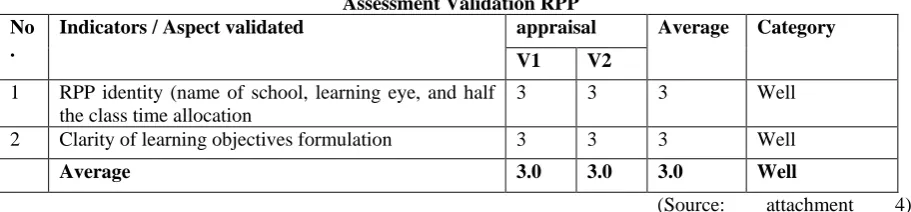
[image:2.595.67.523.594.700.2]Validation of learning implementation plan implementation, prior to field trials and research instruments developed product should be assessed or dibvalidasi by experts. Rate validation is performed by two validators who are experts in their fields. The objective of the stage is as feasible to prove that the instrument used. The results of the validation assesment of the implementation of learning which is validated by a validator seen in Table 4.1 as follows:
table 4.1
Assessment Validation RPP No
.
Indicators / Aspect validated appraisal Average Category
V1 V2
1 RPP identity (name of school, learning eye, and half the class time allocation
3 3 3 Well
2 Clarity of learning objectives formulation 3 3 3 Well
Average 3.0 3.0 3.0 Well
(Source: attachment 4) Based on table 4.1 it can be seen that the average results of recent research by two validators RPP is 3.0 to match the scale of Likert Crete "Good" artimya lesson plan is feasible suggestions and feedback by the validator on RPP made still less specific, step on core activities learning and adapted to the standard stages of the process, and as well as the allocation of instructional time should be given time allocation
Validation Feasibility Assessment Material No
.
Aspects validated appraisal Average Category
V1 V2
1 KD material linkages with the duties and illustrations 3 3 3 Very good
2 The accuracy of the material facts and concepts, principles, theories of learning civics by formulating it precisely to avoid misconceptions students
4 3 3.5 Very good
3 Completeness is developed according to folklore 3 4 3.5 Well
Average 3.33 3.50 3.33 Very good
(Source: Appendix 5) Based on Table 4.2 it can be seen that the average results of recent research in validasi feasibility of the material is 3.3 with two validators assessment criteria of each indicator is very "very good" this shows that there material this on teaching materials folklore has been worth it tested in the field.
table 4.3
Validate Eligibility Assessment Presentation Components No
.
Aspects validated appraisal Average Category
V1 V2
1 Grievance concept, presentation of material in teaching materials in accordance with a simple flow leading to a complex groove, so that students can follow it properly
4 4 4 Very good
2 Developing Capabilities nationalism behavior in shaping attitudes of students
4 4 3 Well
3 The closing section which lists library, a subject index, glossary of terms (glossary) and petunujuk performing tasks
3 2 2.5
Average 3.75 3.25 3.55 Very good
(Source: Annex 6)
Based on Table 4.3 it can be seen that the average assessment is 3.55 material feasibility validation criteria Linkret scale validator assessment was "good", indicating that the material in teaching materials folklore has been worth it tested in the field with minimal revision.
table 4.4
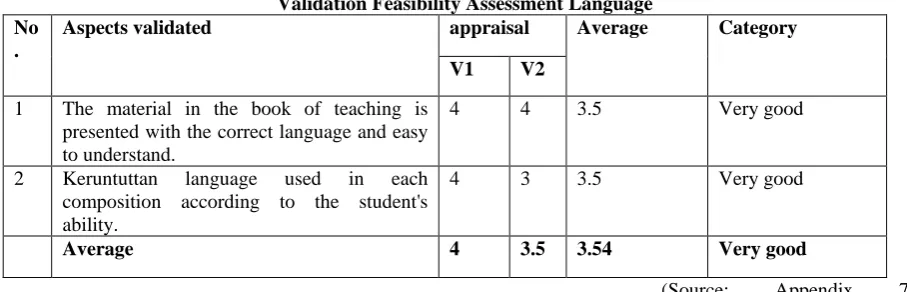
Validation Feasibility Assessment Language No
.
Aspects validated appraisal Average Category
V1 V2
1 The material in the book of teaching is presented with the correct language and easy to understand.
4 4 3.5 Very good
2 Keruntuttan language used in each
composition according to the student's ability.
4 3 3.5 Very good
Average 4 3.5 3.54 Very good
[image:3.595.65.519.512.658.2](Source: Appendix 7) Based on Table 4.4 it can be seen that the average language assessment results validation is 3,54 criteria Linkret scale is a validator votes "very good", indicating that language teaching materials folklore is feasible tested in the field
table 4.5
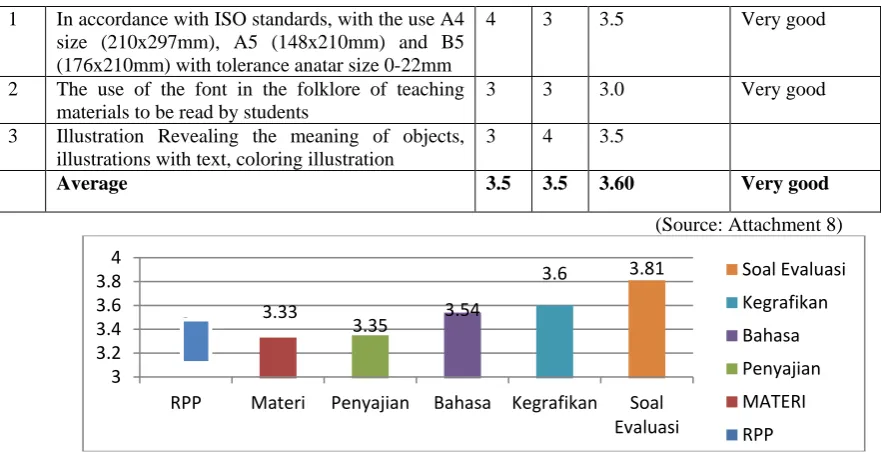
Validation Feasibility Assessment kegrafikan No
.
Aspects validated appraisal Average Category
1 In accordance with ISO standards, with the use A4 size (210x297mm), A5 (148x210mm) and B5 (176x210mm) with tolerance anatar size 0-22mm
4 3 3.5 Very good
2 The use of the font in the folklore of teaching materials to be read by students
3 3 3.0 Very good
3 Illustration Revealing the meaning of objects, illustrations with text, coloring illustration
3 4 3.5
Average 3.5 3.5 3.60 Very good
(Source: Attachment 8)
Figure 4.1 Diagram Validation Results Research Instruments Research and Teaching Material
In the diagram above menejelaskan about the instruments and materials ajaryang validated by expert. RPP validation value of 3.00 (good), Materials 3.33 (very good), Presentation of 3.35 (very good), English 3.54 (Very Good), Kegrafikan 3.6 (very good), the evaluation questions 3, 81 (excellent). So for the overall value of the validation results are assessed by validator experts including criteria very well.
table 4.6
Results of research keterlaksanaan lesson plan (Practicality teaching materials)
No. aspects Rating Meeting 1 meeting 2 meeting 3
O1 O2 O1 O2 O1 O2
1 Initial activity
1. Delivering destination 4 3 3 3 4 3
2 Core activities
3 Cover
4 Observers Atmosphere Class
Average 3.55 3.33 3.55 3.00 4.00 3.60
Ket. O1 = Observer 1, O2 = 2 (Source Attachment 9)
[image:4.595.68.509.69.298.2]Based on the above table it can be seen that the average observer ratings observation results in the fourth grade learning accomplished in accordance with the opinion (Riduan., 2013: 41) as very strong.
table 4.7
Response Percentage Students
No. Question Response Student Class IV-A
Iya Not
Average 93% 7%
(Source Attachment 10) Based on table 4.7 in mind that all of the students answer questions that views literacy teaching materials indigenous culture is interesting. Of the 10 questions answered by the average student teaching material students' responses to folklore 93%, so in accordance with the criteria of students according to (Riduwan, 2013: 41) as very good and practical and fit for use.
table 4.8
Test Result Data Validitasi attitude Ability Test
No. r count r table Information
1 .690 0,349 valid
3 3.33 3.35 3.54
3.6 3.81
3 3.2 3.4 3.6 3.84
RPP Materi Penyajian Bahasa Kegrafikan Soal Evaluasi
[image:4.595.67.515.400.553.2]2 .639 0,349 valid
3 0.731 0,349 valid
(Source Attachment 11)
[image:5.595.72.513.71.104.2]Through the SPSS 24 statistical calculations, evaluation sheets attitude capability consists of 10 questions were submitted to 35 sisswa shows the overall item is valid, because t is greater than t table. Thus the 10 items on the evaluation sheet test. The ability to use as decent attitude measurement tool capability attitudes.
table 4.9
The reliability analysis Ability Test Questions Item student attitudes Reliability Statistics
Cronbach's
Alpha N of Items
, 707 5
(Source Attachment 12)
The otherwise normal if the value of Cronbach's Alpha greater than 0.60. Thus, the data in Table 4.9 can be declared reliable or stable.
[image:5.595.66.519.304.396.2]Results attitude abilities done by mengkuru ability students' attitudes through the pretest and posttest to the control and experimental classes. Results pretest and posttest control group and the experiment can be seen in Table 4:10
table 4.10
The reliability analysis Ability Test Item Attitude Problem No. Class IV-A (Control) Class IV-B (Experiment)
1 69 71 62 70
2 47 62 62 80
3 56 69 75 87
4 43 62 61 79
Average 60 74 63 85
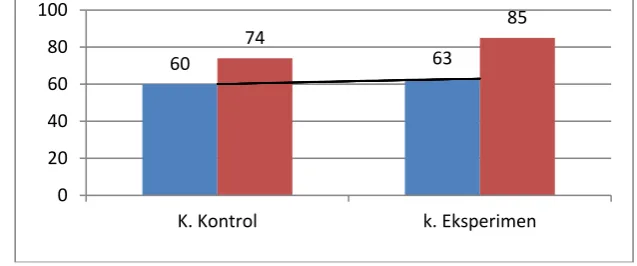
[image:5.595.145.464.449.582.2](Source Attachment 13) At 4:13 table can know the results of the control and experimental class pretest still not in accordance with the KKM is 70. The average value of pretest class IV-A 60 and the average value of pretest class IV-B 63. As for the average grade classroom posttest results IV-B experienced an increase of 85 over the KKM. However, for class IV-A as kels still control more than KKM is the average value of 74.
Figure 4.2 Diagram average pretest and posttest experimental class and control
[image:5.595.70.514.634.706.2]In Figure 4.2 it can be seen an increase in the value difference between the students' ability attitude class IV-A and IV-B.
table 4.11
Normality Test One Sample Kolmogorov-Smirnov Test
Class variables Asymp. Sig. (2-tailed)
Control Ability Attitude (pretest) 0109
Ability Attitude (posttest) 0141
Experiment Ability Attitude (pretest) 0.131
Ability Attitude (posttest) 0.187
(Source Attachment 12) In this case the researchers used SPSS 24 with technical One Sample Kolmogorov-Smirnov Test with significance rate of 0.05. Normality Test results can be seen in the table above 4.11. based on the above table shows the value signitikansi posttest control group 0.109 and 0.141. Then to the value of the experimental class
60 74 63
85
0 20 40 60 80 100
pretest signitifikasi postess 0.131 and 0.187. Thus, the data above can be considered normal for more than the level signitifikasi 0.05.
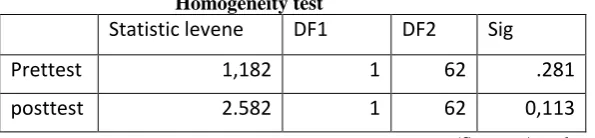
table 4.12 Homogeneity test
Statistic levene DF1 DF2 Sig
Prettest 1,182 1 62 .281
posttest 2.582 1 62 0,113
(Source Attachment 13) From 4:12 table shows the significant value of 0.281 pretest and posttest sgnifikansi value of 0.113. With each variable Accordingly higher than 5%, or 0.05. So based on these data the variance between the two groups is assumed to be homogeneous.
Test for normality and homogeneity test is a prerequisite test for determining the data used is tesdistribusi normal and homogeneous. After the data is otherwise normal and homogeneous, then the data can be used to perform hiptesis test or t-test as follows
a. Ha = there is influence of the use of folklore against nationalism Elementary School fourth grade students Pajagalan I Sumenep theme of the beauty of the diversity of my country.
b. H0 = there is no influence resource use folklore to nationalism Elementary School fourth grade students the beauty of diversity Pajagalan first theme country.
Both hypotheses were tested by t-test statistical analysis, to make decisions by comparing ttable (0.05) with t as follows.
a. If t is greater than t𝑡𝑡𝑡𝑡𝑡𝑡le (T ˃ ttabel) then the null hypothesis (Ho), which was rejected and the alternative hypothesis (Ha) is accepted.
b. If t is less than t𝑡𝑡𝑡𝑡𝑡𝑡𝑙𝑙e (T ˂ ttabel) then the null hypothesis (Ho) filed accepted and alternative hypothesis (Ha) is rejected.
Independent Samples Test
Levene's Test for Equality of
Variances t-test for Equality of Means
F Sig. t df
Sig. (2-tailed)
Mean Differen
ce
Std. Error Differen
ce
95% Confidence Interval of the
Difference Lower Upper Pretest Equal
variances
assumed 1,182 0,281 0,685 62 0,496 2,188 3,195 -4,198 8,573
Equal variances
not assumed 0,685 60,956 0,496 2,188 3,195 -4,2 8,575
Posttest Equal variances
assumed 2,582 0,113 3,67 62 0,001 10,781 2,938 4,909 16,654
Equal variances
not assumed 3,67 58,751 0,001 10,781 2,938 4,902 16,66
(Source Attachment 14) According to the table 4:13 knowable at posttets value t = 3.670 with a precision of 0.05 and df = 62, then a large table = 1.670. If t> t table so Ha is received at the level of 5%. From these data can be written t = 3.670> table = 1.670, so Ha is received. It can be concluded that there are significant resource use folklore to the attitude nasioanalisme Elementary School fourth grade students Pajagalan I Sumenep.
DISCUSSION
Practicality teaching materials folklore refers to opini Akbar (2013, p. 37) after validating the validator then dilkuakan field tests of objects that students with learning and knowing keterlaksanan student response after the use of teaching materials folklore.Thus the material practicality aje folklore implementation aspect of the learning process and the students' responses as very strong. That's because the learning process implementation level reached 93% and the percentage of students' responses after the use of teaching materialsfolklore reached 95%.
Effectiveness of Learning (test kempampuan attitudes, normality test, homogeneity and test the effectiveness of the use of teaching materials). The data were obtained as follows: the results of the validation test is very valid teaching materials average value obtained> 0.80 with a little revision. Results analisisi keeftifan through t-test for the control group and the experimental pretestt = 3.670> table = 1.670,, There are differences to the Traffic nationalism Elementary School fourth grade students Pajagalan I Sumenep.
CONCLUSION
Based on the results of the validation test conducted by two validators that validate the contents of component materials or get the value of 0.88. Components presenting teaching materials can be categorized as very valid with a value of 0.89. Components of language teaching materials can be categorized as very valid with a value of 0.88. Then graphicscomponents can be categorized as very valid with a value of 0.99. Thus the value of materials otherwise very valid folklore with a few minor revisions.
Subjects folklore theme of the beauty of diversity developed country otherwise practical and can be used for elementary school fourth graders. Based on the analysis implentation level learning process during the three meetings was 93% and the percentage of students' responses after the use of teaching materials folklore in the form of a questionnaire given to students at the end of the third meeting of up to 95% with very strong criteria.
Based on the results of the t test for the data pretest control group and the experimental value of t = 0.401 <table = 1.668, so there was no significant difference for the data pretest. Then the t-test value of t = 5.767> table = 1.668. Based on the results of the analysis can be inferred resource of folklore theme of the beauty of the diversity of my country, is effective to improve the ability of nationalism Elementary School fourth grade students Pajagalan I Sumenep.
REFERENCES
Akbar, Sa’ud. (2013). Instrumen perangkat pembelajaran. Bandung: PT. Remaja Rosdakarya.
Coenders. (2003). The efeect of education on nationalism and ethnic exclusionism: an internasional comparison. political psychology. Journal Departemen of Sociology/ICSUniversty of Nijmegen, (2)24, 30-38. Husinaffan, M dan Maksum Hafidh (2016). Membangun kembali sikap nasionalisme bangsa indonesia dalam
menangkal budaya asing di era globalisasi. Jurnal Pesona Dasar. (3)4, 65–72.
Kosterman, R., & Feshbach, S. (2010). Toward a measure of patriotic and nationalistic attitudes. Political Psychology, (2)10, 257–274.
Lestari, Ika.(2013). Pengembangan bahan ajar berbasis kompetensi. Jakarta:@akademia
Mummendey, A., Klink, A., Mielke, R., Wenzel, M., & Blanz, M. (2013). Socio-structural characteristicsof intergroup relations and identity management strategies: Results from a.eld study in EastGermany.
European Journal of Social Psychology, (6)29, 259–285.
Nur’aini, Umri dan Indriyani. (2008). Bahasa indonesia untuk sekolah dasar kelasV. Jakarta: Pusat Perbukuan, Departemen Pendidikan Nasional.
Pettigrew, T. F., & Meertens, R. W. (2003). Subtle and blatant prejudice in western Europe. EuropeanJournal of Social Psychology, (3)25, 57–75.
Prastowo, Andi. (2013). Pengembangan bahan ajar tematik. Jogjakarta: Diva Press
Ratna, Nyoman Kutha. (2014). Peranan karya sastra, seni, dan budaya dalampendidikan karakter. Yogyakarta: Pustaka Pelajar.
Riduwan. (2013). Dasar-dasar statistika. Bandung: Alfabet
Silaban, Winner. (2012). Pemikiran soekarno tentang nasionalisme. Jurnal Dinamika Politik, (1)3, 56-61. Sugiyono. (2016). Metodepenelitian kuantitatif, kualitatif dan R&D. Bandung: PT Alfabet
Thiagarajan, S. Semmel, Dorothy S, Semmel, Melvyn I. (1997) Imtructional devlepment for training of exeptional childer. Minesota: The Council For Exeptional Children.
Triandis, H. C., Bontempo, R., Villareal, M. J., Asai, M., & Lucca, N. (2000). Individualism and collectivism: Cross-cultural perspectives on self-ingroup relationships. Journal of Personality and SocialPsychology, (3)54, 323–338.