BIROn - Birkbeck Institutional Research Online
Forrester, Gillian and Thomas, Michael S.C. (2015) What is universal
and what differs in language development?
Language, Cognition and
Neuroscience 30 (8), pp. 922-927. ISSN 2327-3798.
Downloaded from:
Usage Guidelines:
Please refer to usage guidelines at or alternatively
What is universal and what differs in language development?
Gillian S. Forrester1 & Michael S. C. Thomas2
1 Department of Psychology, University of Westminster, London, UK 2 Developmental Neurocognition Lab, Birkbeck, University of London, UK
Running head: Species universals and individual differences
Corresponding author:
Dr. Gillian S. Forrester
Department of Psychology
University of Westminster
115 New Cavendish Street
London W1W 6UW
United Kingdom
Goldin-‐Meadow (2015) presents an exceptional synthesis of work from studies
of children acquiring language under variable circumstances of input or
processing abilities. Deaf children who acquire homesign without any well-‐
formed model from which to learn language represent a powerful example.
Goldin-‐Meadow argues that the resilient properties of language that
nevertheless emerge include simple syntactic structures, hierarchical
organisation, markers modulating the meaning of sentences, and social-‐
communicative functions. Among the fragile or input-‐dependent properties are
the orders that the language follows, the parts into which words are decomposed,
and the features that distinguish nominals from predicates. Separation of these
two types of properties poses questions concerning the innate constraints on
language acquisition (perhaps these equate to the resilient properties) and
concerning the specificity of processes to language (e.g., whether properties such
as hierarchical organisation are specific to language or originate in the structure
of thought).
The study of the resilient properties of human language in the face of
adversity, and the relation of these properties to the information that is encoded
in the human genome, represent a research strategy that draws inferences about
species universals (properties that all humans share) from data about individual
differences (factors that make humans different from one another). In the
following, we suggest three reasons to be cautious about this approach.
Comparisons of typical and atypical development may not reveal the
The first concerns the relation of atypical systems to typical systems. The
method adopted assumes that what is revealed in a case of language acquisition
without a language model is the resilient properties that are otherwise hidden in
the presence of a language model: typical development represents the addition
of resilient properties and the fragile properties filled in by the language model.
Remove the latter in the atypical case, and the former is revealed. This is to
employ what is sometimes called the ‘transparency’ assumption. In the
developmental case, this assumption has been questioned (Thomas & Karmiloff-‐
Smith, 2002). Rather than the atypical case representing the development of
some parts of the typical system (here, the resilient properties), what we may
see is a qualitatively atypical system that is not directly comparable to the typical
case, principally due to compensatory changes.
Figure 1 represents this idea more concretely. Goldin-‐Meadow compares
the use of hand signs in communication in homesign, in sign language, and in
gesturing in typically developing (TD) children and adults. The difference (or
subtraction) between homesign and sign language in the manual modality
reveals resilient properties, while TD gesture represents a baseline of
spontaneous gesture. Figure 1 depicts the idea that communication employs at
least three sorts of information: that transmitted orally, that transmitted by hand
gestures, and pre-‐existing shared knowledge / context between speaker and
listener of what may be intended by the speaker in a communicative act. In the
TD individual, most of the weight is placed in the oral channel, relatively little in
gesture, and relatively little in shared context. In the deaf individuals, the oral
compensatory re-‐weightings. Homesign relies heavily on shared context, as well
as increasing the weighting of the hand channel. Sign language instead relies
most heavily on the hand channel, relying less on shared context. The reduced
reliance on shared context enables it to be acquired by communities of speakers
who do not know each other well, but requires more information to be
transmitted via the hand channel. Such re-‐weighting may not only be a
characteristic of a developmental state but also a flexible strategy, such as when
TD individuals increase their gesturing whilst attempting to communicate with
someone who speaks a different language.
In this view, then, language development under atypical circumstances is
about flexibly re-‐weighting the use of different information sources to achieve
effective communication. Subtraction methodology applied to the single channel
of hand movements would not serve to reveal the hidden resilient properties
that covertly act during typical language acquisition. Rather, what is observed in
homesign is a different strategy that forces extra information through a gesture
communication channel while relying much more heavily on a shared
understanding of context of what is probably intended. Such understanding is
present in a family unit with an extensive shared history of experience.
Can individual differences data really tell us about species universal
developmental mechanisms?
The second caution is how one moves towards a mechanistic understanding
based on the type of data provided by Goldin-‐Meadow’s synthesis, the explicit
goal stated in the title of Goldin-‐Meadow’s article. How can we anchor debates
what it means for them to ‘govern’ development? How can we evaluate the
proposal that ‘individual differences … provide insight into how children bring
the [species universal] resilient properties to bear on language learning’?
Computational modelling of development provides one tool to address these
issues. It is instructive to see what is involved in building a model to simulate
some of the empirical effects that Goldin-‐Meadow refers to, such as those related
to how socio-‐economic status (SES) effects on language development interact
with the effects of early brain damage.
There are four steps necessary. First, it is necessary to have a model that
simulates development trajectories of language acquisition. This requires
specification of the learning mechanisms that all individuals share, and
specification of the language environment to which all individuals are exposed.
Second, it is necessary to stipulate a theory of individual differences that comes
in (at least) two parts: what varies between individuals in their learning
mechanisms (let us call them intrinsic factors) and what varies in the language
environments with which they interact (let us call them extrinsic factors). Third,
to simulate a given set of data, it is necessary to make an assumption about the
relative extents (or weighting) that intrinsic and extrinsic factors contribute to
individual differences in that population. And fourth, it is necessary to simulate
the development of large numbers of children, to observe the modulations that
individual differences factors produce in developmental trajectories. These
modulations may embody potentially complex interactions between intrinsic
and extrinsic factors. What is involved, then, is modelling at a population level, so
that individual differences can be properly considered within a developmental
One recent model provides an example. It sought to simulate SES effects
on language development in the domain of inflectional morphology (Thomas,
Forrester & Ronald, 2013). The model captured data on English past tense
acquisition, where children usually find regular verbs easier to learn than
irregular verbs. For current purposes, we might consider this difference a
dimension of difficulty in language acquisition. An artificial neural network was
employed as the learning mechanism; intrinsic variations were produced by
small differences in multiple parameters affecting network construction,
activation dynamics, and plasticity; the effects of SES were simulated by a
manipulation of the quantity of language information networks were exposed to,
in line with the research that Goldin-‐Meadow reviews; and several populations
of children were simulated where intrinsic and extrinsic factors made different
relative contributions to producing individual differences.
Now, let us take a couple of qualitative empirical observations noted by
Goldin-‐Meadow: children with reduced processing capacity due to early brain
lesions show exaggerated difficulty on the more challenging parts of language
(Stiles et al., 2014); and variations in SES cause greater divergence of
developmental trajectories in syntax in children with reduced processing
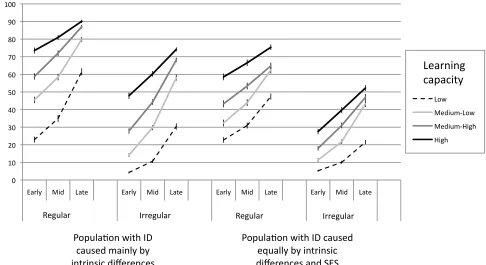
capacity compared to TD children (Rowe et al., 2009). Figure 2 shows
developmental trajectories from the Thomas et al. model for two populations,
each of 1000 simulated children. In one population, intrinsic factors were
primarily responsible for producing individual differences (i.e., children had very
different capacities to learn). In the other, intrinsic and extrinsic (SES) factors
were equally responsible. Networks were separated into groups according to
impact of task difficulty (the difference between regular and irregular verb
acquisition) was exaggerated in low learning capacity networks, per Stiles et al.
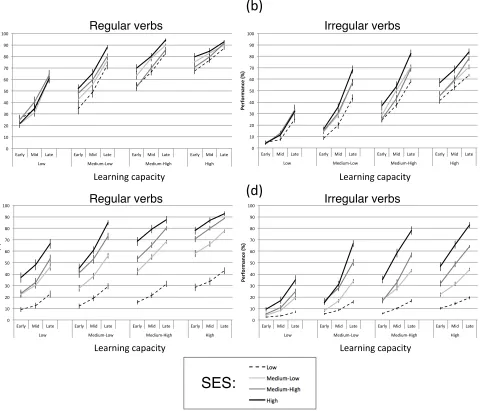
(2014). Figure 3 now splits the population according to SES. Panels (a) and (b)
show regular and irregular verb trajectories for the population with mainly
intrinsically caused individual differences, (c) and (d) for equally intrinsically
and extrinsically (SES) caused individual differences. Did low capacity
exaggerate the divergent effects of SES on trajectories? Yes, in three out of four
cases (b-‐d), most clearly for regular verbs in the equal intrinsic-‐extrinsic
population. Low capacity networks were increasingly impacted across
development by having poorer language input. Only when intrinsic sources of
variation were a strong limiting factor did this not occur, in Fig. 3(a).
We discuss the model here for four reasons. First, it illustrates the kind of
framework necessary to consider the relationship between individual
differences data and species universal development with respect to mechanism.
Second, it demonstrates that interactions of task difficulty, learning capacity, and
SES such as those reviewed by Goldin-‐Meadow can emerge from relatively
generic associative networks. Third, in the model, the advantage of regular verbs
over irregular verbs held in all the simulated conditions presented – this
‘resilient’ property wasn’t traceable to innate structures, it was a property of the
task; it just happened to be invariant over the conditions considered. The source
of resilient properties must therefore be interpreted with caution. Last, the
model shows the potential trap in too readily drawing inferences about species
universal mechanisms from individual differences data: Figure 3(a) indicates
that variations in the language environment associated with SES had little impact
were more important). One might conclude that the environment was not
important for language development based on individual differences. But in this
simulated population, species universal development was 100% experience-‐
dependent. Variations in development were mainly due to intrinsic factors.
Variation in gesture and communication beyond humans
Our third caution also concerns species universals. An important complementary
approach is to allow these universals to vary in comparative studies, thereby
providing a broader evolutionary context for communication. Recent data
suggest that comparative studies examining gesture and communication in
primates may offer a valuable insight into species universals in humans.
Due to their phylogenetic proximity to humans, great apes represent an
excellent proxy to investigate universals of human communication. The ape
model may reflect the ancestors of modern humans prior to the emergence of
language but after the emergence of left hemisphere dominant regions for
language processing (Cantalupo, Pilcher & Hopkins, 2003; Spocter et al., 2010).
Our shared evolutionary history of left cerebral dominance for motor
articulation of the hands and mouth may explain why, like humans, captive and
wild chimpanzees express population-‐level right hand biases for the production
of communicative gesture (e.g., Hopkins et al., 2005; Hobaiter & Byrne 2013).
Great apes are also frequently reported as right-‐handed tool users (e.g.,
Forrester, Quaresmini, Leavens, Mareschal & Thomas, 2013; Tabiowo &
Forrester, 2013). Moreover, right-‐hand dominant object manipulation sequences
have been likened to simple action syntax (e.g., Byrne & Byrne 1991). Thus,
organisation are likely to have origins in behaviours inherited from a last
common ancestor of humans and apes. This position is supported by
neurophysiological evidence: Broca’s area has been argued to be a left
hemisphere dominant supra-‐modal processor for routine, sequenced action that
was later adopted for behaviours that require action syntax (e.g., tool use) and
ultimately behaviours that require an internal syntax (e.g., language) (see,
Tettamanti & Weniger, 2006). Additional neurophysiological evidence
demonstrates: (1) shared neural correlates for language and tool use in Broca’s
area (Higuchi et al., 2009) and (2) that language practised through either speech
or gesture is controlled by the same motor regions (Gentilucci, Benuzzi, Gangitan
& Grimaldi, 2001). The exploration of the communicative predecessors to
human language via great ape models has the potential to inform about the
universal, phylogenetic properties of language and their neural correlates.
Great ape models further provide an opportunity to investigate resilient
properties of communication systems and their developmental trajectories by
manipulating the social environment. For obvious ethical reasons, we do not
manipulate children’s exposure to social engagement for scientific purposes.
However, investigations of non-‐human primate behaviour allow for the
exploration of cognitive outcomes associated with a range of different rearing
histories. For example, in typically developing children, pointing gestures
generally coincide with the production of first words (e.g., Bates & Snyder, 1987).
The general consensus from the literature is that apes do not comprehend the
pointing gestures of humans (e.g., Tomasello, 2006). However, recent meta-‐
analyses have revealed that cross-‐fostered apes (exposed to artificial languages
addition to a host of other communication processes thought to be unique to
humans (e.g., understanding the direction of attention in others) (Lyn, Russell &
Hopkins, 2010). Conversely, apes raised in communication-‐deprived
environments (e.g., biomedical institutions, reared in single cages) do not
develop these communicative capabilities. The ‘Lived Experiences’ model further
demonstrates that an ape’s ability to engage in joint attention (a foundational
component of human communication) can be significantly influenced by the
individual’s past engagement experiences (Bard et al., 2014). These findings
clearly demonstrate that even with the phylogenetic neural architecture intact,
exposure to culturally relevant stimuli is required to trigger the development
and acquisition of communication skills. There is no reason to believe that the
case would be any different for language acquisition during human development.
Lastly, investigations of ape communication development that allow for the
manipulation of the age at which a communication-‐rich environment is
introduced provide an additional powerful tool to offer further perspectives on
the resilient features of human language.
Studies of human language generally neglect the fact that animals use all
of their senses to send and receive information about the world (e.g., Darwin
1872). Investigations of child language development assume that intentional
communication is restricted to hand and mouth articulation, even though it is
widely accepted humans use a rich repertoire of verbal and nonverbal signals to
communicate. Like humans, great ape communication is embodied and
incorporates elements of posture, eye gaze, facial expression, direction of
attention, limb action and proximity to the communication recipient (Forrester,
reared in an environment devoid of language structure are likely to use
embodied communication skills in a structured manner to communicate intent,
beyond simply vocal or gestural methods. Perhaps we need to broaden our
definitions of ‘communication’ and ‘language’ to take into account the complex
multimodal nature of communicative behaviour. The investigation of modern
human cognitive function requires a dual perspective, as the evolution and
development of language functions are inextricably linked.
Acknowledgements
This work was supported by UK ESRC grant RES-‐062-‐23-‐2721.
References
Bard, K. A., Bakerman, R., Boysen, S. T., & Leavens, D. A. (2014). Emotional
engagements predict and enhance social cognition in young chimpanzees.
Developmental Science, 17(5), 682-‐696. doi: 10.1111/desc.12145
Bates, E., & Snyder, L. S. (1987). The cognitive hypothesis in language
development. In E. Ina, C. Uzgiris, & E. J. McVicker Hunt (Eds.), Infant
performance and experience: New findings with the ordinal scales (pp.
168–204). Urbana, IL, USA: University of Illinois Press.
Byrne, R. W., & Russon, A. E. (1998). Learning by imitation: a hierarchical
approach. Behavioral and Brain Sciences, 2, 667-‐721.
Cantalupo, C., Pilcher, D. L., & Hopkins, W. D. (2003). Are planum temporale and
sylvian fissure asymmetries directly correlated? A MRI study in great apes.
Darwin, C. (1872). The Expression of the Emotions in Man and Animals. 2nd
edition. New York: D. Appleton. http://dx.doi.org/10.5962/bhl.title.4820.
Forrester, G. S. (2008). A multidimensional approach to investigations of
behaviour: Revealing structure in animal communication signals. Animal
Behaviour, 76, 1749–1760. doi:10.1016/j.anbehav.2013.09.010.
Forrester, G. S., Quaresmini, C., Leavens, D. A., Mareschal, D., & Thomas, M. S. C.
(2013). Human handedness: An inherited evolutionary trait. Behavioural
Brain Research, 237, 200-‐6. doi: 10.1016/j.bbr.2012.09.037.
Gentilucci, M., Benuzzi, F., Gangitano, M., & Grimaldi, S. (2001). Grasp with hand
and mouth: A kinematic study on healthy subjects. Journal of
Neurophysiology, 86(4), 1685–1699.
Goldin-‐Meadow, S. (2015). Studying the mechanisms of language learning by
varying the learning environment and the learner. Language, Cognition and
Neuroscience. doi: 10.1080/23273798.2015.1016978.
Higuchi, S., Chaminadeb, T., Imamizua, H. & Kawatoa, M. (2009). Shared neural
correlates for language and tool use in Broca’s area. Neuroreport, 20, 1376-‐
1381. doi: 10.1097/WNR.0b013e3283315570.
Hobaiter, C., & Byrne, W. B. (2013). Laterality in the gestural communication of
wild chimpanzees. Annals of the New York Academy of Sciences, 1288, 9-‐16.
doi: 10.1111/nyas.12041
Hopkins, W. D., Russell, J., Freeman, H., Buehler, N., Reynolds, E. & Schapiro, S. J.
(2005). The Distribution and Development of Handedness for Manual
Gestures in Captive Chimpanzees (Pan troglodytes). Psychological Science,
Lyn, H., Russell, J. & Hopkins, W. (2010). The impact of environment on the
comprehension of declarative communication in apes. Psychological
Science, 21, 360-‐365. doi: 10.1177/0956797610362218.
Rowe, M. L., Levine, S.C., Fisher, J., & Goldin-‐Meadow, S. (2009). Does linguistic
input play the same role in language learning for children with and without
early brain injury? Developmental Psychology, 45, 90-‐102. doi:
10.1037/a0012848
Spocter, M. A., Hopkins, W. D., Garrison, A. R., Bauernfeind, A. L., Stimpson, C. D.,
Hof, P. R., et al. (2010). Wernicke’s area homologue in chimpanzees (Pan
troglodytes) and its relations to the appearance of modern human language.
Proceedings of the Royal Society B, 277, 2165–74. doi:
10.1098/rspb.2010.0011
Stiles, J., Reilly, J. S., Levine, S. C., Trauner, D., & Nass, R. D. (2014). Neural
plasticity and cognitive development: Insights from children with perinatal
brain injury. Oxford University Press, in press.
Tabiowo, E. & Forrester, G. S. (2013). Structured bimanual actions and hand
transfers reveal population-‐level right-‐handedness in captive gorillas.
Animal Behaviour, 68, 1049-‐1057. doi:10.1016/j.anbehav.2013.09.010.
Tettamanti, M. & Weniger, D. (2006). Broca’s area: a supramodal hierarchical
processor? Cortex, 42, 491-‐494. doi:10.1016/S0010-‐9452(08)70384-‐8.
Thomas, M. S. C. & Karmiloff-‐Smith, A. (2002). Are developmental disorders like
cases of adult brain damage? Implications from connectionist modelling.
Behavioral and Brain Sciences, 25(6), 727-‐788. doi:
Thomas, M. S. C, Forrester, N. A., & Ronald, A. (2013). Modeling socio-‐economic
status effects on language development. Developmental Psychology, 49(12),
2325-‐43. doi: 10.1037/a0032301
Tomasello, M. (2006). Why Don’t Apes Point? In N. J. Enfield & S. C. Levinson
(eds.), Roots of Human Sociality: Culture, Cognition and Interaction. Oxford
& New York: Berg, pp. 506-‐524.
Figure captions
Figure 1: A schematic of the (possible) relative use of oral communication,
gesture communication, and shared context to achieve transmission of a
message in typical development, homesign, and sign language. The thickness of
each arrow represents the extent to which each source of information is utilised.
The use of hand signs is not directly comparable across conditions because each
case represents a re-‐weighting of channels.
Figure 2: Simulated data from a population-‐level model of past tense acquisition
designed to capture interactions between the effects of socio-‐economic status
(SES) and learning ability on developmental trajectories. Data are shown for two
simulated populations, one in which individual differences (ID) are mainly
caused by intrinsic variations in learning ability, one in which intrinsic and
extrinsic (SES) variations are equally responsible for producing individual
differences. Trajectories across three points in development (early, mid, late) are
split by learning capacity, with around 250 simulated individuals per group. For
both populations, the difficulty of acquiring irregular versus regular verbs is
exaggerated by low learning capacity.
Figure 3: Simulated trajectories from the population modelling, split by
difference socio-‐economic status levels. (a) Trajectories for the population in
which intrinsic variations in learning ability are mainly responsible for
population in which intrinsic and extrinsic (SES) variations are equally
responsible for producing individual differences, for (c) regular and (d) irregular
verbs. (b) to (d) all show that SES differences cause divergent trajectories for low
learning capacity networks.
Figures
Figure 1
Speaker' Listener'
Oral' Hands' Shared' context'
Speaker' Listener'
Oral' Hands' Shared' context'
Speaker' Listener'
Oral' Hands' Shared' context'
Figure 2 0" 10" 20" 30" 40" 50" 60" 70" 80" 90" 100"
Early" Mid" Late" Early" Mid" Late" Early" Mid" Late" Early" Mid" Late"
Low" Medium;Low" Medium;High" High"
Pe rf or m an ce *(%) * Verb*type*per*popula5on* Low" Medium;Low" Medium;High" High" Learning( capacity(
Regular( Irregular(( Regular( Irregular((
[image:19.595.70.556.140.405.2]Figure 3 0" 10" 20" 30" 40" 50" 60" 70" 80" 90" 100"
Early" Mid" Late" Early" Mid" Late" Early" Mid" Late" Early" Mid" Late" Low" Medium;Low" Medium;High" High"
Pe rf or m an ce *(%) * Ability* Low" Medium;Low" Medium;High" High" 0" 10" 20" 30" 40" 50" 60" 70" 80" 90" 100"
Early" Mid" Late" Early" Mid" Late" Early" Mid" Late" Early" Mid" Late"
Low" Medium;Low" Medium;High" High"
Pe rf or m an ce *(%) * Ability* Low" Medium;Low" Medium;High" High" 0" 10" 20" 30" 40" 50" 60" 70" 80" 90" 100"
Early" Mid" Late" Early" Mid" Late" Early" Mid" Late" Early" Mid" Late"
Low" Medium;Low" Medium;High" High"
Pe rf or m an ce *(%) * Ability* Low" Medium;Low" Medium;High" High" 0" 10" 20" 30" 40" 50" 60" 70" 80" 90" 100"
Early" Mid" Late" Early" Mid" Late" Early" Mid" Late" Early" Mid" Late" Low" Medium;Low" Medium;High" High"
Pe rf or m an ce *(%) * Ability* Low" Medium;Low" Medium;High" High"
SES:
!
Learning(capacity( Learning(capacity( Learning(capacity( Learning(capacity((a)(
(b)(
(c)(
(d)(
Regular verbs! Irregular verbs!
[image:20.595.39.519.133.544.2]