BIROn - Birkbeck Institutional Research Online
Filippetti, Maria Laura and Johnson, Mark H. and Lloyd-Fox, Sarah and
Dragovic, D. and Farroni, T. (2013) Body perception in newborns. Current
Biology 23 (23), pp. 2413-2416. ISSN 0960-9822.
Downloaded from:
Usage Guidelines:
Please refer to usage guidelines at
or alternatively
Body Perception in Newborns
Maria Laura Filippetti,
1,*
Mark H. Johnson,
1Sarah Lloyd-Fox,
1Danica Dragovic,
2and Teresa Farroni
31
Centre for Brain and Cognitive Development, Birkbeck
College, University of London, London WC1E 7HX, UK
2Department of Pediatric Unit, Hospital of Monfalcone,
Gorizia 34074, Italy
3
Dipartimento di Psicologia dello Sviluppo e della
Socializzazione, University of Padua, Padua 35131, Italy
Summary
Body ownership and awareness has recently become an
active topic of research in adults using paradigms such as
the ‘‘rubber hand illusion’’ and ‘‘enfacement’’ [
1–11
]. These
studies show that visual, tactile, postural, and anatomical
information all contribute to the sense of body ownership
in adults [
12
]. While some hypothesize body perception
from birth [
13
], others have speculated on the importance
of postnatal experience [
14, 15
]. Through studying body
perception in newborns, we can directly investigate the
factors involved prior to significant postnatal experience.
To address this issue, we measured the looking behavior
of newborns presented with visual-tactile synchronous
and asynchronous cues, under conditions in which the
visual information was either an upright (body-related
stim-ulus; experiment 1) or inverted (non-body-related stimstim-ulus;
experiment 2) infant face. We found that newborns preferred
to look at the synchronous condition compared to the
asyn-chronous condition, but only when the visual stimulus was
body related. These results are in line with findings from
adults and demonstrate that human newborns detect
inter-sensory synchrony when related to their own bodies,
consistent with the basic processes underlying body
perception being present at birth.
Results and Discussion
Studies investigating body ownership and awareness in adults
have highlighted the importance of the temporal synchrony
and spatial congruency of sensory stimuli [
12
], in addition to
body morphology and anatomical posture [
4, 5, 10, 16
]. These
studies show that body-related cues, here defined as
informa-tion attributable to the current posiinforma-tion of one’s own body, are
fundamental for body perception. Despite several studies on
infants that have shown the important role of proprioception
(where movements are self-produced) and multisensory
inte-gration in the development of body awareness during infancy
[
17–20
], to our knowledge, only one study has investigated the
role of body-related synchrony detection during infancy solely
based on afferent information [
21
]. However, it remains
un-known whether these factors play a role from birth or whether
the detection of body-related intermodal synchrony develops
gradually with experience throughout infancy. We addressed
this issue and hypothesized that, in the absence of any visual
feedback from self-generated movements, newborns would
show a preference (as measured by longer looking) to a
syn-chronous visual-tactile condition when viewing a video of an
upright infant face as compared to an asynchronous,
tempo-rally delayed condition (experiment 1). Furthermore, we
pre-dicted that this increased attention to intersensory synchrony
would not be present in the context of a visual stimulus that
did not resemble themselves (the same infant face video, but
inverted; experiment 2). By inverting the visual stimulus, we
reduced the likelihood that the newborns would relate it to
their own bodies [
12, 18, 21
]. In other words, rather than a
gen-eral preference for synchrony of observed and felt actions,
newborns would prefer this perfect matching only in the
context of stimuli that are related to their own bodies (see an
example of the experimental paradigm in
Figure 1
).
The data from the two experiments were analyzed with a
two-way mixed ANOVA, with visual-tactile stimulation
(syn-chronous versus asyn(syn-chronous) as a within-subject factor
and type of video (upright versus inverted) as a
between-sub-ject factor. The analysis showed that while there were no
sig-nificant main effects of inversion [F(1,38) = 0.48, p = 0.49] or
synchrony [F(1,38) = 1.79, p = 0.19], the predicted interaction
effect was significant [F(1,38) = 8.29, p = 0.007,
r
= 0.80],
indi-cating that the looking time during the synchronous and
asynchronous conditions differed according to whether the
video was upright or inverted (see
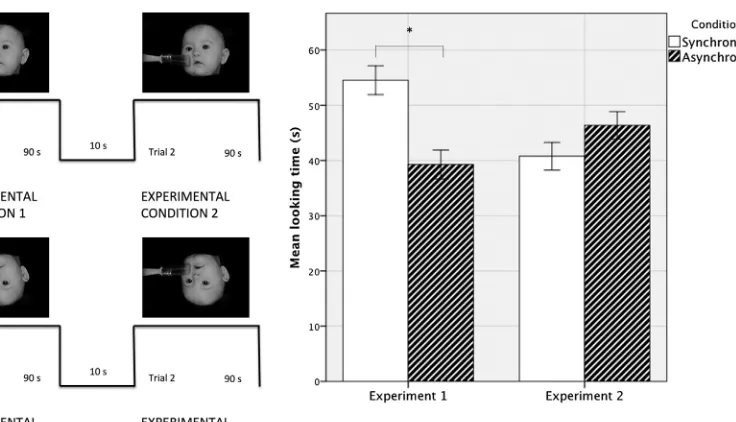
Figure 2
). To investigate
this interaction further, we performed two separate
paired-sample t tests. The results of experiment 1 showed that there
was a significant difference between the synchronous (mean =
54.54, SE = 3.66) and asynchronous (mean = 39.28, SE = 5.04)
conditions [
t
(19) = 2.92, p = 0.009]. The results of experiment 2,
in which newborns were presented with synchronous and
asynchronous visual-tactile stimulation while they watched
the inverted face video, showed no significant difference
between the two conditions [synchronous condition, mean =
40.77, SE = 4.02; asynchronous condition, M = 46.36, SE =
4.18;
t
(19) =
2
1.12, p = 0.30; see
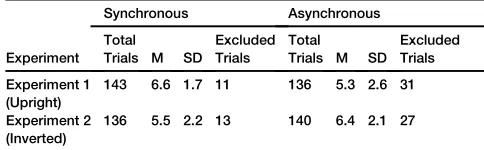
Table 1
for additional
analyses]. Several studies on human newborns (for a review,
see [
22
]) have shown that they respond differentially to viewing
upright, as compared to inverted, face-like stimuli. Results of
the present study confirm the importance of the upright face
for the detection of synchronous intersensory information.
There was no effect of order of presentation of the conditions
in either experiment [experiment 1, F(1,18) = 1.62, p = 0.22;
experiment 2, F(1,18) = 2.52, p = 0.13].
The results of experiment 1 could be interpreted as a
prefer-ence for redundant sensory information and are in line with
previous studies demonstrating that newborns are able to
integrate intersensory stimulation [
23, 24
]. Our finding is also
consistent with the intersensory redundancy hypothesis
(IRH), which highlights the importance of amodal information,
such as temporal synchrony, for early perceptual development
and learning [
25, 26
]. However, our results go beyond this
conclusion as we show a preference for visual-tactile temporal
synchrony only when the visual stimulus presented is relevant
to the infant’s own body. Since we did not use live video of the
watching infant herself, we are able to rule out the contingent
visual feedback from the viewing infant’s own self-performed
actions. These findings are in accord with previous studies in
older infants and adults, in which it has been shown that the
*Correspondence:[email protected]
illusion of owning a specific body part occurs only when the
fake limb matches the physical and morphological features
of the real one [
10, 18, 21
].
To our knowledge, only one other study has investigated the
role of body-related synchrony detection during infancy in the
absence of any efferent information [
21
]. These authors
demonstrated that, when presented with a video display of
life-like baby doll legs, infants aged 7 and 10 months
discrim-inate between contingent and noncontingent visual-tactile
information. Importantly, because the infants were watching
baby doll legs and could not control the visual feedback of
their movements, they demonstrated the ability to discriminate
contingency independently from movements of their own
bodies [
21
]. Furthermore, the authors observed that this
pref-erence disappears when 10-month-old infants are presented
with nonbody objects (i.e., wooden blocks), showing that
morphological similarities between the stimulus and their
own bodies are important in the detection of visual-tactile
con-tingency at this age [
21
]. In the present experiments, we tested
the role of body-related stimuli with newborns, finding that
from the first days of life, infants can detect intersensory
syn-chrony when related to their own bodies. Previous studies on
infants showed that 3 s delay is sufficient for 3-month-old
infants to differentiate between synchrony and asynchrony
[
27, 28
]. We now provide evidence that newborns can
discrim-inate between synchrony and asynchrony when presented
with 5 s delay.
We do not know whether the newborns in our studies
attrib-uted the upright dynamic face seen on the screen as directly
belonging to their own bodies. However, our findings are in
line with research on self-identification in adults [
12
]. Studies
on ‘‘enfacement’’ in adults show that seeing another person’s
face being touched synchronously with one’s own face evokes
a change in self-face recognition, whereby the other face
becomes incorporated to some extent into the representation
of one’s own face [
9
]. In these studies, the ‘‘other’’ becomes
included in the mental representation of one’s own face as
a consequence of viewing a perfect matching between the
seen and felt sensory stimulation in the context of watching
the other person’s face. In order to maintain a coherent
and updated sense of one’s body, the internal body model
and the new, external information provided are compared
together, and irrelevant or incongruent information is
dis-carded [
29
].
To our knowledge, this is the first study to investigate
visual-tactile stimulation of faces in infants, solely based on afferent
information. Legerstee et al. [
30
] showed that 5- and
8-month-old infants look longer at video of their own faces
compared to those of peers and dolls, but only when it is
mov-ing (live video feed). This highlights the importance of
self-generated movement by means of a matching between their
executed actions and the visual feedback. In the present
research, because the matching between seen and felt touch
was the only congruent information that the newborns could
rely on, we demonstrated that perception of visual-tactile
syn-chrony may be important for differentiating between self and
other in the absence of any self-generated movement.
[image:3.603.56.303.76.309.2]In the current study, we specifically investigated the role
of temporal synchrony in multisensory integration. In future
work, it will be important to examine the role of bodily location
Figure 1. Experimental Design
[image:3.603.164.532.79.290.2]An example of the video stimuli used in the study. Experiment 1: visual-tactile synchronous compared to visual-visual-tactile asynchronous stimulation using body-related information (a dynamic upright infant face). Experiment 2: visual-tactile synchronous compared to visual-tactile asynchronous stim-ulation using non-body-related information (a dynamic inverted infant face). In the synchronous condition, the newborn was touched on the cheek with a paintbrush on the specularly congruent location, and the strokes perfectly matched (e.g., temporally and spatially) the brush stroke on the infant’s cor-responding cheek displayed on the screen. In the asynchronous condition, the newborn was again touched on the cheek, but the tactile stimulation was delayed with regard to the brush stroke displayed on the screen by 5 s. An experimenter who stood behind the infant to prevent them from being distracted delivered stroking manually. Each stroke lasted approximately 1 s and started on the middle of cheek and ended at the beginning of the ear. In experiment 2, the newborns were presented with the same videos as in experiment 1, but this time the image was inverted using video-editing software (Adobe Premiere Pro CS6) to rotate the video by 180. In order to counterbalance the side of the stroke and still keep constant the spatial con-gruency between touched and observed cheek, we used mirrored versions of the videos in both experiments.
Figure 2. Looking Time Results
Mean and SE of looking times to the synchronous and asynchronous stimuli in experiments 1 and 2. Only in experiment 1 was an effect of synchrony observed.
Current BiologyVol 23 No 23
2
as a constraint on intermodal perception. We know from
research with adults that a rubber hand located in an
incon-gruent anatomical and postural position reduces the illusion
of owning that hand [
12
]. It is worth investigating whether a
change in the bodily location of the touch compared to that
observed on the video would eliminate the preference for
visual-tactile temporal synchrony in newborns. This would
strengthen the view that bottom-up sensory information and
top-down cues related to one’s own body are present at birth
and together help the newborn to form a reliable percept of
her own body across development. Future work could also
examine the extent to which attention to particular visual
fea-tures is critical for the effect we have observed.
The current findings have important implications for our
un-derstanding of the development of body awareness. In accord
with the infancy literature on the development of body
awareness [
15, 17
], we propose that intermodal detection of
synchrony provides important information allowing infants to
differentiate the self from others and to form a coherent
repre-sentation of their own bodies. Our results provide the first
evidence of body-related visual-tactile temporal synchrony
detection in newborns.
Experimental Procedures
Participants
The study was conducted at the Pediatric Unit of the Hospital of Monfal-cone. Forty newborns (20 female; ten in experiment 1 and ten in experi-ment 2) from 12 to 103 hr of age at time of test took part in the study; 20 additional newborns also participated but were excluded due to fussiness (ten), low intercoder reliability (four), or equipment failure (six). All the new-borns that completed the study met the screening criteria of normal deliv-ery, had a birth weight of more than 2,500 g, and had an Apgar score of at least 8 at 5 min. No abnormalities were present at birth.
The 20 newborns that participated in experiment 1 had a mean age of 45.2 hr (SD = 19.8), with a mean gestational age of 39.7 weeks (SD = 1.53). The 20 newborns that participated in experiment 2 had a mean age of 49.8 hr (SD = 26.89), with a mean gestational age of 39.3 weeks (SD = 1.03). The testing took place when the baby was awake and alert, usually during the hour preceding the feeding time. Parents were informed about the procedure and gave their consent to their child’s participation. The local ethics committee approved the study protocol.
Apparatus and Stimuli
The newborns sat on the experimenter’s lap in a research room within the hospital. The distance between the monitor (size 27 in or 69 cm) and the newborn’s head was approximately 30 cm [31, 32]. The newborn’s eye level was aligned to the center of the screen. A video camera was placed on the
top of the screen and filmed the infant’s eyes, allowing the experimenter to monitor his/her eye movements.
The visual stimuli in all the experiments consisted of two identical—previ-ously recorded—videos, one displayed on the left of the screen and one on the right to ensure that newborns’ attention was engaged and to avoid sticky fixation (though it is important to bear in mind that the use of the same face shown side by side during the experimental session may have affected the behavior of the infants, potentially preventing them from relating their faces to one of the two stimuli).
In both experiments, these videos presented a 5-month-old infant face being stroked with a paintbrush every 10 s from a specular point of view, just as the neonate watching the screen would see her face being touched in front of a mirror. Therefore, in both experiments, the viewing newborn’s side of the stroke was always spatially congruent with the side of the face seen stroked on the screen. The two identical faces subtended a visual angle of 18.4321.4each, and together the two experimental stimuli subtended a visual angle of 18.4358.4. In all of the stimuli, the pupil was 1 cm in diameter and the pairs of faces were 13.3 cm apart. The stimuli were presented using E-Prime 2.0.10. A prerecorded unfamiliar infant face was chosen because we assumed that newborns from 12 to 103 hr have no experience of their own specular images in a mirror, and so don’t know the invariant features of their own faces.
The two different conditions investigated in each of the two experiments are illustrated inFigure 1.
Procedure
Once the newborn was seated and fixated upon the center of the screen, the experiment began. One synchronous and one asynchronous trial were presented to each newborn. The order of presentation of the two trials and the cheek on which the infant was stroked were counterbalanced across infants. Each trial lasted 90 s, interleaved with a 10 s rest period (blank screen). Directly before the rest period, a flashing icon was presented to maintain the newborn’s attention.
Each trial was divided into eight segments (10 s each), where a segment started from the first frame in which the paintbrush touched the infant cheek to the first frame in which the next paintbrush appeared on the screen. The first stroke was presented after 3 s of stimulus presentation, followed by 10 s of video before the next stroke was presented, and so on. Within a 90 s trial, there were eight strokes in total. Therefore, each stroke was presented on the screen approximately every 10 s and, depending on the condition, was either synchronous with the touch delivered on the newborn’s face or mismatched and presented with a lag of 5 s relative to the touch. Based on the video recordings, two independent observers coded how long each newborn looked at the monitor (the second observer was naive to the hypothesis) and total looking time was measured for each trial. The anal-ysis was conducted by comparing the looking time values of the two coders. Two interrater reliability analyses were performed: Pearson’s r correlation analysis and Cohen’s kappa reliability analysis. The Pearson’s r correlation was performed on the total sample and wasr= 0.96 for experiment 1 and r= 0.83 for experiment 2. Cohen’s kappa analysis was performed for 20% of the sample of each experiment, revealing scores of k = 0.73 for experi-ment 1 and = 0.74 for experiexperi-ment 2.
[image:4.603.54.296.109.184.2]Despite having chosen a 90 s trial length for each experimental condition, we decided to take into account the effective interest of the infant by applying an offline infant-control procedure, allowing us to measure the actual fixation time. Therefore, when the infant looked away for over 10 s, the remaining section was discarded from the looking time analysis (see Table 1). Furthermore, if the newborn did not see the brush touching the in-fant’s face, the 10 s segment that included this brush stroke was excluded from further analyses [note that the final results remain the same if looking time during the segments where the newborn did not see the brush is also included in the analyses;t(19) = 3.05, p = 0.007 for experiment 1; synchro-nous condition, mean = 59.30, SE = 3.54; asynchrosynchro-nous condition, mean = 44.29, SE = 4.93;t(19) =20.82, p = 0.42, for experiment 2; synchronous con-dition, mean = 45.38, SE = 4.25; asynchronous concon-dition, mean = 49.35, SE = 4.01]. This exclusion criterion was applied in order to be confident that the synchronicity of the visual and tactile information was perceived by the newborn. Indeed, we assumed that if the infant did not see the brush on the screen, the integration of the sensory information did not occur.
Acknowledgments
This work was supported by the EC Marie Curie Initial Training Networks (MC-ITN-264301 TRACKDEV to M.L.F.). M.H.J. and S.L.F. are supported Table 1. Number and Distribution of Trials for which Data Were Discarded
Using an Offline Infant-Control Procedure
Experiment
Synchronous Asynchronous
Total Trials M SD
Excluded Trials
Total Trials M SD
Excluded Trials
Experiment 1 (Upright)
143 6.6 1.7 11 136 5.3 2.6 31
Experiment 2 (Inverted)
136 5.5 2.2 13 140 6.4 2.1 27
by the UK Medical Research Council (G0701484). T.F. is supported by the Wellcome Trust (073985/Z/03/Z) and University of Padua. The authors thank the parents and infants who participated in the study and Giulia Orioli for help in testing the infants. Furthermore, the authors are deeply indebted to the nursing staff for their collaboration.
Received: July 10, 2013 Revised: September 6, 2013 Accepted: October 8, 2013 Published: November 21, 2013
References
1. Apps, M.A., Tajadura-Jime´nez, A., Turley, G., and Tsakiris, M. (2012). The different faces of one’s self: an fMRI study into the recognition of current and past self-facial appearances. Neuroimage63, 1720–1729. 2. Botvinick, M., and Cohen, J. (1998). Rubber hands ‘feel’ touch that eyes
see. Nature391, 756.
3. Ehrsson, H.H., Holmes, N.P., and Passingham, R.E. (2005). Touching a rubber hand: feeling of body ownership is associated with activity in multisensory brain areas. J. Neurosci.25, 10564–10573.
4. Guterstam, A., Petkova, V.I., and Ehrsson, H.H. (2011). The illusion of owning a third arm. PLoS ONE6, e17208.
5. Kalckert, A., and Ehrsson, H.H. (2012). Moving a rubber hand that feels like your own: a dissociation of ownership and agency. Front. Hum. Neurosci.6, 40.
6. Makin, T.R., Holmes, N.P., and Ehrsson, H.H. (2008). On the other hand: dummy hands and peripersonal space. Behav. Brain Res.191, 1–10. 7. Sforza, A., Bufalari, I., Haggard, P., and Aglioti, S.M. (2010). My face in
yours: visuo-tactile facial stimulation influences sense of identity. Soc. Neurosci.5, 148–162.
8. Tajadura-Jime´nez, A., Grehl, S., and Tsakiris, M. (2012). The other in me: interpersonal multisensory stimulation changes the mental representa-tion of the self. PLoS ONE7, e40682.
9. Tajadura-Jime´nez, A., Longo, M.R., Coleman, R., and Tsakiris, M. (2012). The person in the mirror: using the enfacement illusion to inves-tigate the experiential structure of self-identification. Conscious. Cogn. 21, 1725–1738.
10. Tsakiris, M., and Haggard, P. (2005). The rubber hand illusion revisited: visuotactile integration and self-attribution. J. Exp. Psychol. Hum. Percept. Perform.31, 80–91.
11. Tsakiris, M. (2008). Looking for myself: current multisensory input alters self-face recognition. PLoS ONE3, e4040.
12. Tsakiris, M. (2010). My body in the brain: a neurocognitive model of body-ownership. Neuropsychologia48, 703–712.
13. Neisser, U. (1991). Two perceptually given aspects of the self and their development. Dev. Rev.11, 197–209.
14. Rochat, P. (2009). Others in Mind: Social Origins of Self-Consciousness (New York: Cambridge University Press).
15. Striano, T., and Rochat, P. (2000). Perceived self in infancy. Infant Behav. Dev.23, 513–530.
16. Longo, M.R., Schu¨u¨r, F., Kammers, M.P.M., Tsakiris, M., and Haggard, P. (2009). Self awareness and the body image. Acta Psychol. (Amst.) 132, 166–172.
17. Bahrick, L.E., and Watson, J.S. (1985). Detection of intermodal proprio-ceptive–visual contingency as a potential basis of self-perception in infancy. Dev. Psychol.21, 963–973.
18. Rochat, P., and Morgan, R. (1995). Spatial determinants in the percep-tion of self-produced leg movements in 3-to 5-month-old infants. Dev. Psychol.31, 626–636.
19. Schmuckler, M.A. (1996). Visual–proprioceptive intermodal perception in infancy. Infant Behav. Dev.19, 221–232.
20. Watson, J.S. (1994). Detection of self: the perfect algorithm. In Self-Awareness in Animals and Humans: Developmental Perspectives, S.T. Parker, R.W. Mitchell, and M.L. Boccia, eds. (New York: Cambridge University Press), pp. 131–148.
21. Zmyj, N., Jank, J., Schu¨tz-Bosbach, S., and Daum, M.M. (2011). Detection of visual-tactile contingency in the first year after birth. Cognition120, 82–89.
22. Johnson, M.H. (2005). Subcortical face processing. Nat. Rev. Neurosci. 6, 766–774.
23. Lewkowicz, D.J., and Ghazanfar, A.A. (2009). The emergence of multi-sensory systems through perceptual narrowing. Trends Cogn. Sci.13, 470–478.
24. Lewkowicz, D.J., Leo, I., and Simion, F. (2010). Intersensory perception at birth: newborns match nonhuman primate faces and voices. Infancy 15, 46–60.
25. Bahrick, L.E., and Lickliter, R. (2000). Intersensory redundancy guides attentional selectivity and perceptual learning in infancy. Dev. Psychol.36, 190–201.
26. Bahrick, L.E., and Lickliter, R. (2012). The role of intersensory redun-dancy in early perceptual, cognitive, and social development. In Multisensory Development, A. Bremner, D.J. Lewkowicz, and C. Spence, eds. (Oxford: Oxford University Press), pp. 183–205. 27. Gergely, G., and Watson, J. (1999). Early socio-emotional development:
contingency perception and the social-biofeedback model. In Early Social Cognition, P. Rochat, ed. (Mahwah: Lawrence Erlbaum Associates Publishers), pp. 101–136.
28. Zmyj, N., Hauf, P., and Striano, T. (2009). Discrimination between real-time and delayed visual feedback of self-performed leg movements in the first year of life. Cogn. Brain Behav.XIII, 479–489.
29. Tsakiris, M., Costantini, M., and Haggard, P. (2008). The role of the right temporo-parietal junction in maintaining a coherent sense of one’s body. Neuropsychologia46, 3014–3018.
30. Legerstee, M., Anderson, D., and Schaffer, A. (1998). Five- and eight-month-old infants recognize their faces and voices as familiar and social stimuli. Child Dev.69, 37–50.
31. Fantz, R.L., Ordy, J.M., and Udelf, M.S. (1962). Maturation of pattern vision in infants during the first six months. J. Comp. Physiol. Psychol. 55, 907–917.
32. Slater, A., Earle, D.C., Morison, V., and Rose, D. (1985). Pattern prefer-ences at birth and their interaction with habituation-induced novelty preferences. J. Exp. Child Psychol.39, 37–54.
Current BiologyVol 23 No 23
4