Performance Evaluation of ODMRP and ADMR
using Different Mobility Models
K. Kavitha
Department of Computer Science & Engg Annamalai University, Annamalai Nagar
Tamil Nadu
K.Selvakumar
Department of Computer Science & Engg Annamalai University, Annamalai Nagar
Tamil Nadu
ABSTRACT
A Mobile ad hoc network (MANET) is a collection of wire-less mobile nodes forming a temporary network without using any existing infrastructure. Mobile Ad-Hoc is a dynamic, multi-hop and autonomous networks composed by wireless mobile nodes. MANETS are subject to rapid and unpredicta-ble changes. MANETS are inexpensive wireless communica-tion network. The mobility model represents the realistic be-havior of each mobile node in the MANET. Routing Protocol for Ad-Hoc networks are typically evaluated using simula-tions. In this paper, we compare the performance of On-Demand Multicast Routing Protocol (ODMRP) with the Adaptive demand driven Multicast Routing Protocol (ADMR) under different mobility models such as Random Way Point Model, Manhattan Model and Random Drunken Model. Using these models, performance metrics such as Packet Delivery Ratio, End-to-End Delay and Control Overhead are evaluated. ODMRP dynamically builds the route and manages the group membership. In ADMR, Multicast routing state is dynamically established and maintained only for active groups and only in nodes located between multicast senders and receivers. ADMR detects the high mobility without the use of GPS or other posi-tioning system. The simulation result shows that the through-put of ADMR is higher than of ODMR at high mobility and ODMR is high at low mobility. End to end delay and control over head of ADMR is higher than ODMR.
Keywords
MANET, ODMRP, ADMR, Random Way Point model, Ran-dom Drunken model, Manhattan model.
1. INTRODUCTION
Ad hoc networks are dynamically created and maintained by the individual nodes comprising the network. They do not require a pre-existing architecture for communication purpos-es and do not rely on any type of wired infrastructure. In an ad hoc network all communication occurs through a wireless media. With current technology and the increasing popularity of notebook computers, interest in ad hoc networks has greatly peaked.
MANET is a kind of wireless ad-hoc network, and is a self-configuring network of mobile routers (and associated hosts) connected by wireless links[1]. The topology of mobile ad-hoc networks is arbitrary. In MANET, the routers are free to move randomly and organize themselves arbitrarily and un-predictably. MANETs require no fixed infrastructure or cen-tral administration. Mobile nodes in an ad hoc network will work not only as hosts but also as routers, and communicate with each other via packet radios.
MANET can be used in personal area networking such as cellular phone and laptop, emergency operations such as dis-aster relief, civilian environments such as meeting rooms and sports stadiums, military environments such as soldiers, tanks
and planes. It is also used in audio and video streaming or whiteboard which requires the ability to transmit data to a group of receivers.
Multicasting is the transmission of datagrams to a group of hosts identified by a single destination address and hence is intended for group-oriented computing. Multicasting can effi-ciently support a variety of applications that are characterized by collaborative efforts and data transmission. Multicasting techniques can be considered as an efficient way to deliver packets from the source to any number of client nodes [2]. Numerous multicast protocols have been proposed for mul-ticast in MANETs. These include traditional tree-based or mesh-based protocols such as MAODV, ADMR and OD-MRP. Some multicast protocols use an overlay based ap-proach such as AM Route and PAST-DM [3]. The routing protocols selected for the present evaluation study include Adaptive Demand-Driven Multicast Routing(ADMR) and On-Demand Multicast Routing Protocol (ODMRP). We chose to compare ADMR and ODMRP because they have been well-documented and have been shown to perform well [4].
nodes movements, since, at each intersection, a node chooses to keep moving in the same direction [1]. In this paper, we are analyzing ODMRP and ADMR protocols by using different mobility models such as Random Way Point model, Manhat-tan model and Random drunken mobility model to measure the performance metrics such as throughput, delay and control overhead[10][11][12].
2. MULTICAST ROUTING PROTOCOLS
Multicasting is a basic one to many communication way. A multicast group contains a special host which is responsible for transmitting data packets to the other hosts in the same group [3].In MANET, multicasting can efficiently support a variety of applications that are characterized by close collabo-rative efforts. Multicast can reduce the communication costs, link bandwidth consumption, sender and router processing and delivery delay. In addition, it can provide a simple and robust communication mechanism when the receiver’s indi-vidual addresses are unknown or changeable. Multicast rout-ing protocols for ad hoc networks have been proposed in order to save the network bandwidth and node resource because they are the protocols for powerful communication used in multi-hop applications, and are more efficient than the ap-proach of sending the same information from the source to each of the receivers individually.Multicast protocols proposed for MANET can be broadly classified into two categories, namely tree based multicast and mesh-based multicast. A tree based multicast routing protocol establishes and maintains either a shared multicast routing tree or multiple source-based multicast routing trees to deliver data packets from sources to receivers of a group. In an ad hoc wireless network, nodes may move freely within the field. For a pair of nodes to communicate route must be formed between intermediate nodes. For this type of network, it is very im-portant to model nodes, positions and movement, as transmit-ting range is generally small when compared to the size of the field. Multicast plays an important role in ad hoc networks. Various multicast protocols have been newly proposed to perform multicasting in Ad hoc Networks such as ODMRP, Core Assisted Mesh Protocol (CAMP), Ad Hoc Multicast Routing (AMRoute).
3. MOBILITY MODELS
Dynamic topology changes in wireless multi-hop network will cause lower network connectivity and/or lower network per-formance. To capture the nature of mobility of nodes in a mobile ad hoc network (MANET), different mobility models have been proposed. The mobility models used in simulations can be roughly divided into two categories: independent entity models and group-based models. In the independent entity models, the movement of each node is modeled independently of any other nodes in the simulation. In the group mobility models, there is some relationship among the nodes and their movements throughout the cells or field. In order to thorough-ly simulate a new protocol for an ad hoc network, it is im-perative to use a mobility model that accurately represents the mobile nodes that will eventually utilize the given protocol. Only in this scenario it is possible to determine whether or not the proposed protocol will be useful when being implemented mobility model should attempt to mimic the movements of real mobile nodes. Changes in speed and direction must occur in a reasonable manner. We choose models from different classes of motion, including random, path-based, and group based movements.
Mobility models can be differentiated according to their spa-tial and temporal dependencies. Spaspa-tial dependency is a measure of how two nodes are dependent in their motion. If two nodes are moving in the same direction then they have high spatial dependency. Temporal dependency is a measure of how the present velocity (magnitude and direction) is relat-ed to previous velocity. Nodes having the same velocity have high temporal dependency.
Movements of mobile nodes considered in this class are com-pletely uncorrelated. Each mobile node follows an individual independent mobility scenario. Random Waypoint, Manhattan and Random Drunken model belong to this class.
[image:2.595.316.532.268.388.2]3.1. Random Way Point (RWP) Model
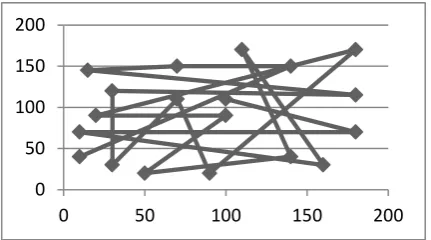
The Random Waypoint Mobility model includes pause times between changes in direction and/or speed. A mobile node begins by staying in one location for a certain period of time [5].Fig 1: Traveling pattern of mobile node using Random Waypoint Mobility Model
Once the time expires, each node chooses a random destina-tion in the simuladestina-tion area and moves towards it with a ran-dom velocity. The mobile node then travel towards the newly chosen destination at the selected speed. Upon arrival, the mobile node pauses for a specific time period before starting the process again.
Figure 1 shows an example traveling pattern of a mobile node using Random Waypoint Mobility Model starting at a ran-domly chosen position, the speed of the mobile node in the figure is uniformly chosen between 0 and 10 m/s. In most of the performance study that use the Random Waypoint Mobili-ty Model, the mobile nodes are initially distributed randomly around the simulation area. When the simulation starts, each mobile node randomly selects one location in the simulation field as the destination.
The mobile nodes then travel towards this destination with constant velocity chosen uniformly and randomly from [0, Vmax], where the parameter Vmax is the maximum allowable velocity for every mobile node. The velocity and direction of a node are chosen independently of other nodes. Upon reaching the destination, the node stops for a duration defined by the 'pause time' parameter Te. If Te=0, this leads to continuous mobility. After this duration, it again chooses another random destination in the simulation field and moves towards it. The whole process is repeated again and again until the simulation ends.
In the Random Waypoint model, Vmax and Tpause are the two key parameters that determine the mobility behavior of
0 50 100 150 200
and the pause time Te is small, the topology is expected to be highly dynamic1. Varying these two parameters, especially the Vmax parameter, the Random Waypoint model can generate various mobility scenarios with different levels of nodal speed.
This mobility model shows that there is high variability in average mobile node neighbor percentage when using Ran-dom Waypoint model. A neighbor of a mobile node is a node that is within the mobile node’s transmission range; the aver-age mobile node neighbor percentaver-age is the cumulative per-centage of total mobile nodes that are given mobile nodes neighbor. There is a complex relationship between node speed and pause time in the Random Waypoint Mobility model.
3.2. Manhattan Model
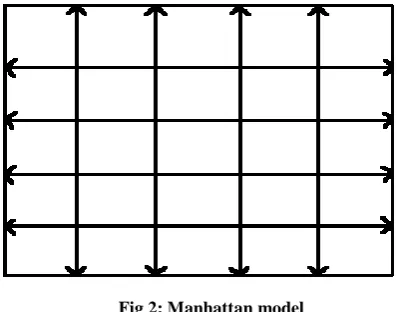
[image:3.595.316.526.72.254.2]We introduce the Manhattan model to emulate the movement pattern of mobile nodes on streets defined by maps. The Man-hattan map used in our study is shown in Figure2. Maps are used in this model. The map is composed of a number of hori-zontal and vertical streets. Each street has two lanes for each direction. The mobile node is allowed to move along the grid of horizontal and vertical streets on the map [6]. At an inter-section of a horizontal and a vertical street, the mobile node can turn left, right or go straight. This choice is probabilistic. The velocity of a mobile node at a time slot is dependent on its velocity at the previous time slot. The Manhattan mobility model is also expected to have high spatial dependence and high temporal dependence.
Fig 2: Manhattan model
[image:3.595.61.260.375.531.2]3.3. Random Drunken Mobility Model
In the Random Drunken mobility model, each node is as-signed a random position within a field. When the node is next considered for movement, the mobility model checks all the possible directions in which the node can move to ensure that it stays within the field boundaries. The node then moves in the direction randomly chosen from the set of possible di-rections. Each node moves by one unit distance in that direc-tion during the mobility interval. Here the pause time is set to zero seconds. The random drunken model periodically moves to a position chosen randomly from its immediate neighboring positions. The frequency of the change in node position is based on a parameter specified in the configuration file. Here each node moves by one unit distance in that direction during the mobility interval. This movement pattern is also known as random walk mobility model.Fig 3: Random Drunken Mobility Model
4. ON-DEMAND MULTICAST ROUTING
PROTOCOL (ODMRP)
ODMRP is a multicast routing protocol that uses the concept of ‘forwarding node’ to do the multicasting. It finds some nodes to be ‘forwarding node’ in the whole network, and only these nodes will forward multicast messages. The source on-demand establishes the routes by broadcasting the Join Data message with Time To Live (TTL). This message is periodi-cally generated to refresh both the membership and routes. Every intermediate node will add the upstream node’s ID in its own routing table upon receiving this message. The mes-sage will be forwarded until it reaches a group member. The group member then creates a Join Table message and broad-casts this message to its neighbors.
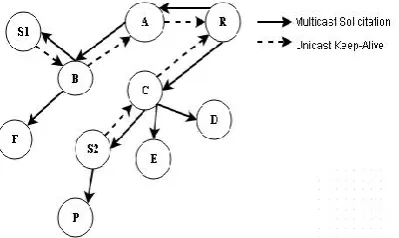
Every neighbor node will know itself that is on the path be-tween the source and the group member if the next hop ID in one of the entries of the Join Table message meets its own ID. This neighbor node then establishes itself as a forwarding node. It sets the Forwarding Group Flag on. Then it builds its own Join Table message based on routing table and propa-gates it on until the message reaches the source via the short-est path as shown in figure 4. The mesh of forwarding nodes is established in this way. This forwarding group supports the shortest paths between any member pairs. The source can send data to all the group members with the help of the mesh. Only the forwarding nodes will forward the multicast data. It is a soft state protocol and there is no need for the group members to send explicit messages to leave the group. Members can stop working at any time, and this change can be detected by the periodic refreshment. If nodes in the network have access to geographical information through equipments like GPS, ODMRP then can adapt to node movements by utilizing mo-bility prediction. With the momo-bility prediction method, the protocol becomes more resilient to topology changes.
Mobile nodes forward non-duplicated data packets if they are forwarding nodes. Since all forwarding nodes relay data, re-dundant paths (when they exist) are available for data packets delivery when the primary path is disconnected. ODMRP also operates as an efficient unicast routing protocol, and doesn’t need support from another underlying unicast routing proto-col.
0 100 200 300 400 500
Fig 4: Creation of mesh in ODMRP
5.
A
DAPTIVED
EMANDD
RIVENM
ULTICASTR
OUTINGP
ROTOCOL(ADMR)
ADMR is a multicast routing protocol that cooperates to es-tablish and maintain forwarding state in the network to allow multicast communication. ADMR adaptively monitors the correct operation of the multicast forwarding state and incre-mentally repairs it when one or more receivers are forwarding nodes and it becomes disconnected from the sender. ADMR supports receivers to receive multicast packets sent by any sender, as well as the newer source specific multicast service model in which receivers may join a multicast group for only specific senders. Each multicast packet is dynamically for-warded from source node S along the shortest delay path through the tree to the receiver of the multicast group G. Each multicast packet originated by node S contains a small ADMR header, including a number of fields used by the protocol in forwarding the packet and in maintaining the multicast distri-bution tree for node S and group G. The sequence number in the ADMR header uniquely identifies the packet and is gener-ated as a count of all ADMR packets flooded in any way that originated from S. The hop count is initialized by S to 0 and is incremented by each node forwarding the packet.
The ADMR header also includes the inter-packet time at which a new packet is expected from the sender S.If the appli-cation layer at node S originates no new multicast packets for G within some multiple of current inter-packet time, the rout-ing layer at S begins originating “keep-alive” packets for G. The keep-alive is used to maintain the existing forwarding state for the multicast distribution tree for S and G. Absence of data packets and keep–alive is an indication of forwarding tree disconnection. When any source S for multicast group G receives the Multicast Solicitation packet (or the single source, in the case of a source-specific multicast group join), the source re-plies to the Multicast Solicitation to advertise to R its existence as a sender for the group.
This reply may take one of two forms. If the next scheduled network flood of an existing multicast data packet is to occur soon, S may choose to advance the time for this network flood and use it as the reply for the Multicast Solicitation from R. The other form that this reply may take is for S to send an ADMR keep-alive packet unicast to R, following the path taken by R's Mul-ticast Solicitation packet, as it traveled toward S as shown in figure 5.
6. PERFORMANCE METRICS
The most important of routing performance metrics are Packet delivery ratio, End to end delay and Control overhead.
6.1. Packet delivery Ratio (PDR):
This is the ratio of total number of packets successfully re-ceived by the destination nodes to the number of packets sent by the source nodes throughout the simulation.
6.2. End to End Delay:
Delay is the time between when a message (CBR data packet) was sent and when it was received.
6.3. Control Over Head:
Control overhead is the ratio of the number of control bytes transmitted per data byte delivered.
7. SIMULATION RESULTS AND
PER-FORAMANCE COMPARISION
We use the simulation model based on Ns2. In our Simulation the simulated traffic is Constant Bit Rate (CBR) traffic. For each simulation, we use 100 nodes, randomly placed over a square field whose length and width is 1000 meters. For the Manhattan model, nodes may only be placed on straight line. To generate multicast traffic, we use four multicast groups, each consisting of 6 receivers. Each multicast source uses a Constant Bit Rate (CBR) flow, transmitting a 100 byte packet every 250 milliseconds. Nodes communicate using IEEE 802.11 for the MAC protocol, with free space radio signal propagation. We run each simulation for 250 seconds and we average the results of 5 simulations for each data point.
8. PERFORMANCE BASED ON
MOBIL-ITY MODELS
In ODMRP and ADMR, three mobility models namely Ran-dom way point, Manhattan model and RanRan-dom drunken mod-el have been compared based on their performance metrics such as throughput, end to end delay and control overhead.
8.1.
Packet Delivery Ratio
[image:4.595.59.259.621.740.2]8.1.1. PDR for Random Way Point Model
Fig 6: Random Way Point Model
8.1.2.
PDR for Random Drunken Model
Fig 7: Random Way Point Model
[image:5.595.55.268.69.575.2]8.1.3.
PDR for Manhattan Model
Fig 8: Manhattan Model
8.2. End To End Delay
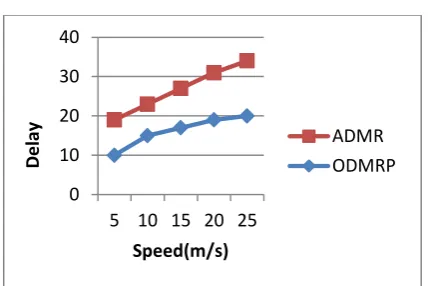
The Delay is high in ADMR When compared to ODMRP in all the three mobility models (Figure 9, 10, 11). It is higher for Manhattan model and Random drunken model when com-pared with Random way point model.
8.2.1. Delay for Random Way Point Model
Fig 9: Random Way Point Model
8.2.2. Delay for Random Drunken Model
Fig 10: Random Drunken Model
8.2.3. Delay for Manhattan Model
Fig 11: Manhattan Model
8.3. Control Overhead
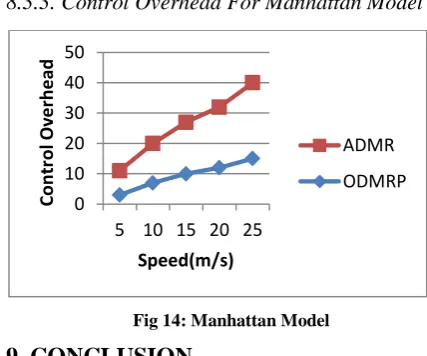
The Control messages are high in ADMR when compared to ODMRP in all the three mobility models (Figure 12, 13, 14).Flooding has no control packets and remains relatively constant and does not increase with mobility.
0 10 20 30 40
5 10 15 20 25
PD
R
Speed(m/s)
ADMR ODMRP
0 10 20 30 40
5 10 15 20 25
PD
R
Speed(m/s)
ADMR ODMRP
0 5 10 15 20 25
5 10 15 20 25
PD
R
Speed(m/s)
ADMR ODMRP
0 10 20 30 40
5 10 15 20 25
D
e
lay
Speed(m/s)
ADMR ODMRP
0 10 20 30 40 50
5 10 15 20 25
D
e
lay
Speed(m/s)
ADMR ODMRP
0 10 20 30 40 50
5 10 15 20 25
D
e
lay
Speed(m/s)
[image:5.595.315.530.85.228.2]8.3.1. Control Overhead for Random Way Point
Model
Fig 12: Random Way Point Model
8.3.2. Control Overhead For Random Drunken
Model
Fig 13: Random Drunken Model
8.3.3. Control Overhead For Manhattan Model
Fig 14: Manhattan Model
9. CONCLUSION
In this paper, ODMRP and ADMR protocols are analyzed using mobility models such as Random Way Point model, Manhattan model and Random drunken mobility model to measure the performance metrics such as throughput, delay and control overhead. The connectivity of the mobile nodes, route setup and repair time are the major factors that affect the performance. The simulation result shows that ADMR is able to maintain good throughput at high mobility as compared to
ODMRP. At low mobility, throughput is high in ODMRP. It is observed that delay and control overhead increases for ADMR as compared to ODMRP under different mobility models. Under Random way point model, ODMRP performs better compared with Manhattan, Random drunken mobility models. In Future these protocols can be compared with some other mobility models and their performance can be analyzed.
10. REFERENCES
[1] B. Malarkodi, P. Gopal, B. Venkataramani, ”Perfor-mance Evaluation of Ad hoc Networks with Different Multicast Routing Protocols and Mobility Models”, In-ternational Conference on Advances in Recent Technol-ogies in communication and Computing, pp.81-84, 2009.
[2] Nurul I. Sarkar and Wilford G. Lol, “A study of manet routing protocols: Joint node density, packet length and mobility”, in Computers and Communications (ISCC), 2010 IEEE Symposium on, June 2010, pp. 515–520.
[3] Yudhvir Singh, Yogesh Chaba, Monika Jain, Prabha Rani, “Performance Evaluation of On-Demand Multi-casting Routing Protocols in Mobile Ad hoc Networks”, in mobile ad hoc networks.
[4] J. Jetcheva and D. B. Johnson, "Adaptive Demand Driv-en Multicast Routing in Multi-Hop Wireless Ad Hoc Networks”, In ACM MobiHoc,October 2001.
[5] A. Madani, N. Moussa, “Self-Organized Behaviour Based Mobility Models for Ad Hoc Networks”, Journal of Theoretical and applied Information Technology 2012.
[6] Niclolas Cooper and Natarajan Meghanathan, “Impact of Mobility Models on Multi-path Routing in Mobile Ad hoc Networks”, IJCNC Vol2, No1, 2010.
[7] Geetha jayakumar, Gopinath Ganapathi, ”Reference point group mobility and random way point models in performance evaluation of MANET routing protocols”, Hindwi publication corporation, Journal of Computer systems, Networks, Communication Vol.2008 (2008), Article ID 860364.
[8] Xu-Zhen, “Bandwidth-Satisfied Multi-path Multicast Routing in Wireless Mesh Network”, ICCP 2010 Pro-ceedings.
[9] N. Aschenbruck, E. Gerhands-Padilla, P. Martini, ”A Survey on mobility models for Performance analysis in Tactical Mobile networks,” Journal of Telecommunica-tion and InformaTelecommunica-tion Technology, Vol.2 pp.54- 61, 2008.
[10]S. Lee, W. Su, J. Hsu, M. Gerla, and R. Bagrodia, "A Performance Comparison Study of Ad Hoc Wireless Multicast Protocols”. In IEEE INFOCOM, 2000.
[11]J.Kumar and R. Rajesh, “Performance analysis of manet routing protocols in different mobility models,” IJCSNS International Journal of Computer Science and Network Security, vol. 9, no. 2, pp. 22–29, Feb.2009.
[12]Narendra Singh Yadav and R.P. Yadav, “The Effects of Speed on the Performance of Routing Protocols in Mo-bile Ad-hoc Networks”, Int. Journal of Electronics, Cir-cuits and Systems, Vol. 1, No. 2, pp 79-84 (2009).
0 10 20 30 40 50
5 10 15 20 25
Co
n
tr
o
l o
ve
rh
e
ad
Speed(m/s)
ADMR ODMRP
0 10 20 30 40 50
5 10 15 20 25
Co
n
tr
o
l Ov
e
rh
e
ad
Speed(m/s)
ADMR ODMRP
0 10 20 30 40 50
5 10 15 20 25
Co
n
tr
o
l Ov
e
rh
e
ad
Speed(m/s)
[image:6.595.51.265.451.629.2]