2018 International Conference on Computer, Electronic Information and Communications (CEIC 2018) ISBN: 978-1-60595-557-5
HEVC Rate Control Algorithm Based on Predictive Weight
Lu WANG, Guo-bao RU and Liang-cai GAN
School of Electronic Information, Wuhan University, Wuhan 430072, China
Keywords: HEVC (High Efficiency Video Coding), Rate control; LCU (Largest Coding Unit), Bit allocation, Parameter Update.
Abstract. Aiming at the shortcomings of HEVC (High Efficiency Video Coding) rate control algorithm using only the information of inter-coded units without using the information of the intra-coded units in the frame to allocate the target bit and update the model parameters, this article proposed a LCU (Largest Coding Unit) layer rate control algorithm based on predictive weight. The proposed algorithm makes full use of the information of both inter-coded units and intra-coded units in the frame, and utilizes a target bit allocation method based on the prediction weight and a model parameter updating method based on the prediction weight which can accurately achieve the target output bit rate, and improve video quality while ensuring the smooth stability of video quality. The experimental results show that in the premise of the same rate control error, BD-PSNR (Bjøntegaard delta peak signal-to-noise rate) of improved algorithm is improved by 0.059dB on average on Low-Delay configuration, and 0.040dB on average higher on Random-Access configuration, and the video quality PSNR(Peak Signal to Noise Ratio)of improved algorithm is less volatile.
Introduction
With the rapid development of intelligent devices and the Internet, video-related applications are becoming more and more common. However, the amount of video information is usually very large, while the capacity of the communication channel for data transmission is limited, so the video information needs to be compressed before transmission[1]. The latest generation of video coding standards HEVC (High Efficiency Video Coding) have been released by JCT-VC (Joint Collaborative Team on Video Coding) organization[2]. In the same video quality constraints, compared with the previous generation coding standard H.264 standard[3], HEVC (High Efficiency Video Coding) standard can save about 50% of the bit stream[4].
Under the limitation of the target rate, by selecting the best series of coding parameters, the rate control algorithm can make the output code rate after compression coding conform to the established target bit rate, and makes the encoded video quality as good as possible. At present, HEVC (High Efficiency Video Coding) mainly has JCTVC-H0213(Joint Collaborative Team on Video Coding-H0213)rate control algorithm[6] and JCTVC-K0103(Joint Collaborative Team on Video Coding-K0103) rate control algorithm[7]. Compared with JCTVC-H0213 (Joint Collaborative Team on Video Coding-H0213) algorithm, JCTVC-K0103(Joint Collaborative Team on Video Coding-K0103) algorithm target bit error is smaller, the video quality is better, while the coding complexity is also significantly reduced. Although the JCTVC-K0103(Joint Collaborative Team on Video Coding-K0103) algorithm has many advantages, it also has the following disadvantages:
(1) In the LCU (Largest Coding Unit) layer target bit allocation, the algorithm only uses the inter prediction information, and does not use the intra prediction information;
(2) When we update the LCU (Largest Coding Unit) layer model parameters, the algorithm only uses the coding information of the encoding unit itself to update it, without using the information of intra and inter prediction. Aiming at the shortcomings of JCTVC-K0103 (Joint Collaborative Team on Video Coding-K0103) algorithm, this paper presents an improved LCU(Largest Coding Unit) layer rate control algorithm.
parameter updating method based on the prediction weight which can accurately achieve the target output bit rate, and improve video quality while ensuring the smooth stability of video quality.
The Intra-frame Prediction Model
Definition 1 Basic unit content characteristics
The symbol S represents the content characteristics of the basic unit, the specific definition is as follows in formula (1):
real
S=D R× =MAD bpp× (1) Where D represents the distortion of the basic unit in the broad sense; R represents the required
bits for the basic unit coding in general; MAD represents the Average Absolute Error of Pixels in Base Unit and the distortion of the basic unit; bppreal represents the number of bits per pixel actually required after the basic unit is encoded.
Intra-frame Prediction Method
For the content feature of the basic unit, as shown in Figure 1,the frame intra prediction model is set up. CTU0 represents the basic unit to be encoded at present;CTU1~CTU6 represents the basic unit next to CTU0 and the encoder has completed the encoding of CTU1~CTU6.If the content characteristic values of two adjacent basic units are approximately equal, they can be considered to be basically the same, that is, the rate distortion model parameter and the target bit number distribution are basically the same . The texture information in the current frame can be compared by comparing the difference in the value of the content characteristics of the base units in the adjacent and different directions, and the same unit of the same texture is assigned the same rate distortion model parameter and the target bit number allocation. When a basic unit is encoded, the encoder can get its distortion and the number of bits required. The encoder can be predicted using the content characteristics of the adjacent coded base units before encoding the next basic unit.
4 CTU
5
CTU CTU6
1
CTU CTU2 CTU3
0 CTU
Figure 1. HEVC basic unit coding diagram.
For the current basic unit CTU0, the intra prediction is performed by the following formula (2) :
0 _ 6 2 3
0 _ 3 2 6
0 _ 2 1 6
0 _ 4 3 6
if if if if H
V
L
R
S S S S
S S S S
S S S S
S S S S
= ≈
= ≈
= ≈
= ≈
(2)
Where S1,S2,S3,S4 and S6 represents the characteristic values of the content in the related basic unit; S0 _H ,S0 _V ,S0 _L and S0 _R represents the CTU0 characteristic value of the content in the horizontal direction prediction, the vertical direction, the upper left corner direction, and the upper right corner direction.
assumed, and their content characteristics are considered to be the same if the relative error of the content characteristic of the adjacent basic unit is less than 0.3, that is, the same model parameters, The same target bit is allocated, and the corresponding basic unit in the left side of the equation (2) is the prediction unit of the current basic unit, for example, and so on. At the same time, the encoder is calculated according to the prediction order in the formula (2). If there are two prediction units in the direction, the encoder will stop the calculation. And then using the model parameters or the number of target bits corresponding to the prediction units in the two directions to update the model parameters of the current basic unit or the number of target bits.
If there are only one prediction unit, The encoder will directly use the model parameter or the target bit number of the prediction unit to update the model parameter or the target bit number .If there are no prediction unit, the encoder won’t update the model parameters or the number of target bits.
The Selection of Predictive Weights
When it comes to intra-frame prediction and inter-frame prediction, the algorithm defines a prediction weight parameter in formula (3) and formula (4) to measure the accuracy of the corresponding prediction so that the encoder can adaptively select relatively better prediction mode before encoding.
if
2
if
and 2 lastSameLevel
lastSameLevel currLCU currLCU
currLCU lastSameLevel
currLCU lastSameLevel Inter
currLCU
lastSameLevel currLC S
S S
S
S S
S S
S
S S
ω
≤
⋅ −
< =
≤ ⋅ 0 others
U
(3)
Where ωInter represents the weights of inter prediction of the current basic unit; SlastSameLevel represents the content characteristics of the cells at the same location as the current basic unit in the same frame and the adjacent frame of the current frame; ScurrLCU represents the content of the current base unit.
_1 _ 2
_
_1 _
if exist 2 units : 0.7 2
if exist 1 units : 0.7 0 others
Intra Intra
Intra i
Intra Intra Intra i
ω ω
ω
ω ω ω
+
>
= >
(4)
Where ωIntra i_ represents the intra prediction weight in each direction of the current basic unit, its value is calculated by the formula (3), then in the formula (3) SlastSameLevelrepresents the content value of the unit adjacent to the current basic unit; ωIntrarepresents the final intra prediction weight of the current base unit. It should be noted that the intra prediction weight is calculated after the current basic unit coding is completed.
HEVC Rate Control Algorithm Based on Predictive Weight
Target Bit Allocation Based on Intra-Frame Prediction
_
_ _ _
_
coded Pic
CurrLCU Intra j CurrLCU pred coded i
i AllCodedLCUInPic R
T ω
ω ∈
= ⋅
∑
(5)2 _
coded i MADi
ω
= (6)_
1
| |
i
i j j
AllPixelsInLCU pixels i
MAD pred org
N
=
∑
−(7)
_ _1 _ _ 2 _
2
CurrLCU Intra CurrLCU Intra CurrLCU Intra
T T
T = +
(8) In equation (5), Rcoded_Pic represents the actual number of bits required for all the basic units that
have been encoded in the current frame; ωcoded i_ represents the predicted weight of the bit allocation of each basic unit in the current frame. In equation (6), MADi represents the average absolute error of the first basic unit in the current frame. In equation (7), Npixels i_ represents the total number of pixels in the i basic unit in the frame; predj represents the predicted value of the j pixel in the i basic unit, orgj represents the original value of the j pixel in the i base unit. In equation (8),
_
CurrLCU Intra
T represents the final intra-prediction target bits.
Target Bit Allocation Based on Predictive Weight
This paper proposes a target bit allocation algorithm based on predictive weights. The algorithm combines the intra prediction and inter prediction algorithm, and the encoder can adaptively select the best prediction mode according to the size of the prediction weight. First, the algorithm finds the corresponding prediction unit according to the intra prediction method. Then, based on the intra prediction weight and the inter prediction weight of the prediction unit, the weight of the predicted basic unit to be encoded after the prediction is obtained. If there are two prediction units, the weight of the current base unit is calculated as follows:
_ _1 _ _ 2 _ _
2
Intra pred Intra pred Curr Intra pred
ω ω
ω = + (9)
_ _1 _ _ 2 _ _
2
Inter pred Inter pred Curr Inter pred
ω ω
ω = + (10) In formula (9),ωCurr_Intra_pred represents the predicted intra prediction weight of the current basic unit; ωIntra_pred_1 and ωIntra_pred_ 2 represents actual intra prediction weight of the corresponding prediction unit. In formula (10), ωCurr_Inter_pred represents the predicted inter prediction weight of the current basic unit; ωInter_pred_1 and ωInter_pred_ 2 represents actual inter prediction weight of the corresponding prediction unit.
Finally, according to the predicted weight of the current base unit, the encoder decides which prediction method to use:
_ _ _ _ _
_ _ _ _ _
if if
CurrLCU Inter Curr Inter pred Curr Intra pred CurrLCU
CurrLCU Intra Curr Inter pred Curr Intra pred T
T
T
ω ω
ω ω
>
=
≤
_ _
Curr Intra pred
ω represents the predicted inter prediction weight and the predicted intra prediction weight of the current basic unit.
_ _
CurrPic header coded Pic
CurrLCU Inter CurrLCU
i i AllNotCodedLCUInPic
T R R
T ω
ω ∈
− −
= ⋅
∑
(12)In equation (12), TCurrLCU_Inter represents the inter-prediction target bits, Rheader represents estimated number of head bits required for the current frame, its value is estimated and based on the number of head bits actually required for the encoded frame that is closest to the current frame and
belonging to the same class; Rcoded_Pic represents the actual number of bits required for all the basic
units that have been encoded in the current frame; ωCurrLCU represents the weight of the bit allocation of the inter-frame prediction of the current basic unit; ωi represents the bit allocation of the inter-frame prediction of each basic unit in the current frame.
Model Parameter Updating Based on Inter-frame Prediction
It is assumed that the basic units of the same position in the adjacent frame of the same class have the same rate distortion curve as the current base unit in the current frame. Thus, the model parameters can be calculated from the coordinates of two points on the rate distortion curve:
1 1
2 2
bpp
bpp
β
β
λ
α
λ
α
= ⋅
= ⋅
(13)
In formula (13), λ1 , bpp1 represents the Lagrangian multiplier used in the current basic unit encoding and the number of bits per pixel actually required to complete the encoding; λ2 , bpp2 represents the Lagrangian multiplier used in the basic unit encoding at the same position in the adjacent frame of the same class and the number of bits per pixel actually required to complete the encoding. To solve the equation of the formula (13), we can get the following formula for updating the model parameters:
1 2
1 2
1 1
ln ln
ln ln
exp(ln ln )
bpp bpp
bpp
λ
λ
β
α
λ
β
−
=
−
= − ⋅
(14)
Equation (14) is a model parameter update algorithm based on inter prediction. The following special cases need to be handled separately:
(1) if bpp1=bpp2, the value of
β
cannot be updated by Equation (14), then we takeβ
=-0.36, the value of α is still updated by Equation (14);(2) if bpp1=bpp2 and λ1=λ2, it means that the contents of the two basic units are exactly the same. And the value of
β
cannot be updated by Equation (14), then we takeβ
=-0.36, the value of α is still updated by Equation (14);(3) Because the distortion curve is a convex function, the model must satisfy
β
<0.When calculated according to equation (14), ifβ
≥0, the value ofβ
cannot be updated by Equation (14), then we takeβ
=-0.36, the value of α is still updated by Equation (14). Finally, the updated model parameters are limited to a reasonable range of values,the range of the value ofβ is [-3.0, -0.36] , the range of the value ofα
is 20 8[1.0 10× − ,1.0 10 ]× .
Model Parameter Updating Based on Inter-frame Prediction
weakened, thus affecting the accuracy of model parameter updates based on inter prediction. Therefore, in order to improve the accuracy of model parameter prediction, this paper proposes the method of intra prediction and uses the mean value of model parameters to update the current base unit model parameters.
1 2
Intra
α = α α⋅ (15)
1 2
2
Intra
β
β
β
= + (16)In the formulas (15) and (16), αIntra and βIntra represent the model parameters of the current basic unit based on intra prediction; α1 and β1 represent predictive unit model parameters;α2 and
2
β represent another predictive unit model parameters.
Model Parameter Updating Based on Predictive Weight
The model parameter updates algorithm based on predictive weight combines the intra prediction and inter prediction algorithm, and the encoder can adaptively select the best prediction mode according to the size of the prediction weight.
_ _ _ _
_ _ _ _
, if
, if
Intra Intra Curr Inter pred Curr Intra pred
Inter Inter Curr Inter pred Curr Intra pred
α
α
β
β
ω
ω
α
α
β
β
ω
ω
= = >
= = ≤
(17)
In equation (17),
α
andβ
represent the final model parameters of the base unit before encoding;Inter
α and βInter represent model parameters based on inter prediction; αIntraandβIntra represent model parameters based on inter prediction; ωCurr_Inter_pred and ωCurr_Intra_pred represent inter prediction weights and intra prediction weights.
Experimental Results and Analysis
In the experiment, HEVC (High Efficiency Video Coding) official recommended bit rate is used as the target bit rate of the rate control[10]. We add the HEVC (High Efficiency Video Coding) rate control algorithm based on predictive weight into the reference test model HM-10.0[8], which replaces the JCTVC-K0103 (Joint Collaborative Team on Video Coding-K0103) algorithm, and then performs the coding test with the HEVC(High Efficiency Video Coding) official recommendation test video sequences[9].
Video Quality after Encoding
Rate-distortion Performance Comparison
In this paper, BD-PSNR (Bjøntegaard delta peak signal-to-noise rate)and BD-Rate[11] (Bjøntegaard delta rate)are used to characterize the rate-distortion performance of the algorithm. Table 3 and Table 4 respectively compare the rate-distortion performance of the JCTVC-H0213(Joint Collaborative Team on Video Coding-H0213) algorithm, the JCTVC-K0103(Joint Collaborative Team on Video Coding-K0103)algorithm, and the proposed algorithm in this paper on Low-Delay configuration and on the Random-Access configuration. According to the experimental data,on Low-Delay configuration, the BD-PSNR (Bjøntegaard delta peak signal-to-noise rate) is improved by 0.784dB on average compared with that of JCTVC-H0213(Joint Collaborative Team on Video Coding-H0213) algorithm and the BD-PSNR is improved by 0.059dB compared with the JCTVC-K0103(Joint Collaborative Team on Video Coding-K0103)algorithm ; On the
[image:7.612.88.524.286.529.2]Random-Access configuration, the BD-PSNR (Bjøntegaard delta peak signal-to-noise rate)is improved by 0.040dB compared with that of JCTVC-H0213(Joint Collaborative Team on Video H0213)algorithm and the JCTVC-K0103(Joint Collaborative Team on Video Coding-K0103) algorithm.
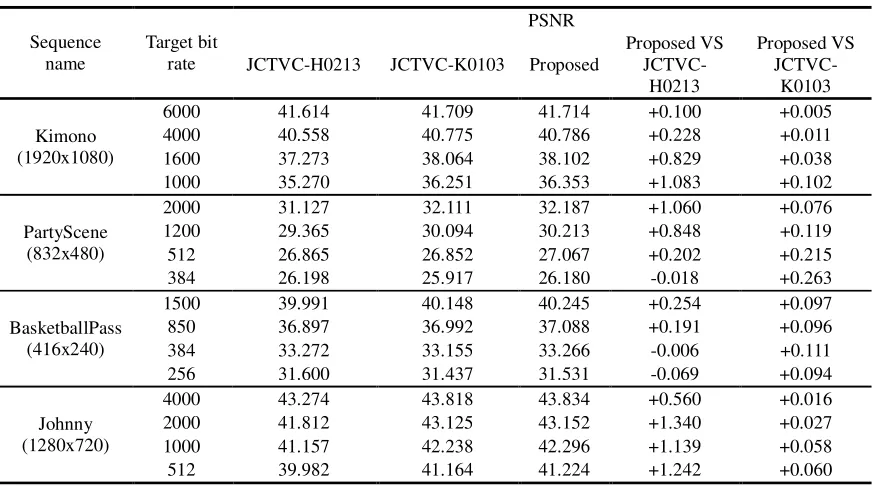
Table 1. Video quality on Low-Delay configuration (unit: dB).
Sequence name
Target bit rate
PSNR
JCTVC-H0213 JCTVC-K0103 Proposed
Proposed VS
JCTVC-H0213
Proposed VS
JCTVC-K0103
Kimono (1920x1080)
6000 41.614 41.709 41.714 +0.100 +0.005 4000 40.558 40.775 40.786 +0.228 +0.011 1600 37.273 38.064 38.102 +0.829 +0.038 1000 35.270 36.251 36.353 +1.083 +0.102
PartyScene (832x480)
2000 31.127 32.111 32.187 +1.060 +0.076 1200 29.365 30.094 30.213 +0.848 +0.119 512 26.865 26.852 27.067 +0.202 +0.215 384 26.198 25.917 26.180 -0.018 +0.263
BasketballPass (416x240)
1500 39.991 40.148 40.245 +0.254 +0.097 850 36.897 36.992 37.088 +0.191 +0.096 384 33.272 33.155 33.266 -0.006 +0.111 256 31.600 31.437 31.531 -0.069 +0.094
Johnny (1280x720)
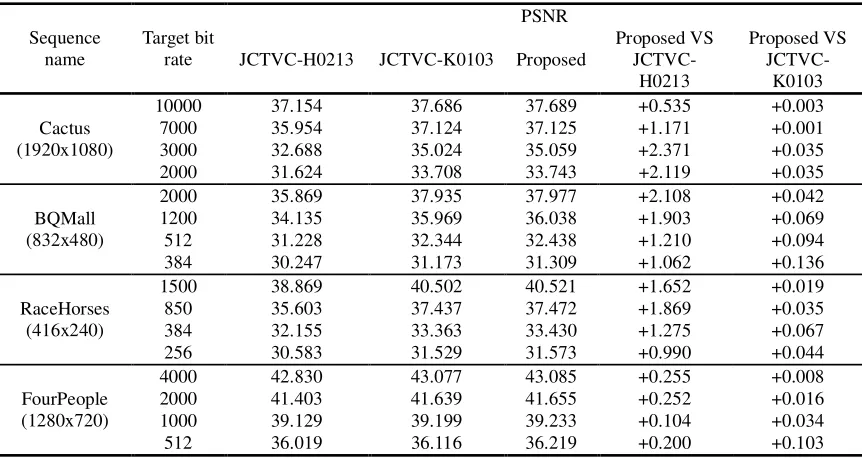
Table 2. Video quality on Random-Access configuration(unit: dB).
Sequence name
Target bit rate
PSNR
JCTVC-H0213 JCTVC-K0103 Proposed
Proposed VS
JCTVC-H0213
Proposed VS
JCTVC-K0103
Cactus (1920x1080)
10000 37.154 37.686 37.689 +0.535 +0.003 7000 35.954 37.124 37.125 +1.171 +0.001 3000 32.688 35.024 35.059 +2.371 +0.035 2000 31.624 33.708 33.743 +2.119 +0.035
BQMall (832x480)
2000 35.869 37.935 37.977 +2.108 +0.042 1200 34.135 35.969 36.038 +1.903 +0.069 512 31.228 32.344 32.438 +1.210 +0.094 384 30.247 31.173 31.309 +1.062 +0.136
RaceHorses (416x240)
1500 38.869 40.502 40.521 +1.652 +0.019 850 35.603 37.437 37.472 +1.869 +0.035 384 32.155 33.363 33.430 +1.275 +0.067 256 30.583 31.529 31.573 +0.990 +0.044
FourPeople (1280x720)
[image:8.612.95.515.335.440.2]4000 42.830 43.077 43.085 +0.255 +0.008 2000 41.403 41.639 41.655 +0.252 +0.016 1000 39.129 39.199 39.233 +0.104 +0.034 512 36.019 36.116 36.219 +0.200 +0.103
Table 3. Rate-distortion performance on Low-Delay Configuration.
Category
Rate-distortion performance Proposed
VS JCTVC-H0213
Proposed VS JCTVC-K0103 BD-Rate BD-PSNR BD-Rate BD-PSNR Class B -28.78% 0.948 -1.97% 0.047 Class C -13.17% 0.544 -2.21% 0.087 Class D -12.34% 0.533 -1.25% 0.057 Class E -45.92% 1.109 -2.52% 0.045 Average -25.05% 0.784 -1.99% 0.059
Table 4. Rate-distortion performance on Random-Access Configuration.
Category
Rate-distortion performance Proposed
VS JCTVC-H0213
Proposed VS JCTVC-K0103 BD-Rate BD-PSNR BD-Rate BD-PSNR Class B -35.32% 1.396 -0.77% 0.019 Class C -41.39% 1.991 -1.94% 0.079 Class D -35.64% 1.810 -0.95% 0.044 Class E -3.83% 0.138 -0.50% 0.016 Average -29.05% 1.334 -1.04% 0.040
Conclusion
[image:8.612.98.517.468.573.2]Acknowledgement
This research was financially supported by National Science Fund subsidized project (No.61671333, No.61072041).
References
[1] L. Tian, Y. M. Zhou and X. J. Cao, “A new rate-complexity-QP algorithm (RCQA) for HEVC intra-picture rate control,” in Proc. of 2014 International Conf. on Computing, Networking and Communications, pp. 375-380, February 3-6, 2014.
[2] Honey Durga Tiwari. High throughput resource shared 2D integer transform computation for H.264/MPEG-4 AVC. Digital Signal Processing. 2016. Vol. 54
[3] M. H. Wang, K. N. Ngan and H. L. Li, “An efficient frame-content based intra frame rate control for High Efficiency Video Coding,” IEEE Signal Processing Letters, vol. 22, no. 7, pp. 896-900, July, 2015.
[4] Lin Y, Zhang X, Xiao J, et al. An Efficient Frame-Level Rate Control Algorithm for High Efficiency Video Coding[J]. KSII Transactions on Internet and Information Systems, 2016, 10(4):1877-1891.
[5] Li B, Li H, Li L, et al. Rate control by R-lambda model for HEVC. JCTVC-K0103, Shanghai, CN, 2013[C].
[6] Yeongil Ryu, Hyun-Joon Roh, Shin Jin Kang, Soo-Kyun Kim, EunSeok Ryu, “Non-Uniform HEVC Tile Partitioning Method for Asymmetric Multicores”, Proceedings of The 11th Asia Pacific International Conference on Information Science and Technology(APIC-IST 2016), pp. 229-231, Jun. 27, 2016.
[7] Hyun-Joon Roh, Sung Won Han, Eun-Seok Ryu, “Prediction Complexity-Based HEVC Parallel Processing for Asymmetric Multicores”, Springer, Multimedia Tools and Applications (MTAP), 2017.
[8] Sharman K, Suehring K. Common HM test conditions and software reference configurations. JCTVC-X1100, Geneva, CH, 2016[C].
[9] H. Sun, S. S. Gao and C. Zhang, “Adaptive bit allocation scheme for rate control in High Efficiency Video Coding with initial quantization parameter determination,” Signal Processing: Image Communication, vol. 29, no. 10, pp. 1029-1045, November, 2014.
[10] J. M. Boyce, Y. Yan, J. Chen, and A. K. Ramasubramonian, “Overview of SHVC: Scalable extensions of the High Efficiency Video Coding standard,” IEEE Trans. Circuits Syst. Video Technol., vol. 26, no. 1, pp. 20–34, Jan. 2016.
[11] McCann K, Sekiguci S, Bross B, et al. HEVC Test Model 3 (HM3) Encoder Description, JCTVC-E602[R].[S.l.]: JCT-VC, 2011.
[12] C. Brites, J. Ascenso, and F. Pereira, “Side information creation for efficient Wyner–Ziv video coding: Classifying and reviewing,”Signal Process., Image Commun., vol. 28, no. 7, pp. 689–726, Aug. 2013.