A VIDEO TRANSCODING USING SPATIAL RESOLUTION
FILTER INTRA FRAME METHOD IN MULTIMEDIA
NETWORKS
1
S.VETRIVEL, 2DR.G.ATHISHA
1
Vice Principal, Subbalakshmi Lakshmipathy College of Science, India.
2
Professor & Head, Department of ECE, PSNA College of Engineering and Technology, India. E-mail: [email protected] , [email protected]
ABSTRACT
Video transcoding is a process of converting one form of video into another form. It provides fine and dynamic adjustment in the bit rate of video bit stream in the compressed domain without imposing additional function in the decoder. In that, H.264 is a successful video coding technique to address a large range of applications, bit rates resolutions qualities and services. Down sampling is special technique used in H.264 to reduce sampling rate of a signal and spatial resolution filter is an optical devices which uses the principles of Fourier options to alter the structure of a coherent light or other electromagnetic radiation, it also one of the technique of spatial domain. Intra-frame is used in video coding (compression) in the video sequence and the H.264/AVC intra-frame decoding and encoding contain a set of computation-intensive coding tools forming a loop in which the data are strongly dependant. We found that in H.264 quality of motion picture degrades so we propose Spatial Resolution Filter to improve the quality. Our experimental result shows that the high computation time saving can be achieved with only negligible quality degradation.
Keywords: Transcoder, H.264, Down sampling, Spatial Resolution Filter, Intra frame, Motion refinement.
1. INTRODUCTION
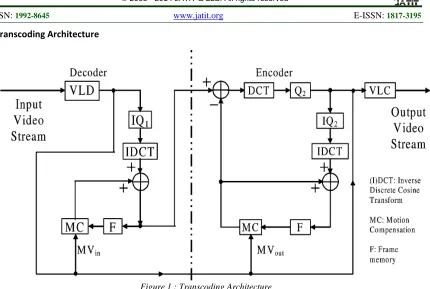
Video transcoding performs one or more operations, such as bit rate and format conversions, to transform one compressed video stream to another. Transcoding can enable multimedia devices of diverse capabilities and formats to exchange video content on heterogeneous network platforms such as the Internet[2]. One scenario is delivering a high-quality multimedia source (such as a DVD or HEVC) to various receivers. The simplest video transcoder is the architecture cascading a decoder and an encoder. This transcoder is time consuming in computation since it cannot benefit from any additional information provided by the decoder. Some works have been contributed to fast transcoding [3] [4]. Generally, these methods can be divided into two sub-categories: homogeneous video transcoding and heterogeneous video transcoding [5].
The former one refers to the application of transcoding under the same standard while the latter one means video format conversion between different standards. Most of the works are dedicated to the same resolution video transcoding. In this paper, we propose a DCT-domain video transcoder
Transcoding Architecture
Figure 1 : Transcoding Architecture
Design of most video coding standards is primarily aimed at having the highest coding efficiency, which is the ability to encode the video at lowest possible bitrate while maintaining certain level of video quality. HEVC, which is a recently emerged video coding standard[9], aims at high coding efficiency while retaining the video quality With its hybrid coding architecture, motion compensation prediction and transform coding technique, it can be seen as an improved version of the previous standard H.264.
2. BACKGROUND WORK
Only a limited number of methods have been proposed to realize heterogeneous transcoding, for example from MPEG-2 to H.263, or from H.264 to H.263. The major difficulties of transcoding a B-picture to a P-B-picture are that the incoming discrete cosine transform (DCT) coefficients of the B-frame are prediction errors arising from both forward and backward predictions, whilst the prediction errors in the DCT domain arising from the prediction using the previous frame alone are not available. The required new prediction errors need to be re-estimated in the pixel domain. This process involves highly complex computation and introduces re-encoding errors. We propose a new approach to convert a B-picture into a P-picture by making use of some properties of motion compensation in the DCT domain and the direct addition of DCT coefficients [4,5,8]. We derive a
set of equations and formulate the problem of how to obtain the DCT coefficients. One difficulty is that the last P-frame inside a GOP with an IBBP structure, for example, needs to be transcoded to become the last P-frame in the IPPP structure, and it has to be linked to the previous reconstructed P-frame instead of to the I-P-frame. We increased the speed of the transcoding process by making use of the motion activity which is expressed in terms of the correlation between pictures. The whole transcoding process is done in the transform domain; hence re-encoding errors are completely avoided. Results from our experimental work show that the proposed video transcoder not only achieves a speed-up of two to six times that of the conventional video transcoder, but it also substantially improves the quality of the video. One of the fundamental challenges in deploying multimedia systems, such as telemedicine, education, space endeavors, marketing, crisis management, transportation, and military, is to deliver smooth and uninterruptible flow of audio-visual information, anytime and anywhere.
memory, processing, and decoder). Thus, a transcoding mechanism is required to make the content adaptive to the capabilities of diverse networks and client devices. A video transcoder can perform several additional functions. For example, if the bandwidth required for a particular video is fluctuating due to congestion or other causes, a transcoder can provide fine and dynamic adjustments in the bit rate of the video bit stream in the compressed domain without imposing additional functional requirements in the decoder [9]. In addition, a video transcoder can change the coding parameters of the compressed video, adjust spatial and temporal resolution, and modify the video content and/or the coding standard used. This paper provides an overview of several video transcoding techniques and some of the related research issues. We introduce some of the basic concepts of video transcoding, and then review and contrast various approaches while highlighting critical research issues. We propose solutions to some of these research issues, and identify possible research directions [10].
2.1.Problem Statement
Mode decision, motion vectors mapping, motion vectors re-estimation and refinement are the major problem of H.264. Macro block mode decision by reusing the pre-encoded information is designed for fixed-size block-based motion estimation, and they are not suitable for H.264 transcoding system. The speed of the transcoding process is very low. The computational complexity is achieved only 40%.
3. TRANSCODING METHODS
An analytical model to estimate the potential gain by employing multi-resolution motion refinement (MMR), assuming the current frame is progressively decoded in the frequency domain. A
decoder-side multi-resolution motion refinement (MRMR) scheme is proposed, where the decoder is able to learn from the already-decoded lower-resolution data to refine the motion estimation (ME), which in turn greatly improves the SI quality
as well as the coding effici ency for the higher resolution data.
3.1.Intra Frame
Video coding (compression) is a part of an intra-frame code. A group of pictures codec with inter frames. The term intra-frame coding refers to the
fact that the various lossless and lossy compression techniques are performed relative to information that is contained only within the current frame and not relative to any other frame in the video sequence [1]. And The H.264/AVC intra-frame decoding and encoding contain a set of computation-intensive coding tools forming a loop in which the data are strongly dependant.
• I-frames are coded without reference to any frame except themselves.
• May be generated by an encoder to create a random access point (to allow a decoder to start decoding properly from scratch at that picture location).
• May also be generated when differentiating image details prohibit generation of effective P or B-frames.
• Typically require more bits to encode than other frame types.
Often, I-frames are used for random access and are used as references for the decoding of other pictures. Intra refresh periods of a half-second are common on such applications as digital television broadcast and DVD storage. Longer refresh periods may be used in some environments. For example, in videoconferencing systems it is common to send I-frames very infrequently.
3.2.Downsampling
Downsampling is a process of reducing the sampling rate of a signal. This is usually done to reduce the data rate or the size of the data. The downsampling factor (commonly denoted by M) is usually an integer or a rational fraction greater than unity. Downsampling by integer factor:
Let M denote the downsampling factor. Filter the signal to ensure that the sampling theorem is satisfied. This filter should, theoretically, be the
sinc filter with frequency cutoff at
M
π
. Let the
filtered signal be denoted
g
( )
k
. Reduce the data by picking out every Mth sample:h
( ) ( )
k
=
g
Mk
. Data rate reduction occurs in this step.Figure 2 : Downsampling by integer factor
3.3.Spatial Resolution Filter
A spatial resolution filter is an optical device which uses the principles of Fourier optics to alter the structure of a beam of coherent light or other electromagnetic radiation. The word “filtering” has been borrowed from the frequency domain [5]. It also defined as a neighborhood (or) An operation that is performed on the pixels inside the neighborhood [1, 2]. Used for filtering basics, smoothing filters, sharpening filters, Unsharp masking and Laplacian techniques we can improve the following qualities,
• Sharpening - highlight transitions.
• Smoothing - blurring and noise reduction.
• Unsharp masking - increasing the apparent sharpness of photographic images.
• Laplacian - highlight regions. Filters are classified as:
• Low-pass (i.e., preserve low frequencies)
• High-pass (i.e., preserve high frequencies)
• Band-pass (i.e., preserve frequencies within a band)
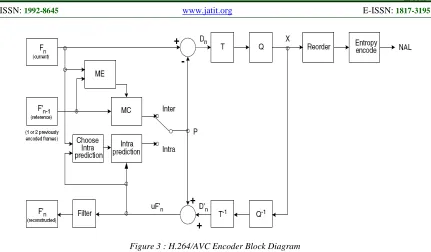
Figure 3 : H.264/AVC Encoder Block Diagram
Figure 4 : H.264/AVC Decoder Block Diagram
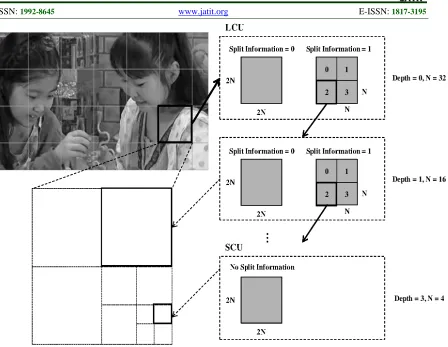
Larger block structure leading to maximum of 64x64 pixels per block intra prediction direction modes which are upto 35 (33 modes + dc + planar) in case of HEVC while h.264 has 9 directional modes of intra prediction adaptive motion vector prediction, which allows codec to find more inter frame redundancies superior parallelization tools, including wave front parallel processing, for more efficient coding in a multi core environment entropy using CABAC only, no more CAVLC improvements to de-blocking filter and addition of one more filter called sample adaptive offset (SAO) that further leaves artifacts along block edges[5].
3.4.HEVC Transcoder
The transcoding schemes discussed here avoid high computational complexity in terms of reduced
[image:5.612.98.515.337.488.2]Figure 5 : HEVC Transcoder Block Diagram
Table 1: HEVC Re-Encoder
H.264/AVC HEVC
MB Size/ 16×16 8×8, 16×16, 32×32, 64×64
MC Block Size 16×16, 16×8, 8×16,
8×8, 8×4, 4×8, 4×4
2N×2N, N×2N, 2N×N, nL×2N, nR×2N, 2N×nD, 2N×nU (N=4,8,16,32) and
conditionally N×N
Intra Prediction 4×4 and 8×8:9,
16×16:4
4×4:18, 8×8:35, 16×16:35, 32×32:35, 64×64:4*
Transform Size 4×4, 8×8 4×4, 8×8, 16×16, 32×32, 4×16, 16×4, 8×32, 32×8
4. RESULT ANALYSIS
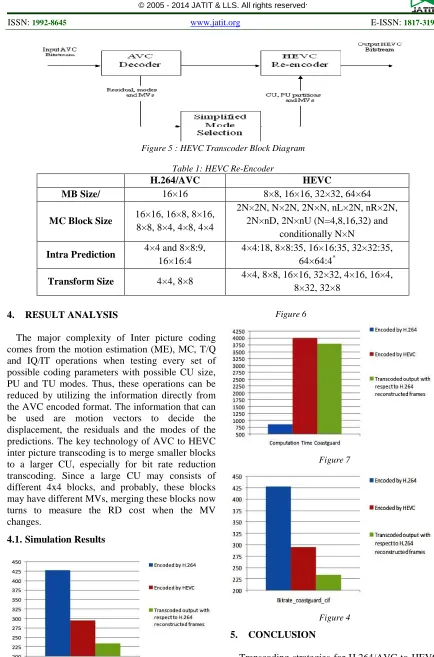
The major complexity of Inter picture coding comes from the motion estimation (ME), MC, T/Q and IQ/IT operations when testing every set of possible coding parameters with possible CU size, PU and TU modes. Thus, these operations can be reduced by utilizing the information directly from the AVC encoded format. The information that can be used are motion vectors to decide the displacement, the residuals and the modes of the predictions. The key technology of AVC to HEVC inter picture transcoding is to merge smaller blocks to a larger CU, especially for bit rate reduction transcoding. Since a large CU may consists of different 4x4 blocks, and probably, these blocks may have different MVs, merging these blocks now turns to measure the RD cost when the MV changes.
4.1.Simulation Results
Figure 6
Figure 7
Figure 4
5. CONCLUSION
this paper. With the input residual, modes and motion vectors of AVC, down sampling, Spatial Resolution Filter, Intra frame, Motion refinement. The numbers of required Video evaluations is significantly reduced for both intra and inter picture transcoding. Besides, the motion estimation, motion compensation as well as fractional pixel interpolation operations are avoided in the proposed inter picture transcoding strategy. The proposed transcoding strategies maintain good trade off between coding efficiency and transcoding complexity.
REFERENCES:
[1] D. Zhang, B. Li, J. Xu, and H. Li, “Fast Transcoding from H.264/AVC to High Efficiency Video Coding”, IEEE International Conference on Multimedia Expo, pp. 651-656, July, 2012.
[2] T.Wiegand et al, “Overview of the H.264/AVC video coding standard”, IEEE Trans. CSVT, Vol. 13, pp. 560-576, July 2003.
[3] J Xin, C.W. Lin and M.T. Sun, “Digital video transcoding”, Proceedings of the IEEE, Vol. 93, pp 84-97, Jan 2005.
[4] A. Vetros, C. Christopoulos and H. Sun, “Video transcoding architectures and techniques: An overview”, IEEE Signal Processing Magazine, Vol. 20, pp 18-29, March 2003.
[5] S. Matsuo, S. Takamura and A. Shimizu, “Modification of Intra Angular Prediction in HEVC” IEEE, Signal & Information Processing Association Annual Summit and Conference (APSIPA ASC), 2012 Asia-Pacific, pp 1-4, Dec 2012.
[6] T. Wiegand, G. J. Sullivan, G. Bjontegaard, and A. Luthra, “Overview of the H.264/AVC Video Coding Standard”, IEEE transactions on circuits and systems for video technology, vol. 13, no. 7, pp. 560-576, July 2003.
[7] I. Kim, J. Min, T. Lee et al, “Block Partitioning Structure in the HEVC Standard”, IEEE transactions on circuits and systems for video technology, vol. 22, no. 12, pp. 1697-1706, December 2012.
[8] Q. Cai, L. Song, G. Li et al, “Lossy and Lossless Intra Coding Performance Evaluation: HEVC, H.264/AVC, JPEG 2000 and JPEG LS”, Asia Pacific Signal & Information
Processing Association Annual Summit and Conference (APSIPA ASC), pp. 1-9, Dec 2012. [9] G. Sullivan, P. Topiwalla and A. Luthra, “The
H.264/AVC video coding standard: overview and introduction to the fidelity range extensions”, SPIE Conference on Applications of Digital Image Processing XXVII, vol. 5558, pp. 53-74 Aug 2004.