© 2016, IRJET | Impact Factor value: 4.45 | ISO 9001:2008 Certified Journal
| Page 376
Effect of Differential settlement of foundation on RCC Building using Staad- Pro
K.B.Jaiswal
1, A.C.Saoji
21
Kiran B.Jaiswal ME (Structure,)BNCOE,Pusad,Maharashtra,India
2
A.C.Saoji (Associate Professor),BNCOE,Pusad,Maharashtra,India
---***---Abstract –
Differential settlement is primary aspect of anybuilding design. It is well known that settlement may occur in the area where soil having low BC. Foundation gets settled due to load acting on structure, calamity, consolidation, nature of soil ground water table fluctuation, forces. Even small amount of differential settlement can cause redistribution of forces in superstructure. In this paper effect of differential settlement on9 storied RCC frame structure using Staad pro software considered. A differential settlement of 25mm, 50mm, 75mm, and 100mm is applied to two rows with fixed support and also spring support is considered and results are compared. DL, LL, WL, SL are considered as per IS code. Mainly corner, center columns.
Key Words: Differential settlement, comparison of forces, modulus of subgrade reaction, staad pro software, building code…
1. INTRODUCTION
It is noted that many times while designing RCC
building / Superstructure structural designer do not
considered the amount of differential settlement which
results in changing shear forces & bending moments in
the building/ superstructure and gives design by
applying maximum factor of safety. This study will give
approximate idea to them about amount of shear
forces, bending moments, Stress & displacement
changes. In this project we have considered G+9
building and DL,LL,WL,SL applied. Firstly analysis done
by considering fixed support to all supports and results
are seen. Then settlement of 25mm,50mm,75mm &
100mm accordingly are applied to two rows along
X-axis as shown in figure 1.to see effect of differential
settlement and results seen. After comparing results of
fixed support & differential settlement it is concluded
that forces & moments are changed when building
undergoes differential settlement which sometimes
results in failure of members & even some time
building may collapse. From this study one can be
concluded that it is very important to take note of
differential settlement during design of any RCC
superstructure / Building for safe & economical design.
1.1 Literature Review
(Skempton and Macdonald, 1956, Burland and
Wroth, 1975)
. stated that Differential settlement is a
general term used to describe the differences in
vertical displacement of foundations. However
differential settlement on its own does not give any
indication of the spatial variation. It is the magnitude of
differential settlement combined with the spatial
variation that influences the behavior of the structure
Polshin and Tokar (1957)
defined a slope, equivalent
to angular distortion; and relative deflection as the
ratio of deflection to the length of the deflected part.
Subsequently similar definitions have been defined by
a number of authors (Fjeld, 1963, Grant
et al.
, 1974,
Burland and Wroth, 1975, Wahls, 1981, Burland
et al.
,
2001a). Burland and Wroth (1975) proposed a
consistent set of definitions based on the displacement
of a number of discrete points on the foundation of a
building.
Meyerhof 1947
analyzed that the building frames
subjected to unequal settlement by
Studying the field
observations and theoretical investigation. It was
concluded that settlement of 1 inch to 2 inch is
inevitable and does not usually harm the buildings
superstructure due to the movement of support. This is
more prominent for structures provided with
individual footing or flexible rafts.
1.2 Building Description
© 2016, IRJET | Impact Factor value: 4.45 | ISO 9001:2008 Certified Journal
| Page 377
Fig -1: Geometrical Configuration of building2. Modeling
Modeling is done using analysis & design software Staad-proV8i . In this total 15 columns are considered of corners & centers. 5 columns each for Ground floor, 5th floor & 9th floor.
[image:2.595.56.554.87.348.2]As given in table 1.
Table -1: Showing Numbering of Columns.
Sr No. Floors Column Numbers 1 Ground floor 5,9,45,41,25
2 5th floor 330,334,370,366,350
3 9th floor 590,594,630,626,610
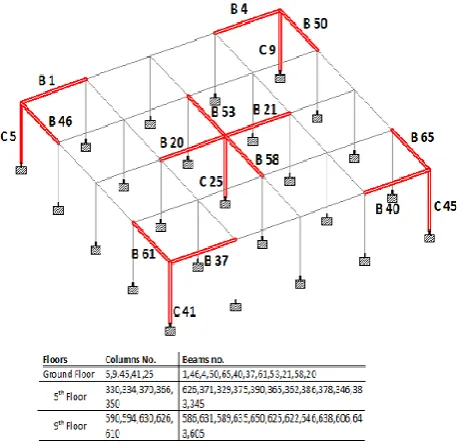
Differential settlements of 25mm,50mm,75mm &100 mm respectively are applied to column no. C32-C36 & C41-C45 with keeping rest configurations same only differential settlement are provided to columns as shown in Fig-2. Loading such as Dead load,live load, Wind load & seismic load kept same for all condition i.e. for fixed support, spring support & when differential settlement are applied.
Fig -2: Isometric View showing Beams & Columns selected for results of differential settlement of Ground floor
3. Results & Discussion
In the following section, the effect of Differential settlement on selected columns i.e. corners & centers columns & beams are mentioned. In first case fixed supports are considered and axial forces, shear forces and bending moments are note down. Then in second case one by one differential settlement of 25mm,50mm,75mm,100mm respectively applied to selected columns as shown in figure 3. To the same building and reactions noted down. And lastly in third case spring supports are applied instead of fixed support by considering modulus of subgrade reaction as K=40000.and results are note down and comparison between three cases presented.
NOTE : In this Report only effects of differential settlement on Ground floor columns are discussed along with positive forces & moments only. Negative forces and moments are not mentioned in the results.
3.1 : Effect of differential settlement on FX on Ground floor Corner & Center Column
[image:2.595.327.556.109.331.2]© 2016, IRJET | Impact Factor value: 4.45 | ISO 9001:2008 Certified Journal
| Page 378
Table -2: Variation of FX in Ground floor Columns
Fx Variation in Ground Floor Colu
mn
Fixe d
25 mm
50 mm
75 mm
100
mm Spring
5 1761 1071 417 103 103 2237
9 176 107 417 103 103 2237
45 176 2397 3034 3671 4307 2237
41 1761 2397 3034 3671 4307 2237
25 290 5615 8326 11037 13748 2561
Chart – 1: Variation of FX in ground floor Column
3.2 : Effect of differential settlement on FY on Ground floor Corner & Center Column
[image:3.595.298.560.123.271.2]From results it is noted that Fy do not effect due to differential settlement. Same values for Fy are noted in all cases except Spring support. Spring support also having very minor changes in Fy values.
Table -3: Variation of FY in Ground floor Columns
Chart – 2: Variation of FY in ground floor Column
3.3 : Effect of differential settlement on FZ on Ground floor Corner & Center Column
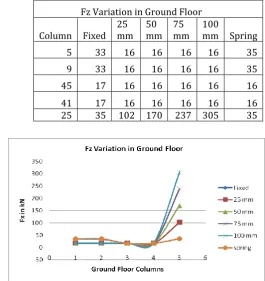
[image:3.595.301.567.456.738.2]From results it is noted that Fz do not effect Corner Columns due to differential settlement, its remain same as incase of fixed support. But Fz at centre columns increases if amount of differential settlement increases.
Table -4: Variation of FZ in Ground floor Columns
Chart – 1: Variation of FZ in ground floor Column Fy Variation in Ground Floor
Column Fixed 25 mm
50 mm
75 mm
100
mm Spring
5 16 16 16 16 16 15
9 34 34 34 34 34 36
45 34 34 34 34 34 36
141 16 16 16 16 16 15
25 35 35 35 35 35 37
Fz Variation in Ground Floor
Column Fixed 25 mm 50 mm 75 mm 100 mm Spring
5 33 16 16 16 16 35
9 33 16 16 16 16 35
45 17 16 16 16 16 16
41 17 16 16 16 16 16
© 2016, IRJET | Impact Factor value: 4.45 | ISO 9001:2008 Certified Journal
| Page 379
3.4 : Effect of differential settlement on MX on Groundfloor Corner & Center Column
[image:4.595.306.564.130.436.2]From table it is noted that corner columns having some moments as shown in below table and the value for Mx remain same in all condition even if Differential settlement is given to building for corner columns But in case of center columns value of Mx is zero.& it is also noted that when spring support is applied to building Mx do not effect & gives no moments.
Table -4: Variation of MX in Ground floor Columns
Chart – 4: Variation of MX in ground floor Column
3.5 : Effect of differential settlement on MY on Ground floor Corner & Center Column
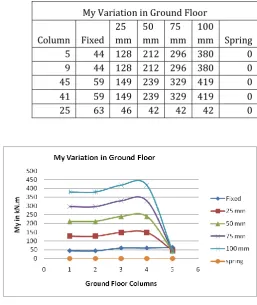
From results it can be state that MY is more dominant. Than MX&MZ. as it affects more in corners columns when differential settlement is given to building but centre columns decreases & remain constant even if amount of differential settlement increases. And it is also noted that MY in spring do not gives is zero.
Table - 5: Variation of MY in Ground floor Columns
Chart – 5: Variation of MY in ground floor Column
3.6 : Effect of differential settlement on MZ on Ground floor Corner & Center Column
[image:4.595.28.288.268.557.2]As we have already seen that MX do not affect due to differential settlement in same way it also noted that MZ do not effect due to differential settlement. Its value remain same as incase of spring support.But when we applied spring support to building MZ values comes equal to zero.
Table - 6: Variation of MZ in Ground floor Columns
Mx Variation in Ground Floor
Column Fixed 25 mm
50 mm
75 mm
100
mm Spring
5 0.36 0.36 0.36 0.36 0.36 0
9 0.361 0.361 0.361 0.361 0.361 0
45 0.36 0.36 0.36 0.36 0.36 0
41 0.361 0.361 0.361 0.361 0.361 0
25 0 0 0 0 0 0
My Variation in Ground Floor
Column Fixed 25 mm
50 mm
75 mm
100
mm Spring
5 44 128 212 296 380 0
9 44 128 212 296 380 0
45 59 149 239 329 419 0
41 59 149 239 329 419 0
25 63 46 42 42 42 0
Mz Variation in Ground Floor
Column Fixed 25 mm
50 mm
75 mm
100
mm Spring
5 55 55 55 55 55 0
9 74 74 74 74 74 0
45 74 74 74 74 74 0
41 55 55 55 55 55 0
© 2016, IRJET | Impact Factor value: 4.45 | ISO 9001:2008 Certified Journal
| Page 380
Chart – 6: Variation of MZ in ground floor Column4. CONCLUSIONS
Effect of differential settlement on superstructure is studied in this paper in terms of forces & moments changes in Ground floor Columns after applying differential settlement of 25mm,50mm,75mm,100mm.and results compared with fixed support & spring supports. From above discussion & study below mentioned points are concluded.
1)From above results it can be concluded that if Differential settlement occurs in the building then FX in columns is affected more than FY & FZ in case of Shear Force.
2) When differential settlement is given there is no changes found in FZ values. But FZ at centre column increases with increase in Differential settlement from 25mm to 100mm. and there in NO change found at the corner columns with increment of differential settlement.
3) MZ having no effect of differential settlement & of any other support. MX In corner column do not change when differential settlement occurs & at centre its value comes zero.
4)MY at corner columns increases when Differential settlement increases & MY at centre columns decreases when Differential settlement increases. MY is Maximum when fixed supports given.
5)Corner columns are having maximum FX & Centre columns having minimum FX. FY increases when spring support is applied compared to fixed support. And MX & MY ground floor spring support value is ZERO & slightly increases with increase in floors.
REFERENCES
[1] Agrawal R.and Hora M.S.(2010), “Effect of differential
settlements on nonlinear interaction behavior of plane frame – soil system”, ARPN Journal of engineering and applied sciences,Vol.5, No.7,pp.75-87
[2] Ms.I.L.sneha (IJETR-2014) Study on vertical settlement
and lateral Displacem,ent in Different types of soils.
[3] Settlement of Building & Associate Damage by
J.B.Burland & C.P. Worth
[4] M.A.Sabry and M.Sabry, Dept.of civil Engineering.Cairo
Univ.,Giza, “ Office building settlement and Remediation
[5] Roy R. and Duuta S.C.(2001), “Differential settlement
among isolated fottings of building frames; ghe problem, its estimation and possible measures”,international journal of applied mechanics and engineering, Vol.6,No.1,pp.165-186
[6] Terence A.Weigel, Kenneth J.Ott,Joseph hagerty, “Load
Redistribution in frame with settling footings
[7] IS: 9214-1979 “ Method of Determination of Modulus of
Subgrade Reaction (K-Value) of soils in field”
[8] IS:8009-1976 “Code of Practice for calculation of
Settlement of Foundations”
[9] IS: 456-2000 “ Code of Practice for general structural
use of plain and Reinforced Concrete”
[10] IS :87-1987 “code of practice for Design load for