© 2015, IRJET.NET- All Rights Reserved
Page 898
Construction approach of a performance indicator system for
controlling production process applied to a packing station for fruit
and vegetables for export
Oumaima Naciri
1, Ayoub Alami
2, Brahim Herrou
3, Mohammed El Hammoumi
41
PhD Student, FST FES, Industrial technology laboratory, university SMBA, Morocco
2PhD Student, FST FES, Industrial technology laboratory, university SMBA, Morocco
3
Professor, EST FES, Industrial technology laboratory, university SMBA, Morocco
4Professor, EST FES, Industrial technology laboratory, university SMBA, Morocco
---***---Abstract -
The production and productionmanagement cannot do without measures. Is produced for economic reasons and also manages for economic reasons. As how to produce as how to manage the production have changed considerably in recent years. But measurement tools and production management, meanwhile, have not always kept pace.
The present article proposes a rigorous and generic for the construction of a production process indicator system. Our approach is validated by an industrial application at a fruit and vegetable packing food company for export.
Key Words:
Measure, Processes, Performance
indicators, System
1.
INTRODUCTION
The manufacturing process involves all the transformations that will suffer the components to achieve the company's finished products. The objective of this process is to produce the products required while ensuring the productivity of the system.
The methods used for production management seeking to improve the flow of products in the production workshops through the planning and scheduling, determining the optimal size of production batches, determination of economic series. [3].
Furthermore, production and production management can not do without measures. Is produced for economic reasons and also manages for economic reasons. As how to produce as how to manage the production have changed considerably in recent years. But measurement tools and production management, meanwhile, have not always kept pace.
Today, production has been very strong destabilization under the pressure of globalization. The company needs to develop instruments for measuring its productive system. The measuring system must now be a steering tool of production at the company's service performance.
As we have already managed to propose a system of indicators for measuring performance of the procurement process [7], we are interested in this article at the central of each business process; production process.
It is in this framework for measuring performance in production, this article offers a rigorous and generic to build a system of indicators for this process and more particularly to that of a Moroccan packing station for fruit and vegetables for export.
In our approach, we will be based mainly on the SCOR model and the results of our investigation into the degree of importance of performance indicators in the Moroccan industrial sector. Thus we will learn from the forward-looking dashboard method (TDBP) to classify our indicators.
2.
INDUSTRIAL CONTEXT
The fruit and vegetable sector has long been considered a lever of the Moroccan economy, is experiencing a huge boom in progress at the production, packaging for marketing and export.
© 2015, IRJET.NET- All Rights Reserved
Page 899
contribution to the progressive performance, which is amajor issue for the survival of businesses and maintaining the proper development of Agriculture regionally and nationally.
Packing stations are the look and the most crucial actor in export-oriented agriculture. Indeed, say the experts of the MAI, "it is at this stage that the valuation of the production takes place. According to industry operators, the price differences of nearly 1 FF / kg between a well calibrated tomato, uniform in color, variety, carrying a known brand,
are easy to obtain. Operators, who have produced the
profitability of a well packing station, more investment in this function ".
To comply with a part in the regulation of markets and their requirements, and secondly to deal with increased competition, packing stations and export of fruit and vegetables are in the obligation improve their products in the best conditions, deadlines and lower costs. And these, by the management of their internal logistics chain.
In this article, we are interested in measuring the performance of the central chain of the process; The production process whose failures are directly perceived by customers
.
3.
PRODUCTION PERFORMANCE
INDICATORS
The indicator shows the most used tool for synthesizing accounting information and not accounting in all business functions and control financial flows and physical flows. Performance indicators are used as well to provide "specific" information on performance, because the main objective of the establishment of such a tool is increasing short- and long-term performance of the company [1]. Lorino [6] defines the indicator as follows: "information to help an actor, individual or collective, more generally, to drive the course of action towards reaching a goal or to enable it to evaluate the result. "
Performance indicators attempt to cover two aspects of the production system: an aspect related to the results and other processes. To this end, two types of indicators can be defined:
• Result indicators indicate the results that can be achieved. Example: the amount produced of an element manufactured by the company.
• Process indicators are used to express the way to get a result. (Example: an outcome indicator as the amount produced, we will process indicators such as the number of incidents, the number of rejected parts, the quality of the components used ...).
Gandhaue [5] estimates that the indicator is a useful tool to measure the performance and gives a typology of indicators: performance indicators, process indicators and environmental indicator.
According to [2], a production measure its performance in terms of traditional outcomes perceived by customers and shareholders.
The quality / delays / QCD costs are three key parameters for measuring the performance of this function.
The search for performance may lead primarily to satisfy shareholders, customers and distributors, but now more than ever, the performance is not limited to these three factors. These dimensions are now complement those related to security, respect for employees and the environment. We will talk about the social responsibility of a company and societal
A production must protect its employees, their development and protect the environment. These two assumptions posed, it seems necessary to add to the dashboard of a production of indicators to measure its challenges.
Drawing on this thinking and knowing that the Balanced Scorecard takes into account the financial aspects (costs) and non-financial (quality, time, organizational learning), we propose to add another axis on the safety aspect social and societal.
In short, we aim to design a system of indicators allowing the control production processes, adopting the results of performance and process indicators, classified according to five table axes Scorecard (Financial, customer, internal process and learning organizational, social and societal security), and is closely linked, of course, in the logic (quality, cost, time, security).
Before discussing our methodology, we propose to present the supply chain of our case study.
4.
INTRODUCING OUR CASE STUDY
© 2015, IRJET.NET- All Rights Reserved
Page 900
vegetables namely:. Tomato, Cucumber, Peppers,Zucchini, Melon.
In the quest to improve performance, this company wants to control its supply chain through a system of indicators. First, we present below its main activities.
Planning
At the beginning of each company the station manager, the quality manager and production manager meet with the leaders of all the cooperative farms to set a production schedule by operating according to estimates by the station preset.
Supply:
•
The manager of the Station receives the group's export program by variety, the review and approval before sending it to the conditioning charge, the quality manager and responsible supply for the application. In the absence of abnormality, the supply manager communicates to each orchard quantities and products to pick. • The station receives the quantity harvested producersaccompanied by a delivery note.
• The cooperative buys cardboard once a day starting before packaging.
Receiving and arrivals of fruit and vegetablesThe reception is a key point in the fruit and vegetable packaging process, it must be rapid to avoid exposure of the goods to sunburn and ambient heat and must be careful to avoid crushing and injuries fruits and vegetables.
A check is performed at each reception by the receiving agent, it is to verify compliance with the date of harvest by the producer and perform the grading of the goods.
Identification of rawmaterial
After control of the raw material receiving, receiving agent makes the identification of the goods.
This operation is provided at the reception area, the agent receiving organizes the products received by lot and identified through a label.
Storage
Storage is a very important operation, but it does not have a mandatory step in the packaging process of fruits and vegetables. It allows one hand adaptation and acclimatization of the goods with packaging conditions
and on the other hand the organization and management of workflow.
Packing
The packaging of fruits and vegetables is a variable process depending on the product and customer requirements. We choose the case of processed tomato made from it represents 90% of total production.
Packaging Tomato:
- Payment: Payment is to pour the tomato in the packaging line, it is done manually. During the tomato payment is subject to injury and crushing hazards. For this reason, the payment is made with care and attention.
- Washing and showering: Washing and showering aim to rid the tomato fruit dust, dirt or any other impurities that contain them. The fruits are washed with potable water treated and controlled.
- Spin: The spin is the elimination of water droplets on the surface of the fruit. This is done mechanically and manually round tomatoes for tomato cluster and cherry tomatoes.
- Drying: It is to remove excess moisture on the surface and interior of the skin of the fruit. The fruits pass under a hot air blown at a temperature of 40 to 60 ° C.
-Sort: Triage aims to eliminate the culls.
- Grading and classification: Classification of fruit according to their diameter.
- Packaging: After selecting and commercial classification presented in the table above, the fruits are put in cardboard boxes. The box varies depending on the product.
- Storage: Storage of tomato takes place in refrigerators at a temperature of 8 to 10 ° C and a relative humidity of 95%.
Processing of Variances: sorting deviations from packaging process are for the local market. Before marketing, the differences are sorted and then sold on the local market.
© 2015, IRJET.NET- All Rights Reserved
Page 901
Palletizing: The pallet is an operation which consists ofcollecting and placing the packages on a pallet for export. It must be done in proper manner and practice with great care to avoid falling each parcel on others and therefore avoid crushing the product.
Storage: The final products ready to ship are stored in the freezer awaiting shipment. The storage temperature may be from 5 to 10 ° C depending on the product Shipping: Shipping is the last step in the packaging process of fruits and vegetables. However, it must take place under controlled conditions and cared for to prevent crushing of the product during moving and loading pallets. Non-compliance: All non-conformities detected during the manufacturing operations is treated compliance with the procedure.
5.
PROPOSED APPROACH:
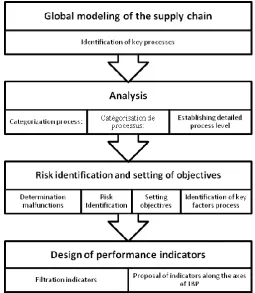
As part of aid to the construction of a system of indicators of the main processes of the supply chain, we propose a generic approach applicable to any supply chain. Our methodology is based on the following steps:
1. Global modeling: it is a crucial step for the measurement of the supply chain, for this, we will use the modeling reference model; SCOR [9] model.
2. Analysis:
In this step we will proceed to: Identifying and process description: The categorization process:
The establishment of process detail level
3. Identification of risks and setting objectives
After the analysis in Step 2, we carry out a process malfunction study. The latter is done by comparing the current process and the process (ideal) of SCOR. This study will allow both to identify malfunctions and risks. As for the setting of objectives, they are determined by a collective work of a team. Goals should meet the key factors of process and risk impairing the proper functioning thereof.
These first three steps allow us to model and diagnose the process and out of process objectives.
4. Design of performance indicators
SCOR repository offers many indicators for control of key processes. But we must choose those that apply to the case
study. For this, the first step in design of our indicators is their filtration;
4.1 Indicators Filtration
In this step, we will filter the indicators will draw on the indicators proposed by the SCOR model and our empirical study (survey results) [8], which aimed to identify the performance indicators most relevant to the main processes of the supply chain in Morocco. This filtering is done by the intersection of the results of these two methods that allow us to identify common indicators. These indicators will, thereafter, a basis for the choice of our own indicators.
The added value of this stage is to build a base of relevant indicators that are adapted to the context of Moroccan industry.
5. Indicators System
[image:4.595.305.561.422.716.2]We propose a system of indicators according to the philosophy-looking dashboard (TDBP) proposed by [4]. Based on: Process Goals, Process Key Factors, Risks, common indicators Figure 1 outlines our work methodology:
Fig 1. Design Process of a system of indicators
© 2015, IRJET.NET- All Rights Reserved
Page 902
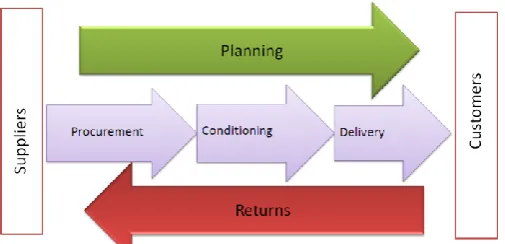
Step 1: The global modelingThis first step requires the use of the description of level 1 SCOR model. After analyzing the supply chain of the station, it turned out that it contains the following five processes:
1. Plan: this is strategic planning. This planning includes: - Exploitation by production planning estimates according to pre-established by the station.
- The supply planning fruits and vegetables according to the export group program with variety.
- Planning shipments - The packaging planning
2. Source: This is the supply of raw materials and purchase supplies for the packaging of fruits and vegetables. This process is cascaded from upstream to downstream from suppliers to customers.
3. Make: The supply chain provides the packaging of products for export.
4. Deliver: the delivery of packaged fruit and vegetables from suppliers to customers or the export group.
5. Return: the return is a very active process in the supply chain of the station. This is the return of finished products supplied non-compliant.
Fig 2. Modeling Level 1 of the supply chain of the station
Step 2: Process Analysis
2.1 Identification process
In this work, we focus on the process Make. In our case, the production of the station is the packaging of fruits and vegetables.
2.2.1. Description
By identification cards, we first identified for each process: · The title of the process
· The purpose of the process
· The head of the process in question
· Customers (externally (eg suppliers) and internal (eg supply cell)
[image:5.595.303.558.254.413.2]· The constraints and dysfunctions within the process · The indicators monitored for this process (number of breaks in the process, etc.)
Table 1. Identification Form Packaging Process Ed titled Process Packing
Purpose of the process
The achievement of fitness programs while ensuring good product quality on time previously set and optimizing performance.
Responsible for the process
Responsible conditioning
Client Process Internal: Delivery process External: client, export group
Process indicators Total Production (n) / total output (n-1)
Number of customer complaints
These identification sheets were produced by a rapid assessment of the processes discussed.
2.2 Categorization process
According to the SCOR model, the packaging process corresponds to the MAKE process. To model this process, there are three types of production:
[image:5.595.37.290.493.615.2]Stock production M1, M2-to-order and M3 Design to order.
Fig 3. Categorization of the Make process
The mode of production of our company is M2: Production (conditioning) to the order.
2.3 Establishment of level of detail process
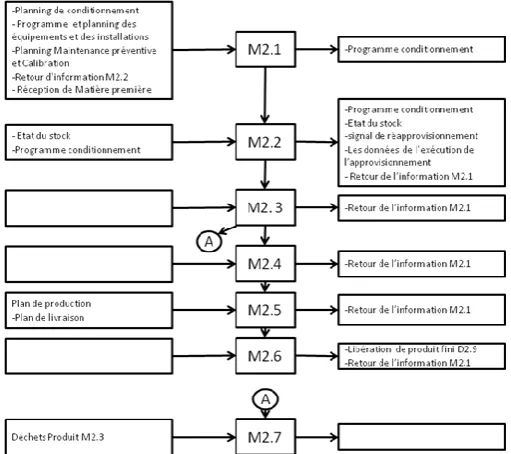
According to this process SCOR model includes seven sub processes:M2.1: Plan production,
M2.2: Preparation of raw material, M2.3: Production and test,
© 2015, IRJET.NET- All Rights Reserved
Page 903
M2.6: Allow delivery of the finished productM2.7: Waste Disposal.
M2.1 The first module aims to program production activities ie the production schedule, the raw material as scheduled and demand means necessary. In our case, this module is not integrated into the packaging process.
M2.2 The next module (preparation of the raw material) is needed to properly place the raw material from a storage area to a specific point of use. For this reason, the module has three main tasks: It must be possible to check whether there is a raw material available and if so, send a signal to the storage of products of releasing the raw material for production. Finally, it should update the plans of raw materials and production.
For modules M2.3, M2.4, we'll assemble in a single module (M2.3 and packaging). M2.3 This module aims to provide better packaging process according to the product and customer requirements.
For both M2.5 and M2.6 modules, we will assemble the single module (M2.4 Step finished product and allow the delivery). M2.4 The module aims to transport the packaged products in a finished product storage.
The M2.7 modules: Disposal of scrap which seeks the elimination of all production waste. In our case study, this module is equivalent to the process M2.5 Disposal of waste and treatment of deviations from packaging processes which are for the local market. Before marketing, the differences are sorted and then sold on the local market.
Fig 3 packaging process level Modeling
Step 3: risk identification and assessment of operational objectives
3.1 Faults / risk
The SCOR model that, through its standard models, simplify the business operating modes, we compared the current process of the packaging station processes (production Make) standard model (Figure 5). Considering the process advocated by SCOR as "ideal", we in this comparison could determine what production process differs from the process "normalized" SCOR to detect malfunctions.
[image:6.595.40.568.277.769.2]
Fig5. Level 3 modeling process 'Make' SCOR model
Fig 6. Level 3 modeling process production station
[image:6.595.307.563.278.505.2]© 2015, IRJET.NET- All Rights Reserved
Page 904
model consists of seven sub-processes (from planning topackaging activities Waste Disposal), is distinguished from the process of station as follows:
The activity related to the sub-process M2.1 SCOR (planning of fitness activities) is not considered by the station as part of the packaging process: The sub-processes "planning packaging activities" exists on the station but is not located within the packaging process. Indeed, the activity related to the planning of packaging activities take place within the planning process. The station manager providing such planning is then further concerns the packaging process, and this both physically and functionally. A number of risks can be addressed. For example, planning for fitness activities by the director without much knowledge of production issues (program and planning of equipment and installations, Preventive Maintenance and Calibration Planning, Bulk Reception) may cause some errors in these schedules (overlapping program production with the schedule Preventive Maintenance). As against the responsible packaging has a clear and effective vision on the process to develop a fitness program.
The activity M2.2 Preparation of the raw material is only interested in the receipt and storage of raw material, for against that of SCOR includes other tasks (On hand, replenishment signal, data execution procurement, back information to M2.1).
From these two malfunctions, we can highlight some risks like:
- Stop production due to the unavailability of the raw material
- Non respect of conditioning program - Late delivery not customer satisfaction - Deterioration in the quality of raw material
3.2 Risk / objectives
[image:7.595.301.564.96.324.2]Based on the risks identified in the previous step and reflection of a working group, made up of three members: the director of the station, the packaging and responsible technical manager and quality assurance. We have established a link risks - objectives.
Table 2. Risk / objectives
Risks Operational Goals
Non European Products Controlling product quality
Ensure continuous product training Non-compliance with
customer requirements
Reduce customer complaints
Delivery delay Observe the conditioning program
Unforeseen machinery failure Increase availability machine.
Non availability of the raw material é
Check the condition of stock
Non compliance with the program
Observe the conditioning program
- Improve productivity - Controlling costs
- Respect the environment - That of securing staff
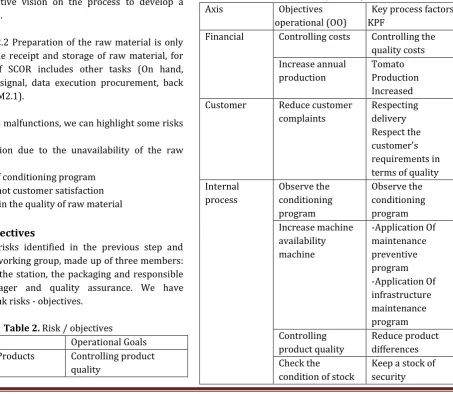
3.3. Identification of key process factors
[image:7.595.103.557.387.781.2]We declined the operational objectives in key success factors, classifying them according to the axes of table-looking edge (Table 3)
Table 3. Objectives / FCP Axis Objectives
operational (OO)
Key process factors KPF
Financial Controlling costs Controlling the quality costs Increase annual
production
Tomato Production Increased Customer Reduce customer
complaints
Respecting delivery Respect the customer's requirements in terms of quality Internal
process
Observe the conditioning program
Observe the conditioning program Increase machine
availability machine
-Application Of maintenance preventive program -Application Of infrastructure maintenance program Controlling
product quality
Reduce product differences Check the
condition of stock
© 2015, IRJET.NET- All Rights Reserved
Page 905
OrganizationalLearning
Ensure continuous product training
Compliance training plan Social and
societal Security
Respect the environment
- Manage recyclables - Monitor energy consumption That of securing
staff
Reduce workplace accidents
Step 4: Indicators Filtration
Based on the SCOR model, we began by identifying three level indicators for the packaging process.
[image:8.595.37.285.396.685.2]We recall that this model gives generic indicators process. To this end, we propose to retain the balance of interaction between these indicators and those from the questionnaire published in our article [8], which deals with important performance indicators in the Moroccan industrial sector. The result of this work is given in Table 4.
Table 4. Interaction Indicators SCOR / Benchmarking Indicators production process Source: Own Elaboration
Common indicators
TRS = é availability rate x performance rate x quality rate Number of finished Productions orders late ÷ Total Production Orders
Time it takes to return to production ÷ number of documents returned into production
Actual production rate target production rate ÷ Actual production time / Theoretical production time Cycle time x Actual Production / Actual Production time Number of product defects due to the quality of raw materials ÷ total number of defects
Monthly energy consumption. Waste recycled
Cost of products damaged due to staff errors ÷ total cost of damaged products
Cost of product defects due to the quality of raw materials Total cost ÷ defects
Total production cost ÷ total number of units produced Production costs Cost of sales ÷
Costs associated with the machine stop Production cost vs last year vs budget
Step. 5 Proposed Indicators
In our study, we notice that the SCOR framework does not take into account the aspect organizational learning and internal customer and social security in measuring the performance production this purpose, we will find it
necessary to propose indicators for these three axes. For this, we used the indicators deemed important for industries in our study sample [8] and which agrees with the objectives of the company.
4.1 Choice of indicators:
For the financial axis:We kept the performance indicator used by the company that responds to the increase in tomato production:
Tomato Production Increased
To control the cost of poor quality, we proposed two indicators:
% Damaged products due to staff errors
% Of defect products due to the quality of MP
For the internal business process:
For the packaging process respect the delivery time depends conditioning program respect. Therefore, we proposed an indicator that meets both FCPs:
Production order made
Concerning the Implementation of the program of preventive maintenance and reduced product spreads, we assigned the indicator:
yield
For the safety stock, it is necessary that the responsible packaging following the situation of stock at any time and have a minimum stock to prevent rupture. To this factor we offer procurement process indicator:
Stock status
For client-axis:
Compliance with customer requirements in terms of quality is reflected by the indicator:
Number of r é customer proclamation
For axis organizational learning: We select the following indicators:
Rates of production stop due to lack of staff training
For axis social and societal safety:
To monitor the energy consumption indicator we suggest: Monthly consumption of energy.
For the management of Quantity recycled waste, we offer this indicator:
Quantity recycled waste.
The last indicator is dedicated to the extent of industrial accidents:
© 2015, IRJET.NET- All Rights Reserved
Page 906
We propose to synthesize the sources of our performance [image:9.595.39.292.124.332.2]indicators, in the form of a matrix (Figure7)
Fig 7. Matrix Indicators / sources Source: Staff Elaboration
[image:9.595.38.354.468.759.2]Finally, we synthesize our work in the form of a table (Table 5) which represents the proposed performance indicators, which are classified according to the forward-looking dashboard axes. Thus we present the calculation of these indicators, target performance, frequency and responsible for data collection.
Table 5. Production System process performance indicators Source: (Personal Development)
AXES Process
indicators Method of calculation Pe rfo rm an ce Fr sequen ce Responsi ble Financia l % Damaged products due to staff errors Cost of products damaged due to staff errors ÷ total cost of damaged products 1 % Quarte rly Responsi ble quality
% Of defect products due to the quality of MP
Cost defect products due to the quality of raw materials Total cost ÷ defects
1 % Quar terly Respon sible quality Internal custome r Number of customer complaint Number of customer complaint
3 Annual Responsi
ble packagin g Internal
process
% of product defect due to the quality MP
Number of defects produced due to the quality of raw materials ÷ total number of defects 1 % Quar terly quality manag er
Yield Availability
rate e x performance rate x quality rate ≥ 70 % Quart erly responsi ble conditio ning Increased annual production Tomato Total Production (n) / total output (n-1)
15 %
Annual responsi ble conditio ning
Production
order made Number finite Productions orders late ÷ Total Production Orders ≥ 75 % quart erly responsi ble conditio ning
Stock status Current stock /
capacity storage é ≥ 10 % regula r Store Manager Organiz ational Learnin g Rates of production stop due to lack of staff training
Shutdown due to lack of staff training / Total production stoppages
≥ 90 %
Annual quality manager Security social and societal Quantity recycled waste. Quantity recycled waste.
- Quarte
rly quality manager Monthly consumption of energy. Monthly consumption of energy.
- Monthl
y quality manager rate frequency of accidents Number of accidents * 10 6
/ number of hours worked
- Annual personal
Manager
6.
Conclusion
Our contribution was the proposal of a structured and generic approach to control the main physical process of an internal supply chain.
In this article, we applied our approach on a fruit and vegetable packing station and we managed to establish a performance of its packaging process indicator system. The next goal will be to complete our approach by implementing a process dashboard and apply it to another industrial case to ensure the generic aspects of our approach.
REFERENCES
[1]
BERGERON H. (2002), " La gestion stratégique
et les mesures de la performance non financière des PME ", 6ème congrès international francophone sur la PME, HEC Montréal, octobre, 17[2] F. Gillet - Goinard, L. Maithi, Toute la fonction production, L’Usine Nouvelle/Dunod, 2007 [3] Julien Francois, 2008 Planication des chaînes
© 2015, IRJET.NET- All Rights Reserved
Page 907
bordeaux 1, école doctorale des sciencesphysiques et de l'ingénieur.
[4] KAPLAN R., NORTON D. : “ Using the Balanced Scorecard As a Strategic Management System”, in Harvard, Business Review, Jan. Feb. 1996 [1996-1]
[5] GRANDHAYE.J.P, POISSON.P, (2001),« Le management par la valeur pour concevoir et rédiger un projet d’établissement hospitalier», Congrès international de l’AFAV
[6] Lorino (2001) LORINO P. (2002), Vers une théorie pragmatique et sémiotique des outils appliquée aux instruments de gestion, documents de recherche DR 02015, ESSEC, Juillet, 34 p. [7] Naciri O., Alami A., Herrou B., Hammoumi M.,
2014 . Design of an evaluation system and performance management of supply service : case study. Volume 6, Issue 1, January, 2014 Edition International Journal of Scientific and Engineering Research (IJSER) - (ISSN 2229-5518).
[8] Naciri O., Alami A., Herrou B., Hammoumi M., 2015 Investigation of the importance of performance indicators in the control of the supply chain of the Moroccan industriel sector. Volume 6, Issue 5, May 2015 Edition International Journal of Scientific and Engineering Research (IJSER) - (ISSN 2229-5518).
[9] SCOR, 2012. SCOR Version 11.0 Overview, URL: http://www.supply-chain.org.