© 2015, IRJET.NET- All Rights Reserved Page 804
Study of Success Factors for Real Estate Construction Projects
Prathamesh. P. Satankar
1, Asst. Prof. S. S. Jain
21
Student, Construction & Management, RMD Sinhgad School of Engineering, Maharashtra, India
2
Associate Professor, Dept. of Civil Engineering, Sinhgad Institute of Technology & Science Vadgaon ,
Maharashtra, India
---***---Abstract -
While the success or failure of a property development project is often influenced by the market conditions, some projects will fail regardless of the market. A succeeded project can be described as a project that has attained success in meeting the overall financial or development objectives set by the project’s developer or stakeholders.This paper aims to identify and study the constraints and the contribution factors which lead to the success of a project. The projects usually suffer and fail due to diligence, poor project planning, poor financial management or operations oversight. Mistakes made in the initial phases of the property development process are compounded and are usually impossible to overcome. For these obvious reasons the initial feasibility, assessment and planning stages are the most critical for the overall project success.
This research also found that the critical success factors in construction projects have different priorities and weights. Also, considering the importance, the critical success factors are respectively: Technical and economic assessment of the required project resources, experience and executive records of the project manager, project strategic planning, time cost and quality management, satisfaction health and environmental safety, user affordability and design consideration, cost of individual units and technology. These findings were essential for developing a framework which will enable the stakeholders to channel appropriate efforts and behaviors towards ensuring the attainment of success on their projects.
Key Words: real estate, success criteria, construction
projects, success factors, stakeholders
1. INTRODUCTION
The conclusive objective of every business is to attain success. However, depending on the external factors and company strategies, variation is observed in the definition of success. Because the construction industry is project-based, the success of construction firms is concluded by project success to a large extent. There are many demeanors of construction project success. Several assessment methods, techniques, and frameworks have been proposed by researchers to assess the performance of projects and to describe the relationship between success and various criteria.
In general, construction project success is measured based on project management performance. A project is acknowledged successful if it is completed within budget and on schedule within a pre specified scope, and if it meets users’ expectations, quality requisites, and technical specifications. Also, performance of project as an objective measure of project targets including completion of the project on schedule, within budget, in good quality, and with fullest customer satisfaction. Time, cost, and quality are the basis of project performance, but also they are not enough for a fair view of project success. Also there are a number of criteria including completing the project on budget and schedule, quality of workmanship, client and project manager’s satisfaction, transfer of technology, environment friendliness, and health and safety.
© 2015, IRJET.NET- All Rights Reserved Page 805 widely investigated except for a small group of studies.
Also choosing the right business metrics and monitoring them through effective scorecards identifies and amplifies the competitive value that corporate real estate creates. Despite the studies focusing on the risk factors and a number of success criteria for different stages of real estate projects such as initiation, planning, execution, sale and use, there has not yet been a complete model to assess real estate project success; however, systematic evaluation of real estate project success requires a framework. Such a framework should incorporate both financial and nonfinancial aspects and short-term and long-term performance attributes.
2. OBJECTIVE OF STUDY
The main objectives of this study include the following:
1.To find out the factors contributing to the success of real estate construction projects.
2.To find out the weightage of each factor using a questionnaire developed by software named SUPER DECISIONS.
3. LITERATURE REVIEW
A number of literatures are taken into account to find the goal of paper
NIU Jing-min, Thomas G. Lechler, JIANG Jun-long (2010)[1]
this paper presents a new success measurement framework using a Chinese real estate project, which identifies different success criteria for different key stakeholders throughout the phases of the project life-cycle.
Ashwini Salunkhe and Rahul Patil (2014) [2] studied that to improve performance of project the delay factors which affect the success of project& is to logically explore the delay factors of project and how these can be avoided or controlled. With the help of detailed literature review and interviews the construction delay factors were grouped into seven categories, which will give the parameters that could have direct effect on success of project.
Zarina Alias, E.M.A. Zawawi, Khalid Yusuf, Aris, NM (2014) [3] studied that to identify the extent of the relationship between CSFs and project performance. The research findings will be expected to assist the organization in evaluating the performance of project management. The conceptual framework was developed by identifying five (5) variables for project success namely Project Management Action, Project Procedures, Human Factors, External Issues and Project Related Factors.
Daniel F. Ofori (2013) [4] studied to identify and assess the quality of project management practices as well as the
critical success factors for projects in Ghana. The study adopted an exploratory approach and utilized a survey method to collect data on project management practices of Ghanaian organizations.
A.W.Shaikh, M.R. Muree and A.S. Soomro (2010) [5] studied to identify the most critical factors that influence the causes of delay in construction projects.
4. RESEARCH METHODOLOGY
The methodology for this study taken from some literature search and conference study, books and international journals. The first step was to construct a conceptual model based on a comprehensive literature review on real estate project success. The list is refined to 23 variables through the pilot study, which involved interviews with two professors of civil engineering and two highly experienced civil engineers from the real estate sector. The identified variables are grouped under four categories, namely, financial, customers, value adding, and operational. These factors are assessed using analytical network process through a software named SUPER DECISIONS wherein questionnaire is generated by the software based on the matrices which are fed to the software.
5. DATA COLLECTION
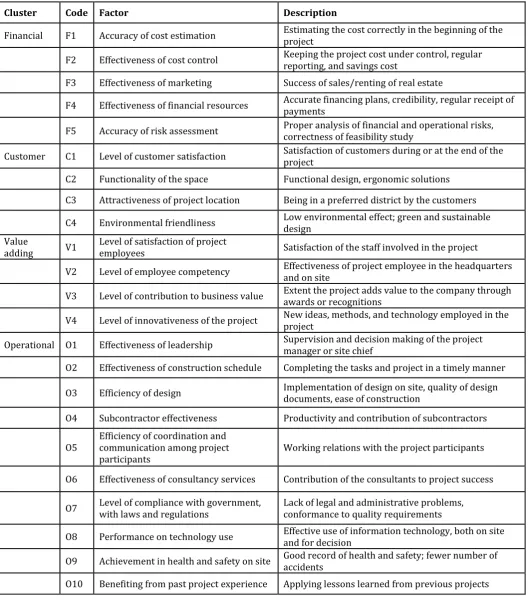
The data was collected from various construction firms around Pune city to classify the causes of delay and data taken from various literatures, books, conference proceedings, internet and international journals. The architects, contractors, and developers of various firms of Pune were targeted for survey. The list of success factors are given in TABLE 1.
6. DATA ANALYSIS
© 2015, IRJET.NET- All Rights Reserved Page 806 and a literature survey. Categorization of the identified
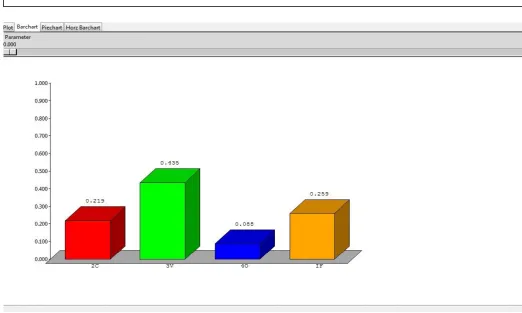
variables leads to a two-level hierarchy, in which the top-level elements (cluster) are decomposed into lower-top-level attributes (node). Thus, each factor on each level should be identified together with its connection with others in the system. In the model, there are inner dependencies within F, V, C, and O. F is assumed to be influenced by C; C is affected by F and V; V is affected by O; and O is affected by F, C, and V. The interrelations among the clusters are depicted in Figure. 1. Comparisons between nodes and among clusters were performed in this step. After the model was constructed, pairwise comparison matrices were formed based on the node connections. The experts were then asked to evaluate these matrices, which were later used to compute the importance weights of the attributes. Pairwise comparisons between parameters were performed based on the brainstorming sessions of the expert team. This collaborative approach was used to achieve a more reliable model through consensus among experts. The consistency of judgment also needed to be computed, as it can be a problem during the ANP exercise. In this step, a software package called SUPER DECISIONS was used to calculate the consistency ratio values (as an indicator of inconsistency of the evaluations). The respondents evaluated a total of 24 matrices that represent the interactions among clusters and nodes of the model. For example, the relative influence of the nodes of the operational cluster on the effectiveness of construction schedule, and the relative influence of the nodes of the customer cluster on the level of contribution to business value, was assessed by the experts. The last step of the analysis is to compute the magnitudes of influence of each node on the project success. The pairwise comparison matrices were combined by the SUPER DECISIONS program to form a synthesized matrix called the super matrix. The importance weight is found in the form of a bar chart which is generated by the software.
3. CONCLUSIONS
This paper analyzed most critical success factors by analytical network process method. If any construction companies try to implement these success factors then performance of project may increase. The graphical presentation of the factors is shown in the Figure 2.
REFERENCES
[1] Saaty, T. L. (1996). Decision making with dependence and feedback: The analytic network process, RWS Publications, Pittsburgh.
[2] Zarina Alias, E.M.A. Zawawi, Khalid Yusuf, Aris, NM), “Determining Critical Success factors of Project Management Practice: A conceptual framework”, (2014).
[3] Danial F. Oferi,”Project Management Practices and Critical Success Factors-A Developing Country Perspective”.
[4] Ozorhon, B., Dikmen, I., and Birgonul, M. T. (2007). “Using analytic network process to predict the performance of international construction joint ventures.”
© 2015, IRJET.NET- All Rights Reserved Page 807
ANNEXURE
Table 1- List of 23 finalized success factors
Real Estate Project Success Factors Used in the Study
Cluster Code Factor Description
Financial F1 Accuracy of cost estimation Estimating the cost correctly in the beginning of the project
F2 Effectiveness of cost control Keeping the project cost under control, regular reporting, and savings cost
F3 Effectiveness of marketing Success of sales/renting of real estate
F4 Effectiveness of financial resources Accurate financing plans, credibility, regular receipt of payments
F5 Accuracy of risk assessment Proper analysis of financial and operational risks, correctness of feasibility study
Customer C1 Level of customer satisfaction Satisfaction of customers during or at the end of the project
C2 Functionality of the space Functional design, ergonomic solutions
C3 Attractiveness of project location Being in a preferred district by the customers
C4 Environmental friendliness Low environmental effect; green and sustainable design
Value
adding V1
Level of satisfaction of project
employees Satisfaction of the staff involved in the project
V2 Level of employee competency Effectiveness of project employee in the headquarters and on site
V3 Level of contribution to business value Extent the project adds value to the company through awards or recognitions
V4 Level of innovativeness of the project New ideas, methods, and technology employed in the project
Operational O1 Effectiveness of leadership Supervision and decision making of the project manager or site chief
O2 Effectiveness of construction schedule Completing the tasks and project in a timely manner
O3 Efficiency of design Implementation of design on site, quality of design documents, ease of construction
O4 Subcontractor effectiveness Productivity and contribution of subcontractors
O5
Efficiency of coordination and communication among project participants
Working relations with the project participants
O6 Effectiveness of consultancy services Contribution of the consultants to project success
O7 Level of compliance with government, with laws and regulations Lack of legal and administrative problems, conformance to quality requirements
O8 Performance on technology use Effective use of information technology, both on site and for decision
O9 Achievement in health and safety on site Good record of health and safety; fewer number of accidents
© 2015, IRJET.NET- All Rights Reserved Page 808