© 2016, IRJET ISO 9001:2008 Certified Journal Page 1334
Optimization of Feeder Design Using virtual Simulation Technique
- A Case Study
Pradnyesh V. Kadam
1, Bhushan S. Kamble
2,
1
PG student at Dept. of Production Engg., KIT’s College of Engineering, Kolhapur, Maharashtra, India
2Assistant Professor, Dept. of Production Engg., KIT’s College of Engineering, Kolhapur, Maharashtra, India
---***---Abstract -
The ability of a molten metal to get the shape of the mould is a casting process. Casting is a defect prone manufacturing process. A variety of defects measuring from 3-6% of the total casting produced are commonly in the acceptable level. Metal casting industries are continuously exposed to ever increasing demands regarding their competitiveness, sound quality products as well as in developing their specific casting process. The casting development process for a new product was in the past determined within the foundry using "personal experience" as well as "shop floor trial and error”. In order to achieve continuous improvements, controlled processes and close customer-vender relationships, foundries have introduced QMS which in turns enable implementation of quality requirements using CAE tools like FEA and simulation of casting techniques which are effective and reliable tools in order to achieve reliable and calculable product development and production processes. Simulation based approach has helped in the improvement of the feedability index which represents yield of riser and quality of casting. The methods layout of a casting is an important activity in tooling development. It involves critical decisions regarding part orientation in mold, parting line, cores, cavity layout, feeder’s size and its location, feedaids and gating system dimensions. An improper layout leads to either poor quality or low yield, affecting manufacturing costs and productivity. Here an attempt is made to virtually simulate feeding system design in order to obtain optimum risering solution by using AutoCAST simulation software.Key Words: Volumetric shrinkage; Hot spot; Casting simulation; Feeding system design; Riser modulus; Casting yield; and Optimum design
1. INTRODUCTION
Manufacturing is the backbone of any industrialized nation. A basic Casting process is one of the earliest metal shaping and forming process. It means pouring molten metal into a refractory mold cavity and allows it to solidify. The solidified object is taken out from the mold either by breaking or taking the mold apart. The solidified object is called casting and the technique followed in method is known as casting process or in other word it’s a process wherein there is shortest distance between raw material and a finished good.
1.1 AutoCAST casting simulation:
The AutoCAST software developed at I.I.T. Bombay in collaboration with Advanced Reasoning Technologies provides a single integrated easy to use environment for casting method design, solid modelling, and simulation. AutoCAST is the world's most intuitive, incredibly fast, and truly integrated casting software for methods design, simulation and optimisation. It is widely preferred and adopted software to improve the quality and yield of existing castings, to develop new castings quickly without foundry trials, and to reduce the total cost in collaboration with customers. It provides a complete solution for casting methods design and optimization. It helps Regarding Part Analysis (Design for Manufacture), Methods Design (Mold layout, Part orientation, Feeders layout, gating system layout,) and Quick Simulation wherein it verifies the methods design by checking possible defects like mold erosion, filling time, and shrinkage porosity through casting simulation. Casting design involves converting the part design to the tooling design: orientation in the mold, parting line, application of draft and allowances, feeding and gating systems, core boxes and other elements. Simulation includes mold filling and casting solidification, useful for optimizing the design of gating and feeding systems respectively (7)
1.2 Case study:
[image:1.595.318.543.568.718.2]The component under study is a 1.9 Kg Cast Iron coupling used in Hydraulic application. The material specifications are as follows.
Fig. 1: Cast Iron coupling component under study
C Si Mn S P Cr Cu
© 2016, IRJET ISO 9001:2008 Certified Journal Page 1335 assembly.
[image:2.595.36.282.223.374.2]Fig- 2.Split Shell mold for casting showing casting cavity
Fig- 3.Resin coated sand core made by hot box method
[image:2.595.36.278.398.546.2]
Fig- 4. Core assembly
Fig. 5. Previous gating and risering system-CAD model of methoding Top and bottom side layout with two castings per mould.
In order to achieve an economical profitable manufacturing process, most patterns are fitted with the maximum amount of cavities (In present condition it is 2 castings in a single shell mold). In many cases a non-symmetrical layout is the result, especially in relation to orientation of component in mold cavity as well as location of gating junction. Because of lack of permeability and common riser for both cavities and also due to different flow patterns gating system, the whole filling process of both cavities is inherently uneven. The gas is not able to come out of mold cavity and it forms a blow hole , shrinkage cavity and micro holes over inside and outside of casting. As shown in Fig.1 and 6 casting shows a blow hole and internal shrinkage cavity and micro pin holes defects. The casting yield is of 54 % with previous condition of gating system as shown in fig.5 which is required to be optimized.
[image:2.595.36.276.568.741.2] [image:2.595.326.540.610.734.2]© 2016, IRJET ISO 9001:2008 Certified Journal Page 1336
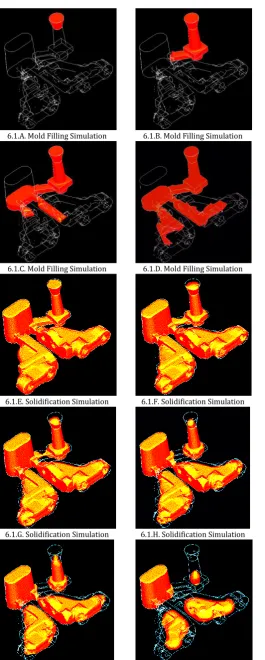
6.1.A. Mold Filling Simulation 6.1.B. Mold Filling Simulation
6.1.C. Mold Filling Simulation 6.1.D. Mold Filling Simulation
6.1.E. Solidification Simulation 6.1.F. Solidification Simulation
6.1.G. Solidification Simulation 6.1.H. Solidification Simulation
6.1.I. Solidification Simulation 6.1.J. Solidification Simulation
6.1.K. Solidification Simulation 6.1.L. Solidification Simulation
6.1.M. Solidification Simulation 6.1.N. Solidification Simulation
Fig-6.1. Mold filling and solidification simulation
The Previous gating and risering system is simulated for hot spot and shrinkage cavities. The mold filling and solidification results are tabulated as shown in fig. 6.1.
[image:3.595.36.302.91.753.2]1.4 Computer assisted casting development :
Fig. 7. Computer assisted casting development
Generation of three dimensional model of the mold incorporating feeder cavities and gating entitles has recently been adopted for visualization and the process simulation; this requires the additional input from the user regarding the location of the mold box sprue, runners and ingates.
[image:3.595.311.564.476.630.2]
© 2016, IRJET ISO 9001:2008 Certified Journal Page 1337 Fig. 8.Proposed Methodology for method design
2. DEVELOPMENT OF METHODING USING
AUTOCAST SIMULATION SOFTWARE:
The following steps were performed on AutoCAST software so as to get the methoding for the casting
1. The 3-D model from CATIA is converted in to the .STL Format.
2. The model is assigned the material- FG 260 shell mold casting
3. Surface area, number of holes, volume, weight etc. were calculated.
4. The parting line and parting plane is suitably adjusted taking into consideration the ease of removing the pattern from the cope and drag part.
5. The cored characters were generated.
6. For the whole assembly the mould box is selected as per the company’s regular practice.
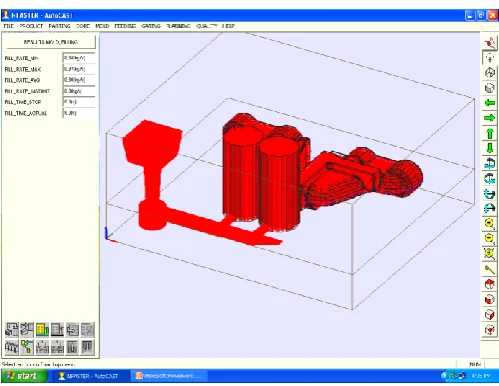
7. Feeding function is carried out to locate shrinkage. 8. The analysis through it showed the two dominant areas which were prone to the shrinkage and micro porosities. 9. For these areas to be taken care of the feeders were provided as visible in the figures.
[image:4.595.308.556.199.495.2]10. The runner bar ,sprue, ingates was designed so as to feed the molten metal to the farthest point from point of metal pouring.
Fig. 9.1 Importing .stl file format 3D model
[image:4.595.307.559.568.760.2]Fig. 9.2 Selection of Casting Process as shell molding
© 2016, IRJET ISO 9001:2008 Certified Journal Page 1338 Fig. 9.4 Selection and Model in Mold
Fig. 9.5 Selection of Parting Line
[image:5.595.296.560.55.501.2]Fig. 9.6 Check for internal shrinkage Defect
[image:5.595.309.557.300.499.2]Fig. 9.7 Design and Model of Feeder
Fig. 9.8 Design of Runner bar and gating system
[image:5.595.308.558.518.711.2]© 2016, IRJET ISO 9001:2008 Certified Journal Page 1339 Fig. 9.10 Shrinkage cavity shifted to riser with red dots
3. EXPERIMENTAL RESULTS:
Experimental trials are carried with modifiedgating system which shows following results.
Previous design Modified design
Casting yield 54% Casting yield 64%
4. CONCLUSION
Simulation of present casting is done in the AutoCAST software by selecting proper parameters. The software has provided a modified gating and risering system. With proposed gating and risering system the percentage of yield has improved from 54% to 64%. The virtual simulation has shown the hotspot, where shrinkage may arise. By using simulation the bottlenecks and non-value added time in casting development can be minimized. Casting simulation can minimize the wastage of resources required for trial production. In addition, the optimization of quality and increased yield implies higher value-addition and lower production cost and improving the profit.
REFERENCES
[1] Dr. B. Ravi, (1999), “Computer-Aided Casting Design –
Past, Present and Future”, Indian Foundry Journal, Vol. 45(1), pp. 65-74.
[2] Dr. B. Ravi, R. C. Creese, D. Ramesh,(1999), “Design for
Casting – A New Paradigm for Preventing Potential Problems” Transactions of the American Foundry Society, Vol. 107.
Materials and Biomaterials Applications, 2(4): Page. 25-28.
[6] L.E.Smiley, D.C.Schmidt, (2013), “Computer design of
feeding systems for iron castings or how to avoid years of problems with 20 minutes of analysis”, AFS Proceeding, Americans foundry society, Schaumburg, IL,USA, Panel 13-1261,
[7] Prof. Gunjan Bhatt, (2013), Usage Of An Integrated
CAD/CAE/CAM System In Foundries, International Journal of Engineering Research & Technology (IJERT), Vol. 2 Issue 6
[8] A.K.Gajbhiye, C.M.Choudhari, D.N.Raut, B.E.Narkhede,
B.M.Bhandarkar, (2014), Minimization of Shrinkage Porosity in A Sand Casting Process By Simulation In AUTOCAST-X Software with Experimental Validation by Destructive testing , International journal of Modern Engineering Research (IJMER), Vol.4 Issue 5.
[9] C. M. Choudhari, B. E. Narkhede, S. K. Mahajan,(2014),
“Casting Design and Simulation of Cover Plate using AutoCAST-X Software for Defect Minimization with Experimental Validation”, 3rd International Conference on Materials Processing and Characterisation, Procedia Materials Science 6, Page. 786 – 797
[10] Harshil Bhatta, Rakesh Barota, Kamlesh Bhatta, Hardik
Beravala ,Jay Shah, (2014 ), “Design Optimization of Feeding System and SolidificationSimulation for Cast Iron” ,Procedia Technology , 2nd International Conference on Innovations in Automation and Mechatronics Engineering, ICIAME 2014, Page.357 – 364
[11] Bhushan S. Kamble, Pradnyesh V. Kadam, (2016)
Optimized Design of Risering System for Casted Component by Using Web Based Online Simulation E-Tool, International Research Journal of Engineering and Technology (IRJET), Volume 3, Issue 3
BIOGRAPHIES:
Pradnyesh V. Kadam P.G Student
Dept. of Production Engineering
KIT’s College of Engineering, Kolhapur Maharashtra.
Bhushan Shankar Kamble Assistant Professor
KIT’s College of Engineering, Kolhapur Maharashtra.