© 2016, IRJET | Impact Factor value: 4.45 | ISO 9001:2008 Certified Journal
| Page 792
Using white limestone cement for the removal of Zn (II) ions
from Zn-electroplating effluent : Kinetic modeling studies
Safa Chaabane
1, Khalifa Riahi
2, Malek Jelassi
3, Béchir Ben Thayer
41
National Agronomic Institute of Tunisia, University of Carthage- Tunisia
.2,4
High Institute of Rural Engineering and Equipment Medjez El Bab,University of Jendouba- Tunisia.
3National Institute of Engineering Tunis, University of Tunis-El Manar- Tunisia
---***---Abstract -
In this paper, white limestone cement(WLC) was investigated to assess the possible use of this mineral material as an effective adsorbent for the removal of Zinc ions from an electroplating factory. The influence of various parameters such as contact time, pH solution, sorbent dose and agitation speed has been studied for the adsorption of Zn (II) onto white limestone cement (WLC) in batch mode. In order to investigate the mechanism of sorption suitable kinetic models have been used to test experimental data. The equilibrium Zn uptake (qe = 5.3 mg/g) onto WLC was
reached for the initial Zinc concentration=38mg/L, pH=10.1, WLC material dosage= 7g/L and for 240 mn equilibrium contact time at 18°C±02. The results showed that, pseudo second-order and Elovich models, provides the best fit to experimental data predicting a chemisorption process. The removal of Zn (II) ions onto WLC material from electroplating effluent was also well describes by homogeneous diffusion and intra-particle diffusion models.
Key Words:
Zinc (II) removal, Electroplating effluent,
White
limestone
cement,
Kinetic
modeling,
Chemisorption.
1. Introduction
Conventional physical and chemical methods for removal of toxic metals including chemical precipitation, ion exchange, membrane separation and adsorption by activated carbon are available, but they have drawbacks such as incomplete metal removal, high energy and reagent requirements, high capital and operational cost and excessive generation of toxic sludge [1-3]. With increasing environmental awareness and the toughening of governmental policies, it has become necessary to develop new environmentally friendly ways to clean up contaminants using low-cost methods [4, 5].
Zinc Electroplating provides corrosion resistance to the steel fastener by acting as a barrier and sacrificial coating. Zinc is more electrochemically reactive than steel, so when
exposed to a corrosive environment, the zinc plating corrodes sacrificially, delaying rust formation on the fastener even after portions of bare steel are exposed. Electroplating production is a widely used and most environmentally harmful industrial process, during which a large volume of wastewater containing heavy metal ions such as copper, zinc, nickel, cadmium, lead and chromium is generated. All these metals are very toxic and cause great environmental damage [6]. As only 30 to 40% of all metals used in plating processes are effectively used, waste effluents from acid-Zn2+- plating lines are responsible for high amounts of Zn2+ encountered in electroplating discharges [7, 8].
Chemical precipitation with lime or caustic soda is one of the common conventional treatments, where recovery of metals or water is not a consideration. However, to effectively decrease metals to acceptable levels requires a large excess of chemicals, which generates volumetric sludge and increases the costs. Other available technologies for electroplating effluent treatment such us ion exchange [9] and electrodeionization (EDI) [10] were studied. It has been demonstrated that certain species of plants, which are naturally available at low cost such as rice husk [1, 2], Trichoderma viride biomass [5], Azolla filiculoides biomass [8], Aspergillus lentulus biomass [11], Saccharomyces cerevisiae biomass [12], sugar cane bagasse [13], crab shells [14], have the potential to effectively remove heavy metals from electroplating industries effluents by a sorption process thus offering an alternative to the existing technologies.
© 2016, IRJET | Impact Factor value: 4.45 | ISO 9001:2008 Certified Journal
| Page 793
2. Materials and methods
2.1 Materials
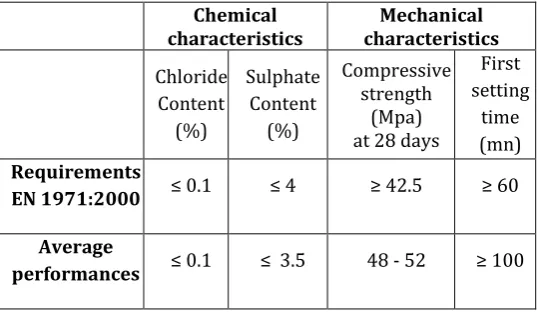
[image:2.595.28.297.442.599.2]The White Cement Company “SOTACIB” is a corporation, which exploits a plant of white cement, in Feriana (Kasserine) in the middle-west of Tunisia. Over the years, several improvements have been made to the production process. The production volume in 2010 is about 476 000 metric tons of White clinker and sales volume reached 505 000 metric tons of white cement. The White Limestone Cement CEM II/A-L 42.5 N is characterized by the homogeneity and the regularity during the time. It is the result of grinding white clinker, between 80 and 94% and limestone with an addition of secondary component between 6 and 20 %. These additions do not include any product promotes the corrosion or negatively affects the properties of concrete made with this cement. This cement is in accordance with the Tunisian standards NT 47-01, certificate delivered by INNORPI, European Standard EN 197-1: 2000, certificate delivered by AENOR and Spanish standard DCE-3471, certificate delivered by the Spanish Ministry of Industry, Tourism and trade. The average performances of chemical and mechanical characteristics of white limestone cement (WLC) compared to the requirements EN 197-1:2000 are given in Table 1 [15].
Table-1: Chemical and mechanical characteristics of white limestone cement
Chemical
characteristics characteristics Mechanical Chloride
Content (%)
Sulphate Content
(%)
Compressive strength
(Mpa) at 28 days
First setting
time (mn) Requirements
EN 1971:2000 ≤ 0.1 ≤ 4 ≥ 42.5 ≥ 60
Average
performances ≤ 0.1 ≤ 3.5 48 - 52 ≥ 100
2.2 Electroplating effluent sampling
The Zn-electroplating wastewater was collected from a factory manufacturing in North of Tunisia. Zn (II) concentration in the electroplating rinse effluent sampled in the present study, for instance, was found much higher than the regulated criteria (5 mg/L, Tunisian Standards NT 106-02). The electroplating rinse effluent (([Zn (II)] = 38 mg/L), pH 3.12), sampled from an acid-Zn2+ -electroplating line, was characterized by high amounts of chlorides ions (3.8 g/L) and boric acid H3BO3 (25 g/L).
2.3 Batch kinetic experiments
Zn (II) sorption kinetics study was carried out with initial concentration from electroplating rinse effluent and kept at room temperature (18°C±02). The flask was capped and stirred magnetically for 300 min to ensure approximate equilibrium. Several mL of reaction solution was sampled for intervals between 0 and 300 min of sorption contact time at pH0= 3, WLC material dose at 7 g/L and for agitation speed at 700 rpm. At the end of each sorption period, the solution was filtered through a 0.45 µm membrane filter and analyzed for Zn (II) concentration. The effect of the initial aqueous pH solution on Zn (II) sorption was examined in a series of experiments while pH varied between 3 and 12.6. The pH of the solution was maintained at a defined value by adding HNO3 and/or NaOH solutions (0.1 M). The added volume for pH adjustment did not exceed 1% of the solution volume. The effect of WLC material dosage on the Zn (II) removal was determined by varying doses from 1 to 20 g/L. The effect of agitation speed (100–1100 rpm) on Zn (II) sorption onto WLC material was also investigated. Measurements were made in triplicates for the analysis of Zn (II) parameter and data were recorded when the variations in two readings were less than 5%. In this paper, All data represents an average of three independent experiments (N = 3) and data represent the mean value.
2.4 Zn (II) analysis and uptake
The analysis of Zn2+ ions was was determined by atomic absorption spectrophotometry. The triplicate experiments demonstrated the high repeatability of this adsorption method and the experimental error could be controlled within 5%. The uptake of Zn2+ ions (mg/g) was calculated from the decrease of the Zn (II) concentration in solution with respect of V, the volume of the solution in L and M the mass of white limestone cement (WLC) in g from mass balance equation as follows:
2.5 Kinetic models
© 2016, IRJET | Impact Factor value: 4.45 | ISO 9001:2008 Certified Journal
| Page 794
by the Linear Driving Force Model and can be solvedanalytically using MATLAB © 2012 [18].
2.5.1 Pseudo first-order equation
The pseudo first-order equation is generally expressed as follows:
After integration and applying the boundary conditions, for qt = 0 at t = 0 and qt = qt at t= t, the integrated form of equation (2) becomes:
Where qe and qt are the amounts of phosphates sorbed at equilibrium and at time t (mg/g), respectively, and k1 is the rate constant of pseudo first-order sorption (l/min).
2.5.2 Pseudo second-order equation
If the rate of sorption is a second-order mechanism, the pseudo second-order chemisorption kinetic rate equation after integration is expressed as:
Where kII is the rate constant of pseudo second-order sorption (g/(mg.min) and qe is the amount of phosphates sorbed at equilibrium (mg/g).
2.5.3 Intra-particle diffusion equation
The fractional approach to equilibrium changes according to a function of (D/r2)1/2, where r is the particle radius and D the diffusivity of solute within the particle. The initial rate of the intra-particle diffusion is the following:
Where kd is the intra-particle diffusion rate constant (mg/g min1/2).
2.5.4 The Elovich equation
The Elovich equation is given as follows:
The integration of the rate equation with the same boundary conditions as the pseudo first- and second-order equations becomes the Elovich equation.
Where α is the initial sorption rate (mg/g min), and the parameter β is related to the extent of surface coverage and activation energy for chemisorption (g/mg).
2.5.5 Mass transfer models in batch system
2.5.5.1 Homogeneous Diffusion Model
Mass conservation inside the particles
The initial and boundary conditions for Eq. (8) are:
2.5.5.2 Linear driving force model (LDF)
If the average metal concentration inside the particle is considered, instead of a concentration profile, the following equations are obtained:
Mass conservation in the fluid inside:
Initial condition:
Rearranging equations (12) and (13) the following expression is obtained that can be solved analytically using the initial conditions of equation (14):
3. Results and discussion
3.1 Effect of experimental conditions
3.1.1 Effect of contact time
© 2016, IRJET | Impact Factor value: 4.45 | ISO 9001:2008 Certified Journal
| Page 795
agitation speed at 700 rpm and for a contact period of 300min at pH=3. The results show that adsorption process is clearly time dependent. It was observed that most of the Zn (II) uptake occurs within a time of 210 mn at 94 % of the totally sorbed for an initial Zn (II) concentration of 38 mg/L. For periods greater than 210 mn, the Zn (II) uptake is further increased but with a much slower rate. At the beginning of the removal experiments, the sorption rate was relatively rapid because Zinc ions were mainly adsorbed at the exterior surfaces of WLC. When the adsorption of the exterior surfaces of the material reached saturation, the Zinc ions entered the related particles and were absorbed with a slower rate by the interior surface of the particles. This finding is in concordance with many authors [19-21] when they studied phosphates removal by minerals such phosphates mine wastes, dolomite and marble wastes. Equilibrium began establishing itself after approximately a contact period of 240 mn. This outcome is generally in line with previous similar studies such as the adsorption of Zn (II) ions onto some natural and low cost adsorbent, where the equilibrium time was evaluated to be about 240 mn [22, 23].
0 1 2 3 4 5 6
0 100 200 300 400
q
t
(m
g/
g)
Contact time (mn)
Fig -1: Effect of contact time on Zn (II) sorption onto WLC (Conditions: [Zn]0 = 38 mg/L, pH0 = 3, adsorbent dose= 7 g/L, agitation speed = 700 rpm at 18 °C±02 )
3.1.2 Effect of pH solutions
The effect of pH on Zn (II) specie from electroplating effluent by sorption onto WLC material was examined in a series of experiments that used the same initial Zn (II) concentration (38 mg/L) while maintaining pH at different values between 3 and 12.6. The effect of pH on Zn (II) specie sorption onto WLC material is illustrated in Fig. 2.
Fig -2: Effect of pH solution on Zn (II) sorption onto WLC (Conditions: [Zn]0 = 38 mg/L, contact time = 240 mn, adsorbent dose = 7 g/L, agitation speed = 700 rpm at 18°C±02 )
The results show that the uptake of Zn (II) specie sorption onto WLC material tends to increase with the increase of pH from 3 mg/g at pH 3.12 to 5.35 mg/g at pH 10.1. With increasing pH, electrostatic repulsion decreases due to reduction of positive charge density on the sorption sites thus resulting in an enhancement of metal sorption. The above fact related to the effect of pH on heavy metal adsorption onto low cost abundantly available materials also supported by several earlier workers [22, 24, 25]. At higher pH values OH- ions compete for Zn (II) with the active sites on the surface of the adsorbent. Zinc is expected to form hydroxides Zn(OH)2 in the high pH condition (pH>8) of cement system. The hydroxy-complexes Zn(OH)42− and Zn(OH)53− can be present in a strong alkaline solution [26].
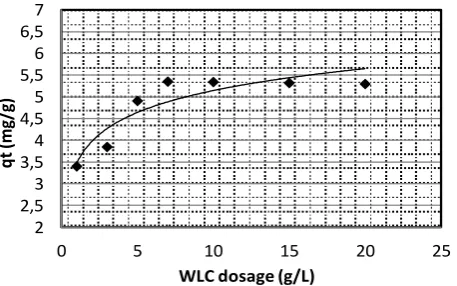
3.1.3 Effect of material dosage
[image:4.595.48.292.375.527.2]© 2016, IRJET | Impact Factor value: 4.45 | ISO 9001:2008 Certified Journal
| Page 796
insufficient to cover completely the exchangeable sites onthe adsorbent, usually resulting in low metal uptake [29]. Moreover, the interference between binding sites due to increased adsorbent concentration can result in a low specific uptake [30].
2 2,5 3 3,5 4 4,5 5 5,5 6 6,5 7
0 5 10 15 20 25
q
t (
m
g/g)
WLC dosage (g/L)
Fig -3: Effect of WLC dosage on Zn (II) sorption onto WLC (Conditions: [Zn]0 = 38 mg/L, contact time = 240 mn, pH0=3, agitation speed = 700 rpm at 18 °C±02 )
3.1.4 Effect of agitation speed
[image:5.595.48.277.192.335.2]The rate of the adsorption process may be controlled by external mass transfer or/and intra-particle diffusion. External mass transfer is usually important at the initial stages of the process. The results show that the rate of zinc sorption on WLS material was not significantly influenced by the degree of stirring (Fig. 4). Thus, mass transfer across the boundary layer did not impact the adsorption rate of the process. Taparcevska et al. [31] investigated the impact of agitation speed (150-190 rpm) on Zn2+ removal from aqueous solutions by employing zeolite and concluded that the rate of zinc adsorption on zeolite was not significantly influenced by the degree of stirring. On the contrary, Shawabkeh et al. [32] used zeolite produced by Jordanian oil shell ash to remove zinc from wastewater and found that the rate of adsorption increased with increasing agitation speed. Finally, the application of appropriate agitation increases ion mobility in the solution and thus, the mass transfer resistance reduces [27, 33].
Fig-4: Effect of agitation speed on Zn (II) sorption onto WLC (Conditions: [Zn]0 = 38 mg/L, contact time = 240 mn, pH0 = 3, adsorbent dose = 7 g/L at 18 °C±02 )
3.2 Kinetic modeling
Adsorption kinetics modeling is very useful for better understanding of Zn (II) sorption mechanisms onto WLC material such as the importance of the chemical reactions and the particle diffusion processes. To fit the obtained Zn (II) sorption experimental data, we used the most well-known of them, namely the pseudo first-order, the pseudo second-order, the intra-particle diffusion model and the Elovich kinetic model. Mass transfer models in batch system (Homogeneous Diffusion Model and Linear Driving Force Model) were also used in this study. Results of the theoretical and experimental values of Zn (II) sorption uptake at equilibrium (qe (mg/g)) and correlation coefficient (R2) are presented in Table 2.
Table-2: Zn (II) uptake (mg/g) and correlation coefficient (R2) of experimental and predicted kinetic models
For the pseudo-first-order model, the difference between experimental and theoretical adsorbed masses at equilibrium is very high. The theoretical values are more to twice times higher than the experimental one. These results state a bad fit between the model and the experimental data. As a consequence, sorption of Zn (II) onto WLC material is not an ideal pseudo-first-order reaction. For the pseudo-second-order model, the difference between the experimental and theoretical Zn (II) sorption uptake at equilibrium is very small (less than 5%). The mass transfer (Homogeneous Diffusion Model) and intra-particle diffusion models were able to fit the kinetic experimental data. The Elovich model can be also suitable for describing the sorption kinetic of Zn (II) onto WLC material. A comparison of calculated and measured results for all kinetic models as time depending is shown (figure 5).
qe (mg/g) R²
Experimental 5.344 0.9463
Pseudo-first-order model 12.67 0.7812
Pseudo
second-order model 5.322 0.9857
Elovich model 5.324 0.9463
Intra-particle
diffusion model 5.799 0.9381
Linear driving
force model 6.529 0.8431
Homogeneous
© 2016, IRJET | Impact Factor value: 4.45 | ISO 9001:2008 Certified Journal
| Page 797
Fig-5: Comparison between experimental and predictedkinetic models for Zn (II) sorption onto WLC
The pseudo first-order and Linear Driving Force Model equations do not give a good fit to the experimental data for the Zn (II) sorption onto WLC material. The pseudo second-order equation provides the best correlation for all of the sorption process and fit the experimental data well. Several researchers have reported that the adsorption of these metals on minerals follows the pseudo second-order model. The pseudo second-order equation describes the chemical sorption and thus some type of chemical reaction is considered to take place that includes valence forces with the exchange of ions or the formation of covalent bonds [27, 34]. The agreement of the Elovich equation with experimental data may be explained as below. The general explanation for this form of kinetic law involves a variation of the energetics of chemisorption with the active sites are heterogeneous and therefore, exhibit different activation energies for chemisorption. Elovich model gives a good correlation for adsorption on highly heterogeneous surfaces and also it shows that along with surface adsorption chemisorptions is also a dominant phenomenon taking place [35]. However, the good fit of the pseudo second-order and Elovich models with the experimental data does not necessarily reveal the true nature of the mechanism that takes place [36]. The reaction kinetic equation limits the uptake rate in only one mechanism [37]. Nevertheless, metal adsorption on minerals is considered a diffusion process in which more than one stage may be observed to take place. The transfer of metal ions from the liquid to the solid phase is a complex process, which involves the diffusion into the boundary layer that surrounds the solid particles, as well as, on the surface and the interior of the solid particles. The adsorption of metal ions on the solid surface includes the following stages [27, 38, 39]:
(i) the transfer of the metal ions from the bulk solution to the liquid–solid interface which takes place through convection,
(ii) the diffusion of the metal ions through the boundary layer that surrounds the solid particles, reaching the solid surface (i.e. film diffusion),
(iii) the diffusion of metal ions on the surface (surface diffusion) and the interior (pore diffusion) of the solid particle,
(iv) the adsorption of the metal ions to active adsorption sites on the mineral’s surface. This stage is considered to be an equilibrium reaction.
The diffusion mechanism depends on several parameters including the structure and the type of adsorbent, the physic-chemical properties of the adsorbent and adsorbate, as well as, other conditions that may affect the process performance [27].
4. CONCLUSIONS
The removal of Zn (II) from an electroplating effluent using white limestone cement (WLC) was carried out under different experimental conditions. The results showed clearly that the increase of pH and sorbent dose increase the Zn (II) sorption efficiencies. The equilibrium sorption capacity of Zn (qe = 5.3 mg/g) onto WLC was reached for the initial Zinc concentration = 38 mg/L, pH = 10.1, WLC material dose = 7 g/L and for 240 mn equilibrium contact time at 18°C±02. All findings presented in this study suggest that the sorption of Zn (II) ions onto WLC material follows the pseudo second-order and Elovich models predicting a chemisorption process. The removal of Zn (II) ions adsorption onto WLC material was also well describes by homogeneous diffusion and intra-particle diffusion models. The on-site technology for Zn (II) treatment enables the extraction of pure zinc ions from rinse water and recycling of the metal back to the plating bath, which is not only economically profitable but also environmentally beneficial. Concentration and extraction of heavy metals by WLC material sorption could be implemented as an efficient and economically viable process, complementing existing water purification methods. The treated effluent can be recycled to rinse tanks therefore reducing water consumption in electro- plating shops.
ACKNOWLEDGEMENT
© 2016, IRJET | Impact Factor value: 4.45 | ISO 9001:2008 Certified Journal
| Page 798
REFERENCES
[1] Wong, K.K., Lee, C.K., Low, K.S, Haron, M.J, Removal of Cu and Pb from electroplating wastewater using tartaric acid modified rice husk. Process Biochemistry, 39, (2003), 437-445.
[2] Krishnani, K.K., Meng, X., Christodoulatos, C., Bodduc, V.M., Biosorption mechanism of nine different heavy metals onto biomatrix from rice husk. Journal of Hazardous Material, 153, (2008), 1222-1234.
[3] Hanif, A., Bhatti, H.N., Hanif, M.A., Removal and recovery of Cu(II) and Zn(II) using immobilized Mentha arvensis distillation waste biomass. Ecological Engineering, 35, (2009) 1427-1434.
[4] Bunluesin, S., Kruatrachue, M., Pokethitiyook, P., Upatham, S., Lanza, G.R., Batch and continuous packed column studies of cadmium biosorption by Hydrilla verticillata biomass. Journal of Bioscience and Bioengineering, 103, (2007), 509-513.
[5] Kumar, R, Bhatia, D, Singh, R, Rani, S, Bishnoi, NR, Sorption of heavy metals from electroplating effluent using immobilized biomass Trichoderma viride in a continuous packed-bed column. International Biodeterioration & Biodegradation, 65, (2011) 1133-1139.
[6] Wang, L.K, Chen, J.P, Hung, Y.T, Shammas, N.K. (Eds.), Handbook on Heavy Metals in the Environment, Taylor & Francis and CRC Press, Boca Raton, FL, (2010), 247–291.
[7] Grebenyuk, V.D., Sorokin, G.V., Verbich, S.V., Zhiginas, L. H., Linkov, V.M., Linkov, N.A, Smit J.J, Combined sorption technology of heavy metal regeneration from electroplating rinse waters. Water SA, 22, (1996), 381-384.
[8] Zhao, M, Duncan, J.R, Van Hille, R.P, Removal and recovery of zinc from solution and electroplating effluent using Azolla filiculoides. Wat. Res, 33, (1999), 1516-1522.
[9] Yalçin, S., Apak, R., Hizal, J., Afsr, H., Recovery of copper (II) and chromium (III, VI) from electroplating-industry wastewater by ion exchange. Sep. Sci. Technol, 36, (2000), 2181-2196.
[10]Feng, X, Wu, Z, Chen, X, Removal of metal ions from electroplating effluent by EDI process and recycle of purified water. Separation and Purification Technology, 57, (2007), 257-263.
[11]Mishra, A, Malik, A, Simultaneous bioaccumulation of multiple metals from electroplating effluent using Aspergillus lentulus. Water research, 46, (2012), 4991-4998.
[12]Machado, M.D, Soares, E.V, Soares, H, Selective recovery of copper, nickel and zinc from ashes produced from Saccharomyces cerevisiae contaminated biomass used in the treatment of real electroplating effluents. Journal of Hazardous Materials, 184, (2010), 357-363.
[13]Sousa, F.W, Sousa, M.J, Oliveira, I.R.N, Oliveira, A.G, Cavalcante, R.M, Fechine, P.B.A, Neto, V.O.S, Keukeleire, D, Nascimento, R.F, Evaluation of a low-cost adsorbent for removal of toxic metal ions from wastewater of an electroplating factory, Journal of Environmental Management, 90, (2009) 3340-3344. [14]Vijayaraghavan, K, Palanivelu, K, Velan, M, Crab
shell-based biosorption technology for the treatment of nickel-bearing electroplating industrial effluents. Journal of Hazardous Materials, B119, (2005), 251-254.
[15]SOTACIB, La société Tuniso-Andalouse de ciment blanc SOTACIB. www.sotacib.com
[16]Ozacar, M, Sengil, I.A, Application of kinetic models to the sorption of disperse dyes onto alunite. Coll. Surf. A: Physicochem. Eng. Asp, 242, (2004), 105-113.
[17]Ornek, A, Ozacar, M, Sengil, I.A, Adsorption of lead onto formaldehyde or sulphuric acid treated acorn waste: Equilibrium and kinetic studies. Biochemical Engineering Journal, 37, (2007), 192-200.
[18]Vilar, VJ.P, Santos, S.C.R, Martins, R.J.E, Botelho, C.M.S, Boaventura, R.A.R, Cadmium uptake by algal biomass in batch and continuous (CSTR and packed bed column) adsorbers. Biochemical Engineering Journal, 42, (2008), 276-289.
[19]Karaca, S, Gurses, A, Ejder, M, Acikyildiz, M, Adsorptive removal of phosphate from aqueous solutions using raw and calcinated dolomite. Journal of Hazardous Materials, B128, (2006), 273-279.
[20]Jellali, S, Wahab, M.A, Anane, M, Riahi, K, Jedidi, N, Biosorption characteristics of ammonium from aqueous solutions onto Posidonia oceanica (L.) fibers. Desalination, 270, (2011), 40-49.
[21]Haddad, K, Jellali, S, Jaouadi, S, Benltifa, M, Mlayah, A, Hamzaoui, A.H, Raw and treated marble wastes reuse as low cost materials for phosphorus removal from aqueous solutions: Efficiencies and mechanisms. C. R. Chimie, 18, (2015), 75-87.
[22]Bhattacharya, A.K, Mandal, S.N, Das S.K, Adsorption of Zn(II) from aqueous solution by using different adsorbents. Chemical Engineering Journal, 123, (2006), 43-51.
[23] Jordao, C.P, Braganc, R, Fernandes, A, Ribeiro, K.L, Nascimento, B.S, Barros, P.M, Zn(II) adsorption from synthetic solution and kaolin wastewater onto vermicompost. Journal of Hazardous Materials, 162, (2009), 804-811.
[24]Munther, I.K, Zinc and cadmium adsorption on low-grade phosphate. Sep. Purif. Technol, 35, (2004), 61-70.
[25]Dakiky, M, Khamis, M, Manassra, M, Mereb, M, Selective adsorption of chromium (VI) in industrial wastewater using low-cost abundantly available adsorbents. Adv. Environ. Res, 6, (2002), 533-540. [26] Li, X.D, Poon, C.S, Sun, H, Lo, I.M.C, Kirk, D.W, Heavy
© 2016, IRJET | Impact Factor value: 4.45 | ISO 9001:2008 Certified Journal
| Page 799
based solidified/stabilized waste materials. Journal ofHazardous Materials, A82, (2001), 215-230.
[27]Malamis, S, Katsou, E, A review on zinc and nickel adsorption on natural and modified zeolite, bentonite and vermiculite: Examination of process parameters, kinetics and isotherms. Journal of Hazardous Materials, 252-253, (2013), 428-461.
[28]Esposito, A, Pagnanelli, F, Lodi, A, Solisio, C, Veglio, F, Biosorption of heavy metals by Sphaerotilus natans: an equilibrium study at different pH and biomass concentrations. Hydrometallurgy, 60, (2001), 129-141.
[29]Tangaromsuk, J, Pokethitiyook, P, Kruatrachue, M, Upatham, E.S, Cadmium biosorption by Sphingomonas paucimobilis biomass. Bioresour. Technol, 85, (2002), 103-105.
[30]Gadd, G.M, White, C, Rome, L.D, Heavy metal and radionuclide uptake by fungi and yeasts, in: P.R. Norri, D.P. Kelly (Eds.), Biohydrometallurgy, A. Rowe, Chippenham, Wilts, UK, 1988.
[31]Taparcevska, J, Markovska, L, Koumanova, B, Meshko, V, Diffusion models for adsorption kinetics of Zn2+, Cd2+ and Pb2+ onto natural zeolite. Water Sci. Technol, 62, (2010), 1136-1142.
[32]Shawabkeh, R, Al-Harahsheh, A, Al-Otoom, A, Production of zeolite from Jordanian oil shale ash and application for zinc removal from wastewater. Oil Shale, 21, (2004), 125-136.
[33]Park, D, Yun, Y.S, Park, J.M, The past, present, and future trends of biosorption. Biotechnol. Bioprocess Eng,15, (2010), 86-102.
[34]Febrianto, J, Kosasih, A.N, Sunarso, J, Ju, Y.H, Indraswati, N, Ismadji, S, Equilibrium and kinetic studies in adsorption of heavy metals using biosorbent: a summary of recent studies. J. Hazard. Mater,162, (2009), 616-645.
[35]Özacar, M, Sengil, I.A, A kinetic study of metal complex dye sorption onto pine sawdust. Process Biochemistry, 40, (2005), 565-572.
[36]Schiewer, S, Patil, S.B, Pectin-rich fruit wastes as biosorbents for heavy metal removal: equilibrium and kinetics. Bioresour. Technol, 99, (2008), 1896-1903. [37]Perez Marin, A.B, Aguilar, M.I, Meseguer, V.F, Ortuno,
J.F, Saez, J, Liorens, M, Biosorption of chromium (III) by orange (Citrus cinensis) waste: batch and continuous studies. Chem. Eng. J, 155, (2009), 199-206.
[38]Sen, T.K, Gomez, D, Adsorption of zinc (Zn2+) from aqueous solution on natural bentonite. Desalination, 267, (2011), 286-294.
[39]Aksu, Z, Tatli, A.I, Tunc, O, A comparative adsorption/biosorption study of Acid Blue 161: effect of temperature on equilibrium and kinetic parameters. Chem. Eng. J, 142, (2008), 23-39.
BIOGRAPHIES
Safa Chaabane earned Engineering diploma in Hydraulic and Management, MSc in Hydrology-Hydrogeology at High Institute of Rural Engineering and Equipment Medjez El Bab, Jendouba University, Tunisia. She is currently a Ph.D Student in National Agronomic Institute, Carthage University, Tunisia. His research interests are water quality and treatment.
Khalifa Riahi.He received his Ph.D. in Geosciences at Faculty of Sciences of Tunis, Tunis Al Manar University, Tunisia. Currently, he is an Assistant Professor in Water and Waste Management and Treatment in High Institute of Rural Engineering and Equipment Medjez El Bab, Jendouba University, Tunisia. His research interests are Environmental Engineering.
Malek Jelassi earned MSc in Applied Mathematics at National Institute of Engineering Tunis, Tunis Al Manar University, Tunisia. He is currently a Ph.D Student in National Institute of Engineering Tunis, Tunis Al Manar University, Tunisia.. His research interests are Statistics, MATLAB.
![Fig -2: Effect of pH solution on Zn (II) sorption onto WLC (Conditions: [Zn]0 = 38 mg/L, contact time = 240 mn, adsorbent dose = 7 g/L, agitation speed = 700 rpm at 18°C±02 )](https://thumb-us.123doks.com/thumbv2/123dok_us/8201684.815778/4.595.48.292.375.527/effect-solution-sorption-conditions-contact-adsorbent-agitation-speed.webp)