© 2016, IRJET | Impact Factor value: 4.45 | ISO 9001:2008 Certified Journal
| Page 2204
Search-Based Face Annotation with CBIR and Clustering-based
Algorithm
Suchita Barkund
1, Dr. Sulochana Sonkamble
2,
1
Student & Pune
2Guide & Pune
PG coordinator
, Dept. of Computer Engineering, Rajarshi Shahu College of Engineering & Research, JSPM Narhe
Technical Campus, Maharashtra, India
---***---Abstract -
Face identification introduces a challenging problem in the various domain areas like image analysis and computer vision. The number of the images available on internet among them most of the images is human facial images. Sometimes images not properly tagged with right names. So, Search-Based Face Annotation (SBFA) framework uses Content-Based Image Retrieval (CBIR) technique in mining web facial images for annotation. The main motive behind the SBFA is to assign right name labels to a given query facial image. K-means clustering algorithm proposed to improve scalability. The additional work of the system is recognition of the user by verified by email. To improve efficiency, system shows result such as the last login, compute total counts of login etc and finally an identification of person realized.Key Words: Search-Based Face Annotation, web facial
images, Content-Based Image Retrieval.
1.INTRODUCTION
Every day a large number of image data are generated such as photographs, medical images and also satellite images. In recent times with rapid growth of social media sites and web photo sharing portals, big amount of photos have been uploaded and shared on the web. In day today life many persons use the advance digital cameras, so they captured, stored and shared their personalized photos on the internet. Due to the speedy growth of the digital accessories like digital camera and many social media tools, users clicked photos and shared that image on the social media sites. The social media sites are Facebook, Twitter, Instagram, Google+ and so on. On those sites persons are automatically tagged with their respective names, by the use of auto face annotation technique. But many times it may happened the facial images are not tagged with proper name. So SBFA framework [1] solves the problem of automated face annotation. When searching a particular images and downloaded it, then some images not labelled properly. For example, when a user search a popular star like Amir Khan and download this image, then user get different name (noisy) on the behalf of respective image. This auto face
annotation technique aims to automatically annotate facial images of person from photo album. The face annotation is also used in the news video domain in which identification of person realized [2] and also online photo sharing applications, hence face detected in the news videos as well as other applications.
However, many users get difficulties in searching massive amount of images in database due to network, hardware problems etc. Basically the current commercial database systems are designed for text data and these systems are not well suited for digital images. Image retrieval system is grouped into two types, one is Text Based Image Retrieval and other is Content Based Image Retrieval. Text Based Image Retrieval is having some cons such as lose of information, more expensive task and time consuming [3]. Content Based Image Retrieval (CBIR) system overcomes these problems for image retrieval.
Face annotation means a process of naming a person from his/her photo or a person involved in video domain also. Face annotation in images and videos enjoys many potential applications in multimedia information retrieval and computer vision. Due to the increasing growth of photos there is a need for automatic indexing which has been emerged. One who might be knows that who is in that photo which is very essential.
One of the approaches in annotation is search-based face annotation. This framework is used to interact with social networks. In this work, a search-based face annotation scheme investigated by mining a human facial images that are freely available over the Internet. In particular, given a query image for annotation, first retrieves subset of similar images from a local facial image database using content-based image retrieval technique and then assign a correct label for annotation. The number of users uploads their image for annotation. The CBIR technique firstly retrieves a short list of top-n most similar facial images from a web facial image database based on texture feature and then annotates facial image.
© 2016, IRJET | Impact Factor value: 4.45 | ISO 9001:2008 Certified Journal
| Page 2205
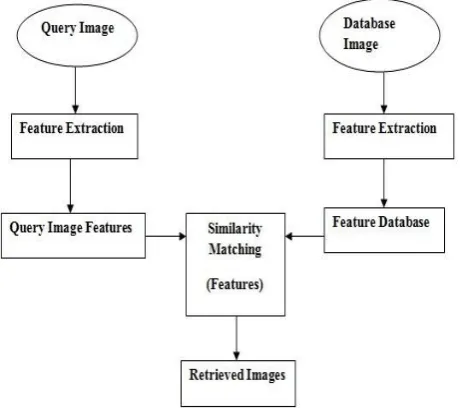
search query image based on user input. This technique first decompose the existing image and convert into compatible image then extracts the image features and stores the texture features efficiently. After that it compares with images from the database and returns the number of images. Feature extraction and similarity measure are dependent on the features (texture) used in the experiment.
Fig -1: Block diagram of CBIR system
In the system adding metadata (keywords) annotation of facial images performed. In which a user manually enter keyword (metadata) while uploading images and stored in the local database. Thus a system provides better indexing and gives accurate result.
2. LITERATURE REVIEW
There are many different studies which are performing face annotation in many applications.
Classic model of face recognition studied in many papers and gives some problems of face recognition with limited training data. The semi supervised methods used to annotate person from video frames [4]. Bayesian framework [5] used to automate the process of face annotation in family photo albums. In this paper, the facial and contextual features used and they are extracted from the region. But it is time consuming process to collect training data. The face recognition (identification) is a most challenging part of all time. The actual face recognition efficiency is affected by illumination, lighting, camera quality, pose of photo taken etc. The authors proposed the framework of an interactive face annotation and used unsupervised learning method that is partial clustering. This study focused on annotation task on personal photos which contains timestamps, geotags and so on [6]. Ozkan and Duygulu [7] proposed a model which is based on graph-based approach. The approach used in this paper text-based image retrieval search results which mainly considered as name as input query.
3. SEARCH-BASED FACE ANNOTATION
The proposed framework of search-based face annotation (SBFA) which consists of the following steps (modules):
(1) Collection of facial images;
(2)Facial image decomposition and feature extraction; (3)Facial feature indexing;
(4)Similar face retrieval; (5)Face annotation.
(1) Collection of facial images:
In the first module we collect the facial images of actor and actress from the internet. The correct label provided to image as they manually entered keyword for images for annotation. After that user upload the image and then stored on the local database for recognition/identifying.
(2) Facial image decomposition and feature extraction: The second step is to preprocess web human facial images such as images of actors, actress etc., to extract the facial image features such as texture. Basically, the color images are having the standard color is RGB color. RGB color model is used. Color is a pixel that integrated with texture feature. In our system, texture feature is extracted by wavelet transform. We used a method for color image decomposition named Haar wavelets. After decomposition resulting decomposition coefficients are used to perform image feature extraction and similarity match with F-norm theory.
(3) Facial feature indexing:
After feature extraction, this step is to index the extracted features of the facial images by applying k-means clustering-based algorithm in which distance is calculated.
(4) Similar face retrieval:
Besides the indexing step, when query image given for face annotation then similar facial images are retrieved on the basis of texture from the indexed facial image database.
(5) Face Annotation:
[image:2.595.39.270.188.392.2]© 2016, IRJET | Impact Factor value: 4.45 | ISO 9001:2008 Certified Journal
| Page 2206
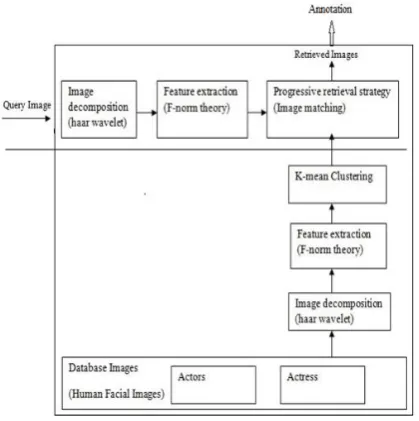
Fig -2: Proposed system architecture
But in the real-life situation there may be duplicate named person issue appeared. By considering this issue, verifying the email is necessary. In this system, last login of the user verify by email id. When the user login their account, total counts also computed. Email verification is also well performed. So efficiency of system improved.
3.1 Content-Based Image Retrieval
In the proposed system CBIR technique is based on decomposition of the database images using Haar wavelets and level of decomposition is 4. After doing decomposition, image features are extracted with F-norm theory. By implementing extraction, matrix of feature vector is formed. After decomposition and extraction, indexing of images is necessary so K-means clustering algorithm applied on the database images. A feature vector matrix is formed and clustered using K-means clustering. Two clusters formed in which the feature vector matrix is stored in the index file according to its cluster. The Euclidean distance is calculated between images. By using F-norm theory, similarity between images computed and an efficient image matching takes place. The image decomposition and feature extraction are performed only on query image during the image retrieval process and further the matching of the similarity takes place.
Fig -3: Flow of proposed CBIR
When given a query image to search, the number of images retrieved from database which based on texture feature.
4. ALGORITHM
K-means Clustering Algorithm:
Input: X = {x1, x2,…..,xn} //set of n data points K = Number of desired clusters
Output: A set of K clusters i.e. 2 clusters
Steps:
1. Randomly select k data points from X as the initial centroids.
2. repeat
3. Assign each point xi to the cluster which has the closest centroid.
4. Calculate the new mean for each cluster. 5. until the centroids don’t change.
K-means clustering is an unsupervised learning method of cluster analysis. In this algorithm, partition n data points into k clusters in which each data point belongs to the cluster with the nearest mean. Given a set of data points (x1, x2, … xn), where each data point is a d-dimensional real vector. Calculate the distance between each cluster centroid and each data point.
Fig -4: Computation of distance
[image:3.595.59.269.110.321.2] [image:3.595.308.429.117.278.2]© 2016, IRJET | Impact Factor value: 4.45 | ISO 9001:2008 Certified Journal
| Page 2207
5. PERFORMANCE EVALUATION
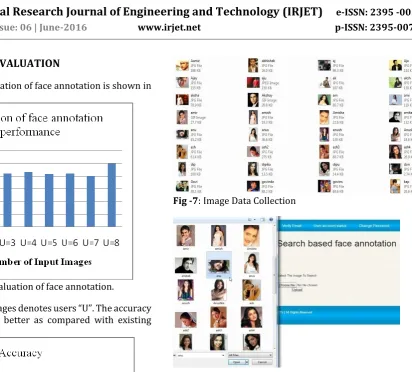
The performance evaluation of face annotation is shown in fig.5.
Fig -5: Performance evaluation of face annotation.
Here, the number of images denotes users “U”. The accuracy of proposed system is better as compared with existing system.
Fig -6: Accuracy comparison of proposed system
6. EXPERIMENTAL RESULTS
To perform the experiment, the general flow starts with the decomposition of database image. With F-norm theory, extracted the image features and vector matrix formed which stored in index file and performed image matching. The progressive retrieval strategy used to balance between computational complexity and retrieval accuracy.
The database contains 50 color images containing actors and actress images to perform the experiment. Mostly, all the images in database are of size 1024*768 before decomposition. For simplicity, all images are pre-processed to be 256x256 sizes. Database images are stored in JPEG, jpg, png and also gif format. Sample database images are shown in the Fig. We have shown some sample query image for annotation. For perfect match image, threshold value set as 1.
Fig -7: Image Data Collection
Fig -8: Select the image to search
Fig -9: Select the image to search
[image:4.595.135.548.44.416.2] [image:4.595.36.271.382.509.2]© 2016, IRJET | Impact Factor value: 4.45 | ISO 9001:2008 Certified Journal
| Page 2208
Fig -11: User account status
7. CONCLUSION
A Search-Based Face Annotation (SBFA) framework uses content-based image retrieval (CBIR) technique in mining human facial images. To assign correct name labels to a given query facial image which is motivated by SBFA. The efficient image decomposition, feature extraction and image matching mechanisms performed by CBIR and annotation of user well performed. The additional work improves the efficiency of the system in which identify the users by performing email verification and last login.
In future scope, it will be useful in Android based application. Videos will be used instead of facial images for annotation. Supervised/semi-supervised methods can be use for face annotation.
REFERENCES
[1] Dayong Wang, Steven C.H. Hoi, Member, IEEE, Ying He, and Jianke Zhu, “Mining Weakly Labeled Web Facial Images for Search-Based Face Annotation,” IEEE Transactions on knowledge and data engineering, 2014, vol. 26, No.1. [2] S. Satoh, Y. Nakamura, and T. Kanade, “Name It: Naming and Detecting Faces in News Videos,” IEEE MultiMedia, vol. 6, no. 1, pp. 22-35, Jan. Mar. 1999.
[3] T. Dharani, I. Laurence Aroquiaraj, “A Survey on Content Based Image Retrieval,” IEEE-2013 International Conference on Pattern Recognition, Informatics and Mobile Engineering (PRIME), PRIME 2013, 978-1-4673-5845-3/13/2013. [4] T.L. Berg, A.C. Berg, J. Edwards, M. Maire, R. White, Y.W. Teh, E.G. Learned-Miller, and D.A. Forsyth, “Names and Faces in the News,” Proc. IEEE CS Conf. Computer Vision and Pattern Recognition (CVPR), pp. 848-854, 2004.
[5] L. Zhang, L. Chen, M. Li, and H. Zhang, “Automated Annotation of Human Faces in Family Albums,” Proc. 11th ACM Int’l Conf. Multimedia (Multimedia), 2003.
[6] Gj Y. Tian, W. Liu, R. Xiao, F. Wen, and X. Tang, “A Face Annotation Framework with Partial Clustering and Interactive Labeling,” Proc. IEEE Conf. Computer Vision and Pattern Recognition (CVPR), 2007.
[7] D. Ozkan and P. Duygulu, “A Graph Based Approach for Naming Faces in News Photos”,Proc. IEEE CS Conf. Computer Vision and Pattern Recognition (CVPR), pp. 1477-1482, 2006.
[8] M.Guillaumin, T.Mensink, J.Verbeek, and C. Schmid,“Automatic Face Naming with Caption-Based Supervision,” Proc. IEEE Conf. Computer Vision and Pattern Recognition (CVPR), 2008.
[9] G.B. Huang, M. Ramesh, T. Berg, and E. Learned-Miller, “Labeled Faces in the Wild: A Database for Studying Face Recognition in Unconstrained Environments”, technical report 07-49, 2007.