Probing-Based Preprocessing Techniques
for Propositional Satisfiability
Inˆes Lynce and Jo˜ao Marques-Silva
IST/INESC-ID, Technical University of Lisbon, Portugal
ines,jpms
@sat.inesc.pt
Abstract
Preprocessing is an often used approach for solving hard instances of propositional satisfiability (SAT). Preprocess-ing can be used for reducPreprocess-ing the number of variables and for drastically modifying the set of clauses, either by elimi-nating irrelevant clauses or by inferring new clauses. Over the years, a large number of formula manipulation tech-niques has been proposed, that in some situations have al-lowed solving instances not otherwise solvable with state-of-the-art SAT solvers. This paper proposes probing-based preprocessing, an integrated approach for preprocessing propositional formulas, that for the first time integrates in a single algorithm most of the existing formula manipula-tion techniques. Moreover, the new unified framework can be used to develop new techniques. Preliminary experimen-tal results illustrate that probing-based preprocessing can be effectively used as a preprocessing tool in state-of-the-art SAT solvers.
1. Introduction
Propositional Satisfiability (SAT) is a well-known NP-complete problem, with extensive applications in many fields of Computer Science and Engineering. SAT has been the subject of intensive research in recent years, with signif-icant theoretical and practical contributions. From a prac-tical perspective, several competing solution strategies for SAT have been proposed. Local search algorithms have allowed solving extremely large satisfiable instances of SAT, and in particular have been shown to be very effec-tive in randomly generated instances of SAT. On the other hand, several improvements to the backtrack search Davis-Putnam-Logemann-Loveland algorithm have been intro-duced, thus allowing to solve either satisfiable and unsat-isfiable instances. These new backtrack search algorithms utilize advanced conflict analysis procedures, that record the causes of failures and that can therefore backtrack non-chronologically.
In addition, there have been significant contributions in terms of formula manipulation techniques which can in some cases yield competitive approaches [2, 3, 4, 7, 8]. It is generally accepted that the ability to reduce either the num-ber of variables or clauses in instances of SAT impacts the expected computational effort of solving a given instance. This ability can actually be essential for specific and hard classes of instances. Interestingly, the ability to infernew
clausesmayalso impact the expected computational effort of SAT solvers. Observe that these new clauses can be use-ful for reducing the number of variables (and consequently the number of clauses).
This paper proposes the utilization of probing-based techniques for manipulating propositional satisfiabil-ity formulas. Probing allows the formulation of hypo-thetical scenarios, obtained by assigning a value to a variable, and then applying unit propagation. Further-more, probing-based techniques build upon a very simple
idea: a table of triggering assignments, which regis-ters the result of applying probing to every variable in the propositional formula.
The new probing-based approach not only provides a generic framework for applying different SAT preprocess-ing techniques (by establishpreprocess-ing conditions on the entries of the table of assignments), but also can be used to implement most existing formula manipulation techniques. Moreover, and to our best knowledge, represents the first approach to
jointlyapply variable and clause probing.
The paper is organized as follows. The next section de-scribes the proposed framework, which allows the integra-tion of existing formula manipulaintegra-tion techniques. Next, ex-perimental results are presented and analyzed. Finally, Sec-tion 4 overviews related work and secSec-tion 5 concludes the paper.
2. Integrating Probing-Based Techniques
prob-ing results. In addition, we establish reasonprob-ing conditions for identifying necessary assignments and inferring new clauses. Finally, we presentProbIt: a probing-based prepro-cessor for propositional satisfiability.
2.1. Preliminaries
In what follows we analyze conditions relating sets of as-signments. Given an assignment 1and a formula
, the re-sult of applying Boolean Constraint Propagation (the itera-tive appliance of unit propagation) togiven is denoted by . When clear from the context, we use the no-tation , and the existence of the CNF formulais implicit. Without assignment, (or ) denotes plain unit propagation, given the existence of unit clauses. Assignment is referred to as the triggering assignment
of the assignments in . We may also use the nota-tion to denote the result of applying unit propaga-tion as the result ofallassignments in the set of assignments
.
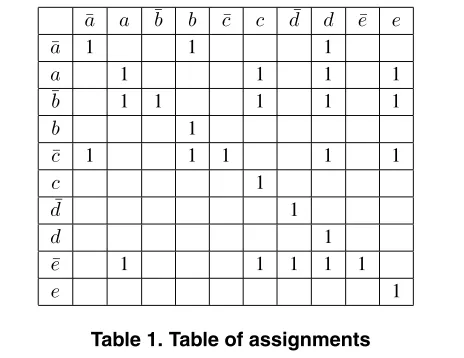
Reasoning conditions are analyzed based on a tabular representation of triggering assignments, i.e. thetable of as-signments, where each row represents a triggering assign-ment, and each column represents a possible implied as-signment 2. In this table, each 1-valued entry
de-notes an implied assignment given a triggering assign-ment . Hence the 1-valued entries of a given row de-note the elements of set .
2.2. Motivating Examples
This section analyzes a few examples, that motivate the techniques upon which our framework is based, and which allow the identification of necessary assignments and the in-ference of new clauses. Consider a CNF formulahaving the following clauses:
This formula has the the table of assignments shown in Table 1. Each line in the table corresponds to the result of applying BCP, given a triggering assignment. For exam-ple, given the assignment a=0 (denoted as), we can conclude from the table that BCP() =,,
.
2.2.1. Necessary Assignments Observe that for the two possible assignments to variable, we always obtain the
1 An assignment is a pair that denotes assigning valueto
lit-eral.
2 In practice the table of assignments is represented as a sparse matrix and so the memory requirements are never significant.
1 1 1
1 1 1 1
1 1 1 1 1
1
1 1 1 1 1
1
1
1
1 1 1 1 1
[image:2.612.320.552.26.205.2]1
Table 1. Table of assignments
implied assignment. Since variable must assume one of the two possible assignments, then the assignment
is deemed necessary. This conclusion is represented
as
3
The same conclusion could be achieved by consider-ing clause
. Any assignment to the variables that satisfies the formula must also satisfy this clause, and so at least one of the assignments that satis-fies the clause must hold. Given that in this example the three assignments that satisfy the clause also imply the as-signment , then this assignment is part of any as-signment that satisfies the CNF formula, and so it is a necessary assignment. This conclusion is represented as
4
The two previous examples concern necessary assign-ments conditions forformula satisfiability. Next we address necessary assignments conditions for preventing formula unsatisfiability.
First, note that the triggering assignment implies both and, and hence a conflict is necessarily declared. As a result, the assignment is deemed nec-essary.
Another explanation for the same assignment comes from considering clause
. The
as-signment makes this clause unsatisfied. Hence, a con-flict is declared, and the assignment is deemed neces-sary. Observe that the necessary assignments obtained from unsatisfiability conditions correspond to the well-known
failed-literal rule[5].
2.2.2. Inferred Clauses Besides the identification of nec-essary assignments, the table of assignments can also be used for inferring new clauses.
3 This condition is the inference rule used in the St˚almarck’s method [12].
Let us consider the triggering assignment and the respective implied assignment . Hence, the clause
can be inferred. Clearly, for each entry in the ta-ble of assignments a new binary clause can be created. In practice our goal is to be selective with which entries to uti-lize for inferring new clauses.
Consider clause . Each assignment that satisfies clause either implies the set of assignments
or . Hence, because at least one of the assignments that satisfies must hold, the clausecan be inferred.
In addition, observe that the triggering assignments
and imply the assignments and , re-spectively (besides other triggering assignments). Since must be subject to one of the two possible assign-ments, then one of the assignments in must also hold, and so the clause can be in-ferred.
The previous examples illustrate how to infer clauses fromformula satisfiabilityrequirements. Next, we illustrate the inference of clauses from necessary conditions for pre-ventingformula unsatisfiability.
First, observe that the set of assignments unsatisfy clause
. As a result, the assignments must not hold simultaneously, and so the clause can be inferred.
Alternatively, observe that the assignments
in imply the assignments in
, that denote an
in-consistent assignment due to variable. Hence, the assign-ments must not hold simultaneously, and so the clause can be inferred.
2.3. Reasoning with Probing-Based Conditions
The examples of the previous section illustrate the forms of reasoning that can be performed given information re-garding the assignments implied by each triggering assign-ment. These forms of reasoning include identification of necessary assignments and inference of new clauses. In this section we formalize different conditions, both for identi-fying necessary assignments and for inferring new clauses. All proposed reasoning conditions result from analyzing the consequences of assignments made to variables and of prop-agating those assignments with BCP.
2.3.1. Satisfiability-Based Necessary Assignments The purpose of this section is to describe the identification of necessary assignments based on formula satisfiability con-ditions. The first condition identifies common implied as-signments given the two possible triggering asas-signments that can be assigned to a variable.
Theorem 2.1 Given a CNF formula, for any variable
of the formula, the assignments defined by
are necessary assignments.
Any complete set of assignments to the variables that sat-isfies the CNF formula must assign either value 0 or 1 to each variable. If for both assignments to , some other variable is implied to the same value, then the assign-ment is deemed necessary.
The second condition identifies common implied assign-ments given required conditions for satisfying each clause.
Theorem 2.2 Given a CNF formula, for any clauseof the formula, the assignments defined by
Ì ¾
are necessary assignments.
Any complete set of assignments that satisfies the CNF formula must satisfy all clauses. Hence, assignments that are common to all assignments that satisfy a given clause must be deemed necessary assignments.
2.3.2. Unsatisfiability-Based Necessary Assignments We now proceed describing the identification of neces-sary assignments based on formula unsatisfiability condi-tions. As mentioned earlier, these conditions correspond to the failed-literal rule [5].
Theorem 2.3 Given a CNF formula , if yields a conflict, then the assignment is deemed nec-essary.
The previous theorem includes the conditions regarding both the identification of inconsistent assignments to a vari-able and the identification of unsatisfied clauses. (Observe that most BCP algorithms do not distinguish between these two situations, being a conflict declared in both cases.)
2.3.3. Implication-Based Inferred Clauses As illus-trated earlier, probing can also be used for inferring new clauses. One simple approach for inferring new clauses is to use each entry in the table of assignments.
Theorem 2.4 Given a CNF formula , if
, then the clause
is an impli-cate of.
Clearly, this result can yield many irrelevant bi-nary clauses. Hence, as described in Section 2.4, the objective is to be selective with which clauses to actu-ally consider.
2.3.4. Satisfiability-Based Inferred Clauses This sec-tion describes the inference of clauses based on formula satisfiability conditions.
Theorem 2.5 Given a CNF formula, for every pair of lit-erals
and
for which there exists a variable
such that,
then the
clause
Clearly, the two possible truth assignments on either imply
½
or
¾
, then one of these two assignments must hold.
Theorem 2.6 Given a CNF formula, for any clause
½
,allclauses of the form,
are implicates of.
Since the original clausemust be satisfied, any set of assignments, each implied by a different literal in, forms an implicate of. We should observe that the number of clauses that can be created is upper-bounded by the Carte-sian product of each set of assignments that results from ap-plying BCP to each triggering assignment. In addition, ob-serve the previous theorem can yield clauses with duplicate literals. Clearly, simple procedures can be implemented that filter out these duplicate literals.
2.3.5. Unsatisfiability-Based Inferred Clauses Next we describe the inference of clauses based on formula unsatis-fiability conditions.
Theorem 2.7 Given a CNF formula, for all pairs ½and
¾ for which there exists a variable such that,
½
¾
the clause
½
¾ is an implicate of.
If two assignments imply distinct truth values on a given variable , then the two assignmentsmustnot hold simul-taneously.
One additional condition related with unsatisfiability is the following:
Theorem 2.8 Given a CNF formula, for each set of
as-signments
½
such
that there exists a clause , with , then the clause,
½
is an implicate of.
If the union of sets of assignments resulting from ap-plying BCP to a set of triggering assignments unsatis-fies a given clause, then the simultaneous occurrence of the
assignments must be prevented. Hence a new clause can be created. Observe that a stronger condition can be estab-lished if the condition
is used, at the
cost of additional computational overhead. Moreover, ob-serve that the result of Theorem 2.8 is related with a tech-nique proposed in [6]. For a clause, where is a disjunction of literals, if assigning value 0 to all literals in
yields a conflict, thenis an implicate of. The two techniques are related since both infer clauses from unsat-isfiability requirements. The work of [6] assumes a specific clause and considers BCP of simultaneous sets of assign-ments5. Theorem 2.8 allows any
triggering assignments, but considers the separate application of BCP (which may yield fewer implied assignments).
5 As a result, we refer to this technique asliteral dropping.
2.4. ProbIt: a Probing-Based SAT Preprocessor
The reasoning conditions described in the previous sec-tion were used to implement a SAT preprocessor, ProbIt. This preprocessor is organized as follows:
1. Create the table of assignments by applying BCP to each individual assignment.
2. Apply a restricted set of the reasoning conditions de-scribed in the previous sections:
(a) Identification of necessary assignments, obtained by reasoning conditions from Theorems 2.1, 2.2 and 2.3.
(b) Identification of equivalent variables, obtained by arestricted application of reasoning conditions from Theorem 2.4.
3. Iterate from 1 while more equivalent variables can be identified.
For the current version of ProbIt we opted not to in-fer new clauses during preprocessing. Existing experimen-tal evidence suggests that the inference of clauses during preprocessing can sometimes result in large numbers of new clauses, which can impact negatively the run times of SAT solvers [7]. The identification of conditions for the selective utilization of clause inference conditions during preprocess-ing is the subject of future research work.
As a result, the utilization of Theorem 2.4 is restricted to the inference of binary clauses that lead to the identifi-cation of equivalent variables. Remember that two-variable equivalence (e.g. ) is described by the pair of clauses
, that can be represented as implications
(and also as .
In ProbIt, rather than inferring new clauses which allow to identify equivalent variables, it is simpler to identify equiv-alences without having to infer the corresponding clauses. Based on the table of assignments, equivalent variables may be identified as follows:
If and ,
then .
If and ,
then .
Moreover, the same reasoning can be applied to identify the two-variable equivalence .
3. Experimental Results
Family ProbIt ProbIt+JQ2 JQuest2 barrel(8) 18.36 700.28 1,118.12 longmult(16) 544.18 1,725.17 4,658.67 queueinvar(10) 48.04 70.96 30.00 miters(25) 166.53 248.11 (2)11,175.65 fvp-unsat-1.0(4) 648.57 1,599.44 549.75 quasigroup(22) 61.21 531.43 735.25
Table 2. Improvements on JQuest2
ProbIt has been integrated on top of JQuest2, a compet-itive Java SAT solver6. JQuest2 is a backtrack search SAT
solver, based on efficient data structures, and implement-ing the most effective backtrack search techniques, namely clause recording and non-chronological backtrack, search restarts, and adaptive branching heuristics. One of the main objectives of JQuest2 is allowing the rapid prototyping of new SAT algorithms. Since ProbIt is still an evolving pre-liminary implementation, the utilization of JQuest2 facili-tates the evaluation and configuration of ProbIt.
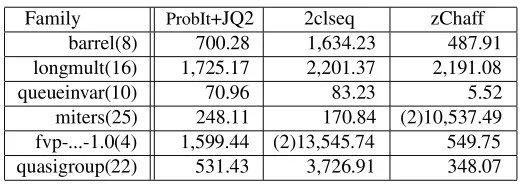
Tables 2 and 3 give the CPU time in seconds required for solving for different classes of problem instances, that include some of the hardest instances. For each benchmark suite, the total number of instances is shown. For all ex-perimental results a [email protected] GHz Linux machine with 1 GByte of physical memory was used. The CPU time was limited to 5000 seconds. Consequently, we added 5000 sec-onds for each instance not solved in the allowed CPU time (the number of aborted instances is indicated in parenthe-sis).
In Table 2, ProbIt+JQuest2 (JQuest2 with ProbIt inte-grated) is compared with the original JQuest2. Moreover, the time required for the preprocessor ProbIt is also given. Table 3 compares ProbIt+JQuest2 with other SAT solvers, namely zChaff and 2clseq. zChaff is one of the most com-petitive SAT solvers. On the other hand, 2clseq is also known a competitive SAT solver, characterized by integrat-ing formula manipulation techniques.
From the obtained results, several conclusions can be drawn:
¯ ProbIt+JQuest2 comes out as the most robust solver on the set of problem instances considered. Despite be-ing implemented in Java, which necessarily yields a slower implementation, ProbIt+JQuest2 performance is indeed comparable to state-of-the-art SAT solvers.
¯ The performance of ProbIt+JQuest2 is comparable to 2clseq in instances where formula manipulation helps
6 JQuest2 entered in the second stage of the indus-trial category in the SAT’2003 Competition (see http://www.satlive.org/SATCompetition/2003/comp03report/).
Family ProbIt+JQ2 2clseq zChaff barrel(8) 700.28 1,634.23 487.91 longmult(16) 1,725.17 2,201.37 2,191.08
queueinvar(10) 70.96 83.23 5.52
miters(25) 248.11 170.84 (2)10,537.49 fvp-...-1.0(4) 1,599.44 (2)13,545.74 549.75 quasigroup(22) 531.43 3,726.91 348.07
Table 3. Comparison with other solvers
on solving an instance. This explains why zChaff per-formance is not competitive for these instances.
¯ ProbIt+JQuest2 performance is also compara-ble to zChaff on instances where more sophisti-cated backtrack search techniques are required. Nonetheless, and when compared to JQuest2 re-sults, ProbIt+JQuest2 may require more time to solve a family of benchmark examples. This can be ex-plained by the time required for applying ProbIt techniques. Clearly this is a drawback when the num-ber of variables in the CNF formula is not reduced.
4. Related Work
The ProbIt algorithm described in the previous section uses probing as the basis for implementing a number of for-mula manipulation techniques. In this section we relate Pro-bIt with previous work in probing and formula manipulation techniques.
4.1. Probing-Based Techniques
In the SAT domain, the idea of establishing hypotheses and inferring facts from those hypotheses has been exten-sively studied in the recent past [3, 4, 5, 6].
Thefailed literal ruleis a well-known and extensively used probing-based technique (see for example [5]): if the assignmentÜ yields a conflict (due to BCP), then we must assignÜ . This rule is covered by necessary as-signments obtained from unsatisfiability conditions (Theo-rem 2.3).
Variable probing is a probing-based technique, which consists of applying the branch-merge rule to each vari-able [3]7. Common assignments to variables are identified, by detecting and merging equivalent branches 8. Observe that variable probing is covered by reasoning conditions es-tablished with Theorem 2.1.
7 The branch-merge rule is the inference rule used in theSt˚almark’s Method[12].
Clause Probing is similar to variable probing, even though variable probing is based on variables and clause probing is based on clauses. Clause probing consists of evaluating clause satisfiability requirements for identi-fying common assignments to variables. Common as-signments are deemed necessary for a clause to become satisfied and consequently for the formula to be satis-fied. These techniques have been applied to SAT in [10] and more recently in [4]. In our framework, clause prob-ing is captured by Theorem 2.2. To the best of our knowl-edge, no other work proposes the joint utilization of vari-able and clause probing.
The notion ofliteral dropping, that considers applying sets of simultaneous assignments for inferring clauses that subsume existing clauses, is described for example in [6]. As mentioned earlier, some of the clause inference condi-tions proposed by Theorem 2.8 can be related with previ-ous techniques for literal dropping, proposing more general conditions for inferring clauses, but based on less power-ful unit propagation.
4.2. Other Manipulation Techniques
Two-variable equivalenceis a well-known formula ma-nipulation technique that has been integrated in ProbIt (see Section 2.4). Additional two-variable equivalence condi-tions can be established, namely by the identification of
strongly connected components[1]. It is interesting to ob-serve that the existing strongly connected components in a CNF formula are captured from the construction of the as-signment table and the application of Theorem 2.4. Further-more, sophisticated techniques have been developed to de-tect chains of biconditionals [8, 11].
The2-closureof a 2CNF sub-formula [7] allows to in-fer additional binary clauses. The identification of the tran-sitive closure of the implication graph is obtained from the construction of the assignment table and the application of Theorem 2.4: if then create clause
.
More recently, a competitive SAT solver incorporating hyper-resolution with binary clauses has been proposed [2]. Given the set of clauses
½
¾
½
¾
, hyper-resolution allows infer-ring . Once again, observe that this technique is cov-ered by the construction of the assignment table and the ap-plication of Theorem 2.4: if then cre-ate clause .
Compared with existing work, probing-based prepro-cessing techniques not only naturally captureallthe above mentioned formula manipulation techniques, but also fur-ther allow the development of new techniques. In addition, the proposed unified framework also allows relating and comparing different formula manipulation techniques.
5. Conclusions
This paper introduces ProbIt, a new probing-based for-mula manipulation SAT preprocessor. ProbIt has been im-plemented as a unified formula manipulation framework, based on probing assignments, that captures a signifi-cant number of formula manipulation techniques. More-over, this new approach integrates for the first time most formula manipulation techniques and allows develop-ing new techniques. In addition, the obtained experimental results clearly indicate that ProbIt is effective in increas-ing the robustness of state-of-the-art SAT solvers.
References
[1] B. Aspvall, M. F. Plass, and R. E. Tarjan. A linear-time al-gorithm for testing the truth of certain quantified boolean formulas. Information Processing Letters, 8(3):121–123, March 1979.
[2] F. Bacchus. Enhancing Davis Putnam with extended binary clause reasoning. InAAAI’02, August 2002.
[3] D. L. Berre. Exploiting the real power of unit propagation lookahead. InLICS Workshop on Theory and Applications of Satisfiability Testing, June 2001.
[4] R. I. Brafman. A simplifier for propositional formulas with many binary clauses. InIJCAI’01, August 2001.
[5] J. Crawford and L. Auton. Experimental results on the cross-over point in satisfiability problems. InAAAI’93, pages 22– 28, 1993.
[6] O. Dubois and G. Dequen. A backbone-search heuristic for efficient solving of hard 3-sat formulae. InIJCAI, August 2001.
[7] A. V. Gelder and Y. K. Tsuji. Satisfiability testing with more reasoning and less guessing. In D. S. Johnson and M. A. Trick, editors,Second DIMACS Implementation Challenge. American Mathematical Society, 1993.
[8] C. M. Li. Integrating equivalency reasoning into davis-putnam procedure. InAAAI’00, pages 291–296, July 2000. [9] C. M. Li and Anbulagan. Look-ahead versus look-back for
satisfiability problems. InCP’97, pages 341–355, October 1997.
[10] J. P. Marques-Silva and T. Glass. Combinational equivalence checking using satisfiability and recursive learning. InProc. of the ACM/IEEE Design, Automation and Test in Europe Conference, pages 145–149, March 1999.
[11] R. Ostrowski, ´Eric Gr´egoire, B. Mazuren, and L. Sais. Re-covering and exploiting structural knowledge from cnf for-mulas. InCP’02, pages 185–199, September 2002. [12] G. St˚almarck. A system for determining propositional logic