89; - 1.8 95= + 7- 90 . 8>490 .818 + 4-897; ,9; 7+ 2 .2 ; ,1- + 9154 5/ ,0 + 3 ; <+ 71414
<?KE ? 7?E F?R? 7CB B T
+ 9FCO GO 8Q @J GPPCB DLN PFC - CE NCC LD 6F-?P PFC
; KGRCNO GPTLD 8P + KB NCS O
&$$)
/Q IIJ CP?B ?P? DLN PFGO GPCJ GO ?R?GI?@IC GK 8P + KB NCS O 7CO C?NAF 7CMLOGPLNT
?P*
FPPM*# # NCOC?NAF! NCMLOGPLNT"OP! ?KB NCS O"?A"Q H #
6IC?OC Q OC PFGO GB CKPGDGCN PL AGPC LN IGKH PL PFGO GPCJ * FPPM*# # FB I"F?KBIC"KCP# %$$&'# )('
Studies Toward the Synthesis and
Structural Elucidation of Chamuvarinin
School of Chemistry and Centre for Biomolecular Sciences,
St Andrews, Fife, Scotland
Vanga Raghava Reddy
June, 2009
Thesis submitted to the University of St Andrews in application
for the degree of Doctor of Philosophy
i Dedicated to:
ii
Acknowledgements
It’s been more than three years since I started my journey of PhD studies at the University of St Andrews and this has been a wonderful time in my life. I have gone through a real learning experience that was enjoyable most of the time. Any success during this time is also due to substantial support of others. I therefore express my deepest thanks to:
My Supervisor Dr Gordon J Florence for welcoming me in his group as a first student and entrusting me with challenging projects. His expertise and motivation has been and will be a benchmark in my professional career. He has always been open for scientific discussions and has an endless supply of ideas. When times I was in trouble he showed abundant patience and support, which is unforgettable. Thanks for all the good times and making my experience so memorable. I also want to acknowledge Dr Stuart J Conway and Dr Andrew D Smith and their respective group members for good scientific discussions and fun times.
I would like to extend my sincere appreciation to Prof. Derek J Woollins for allowing us to share his lab facilities during my first year of PhD studies, and I am also thankful to Woollins group members especially Dr. Sarah Parveen and Dr Vit Matsuka for their friendship and support.
iii these guys and wish them all the best. And importantly Dr Ross G Murray is wonderful friend, scientist and someone who I share many things, apart from that many thanks for helping me in my language and scientific corrections and always allowed me to share his time in proof reading.
My thanks are also due to the NMR and Mass spectroscopy groups for their support by providing wonderful facilities and also my special thanks due to generous financial support provided by the School of Chemistry and The University of St Andrews under EaStCHEM program for my studies.
Declarations
I, Vanga Raghava Reddy, hereby certify that this thesis, which is approximately 42,000 words in length, has been written by me, that it is the record of work carried out by me and that it has not been submitted in any previous application of higher degree.
Date………. Signature of Candidate……….………
I was admitted as a research student in September 2005 and as a candidate for the degree of Doctor of Philosophy in April 2009; the higher study for which this is a record was carried out in the University of St Andrews between 2005 and 2009.
Date………. Signature of Candidate………
I hereby certify that the candidate has fulfilled the conditions of the Resolution and Regulations appropriate for the degree of Doctor of Philosophy in the University of St Andrews and that the candidate is qualified to submit this thesis in application for this degree.
Copyright Declarations
Restricted Access
In submitting this thesis to the University of St Andrews we understand that we are giving permission for it to be made available for use in accordance with the regulations of the University Library for the time being in force, subject to any copyright vested in the work not being affected thereby. We also understand that the title and the abstract will be published, and that a copy of the work may be made and supplied to any bona fide library or research worker, that my thesis will be electronically accessible for personal or research use unless exempt by award of an embargo as requested below, and that the library has the right to migrate my thesis into new electronic forms as required to ensure continued access to the thesis. We have obtained any third-party copyright permissions that may be required in order to allow such access and migration, or have requested the appropriate embargo below.
The following is an agreed request by candidate and supervisor regarding the electronic publication of this thesis:
Access to all or part of printed copy but embargo of all or part of electronic publication of thesis for a period of two years on the following ground:
publication would preclude future publication.
Embargo on all or part of printed copy and electronic copy for the fixed period of two years on the following ground:
publication would preclude future publication.
Date ……… Signature of Candidate ………
vi
Abstract
Chamuvarinin (22) is a unique annoanceaeous acetogenin isolated from the roots of Senegalese medicinal plant Uvaria chamae by Laurens and co-workers in 2004. It displays highly potent cytotoxicity towards the cervical cancer cell lines (KB 3-1, IC50 =
0.8 nM). Structurally, chamuvarinin is the first reported acetogenin to contain an
adjacently linked bis-THF-THP ring system spanning the C15-C28 carbon backbone.
However, initial efforts to assign the relative and absolute configuration within this
stereochemical array, on the basis of 1H and 13C NMR analysis, provided only partial information pertaining to the relative configuration of C15-C19 region. As a
consequence, 32 diastereomeric structural possibilities exist for the highly unusual
structure of chamuvarinin; an unrealistic target for total synthesis. The synthesis of the
central core tricyclic (BCD) intermediate represents the most challenging aspect in the entire synthesis, which in turn will aid ultimate structural proof.
At the outset of the project the stereochemical configuration of C15-C28 (BCD) of
chamuvarinin was uncertain and a library approach was proposed to enable structure
elucidation (Scheme A-1). Chapter 2 and Chapter 3 detail the synthesis of possible diastereomers of the C9-C21 (51) and C22-C34 fragments (52). Chapter 4 details the intial strategy to couple the key diastereomeric fragments in a series of model studies.
vii 1 2 8
15
PPh3I
O O A A Etherification RCM O D
OBoc O OTBS
B OBn
HO 19
23
28 O O O
OH B D O O Wittig Olefination 22
C22-C34 fragment (52)
C1-C8 fragment (50)
C9-C21 fragment (51)
C 34 9 21 22 34 8 1 Scheme A-1
O O O
OBn OH
B C
D
SN2 d isplacement
O
OTBS O
OBn OTBS
BCD fragment (227)
C9-C20 fragment (119)
viii
CONTENTS
Page
Dedication i
Acknowledgements ii
Declarations and Copyright Access iv
Abstract vi
Compound numbering xii
List of Abbreviations xiii
Chapter One: Introduction 1.1 Natural products in drug discovery 1
1.1.1 Structural reassignments in natural products 3
1.2 Plant-derived natural products and drug discovery 5
1.2.1 The annonaceae plant family 7
1.3 Classification of acetogenins 9
1.3.1 Biosynthesis of tetrahydrofuran acetogenins 11
1.3.2 Bioactivity and mechanism of action 11
1.3.3 Structure activity relationships (SAR) 15
1.4 Chamuvarinin- Isolation, structure and biological activity 17
1.4.1 Structure elucidation 18
1.5 Selected approaches to acetogenin synthesis 20
1.5.1 Roush synthesis of asimicin 21
1.5.2 Crimmins synthesis of mucocin 26
1.6 Retrosynthesis 32
Chapter Two: Results and Discussion 2.1 Retrosynthesis 35
ix
2.2.1 Synthesis of aldehyde 55 40
2.2.2 Synthesis of C9-C15 sulfone 56 41
2.3 Julia coupling of aldehyde 55 and sulfone 56 44
2.3.1 Julia olefination 44
2.3.2 Recent applications of the modified-Julia olefination 49
2.3.3 Synthesis of C9-C20 olefin 51
2.3.4 Synthesis of olefin epoxide 100 53
2.4 Sharpless asymmetric dihydroxylation 55
2.4.1 Applications of Sharpless asymmetric dihydroxylation 57
2.4.2 Dihydroxylation of 100 58
2.5 Synthesis of C9-C21 frgament 61
2.5.1 C20 oxidation of THF diol 112 61
2.5.2 Synthesis of THF aldehyde 119 64
2.5.3 Final Steps to C9-C21 fragment 66
2.5.4 Mosher analysis of C-20 hydroxyl in 120 68
Chapter Three: Results and Disccussion 3.1 Retrosynthesis 73
3.2 Synthesis of hydroxyl olefin 75
3.2.1 Hydroxy olefin cyclisation 76
3.2.2 Synthesis of diastereomeric C22-C34 subunits 79
3.3 Antipodal series of C22-C34 allylic alcohols 83
Chapter Four: Results and Discussion 4.1 Retrosynthesis for the construction of C-ring 87
4.2 Ring closing metathesis studies 88
4.2.1 Ring closing metathesis background 88
4.2.2 General mechanism for ring closing metathesis reaction 90
x
4.2.4 Ring closing metathesis model studies 94
4.3 Stereoselective allylic etherification 96
4.3.1 Pd-catalysed allylic etherification 96
4.3.2 Rhodium catalysed allylic etherification 100
4.3.3 Etherification model studies 104
4.4 Revised target for chamuvarinin synthesis 107
4.5 Cross metathesis model study for the synthesis of C-ring 110
4.5.1 Cross metathesis: Background 112
4.5.2 Applications of cross metathesis in total synthesis 114
4.5.3 Assembling model substrates 228 and 152 by CM 117
4.5.4 Attempts for assembling of C9-20 and C21-C34 fragments 118
Chapter Five: Results and Discussion 5.1 Revised retrosynthetic analysis: an alkyne addition approach 122
5.2 Synthesis of syn-THP-alkyne partners 124
5.2.1 Mosher analysis of C-23 hydroxyl group in 247 125
5.2.2 Felkin-Anh model for alkynation of 151 127
5.2.3 Synthesis of C21-C34 fragment 250 128
5.2.4 Key fragment coupling 129
5.2.5 Completion of central BCD fragment 131
5.2.6 Hydrogenation of C21-C22 alkyne 132
Chapter Six: Summary and Future Work 6.1 Final steps towards the BCD C9-C34 fragment 135
6.2 Proposed synthesis of BCD fragment 227 136
6.2.1 Proposed synthesis of butenolide C1-C9 unit 50 137
6.2.2 Completion of chamuvarinin 138
xi
Chapter Seven: Experimental
7.1 General experimental 141
7.2 Experimental for Chapter 2 144
7.3 Experimental for Chapter 3 167
7.4 Experimental for Chapter 4 189
7.5 Experimental for Chapter 5 202
References 212
vi
Compound Numbering
All compounds intended toward the structure elucidation or total synthesis of chamuvarinin (22) will be numbered according to the carbon chain of the natural product. This numbering is given on the structure and is used in 1H NMR
assignments.
O O O
OH
O O
1 2 9
15 19
23 28
34 35
37
Chamuvarinin (22)
xiii
LIST OF ABBREVATIONS
α alpha
[α] specific rotation
app. apparent
Ac ` acetyl
Ar aryl
AcOH acetic acid
atm 1 atmosphere = 105 Pa (pressure)
BAIB iodobenzene diacetate
b.p. boiling point
br broad (IR and NMR)
β beta
n-butyl normal-butyl t-butyl tert-butyl
Boc tert-butyloxy carbonyl
BT benzothiozyl
BTFP bis-triflurophenyl
Bn benzyl
Bz benzoyl
oC degrees Celsius
calc. Calculated
cat. catalyst or catalytic
CSA (+)-10-camphorsulfonic acid
DCM dichloromethane
(DHQ)2PHAL bis(dihydroquinino)pthalazine
DHQD dihydroquinidine
DIAD diisopropyl azodicarboxylate DIEA N,N-diisopropylethylamine DMAP 4-(N,N-dimethylamino)pyridine
xiv
DMF N,N-dimethylformamide
DMP Dess-Martin Periodinane DMPU N,N-dimethylpropyleneurea
DMSO dimethyl sulfoxide
eq. equivalent
Et ethyl
γ gamma
g gram(s)
h hour(s)
HMPA hexamethylphosphoramide
HRMS high resolution mass spectrometry
IC50 concentration required for 50% inhibition (of biological effect)
Imid Imidazole
J 1H-1H coupling constant
KHMDS potassium hexamethyldisilazide
L litres
LiHMDS lithium hexamethyldisilazide
m milli; multiplet (NMR)
M concentration in moles L-1
Me methyl
MOM methoxymethyl
µ micro
m-CPBA 3-chloroperoxybenzoic acid
MHz megahertz
min minute(s)
Ms mesyl
MTPA α-methoxy-α-(trifluoromethyl)phenyl acetate NaHMDS sodium hexamethyldisilazide
NMO 4-methylmorpholine N-oxide
NMR nuclear magnetic resonance
nOe nuclear Overhausser effect
Nu unspecified nucleophile
xv
p para
Ph phenyl
pH -log[H+]
ppm parts per million
PPTS pyridinium p-toluenesulfonate
PT phenyl tetrazole
py pyridine
PYR pyridyl
R unspecified alkyl group
RT room temperature
Rf thin-layer chromatography retention factor
TEMPO 2,2,6,6-tetramethyl-1-piperidinyloxy TBAF tetrabutylammonium fluoride
TBAI tetrabutylammonium iodide
TBS t-butyldimethylsilyl
TBT N-tert-butyltetrazole
TES triethylsilyl
THF tetrahydrofuran
tlc thin-layer chromatography
TMS trimethylsilyl
Ts 4-methylbezenesulfonyl chloride
Tris 2,4,6-triisopropylbenzenesulfonyl chloride
Chapter One
1
Chapter One
Introduction
Nature has evolved a structurally diverse array of secondary metabolites, isolated from terrestrial and marine sources, which possess potent biological activities, that provide a vast and virtually unlimited source of new lead agents for both the pharmaceutical and agrochemical industries.1 Today, natural products are responsible for about half of the approved drugs that are currently available. This percentage rises for treatment of infection or cancer, as natural product-derived treatments account for approximately 60% of the drugs either in use or awaiting FDA approval in the period between 1981 and 2002.2,3,4
1.1 Natural products in drug discovery
Chapter One
2
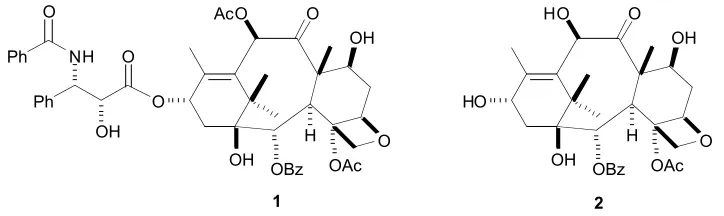
the Pacific yew tree (taxus brevifolia).5 Its potential was recognised during research in the 1960s and 1970s. However, only one gram of metabolite could be extracted from 24 kg of dried bark. Since a 125 year old tree was only capable of producing around 2 kg of bark and this species relatively rare, the supply issue was particularly acute, and slowed its development as a drug.6 However, the supply problem was eventually resolved after it was found the needles of the common European yew (taxus baccata) where rich in 10-deacetylbaccatin-III7 (10-DAB, 2 in Figure 1.1). The total synthesis of Taxol® was completed by Holton and Nicolaou, independently.6,7 This work later allowed for the large-scale manufacture using a semi-synthetic approach.8
O
O OH OBz
H OAc AcO
OH
O O Ph
OH NH O Ph
O
O OH OBz
H OAc HO
OH
HO
[image:19.612.148.510.360.468.2]1 2
Figure 1.1:Structure of Taxol® (1) and 10-deacetylbaccatin (2)
Two further examples where total synthesis plays an important role in alleviating the problem of supply are galantamine 3 (alzheimer’s) and mycophenolate sodium 4
Chapter One
3 OH
MeO O
O
3 4
N O
MeO
Me
O O
[image:20.612.170.482.85.166.2]Na
Figure 1.2: Strucutres of galantamine (3) and mycophenolate sodium (4).
1.1.1 Structural reassignments in natural products
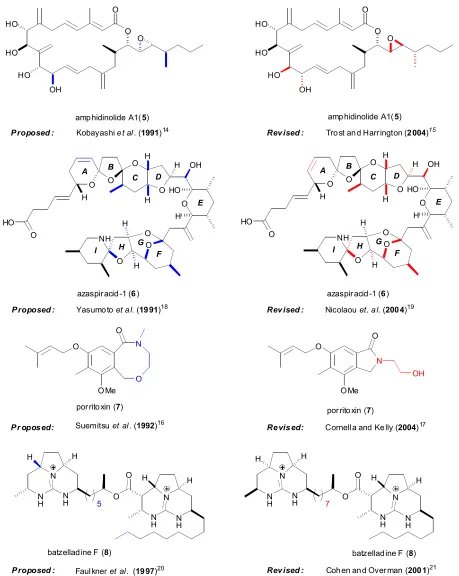
Chapter One 4 HO HO HO OH O O O O O O O HO O H H OH O HO O O NH O H H A B C D E F G H I H H H N N H H N H H O O O OMe
amphidinolide A1(5)
Kobayashiet al. (1991)14 Trost and Harrington (2004)15
azaspiracid-1 (6)
Yasumotoet al.(1991)18
batzelladine F (8)
Faulkneret al. (1997)20 porritoxin (7)
Suemitsuet al.(1992)16
N N H H N H
Proposed : Revised :
Pr oposed: Proposed : Proposed : HO HO HO OH O O O
amphidinolide A1(5)
O O O O HO O H H OH O HO O O NH O H H A B C D E F G H I H H H
azaspiracid-1 (6)
Nicolaouet. al.(2004)19 Revised : O OMe N O OH
porritoxin (7)
Cornella and Kelly (2004)17 Revised: N N H H N H H O O
batzelladine F (8)
[image:21.612.117.576.79.655.2]Cohen and Overman (2001)21 N N H H H N H Revised : O N O H 5 7
Chapter One
5
1.2 Plant-derived natural products and drug discovery
Among natural products, plants possess great chemical versatility; due to ecological necessity, many secondary metabolites accumulate in plants as a chemical defensive strategy against microbes and other predator threats, thus preventing over-browsing of the plant. Some of the defensive strategies may become useful directly or indirectly in the design of pharmaceuticals for human use.22 The variety of secondary metabolites produced by plants is broader than those of other organisms. The realm of drugs obtained from plants is vast, wider than any other source of natural products, and they are the basis for the traditional medicinal philosophies and practices in China, India and isolated tribal populations.23
Plant-derived pharmaceuticals and phytochemicals retain their historic significance in the drug industry.4 Such materials are still commonly used in the treatment and prevention of many human diseases. A substantial portion of all the currently prescribed drugs are derived directly or indirectly from plant sources.23 Many potent drugs with novel features have been isolated. For example, the potent antimalarial drug artemisinin24 (9, Figure 1.4). Azadirachtin25 (10), which displays strong antifeedant
Chapter One
6
plants have generated more progeny, and so the capacity to produce and safely store such useful metabolites.28,29
O O
O H H3C
CH3
CH3
H H O
O
O CO2Me
O MeO2C
A cO O
OH O H
O O
OH O
H
10 9
Figure 1.4:Structures of artemisinin (9) and azadirachtin (10)
A chemical class that has not been explored in this discussion, but has proven to be a viable source of cytotoxic compounds, is that of the acetogenins. The acetogenin family of natural products is a class of polyketide-derived metabolites, originally isolated from the tropical and subtropical plants, of the Annonaceae genus.30,31 In 1982, uvaricin (11) was discovered in the root extracts of Uvaria accuminata, and displayed
in vivo activity as an antileukemic (P-388) agent. This invigorated the wide interest in this plant family.32 Today, more than four hundred annonaceous acetogenins have been isolated from various annonaceae plant species.33
O O
OAc OH
O O
11
Chapter One
7
1.2.1 The annonaceae plant family
The annonaceae is a large family of tropical and subtropical trees, shrubs and lianas comprising ca. 130 genera and more than 2300 species.30 Some of annonaceae produce
edible fruits; custard apple, sugar apple, atemoya, cherimoya and pawpaw.
Many members of this family are used in traditional medicinal practices for the treatment of antiparasitic, anti-tumour and the treatment of intestinal disease.34 However, their phytochemical study has not been extensively carried out due to their distribution in tropical and subtropical areas. Since 1980, many interesting compounds have been reported. One such source of acetogenins is Annona cherimolia, a tropical plant from Peru, used traditionally to kill insects and parasites. The seeds from this plant have yielded two anti-tumour compounds: annomolin (12) and annocherimolin (13, Figure 1.7).35 The former showed selective inhibitory effects against human
Chapter One 8 O OH OH OH OH O O O OH OH O O OH OH 12 13
Figure 1.7: Structures ofacetogenins annomolin (12)and annocherimolin (13)
Human cancer cell lines ED50 (µg/mL)
Compoundi BSTa LC
50 (µg/mL)
A-549b MCF-7c HT-29d A-498e PC-3f MIA PaCa-2g
12 13 Adriamycin(14)h
9.40 x 10⁻³ 5.80 x 10⁻³ NT
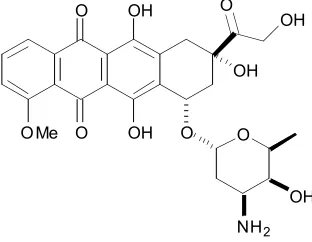
2.37 1.15 x 10⁻⁴ 8.92 x 10⁻⁵ 6.88 x 10 -4 5.39 x 10 -6 2.18 1.56 4.06 x 10⁻⁶ 2.49 x 10 -6 1.53 x 10⁻¹ 1.02 1.20 x 10⁻⁵ 1.13 x 10⁻³ 1.82 x 10⁻² 1.28 x 10⁻² 2.26 x 10⁻³ 5.02 x 10⁻² 2.62 x 10⁻³ aBrine shrimp test. bHuman lung carcinoma. cHuman breast carcinoma. dHuman colon adenocarcinoma. eHuman kidney carcinoma. fHuman prostate adenocarcinoma. gHuman pancreatic carcinoma. hPositive control standard. fNT: Not tested. iTable reproduced from ref 35
Table 1.1: BST and cytotoxicities in human solid tumour cell lines for 12 and 13
O O OH OH OH O O O OMe OH NH2 OH
[image:25.612.249.405.548.669.2]Chapter One
9
1.3 Classification of acetogenins
Annonaceous acetogenins are classified according to their relative stereostrucutres across the tetrahydrofuran (THF) rings; and the typical structures of annonaceous acetogenins consist of an unbranched chain of 30-32 carbon atoms with a central core unit of one, two or three adjacent terahydrofuran rings near the mid-point of the carbon backbone. One end of the chain is generally attached to the 2-position of a (S)-4-methyl butenolide, which is thought to be the biological pharmacophore.36 The clearest classification are mono-THF, adjacent bis-THF, non-adjacent bis-THF, tri-THF, and non-classical acetogenins (containing tetrahydropyran (THP) ring and hydroxylated THF compounds), followed by the sub-classification of γ-lactone, substituted γ-lactone, or ketolactone variations (Figure 1.9).37
O
OH R
O O
OH R
O OH
OH O OH
O R
O R2
O
O
O O
O HO
O R1
(where R = R1= R2= H, OH)
mono-THF adjacent bis-THF non-adjacent bis-THF
THP substituted!-lactone keto-lactone !-lactone
Chapter One
10 C10H21
C10H21
O O O
C10H21
O HO OH O
O C10H21
OH
OH O
O C10H21
OH
OH O
HO
O O
OH OH
C9H19 O O
OH OH
C10H21 OH
Chapter One
11
1.3.1 Biosynthesis of tetrahydrofuran acetogenins
Since annonaceous acetogenins are believed to arise from fatty acid derivatives, these would have been biosynthesised via the polyketide pathway. The THF ring systems arise from isolated Z-double bonds through poly-epoxidation of an unconjugated polyene, followed by tandem inter- or intramolecular THF ring formation as shown in
Scheme 1.1. The semisynthesis of additional THF rings from double bond containing acetogenins strongly supports this hypothesis.37 This elegant biosynthetic route has stimulated chemists to undertake the development of new synthetic routes to reach these biologically important molecules.
1.3.2 Bioactivity and mechanism of action
The biological properties of acetogenins have been appreciated for a long time by Indian tribes from the South American rain forest, who still use the extracts from these plants as pesticidal and antiparasitic agents. Many other activities, like anthelmic, antimalarial, antimicrobial and antiprotozoal have been reported. The most important biological activity seems to relate to their cytotoxic activity and their potential as antitumour agents.34,38
Chapter One
12
(ED50 = 4.5 x 10⁻⁵ µg/mL) (Figure 1.10) are the most potent inhibitors of the bovine
heart mitochondrial complex I identified to date.40
O O
OH OH
O
O OH
15
O O
OH OH
O
O OH
[image:29.612.117.542.146.293.2]16
Figure 1.10: Structures of bullatacin (15) and rolliniastatin I (16)
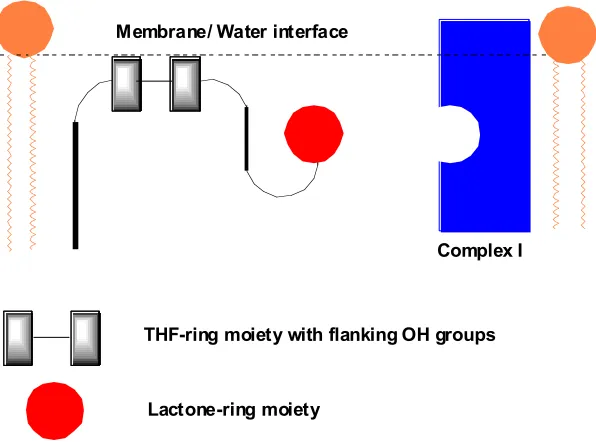
Although acetogenins are thought to act at the terminal electron transfer step of complex I (Figure 1.11), there is still no definitive experimental evidence to verify whether they in fact bind to the ubiquinone reduction site.41 Complex I has been
Chapter One
13 Membrane/ Water interface
THF-ring moiety with flanking OH groups
Lactone-ring moiety
[image:30.612.180.478.85.306.2]Complex I
Figure 1.11: General schematic for the mechanism of action of acetogenins
Chapter One
14
O O
O
O O
O H
H
17
NH
O O
O
OH
O N
N N OPh
O O
N N
O Cl S
t-Bu
18
[image:31.612.127.526.88.367.2]19 20
Figure 1.12: Reported inhibitors rotenone (17), piericicdin-A (18), fenpyroximate (19)
and pyridaben (20) of Complex I
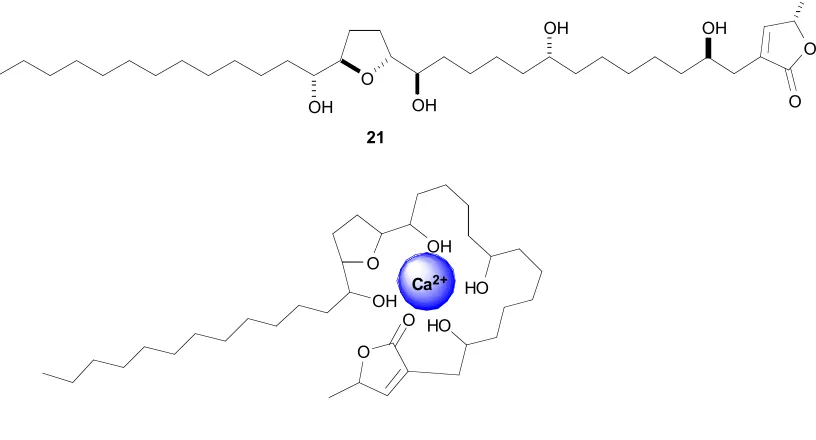
It is also hypothesised that the mechanism of action may also be related to ionophoric abilities, based on observed complexation with cations.48 Although acetogenins present no ionophoric effects in biological studies with living cells,49 it has been shown that structurally related analogues of acetogenins present strongly selective abilities to complex divalent cations, such as Ca2+ (Figure 1.13). This depends on both the nature
Chapter One
15
O OH
HO
HO O
O OH Ca
2+ O
OH OH
OH OH
O
O
[image:32.612.125.533.89.309.2]21
Figure 1.13:Schematic view of complexation of annonacin (21) with Ca2+
1.3.3 Structure Activity Relationships (SAR)
Chapter One
16
1. The presence of polar functional groups such as hydroxyl group in the spacer, the number of THF rings, and the stereochemistry around the THF ring(s) with flanking hydroxyl groups are not essential structural factors for potent activity. 2. The natural γ-lactone ring is itself not crucial for activity and can be substituted
with a ubiquinone ring.53
3. Acetogenins acts as strong inhibitors only when the γ-lactone and the THF ring moieties are directly linked by an alkyl spacer, with an optimum length of 13 carbon atoms.
The presence of α,β unsaturated γ-lactone ring is one of the common structural features of the vast majority of acetogenins. Recent synthetic studies suggest that the teriminal
γ-lactone is essential for the potency of the acetogenins as complex I inhibitors, although some reports propose that the alkyl chain plays a more crucial role. However, the roles of other ring moieties have not been sufficiently emphasised. Miyoshi et al.54
Chapter One
17
1.4 Chamuvarinin- isolation and biological activity
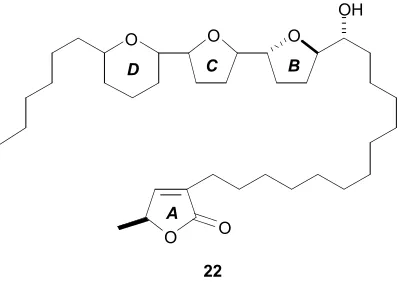
Chamuvarinin (22, Figure 1.14) was isolated in 2004 by Laurens et al. from the roots of Uvaria chamae.55 It is a unique acetogenin bearing an unusual THP ring adjacent to a bis-THF ring system. This species has proven to be a rich source of bioactive metabolites. Prior to chamuvarinin, eight mono-THF acetogenins were also obtained from this plant’s roots.36 Initial biological screening of chamuvarinin showed it to be a highly potent cytotoxic agent with an IC50 = 0.8 nM against KB 3-1 (human epidermoid
carcinoma) cells.
O O O
OH
O O
A
B C
D
[image:34.612.229.428.397.538.2]22
Chapter One
18
1.4.1 Structure elucidation
The determination of the absolute configuration of 22,and of acetogenins in general, is cumbersome, as X-ray structure analysis is often difficult due to the amorphous nature of these compounds, plus the definite sterochemical assignments can not readily be made by 1H and 13C NMR spectroscopy. Despite advances in characterisation methods, the stereochemical assignment of a certain number of this important family of natural products is still incomplete. For example, whilst the stereochemistry in the butenolide ring is known to be S, the relative chemistry of the THF regions of certain mono- and
bis- THF acetogenins still remains undetermined.33 As a result, total synthesis provides the only viable approach to solve these stereochemical puzzles.
The partial stereochemical structure of chamuvarinin (22) was proposed by Laurens et al. using 1H and 13C NMR spectra alongside HRMS, IR and UV data.55 The 1H NMR spectrum of chamuvarinin 22 defied complete stereochemical analysis and the relative stereochemistry of the C15-C19 region was assigned on the basis of correlation with the preferred coincidence data of several other acetogenins (Figure 1.15).56 A total of thirty seven 13C signals and apparently, six well resolved 1H signals in the range of δ H
Chapter One
19
ring motif. The unambiguous determination of stereochemistry in chamuvarinin is a prerequisite to structure activity relationships and it may also provide important information regarding the biosynthetic pathway to this unusual secondary metabolite. However, it became apparent that a synthetic approach would provide the only conclusive means of determining the relative stereochemistry within the C15-C28 region, and ultimately the absolute configuration of chamuvarinin.
O O O HO
O A
B
C
D 15
1
2
19
23
28
O
Relative Known
Unknown Spacer
[image:36.612.203.452.275.546.2]Tail
Chapter One
20
1.5 Selected approaches to acetogenin synthesis
Since the initial isolation of uvaricin in 1982, annonaceous acetogenins have increasingly captured the attention of synthetic and medicinal chemists, owing to the variation of stereochemistry around the central tetrahydrofuran motifs and at the sites bearing additional hydroxyl groups,37,56c,d coupled with their impressive biological
profiles.
Although numerous efforts by research groups have generated approaches to the acetogenin class of molecules over the last two decades, there still remains a lot of work to be done. Most investigations have been focussed on the construction of the adjacent bis tetrahydrofuran acetogenins bearing six oxygenated stereocentres. The first successful approach was reported in 1991 by Hoye and co-workers57 who employed a two-directional inside-out cascade sequence with diepoxide 23 to prepare the bis-THF
Chapter One
21
O O
OAc OH
O O
25 O
O OH
OTs HO
HO 1. TsCl (1.0 eq,), NEt3,
DMAP, DCM, 0oC 2. Amberlyst-15, MeOH
RT, (40%)
24 23
15 19
24 OH
O O
O OH O
Scheme 1.2: Hoye’s synthesis of 15,16,19,20,23,24-hexaepi uvaricin (25)57
1.5.1 Roush’s synthesis of asimicin
Asimicin (26) and bullatacin (15) are two diastereomeric annonaceous acetogenins. Asimicin 26 was isolated from the pawpaw tree, Asimina trilobadunal,58 and bullatacin
Chapter One
22 O
O
OH OH
O
O OH
O O
OH OH
O
O OH
26
[image:39.612.120.539.90.227.2]15
Figure 1.16: Structures of asimicin (26) and bullatacin (15).
Recently, the Roush group has completed the synthesis of both asimicin (26) and bullatacin (15).61 Presented here is Roush’s approach to asimicin (26). This study relied on two sequential chelate controlled [3+2] annulation reactions of chiral allylsilanes (27
and 29) with appropriately substituted aldehydes (28 and 30) (Scheme 1.3) to build the central bis-THF core.62 The total synthesis of asimicin 26 was completed by the
Chapter One
23 O
O
SiMe2Ph TBSO
OTBS OTBS
SiMe2Ph
TBSO
BnO O
H +
+
OH OH
O
O OH
[3+2] annulation
O OTBS
CHO PhMe2Si
[3+2] annulation
26
28 27
30 29
Scheme 1.3: Roush et al. retrosynthesis of asimicin (26)61a
The synthesis of asimicin began with the stereoselective [3+2] annulation, reaction of allylsilane 29 with α-benzyloxy acetaldehyde 30 to afford the 2,5-trans substituted THF
Chapter One
24
SiMe2Ph TBSO
BnO H SnCl4, DCM 4 Å Sieves -45oC (95%)
29
30
O OTBS PhMe2Si
O OTBS
CHO PhMe2Si
31
28
OBn O
2 steps
Scheme 1.4: Roush et al. synthesis of THF aldehyde 28
The synthesis of functionalised allylsilane 27, which contains functionality necessary for installing the butenolide was realised via an asymmetric allylboration of aldehyde
32 with γ-silyl allylborane 33,63 followed by the TBS protection gave 27 (Scheme 1.5).
Treatment of aldehyde 28 with allylsilane 27 mediated by SnCl4 afforded the bis-THF
Chapter One
25
SnCl4, DCM
4 Å sieves (80%)
PhMe2Si B(Ipc)2
1.33, BF3.OEt2, -78oC
2. TBSCl, Imid., DMF
50oC (75%)
33
OTBDPS OTBS
SiMe2Ph
TBSO
O O
OTBS OTBS
OTBS
OTBDPS
O O
OH OH
O
O OH
O OTBS
CHO PhMe2Si
28
PhMe2Si SiMe2Ph
34
26
OTBDPS OTBS
32
O
H
27
Chapter One
26
1.5.2 Crimmin’s synthesis of mucocin
In 1995, McLaughlin and co-workers65 reported the isolation and structure determination of mucocin (35), the first member of the annonaceae family bearing a tetrahydropyran motif non-adjacently linked to a tetrahydrofuran motif. This compound was shown to exhibit high activity in the BST assay (IC50 1.3 µg/mL), as well as
demonstrating remarkable inhibitory effects towards cancer cell lines. Early reports by Sinha and co-workers towards the synthesis of this molecule exploited a tandem oxidative cyclisation with rhenium oxide.66 In 2006, Crimmins and co-workersreported
the total synthesis of mucocin,67 in which the key transformation involved sequential ring closing metathesis to access both key fragments 36 and 37 (Scheme 1.6). These individual fragments were coupled together by the application of cross metathesis, which finally provided mucocin (35), by the introduction of butenolide unit 39 via
Chapter One
27
O O
OH
OH
OH O
O HO
O O
OH
OMOM BnO
OPMB O
O I
O OH BnO
O OMOM
TIPS +
Pd( 0)-catalysed coupling
cr oss metathesis
+
35
37 36
38 39
Scheme 1.6:Crimmins et al. retrosynthetic plan to mucocin 35
The strategy for the C18-C34 fragment relied on ring closing metathesis to construct
syn-THP 36 (Scheme 1.7). To this end, employing the aldol reaction of intermediate 40
with acrolein, gave the desired syn-aldol adduct 41 with good diastereoselectivity (11:1 dr).68 Subsequent silyl protection of the secondary hydroxyl, followed by the removal of the chiral auxillary, allowed the conversion to triene 42. Intermediate 42 underwent ring closing metathesis using Grubbs second generation catalyst 43. This was followed by the acidic work-up to remove the TES group and complete the C18-C34 fragment
Chapter One
28 O
BnO
OTES
O OH BnO
42
36 N O
BnO
TiCl4,i-Pr2NEt NMP, acrolein DCM, -78oC
(77%)
Grubbs II cat.43 Ph-H, 80oC thenp-TsOH MeOH (79%) Xc O
O BnO
40 O Xc
O BnO
41 O Xc
OH
N N Mes
Ru
Cl Ph
PCy3 Cl
Mes
43
Chapter One
29
Next, the intermediate 44 was synthesised by Crimmins asymmetric glycolate-aldol reaction sequence, which then allowed the installation of the olefin by Wittig two carbon extension. In order to effect the regioselective formation of the five membered ring over the six membered cyclic ether, Hoye’s “activation” strategy was utilised.69 To
apply this strategy, intermediate 44 was now taken onto tetraene 45 over four steps. Exposure of tetraene 45 to Grubbs second generation catalyst gave excellent regioselectivity and provided five and six membered rings in 7:1 ratio (Scheme 1.8).
O
O OTES
TIPS HO
44
O OTES
TIPS
45
O OMOM
TIPS 4 steps
82%
1. Grubbs II cat.43, Ph-H, 80oC then p-TsOH, MeOH (79%) 2. MOMCl,iPr2NEt, DMAP
DCM, (89%)
37
Chapter One
30
Next, the two fragments 36 and 37 were coupled by cross metathesis using the Hoveyda-Grubbs catalyst (46) to afford bicyclic ether 47 (E:Z/6:1). Finally, coupling of advanced acetylene 47 and the fully elaborated butenolide side chain 38 was achieved by a Sonogoshira-type cross-coupling (Scheme 1.9).70 This was followed by the
Chapter One 31 O O OH OMOM BnO OPMB O I OPMB O O (PdPPh3)2Cl2, CuI, NEt3
(82%) 38 48 O O O OH OH OH O O HO 35
1. TsNH-NH2, NaOAc (77%) 2. BF3.OEt2, Me2S
(85%) O O OH OMOM BnO 1. Hoveyda-Grubbs catalyst (46) (68%) 2. TBAF, THF (81%) O OH BnO 36 N N Mes Mes Ru O Cl Cl 46 47 O OMOM TIPS 37 +
Chapter One
32
1.6 Retrosynthesis
As outlined in section 1.3.1, the primary objective of this project was to develop a total synthesis which is capable of resolving the stereostructure of chamuvarinin. This 36-carbon annonaceous acetogenin is a highly complex structure, containing eight secondary sterocentres, six of which are bridging stereocentres associated within the contiguous bis-THF-THP ring system in 22. Stepwise advancement, followed by a systematic interconnection of these motifs, is expected to bring about a complete synthesis and enable the structure elucidation.
Such a synthetic strategy must be flexible and be able to address the unique features of chamuvarinin, in addition to formulating and evaluating general solutions to the problems of the structure determination that are common to the annonaceous acetogenin class of compounds. The pioneering work on acetogenins has offered a valuable insight into the challenges that exist in executing a total synthesis and the structural determination of such a complex target.
Chapter One
33
O O O
OH
O O A
B C D
22
O O O
OH
O O O
OH
O O O
OH
O O O
OH
O O O
OH
O O O
OH
Scheme 1.11: Flexible and modular approach to library of chamuvarinin (22) congeners.
Chapter One
34
realised that a modular and flexible route utilising contemporary methods would allow a general and efficient synthesis to chamuvarinin as well as some analogs of biological interest. To this end, it was expected that the most valuable C9-C34 fragment 55 could be realised by a tandem etherification and ring-closing metathesis of the two key C9-C21 fragment 51 and C22-C34 fragment 52. The following chapters of this report separately address the issues of identifying the validity of this approach to synthesis the chamuvarinin.
1 2
8 15
O O O
OTBS B C D O H
PPh3I
O O A A + Etherification RCM O D OBoc O OTBS B OBn HO 19 23
28 O O O
OH B C D O O Wittig Olefination + 22 52 50 49 51
Chapter Two
35
Chapter Two
Results and Discussion
Synthesis of C9-C21 Fragment
According to our proposed retrosynthetic analysis for chamuvarinin (Scheme 1.12), the
C9-C21 subunit (51) would incorporate the B-ring THF motif. Overall, this subunit
contains four stereocentres, two of which are part of the tetrahydrofuran ring fixed on a
seven-carbon backbone. Therefore, the installation of correct stereochemistry in a
concise order was critical.
2.1 Retrosynthesis
It was envisioned that the tetrahydrofuran system could arise from an epoxy alcohol
cyclisation of epoxydiol 53 (Scheme 2.1). In turn, the two oxygenated central carbons
at C15 and C16 were expected to be derived by Sharpless asymmetric dihydroxylation
of olefin 54, which arises from Julia-Kocienski coupling of aldehyde 55 and sulfone 56.
Access to aldehyde 55 could be readily achieved from a TBS-protected glycidol 57
opening, while sulfone 56 could be synthesised from the mono protected
Chapter Two 36 O OTBS OBn OH 9 15 OBn O OH OH OBn TBSO OTBS TBSO H OTBS O S N N N N O
TBSO HO OH
9 9 9 15 15 15 16 16 19 19 53 vinyl addition 5-exo cyclisation 54 Julia-Kocienski olefination 55 56 + Ph O O 57 58 51 OBn
Chapter Two
37
2.2 Preparation of chiral epoxide 57
To enable a realistic assault on the total synthesis of chamuvarinin, it was necessary to
provide sufficient amounts of C9-C21 subunit. To this end, an efficient synthesis of
chiral epoxide 57 was required. This chiral epoxide will serve to install the C19 centre
on C9-C21 subunit 52 (Scheme 2.1).
In order to prepare the key C9-C21 subunit, several factors were considered, including
ease of preparation and access to either enantiomer with high levels of
enantioselectivity. Despite the rise of numerous prominent approaches for the
introduction of epoxides with high yield and enantiomeric excess, methods targeted at
the formation of enantiopure terminal epoxides have always proven disappointing.71 To
date, the most efficient way to prepare enantiopure terminal epoxides from readily
available racemic epoxides is to exploit the resolution mode of chiral salen catalysts to
enrich enantiopurity (Scheme 2.2). Pioneering work by Jacobsen et al.72,73 has
dominated this field, and provides a highly efficient method for the synthesis of
enantiopure terminal epoxides and 1,2-diols. The Jacobsen hydrolytic kinetic resolution
(HKR) using the (R,R)-Co(II)[salen] catalyst 59 (Figure 2.1), in the presence of H 2O
and AcOH at ambient temperature has found widespread application in organic
Chapter Two 38 N N tBu tBu tBu tBu O O Co 59
Figure 2.1: Structure of the [(R,R)(salen)]Co catalyst 59.
Where X = OAc, Cl, OH, OBz, OPh, OTs, SbF6
R O R O R O R O R HO OH R OH OH (R,R)-60
H2O
+ +
(S,S)-61 H2O
N N tBu tBu tBu tBu O O Co N N tBu tBu tBu tBu O O Co
(R,R)-60 (S,S)-61
X X
Scheme 2.2: General reaction for HKR reaction.
The synthesis of C9-C21 subunit began with the preparation of TBS protected glycidol
ether (Scheme 2.3). Protection of glycidol epoxide 62 as its tert-butyldimethylsilyl
ether with TBSCl and imidazole in DCM provided (±)-63. This reaction was performed
on scales of up to 50 g and subsequent material was carefully filtered through a silica
Chapter Two
39 O
HO
O TBSO
TBSCl, Imidazole
DCM (88%)
62 63
Scheme 2.3: Preparation of TBS-protected glycidol ether 63
Using the HKR reaction process, treatment of the racemic TBS-protected epoxide 63
under Jacobsen’s standard conditions yields enantiomerically pure epoxide
(Scheme 2.4). Activation of the (R,R)-Co(II)[salen] catalyst in situ by stirring with neat
epoxide 63 and acetic acid at room temperature. This was followed by dilution with
THF and addition of H2O to provide the enantiomerically enriched (S)-epoxide 57 in
41% yield along with diol 64 in 32% yield. The optical rotation of
!
["]D20 +12.6 (c, 3.1
C6H6) was comparable with the value reported
!
["]D20 +13.5 (c, 2.8 C6H6), consistent
with high levels of enantioselectivity.74
TBSO
O
(R,R)-Co(II)[salen] (59) AcOH, H2O, THF
16 h, RT
TBSO
O TBSO OH
OH +
63 (41%,57) 64
Chapter Two
40
2.2.1 Synthesis of aldehyde 55
With the chiral epoxide 57 in hand, the synthesis of aldehyde 55 could begin. This
required a regioselective epoxide opening with allylmagnesium bromide (Scheme 2.5).
Treatment of epoxide 57 with the cuprate derived from allylmagnesium bromide and
copper (I) iodide in THF at -40 oC afforded the desired product 65 as the only
observable isomer in an excellent 82% yield.73b The resultant hydroxyl group in 65 was
readily protected as its TBS-ether 66 in excellent yield via treatment with TBSCl,
imidazole and catalytic DMAP in DCM.
O TBSO
BrMg
CuI, THF, -40oC (82%)
TBSO
OH
TBSCl, imidazole DMAP, DCM
(98%)
TBSO
OTBS
57 65
66
Scheme 2.5: Synthesis of olefin fragment 66
Finally, oxidative cleavage of terminal olefin 66 was required (Scheme 2.5). A
two-step sequence was employed to this effect. Firstly, dihydroxylation of the terminal
olefin 66 with catalytic OsO4 and NMO provided the 1,2-diol 67, as an diastereomeric
mixture in 78% yield.75 Subsequent, oxidative cleavage of the 1,2-diol 67 with NaIO 4
Chapter Two
41 yield. The aldehyde was obtained in sufficiently pure form to be utilised directly in
further transformations, as prolonged storage resulted in further aerobic-oxidation.
TBSO H
OTBS O TBSO
OTBS
66
OsO4(2.5 mol%), NMO THF/H2O, RT, 5h
(78%)
TBSO
OTBS
OH OH
67
55 NaIO4
MeOH/H2O (3:2) 0oC, 30 min.
(98%)
Scheme 2.6: Synthesis of aldehyde 55
2.2.2 Synthesis of C9-C15 Sulfone 56
For the Julia-Kocienski olefination, sulfone 56 was required. The synthesis of sulfone
56 began with the monobenzylation of 1,7-heptanediol 58 (Scheme 2.7). Upon on the
realisation that the conventional approach for installing the benzyl ether protecting
group using benzyl bromide and sodium hydride could not produce more than 25%
yield of the desired product 68, alternative methods were investigated. Modified
conditions employing tert-butylammonium iodide as a catalyst in 3:1 THF/DMSO
resulted in only a slight improvement, i.e. 49% yield over the conventional procedure
(entry 2, Table 2.1).76 However, treatment of excess alcohol 58 with NaH and benzyl
bromide in dry THF afforded an acceptable yield 75% (based on benzyl bromide).
Initially, in order to separate the product from unreacted diol, column chromatography
Chapter Two
42 circumvent this shortcoming, the mixture of product and unreacted starting material
was distilled under reduced pressure. The three fractions collected were alcohol, ca. 1:1
mixture alcohol/product, and finally the pure product 68 (entry 4, Table 2.1). Although
this slightly lowered the yield to 69%, the purification time was significantly reduced.
[image:59.612.143.517.539.679.2]aproduct purified by column chromatography; bproduct purified by distillation under reduced pressure.
Table 2.1: Benzylation conditions for 58.
With mono-benzyl protected diol 68 in hand, the introduction of phenyltetrazolyl
(PT)-sulfide was readily achieved using the Mitsunobu protocol.77 Treatment of alcohol 68
with triphenylphosphine (PPh3), diisopropylazodicarboxylate (DIAD),
1-H-phenyltetrazole-5-thiol in THF provided the corresponding sulfide 69 in excellent yield.
HO OH HO OBn
S OBn
N N
N NPh
NaH, BnBr, TBAI
THF,RT, 10h (69%)
N N N
N SH Ph
PPh3, DIAD, THF 0oC to RT ( 83%)
58 68
69
Scheme 2.7: Synthesis of sulfide69
Entry Condition(s) (68) Yield (%)
1 58 (1 eq.), BnBr (1.1 eq.), NaH, DMF, RT 25 2 58 (1 eq.), BnBr (1.0 eq), NaH, TBAI,
THF/DMSO (3:1), RT
49
Chapter Two
43 Oxidation of the resultant sulfide 69 proceeded with unexpected challenges (Scheme
2.8). With quantities of 69 in hand, oxidation of sulfide 69 to sulfone 56 using
m-CPBA in DCM only provided the desired sulfone in 30% yield.78 Initially, we opted for
m-CPBA, available directly from a commercial supplier. In addition to the
disappointingly low and unreliable yields on a larger scale, this transformation was also
found to be slow in most settings. Use of 10 equivalents of NaHCO3 to buffer the
m-chlorobenzoic acid present in the commercial reagent only slightly improved the
reaction outcome. On the other hand, the yield and purity of sulfone 56 were provided
superior levels after a preliminary m-CPBA purification step, which included several
pH 7.2 buffer washes and recrystallisation, to provide 56 in 42% yield.79 Gratifyingly,
oxidation with catalytic Mo-catalyst [Mo7O24(NH4)6.H2O] using 30 vol% H2O2 as a
co-oxidant in EtOH gave a smooth conversion of sulfide to sulfone in 80% yield.80
S
BnO N
N N N Ph
69
S
BnO N
N N N Ph
56
O O
m-CPBA, NaHCO3 DCM, RT
(42%)
(NH4)6Mo7O24. 4H2O (0.22 eq.), 30% H2O2(10 eq.), EtOH,
0oC to RT (80%)
Chapter Two
44
2.3 Julia coupling of aldehyde 55 and sulfone 56
Having successfully synthesised the sulfone 56, investigation of the selective Julia
olefination between the aldehyde 55 and sulfone 56 was required. A variety of different
approaches to olefin synthesis have been developed, which attempt to address the
stringent demands required in the total synthesis of natural products.81 However, no
single method yet provides a universal solution to the problem of E:Z selectivity.82
Arguably, the most efficient and generally applicable methods for alkene synthesis
remain those involving direct olefination of carbonyl compounds. Such methods are
best exemplified by the Wittig reaction83 and also include the Horner-Wittig,83b, 84
Horner-Wadsworth-Emmons (HWE),83b, 85 Peterson,86 Johnson,87 and classical Julia
olefinations.88
2.3.1 Julia olefination
In 1973, Julia and Paris88a reported an Julia olefination procedure which utilised the
reductive elimination of β-acyloxysulfones as the alkene forming step.89 A new variant
of the classical Julia olefination, the so called one-pot or modified Julia olefination90
allows for a single-step synthesis of olefins from carbonyl compounds and heterocyclic
sulfones via a novel condensation process initially described by S. Julia in 1991
(Scheme 2.9). The reaction commences with the deprotonation of an aryl or alkyl
benzothiozol-2-yl sulfone 70, because the resulting anion 71 acts as the nucleophile
Chapter Two
45 component 72, forming a transient β-alkoxysulfone intermediate 73. The alkoxide
continues along the reaction pathway, attacking the electrophilic C=N bond of
benzothiazole (BT) portion of the molecule in an intramolecular fashion. This series of
consecutive reactions results in a putative spirocyclic intermediate 74 that selectively
breaks down via an overall Smiles rearrangement to afford the alkene 77 together with
loss of sulfur dioxide 78 and elimination of metallated benzothiazolone 76.
S N S N R 2 H O S N SO2 O R1 R2 S N S O2 O R2
R1 S N O S N O R 2 S R1 O O base addition 72 Smiles rearrangement R1 R2 SO2 + + 70 71 73 74
75 76 77 78
O2 S
H R1
O2 S R1
Scheme 2.9: The modified Julia olefination with (BT) sulfones mechanism
The observed steroselective formation of E-olefins in stabilised-metallated BT-sulfones
with aromatic aldehydes was reported by S. Julia et al.90,91 accordingly he postulated
that there was the creation of a positive charge at the benzylic position during the
Chapter Two
46 zwitterions 82 and 83 upon E1 elimination of 84 (Scheme 2.10). Steric repulsion
between the R1 and R2 groups in 82 would then favour 83 and the subsequent formation
of (E)-olefin 85 over (Z)-olefin 86 upon final extrusion of sulfur dioxide.
N S
SO2
R1
H R2
O
N S O2S
O R1
R2
Li N
S O2S
O R1 R2 Li N S OLi R1 R2 SO2 R2 R1 R1 SO2 R2 + R1 R2
R1 R2
SO2 SO2 70 83 82 85 86 81 80 79
Z-minor E-maj or
R2= aryl
84
Scheme 2.10: Mechanistic explanation for modified Julia reaction
However, the stereochemical outcome of the one-pot Julia reaction is influenced
strongly by both substrate and reaction conditions. One such example was reported in
1996 by Kocienski and co-workers,92 who used it to synthesise the triene portion of
rapamycin (Scheme 2.11). Using LiHMDS, as the base to deprotonate benzothiazolyl
sulfone 88, the metallated BT-sulfone was then condensed with aldehyde 87 giving a
68% yield of alkene 89 with a 19:1 E:Z ratio. They also observed the substrate
dependence of the reaction when aldehyde 90 was condensed with BT-sulfone 91, the
Chapter Two
47 reaction exemplifies that stabilised BT-sulfone anions have a preferential tendency to
give (Z)-configured products.
O S S OMe OTBS H 19 20 21 22 O S S CHO OMe H S O2 OTBS BT O S S CHO OMe H OTBS S O2 BT
M yield89 [C19-C20]E:Z
Li 75% 29:71
Na 21% 43:57
K ---- 18:82
M yield89 [C21-C22]E:Z
Li 68% 95:5
Na 21% 78:22
+
+ MN(SiMe3)2, THF
-78oC to RT MN(SiMe3)2, THF
-78oC to RT
87 88
89
90 91
Chapter Two
48 The modified Julia olefination was first described using BT-sulfone, but has since been
extended to a range of heteroaryl sulfones (Figure 2.2). In fact, any aryl unit that may
support a Smiles rearrangement can potentially be employed in the Julia olefination
chemistry, and many other activators have been investigated. Julia described reactions
where pyridine and pyrimidine heterocyclic sulfones could be employed in olefination.
Later, Kocienski extended the library of heteroarenes that were able to perform the
reaction to 1-isoquinolinoyl, 1-methyl-2-imidazolyl, 2-imidazolyl,
4-methyl-1,2,4-triazol-3-yl, and 1-phenyl-1H-tetrazol-5-yl (PT).93 Advantageously, the
carbanions of PT-sulfones exhibit a reduced propensity to self-condense as compared to
the analogous BT-sulfones. More recently, non-heterocyclic aromatics have been used,
for example bistrifuromethylphenyl94 and hexachlorophenyl,95 to affect the modified
Julia reaction (Figure 2.2).
S
N N
R N
N N N
PYR PT : R = Ph TBT: R =tBu N
N
N
N
N N
N N
CF3
F3C
BTFP BT
Chapter Two
49
2.3.2 Recent applications of the modified-Julia olefination
Applications of the modified Julia olefination in target directed synthesis began to
appear soon after its disclosure. In the asymmetric total synthesis of (-)-callystatin A
(92) by Smith et al.96 two separate modified Julia olefinations were used to install two
(E)-olefin moieties (Scheme 2.12). The C6-C7 (E)-alkene was installed using the
Kocineski-modified process, in which the PT-sulfone 93 was dissolved along with the
α,β-unsaturated aldehyde 94 in DME and treated with NaHMDS in the presence of
HMPA. The (E)-olefin 95 was the only product and due to the relative instability of the
anion of the PT-sulfone 93 the isolated yield of the product 95 was modest.
O
OMe S O
O
N N N N Ph
OHC TESO
(Z) (E)
+
O
OMe TESO
(Z) NaHMDS, HMPA
DME, -78oC
(35%)
93 94 95
O 92
O O
OH
6 7 6
7
Chapter Two
50 In a further example, Jacobsen et al.97 observed unprecedented base and solvent effects
for their PT-sulfone coupling reaction for the advanced intermediate 96 in their
synthesis of the antifungal agent, (+)-ambruticin. Addition of cyclopropyl PT-sulfone
97 to aldehyde 98 was strongly dependent on the polarity of the solvent (Scheme 2.13).
In this specific case, the nature of the counterion was perhaps not the most influential
factor, since very polar and strongly coordinating solvents such as DMF, HMPA and
DMPU likely annihilated the possible differences between lithium, sodium and
potassium cations. Hence, the E/Z ratio correlated well with the increasing polarity and
coordinating ability of the solvents with counter ion and afforded 96, the desired
E-isomer almost exclusively (entries 5 and 6, Table 2.2).
O MeO
S O O PT
O OTBS
CHO OTBS
TBDPSO +
O MeO
O
OTBS OTBS
TBDPSO
96
97 98
conditions
(see table)
Chapter Two
[image:68.612.123.534.78.211.2]51
Table 2.2: Julia olefination conditions for Jacobsen’s synthesis of (+)-ambruticin
Since its discovery the modified-Julia olefination reaction has become one of the more
commonly used tools for the assembly of advanced and functionalised intermediates in
the course of target-directed synthesis.98 Although many of such examples have been
recently reported, access to functionalised olefins and the grounds for poor
stereoselectivity of specific substrates are still somewhat unclear and the use of
functionalised aldehydes or ketones often remains a matter of trial-and-error.99
23.3 Synthesis of C9-C20 olefin
With aldehyde 55 and sulfone 56 in hand, the coupling of the two components was
required. As outlined above, this transformation proved to be more challenging then
expected, as detailed in Scheme 2.14 and Table 2.3. Initially employing KHMDS at
-78 oC (entry 1), led only to recovered starting materials. Elevating the reaction
temperature from -78 oC to -50 oC following the addition of aldehyde 55 (entries 2-6),
led to unreliable yields with modest E:Z selectivity, along with significant
decomposition of the aldehyde coupling partner 55. Gratifyingly, upon switching the
Entry Condition(s) E/Z
1 NaHMDS, THF, -78 oC 1:8
2 KHMDS, DME, 18-crown-6, -60 oC 1:3
3 KHMDS, DMF, -60 oC 1:1
4 LiHMDS, THF:HMPA (4:1), -60 oC 3:1
5 LiHMDS, DMF:HMPA (4:1), -35 oC >30:1
Chapter Two
52 base to NaHMDS (entry, 7) the E:Z selectivity improved to synthetically useful levels
(E:Z = 92:8). However, the yield of the olefin remained unsatisfactory. Gratifyingly,
upon switching the solvent to DME, efficient coupling of 55 with 56 provided 54 in
75% yield with essentially complete (E)-selectivity.100
OBn TBSO
OTBS
TBSO H
OTBS O
S N N
N N Ph +
OBn
KHMDS, THF, -78oC or
NaHMDS, THF, - 78oC (see table2.2)
NaHMDS, DME, -78oC (75%)
55 56
54
O O
Scheme 2.14: Synthesis of (E)-olefin (54) via Julia olefination