©IJRASET: All Rights are Reserved
585
Implementation of Color Face Recognition using
LTP and KNN-LR Classifier
Gurjantpal Kaur1, Er.Jaspreet Kaur2, Er.Varinderjit Kaur3, Dr.Naveen Dhillon (Principal)4
1
(Student)R.I.E.T(Phagwara)
2
(A.P), 3(HOD )M. Tech(CSE)
Abstract: Face recognition is by using images or video is one of the most trending topic now a days. It is preferable in various fields to maintain the security and privacy. The main lead of using face recognition system is uniqueness and high acceptance over other biometric systems. Though this system is considered to be accurate but the detection of face is a difficult process as face detection is having the high degree of variability. Various techniques have been proposed earlier for detection of the face but still the results obtained were not efficient. The main problem with these types of systems is the accuracy and the speed of detection of the face, error etc. The proposed work (LTP-LR-KNN) replaces the PCA with Local Ternary Pattern(LTP) and for classification the hybrid mechanism i.e. K-Nearest Neighbor (KNN) and LR is used. The results prove the efficiency of the LTP-LR-KNN over traditional techniques in the term of accuracy, MSE, correlation and error.
Keywords: Face Recognition, Principal Component Analysis, Local Ternary Pattern, K-Nearest Neighbor.
I. INTRODUCTION
Biometrics may be described as an individual authentication on the basis of his/her behavioral or anatomical features. Various advantages are associated with the biometrics system as compare to the ordinary techniques used for identification of an individual like tokens, passwords etc. Demerits of traditional authentication system are as follow: (i) physical presence of an individual whose authentication is to be done is essential at the place of identification. (ii) In traditional techniques it is required to remember lengthy passwords or PIN numbers. Biometric based authentication system is highly secure and does not require remembering lengthy PIN numbers. Biometrics authentication system can be of various types and some of them are given below:
A. Face recognition B. Iris Recognition C. Fingerprints recognition D. Palm recognition
Generally, Biometric recognition systems are divided into two functionalities such as:
1) Verification: In this process, identity is recognized either it is the person who is claim to be is so or not. Consider an example to understand the concept. If a person named John Doe is claiming that he is that person and provides fingerprints for the recognition then in that case system compares the offered fingerprints with the one enclosed into database. There are number of applications which offer authentication controls such as physically or logically. Physically means the entrance to a building and logically means computer login such as transactions at a bank, access control, and medical records management are the famous examples of verification applications
2) Identification: this process concludes that whether the identity of that person resides in the database or not. The identification process initiates from entering the data into the system and then comparison has started from large number of enrolled identities. Basically there are two types of scenarios of identification either positive or negative. In the positive identification, identity is totally matched with that identity entered into the database which means that person is authorizedwhereas if the person identity does not matched with the identity resides in the database is known as negative identification and it means person is not known. Some of the examples of positive identification systems are “PIN-less” access control systems and welfare disbursement schemes, on the counter part, watch –list surveillance and driver license issuance are the practical applications of the negative identification systems.
II. TECHNIQUES USED
©IJRASET: All Rights are Reserved
586
feature extraction. Along with this, the proposed work also implements the hybrid classification technique by combining the KNN and LR classifiers. A brief introduction to the techniques that are used in proposed work is as below:A. LTP
The local binarypattern mechanism of feature extraction was very sensitive to noise; it means that the LBP is more prone to noise. To overcome this mess of LBP, a generalized LBP was designed and named as LTP i.e. Local Ternary Pattern. LTP was developed by Tan and Triggs. LTP is based on 3 coded values such as gray levels in a region of width ± t around ic are set to 0. One upper value is set to +1 and one lower value is set to 1.
B. KNN
KNN stands for k nearest neighbor algorithm which is widely used for classifications. It is the type of instance based learning algorithm which stores the trained data set in order to classify new and classified data set. The nearest neighbor is found on the basis of distance by using the distance metrics. A distance metric is the function based on the real values for x, y and z coordinates.
d(x, y)≥0, and d(x, y) = 0 iff x = 0 … … … (6)
III. PROBLEM FORMULATION
Face is our primary focus of attention in social intercourses. It plays an important role in providing human identity. This approach is much popular in many of the fields such as recognition or can say for the security or authentication purpose. Many algorithms and techniques are developed to update the traditional systems. PCA is one of the existing techniques which is used to extract the features from the face images samples. There are several researchers who have used this technique for the feature extraction. Due to this fact, there is a requirement of updating the existing technique by replacing it with the new proposed technique for high successful ratio. After the extraction of features, classification has done in the process of face recognition. And this classification is done using KNN classifier in the existing systems. The KNN classifier for testing and training purpose is very simple and the mature technique. Considering these particulars, both the techniques i.e. PCA and KNN for feature extraction and classification respectively can be replaced with advanced technique of them for better recognition.
IV. PROPOSED WORK
Face recognition is an important aspect in identification of an individual. Growing use of biometrics has increased the research work done in the field of face recognition. Lots of work is done in this field to improve the conventional techniques employed. The disadvantage of the conventional techniques was that it used PCA which cannot perform accurately where there are some variations in face samples. Thus it has proved to be inefficient when it comes to variations in datasets. Therefore, the PCA can be replaced with the new proposed technique such as LTP i.e. Local Ternary Pattern for the feature extraction in face recognition system for enhanced quality and efficiency. Furthermore, KNN is the most basic classifier due to which it can be replaced with the advanced technique of the classifier such as LR. The successful rate of the proposed classifier is high. The hybrid model of KNN-LR will perform significantly in terms of classification.
The methodology if the proposed work is defined below.
1) First step is to select the input image. The image selection is done from available dataset of facial images. Then this input image is used for further processing such as classification feature extraction etc.
2) Next step is to extract the features from the dataset of selected images. Here the feature extraction is done by using the LTP mechanism. These extracted features are use for pattern matching at the time of recognition.
3) After extracting the features from the images, this step is organized to perform the classification on the extracted features. The classification is performed by using the KNN-LR classifier.
4) Next step is o train the dataset.
5) Perform testing of the available dataset by using the trained dataset. The testing is done on the basis of the extracted features and performed classifications.
©IJRASET: All Rights are Reserved
587
Figure 1 Framework of proposed work
V. RESULTS
This section represents the results that are obtained after implementing the proposed work in MATLAB. The performance of the proposed system is evaluated in the terms of accuracy, MSE, BER and Correlation with respect to the different k values.
A. MSE
MSE is a parameter that defines the average error of an image. It is a difference between the estimator and the estimated value. It has used to estimate the quality of the proposed technique with respect to the traditional technique. Its value always is non-negative and closer to zero value is better.
= 1 [ ( , )− ( , )] … … … . . (5.1)
B. Correlation
In a normal image, the correlation of the near located pixel is close to one. Following formulation is used for evaluating the correlation among two images:
( ) = 1 … … . (5.2)
( ) = 1 − ( ) … … (5.3)
( , ) =1 ( − ( )( − ( )) … . . (5.4)
= ( , )
( ) ( … … . (5.5)
Calculate parameters Perform Testing Select Face Samples
Extract features of face images using LTP
Perform classification through KNN-LRclassification technique
©IJRASET: All Rights are Reserved
588
The graph in figure 2 classifies the accuracy of proposed work with respect to different k values. The x axis in the graph shows the values corresponding to the k factor that varies from 2 to 20. The y axis shows the accuracy from 0 to 1. As per the observations from the graph, it can be said that the accuracy of the proposed work is evaluated to be 0.09714 and this remains constant with respect to the different k values.Figure 2 Accuracy of proposed work (LTP-LR-KNN).
[image:4.612.203.407.136.274.2]The figure 3 portrays the graph of MSE i.e. Mean Square Error that is evaluated in case of proposed work. The MSE is a performance parameter that is evaluated to measure the mean square error in the output signals generated by the proposed work. The value of MSE should be always low as the system with highest MSE is considered to be less efficient and reliable. The MSE of proposed work is 3.457.
Figure 3 MSE of proposed work (LTP-LR-KNN)
The graph (figure 4) depicts the correlation of proposed work. The correlation is evaluated to measure the level of correlation among input and output images. The increment in the correlation value shows that the input and output signals are highly correlated to each other. This directly implicates that after performing heavy operation to the input image, the real information within the image did not get effected. The correlation of the proposed sys8tem is 0.8922.
Figure 4 Correlation of proposed work (LTP-LR-KNN)
2 4 6 8 10 12 14 16 18 20
0 0.2 0.4 0.6 0.8 1
k
A
c
c
u
ra
c
y
Graph of Accuracy vs k different Value (LTP-LR-KNN)
2 4 6 8 10 12 14 16 18 20
0 0.5 1 1.5 2 2.5 3 3.5 4 4.5 5
k
M
S
E
Graph of Accuracy vs k different Value (LTP-LR-KNN)
2 4 6 8 10 12 14 16 18 20
0 0.2 0.4 0.6 0.8
1 X: 15
Y: 0.8922
k
C
o
rr
e
la
ti
o
n
[image:4.612.196.415.346.494.2]©IJRASET: All Rights are Reserved
589
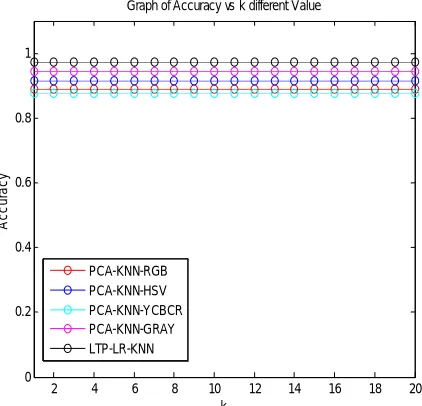
The graph in figure 5 exhibits the comparison of LTP-LR-KNN, PCA-KNN-HSV, PCA-KNN-YCBCR and PCA-KNN-GRAY. The comparison is shown in the term of accuracy. The accuracy for LTP-LR-KNN is 0.9714, GRAY is 0.9429, PCA-KNN-HSV is 0.9167, PCA-KNN-RGB is 0.8889 and PCA-KNN-YCBCR is 0.875. The facts and figures show that the proposed work has higher value of accuracy in comparison to the rest of the techniques.Figure 5 Accuracy of proposed and traditional works.
[image:5.612.200.402.435.602.2]The figure 6 betokens the comparison of error in generated output of proposed and traditional work. Here KNN-RGB, PCA-KNN-HSV, PCA-KNN-YCBCR and PCA-KNN-GRAY are considered as the traditional techniques. The only difference is of used color model. The error of LTP-LR-KNN (proposed work) is 0.02857, PCA-KNN-GRAY is 0.5714, PCA-KNN-HSV is 0.8333, PCA-KNN-RGB is 0.1111 and PCA-KNN-YCBCR is 0.125.
Figure 6 Error of proposed technique and traditional techniques
Table 1 Accuracy of traditional and proposed work
S. No. Techniques Accuracy
1. LTP-LR-KNN 0.9714
2. PCA-KNN-GRAY 0.9429
3. PCA-KNN-HSV 0.9137
4. PCA-KNN-RGB 0.8889
5. PCA-KNN-YCBCR 0.875
2 4 6 8 10 12 14 16 18 20
0 0.2 0.4 0.6 0.8 1
k
A
c
c
u
ra
c
y
Graph of Accuracy vs k different Value
PCA-KNN-RGB PCA-KNN-HSV PCA-KNN-YCBCR PCA-KNN-GRAY LTP-LR-KNN
2 4 6 8 10 12 14 16 18 20
0 0.2 0.4 0.6 0.8 1
k
E
rr
o
r
Graph of Error vs k different Value
[image:5.612.58.550.647.732.2]©IJRASET: All Rights are Reserved
590
Table.2 Error of traditional and proposed workS. No. Techniques Error
1. LTP-LR-KNN 0.02857
2. PCA-KNN-GRAY 0.05714
3. PCA-KNN-HSV 0.8333
4. PCA-KNN-RGB 0.1111
5. PCA-KNN-YCBCR 0.125
Table 1 and 2 shows the comparison of accuracy and error of proposed and traditional work. The tables are drawn on the basis of the values that are observed from the graphs that are observed after implementing the proposed work in MATLAB and depicted in graphs. On the basis of the table 1, it is concluded that the accuracy of the proposed work is higher in comparison to the rest of the considered mechanism. Similarly, table 2 authenticated the lower error rate of the proposed work in contrast to other mechanisms.
VI. CONCLUSION
The qualitymining is akey step of the biometric recognition system. The basic task of the feature extraction should be done with great accuracy and precision for further matching and identification. In face recognition system, the extracted and classified features are used for the purpose of recognition and identification. Thus various techniques have been developed and applied for this purpose. This study implements the LTP-LR-KNN mechanism for recognizing the faces on the basis of available dataset. The LTP is used as an alternative to PCA for extracting features and the combined i.e. LR and KNN classifiers are used for classifying the extracted features. The results depict that the LTP-LR-KNN outperforms the RGB, YCBCR, PCA-KNN-GRAY and PCA-KNN-HSV in terms of accuracy, error, MSE. In future more amendments can be done on feature extraction domain. The LTP can be replaced by a hybrid feature extraction technique i.e. the combination of local binary pattern and local phase quantization. Furthermore, the KNN classifier is used in this along with LR. The KNN evaluates on the basis of distance only irrespective to the properties. Thus fuzzy inference system based classifier can be applied to extract the features in more perfect way.
REFERENCES
[1] Can Eyupoglu, “Implementation of Color Face Recognition Using PCA and KNN Classifiers”, IEEE, Pp 1-4, 2016
[2] Vinay Hiremath Et Al, “Face Recognition Using Eigen face Approach”,IDT workshop on interesting results in computer science and engineering, Sweden. 2009.
[3] Soninder Singh, “A Robust Technique Implementation for Facial Recognition Under Eigen Feature Extraction”, Journal of Global Research in Computer Science, Vol. 4, No. 8, 2013.
[4] Mayank Agarwal Et Al, “Face Recognition Using Eigen Faces and Artificial Neural Network”, IJCTE, Vol. 2, No. 4, Pp. 624-629, August 2010. [5] Yogesh Tayal Et Al, “Face Recognition Using Eigen face”, IJETCAS, Vol. 3, No. 1, Pp. 50-55, February 2013.
[6] Kwok-Wai Wong Et Al, “An Efficient Algorithm for Human Face Detection And Facial Feature Extraction Under Different Conditions”, ELSEVIER, Vol. 34, Pp. 1993-2004, 2001.
[7] Pawan Sinha Et Al, “Face Recognition By Humans”, IEEE, Vol. 94, No. 11, Pp. 1948-1962, January 2007.
[8] Faizan Ahmad Et Al, “Image-Based Face Detection and Recognition: Based Face Detection and Recognition: Based Face Detection and Recognition: “State Of The Art”, IJCSI.
[9] Sujata G. Bhele et al, “A Review Paper on Face Recognition Techniques”, IJARCET, Vol. 1, No. 8, Pp. 339-346, October 2012.
[10] Navneet Jindal Et Al, “Enhanced Face Recognition Algorithm Uses PCA with Artificial Neural Networks”, IJARCSSE, Vol. 3, No. 6, Pp. 864-872, June 2013. [11] Andrew W. Senior Et Al, “Face Recognition and Its Applications”, Achievements and Challenges in Fingerprint Recognition, Pp. 101-115.
[12] Walaa Mohamed Et Al, “A New Method for Face Recognition Using Variance Estimation and Feature Extraction”, IJETTCS, Vol. 2, No. 2, Pp. 134-141, April 2013.
[13] Zeynep Orman et al, “A Study on Face, Eye Detection and Gaze Estimation”, IJCSES, Vol. 3, No. 3, Pp. 29-46, August 2011.
[14] Ashok Kumar et al, “A MATLAB based Face Recognition System using Image Processing and Neural Networks”, IJARCSSE, Vol. 6, No. 4, Pp. 871-875, April 2016.
[15] Ben Niua et al, “Two-Dimensional Laplacian Faces Method for Face Recognition”, ELSEVIER, Vol. 41, No. 10, Pp. 3237-3243, October 2008. [16] G. Prabu Teja et al, “Face recognition using subspaces techniques” , IEEE, June 2012.
[17] Jeremiah R. Barr et al, “Face Recognition from Video: A Review”, IJPRAI, Vol. 26, No. 5, Pp. 53, August 2012.
[18] Hehua Chi A et al , “Facial Expression Recognition Based On Cloud Model”, Remote Sensing and Spatial Information Sciences, Vol. 38, No. 2, Pp. 124-128. [19] C.Nagaraju et al, “An Efficient Facial Features Extraction Technique For Face Recognition System Using Local Binary Patterns”, IJITEE, Vol 2, No. 6, Pp.
76-78, May 2013.
[20] Joseph F. Grafsgaard, “Automatically Recognizing Facial Expression:”, IEEE, December 2013.
[21] ShengCai Liao et al, “Face Recognition Using Ordinal Features”, SPRINGER, Vol. 3832, Pp. 40-46, 2005.