A Novel Study on Face Recognition Algorithms and
its Challenges
Sumana Achar1, Kavana2, Anahga B. V3
1, 2, 3Dept of Telecommunication APS College of Engineering, Bangalore, India
Abstract: Face recognition system is an application of computer vision and Image processing which is capable of performing two major tasks of identifying and verifying a person from an image or a video database. The human face is a complicated multidimensional model and it needs a sturdy recognition technique to recognize a human face. The face recognition accuracy is depends on two procedure which are human face detection and a feature extraction method. Many of face recognition feature extraction techniques are used to recognize the face but it needs more enhancements acquire to get optimum outcome. This paper majorly concentrates on comparative study between PCA (Principal Component Analysis), LDA (Linear Discriminant Analysis), Clustering and SVM (Support Vector Machine) algorithms.
Keywords: Image processing, Face Recognition, PCA, LDA, SVM, Cluster, Eigen face, Eigen vectors, Scatter matrix, Mean image.
I.INTRODUCTION
Image processing is a method to perform some operations on an image, in order to get an enhanced image or to extract some useful information from it [1]. It is a process of pictures victimization mathematical operations using any kind of signal process provided the input is an image [2].Image processing basically includes importing the image via image acquisition tool, analysing and manipulating the image, output in which result can be altered image or report that is based on image analysis [1]. The purposes of image processing are virtualisation-observe the objects that are not visible, image sharpening and restoration-to create a better image, image retrieval-seek for the image of interest, measurement of pattern-measure various objects in an image, image recognition-distinguish the objects in an image. Analog or visual techniques of image processing can be used for hard copies like printouts and photographs. Digital techniques help in manipulation of the digital images by using computers [3].Face is one of the variables that are very easy to remember in real life. Generally humans can remember and recognise a person based on his face. Moreover it is one of the complex variables when viewed from the perspective of computer vision [4]. Face Recognition has become a very active research area, partly because of the increased interest in biometric security system. A Face Recognition System (FRS) is a computer vision and it automatically searches a human face from database of images. Face recognition falls under the sector of object detection. It is a typical kind of detection as it involves the detection of the frontal faces which almost look alike [5]. A human face can modify because of many conditions like increasing age ,wearing a glass, have a beard and change in hair style that generate complexity in recognition process of face [6]. Facial recognition process is divided into three stages namely-fetch the image, process the image and compression or classification and indicates whether the subject in the input image is present in the database or not. Generally, FRS is used for Verification (one-to-one matching) and Identification( one-to-many matching).
II.ISSUES AND CHALLENGES IN FACE RECOGNITION SYSTEM
There are numerous factors due to which the appearance of the face varies. These variations may be due to physical nature of the face that are independent of the observer. The other issues due to which face recognition rate may drop are likely due to the changes in camera angle , variation in the angle of light that illuminated on the face, change in facial features , facial expressions, occlusions, changes in the surroundings while capturing the images. The system faults like camera distortion, background noise, insufficient storage, improper techniques of the system can deteriorate the FRS.
III.IMAGE DATABASE DESIGN AND ALGORITHMS A. Principal Component Analysis (PCA)
and shows the effective low dimensional structure of facial features. This dimensional reduction discards information which is not in use and precisely decomposes the face structure components into orthogonal components known as Eigen faces. The face features are extracted by the PCA method, reducing the dimensionality of input space.
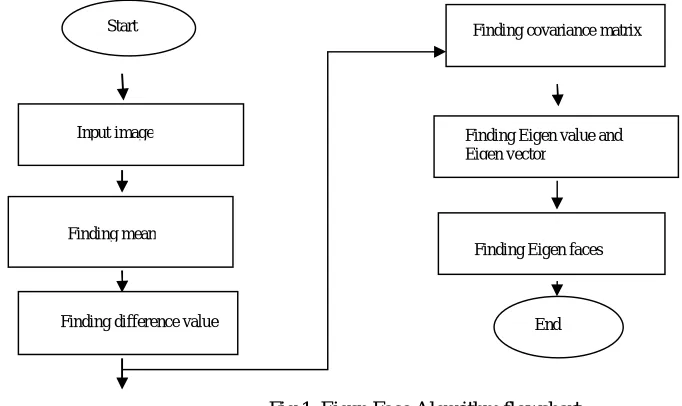
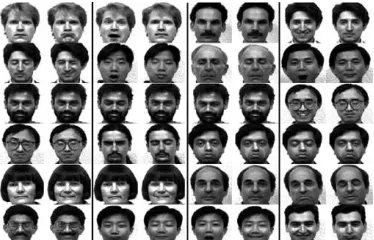
[image:2.612.94.435.183.386.2]The purpose of PCA is to reduce large dimensionality of the image space to the smaller intrinsic dimensionality of feature space, which is needed to describe the data economically. PCA finds major applications in the fields of image analysis, reorganising unknown faces and dimensional data resolution [7]. PCA method use Eigen face algorithm. as depicted in Fig. 1 the Eigen face algorithm flowchart and the images trained on PCA for normal images surveyed from various papers as an illustration.
Fig 1. Eigen Face Algorithm flowchart
Let I be an image of size ( , ) then the training operation of PCA can be explained in mathematical form with following steps.
1) Convert the training image matrix I of pixel (N,M) in the vector form as X as (N,1) Where N=PXQ
2) Create a training set of training image vectors by concatenating each column vector Xi such that its size is (N, M) and
X=[ , , … , ] where, Xi represent the ith image vector.
M=number of training images
N=size of training images
3) Compute the mean of training set and given by A:
= ∑ (1)
4) Obtain mean subtracted vector (B) by subtracting mean from each training image and is given by:
= − (2)
5) Create the difference matrix B by concatenating mean subtracted vectors such that difference matrix is given by:
= [ , , , . . , ]
6) Compute the covariance matrix (C) such that it reduces the computation.
The covariance matrix is given by: = (3)
7) Compute the Eigen vectors and Eigen values of the covariance matrix C
8) × = × (4) = × Here, W is the Eigen vector matrix. (5)
9) Order the eigenvectors descending by their Eigen value. The k principal components are the eigenvectors corresponding to the k largest Eigen values. Projecting the sample images to this Eigen face space. k< less than total samples M
× = × ( − ) (6)
Start
Input image
Finding mean
End Finding difference value
Finding covariance matrix
Finding Eigen value and Eigen vector
10) For recognition of unknown face or test image, normalize it by subtracting from mean vector of all images in the training set. Then using equation (5) project the normalized test image as shown in the following equation: D is the normalized test image.
= × (7)
11) After the feature vector (weight vector) for the test image have been found out, next step is to classify it. For the classification task we could simply use Euclidean distance classifier.
= || − || (8)
[image:3.612.50.237.178.298.2]If distance is small then we can say the images are similar and we can decide which is the most similar image in the database [9]
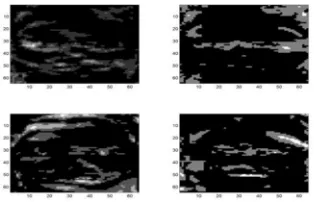
Fig 2. Eigen faces for normal images for variation in expressions Fig 3. Eigen Faces for normal image with PCA
B. Linear Discriminant Analysis calculation
LDA is another holistic approach based face recognition method proposed by Etemad and Chellapa. However, unlike Eigen faces which attempt to maximize the scatter of the training images in face space, it attempts to maximize the between class scatter, while minimizing the within class scatter. In other words, moves images of the same face closer together, while moving images of different faces further apart. Overall it tries to increase the ratio of the between-class scatter to within class scatter. Here, the class is the collection of images of the same person.
Linear Discriminant Analysis (LDA) is a generalization of Fisher’s linear discriminant, a method in statistics, pattern recognition and machine learning to find a linear combination of features that characterises or separates two or more classes of objects and events. Unlike Eigen faces which attempt to maximize the scatter of the training image in face space, it attempts to maximize the between class scatter. It is a data separation technique. The objective of LDA is to find the direction that can well separate the different classes of the data once projected upon. Recognition is performed by projecting a new face onto the Fisher space. LDA is used in statistics, pattern recognition and machine learning to find a linear combination of features which separates two or more classes of objects or events.
1) Let X be a random vector with samples drawn from c classes = [ , , , … . , ]
= [ , , , … . , ] where ith image vector
2) The scatter matrices SB and SW are calculated as:
=∑ ( − )( − ) (9)
=∑ ∑ Є ( − )( − ) (10)
Where U is the total mean.
= ∑ (11)
And is the mean of class. Є (1,2, … , ) =
| |∑ Є (12)
Fisher's classic algorithm now looks for a projection W that maximizes the class seperability criterion.
= arg (| |)
(| |) (13)
= arg (| | (14)
= arg | |
| | (15)
The transformation matrix W projects the sample images into the (c-1) dimensional space, also known as fisher face that is then given by:
= (16) The expression for projection of image samples is given by:
( )× = × ( − ) (17)
[image:4.612.230.387.209.310.2]Rest of the procedure for face recognition is similar to that of PCA.[9]
Fig. 4. Fisher faces
C. Clustering Algorithms
Cluster is the task of grouping a set of objects in such a way that objects in the same group are more similar to each other than to those in other groups[20]. Clustering includes different algorithms namely: k-means, c-means, Rank-Order, Co-Clustering. K-means clustering groups data vectors into a pre-defined number of cluster based on Euclidean distance; c-K-means clustering is a data clustering algorithm in which each data point is associated with cluster through a membership degree [12]; Rank –Order clustering is a form of agglomerative hierarchical clustering using nearest neighbour based distance measure [13]; Co-clustering method automatically select the class independent salient features from still image.
1) K-Means Clustering Algorithm: k-means algorithms proved their usefulness in the area of image analysis, segmentation process. Thus the steps for k-mean algorithm are as follow:
Step 1: Initialize step with centre C
Step 2: For each data point , compute its minimum distance with each centre . = ∑ | ( )
∑ | ( ) (18)
Step 3: For each centre , recomputed the new centre from all data points belong to this cluster. Step 4: Repeat steps 2 and 3 until convergence.
2) Modified k-means : Modified k-means algorithm is a new algorithm for k-means based on the optimization formulation The steps of this algorithm represented as
Step 1: Dividing data set (D) into k-parts
D=⋃ , ∩ = , 1≠ 2 (19) Step 2: Let ( )( ), = 1, … , be initial clustering centres calculated by:
( )( )= ∑ ( )/| |
( )∈ , k=1,….,K (20)
Step 3: Decide membership of the patterns in each one of the K Clusters according to the minimum distance from cluster centre. Step 4: Calculate new centre using the iterations
Step 5: Repeat step 3 and 4 till there in no change in cluster centre.
3) C-Means Clustering Algorithm: The algorithm employs fuzzy partitioning such that a given data point can belong to several groups with a degree specified by membership grades between 0 and 1
= 1,∀ = 1, … . (21)
Step 2: To calculate the C cluster =∑ /∑ = 1, … . . .
Step 3: Use = ( − ) ( − )/∑ to calculate the C results of covariance matrix , i=1,……C.
Step 4: Use = ( , ) /( )/∑ [ ( , )] /( ) to calculate new matrix U, repeat step 2.
4) Rank-Order Clustering Algorithm: In Rank-Order clustering distance between two clusters is computed and following are the steps used to calculate the distance between clusters
Step1 : Initialize cluster C={ , ……… } by letting each face be a single-element cluster. Step 2: Repeat for all pairs C and C in C clusters.
Step 3: Compute the distances ( , ) by , ( , )
( , ( )) and ( , ) by , . ( , ) where , =| | | |
∑ ∈ ∪ ∑ ( , ( )) (22) Step 4: Denote ( , ) as candidate merging pair if ( , ) < t and ( , ) <1 where t is Rank-Order threshold. Step 5: Do transitive merge on all candidate merging pair and update C and absolute distance between clusters. Step 6: Move all single-element clusters in C into an “un- grouped” face cluster
5) Co-Clustering Algorithm: Co-clustering, often referred as a biclustering in 2D aims to explore the association in data matrix amongst utterances and features in terms of sub-matrices.
Initialization:
× = [ , , … … … . ], D, Q, where A is input facial expression feature matrix, D corresponds to the selected singular vectors
and Q represents the number of co-clusters.
Step 1: Normalize the features for i = 1,…,n to have zero mean and unit variance.
= ( = 1, … ) × =[ , … . . ] (23)
Step 2: Apply the SVD to and let and denotes the row space and columns space respectively.
= [ , . . , ] = [ , … , ] (24)
= [ , … , ] = [ , … . , ] (25)
Step 3: For the given Q , compute the smallest Step 4: Compute the probability using =
√ ( )e
∗( )
of a given sample to group in a loop , l =0,…. L. Where is centre and is covariance is sample
Step 5: Repeat the process for . Row information from and column information from are grouped together in groups forming the sub-matrices.
[image:5.612.123.470.530.607.2]Step 6: Sort the co-clusters in descending order and exclude features that belongs to first N co-clusters.
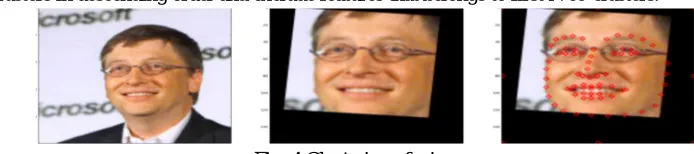
Fig. 4 Clustering of a image
classification purpose namely: Linear SVM classifier; Kernel SVM classifier[18].The major problem to deal with multi-class issue, so different methods are adopted to overcome this problem namely SVM is combined with Relative Difference Space (RDS) [15], SVM ensemble method[16]. Thus the SVM was first proposed by Vapanik [16], which can be used for pattern recognition and non-linear regression by minimizing the structural risk.
State vector machine algorithm is used for pattern recognition purpose which belongs to different classes.
Step 1: Assume a training set as X = { , ,…. } which include N samples of K classes (K ≤ ) the ck represents class ID. Step 2: Figure out reference point re of each class in RDS. For k classes there are k reference points.
Step 3: re is located the RDS transformation is given by = { -re | = 1,2, . . , } = { − | ≠ ; =
1,2, … . , ; = 1,2, … . } where is the relative within-class set and is the relative between-class set.
Step 4: Thus we get a binary set of points where i= 1,2,…,N where each point belongs to classes that are identified.
IV.ANALYSIS ON COMPARATIVE STUDY
TABLE I
V. CONCLUSION
Researchers in face recognition have used, modified and adapted many algorithms and methods to their purpose. Principle component analysis (PCA) was applied to face representation and recognition. The PCA method is obviously of advantage to feature extraction, but it is more suitable for image reconstruction because of no consideration for the separability of various classes. Aiming at optimal separability of feature subspace, LDA (Linear Discriminate Analysis) can just make up for the deficiency of PCA. Large margin classifiers in machine learning such as Support Vector Machine (SVM) have been successfully applied to a number of applications, ranging from time series prediction, to face recognition, to Biological data processing for medical diagnosis.
Algorithm are chosen depending upon required accuracy and also based upon the application. Based on the study of these algorithms, PCA and LDA perform well under suitable conditions like Normal light and no pose variation , distance from camera should be 1-3 feet for best results, where as clustering can be used in the situations where there will be change in the facial expression , but like PCA they also work for certain conditions, they cannot be used when there is a change in illuminations, presence of occlusion, thus SVM is most suitable technique which overcomes the problems like illumination, occlusion, ageing and mainly it can be used in hybrid face recognition techniques. Thus we can conclude SVM has higher accuracy in face recognition technique where as PCA has the least. Possibilities of increasing this accuracy of PCA can be done by hybrid combination of such techniques.
VI. ACKNOWLEDGEMENT
We thank our college for their kind support and encouragement .
REFERENCES
[1] https://ssiu.ut.ee/image processing/ book
[2] Prof. Pritika V. Mamankar, Prof. Sonika A. Chorey, Prof. Rachana S. Sawade, “ Face Recognition using Principal Component Analysis”, International Journal
of Scientific & Engineering Research, Volume 7, Issue 2, February-2016
[3] https://www.engineers garage .com/articles/image-processing-historical-applications.
[4] Anissa Lintang Ramadhani, Purnawarman Musa, Eri Prasetyo Wibowo, “Human Face Recognition Application Using PCA and Eigenface Approach.”
[5] Navya Sushma Tummala, PNRL Chandra Sekhar, Face Recognition Using PCA and Geometric Approach, Proceedings of the IEEE 2017 International
Conference on Computing Methodologies and Communication (ICCMC)
[6] Riddhi A. Vyas, Dr.S.M. Shah, “Comparision of PCA and LDA Techniques for Face Recognition Feature Based Extraction With Accuracy Enhancement”,
International Research Journal of Engineering and Technology (IRJET), Volume: 04 Issue: 06 , June -2017
Algorithm PCA LDA SVM Clustering
Com p a ri n g pa ra m et e rs Time Elapsed 0.009531 Seconds 0.052781 Seconds 0.55354 Seconds 0.443755 Seconds Subspace projection Eigen faces N X K dimensions Fisher faces N X(C-1) dimensions - k clustering points
[7] Rekha E, Dr.Ramaprasad P ”An Efficient Automated Attendance Management System Based on Eigen Face Recognition”, 978-1-5090-3519-9/17/$31.00_c 2017 IEEE
[8] Valerian Ezra Vyanza, Budhi Irawan,Casi Setianingish, “Design of Smart Door System foe Live Face Recognition Based on Image Processing using PCA and
Template Matching Correlation Methods”, The 2017 IEEE Asia Pacific Conference on Wireless and Mobile (APWiMob).
[9] Anshun Raghuwanshi, Dr. Preeti D Swami, “ An Automated Classroom Attendance System Using Video based Face Recognition” , 2017 2nd IEEE
International Conference On Recent Trends in Electronics Information & Communication Technology (RTEICT), May 19-20, 2017, India
[10]Zhen Wang, Meng Yang “ A Fast Clustering Algorithm in Image Segmentation” , 2010 IEEE
[11]Rehna Kalam K.Manikandan “ Enhancing K-meams Algorithm For Image Segnentation” 2011 IEEE.
[12]Milos Oravec, Dominik Sopiak , Vojtech Jirka, Jarmila Pavlovicova,Mark Bundiak “ Clustering algorithms for face recognition based on client-server
architecture” 2015 IEEE.
[13]Charles Otto, Dayong Wang , Anil K Jain , “ Clustering Millions Of Faces By Identity”April 2016 IEEE.
[14]Sheheyar Khan, Lijiang Chen, Xuefei Zhe, Hong Yan “ Feature Selection Based On Co-clustering for effective Facial expression recognition”. Proceedings of
the 2016 international conference on machine learning and cybernetics, jeju, South Korea, 10-13 july , 2016 IEEE
[15]Pei Jiang , Yongjie Li “A Hybrid Face Recognition Algorithm Based on WT, NMFs and SVM” 978-1-4244-1674-5/$25.00 2008 IEEE.
[16]Aniruddha Dey , Shiladitya Chowdry , Manas Ghosh “Face Recognition using Ensemble Support Vector Machine” 2017 IEEE.
[17]Y.Liu, Y.K.Shi, M.W.Xu, “ A Further improved Support Vector Machine Model along with Particle Swarm Optimization for Face Orientations Recognition
Based on Eigeneyes by using Hybrid Kernel” 2017 IEEE.
[18]R. Senthikumar, Dr.R.K Gnanamurthy “ Performance improvement in Classification Rate of Apperance Based Statistical face Recognition Methods using SVM
classifier” 978-1-5090-4/17/$31.00 2017 IEEE.
[19]Shao-Hong, Yin Min Li “ Study on a modified Fuzzy C-Means Clustering Algorithm” 2010 IEEE