27 http://aajhss.org/index.php/ijhss International Journal of Humanities and Social Sciences
p-ISSN: 1694-2620 e-ISSN: 1694-2639 Vol. 7 No. 1, pp. 27-35, ©IJHSS
Effects of single parenting on student’s academic
performance: A case study at Amamoma Presbyterian
junior high school
Simon Ntumi, Felix Larbi & Linda Adjeibea Yirenkyi Department of Educational Foundations
College of Education Studies University of Cape Coast, Ghana
Abstract
The phenomenon of single parenting is a social problem in various countries in the world today. It has become a global concern which deprives many school children the opportunity to attain academic excellence in their lives and excellent labour factor for national productivity and progress. The objective of the study was to determine the effects of single parenting on the academic performance among the students of Amamoma Presbyterian Junior High School in the Cape Coast Metropolis. The study aimed to contribute to knowledge by shedding light on the effect of single-parenting on the academic performance of student’s. The study again aimed to come out with evidence that will generate enough data for teachers, social workers, counsellors, psychologists and parents on the effects of single parenting on students’ academic performance. To accomplish this, the researchers employed descriptive survey as the research design. The study sample consisted of 47 students who were identified to be living under single parents. The instrument used for data collection was solely questionnaires. The key findings of the study revealed that, a larger percentage of the respondents are sometimes depressed and not emotionally sound and this makes them feel uncomfortable in their academic pursuit. Again, the results of the study showed that single parents do not regularly monitor and supervise the academic progress of their wards and in effect, these children are normally not provided with the necessary learning materials to aid their learning. It was concluded that single parenting is a social cancer in Amamoma Presbyterian Junior High and its leads to poor academic performance. Based on the findings, the researchers recommended that parents should be educated on the effects of single parenting on their wards academic performance through workshops, seminars and the mass media. This will help them to be more responsible towards their children education.
28 http://aajhss.org/index.php/ijhss Introduction
Background to the study
It is evident that parents are the first point of contact of children and when both parents are alive and responsible, it implies that the child would derive effective care from the parents (Tan-Kuick, & Ng, 2011). They further asserted that, when one of the parent is absent in the life of a child a gap is created as the child would lose the support from the parents. In the view of Addo-Adeku, Opare and Banini (2003), it has been affirmed that single parenting comes as a results of divorce or from the death of one spouse which leaves the roles of child rearing in the hands of a one parent. In the work of Benokraitis (2002), there is enough evidence that the magnitudes of parental divorce is different from others and are mostly depends on a lot of factors. He further argues that the absence of one parent has serious effects on the child which eventually influences the educational opportunities and success of the child in school. The above ascensions show that single parenting can have effects on children in diverse ways for example academic performance of children. Parents plays a major role in educating their children and the type of parenting they offer to their children have the ability to influence their thinking and learning abilities at the formative years of children (Sulaiman, 2012).
It appears that, there is relationship between parenting and students’ academic performance. That is, single parenting can affect students’ performance. It is against this backdrop that Addae-Boahene and Akorful (2000), Boardman and Evans (2000) and Nyarko (2011) in their study believed that in order to help alleviate the problems that plague in educational system today, the right parenting should be given to children so as to help raise the standard of quality education. To them, parenting is crucial in developing the right human resources who can take part in the national development. If the child’s cognition may develop positively or negatively and affect educational attainment, it is based largely on the type of parental care the child is given.
In Ghana, not until recently, most studies were concentrated on the impact of community participation and its involvement in school activities and how it can influence on student’s academic performance. Most studies were not recognising the significant impact of parenting on students’ academic attainment (Addae-Boahene & Akorful, 2000; Boardman & Evans, 2000; Nyarko, 2011).
Statement of the problem
29 http://aajhss.org/index.php/ijhss Purpose of the study
The purpose of the study was to investigate the effects of single parenting on the academic performance among the students of Amamoma Presbyterian Junior High School in the Cape Coast Metropolis. The purpose of study was also to come out with the extent to which single parenting has affected the academic performance of student’s. This will help contribute to knowledge by shedding light on the effects of single parenting. The study again aimed to generate enough data for teachers, workers, counsellors, psychologists social and parents who are concerned with the care and welfare of the basic school student’s on the issue of single parenting.
Research Questions
1. What are the attitudes of students’ towards of living under single parents? 2. What are the effects of single parent on student’s academic performance?
Review of Related Literature
Single parenting and its effects on academic performances of students
Conducted studies on effects of single parenting gives ample evidence that single parenting generates a lot of effects on the well-being of the students living under such conditions. Hilton and Desrochers (2002) posits that the parent’s psychological that occurs in children after a divorce has a direct effect on their well-being. Undeniably, all parents want their children to do well at school, but not all parents are willing in putting strategies in place to facilitating the success and progress of their children (Nelson, 2009). Adolescents and young adults need educational assistants from their families, especially with their immediate parents to be able to succeed in their higher education and their life as well. Tope (2012) pointed out that, because of the impact that single parenting has on the development of children’s personality traits, as well as social and academic achievements, it is necessary and worthwhile that it should be given the needed attention.
Similarly, Jacobs and Harvey (2005) indicated in their study that single parenting serves as one of the major contributors to student’s academic attainment in schools. They further established that most children under the guidance of single parents are seriously affected in the pursuit of their educational career as they grow. According to them, these effects comes most of the time from the single mother or father who does not have adequate resources to support their children’s educational enterprise. Clark and Hamplova (2013) found out that most children under the supervision of single parenting lose concentration of their academics. The above ample evidence in literature insinuates that single parenting is correlated with children’s school achievement. Inconsistency and poor parenting given to children are correlated with lower grades in children performance.
30 http://aajhss.org/index.php/ijhss of Tope it therefore means that without the appropriate parenting children are more likely to perform poorly in school especially at their formative years of age.
Many studies have documented the challenges faced by children living under single parents and its d sized effects on their performance. Even though, some of these studies have been unconvincing, a majority of them reviewed show that children from single-parent homes score lower on tests items in their class, poor thinking abilities and eventually complete fewer years of school as compared to children from two-parent homes (Glasgow, Dornbusch, Troyer, Steinberg, & Ritter, 2004).
In a study conducted by Kim (2004), it was pointed out that parental involvement in the school environment appears greater because most parents engaged themselves in some school activities such as Parent-Teacher Associations (PTA). Some also spends enough time to discuss the potentials of their children, others parents discuss school work and make sure that their children do their exercises, homework, projects. The results further showed that responsible couples are more likely to involve in their children’s education than single parent.
In another research conducted by Clarke-Stewart, Vandell, McCartney, Owen and Booth (2000), the findings revealed that parental involvement is positively associated with students’ academic performance in school but student’s will turn to perform poorly when their parents are not much involved in their education. In a related way, Donkor (2010) in his study indicated that lack of proper supervision and monitoring of their wards progress in schools leads to poor performance of their children. He further expanded that parents who actively engage themselves in the academic activities of their children, are most likely to have a positive influence on their academic performance.
According to Berk (2000), the differences in academic performance of children will exist when children living under single parents are provided with the need academic as compare to children who enjoy all the academic benefits. Berk further explained that in two parent’s homes, both the parents have a significant role to play in child’s education lifetime. The role of the father is to give the necessary learning aids for the child educational advancement, whilst the mother is to serve as a supplement to the father's efforts in order to give the best to the child. Kelly and Emery (2003) in their study examined the effects of family structure and parenthood on the academic performance of students. They pointed out that students from single sometimes perform poorly due to the fact that they do not get external support from the parents.
Methodology Research Design
The research design adopted for the study was descriptive survey. The descriptive survey design was employed or deemed appropriate because the study sought to collect data from students on their attitudes towards single parenting and the effects of single parenting on their studies through the use of questionnaire.
Sample and sampling procedure
31 http://aajhss.org/index.php/ijhss Instrument
The instrument that was used for the data collection was solely questionnaire. Care was therefore taken to ensure that the questions were clear and unambiguous and easy for the student’s to understand and respond accurately.
Data Collection
The questionnaires were self-administered. Items in the questionnaire were thoroughly explained to the students before they were made to provide responses to the items. This ensured clarity and accuracy of the responses. The questionnaire was administered and collected the same day. This was to ensure 100% return rate. Basically, data gathered in the study were analysed descriptively (using tables, frequencies and percentages). The results of the findings were then interpreted.
Data Analysis Demographic Data
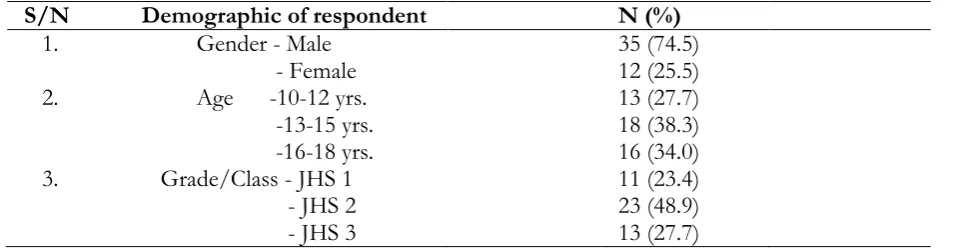
[image:5.595.63.544.378.502.2]Table 1 shows the gender distribution of the respondents involved in the study. Gender is an important social, cultural and psychological construct which describes the expected attitudes and behaviours a society associates with sex.
Table 1. Demographic Data (N=47)
S/N Demographic of respondent N (%) 1. Gender - Male
- Female 35 (74.5) 12 (25.5) 2. Age -10-12 yrs.
-13-15 yrs. -16-18 yrs.
13 (27.7) 18 (38.3) 16 (34.0) 3. Grade/Class - JHS 1
- JHS 2 - JHS 3
11 (23.4) 23 (48.9) 13 (27.7) Key: N- Number of respondent. %- Percentage.
Source: Author’s Survey, November, 2015
Table 1 represents the demographic data of students living under single parents who participated in the study and their corresponding percentages. From the table, it is indicated that 35 (74.5%) were males, 12 (25.5%) were females. The table further shows that between the ages of 10- 12 there were 13 (27.7%) of the respondents. 18 (38.3%) of them fell within the ages of 13-15 and 16 (34.0%) were between the ages of 16-18 yrs. with respect to their grades or class, 11 (23.4%) were in JHS 1, 23 (48.9%) were also in JHS 2 whilst 13 (27.7%) were in JHS 3.
Research question 1.
What are the attitudes of students towards single parenting?
32 http://aajhss.org/index.php/ijhss Table 2: The attitudes of students towards single parenting (N=47)
Statements Yes No Total
N % N % N %
1. Do you feel depressed living
under a single parent? 39 82.9 8 17.0 47 100
2. Do you like to be taken care of
by one parent? 3 6.30 44 93.6 47 100
3. Are you emotionally disturbed
living under a single parent? 42 89.3 5 10.5 47 100
4. Do you like the conditions of
living with one parent? 4 8.50 43 91.5 47 100
Key: N- Number of respondents, %- Percentage. Source: Authors Survey, November, 2015
From the above table, it is revealed that 39 (82.9%) respondents confirmed that they feel depressed living under a single parent. 8 (17.0%) students also responded that they do not feel depressed living under a single parent. The table again shows that 44 (93.6%) students responded that they do not like being taken care of by one parent. 3 (6.3%) students also responded that they like to be taken care of by one parent. It is again evident from the table that 42 (89.3%) students feel emotionally disturbed living under a single parent whereas 5 (10.6%) students are not emotionally disturbed living under a single parent. Finally from the table 43 (91.5%) indicated that they do not like the conditions of living with one parents and 4 (8.5%) said they like the conditions of living with one parent.
Research question 2.
The effects of single parenting on students
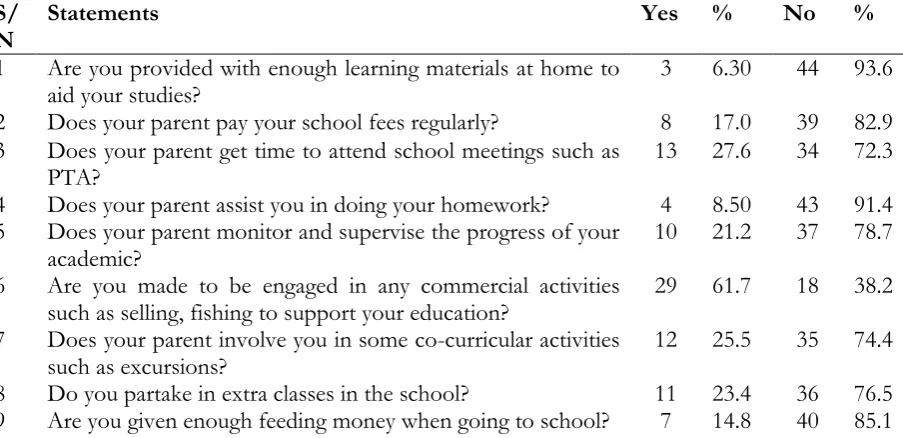
The objective of this research question was to investigate and find out the effects of single parenting on students. The results are presented in Table 3 below
Table 3
.
The effects of single parenting on student’s academic performance (N=47)S/
N Statements Yes % No %
1 Are you provided with enough learning materials at home to aid your studies?
3 6.30 44 93.6
2 Does your parent pay your school fees regularly? 8 17.0 39 82.9
3 Does your parent get time to attend school meetings such as
PTA? 13 27.6 34 72.3
4 Does your parent assist you in doing your homework? 4 8.50 43 91.4
5 Does your parent monitor and supervise the progress of your
academic? 10 21.2 37 78.7
6 Are you made to be engaged in any commercial activities such as selling, fishing to support your education?
29 61.7 18 38.2
7 Does your parent involve you in some co-curricular activities
such as excursions? 12 25.5 35 74.4
8 Do you partake in extra classes in the school? 11 23.4 36 76.5
[image:6.595.75.527.541.760.2]33 http://aajhss.org/index.php/ijhss
10 Does your parent regularly buy your school uniform? 14 29.7 33 70.2
Key: N- Number of respondents. %- Percentage. Source: Authors Survey, November, 2015
From the above table, it is shown that, 44 (93.6%) students answered that they are not provided with enough learning materials at home to aid your studies. Only 3 (6.3%) of them answered that they are provided with enough learning materials at home to aid your studies even though they live under single parent. Again, 39 (82.9%) of the students agreed that their parent does not pay their school fees regularly. Eight (17.0%) agreed that their parent pay their school fees regularly. Thirty four (72.3%) admitted that their parent does not get time to attend school meetings such as PTA. Thirteen (27.6%) admitted that their parent gets time to attend school meetings such as PTA. 43 (91.4%) said that their parent does not assist them in doing your homework. Only 4 (8.5%) agreed that their parent assists them in doing their homework. Thirty seven (78.7%) of the students responded that their parent does not monitor and supervise their progress in academics whiles 10 (21.1%) answered that their parent monitors and supervises their progress in academics. Twenty nine (61.7%) admitted that they are made to engage in some commercial activities such as selling and fishing to support their education. Eighteen (38.2%) answered that are not made to engage in some commercial activities such as selling and fishing to support their education. Thirty five (74.4%) agreed that due to lack of financial support, their parent does not involve them in some co-curricular activities such as excursions. Only 12 (25.5%) students said their parents involve them in some co-curricular activities. The table still show that 36 (76.5%) agreed that they do not partake in extra classes in the school. A minimum of 11 (23.4%) students said that they partake in extra classes in the school. A large population of the respondents, that is, 40 (85.1%) agreed that they are not given enough feeding money when going to school. A few of them, that is, 7 (14.8%) agreed that they are given enough feeding money when going to school. Finally, 33 (70.2%) said their parent does not buy their school uniform regularly whereas 14 (29.7%) agreed that their parent buys their school uniform regularly even though they are living under single parent.
Results and Discussions
The first research question was to explore the attitudes of students towards single parenting. Considering the nature of single parenting in Amamoma Junior High School and its effects on student’s reactions and attitudes, it is not surprising for one to realised that the key findings of the study gave evidence that majority of the students living under single parent have negative attitudes and reactions towards single parenting. It was affirmed that students living under single parent care are mostly depressed and emotionally not sound in their educational endeavours, making them reluctant towards their academic progress and subsequently they perform poorly as compared to their peers living under double parents. The findings of the study is parallel to the study of Berk (2000) that, differences in academic performance of children exist when those living under single parents are emotionally disturbed and cannot cope with their learning and usually perform worse than from two parent families. That notwithstanding, Kelly and Emery (2003) in their study which examined the effects of family structure and parenthood on the academic performance of students, agreed with this study that children living under single parents are less privileged to most of the parental care and are less likely to perform well in schools.
34 http://aajhss.org/index.php/ijhss teaching and learning materials to aid in their learning. The results of the study further shows that single parents do not have enough time to monitor and supervise their children’s academic performance. A large percentage of the sampled students for study confirmed that their parents do not assist them in doing their homework. The overall findings was that single parenting affect students expectation thus leading to loss of control and responsiveness toward the academics and this eventually affect the child’s academic outcome at all levels of education. This postulate to the idea that students struggling to pursue their education do not get any external assistance. The findings of the study lends support the work of Donkor (2010) who indicated that, the poor performance of children living under single parents emanates from the parents. To him, these parents do not provide proper supervision and monitoring of their wards academic progress. The findings of the study is also in relation to the study of Clarke-Stewart, Vandell, McCartney, Owen and Booth (2000) who revealed that parental involvement is positively associated with students’ academic performance in school but student’s will turn to perform poorly when their parents are not much involved in their education.
Conclusions, Recommendations and Implications of the Study
Considering the findings of the study, it can be concluded that the effects of single parenting on students’ academic performance in Amamoma Presbyterian Junior High is quite severe and eventually leads to their poor academic performance. The study produced real evidence which can be concluded that students living under single parents feel depressed and are emotionally not sound and this makes them feel uncomfortable in their learning. It can also be drawn from the study that academic performance and single parenting are negatively related; hence the more the cases of parents being unconcerned about their children’s education, the poorer the academic performance of their children in school.
Based on the findings, the following recommendations are hereby made. Firstly, teachers of these students should transcend beyond teaching and imparting knowledge but also by going a step to offering counselling, encouragement and sharing personal experiences that will go a long way to motivate them to excel in their education. Secondly, all the concerned bodies within the school community such as Non-Governmental Organisations (NGOs), Teacher–Parent Associations (PTA), Counsellors, Psychologist, Commission for Human Right and Justice (CHRAJ) must help in educating parents about the effects of single parenting on their wards academic performance through workshops, seminars and the mass media. This will help them to be responsible towards their children’s education and also provide the needed support necessary for their wards to achieve academic success.
35 http://aajhss.org/index.php/ijhss References
Addai, F. (2010). The effect of parenting style and parental involvement on students Academic performance, University of Education: Winneba.
Addo-Adeku, K., Opare, J. A. & Banini, D. A. (2003). Quality of basic education in Ghana. Educational Research Network for West and Central Africa, Accra, Ghana .
Baumrind, D. (1967). Child-Care Practices Antecedent Three Patterns of Preschool Behaviour. Genetic Psychology Monographs, 75 (3), 43-88.
Berk, L. E. (2000). Child development (5th ed.). Boston, USA: Allyn and Bacon Publications.
Boardman, G. L., Hopson, L. M., Rose, R. A., Glennie, E. J., (2012). Students’ Perceived Parental School Behaviour Expectations and Their Academic Performance: A Longitudinal Analysis. Interdisciplinary Journal of Applied Family Studies, Family Relations, 61 (2), 175 – 191.
Bradley, R. H., & Caldwell, B. M. (1995). Care Giving and the Relation of Child Growth and Development: Describing Proximal Aspects of Care Giving Systems. Developmental Review, 15 (1), 38-85.
Benokraitis, R. (2002). Parenting moral teens in immoral times. USA; Concordia Publishing House.
Clarke-Stewart, K. A., Vandell, D. L., McCartney, K., Owen, M. T., & Booth, C. (2000). Effects of Parental Separation and Divorce on Very Young Children. Journal of Family Psychology, 14 (2), 304-326.
Donkor, A. K. (2010). Parental Involvement in Education in Ghana: The Case of a Private Elementary School, 33 (1), 23-38.
Glasgow, K. L., Dornbusch, S. M., Troyer, L., Steinberg, L., & Ritter, P. L. (2004). Parenting Styles, Adolescents’ Attributions, and Educational Outcomes in Nine Heterogeneous High Schools. Child Development, 68 (1), 507-529.
Kim, H. Y. (2013). Statistical Notes for Clinical Researchers. Korean Academy of Conservative, 38 (1), 52-54. Hamplova, Z. P. (2013). Impacts of Parenting on Children's Schooling. Journal of Student Engagement:
Education Matters, 2 (1), 36–41
Jacobs, N. & Harvey, D. (2005). Do parents make a difference to children’s academic achievement? Differences between parents of higher and lower achieving students, Educational Studies, 31 (4), 431–448.
Kelly, J. B. & Emery, R. E. (2003). Children's Adjustment Following Divorce: Risk and Resilience Perspectives. Family Relations, 52(4), 352-362.
Nelson, J. K. (2009). Impact of parent's education on student success. Utah Valley University: Utah, USA.
Nyarko, K. (2011). The Influence of Authoritative Parenting Style on Adolescents’. Academic Achievement, 6 (2), 282-287.
Steinberg, L., Lamborn, S. D., Dornbusch, S. M., & Darling, N. (1992). Impact of Parenting Practices on Adolescent Achievement: Authoritative parenting, school involvement an encouragement to succeed. Child Development, 63(4), 1266-1281.
Sulaiman, T. (2012). Africa Investment - After Ghana Vote, Investors Turn to Economy. Retrieved on 28th August,
2015 from http:llwww.reuters.com/article.
Tan-Kuick, C. L., & Ng, K.Y. (2011). The Mediating Effects of Peer and Parental Encouragement on Student's Choice of a Nursing Education. Journal of Applied Business and Management Studies, 2 (1), 1-10.