New Methods and Applications in Solid-State NMR
Spectroscopy of Quadrupolar Nuclei
Sharon E. Ashbrook* and Scott Sneddon
School of Chemistry, EaStCHEM and Centre of Magnetic Resonance, University of St Andrews, St Andrews KY16 9ST, United Kingdom
*Email:[email protected]
Abstract
1.Introduction
Among the most important aims of the solid-state chemist is the ability to predict and control the properties of compounds and, therefore, to design a material (and the requisite synthetic route) specifically for a particular application. Key to this is an understanding of the structure-property-function relationships in the solid state, with the first, and perhaps most vital, step being a detailed structural characterisation. Historically, this has been achieved using techniques based on Bragg diffraction, relying on the presence of the long-range order characteristic of many solids. While extremely powerful for ordered crystalline solids, diffraction typically produces a structural picture averaged over both time and lengthscale. As many of the interesting properties of solids (such as the activity of microporous catalysts, the radiation resistance and durability of ceramics or the capacity of energy materials) arise from the variation of this periodic nature, the use of spectroscopic techniques, which have the ability to probe the detailed atomic-scale structure, is a vital, and yet often overlooked, complementary approach. Nuclear magnetic resonance (NMR) spectroscopy has long been heralded as a sensitive probe of the local environment in solids, able to provide detailed information on structure and disorder in the solid state, while its sensitivity to motion over a wide range of timescales also enables dynamics to be investigated.1,2The use of1H, 13C, 29Si and31P NMR spectroscopy has had
a significant impact in the pharmaceutical industry, materials chemistry, geochemistry and industrial chemistry, for the study of drugs and active pharmaceuticals, catalysts, glasses, zeolites and minerals.3-10
for nuclei with spin quantum number I = 1/2, high-resolution or isotropic spectra can be obtained. The NMR spectra of quadrupolar nuclei,i.e., those with I > 1/2, are additionally affected by an interaction with the electric field gradient at the nucleus.13,14The anisotropic quadrupolar broadening can be significant, with lineshapes broadened over many MHz. Furthermore, this anisotropy cannot be removed completely by MAS, and so spectra remained broadened even when the sample is rotated.13,14 Although, in principle, the quadrupolar interaction provides an additional probe of the local structure and geometry, more usually, the anisotropic broadening prevents the resolution of distinct lineshapes, and makes the acquisition of detailed information significantly more challenging.
Over 74% of the nuclides in the Periodic Table have spin quantum number I > 1/2, and for over 63% elements the only NMR-active isotopes are quadrupolar, meaning that there are no I = 1/2 counterparts available for study. However, quadrupolar nuclei, such as 2H, 6/7Li, 11B, 14N, 17O, 23Na, 25Mg, 27Al, 35Cl, 39K, 59Co, 69/71Ga and 93Nb, are of
importance across the fields of chemistry, physics, biology, materials science and geology, as they are present in inorganic oxides, functional materials and ceramics, glasses and clays, polymers, pharmaceuticals and biomaterials, energy materials and in the compounds that make up the inner layers of our own planet.1,2,14-20 The development of methods for studying these nuclei using NMR spectroscopy, and the ability to exploit the site-specific and atomic-scale structural information this provides is, therefore, crucial.
will conclude by considering where future advances will take this field and the challenges that will remain. By its very nature, a Perspective cannot be a comprehensive review of the area, and readers are also referred to Ref. 14(and all articles within) for a more complete general overview and detailed discussion of specific areas.
2. Background and basic experiments
Solid-state NMR spectra of quadrupolar nuclei are dominated by the interaction between their nuclear electric quadrupole moment, eQ, and the electric field gradient (EFG) at the nucleus.13 The EFG can be defined in its principal axis system by three components, VXX, VYY and VZZ, and is usually described in terms of its magnitude, given
by the quadrupolar coupling constant, CQ= eQVZZ/h, and an asymmetry (or shape),Q =
(VXX– VYY)/VZZ, such that 0 Q 1. The quadrupolar interaction can be very large, with
CQvalues of many hundreds of kHz to tens (and even hundreds) of MHz.1,2,13Despite this,
in most practically-relevant cases the quadrupolar interaction remains smaller than the dominant Zeeman interaction, and its effect upon the nuclear spin energy levels is
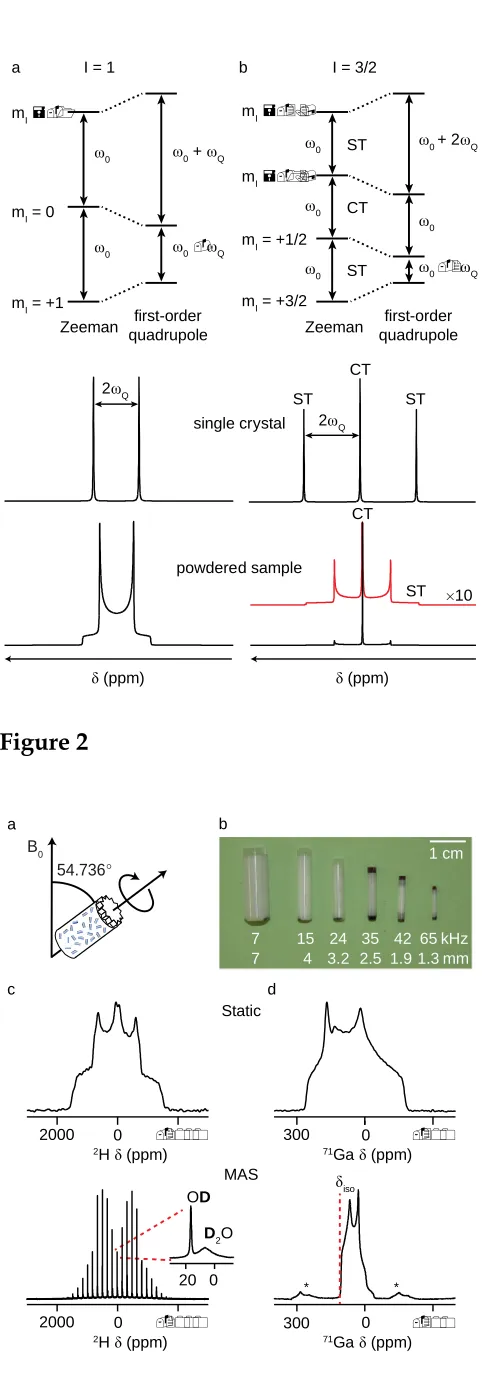
described using perturbation theory. Figure 1 shows the perturbation of the Zeeman
energy levels caused by the quadrupolar interaction for nuclei with I = 1 and I = 3/2, and the lifting of the degeneracy of the single-quantum transitions. For the powdered solids most typically studied, different crystallite orientations result in a large anisotropic broadening, although for half-integer spins the central transition (CT) remains relatively sharp and is, in many cases, the only transition observed experimentally.1,2,13
The standard technique for improving resolution in solid-state NMR is MAS,11
where the sample is rapidly rotated around an axis inclined at an angle of 54.736° to the external magnetic field, as shown inFigure 2a. Samples are packed into rotors of varying
diameter (Figure 2b), with the maximum possible MAS rate increasing as the rotor
efficiently, the rotation must be fast (relative to the magnitude of the interaction). This is usually achievable for the CSA and many dipolar couplings. However, the magnitude of the quadrupolar interaction is often such that complete averaging is not possible, and the lineshape is broken up into a series of spinning sidebands,1,2,14 separated by integer multiples of the spinning rate, as shown by the 2H (I = 1) NMR spectra of oxalic acid in
Figure 2c,21where MAS resolves two resonances, corresponding to OD and D2O species.
In many cases, the magnitude of the quadrupolar interaction is such that the first-order perturbation shown in Figure 1 is not sufficient to describe its effect upon the nuclear energy levels, and higher-order perturbations must be considered.13All transitions are affected by the second-order quadrupolar interaction, which has both an isotropic component (with the important result that the resonance position no longer reflects only the chemical shift), and anisotropic components (that lead to additional line broadening), as shown by the71Ga (I = 3/2) NMR spectra of GaPO4berlinite (a simple compound with a
single Ga site) in Figure 2d.22 The second-order broadening increases with CQ, but decreases as the B0 field strength increases, making the use of high magnetic fields
particularly beneficial for quadrupolar nuclei. As the second-order quadrupolar interaction has a more complex angular dependence, it is only partially averaged under MAS and a powder-pattern lineshape is still obtained, as can be seen in Figure 2d for GaPO4 berlinite.22 Simple lineshape fitting enables the extraction of the NMR parameters.
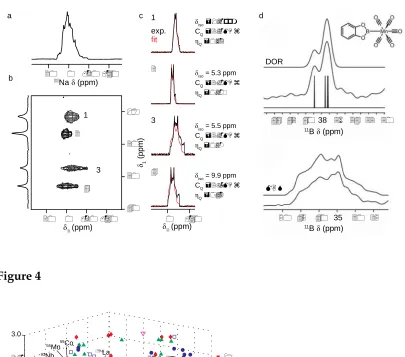
However, while this is straightforward when only one resonance is present, for materials containing a number of distinct species the lineshapes may overlap, as shown inFigure 3a
for the23Na MAS spectrum of Na4P2O7(with four distinct Na species), and it is difficult to
extract the relevant information from the complex lineshape.23
If the magnitude of the quadrupolar interaction is large (a problem exacerbated at low B0 fields or for nuclei with low ), even CT lineshapes may be broadened such that
lineshapes are very broad, spectra must be acquired in a piecewise manner, with a number of experiments performed at different transmitter frequencies and added together to produce the final spectrum. Recent work by Schurko and co-workers24-28has considerably eased the acquisition of wideline spectra, through the implementation of pulses (e.g., WURST) that offer more broadband excitation, resulting in improvements in the spectra obtained, and reductions in the time taken to acquire them. For wideline experiments sensitivity is a particular challenge, and many approaches have been used to overcome this, including Carr–Purcell–Meiboom–Gill (CPMG) echo trains,29and manipulation of the
population of the nuclear energy levels using FAM-type30 pulses, double frequency
sweeps31 or shaped hyperbolic secant pulses.14,32 Most approaches used are equally applicable to rotating samples, and can be used in conventional MAS experiments. See
Refs. 33 and 34for more detail in this area.
The combination of broadband pulses and sensitivity improvements, coupled with the recent availability of high magnetic fields, has certainly resulted in a step change in the quality of wideline spectra that can be obtained and expanded the range of materials able
to be studied, with this approach recently applied to e.g., 35Cl of organometallic
complexes,35 25Mg NMR in minerals,36 87Sr NMR of carboxylates,37 115In complexes,38 inorganic 135Ba compounds,39 79Br and 127I NMR,18 and the acquisition of 14N (I = 1)
spectra
.
40 While interesting correlations of the NMR parameters with structural features such as the nature of ligand binding35 or the strength of halogen bonds,41 have been observed, applications do seem restricted to cases where the number of overlapped lineshapes is very small, and where other interactions (such as dipolar couplings) do not significantly affect the spectra. In many cases, removal of the broadening and resolution of distinct sites will be required before structural information can be obtained.The broadening in the NMR spectra of quadrupolar nuclei limits both sensitivity and resolution and severely hampers the extraction of site-specific structural information. Perhaps the most enduring aim in solid-state NMR of quadrupolar nuclei over the last few decades, therefore, has been the complete removal of the quadrupolar broadening and the acquisition of high-resolution (isotropic) spectra and, although most major developments in this area are less recent, this subject has had such an impact on the history of NMR of quadrupolar nuclei, a brief review of the methods now used is warranted.
The orientational dependence of the second-order quadrupolar broadening is more complex than that of the CSA, dipolar couplings (or the first-order quadrupolar interaction), and cannot be removed by spinning around a single angle alone. The first approaches to solving this problem, developed in the late 1980s, were composite sample rotation techniques, i.e., involving rotation of the sample around two different angles – simultaneously in the case of double rotation (DOR)42 and sequentially for dynamic angle spinning (DAS).43 Conceptually, DOR is easier to understand, with two rotors used, one inside the other. Each spins at a different angle (54.74° and 30.56°), to average the two different anisotropic components of the broadening. In DAS, the sample is sequentially rotated around two different angles (for different times) in a two-dimensional
experiment,42 with times and angles chosen such that the quadrupolar broadening is
refocused. For further information on DOR and DAS seeRef.14.
The study of quadrupolar nuclei in the solid state was revolutionised in 1995 by the
introduction of the multiple-quantum (MQ) MAS experiment.44 Unlike DAS and DOR,
MQMAS uses sample rotation around a single angle (i.e., 54.736°, thereby additionally removing CSA and dipolar interactions), and so can be performed using a conventional probehead. Removal of the second-order quadrupolar interaction is achieved within a two-dimensional experiment, where multiple-quantum (e.g., mI = + 3/2 mI = – 3/2)
Cross-sections enable the NMR parameters for each site to be determined individually, as shown in Figure 3c. For a more detailed discussion on MQMAS seeRefs.14,45 and 46. A conceptually similar experiment, termed STMAS, using the correlation, not of multiple-quantum transitions but of the single-multiple-quantum satellite transitions (ST), was introduced in in 2000 by Gan,47 as an alternative approach. Its implementation is more challenging than that of MQMAS (with the need for very accurate adjustment of the spinning angle (to ±0.002°), a stable spinning rate and accurate pulse timings), but it typically offers a significant sensitivity advantage over MQMAS (in many cases of factors between 4 and 8). For further information on STMAS seeRefs.14 and 48.
Recent hardware advances have, however, also seen a resurgence of interest in DOR, although the size of the outer rotor does still restrict the MAS rates that can be used, producing a range of spinning sidebands that can complicate spectral analysis. Impressive recent work has used DOR to investigate dipolar and J couplings between quadrupolar
spins,51-53 providing not only information on the fundamental nature, presence and
magnitude of higher-order interactions54 (of interest to the specialist), but important structural information of interest to the chemist. Figure 3d shows the 11B DOR (top) and
MAS (bottom) spectra of manganese catecholboryl pentacarbonyl. The coupling patterns
revealed by DOR enabled information on the 55Mn quadrupolar interaction to be
extracted, enabling the observation that the interaction of Mn with the carbonyl ligands is stronger than that with catecholboryl ligand.52
The desire to remove the quadrupolar broadening and acquire high-resolution spectra has driven much research over the past few decades. However, with the progress made in recent years, it is now possible not only to achieve this almost routinely, but to combine experiments such as MQMAS and STMAS with the magnetisation transfer experiments commonly used in spin I = 1/2 NMR, enabling access to the full panoply of information NMR can provide.
4. Commonly-studied quadrupolar nuclei
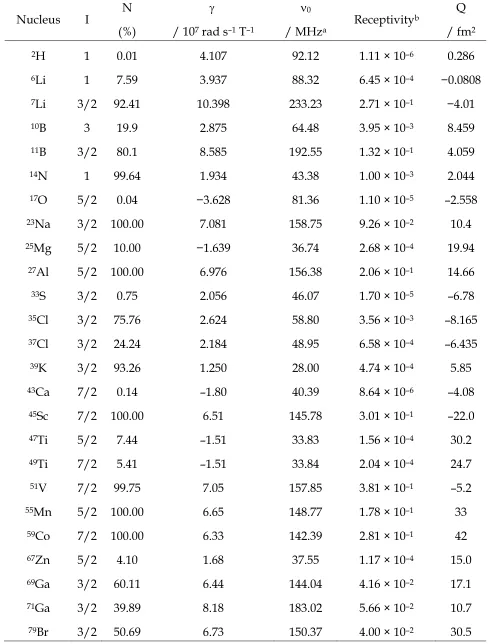
The ease with which an NMR spectrum can be acquired is determined by a number of parameters including the natural abundance (N), spin quantum number (I) and gyromagnetic ratio () of the nucleus. These are typically combined into a receptivity, given by 3N (I (I + 1)), usually quoted relative to 1H. However, for quadrupolar nuclei
another important factor is the magnitude of the quadrupolar broadening of the spectral lines. Although for any specific material this depends upon the EFG and the Sternheimer antishielding factor,55 the magnitude of the nuclear quadrupole moment is an important
commonly-studied quadrupolar nuclei, and Figure 4 shows a plot of the receptivities, Larmor frequencies and quadrupole moments of a range of isotopes.2,14
Commonly-studied nuclei include those with reasonable natural abundance and small to medium quadrupolar coupling (e.g., 6/7Li, 11B, 23Na, 27Al, 45Sc, etc., as seen on
Figure 4), while for nuclei with low natural abundance (such as 17O) isotopic enrichment
often has to be employed. For nuclei with low, such as39K and25Mg (seeFigure 4), high
magnetic field, and the sensitivity enhancement techniques discussed above, are usually required. Fast MAS is usually needed for nuclei exhibiting larger quadrupolar
interactions, such as 69/71Ga and 93Nb, while for species where the quadrupolar
broadening is often much larger than available MAS rates (e.g., 35/37Cl, 79/81Br, 127I, 91Zr,
87Sr) the wideline approaches discussed above are preferred. Although NMR of nuclei
with integer spin is typically quite different to that of nuclei with half-integer spin (owing to the lack of a narrow CT), and could indeed form the basis for an entire review or perspective in itself, it is worth mentioning the two most commonly-studied such nuclei here, 2H and 14N.14, 56-57 Spectral acquisition is restricted to systems and species with smaller quadrupolar couplings (many 2H species and 14N in symmetrical environments)
for MAS experiments, while wideline spectra of static samples are acquired for materials exhibiting larger CQ.
5. Chemical structure and disorder
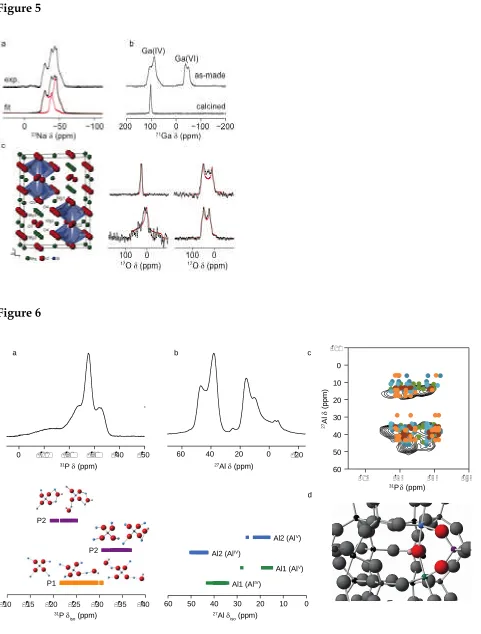
group. Although less straightforward than for I = 1/2 systems, this information can be obtained from many MAS spectra of quadrupolar nuclei, as shown inFigure 5a, where a
23Na NMR spectrum of a novel vanadyl oxalatophosphate, Na2[(VO)2(HPO4)2C2O4].2H2O
is able to distinguish between two proposed space groups,P21/mand P21, obtained from
refinements to the diffraction measurements.58 The presence of two overlapping
quadrupolar lineshapes, supports a space group of P21, rather than P21/m, where only a
single distinct Na species would be expected. Spectroscopy can also identify minor impurities in materials (or those more difficult to distinguish by diffraction), that might have important effects upon the properties.59-60 More generally, the magnitude of various NMR parameters can provide structural information, and many authors have attempted to determine (with varied success) the dependence of NMR parameters upon the local geometry for a range of quadrupolar nuclei.2 The coordination number of a species can have a significant effect uponiso, as illustrated by the71Ga (I = 3/2) spectra of the as-made
and calcined GaPO-34 microporous frameworks shown in Figure 5b.22 In the as-made
sample, F– anions bridge two Ga1 atoms, creating both four- (Ga2 and Ga3) and
six-coordinate (Ga1) gallium. Upon calcination, a purely tetrahedral framework is produced, as shown by the change in chemical shift, while the symmetry change, fromP–1 toR–3, is reflected in the presence of just one quadrupolar lineshape. Other well-known examples include the significant difference in11B CQ values for trigonal (2-2.8 MHz) and tetrahedral
(0-0.6 MHz) boron,2and the dependence of the17O CQupon the covalency of the X-O bond
– an observation that allows bridging (e.g., Si-O-Si) and non-bridging, (e.g., Si-O-Mg), species to be distinguished in minerals and glasses.19 Also commonly exploited in the study of biological and organic materials is the dependence of2H NMR parameters (both
CQandiso) on the geometry (i.e., both distance and angle) of hydrogen bonds.61
propose tentative spectral assignments.2 However, considerable care must be taken as many different aspects of a structure can affect the NMR parameters. A classic example is the 27Al NMR spectrum of andalusite (Al2SiO5), which contains two distinct Al sites,
corresponding to five- and six-coordinate Al. Two resonances are observed in the spectrum, with CQ values of 5.8 MHz and 15.3 MHz, respectively.2,62 However, the latter
results not from the five-coordinate Al as expected, but from the six-coordinate Al species, owing to a significant distortion of the coordination environment. In recent years, an alternative approach has been used to aid spectral understanding, exploiting the developments in the calculation of NMR parameters from first principles. Although used in conjunction with experiment in various areas of chemistry for many years, the need to approximate a solid as a cluster (centred on the atom of interest and with remote bonds terminated, typically by H), had limited the influence of computation in solid-state NMR spectroscopy. Interest in this area has been revitalised in recent years by the introduction of codes exploiting periodic boundary conditions to recreate the extended three-dimensional structure of a solid, most of which use density functional theory (DFT), a theoretical framework favoured for its cost-efficiency and accuracy.63 The impact these methods have had on the experimental NMR community in particular has been significant, as evidenced by recent reviews.64-66Calculations play a key role in interpreting
and assigning NMR spectra, as shown in Figure 5c, where quadrupolar-broadened 17O
NMR lineshapes (extracted from an STMAS spectrum) of the four distinct 17O species in
wadsleyite, -Mg2SiO4, are compared to those predicted using DFT calculations.8,67
Calculations not only enable assignment of the four oxygen species, but also verify the unexpectedly high experimental CQ values68 for the non-bridging species O3 and O4 (4.4
and 3.8 MHz, respectively), which are more typical of those expected for bridging oxygen atoms.
potential structural models able to be evaluated by comparing calculated and experimental NMR parameters. Calculations can also play a significant role in “NMR
Crystallography”,69 where the combination of information from diffraction and NMR
spectroscopy is used to provide quantitative structural detail, not able to be obtained from either method alone. The addition of computation (sometimes then referred to as “SMARTER Crystallography”), provides a link between the two experimental approaches. An excellent example of this is the recent work of Martineau et al., where a structural model for a fluorinated inorganic-organic hybrid, Zn3Al2F12[HAmTAZ]6, (AmTAZ =
3-aminotriazole) was proposed using unit cell dimensions and a number of possible space groups (from diffraction), and the number and proportion of distinct species and their coordination environment (from 27Al, 67Zn, 19F, 1H, 15N and 13C NMR).70 Possible models were then optimised, and ultimately validated, using DFT calculations. Although not yet perhaps routine, the combination of periodic calculations alongside experiment is now used frequently for simple systems, with the study of more complex materials beginning to be tackled with more advanced computational approaches. This has certainly been one of the most successful areas of recent development, and will undoubtedly have a wide and lasting impact on the field in the coming years.
Although information can be obtained from conventional NMR spectra, for detailed structural insight it is necessary to understand how the atoms in a structure are arranged in relation to each other. This can be achieved by probing the interactions between spins, either through space (for the dipolar interaction) orviacovalent bonds (for the J coupling). Recently, there have been significant developments in the application of two-dimensional correlation experiments, previously used only for I = 1/2 nuclei, to quadrupolar spins. Both heteronuclear and homonuclear experiments are known, although the former are typically easier both to implement and to interpret,14,20,71 and in many cases experiments are combined with MQMAS to improve resolution for the quadrupolar spin(s).14,71, The transfer of magnetisation through the heteronuclear J coupling is common, with, e.g.,
J couplings for many quadrupolar nuclei have resulted in the greater development of approaches that exploit the (larger) dipolar interaction. A commonly-used approach for transferring magnetisation between spin I = 1/2 nuclei via the dipolar coupling is cross polarisation (CP). However, CP dynamics are significantly more complicated for quadrupolar nuclei,76-77 with their efficiency dependent upon the radiofrequency (rf) field strength, the quadrupolar coupling and the spinning rate.78-79 Alternative approaches utilised in recent years involve the use of trains of rf pulses to recouple (i.e., reintroduce) the dipolar interaction in experiments initially designed to utilise J couplings.6,71,80-84 Whilst a common complaint from the non specialist is that the vast number of possible experiments (and their often inexplicable acronyms) is confusing, essentially all experiments are similar – with the transfer of magnetisation from one type of spin to another, and a cross peak in the spectrum indicating the presence (and sometimes magnitude) of the interaction that they share. Advances, however, continue to be made, with one of the more recent being the introduction of a suite of methods for acquiring (indirectly)14N MAS spectra (see later for a more detailed discussion).85-87 In general, this is an important area of considerable current development, and further progress over the next few years will ease both the choice (once the most efficient and more robust methods have been established) and implementation of these methods for a specific system for the general chemist.
For materials exhibiting a deviation from the periodicity associated with the solid
state, i.e., those with compositional or positional disorder, structure solution is
a Czjzek model.88 This broadening can make it more difficult to resolve overlapping contributions even when MQMAS is used, and information next nearest neighbour (NNN) atoms can be more difficult to obtain. This can be overcome to some extent by combining experiments with DFT calculations for a series of structural models where the local environment of an atom is varied and calculated NMR parameters can then be compared to experiment.66,89-95 Some recent examples (see also later sections) include 27Al NMR
spectroscopy and DFT calculations to probe the Al/Si cation disorder in Gehlenite (Ca2Al2SiO7),91 where contributions from the seven Al local environments can be
distinguished, and 27Al/31P NMR spectroscopy to investigate anion disorder in the AlPO
framework STA-2.92For this latter case, as shown inFigure 6, the comparison of a range of
27Al and31P NMR spectra, with the NMR parameters calculated for models with differing
hydroxyl positions was able to show that hydroxyls bridge between Al1 and Al2 in the cancrinite cages, but that two hydroxyls do not occupy the same cage simultaneously.90
6. Dynamics and chemical reactivity
NMR spectroscopy has proven a useful probe of dynamics in the solid state, owing to its sensitivity to motion on timescales that vary over many orders of magnitude. This arises from a modulation of the resonance frequency caused by motion either of an atom itself, or of atom(s) in the local surroundings. Different motional timescales can be investigated, with fast motion (107 to 1011 s–1) probed by changes in relaxation (not
discussed in detail here), slow motions (103to 10–1s–1) by exchange experiments, and rates
intermediate to these extremes by changes to the spectral resonances. For quadrupolar nuclei, motion modulates the EFG tensor and so spectra are, therefore, sensitive to timescales determined by the inverse of the linewidth; typically 107 to 104 s–1 for
resonances broadened by the first-order quadrupolar interaction and 105 to 103 s–1 for CT
One of the most commonly-exploited quadrupolar nuclei for studying dynamics is
2H (I = 1), with typical linewidths (for static samples) of 1-200 kHz.57,96-97Furthermore, the
ability to selectively deuterate provides site-specific motional information. The changes to the spectral lineshape as a function of temperature provide information on the geometry of the dynamic process and its rate, typically by comparison of experimental and simulated lineshapes.97 Wideline experiments have also recently been demonstrated for
14N in elegant work by Schurko and O’Dell, and offer similar potential for the future.40,56,96
In addition to improving resolution and sensitivity, use of MAS is also able to extend the timescales that can be probed by2H NMR, with the width of the sidebands affected by the
interference of motion with the averaging of the quadrupolar interaction by MAS.21,96 In contrast to lineshape analysis, where the geometry of the motional process must be known, model-independent information (on the rate or activation energy) can be obtained from the linewidth variation with temperature, for each resolved resonance.98-99
For nuclei with half-integer spin quantum number, only the CT is typically observed. The shape and width of this second-order broadened lineshape is also sensitive to dynamics (at rates comparable to the magnitude of the interaction).96While comparison of experimental and simulated lineshapes will, in principle, be able to determine the type and rate of motion, the overlap of lineshapes in an MAS spectrum hinders the extraction of accurate and site-specific information. However, if resonances are reasonably well resolved, variable-temperature MAS experiments can provide information, and 17O NMR
in particular has been exploited in this manner by a number of authors.96 An elegant
example is the work of Hampson et al. who used two-dimensional 17O exchange
spectroscopy (EXSY) experiments to distinguish the motional model and timescale (10 s–1)
for the hopping of the WO4 groups in ZrW2O8.100 If multiple sites are overlapped in an
microsecond timescale results in a significant broadening of resonances. This was first demonstrated for a microporous phosphate framework, AlPO-14, where broadening of the
27Al STMAS spectrum was observed as a result of motion of the template
(isopropylammonium) within the pores of the material.48,101
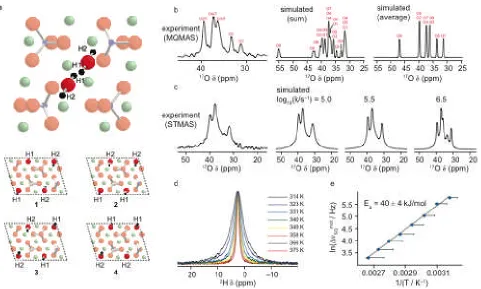
The combination of DFT calculations and experiment can be particularly powerful when studying dynamics. One example of this is the recent investigation of clinohumite, 4Mg2SiO4.Mg(OH)2,8,102-105 which exhibits two possible hydroxyl proton positions, H1 and
H2 (see Figure 7a), each of which has a fractional occupancy (from diffraction) of 0.5.
Figure 7bshows that the17O MQMAS spectrum, simulated by summing calculated spectra
for different structural models, is in poor agreement with experiment. However, if the calculated 17O NMR parameters are averaged prior to simulation, there is much better
agreement, suggesting that there is dynamic, rather than static, disorder of the hydroxyl groups.103 This is confirmed in Figure 7c, where the isotropic experimental 17O STMAS
spectra show significant broadening of some of the resonances, as a result of hydroxyl dynamics, and confirm log10k = 5.5.101The temperature-dependent MAS linewidth enables
an activation energy of 40 ± 4 kJ mol–1 for H1/H2 exchange to be determined (Figures 7d
and 7e).104
The sensitivity of NMR spectroscopy to local structure and to dynamics makes it a convenient tool for following physical and chemical transformations. These can be as simple as (de)hydration, apparent often from the change in coordination number of nuclei such as 27Al and 71Ga or, alternatively, more major changes to the NMR spectrum, as
products. Of considerably more use, however, is in situ study, which has the added advantage of enabling the detection of transient species. Simple (de)hydration processes can be easily followed, and in some cases occur inadvertently, owing to the frictional heating resulting from either MAS or decoupling. Such a reversible phase transition was observed for AlPO-53(A),106 which dehydrated in the rotor to produce the related phase
JDF-2 – a change that was immediately apparent from the 27Al MAS NMR spectra. For
more complex reactions in situ NMR can be challenging, both from a practical point of view (with the need to reproduce conditions,i.e., temperature, pressure, reactant flow of a reaction, when the sample is spinning) and, for quadrupolar nuclei, from a spectroscopic point of view, with the presence of the quadrupolar broadening. For more ambitious
reactions, in situ experiments are more usually performed on static samples, with
hardware specially adapted to enable the reaction conditions to be as closely reproduced as possible (see below for examples). Although an exciting area (particularly for those interested in catalysis and small molecule storage) these experiments remain practically challenging and considerable advances are required before they can be considered in any sense routine. They do, however, perhaps offer one of the more interesting avenues for future development, as dynamics and reactions are often difficult to study in real time using other techniques.
7. Recent applications of solid-state NMR of quadrupolar nuclei
Solid-state NMR spectroscopy of quadrupolar nuclei has been widely applied to a range of problems in areas as diverse as chemistry, biology, geology and materials science. While a complete review is, of course, not practical in the context of a Perspective, below we highlight some recent applications in a few areas of current interest, to show what is presently possible. The reader is referred to the literature for more detailed reviews.
3,8-10,14-20
Among the major challenges facing the world today are the growing threats from global warming, geopolitics and the finite amount of extractable fossil fuel reserves. It is anticipated that the world’s energy systems will have to undergo a radical change in the near future, resulting in a pressing search for new energy materials that are efficient, clean and cost effective, both to produce and to operate. Solid-state NMR spectroscopy is ideally suited not only to the study of the local structure of such materials, but also the investigation of the dynamic and electrochemical processes that occur.14,107-109 Research to date has focussed primarily on lithium battery materials and oxide ion conductors, with
6/7Li and 17O NMR attracting considerable recent attention.14,107-109 However, the
experimental challenges posed here do not necessarily result from the quadrupolar nature of these nuclides, but from the need to understand the processes and structural changes that occur under operating conditions,i.e.,in situ, to be of real relevance.
Many investigations of energy materials exploit6/7Li NMR spectroscopy, owing to
the widespread use of lithium ion battery technology. Spectral acquisition is eased by small quadrupolar couplings and high sensitivity and, although diamagnetic materials exhibit a very small chemical shift range (typically a few ppm), the chemical shifts for Li in paramagnetic systems can be quite significant, often in the range of 1600 ppm.2,107-109 Despite the success of Li ion batteries, the toxicity and cost of the most commonly-used cathode material, LiCoO2, has prompted researchers to find viable alternatives. One
promising series of materials are the layered lithium cobalt nickel manganese oxides, i.e.,
LiMO2 (where M = Ni, Mn, Co). Using 6Li MAS NMR, Yoon et al.110 were able to
demonstrate that lithium was found both in the transition metal and lithium layers (the
former demonstrated by the significant shifts resulting from the Ni2+ and Mn4+
neighbours), and both types of lithium were removed on charging. Similar structural investigations of a number of possible candidate materials have been undertaken using
6/7Li NMR, utilising the ability of the technique to probe local structure and its sensitivity
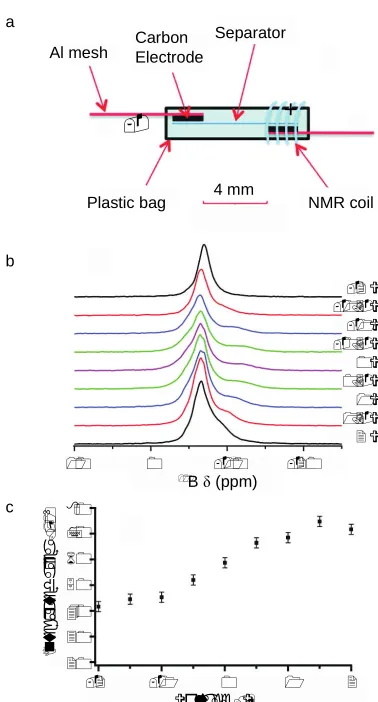
Of increasing interest, however, is the use of in situ NMR to investigate the production of transient states and the dynamic and chemical processes taking place in real time, during the operation of electrochemical devices.107In general,in situexperiments are performed (without the use of MAS) on entire devices connected to a potentiostat and NMR spectra are recorded as a function of the charge or discharge state, in approaches pioneered by Tarascon111and, more recently, by Grey.107,112-113In a recent example113in situ
11B NMR was used for real-time studies of capacitors, investigating the adsorption of BF4–
anions on highly porous carbon. Figure 8a shows the experimental setup used, modified from a flexible plastic bag cell design, separating the two electrodes so that only one is placed in the NMR coil.113 This enables signals from the cathode or anode to be detected
separately. Three resonances are observed in the NMR spectrum (see Figure 8b),
corresponding to BF4– anions strongly bound in the double layers near the carbon
electrode, weakly-bound ions (at downfield shifts), and a narrow peak resulting from free electrolyte. When the cell is charged the peaks from strongly- and weakly-bound BF4–
begin to merge, while at more negative voltages the peak attributed to the strongly-bound anions is lost completely. Integration of the 11B NMR resonances (Figure 8c) reveals a
gradual decrease in the total signal intensity as the voltage decreases, consistent with the diffusion of BF4– ions to the electrode outside of the NMR coil. Similar experiments have
been carried out for batteries, supercapacitors and fuel cells.107-109
In addition to battery and capacitor materials, the increasing application of oxide ion conductors in solid oxide fuel cells, sensors and separators has resulted in considerable NMR investigation of these materials.109 Despite the need to isotopically enrich in many cases,17O NMR spectroscopy has emerged as the method of choice to investigate the local
structure and the dynamic processes that take place. An elegant example of this type of study is the work of Kim and Stebbins, where 17O NMR was used to study motion in
Y-doped CeO2, a promising solid-oxide electrolyte material.114 A number of 17O resonances
Variable-temperature measurements showed coalescence between some of the peaks, with exchange between sites with Y neighbours occurring at a lower temperature than exchange involving sites distant from the dopant cation. Rapid exchange of all oxygen sites was observed above 400 °C. Such study will be vital in understanding and designing materials for future application.
Quadrupolar NMR of microporous materials
Microporous materials have found applications in gas storage and separation, catalysis and drug delivery, as their structures contain pores and channels of similar size to small molecules. Common microporous frameworks include (alumino)silicate zeolites, phosphate-based frameworks (also typically containing Al, Ga, Si, Mg, etc., cations) and
MOFs (with metal cations connected by organic linker molecules).115 The basic
constituents of these frameworks all contain NMR-active nuclei (many of which are quadrupolar), and in addition, mineralisers and structure directing agents (SDAs) also contain many nuclei suitable for study. For more detailed discussion see alsoRefs. 3, 5, 9, 14, and116.
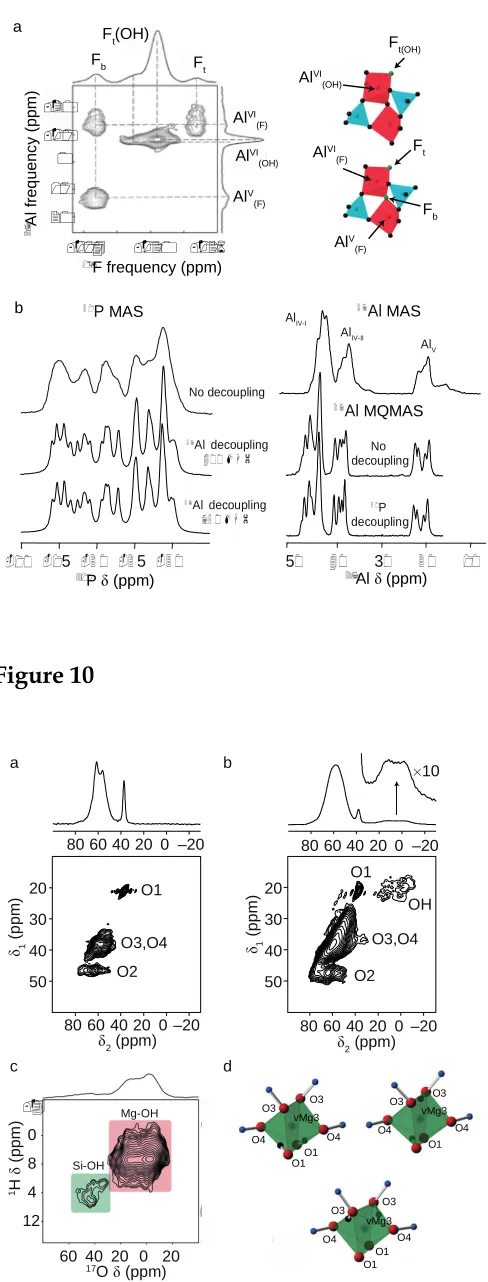
While the framework topology of microporous materials can often be determined using diffraction, NMR can provide additional detailed and element-specific information on framework substitution, the nature, disorder and dynamics of guests within the pores, and the position or disorder of charge-balancing species. NMR crystallographic approaches have found particular application in this area,116-117 as evidenced by recent work on STA-2 (Figure 6), AlPO cloverite and AlPO-CJ2.92,118-119In the latter case, a variety of multinuclear NMR experiments were required in order to quantify the number and type of Al/P environments, and understand the framework structure and connectivity. However, using two-dimensional correlation experiments, such as the 19F-27Al J-HMQC
spectrum shown in Figure 9a,119 information about the OH–/F– distribution (not easily
(–115 ppm) is connected to both five- and six-fold Al species, while the terminal F– (–125
ppm) is linked only to six-fold Al. The F–species (–121 and –118 ppm), are linked to
five-fold Al coordinated by OH. In other work, Beitone et al. used a combination of X-ray diffraction and NMR spectroscopy to distinguish between two proposed space groups,I– 43m and P–43n, for a new zinc-aluminum phosphate Zn3Al6(PO4)12.4tren.17H2O
(MIL-74).120 More recently, Massiot et al. used a range of experiments (including three-dimensional 27Al/31P NMR experiments) to demonstrate that the unit cell of AlPO-40
contained 32 Al and 32 P sites, and was at least four times the size proposed initially.121 The excellent resolution achieved (using decoupling) in31P MAS and27Al MQMAS spectra
is shown inFigure 9b.
The great utility of microporous materials is their ability to selectively absorb and interact with guest molecules, either through interaction with framework metals or by adsorption into pores. As oxygen lines the pores of many microporous materials, it might
seem that 17O NMR spectroscopy should be a popular choice. However, application is
limited by the low natural abundance of this isotope (0.037%). Many zeolites have been isotopically enriched using post-synthetic exchange with17O2gas, and although extremely
useful, care must be taken when interpreting peak intensities, unless the kinetics (and uniformity) of the exchange process are understood.14,19For aluminosilicates, resolution of
17O NMR spectra can be limited unless the Si/Al ratio is high, but for materials with little
cation disorder oxygen species can be resolved using MQMAS or DOR. As shown by the impressive work on the zeolite ferrierite, where 10 oxygen species are distinguished, variable field measurements are often vital.122 Enrichment of phosphate frameworks is considerably more challenging as the SDA, and the framework itself, can break down at the temperatures used for gas exchange. Although solvothermal synthesis using H217O (l)
is possible, this is costly and cost inefficient, with relatively little of the enriched material ending up in the framework. It has recently been shown, however, that cost-efficient 17O
enrichment of MOFs (including MIL-53(Al) and CPO-27-Mg) has also been recently
demonstrated by He et al., with the reactants mixed and sealed in an autoclave that
contained a small amount of H217O (l).124 This work was also able to distinguish between
bridging oxide and hydroxide ligands in UiO-66 - a task that would be almost impossible to achieve by diffraction techniques.124
MOFs exhibit a greater structural variation than zeolites or phosphate-based frameworks owing to the larger number of possible combinations of organic linkers and metals. Furthermore, with the growing possibility of post-synthetic modifications, an even
greater variation of the structure is possible.115 The study of MOFs using NMR
spectroscopy has generally been limited to 1H and 13C (I = 1/2) experiments, although
there have been some recent investigations of the metals.9,116 For example, 27Al and 45Sc
NMR have been used to study the motion and flexibility in MIL-53, where it is known that the MOF exhibits a so-called breathing motion, increasing the unit cell volume (by up to 230%) when a guest molecule is adsorbed.125-126 In addition, 2H NMR has been recently
used to study the dynamics of the linker molecules in a number of MOFs, revealing that motions such as C2rotation of the benzene rings in terephthalate-based MOFs.127-128
Quadrupolar NMR in the Earth sciences
Solid-state NMR spectroscopy has had a significant impact in the field of geochemistry, with 29Si (I = 1/2) NMR used extensively to study minerals, glasses and
clays. However, the main constituents of our planet - crustal aluminosilicates and the deep Earth magnesium silicates, also contain quadrupolar nuclei, primarily 17O, 27Al and
25Mg.8,10,14 Natural minerals are complex multicomponent systems, which display
straightforward study – with 100% natural abundance and high . For 17O, isotopic
enrichment is often required, while the relatively low natural abundance, low and large quadrupolar broadening combine to make25Mg NMR spectroscopy more of a challenge.
Many minerals and clays have been studied using 27Al NMR spectroscopy,8,10,14 although quadrupolar broadening prevents the resolution of distinct species unless MQMAS is used. The NMR parameters can often be related to local structural features, such as the distortion of coordination polyhedra or variation in cation-oxygen bond distances.2,8,10The dependence of the27Al chemical shift on coordination number has been
exploited to help determined substitution mechanisms in natural minerals.2,8,10 It is difficult to determine the effect of NNN substitutions, e.g., cation site disorder, in aluminosilicates, owing to the quadrupolar broadening. More recently, however, the combination of experiment and calculation has offered an improved approach. This was elegantly demonstrated in the recent work of Massiot and co-workers, who investigated Al/Si ordering in gehlenite, Ca2Al2SiO7.91 Using MAS, MQMAS and two-dimensional
29Si/27Al HMQC experiments, seven distinct Al sites, Al-(OAl)4–p(OSi)p and Al-(OAl)3–
p(OSi)p were identified. Comparison to DFT calculations of model structures determined
that a purely random distribution of Al and Si (i.e., not respecting Lowenstein’s rule129) was present. This work really shows what is possible when state-of-the-art experiments and calculations are combined, and reflects the future direction of NMR crystallography.
Dynamic processes are of considerable interest in the Earth sciences, and many examples of investigations that use quadrupolar NMR spectroscopy (e.g.,2H,17O,27Al and
25Mg) are known.8,10,14 Of particular interest is the differentiation between static and
dynamic disorder as, for example, in the case of the humite minerals shown in Figure 7, and described in detail above. In general, an understanding of OH–/F– disorder is a
environments in Na0.95K0.05AlSiO4 (nepheline) using 23Na NMR14,130 and exchange of the
two Mg sites in forsterite,-Mg2SiO4, using25Mg NMR.14,131
The study of the deep Earth silicate minerals is hampered by the requirement to synthesise these materials at high pressure (e.g., up to 130 GPa).8,132 Use of a piston cylinder or a multi-anvil apparatus can restrict the amount of material available, to just a few mg in the latter case, limiting sensitivity and increasing the technical challenge of the measurements. Nonetheless, the recent advances in probe technology and greater availability of high magnetic fields have facilitated the study of such systems. Over the last few decades it has been recognised that the nominally-anhydrous minerals in the mantle can store significant quantities of hydrogen, typically referred to as water, at defects in the crystal lattice.8The advantages of using NMR to study these materials were highlighted in recent work combining experiment and DFT calculations to investigate the hydration of wadsleyite,-Mg2SiO4.133 Significant differences are seen in the STMAS (20.0 T) spectra of
anhydrous and hydrous wadsleyite, as shown in Figures 10a and 10b, with a decrease in
the intensity of O1 and an increase in a broad resonance attributed to OH–. DFT
calculations showed that the substitution was compensated by a Mg3 vacancy, and that the 1H spectrum could only be matched by protonation not just of O1, but also of the
O3/O4 silicate oxygens. This was confirmed by1H/17O correlation experiments, as shown
inFigure 10c, where Si-OH and Mg-OH species can be identified.133
while chemically-distinct species can be identified, resolution of individual sites is not possible.134 In the context of the Earth Sciences, 27Al and 17O NMR spectroscopy are
perhaps the most useful approaches, with27Al NMR spectra providing information on the
Al coordination number, while17O MQMAS experiments are able to resolve Si,
Si-O-Al and Si-O-Al-O-Si-O-Al species, thus probing the extent of framework disorder.135-137Experiments on samples that have been rapidly quenched from high temperature, or experiments carried out under higher pressures, can be used to quantify the structural changes observed in glasses, with the most notable changes being increased coordination of Al (and Si) species with increasing pressure.10,14,134
Quadrupolar NMR of organic and biological materials
As one might expect, the most commonly-studied nuclei in NMR studies of organic and biological materials are1H,13C and15N.2,6,7As all have I = 1/2, high-resolution spectra are relatively easy to acquire (if fast MAS rates or high-power decoupling are available) and sensitivity can be enhanced by using CP. However, quadrupolar nuclei, such as23Na,
25Mg, 39K, 43Ca, 63Cu and 67Zn, are abundant in biological systems, including proteins,
enzymes and cell nuclei,14,138,139 while nuclei such as 23Na, 7Li and 133Cs have
pharmacological application. In addition to the challenges faced for inorganic solids, there are often relatively few metal sites in biological systems, and many of the relevant species have low receptivities and/or significant quadrupolar broadening. This emerging area, therefore, had been facilitated more than most by the use of higher magnetic fields, advances in hardware and the introduction of sensitivity enhancement schemes.14,33
It has been estimated that at least one third of all proteins and enzymes that have been purified require metals for their biological function.14 One such example is zinc-containing proteins, where the metal centre plays an important role in structure and catalysis. There are relatively few solid-state 67Zn NMR studies, owing its low natural
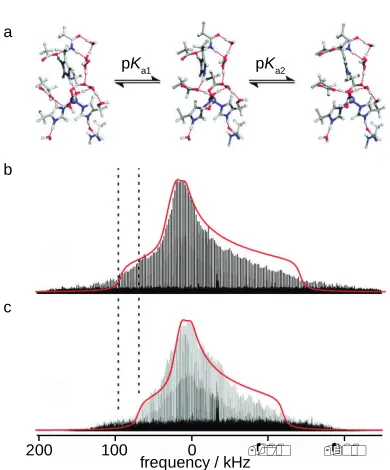
Despite these challenges, in impressive work Liptonet al. were able to obtain67Zn CPMG
NMR spectra for the wild type (WT) and the H265A mutant of Aquifex aeolicusLpxC.140A difference was observed in the 67Zn spectrum with pH, as shown inFigure 11for the WT
protein. The appearance of a third Zn species at high pH (with a CQ of 14.3 MHz) was
attributed to changes in the protonation state of a nearby histidine residue, by comparison of the experimental measurements to theoretical calculations, providing insight into the structure of the protein at physiological conditions.
As with protein study, investigation of biomaterials using NMR spectroscopy has also primarily exploited spin I = 1/2 nuclei such as13C, 15N and31P, owing to the ease of
spectral acquisition. However, of considerable potential is 43Ca (I = 7/2) NMR
spectroscopy, as calcium can be found in naturally-occurring bone, tooth enamel and dentin.141 Calcium can be challenging to study, owing to its very low natural abundance (0.135%) and the high cost of isotopic enrichment. A number of 43Ca NMR investigations
of bone and bone-related minerals have been performed,141with the first spectra of natural
biominerals, a horse bone and a cow tooth, appearing in 2010.142 In this work, a
combination of 43Ca solid-state NMR and Ca K-edge X-ray absorption spectroscopy
provided information about the calcium coordination shell, and demonstrated a correlation of the 43Ca chemical shift with the (average) Ca-O bond distance.142 The complex nature of bone (a composite material where hydroxyapatite-like phases and an organic matrix are combined) has also led to considerable study of model apatite systems. In addition to the study of pure hydroxyapatite (Ca10(PO4)6(OH)2), which contains two
distinct Ca sites, investigations have also focussed on possible substitutions of CO32–,
HPO42–, Na+ and Mg2+ into the apatite lattice.142 The importance of biomaterials in the
modern world will ensure this is an area of active research, with great benefit being obtained from higher magnetic fields.
1), although earlier study focussed on 15N (I = 1/2) despite its low natural abundance
(0.36%). As described above,14N does not exhibit a central transition and observation of all
species (except those with symmetrical environments) was prohibitively time consuming until recent years. An increase in the availability of high-field measurements (and concomitant increases in sensitivity) brought some progress for wideline measurements, but perhaps the most significant advance in recent years has been the use of indirect
detection experiments.14,85-87 These MAS-based methods exploit the transfer of
magnetisation between a spin I = 1/2 nucleus, typically 1H or 13C, and 14N, with the14N
MAS spectrum (exhibiting lineshapes broadened by the second- and sometimes
third-order quadrupolar interaction). These have been used to provide information on 14N
quadrupolar couplings, C-N internuclear distances and dynamics in amino acids, small peptides and pharmaceutical compounds,14,85-87 and represent an exciting area for future application.
8. Challenges and outlook
DOR42 and STMAS.48 It is indisputable that NMR study of quadrupolar nuclei was
revolutionised by the introduction of MQMAS,44 and this has enabled a far greater
applicability than was envisaged in the early 1990s. However, difficulties still remain with this method, with the need for improved sensitivity, both in absolute terms and per unit time. Possible solutions could be the use of more complex pulses, or changes to the way spectra are acquired. It has been demonstrated that some multidimensional spectra can be obtained in a single scan or step144 and, while this is currently difficult to implement in every experiment, future software advances may make this routine for many spectra in the near future.
Although the faster MAS rates currently available contribute to improved spectral resolution, the limited sample volumes compound the second significant challenge that afflicts NMR spectroscopy of quadrupolar nuclei – that of sensitivity. The increasing availability of high-field measurements will certainly help this problem, and the recent developments in microcoil technology (enabling extremely strong rf fields to be achieved) should mitigate, at least to some extent, the limiting sensitivity of small volumes.145 This will also enable better decoupling to be used, and simultaneously, therefore, aid resolution. It may be that additional advances will also be forthcoming if increased effort could be expended on the development of better methods for isotopic enrichment, with modifications to existing synthetic procedures able to significantly reduce the cost (in terms of both time and money). However, perhaps the technique generating the most interest in this regard is that of dynamic nuclear polarisation (DNP),146 in which the transfer of polarisation from unpaired electrons to nuclei is able to provide significant signal enhancements. Although to date, largely applied to organic solids, porous materials and surfaces, exploiting both rapid spin diffusion among 1H spins (prior to transfer to the
observed, only time will tell if DNP will prove to be the panacea that is suggested, but it is certainly an exciting area requiring future research investment.
One clear future direction for improving the understanding of solid-state structure is the need for a closer relationship between the complementary diffraction-based and spectroscopic methods. This will enable a detailed picture of a material on a range of lengthscales and timescales to be constructed – essential if its physical and chemical properties are to be understood and, therefore, exploited. Computation may well be the key here – easing not only the understanding, interpretation and assignment of the complex spectral lineshapes observed, but enabling the prediction of NMR parameters for potential structural models and subsequent comparison to NMR experimental measurements. The greatest impact might well arise from the widening interest in methods for the generation of possible structural models prior to the calculation of NMR parameters, both in terms of high-throughput calculations in disordered systems and from first-principles (as in theab initiorandom structure searching or AIRSS150approach).
An important goal for NMR spectroscopy is the understanding of the structural changes that occur during phase transitions, adsorption and chemical reactions. While
progress has been made in many areas using ex situ measurements, i.e., following an
for future research.
It is clear that much more technological and methodological development is required before NMR spectroscopy of quadrupolar nuclei can achieve anywhere near its full potential. However, the consistent progress made over the last few decades augurs well for further advances in the years to come. It is to be hoped that researchers of the future will view NMR spectroscopy as an important component of a suite of analytical techniques that should be combined to provide detailed information on structure, disorder and dynamics in the solid state.
Acknowledgements
References
1. Apperley, D. C.; Harris, R. K.; Hodgkinson, P. Solid State NMR Basic Principles and Practice, Momentum Press, New York, 2012.
2. MacKenzie, K. J. D.; Smith, M. E. Multinuclear Solid-State NMR of Inorganic Materials, Pergamon Press, Oxford, 2002.
3. Klinowski, J.Prog. Nucl. Magn. Reson. Spectrosc.1984,16, 237-309. 4. Eckert, H.Prog. Nucl. Magn. Reson. Spectrosc.1992,24, 159-293. 5. Klinowski,J. Anal. Chim. Acta.1993,283, 929-965.
6. Brown, S. P.Macromol. Rapid Commun.2009,30,688-716. 7. Hodgkinson, P.Ann. Rep. NMR Spectrosc.2010,72, 185-223.
8. Ashbrook, S. E.; Griffin, J. M.Ann.Rep.NMR Spectrosc.2013,79, 241-332. 9. Sutrisno, A.; Huang, Y.Solid State Nucl. Magn. Reson.2013,49-50, 1-11.
10. Stebbins, J. F.; Xue, X. Y. Spectroscopic Methods in Mineralogy and Materials Sciences, Mineralogical Society of America, Chantilly, 2014.
11. Andrew, E. R.; Bradbury, A.; Eades, R. G.Nature1958,182, 1659-1659. 12. Hodgkinson, P.Prog. Nucl. Magn. Reson. Spectrosc.2005,46, 197-222.
13. Vega, A. J. Quadrupolar Nuclei in Solids, eMagRes, 2010. DOI:
10.1002/9780470034590.emrstm0431.pub2.
14. Wasylishen, R. E.; Ashbrook, S. E.; Wimperis, S. (Eds) NMR of Quadrupolar Nuclei in Solid Materials, John Wiley & Sons Ltd, Chichester, 2012.
15. Fernandez, C.; Pruski, M.Topics in Curr. Chem.2012,306, 119-188. 16. Freitas, J. C. C.; Smith, M. E.Ann. Rep. NMR Spectrosc.2012,75, 25-114. 17. Bräuniger, T.; Jansen, M. Z.Anorg. Allg. Chem.2013,639, 857-879.
18. Chapman, R. P.; Widdifield, C. M.; Bryce, D. L.Prog. Nucl. Magn. Reson. Spectrosc.2009, 55, 215-237.
19. Ashbrook, S. E.; Smith, M. E.Chem. Soc. Rev.2006,35, 718-735.
20. Ashbrook, S. E.; Duer, M. J.Concepts Magn.Reson.2006,28A, 183-248.
634-642.
22. Amri, M.; Ashbrook, S. E.; Dawson, D. M.; Griffin, J. M.; Walton, R. I.; Wimperis, S. J.
Phys. Chem. C2012,116, 15048-15057.
23. Engelhardt, G.; Kentgens, A. P. M.; Koller, H.; Samoson, A. Solid State Nucl. Magn. Reson.1999,15, 171-180.
24. Schurko, R. W. Acquisition of Wideline Solid-State NMR Spectra of Quadrupolar Nuclei, eMagRes, 2011. DOI: 10.1002/9780470034590.emrstm1199.
25. O’Dell, L. A; Schurko, R. W.Chem.Phys.Lett.2008,464, 97-102.
26. O’Dell, L. A; Rossini, A. J.; Schurko, R. W.Chem.Phys.Lett.2009,468, 330-335. 27. Schurko, R. W.Acc. Chem. Res.2013,46, 1985-1995.
28. O’Dell, L. A.Solid State Nucl. Magn. Reson.2013,55-56, 28-41. 29. Meiboom S.; Gill, D.Rev.Sci.Instrum.1958,29, 688-691.
30. Madhu, P. K.; Goldbourt, A.; Frydman, L.; Vega, S.Chem. Phys. Lett.1999,307, 41–47. 31. Kentgens, A. P. M.; Verhagen, R.Chem. Phys. Lett.1999,300, 435-443.
32. Seigel, R.; Nakashima, T. K.; Wasylishen, R. E.Chem. Phys. Lett.2004,388, 441-445. 33. Nakashima, T. T.; Wasylishen, R. E.Sensitivity and Resolution Enhancement of Half-integer
Quadrupolar Nuclei in Solid-state NMR, eMagRes, 2011. DOI:
10.1002/9780470034590.emrstm1200.
34. Perras, F. A.; Viger-Gravel, J.; Burgess, K. M. N.; Bryce, D. L. Solid State Nucl. Magn. Reson.2013,51-52, 1-15.
35. Johnston, K. E.; O'Keefe, C. A.; Gauvin, R. M.; Trébosc, J.; Delevoye, L.; Amoureux, J. P.; Popoff, N.; Taoufik, M.; Oudatchin, K.; Schurko, R. W. Chem. Eur. J. 2013, 19, 12396-12414.
36. Griffin, J. M.; Berry, A. J.; Ashbrook, S. E.Solid State Nucl. Magn. Reson.2011,40, 91-99. 37. Burgess, K. M. N.; Xu, Y.; Leclerc, M. C.; Bryce, D. L.Inorg. Chem.2014,53, 552−561. 38. Hamaed, H.; Johnston, K. E.; Cooper, B. F. T.; Terskikh, V. V.; Ye, E., Macdonald; C. L. B.; Arnold, D. C.; Schurko, R. W.Chem. Sci.2014,5, 982-995.
41. Attrell, R. J.; Widdifield, C. M.; Korobkov, I.; Bryce, D. L. Cryst. Growth Des. 2012, 12, 1641-1653.
42. Samoson, A.; Lippmaa, E.; Pines, A.Mol.Phys.1988,65, 1013-1018.
43. Mueller, K. T.; Sun, B. Q.; Chingas, G. C.; Zwanziger, J. W.; Terao, T.; Pines, A.J.Magn. Reson.1990,86, 470-487.
44. Frydman, L.; Harwood, J. S.J.Am.Chem.Soc.1995,117, 5367-5368. 45. Goldbourt, A.; Madhu, P. K.Ann.Rep.NMR Spectrosc.2004,54, 81-153.
46. Rocha, J.; Morais, C. M.; Fernandez, C.Topics in Curr. Chem.2005,246, 141-194. 47. Gan, Z.J.Am.Chem.Soc.2000,122, 3242-3243.
48. Ashbrook, S. E.; Wimperis, S.Prog.Nucl.Magn.Reson.Spectrosc.2004,45, 53-108. 49. Gan, Z.; Kwak, H. T.J.Magn.Reson.2004,168, 346-351.
50. Colaux, H.; Dawson, D. M.; Ashbrook, S. E.J. Phys. Chem. ADOI: 10.1021/jp505752c. 51. Perras, F. A.; Bryce, D. L.J. Magn. Reson.2011,213, 82-89.
52. Perras, F. A.; Bryce, D. L.J. Chem. Phys.2013,138, 174202. 53. Perras, F. A.; Bryce, D. L.J. Magn. Reson.2014,242, 23-32.
54. Ashbrook, S. E.; McManus, J.; Thrippleton, M. J.; Wimperis, S.Prog.Nucl.Magn.Reson. Spectrosc.2009,55, 160-181.
55. Sternheimer, R.Phys. Rev.1954,95, 736-750.
56. O’Dell, L.Prog.Nucl.Magn.Reson.Spectrosc.2011,59, 295-318.
57. Hoatson, G. L; Vold, R. L.2H NMR Spectroscopy of Solids and Liquid Crystals, NMR Basic
Principles Prog.,1994,32, 1-67.
58. Colin, J. F.; Bataille, T.; Ashbrook, S. E.; Audebrand, N.; Le Polles, L.; Pivan, J. Y.; Le Fur, E.Inorg.Chem.2006,45, 6034-6040.
59. Johnston, K. E.; Tang, C. C.; Parker, J. E.; Knight, K. S.; Lightfoot, P.; Ashbrook, S. E. J.
Am. Chem. Soc.2010,132, 8732-8746.
60. Hanna, J. V.; Smith, M. E.; Whitfield, H. J.J. Am. Chem. Soc.1996,118, 5772-5777. 61. Sheppard, D.; Tugarinov, V.J.Magn.Reson.2010,203, 316-322.
63. Pickard, C. J.; Mauri, F.Phys. Rev. B,2001,63, 245101.
64. Cuny, J.; Messaoudi, S.; Alonzo, V.; Furet, E.; Halet, J. F.; Le Fur, E.; Ashbrook, S. E.; Pickard, C. J.; Gautier, R.; Le Polles, L.J. Comp. Chem.2008,29, 2279-2287.
65. Charpentier, T.Solid State Nucl. Magn. Reson.2011,40, 1-20.
66. Bonhomme, C.; Gervais, C.; Babonneau, F.; Coelho, C.; Pourpoint, F.; Azaïs, T.; Ashbrook, S. E.; Griffin, J. M.; Yates, J. R.; Mauri, F.; Pickard, C. J. Chem. Rev. 2012, 112, 5733-5779.
67. Ashbrook, S. E.; Le Polles, L.; Pickard, C. J.; Berry, A. J.; Wimperis, S.; Farnan, I. Phys. Chem.Chem.Phys.2007,9,1587-1598.
68. Ashbrook, S. E.; Berry, A. J.; Hibberson, W. O.; Steuernagel, S.; Wimperis, S. J. Am.
Chem. Soc.2003,125, 11824-11825.
69. Harris, R. K.; Wasylishen, R. E.; Duer, M. J. (Eds), NMR Crystallography, John Wiley & Sons Ltd, Chichester, 2009.
70. Martineau, C.; Cadiau, A.; Bouchevreau, B.; Senker, J.; Taulelle, F.; Adil, K. Dalton
Trans.2012,41, 6232-6241.
71. Amoureux, J. P.; Trebosc, J.; Delevoye, L.; Lafon, O.; Hu, B.; Wang, Q. Solid State Nucl. Magn.Reson.2009,35, 12-18.
72. Ashbrook, S. E.; Cutajar, M.; Pickard, C. J.; Walton, R. I.; Wimperis, S. Phys. Chem. Chem.Phys.2008,10, 5754-5764.
73. Wiench, J. W.; Pruski, M.Solid State Nucl. Magn. Reson.2004,26, 51-55.
74. Montouillout, V.; Morais, C. M.; Douy, A.; Fayon, F.; Massiot, D. Magn. Reson. Chem.
2006,44, 770-775.
75. Iuga, D.; Morais, C.; Gan, Z.; Neuville, D. R.; Cormier, L.; Massiot, D.J. Am. Chem. Soc.,
2005,127, 11540–11541.
76. Ashbrook, S. E.; Wimperis, S.Mol.Phys.2000,98, 1-26. 77. Amoureux, J. P.; Pruski, M.Mol.Phys.2002,100, 1595-1613. 78. Ashbrook, S. E.; Wimperis, S.J.Chem.Phys.2004,120, 2719-2731. 79. Ashbrook, S. E.; Wimperis, S.J.Chem.Phys.2009,131, 194509.
Amoureux, J. P.J.Chem.Phys.2012,137, 144201.
81. Hu, B.; Trebosc, J.; Amoureux, J. P.J. Magn. Reson.2008,192,112–122. 82. Levitt, M. H.J. Chem. Phys.2008,128, 52205.
83. Mali, G.; Fink, G.; Taulelle, F.J. Chem. Phys.2004,120, 2835-2845. 84. Eden, M.; Zhou, D.; Yu, J.Chem. Phys. Lett.2006, 431, 397-403. 85. Gan, Z.J. Am. Chem. Soc.2006,128, 6040-6041.
86. Cavadini, S.; Antonijevic, A.; Lupulescu, A.; Bodenhausen, G.J. Magn. Reson.2006,182, 168-172.
87. Cavadini, S.Prog.Nucl.Magn.Reson.Spectrosc.2010,56, 46-77.
88. de Lacaillerie, J. B. D.; Fretigny, C.; Massiot, D.J.Magn.Reson.2008,192, 244-251.
89. Ferrara, C.; Tealdi, C.; Pedone, A.; Menziani, M. C.; Rossini, A. J.; Pintacuda, G.; Mustarelli, P.J.Phys.Chem.C2013,117, 23451-23458.
90. Johnston, K. E.; Mitchell, M. R.; Blanc, F.; Lightfoot, P.; Ashbrook, S. E.J.Phys.Chem.C
2013,117, 2252-2265.
91. Florian, P.; Veron, E.; Green, T. F. G.; Yates, J. R.; Massiot, D. Chem. Mater. 2012, 24, 4068-4079.
92. Seymour, V. R.; Eschenroeder, E. C. V.; Castro, M.; Wright, P. A.; Ashbrook, S. E.
CrystEngComm2013,15, 8668-8679.
93. Blanc, F.; Middlemiss, D. S.; Gan, Z.; Grey, C. P. J. Am. Chem. Soc. 2011, 133, 17662-17672.
94. Ashbrook, S. E.; Dawson, D. M.Acc. Chem. Res.2013,46, 1964-1974. 95. Florian, P.; Massiot, D.CrystEngComm2013,15, 8623-8626.
96. O'Dell, L. A.; Ratcliffe, C. I.Quadrupolar NMR to Investigate Dynamics in Solid Materials, eMagRes, 2011. DOI: 10.1002/9780470034590.emrstm1209.
97. Vold, R. L.; Hoatson, G. L.J. Magn. Reson.2009,198, 57-72.
98. Cutajar, M.; Ashbrook, S. E.; Wimperis, S.Chem. Phys. Lett.2006.423, 276-281. 99. Thrippleton, M. J.; Cutajar, M.; Wimperis, S.Chem.Phys.Lett.2008,452, 233-238.
101. Antonijevic, S.; Ashbrook, S. E.; Biedasek, S.; Walton, R. I.; Wimperis, S.; Yang, H. J. Am.Chem.Soc.2006,128, 8054-8062.
102. Ashbrook, S. E.; Berry, A. J.; Wimperis, S.J.Am.Chem.Soc.2001,123, 6360-6366.
103. Griffin, J. M.; Wimperis, S.; Berry, A. J.; Pickard, C. J.; Ashbrook, S. E.J.Phys.Chem.C
2008,113, 465-471.
104. Griffin, J. M.; Miller, A. J.; Berry, A. J.; Wimperis, S.; Ashbrook, S. E.Phys.Chem.Chem. Phys.2010,12, 2989-2998.
105. Griffin, J. M.; Yates, J. R.; Berry, A. J.; Wimperis, S.; Ashbrook, S. E.J. Am.Chem.Soc.
2010,132, 15651-15660.
106. Ashbrook, S. E.; Cutajar, M.; Griffin, J. M.; Lethbridge, Z. A.; Walton, R. I.; Wimperis, S.J.Phys.Chem.C.2009,113, 10780-10789.
107. Blanc, F.; Leskes, M.; Grey, C. P.Acc.Chem.Res.2013,46, 1952-1963. 108. Grey, C. P.; Dupre, N.Chem. Rev.2004,104, 4493-4512.
109. Blanc, F.; Spencer, L.; Goward, G. R. Quadrupolar NMR of Ionic Conductors, Batteries, and Other Energy-related Materials, 2011. DOI: 10.1002/9780470034590.emrstm1215.
110. Yoon, W. S.; Grey, C. P.; Balasubramanian, M.; Yang, X. Q.; Fischer, D. A.; McBreen, J. Electrochem.Solid State Lett.2004,7, A53-A55.
111. Letellier, M.; Chevallier, F.; Clinard, C.; Frackowiak, E.; Rouzaud, J. N.; Beguin, F.; Morcrette, M.; Tarascon, J. M.J. Chem. Phys.2003,118, 6038-6045.
112. Key, B.; Bhattacharyya, R.; Morcrette, M.; Seznec, V.; Tarascon, J. M.; Grey, C. P. J. Am.
Chem. Soc.2009,131, 9239-9249.
113. Wang, H.; Köster, T. K. J.; Trease, N. M.; Ségalini, J.; Taberna, P. L.; Simon, P.; Gogotsi, Y.; Grey, C. P.J.Am.Chem.Soc.2011,133, 19270-19273.
114. Kim, N.; Stebbins, J. F.Chem.Mater.2007,19, 5742-5747.
115. Wright, P. A.Microporous Framework Solids, The Royal Society of Chemistry, 1st edn, 2008.
116. Ashbrook, S. E.; Dawson, D. M.; Seymour, V. R. Phys. Chem. Chem. Phys. 2014, 16, 8223-8242.