Learning Features that Predict C u e Usage
Barbara
Di Eugenio"
J o h a n n a D . M o o r e t M a s s i m o P a o l u c c i "+ U n i v e r s i t y o f P i t t s b u r g hP i t t s b u r g h , P A 15260, U S A
{ d i e u g e n i , j m o o r e , p a o l u c c i } @ c s .pitt. e d u
A b s t r a c t
Our goal is to identify the features that pre- dict the occurrence and placement of dis- course cues in tutorial explanations in or- der to aid in the automatic generation of explanations. Previous attempts to devise rules for text generation were based on in- tuition or small numbers of constructed ex- amples. We apply a machine learning pro- gram, C4.5, to induce decision trees for cue occurrence and placement from a corpus of data coded for a variety of features previ- ously thought to affect cue usage. Our ex- periments enable us to identify the features with most predictive power, and show that machine learning can be used to induce de- cision trees useful for text generation.
1 I n t r o d u c t i o n
Discourse cues are words or phrases, such as because, first, and although, that mark structural and seman- tic relationships between discourse entities. They play a crucial role in m a n y discourse processing tasks, including plan recognition (Litman and Allen, 1987), text comprehension (Cohen, 1984; Hobbs, 1985; Mann and Thompson, 1986; Reichman-Adar, 1984), and anaphora resolution (Grosz and Sidner, 1986). Moreover, research in reading comprehension indicates that felicitous use of cues improves compre- hension and recall (Goldman, 1988), but that their indiscriminate use may have detrimental effects on recall (Millis, Graesser, and Haberlandt, 1993).
Our goal is to identify general strategies for cue us- age that can be implemented for automatic text gen- eration. From the generation perspective, cue usage consists of three distinct, but interrelated problems: (1) occurrence: whether or not to include a cue in the generated text, (2) placement: where the cue should be placed in the text, and (3) selection: what lexical item(s) should be used.
Prior work in text generation has focused on cue selection (McKeown and Elhadad, 1991; Elhadad and McKeown, 1990), or on the relation between
*Learning Research & Development Center
tComputer Science Department, and Learning Re- search ~z Development Center
tlntelllgent Systems Program
cue occurrence and placement and specific rhetori- cal structures (RSsner and Stede, 1992; Scott and de Souza, 1990; Vander Linden and Martin, 1995). Other hypotheses about cue usage derive from work on discourse coherence and structure. Previous research (Hobbs, 1985; Grosz and Sidner, 1986; Schiffrin, 1987; M a n n and Thompson, 1988; Elhadad and M c K e o w n , 1990), which has been largely de- scriptive, suggests factors such as structural features of the discourse (e.g., level of embedding and segment complexity), intentional and informational relations in that structure, ordering of relata, and syntactic form of discourse constituents.
Moser and Moore (1995; 1997) coded a corpus of naturally occurring tutorial explanations for the range of features identified in prior work. Because they were also interested in the contrast between oc- currence and non-occurrence of cues, they exhaus- tively coded for all of the factors thought to con- tribute to cue usage in all of the text. F r o m their study, Moscr and Moore identified several interesting correlations between particular features and specific aspects of cue usage, and were able to test specific hypotheses from the hterature that were based on constructed examples.
In this paper, we focus on cue occurrence and placement, and present an empirical study of the hy- potheses provided by previous research, which have never been systematically evaluated with naturally occurring data. W c use a machine learning program, C4.5 (Quinlan, 1993), on the tagged corpus of Moser and Moore to induce decision trees. T h e number of coded features and their interactions makes the man- ual construction of rules that predict cue occurrence and placement an intractable task.
Our results largely confirm the suggestions from the hterature, and clarify them by highhghting the most influential features for a particular task. Dis- course structure, in terms of both segment structure and levels of embedding, affects cue occurrence the most; intentional relations also play an important role. For cue placement, the most important factors are syntactic structure and segment complexity.
T h e paper is organized as follows. In Section 2 we discuss previous research in more detail. Section 3 provides an overview of Moser and Moore's coding scheme. In Section 4 we present our learning exper- iments, and in Section 5 we discuss our results and conclude.
2 R e l a t e d W o r k
McKeown and Elhadad (1991; 1990) studied severai connectives (e.g., but, since, because), and include m a n y insightful hypotheses about cue selection; their observation that the distinction between but and ¢l- thoug/~ depends on the point of the move is related to the notion of core discussed below. However, they do not address the problem of cue occurrence.
Other researchers (R6sner and Stede, 1902; Scott and de Souza, 1990) are concerned with generating text from " R S T trees", hierarchical structures where leaf nodes contain content and internal nodes indi- cate the rt~etorical relations, as defined in Rhetori- cal Structure Theory (RST) (Mann and Thompson, 1988), that exist between subtrees. They proposed heuristics for including and choosing cues based on the rhetorical relation between spans of text, the or- der of the relata, and the complexity of the related text spans. However, (Scott and de Souza, 1990) was based on a small number of constructed exam- pies, and (R6sner and Stede, 1992) focused on a small number of R S T relations.
(Litman, 1996) and (Siegel and McKeown, 1994) have applied machine learning to disambiguate be- tween the discourse and sentcntial usages of cues; however, they do not consider the issues of occur- rence and placement, and approach the problem from the point of view of interpretation. We closely follow the approach in (Litman, 1996) in two ways. First, we use C4.5. Second, we experiment first with each feature individually, and then with "interesting" sub- sets of features.
3 R e l a t i o n a l D i s c o u r s e A n a l y s i s
This section briefly describes Relational Discourse Anal~tsis ( R D A ) (Moser, Moore, and Glendening, 1996), the coding scheme used to tag the data for our machine learning experiments. 1
RDA is a scheme devised for analyzing tutorial ex- planations in the domain of electronics troubleshoot- ing. It synthesizes ideas from (Grosz and Sidner, 1986) and from RST (Mann and Thompson, 1988). Coders use RDA to exhaustively analyze each expla- nation in the corpus, i.e., every word in each expla- nation belongs to exactly one element in the anal- ysis. An explanation may consist of multiple seg- ments. Each segment originates with an intention of the speaker. Segments are internally structured and consist of a core, i.e., that element that most di- rectly expresses the segment purpose, and any num- ber of contributors, i.e. the remaining constituents. For each contributor, one analyzes its relation to the core from an intentional perspective, i.e., how it is intended to support the core, and from an informa- tional perspective, i.e., how its content relates to that
1For more detail about the RDA coding scheme see (Moser and Moore, 1995; Moser and Moore, 1997).
of the core. The set of intentional relations in RDA is a modification of the presentational relations of RST, while informational relations are similar to the subject matter relations in RST. Each segment con- stituent, both core and contributors, m a y itself be a
segment with a core:contributor structure. In some
cases the core is not explicit. This is often the case with the whole tutor's explanation, since its purpose is to answer the student's explicit question.
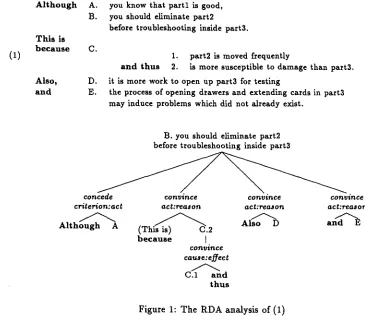
As an example of the application of R D A , consider
the partial tutor explanation in (1) 2 . T h e purpose of
this segment is to inform the student that she m a d e the strategy error of testing inside part3 too soon. T h e constituent that makes the purpose obvious, in this case (l-B), is the core of the segment. T h e other constituents help to serve the segment purpose by contributing to it. (1-C) is an example ofsubsegment
with its o w n core:contributor structure; its purpose
is to give a reason for testing part2 first.
T h e R D A analysis of (I) is shown schematically in Figure 1. T h e core is depicted as the mother of all the relations it participates in. Each relation node is labeled with both its intentional and informational relation, with the order of relata in the label indicat- ing the linear order in the discourse. Each relation node has up to two daughters: the cue, if any, and the contributor, in the order they appear in the dis-
c o u r s e .
Coders analyze each explanation in the corpus and enter their analyses into a database. The corpus con- sists of 854 clauses comprising 668 segments, for a total of 780 relations. Table 1 summarizes the dis- tribution of different relations, and the number of cued relations in each category. Joints are segments comprising more than one core, but no contributor; clusters are multiunit structures with no recogniz- able core:contributor relation. (l-B) is a cluster com- posed of two units (the two clauses), related only at the informational level by a temporal relation. Both clauses describe actions, with the first action descrip- tion embedded in a matriz ("You should"). Cues are much more likely to occur in clusters, where only in- formational relations occur, than in core:contributor structures, where intentional and informational rela- tions co-occur (X 2 = 33.367, p <.001, df = 1). In the following, we will not discuss joints and clusters any further.
An important result pointed out by (Moser and Moore, 1995) is that cue placement depends on core position. When the core is first and a cue is asso- ciated with the relation, the cue never occurs with the core. In contrast, when the core is second, if a cue occurs, it can occur either on the core or on the contributor.
(i)
A l t h o u g h
This is because
Also, and
A. you know that part1 is good, B. you should eliminate part2
before troubleshooting inside part3.
C.
D.
E.
1. part2 is moved frequently
a n d t h u s 2. is more susceptible to damage than part3.
it is more work to open up part3 for testing
the process of opening drawers and extending cards in part3 may induce problems which did not already exist.
concede criterion:act
Although A
B. you should eliminate part2 before troubleshooting inside part3
c o n v i n c e C o n u s n c e c o n u g n e e
act:reason act:reason act:reason
(Th 2
because } c o n v i n c e cause:effect
C.1 and thus
Figure 1: The RDA analysis of (1)
4 L e a r n i n g f r o m t h e c o r p u s
4.1 T h e a l g o r i t h m
We chose the C4.5 learning algorithm (Quinlan, 1993) because it is well suited to a domain such as ours with discrete valued attributes. Moreover, C4.5 produces decision trees and rule sets, both often used in text generation to implement mappings from func- tion features to f o r m s ? Finally, C4.5 is both read- ily available, and is a benchmark learning algorithm that has been extensively used in NLP applications, e.g. (Litman, 1996; Mooney, 1996; Vander Linden and Di Eugenio, 1996).
As our dataset is small, the results we report are based on cross-validation, which (Weiss and Ku- likowski, 1091) recommends as the best method to evaluate decision trees on datasets whose cardinality is in the hundreds. Data for learning should be di- vided into training and test sets; however, for small datasets this has the disadvantage that a sizable por- tion of the data is not available for learning. Cross- validation obviates this problem by running the algo- rithm N times (N=10 is a typical value): in each run, (N~l)th of the data, randomly chosen, is used as the training set, and the remaining ~ t h used as the test
3We will discuss only decision trees here.
set. The error rate of a tree obtained by using the whole dataset for training is then assumed to be the average error rate on the test set over the N runs. Further, as C4.5 prunes the initial tree it obtains to avoid overfitting, it computes both actual and esti- mated error rates for the pruned tree; see (Quinlan, 1993, Ch. 4) for details. Thus, below we will report the average estimated error rate on the test set, as computed by 10-fold cross-validation experiments.
4.2 T h e f e a t u r e s
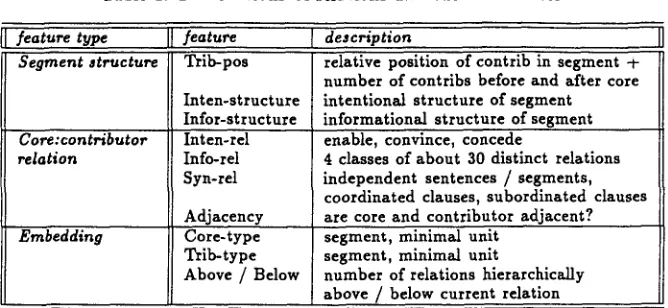
Each data point in our dataset corresponds to a core:contributor relation, and is characterized by the following features, summarized in Table 2.
S e g m e n t S t r u c t u r e . Three features capture the global structure of the segment in which the current core:contributor relation appears.
• (Con)Trib(utor)-pos(ition) captures the posi- tion of a particular contributor within the larger segment in which it occurs, and encodes the structure of the segment in terms of how many contributors precede and follow the core. For ex- ample, contributor (l-D) in Figure 1 is labeled as BIA3-2after, as it is the second contributor following the core in a segment with 1 contrib- utor before and 3 after the core.
[image:3.612.101.466.74.399.2]of relation
tl Total I #
of cued relations II
Core:Contributor 406 181
Joints 64 19
Clusters 310 276
Total 780 476
Table 1: Distributions of relations and cue occurrences
[I feature type feature dencription
Segment ntructure Trib-pos relative position of contrib in segment t number of contribs before and after core
Inten-structure intentional structure of segment
Infor-structure informational structure of segment
Core:contributor Inten-rel enable, convince, concede
relation Info-rel 4 classes of about 30 distinct relations
Syn-rel independent sentences / segments,
coordinated clauses, subordinated clauses
Adjacency are core and contributor adjacent?
Embedding Core-type segment, minimal unit
Trib-type segment, minimal unit
Above / Below number of relations hierarchically
above / below current relation
Table 2: Features
• /nten(tional)-structure indicates which contrib- utors in the segment bear the same intentional relations to the core.
• Infor(mationalJ-structure. Similar to inten- tional structure, but applied to informational relations.
C o r e : c o n t r i b u t o r r e l a t i o n . These features more specifically characterize the current core:contributor
relation.
• lnten(tionalJ-rel(ation). One of concede, con- vince, enable.
• Infor(maiional)-rel(ation). About 30 informa- tional relations have been coded for. However, as preliminary experiments showed that using them individually results in overfitting the data, we classify them according to the four classes proposed in (Moser, Moore, and Glendening,
1996):
causality, similarity, elaboration, tempo- ral. Temporal relations only appear in clusters, thus not in the data we discuss in this paper.• Syn(tactic)-rel(atiou). Captures whether the core and contributor are independent units (seg- ments or sentences); whether they are coordi- nated clauses; or which of the two is subordinate to the other.
• Adjacency. Whether core and contributor are adjacent in linear order.
E m b e d d i n g . These features capture segment em- bedding, Core-type and Trib-type qualitatively, and
A bore/Below quantitatively.
• Core-type/(ConJTrib(utor)-type. Whether the core/the contributor is a segment, or a mini- mal unit (further subdivided into action, state,
matriz).
• Above//Belozo encode the number of relations hi- erarchically above and below the current rela- tion.
4.3 T h e e x p e r i m e n t s
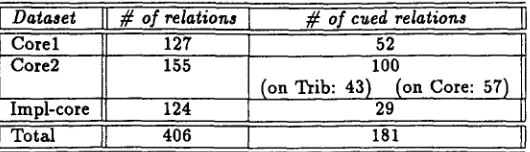
Initially, we performed learning on all 406 instances of core:contributor relations. We quickly determined that this approach would not lead to useful decision trees. First, the trees we obtained were extremely complex (at least 50 nodes). Second, some of the sub- trees corresponded to clearly identifiable subclasses of the data, such as relations with an implicit core, which suggested that we should apply learning to these independently identifiable subclasses. Thus, we subdivided the data into three subsets:
• Core/: core:contributor relations with the core in first position
• Core~: core:contributor relations with the core in second position
• Impl(icit)-core: core:contributor relations with an implicit core
[image:4.612.190.408.52.115.2] [image:4.612.132.466.133.287.2]11 O t set II # of Z tio s I
# of c ed reZatio s
II
Corel 127
Core2 155
Impl-core 124
52 100
(on Trib: 43) (on Core: 57) 29
II Total II 406 I 181
Table 3: Distributions of relations and cue occurrences
We ran four sets of experiments. In three of t h e m we predict cue occurrence and in one cue placement. 4
4 . 3 . 1 C u e O c c u r r e n c e
Table 4 summarizes our main results concerning cue occurrence, and includes the error rates asso- ciated with different feature sets. We adopt Lit- m a n ' s approach (1906) to determine whether two er- ror rates El and £2 are significantly different. We c o m p u t e 05% confidence intervals for the two error rates using a t-test. £1 is significantly better t h a n £~ if the upper b o u n d of the 95% confidence inter- val for £1 is lower t h a n the lower b o u n d of the 95% confidence interval for g2-~
For each set of experiments, we report the following:
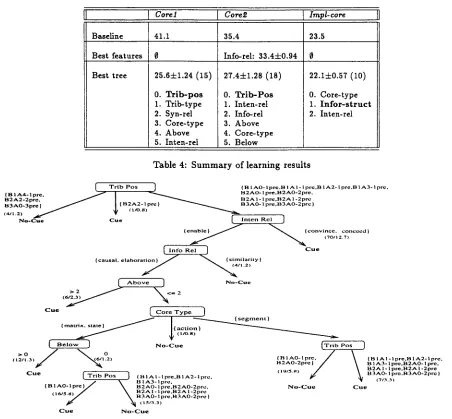
1. A baseline measure obtained by choosing the majority class. E.g., for Corel 58.9% of the re- lations are not cued; thus, by deciding to never include a cue, one would be wrong 41.1% of the times.
2. T h e best individual features whose predictive power is better t h a n the baseline: as Table 4 makes apparent, individual features do not have much predictive power. For neither Gorcl nor
Impl-core does any individual feature perform better t h a n the baseline, and for Core~ only one feature is sufficiently predictive.
3. (One of) the best induced tree(s). For each tree, we list the n u m b e r of nodes, and up to six of the features t h a t appear highest in the tree, with their levels of embedding. 5 Figure 2 shows the tree for Core~ (space constraints prevent us from including figures for each tree). In the figure, the numbers in parentheses indicate the n u m b e r of cases correctly covered by the leaf, and the number of expected errors at t h a t leaf.
Learning turns out to be most useful for Corel,
where the error reduction (as percentage) from base- line to the upper b o u n d of the best result is 32%;
~AII our experiments are run with groupin 9 turned on, so that C4.5 groups values together rather than creating a branch per value. The latter choice always results in trees overfitted to the data in our domain. Using classes of informational relations, rather than individual infor- mational relations, constitutes a sort of a priori grouping. SThe trees that C4.5 generates are right-branching, so this description is fairly adequate.
error reduction is 1 9 % for Core2 and only 3 % for
Impl- core.
T h e best tree was obtained partly by informed choice, partly by trial and error. Automatically try- ing out all the 211 -- 2048 subsets of features would be possible, but it would require manual examina- tion of about 2,000 sets of results, a daunting task. Thus, for each dataset wc considered only the follow- ing subsets of features.
1. All features. This always results in C4.5 select- ing a few features (from 3 to 7) for the final tree. 2. Subsets built out of the 2 to 4 attributes appear-
ing highest in the tree obtained by running C4.5 on all features.
3. In Table 2, three features -- Trib-pos, In~e~-
struck, Infor-s~ruct- concern segment struc-
ture, eight do not. W e constructed three subsets by always including the eight features that do not concern segment structure, and adding one of those that does. The trees obtained by includ- ing Trib-pos, I~tert-struc~, Infor-struc~ at the same time are in general more complex, and not significantly better than other trees obtained by including only one of these three features. We a t t r i b u t e this to the fact t h a t these features en- code partly overlapping information.
Finally, the best tree was obtained as follows. We build the set of trees that are statistically equivalent to the tree with the best error rate (i.e., with the lowest error rate upper bound). A m o n g these trees, we choose the one t h a t we deem the most perspicuous in terms of features and of complexity. Namely, we pick the simplest tree with Trib-Pos as the root if one exists, otherwise the simplest tree. Trees t h a t have Trib-Pos as the root are the most useful for text generation, because, given a complex segment,
Trib-Pos is the only attribute t h a t unambiguously identifies a specific contributor.
Our results make apparent t h a t the structure of segments plays a fundamental role in determining cue occurrence. One of the three features concerning segment structure (Trib-Pos, Inten-Structure, Infor- StrucZure) appears as the root or just below the root in all trees in Table 4; more importantly, this same configuration occurs in all trees equivalent to the best tree (even if the specific feature encoding segment structure m a y change). T h e level of embedding in a
[image:5.612.183.448.50.126.2]Core l Core2 Impl-core
Baseline 41.1 35.4 23.5
Best features 0 Info-rel: 33.44-0.94 O
Best tree 25.64-1.24 (I5)
O. Trlb-pos
1. Tril>-type 2. Syn-rel 3. C0re-type 4. A b o v e 5. Inten-rel
27.44-1.28 (18)
O. T r i b - P o s I. Inten-rel 2. Info-rel 3. Above 4. Core-type 5. Below
22.1+0.57 (10)
O. Core-type 1. I n f o r - s t r u c t 2. Inten-rel
Table 4: S u m m a r y of learning results
T r i b POS } { B 1A0- I prc.B l A 1-1 prc.B 1A2-1 pre.B 1A3- I pre. {B I A , - I pre. / ~ _ 8 1 ) p ~ B 2 A 0 - I p r e . B 2 A 0 - 2 p r e .
B2A2.2pr¢i ~ B 2 A I- 1 p r e . B 2 A 1-2pr*2 B 3 A 0 - 3 p r e { B21A2. ~ N . ~ . ~ B 3 A 0 - 1 P r c ' B 3 A 0 - 2 p r c } (4/I.2)
N o - C u e C u e [ Intcn Rcl J
{causal. elaboration} /
/
[ ,,,,o~o }
C u e [ Core T y p e )
{ m a t . . { a c t i o n )
[ ae~ow ) No-Cu~
C u e [ T r i b P o s ] { B I A l - l p r e . B 1 A 2 - 1 p r c . {B IA0-1 p r e / ~ B I A 3 - 1 p r ¢ . B 2 A 0 -
I pre.B2AO-2prc. B 2 A l - I prc.B2A 1-2pro
\ B 3 A 0 - 1 p r e . B 3 A 0 - 2 p r e } ( 1 6 / 5 ~ /
(15/3.3) C u e N o - C u e
{cneb'c} / ~ { .... i ... d} ( 7 0 / I 2.7) [ Int-o R e l J C u e
{ sioailarity }
~
/I 2 , N o - C u e{ s e g m e n t }
( T . b Pos J
{ B 1 A 0 - 1 p r e , / / \ [ B I A l - l p r e . B l A 2 - 1 p r ¢ . B 2 A 0 - 2 p r e } / B 1A3- I p r c . B 2 A 0 - I pro. B 2 A 1 - I p r e . B 2 A 1-2pre (1915.8, ~ Z r B3A0- I prc.B3A0=2prc }
(713 3) N o - C u e C u e
Figure 2: Decision tree for Core2 - - occurrence
segment, as encoded by Core-type, Trib-type, Above
a n d Below also figures prominently.
InLen-rel appears in all trees, confirming the in- t u i t i o n t h a t the speaker's purpose affects cue occur-
rence. More specifically, in Figure 2, Inten-reldistin-
guishes two different speaker purposes, convince a n d
enable. T h e same split occurs in some of the best
trees induced on Core1, with the same outcome: i.e.,
convince directly correlates with the occurrence of a
cue, whereas for enable other features must be taken
into account. 6 I n f o r m a t i o n a l relations do not a p p e a r as often as i n t e n t i o n a l relations; their discriminatory power seems more relevant for clusters. P r e l i m i n a r y
ewe can't draw any conclusions concerning concede,
as there are only 24 occurrences of concede out of 406
core:contributor relations.
experiments show t h a t cue occurrence in clusters de- pends only on informational a n d syntactic relations.
Finally, Adjacency does not seem to play a n y sub-
s t a n t i a l role.
4 . 3 . 2 C u e P l a c e m e n t
While cue occurrence and placement are interre- lated problems, we performed learning on them sep- arately. First, the issue of placement arises only in
the case of Core~; for Core1, cues only occur on the
c o n t r i b u t o r . Second, we a t t e m p t e d experiments on
Core2 t h a t discriminated between occurrence a n d placement at the same time, a n d the derived trees were complex a n d not perspicuous. T h u s , we r a n a n
e x p e r i m e n t on the 100 cued relations from Core~ to
[image:6.612.69.521.49.468.2]Baseline 43%
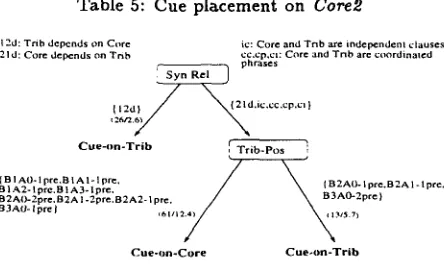
Best features Syn-reh 24.1:t:0.69 Trib-pos: 40+0.88 Best tree 20.6+0.97 (5)
[image:7.612.81.303.129.267.2]O. Syn-rcl 1. Trib-pos
Table 5: Cue placement on Core2
12d: Ttab depends on Core i¢: Core and T a b are independent clauses
21d: Core depends on T a b cc.cp.ct: Core and T n b are coordinaled
phrases " N ~ d .: ,:c ,=p ,:, I
{ i z d } . " . " ." . ,26,'2. V
C u e - o n - T r i b [ T r i b - P o s
hB/AO71Pre.~'B. I A 1.~ I Pro' ~ { B2AO-Iofe B2AI-Iprc
C u e - o n - C o r e C u e ~ o n - T r i b
Figure 3: Decision tree for C o r e ~ - - placement
see Table 5.
We ran the same trials discussed above on this dataset. In this case, the best tree - - see Figure 3 - - results from combining the two best individual features, and reduces the error rate by 50%. T h e most discriminant feature turns out to be the syn- tactic relation between the contributor and the core. However, segment structure still plays an important role, via Trib-pos.
While the importance of S~ln-rel for placement seems clear, its role concerning occurrence requires further exploration. It is interesting to note that the tree induced on G o r e l - - the only case in which Syn- rel is relevant for occurrence - - indudes the same dis- tinction as in Figure 3: namely, if the contributor de- pends on the core, the contributor must be marked, otherwise other features have to be taken into ac- count. Scott and de Souza (1990) point out that "there is a strong correlation between the syntactic specification of a complex sentence and its perceived rhetorical structure." It seems that certain syntactic structures function as a cue.
5 D i s c u s s i o n a n d C o n c l u s i o n s
We have presented the results of machine learning ex- periments concerning cue occurrence and placement. As (Litman, 1996) observes, this sort of empirical work supports the utility of machine learning tech- niques applied to coded corpora. As our study shows, individual features have no predictive power for cue occurrence. Moreover, it is hard to see how the best combination of individual features could be found by manual inspection.
Our results also provide guidance for those build- ing text generation systems. This study clearly in-
dicates that segment structure, most notably the ordering of core and contributor, is crucial for de- termining cuc occurrence. Recall that it was only
by considering Corel and Core~ relations in distinct
datasets that we were able to obtain perspicuous de- cision trees that signifcantly reduce the error rate.
This indicates that the representations produced by discourse planners should distinguish those ele- ments that constitute the core of each discourse seg- ment, in addition to representing the hierarchical structure of segments. Note that the notion of core
is related to the notions of nucleus in R S T , intended
effect in (Young and Moore, 1994), and of point of
a m o v e in (Elhadad and M c K e o w n , 1990), and that text generators representing these notions exist.
Moreover, in order to use the decision trees derived here, decisions about whether or not to m a k e the core explicit and h o w to order the core and contributor(s) must be m a d e before deciding cue occurrence, e.g.,
by exploiting other factors such as focus ( M c K e o w n ,
1985) and a discourse history.
Once decisions about core:contributor ordering
and cuc occurrence have been made, a generator must still determine where to place cues and se-
lect appropriate Icxical items. A major focus of
our future research is to explore the relationship be- tween the selection and placement decisions. Else- where, we have found that particular lexical items tend to have a preferred location, defined in terms of
functional (i.e., core or contributor) and linear (i.e.,
first or second relatum) criteria (Moser and Moore, 1997). Thus, if a generator uses decision trees such as the one shown in Figure 3 to determine where a cuc should bc placed, it can then select an appro- priate cue from those that can m a r k the given in-
tentional / informational relations, and are usually
placed in that functional-linear location. To evaluate this strategy, we must do further work to understand whether there are important distinctions among cues (e.g., so, because) apart from their different preferred locations. The work of Elhadad (1990) and Knott (1996) will help in answering this question.
Future work comprises further probing into ma- chine learning techniques, in particular investigating whether other learning algorithms are more appro- priate for our problem (Mooney, 1996), especially al- gorithms that take into account some a priori knowl- edge about features and their dependencies.
A c k n o w l e d g e m e n t s
This research is supported by the Office of Naval Research, Cognitive and Neural Sciences Division (Grants N00014-91-J-1694 and N00014-93-I-0812). Thanks to Megan Moser for her prior work on this project and for comments on this paper; to Erin Glendening and Liina Pylkkanen for their coding ef- forts; to Haiqin Wang for running m a n y experiments; to Giuseppe Carenini and Stefll Briininghaus for dis- cussions about machine learning.
R e f e r e n c e s
Cohen, Robin. 1984. A computational theory of the function of clue words in argument understand- ing. In Proceedings of COLINGS~, pages 251-258, Stanford, CA.
Elhadad, Michael and Kathleen McKeown. 1990. Generating connectives. In Proceedings of COL- INGgO, pages 97-101, Helsinki, Finland.
Goldman, Susan R. 1988. The role of sequence markers in reading and recall: Comparison of na- tive and normative english speakers. Technical re- port, University of California, Santa Barbara.
Grosz, Barbara J. and Candace L. Sidner. 1986. At- tention, intention, and the structure of discourse.
Computational Linguistics, 12(3):175-204. Hobbs, Jerry R. 1985. On the coherence and struc-
ture of discourse. Technical Report CSLI-85-37, Center for the Study of Language and Informa- tion, Stanford University.
Knott, Alistair. 1996. A Data-Driver, methodology for motivating a set of coherence relations. Ph.D. thesis, University of Edinburgh.
Litman, Diane J. 1996. Cue phrase classification using machine learning. Journal of Artificial In- telligence Research, 5:53-94.
Litman, Diane J. and James F. Allen. 1987. A plan recognition model for subdialogues in conver- sations. Cognitive Science, 11:163-200.
Mann, William C. and Sandra A. Thompson. 1986. Relational propositions in discourse. Discourse Processes, 9:57-90.
Mann, William C. and Sandra A. Thompson. 1988. Rhetorical Structure Theory: Towards a functional theory of text organization. TEXT, 8(3):243-281.
McKeown, Kathleen R. 1985. Tezt Generation: Us-
ing Discourse Strategies and Focus Constraints to Generate Natural Language Tezt. Cambridge Uni- versity Press, Cambridge, England.
McKeown, Kathleen R. and Michael Elhadad. 1991. A contrastive evaluation of functional unification grammar for surface language generation: A case study in the choice of connectives. In C. L. Paris, W. R. Swartout, and W. C. Mann, eds., Natu- ral Language Generation in Artificial Intelligence and Computational Linguistics. Kluwer Academic Publishers, Boston, pages 351-396.
Millis, Keith, Arthur Graesser, and Karl Haberlandt. 1993. The impact of connectives on the memory for expository text. Applied Cognitive Psychology, 7:317-339.
Mooney, Raymond J. 1996. Comparative experi- ments on disambiguating word senses: An illus- tration of the role of bias in machine learning. In
Conference on Empirical Methods in Natural Lan- guage Processing.
Moser, Megan and Johanna D. Moore. 1995. In- vestigating cue selection and placement in tutorial discourse. In Proceedings of ACLgS, pages 130- 135, Boston, MA.
Moser, Megan and Johanna D. Moore. 1997. A cor- pus analysis of discourse cues and relational dis- course structure. Submitted for publication. Moser, Megan, Johanna D. Moore, and Erin Glen-
dening. 1996. Instructions for Coding Explana- tions: Identifying Segments, Relations and Mini- real Units. Technical Report 96-17, University of Pittsburgh, Department of Computer Science. Quinlan, J. Ross. 1993. C~.5: Programs for Machine
Learning. Morgan Kaufmann.
Reichman-Adar, Rachel. 1984. Extended person-machine interface. Artificial Intelligence, 22(2):157-218.
RSsner, Dietmar and Manfred Stede. 1992. Cus- tomizing RST for the automatic production of technical manuals. In R. Dale, E. Hovy, D. RSsner, and O. Stock, eds., 6th International Workshop or* Natural Language Generation, Springer-Verlag, Berlin, pages 199-215.
Schiffrin, Deborah. 1987. Discourse Markers. Cam- bridge University Press, New York.
Scott, Donia and Clarisse Sieckenius de Souza. 1990. Getting the message across in RST-based text gen- eration. In R. Dale, C. Mellish, and M. Zock, eds., Current Research in Natural Language Gen- eration. Academic Press, New York, pages 47-73. Siegel, Eric V. and Kathleen R. McKeown. 1994. Emergent linguistic rules from inducing decision trees: Disambiguating discourse clue words. In Proceedings of AAAI94, pages 820-826.
Vander Linden, Keith and Barbara Di Eugenio. 1996. Learning micro-planning rules for preven- tative expressions. In 8th International Workshop on Natural Language Generation, Sussex, UK.
Vander Linden, Keith and James H. Martin. 1995. Expressing rhetorical relations in instructional text: A case study of the purpose relation. Com- putational Linguistics, 21(1):29-58.
Weiss, Sholom M. and Casimir Kulikowski. 1991. Computer Systems that learn: classification and prediction methods from statistics, neural nets, machine learning, and ezpert systems. Morgan Kaufmann.