A Probability Model to Improve Word Alignment
Colin Cherry and Dekang Lin Department of Computing Science
University of Alberta
Edmonton, Alberta, Canada, T6G 2E8
{colinc,lindek}@cs.ualberta.ca
Abstract
Word alignment plays a crucial role in sta-tistical machine translation. Word-aligned corpora have been found to be an excellent source of translation-related knowledge. We present a statistical model for comput-ing the probability of an alignment given a sentence pair. This model allows easy in-tegration of context-specific features. Our experiments show that this model can be an effective tool for improving an existing word alignment.
1 Introduction
Word alignments were first introduced as an in-termediate result of statistical machine translation systems (Brown et al., 1993). Since their intro-duction, many researchers have become interested in word alignments as a knowledge source. For example, alignments can be used to learn transla-tion lexicons (Melamed, 1996), transfer rules (Car-bonell et al., 2002; Menezes and Richardson, 2001), and classifiers to find safe sentence segmentation points (Berger et al., 1996).
In addition to the IBM models, researchers have proposed a number of alternative alignment meth-ods. These methods often involve using a statistic such asφ2(Gale and Church, 1991) or the log likeli-hood ratio (Dunning, 1993) to create a score to mea-sure the strength of correlation between source and target words. Such measures can then be used to guide a constrained search to produce word align-ments (Melamed, 2000).
It has been shown that once a baseline alignment has been created, one can improve results by using a refined scoring metric that is based on the align-ment. For example Melamed uses competitive link-ing along with an explicit noise model in (Melamed, 2000) to produce a new scoring metric, which in turn creates better alignments.
In this paper, we present a simple, flexible, sta-tistical model that is designed to capture the infor-mation present in a baseline alignment. This model allows us to compute the probability of an align-ment for a given sentence pair. It also allows for the easy incorporation of context-specific knowl-edge into alignment probabilities.
A critical reader may pose the question, “Why in-vent a new statistical model for this purpose, when existing, proven models are available to train on a given word alignment?” We will demonstrate exper-imentally that, for the purposes of refinement, our model achieves better results than a comparable ex-isting alternative.
We will first present this model in its most general form. Next, we describe an alignment algorithm that integrates this model with linguistic constraints in order to produce high quality word alignments. We will follow with our experimental results and dis-cussion. We will close with a look at how our work relates to other similar systems and a discussion of possible future directions.
2 Probability Model
and let F be a French sentencef1, f2, . . . , fn. We
define a linkl(ei, fj)to exist ifeiandfjare a
trans-lation (or part of a transtrans-lation) of one another. We define the null link l(ei, f0) to exist ifei does not
correspond to a translation for any French word in F. The null linkl(e0, fj) is defined similarly. An
alignmentAfor two sentencesE andF is a set of links such that every word inEandF participates in at least one link, and a word linked toe0orf0 partic-ipates in no other links. Ifeoccurs inE xtimes and f occurs inF ytimes, we say thateandf co-occur xytimes in this sentence pair.
We define the alignment problem as finding the alignmentA that maximizesP(A|E, F). This cor-responds to finding the Viterbi alignment in the IBM translation systems. Those systems model P(F, A|E), which when maximized is equivalent to maximizingP(A|E, F). We propose here a system which modelsP(A|E, F)directly, using a different decomposition of terms.
In the IBM models of translation, alignments exist as artifacts of which English words generated which French words. Our model does not state that one sentence generates the other. Instead it takes both sentences as given, and uses the sentences to deter-mine an alignment. An alignment A consists oft links{l1, l2, . . . , lt}, where eachlk=l(eik, fjk)for someikandjk. We will refer to consecutive subsets
ofAaslji = {li, li+1, . . . , lj}. Given this notation,
P(A|E, F)can be decomposed as follows:
P(A|E, F) =P(l1t|E, F) =
t Y
k=1
P(lk|E, F, lk1−1)
At this point, we must factorP(lk|E, F, lk1−1)to make computation feasible. LetCk ={E, F, lk1−1} represent the context oflk. Note that both the
con-textCk and the link lkimply the occurrence of eik andfjk. We can rewriteP(lk|Ck)as:
P(lk|Ck) =
P(lk, Ck)
P(Ck)
= P(Ck|lk)P(lk) P(Ck, eik, fjk)
= P(Ck|lk) P(Ck|eik, fjk)
× P(lk, eik, fjk) P(eik, fjk)
=P(lk|eik, fjk)×
P(Ck|lk)
P(Ck|eik, fjk)
HereP(lk|eik, fjk)is link probability given a co-occurrence of the two words, which is similar in spirit to Melamed’s explicit noise model (Melamed, 2000). This term depends only on the words in-volved directly in the link. The ratio P(Ck|lk)
P(Ck|eik,fjk) modifies the link probability, providing context-sensitive information.
Up until this point, we have made no simplify-ing assumptions in our derivation. Unfortunately, Ck ={E, F, lk1−1}is too complex to estimate con-text probabilities directly. Suppose F Tk is a set
of context-related features such that P(lk|Ck) can
be approximated byP(lk|eik, fjk, F Tk). LetC
0
k =
{eik, fjk}∪F Tk.P(lk|C
0
k)can then be decomposed
using the same derivation as above.
P(lk|Ck0) =P(lk|eik, fjk)×
P(Ck0|lk) P(Ck0|eik, fjk)
=P(lk|eik, fjk)×
P(F Tk|lk)
P(F Tk|eik, fjk) In the second line of this derivation, we can drop eikandfjkfromC
0
k, leaving onlyF Tk, because they
are implied by the events which the probabilities are conditionalized on. Now, we are left with the task of approximatingP(F Tk|lk) andP(F Tk|eik, fjk). To do so, we will assume that for all f t ∈ F Tk,
f t is conditionally independent given either lk or
(eik, fjk). This allows us to approximate alignment probabilityP(A|E, F)as follows:
t Y
k=1
P(lk|eik, fjk)×
Y
f t∈F Tk
P(f t|lk) P(f t|eik, fjk)
In any context, only a few features will be ac-tive. The inner product is understood to be only over those featuresf tthat are present in the current con-text. This approximation will causeP(A|E, F) to no longer be a well-behaved probability distribution, though as in Naive Bayes, it can be an excellent es-timator for the purpose of ranking alignments.
|f t, eik, fjk|. If this pair is also linked, then we in-crement the count of|f t, lk|. Note that our definition ofF Tkallows for features that depend on previous
links. For this reason, when determining whether or not a feature is present in a given context, one must impose an ordering on the links. This ordering can be arbitrary as long as the same ordering is used in training1and probability evaluation. A simple solu-tion would be to order links according their French words. We choose to order links according to the link probabilityP(lk|eik, fjk) as it has an intuitive appeal of allowing more certain links to provide con-text for others.
We store probabilities in two tables. The first ta-ble stores link probabilitiesP(lk|eik, fjk). It has an entry for every word pair that was linked at least once in the training corpus. Its size is the same as the translation table in the IBM models. The sec-ond table stores feature probabilities, P(f t|lk) and P(f t|eik, fjk). For every linked word pair, this table has two entries for each active feature. In the worst case this table will be of size2×|F T|×|E|×|F|. In practice, it is much smaller as most contexts activate only a small number of features.
In the next subsection we will walk through a sim-ple examsim-ple of this probability model in action. We will describe the features used in our implementa-tion of this model in Secimplementa-tion 3.2.
2.1 An Illustrative Example
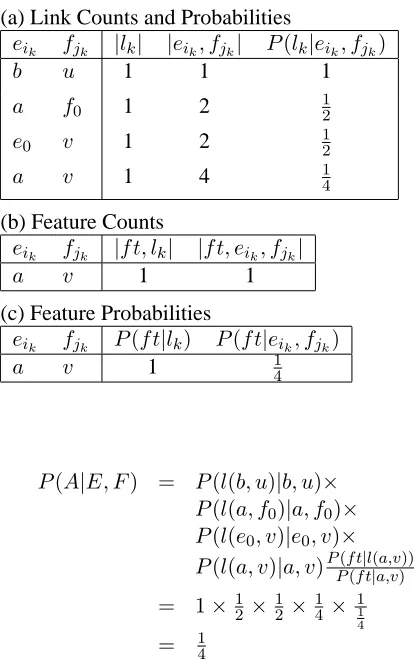
Figure 1 shows an aligned corpus consisting of one sentence pair. Suppose that we are concerned with only one feature f t that is active2 for eik and fjk if an adjacent pair is an alignment, i.e., l(eik−1, fjk−1) ∈ l
k−1
1 or l(eik+1, fjk+1) ∈ l
k−1 1 . This example would produce the probability tables shown in Table 1.
Note how f tis active for the (a, v) link, and is not active for the(b, u)link. This is due to our se-lected ordering. Table 1 allows us to calculate the probability of this alignment as:
1
In our experiments, the ordering is not necessary during training to achieve good performance.
2
Throughout this paper we will assume that null alignments are special cases, and do not activate or participate in features unless otherwise stated in the feature description.
a b a
u v v
e
f0 0
Figure 1: An Example Aligned Corpus
Table 1: Example Probability Tables
(a) Link Counts and Probabilities
eik fjk |lk| |eik, fjk| P(lk|eik, fjk)
b u 1 1 1
a f0 1 2 12
e0 v 1 2 12
a v 1 4 14
(b) Feature Counts
eik fjk |f t, lk| |f t, eik, fjk|
a v 1 1
(c) Feature Probabilities
eik fjk P(f t|lk) P(f t|eik, fjk)
a v 1 14
P(A|E, F) = P(l(b, u)|b, u)× P(l(a, f0)|a, f0)× P(l(e0, v)|e0, v)× P(l(a, v)|a, v)PP(f t(f t|l|(a,va,v))) = 1×12× 12× 14× 11
4 = 14
3 Word-Alignment Algorithm
In this section, we describe a world-alignment al-gorithm guided by the alignment probability model derived above. In designing this algorithm we have selected constraints, features and a search method in order to achieve high performance. The model, however, is general, and could be used with any in-stantiation of the above three factors. This section will describe and motivate the selection of our con-straints, features and search method.
features and constraints that are based on linguistic intuitions.
3.1 Constraints
The reader will note that our alignment model as de-scribed above has very few factors to prevent unde-sirable alignments, such as having all French words align to the same English word. To guide the model to correct alignments, we employ two constraints to limit our search for the most probable alignment. The first constraint is the one-to-one constraint (Melamed, 2000): every word (except the null words e0andf0) participates in exactly one link.
The second constraint, known as the cohesion constraint (Fox, 2002), uses the dependency tree (Mel’ˇcuk, 1987) of the English sentence to restrict possible link combinations. Given the dependency treeTE, the alignment can induce a dependency tree
for F (Hwa et al., 2002). The cohesion constraint requires that this induced dependency tree does not have any crossing dependencies. The details about how the cohesion constraint is implemented are out-side the scope of this paper.3 Here we will use a sim-ple examsim-ple to illustrate the effect of the constraint. Consider the partial alignment in Figure 2. When the system attempts to link of and de, the new link will induce the dotted dependency, which crosses a previously induced dependency between service and
donn´ees. Therefore, of and de will not be linked.
the status of the data service
l' état du service de données
nn det pcomp mod
[image:4.612.336.512.78.192.2]det
Figure 2: An Example of Cohesion Constraint
3.2 Features
In this section we introduce two types of features that we use in our implementation of the probabil-ity model described in Section 2. The first feature
3
The algorithm for checking the cohesion constraint is pre-sented in a separate paper which is currently under review.
the host discovers all the devices
det subj
pre det obj
l' hôte repère tous les périphériques
1 2 3 4 5
1 2 3 4 5 6
6
[image:4.612.129.245.483.572.2]the host locate all the peripherals
Figure 3: Feature Extraction Example
typef taconcerns surrounding links. It has been
ob-served that words close to each other in the source language tend to remain close to each other in the translation (Vogel et al., 1996; Ker and Change, 1997). To capture this notion, for any word pair (ei, fj), if a linkl(ei0, fj0)exists wherei−2≤i0≤
i+ 2andj−2 ≤j0 ≤j+ 2, then we say that the featuref ta(i−i0, j−j0, ei0)is active for this context.
We refer to these as adjacency features.
The second feature type f td uses the English
parse tree to capture regularities among grammati-cal relations between languages. For example, when dealing with French and English, the location of the determiner with respect to its governor4is never swapped during translation, while the location of ad-jectives is swapped frequently. For any word pair (ei, fj), letei0 be the governor ofei, and letrel be
the relationship between them. If a linkl(ei0, fj0)
exists, then we say that the featuref td(j−j0, rel)is
active for this context. We refer to these as depen-dency features.
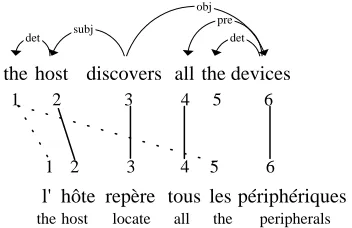
Take for example Figure 3 which shows a par-tial alignment with all links completed except for those involving ‘the’. Given this sentence pair and English parse tree, we can extract features of both types to assist in the alignment ofthe1. The word pair(the1, l0) will have an active adjacency feature f ta(+1,+1, host)as well as a dependency feature
f td(−1, det). These two features will work together
to increase the probability of this correct link. In contrast, the incorrect link(the1, les)will have only f td(+3, det), which will work to lower the link
probability, since most determiners are located
be-4
fore their governors.
3.3 Search
Due to our use of constraints, when seeking the highest probability alignment, we cannot rely on a method such as dynamic programming to (implic-itly) search the entire alignment space. Instead, we use a best-first search algorithm (with constant beam and agenda size) to search our constrained space of possible alignments. A state in this space is a par-tial alignment. A transition is defined as the addi-tion of a single link to the current state. Any link which would create a state that does not violate any constraint is considered to be a valid transition. Our start state is the empty alignment, where all words in EandFare linked to null. A terminal state is a state in which no more links can be added without violat-ing a constraint. Our goal is to find the terminal state with highest probability.
For the purposes of our best-first search, non-terminal states are evaluated according to a greedy completion of the partial alignment. We build this completion by adding valid links in the order of their unmodified link probabilitiesP(l|e, f)until no more links can be added. The score the state receives is the probability of its greedy completion. These completions are saved for later use (see Section 4.2).
4 Training
As was stated in Section 2, our probability model needs an initial alignment in order to create its prob-ability tables. Furthermore, to avoid having our model learn mistakes and noise, it helps to train on a set of possible alignments for each sentence, rather than one Viterbi alignment. In the following sub-sections we describe the creation of the initial align-ments used for our experialign-ments, as well as our sam-pling method used in training.
4.1 Initial Alignment
We produce an initial alignment using the same al-gorithm described in Section 3, except we maximize summed φ2 link scores (Gale and Church, 1991), rather than alignment probability. This produces a reasonable one-to-one word alignment that we can refine using our probability model.
4.2 Alignment Sampling
Our use of the one-to-one constraint and the cohe-sion constraint precludes sampling directly from all possible alignments. These constraints tie words in such a way that the space of alignments cannot be enumerated as in IBM models 1 and 2 (Brown et al., 1993). Taking our lead from IBM models 3, 4 and 5, we will sample from the space of those high-probability alignments that do not violate our con-straints, and then redistribute our probability mass among our sample.
At each search state in our alignment algorithm, we consider a number of potential links, and select between them using a heuristic completion of the re-sulting state. Our sampleS of possible alignments will be the most probable alignment, plus the greedy completions of the states visited during search. It is important to note that any sampling method that concentrates on complete, valid and high probabil-ity alignments will accomplish the same task.
When collecting the statistics needed to calcu-late P(A|E, F) from our initial φ2 alignment, we give each s ∈ S a uniform weight. This is rea-sonable, as we have no probability estimates at this point. When training from the alignments pro-duced by our model, we normalize P(s|E, F) so thatP
s∈SP(s|E, F) = 1. We then count links and
features inS according to these normalized proba-bilities.
5 Experimental Results
We adopted the same evaluation methodology as in (Och and Ney, 2000), which compared alignment outputs with manually aligned sentences. Och and Ney classify manual alignments into two categories: Sure (S) and Possible (P) (S⊆P). They defined the following metrics to evaluate an alignmentA:
Table 2: Comparison with (Och and Ney, 2000)
Method Prec Rec AER
Ours 95.7 86.4 8.7
IBM-4 F→E 80.5 91.2 15.6
IBM-4 E→F 80.0 90.8 16.0
IBM-4 Intersect 95.7 85.6 9.0
IBM-4 Refined 85.9 92.3 11.7
and testing corpora with Minipar.5 We then ran the training procedure in Section 4 for three iterations.
We conducted three experiments using this methodology. The goal of the first experiment is to compare the algorithm in Section 3 to a state-of-the-art alignment system. The second will determine the contributions of the features. The third experi-ment aims to keep all factors constant except for the model, in an attempt to determine its performance when compared to an obvious alternative.
5.1 Comparison to state-of-the-art
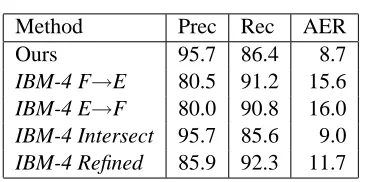
Table 2 compares the results of our algorithm with the results in (Och and Ney, 2000), where an HMM model is used to bootstrap IBM Model 4. The rows
IBM-4 F→E and IBM-4 E→F are the results
ob-tained by IBM Model 4 when treating French as the source and English as the target or vice versa. The row IBM-4 Intersect shows the results obtained by taking the intersection of the alignments produced by IBM-4 E→F and IBM-4 F→E. The row IBM-4 Refined shows results obtained by refining the
inter-section of alignments in order to increase recall. Our algorithm achieved over 44% relative error reduction when compared with IBM-4 used in ei-ther direction and a 25% relative error rate reduc-tion when compared with IBM-4 Refined. It also achieved a slight relative error reduction when com-pared with IBM-4 Intersect. This demonstrates that we are competitive with the methods described in (Och and Ney, 2000). In Table 2, one can see that our algorithm is high precision, low recall. This was expected as our algorithm uses the one-to-one con-straint, which rules out many of the possible align-ments present in the evaluation data.
5
[image:6.612.339.519.95.180.2]available at http://www.cs.ualberta.ca/˜lindek/minipar.htm
Table 3: Evaluation of Features
Algorithm Prec Rec AER
initial (φ2) 88.9 84.6 13.1 without features 93.7 84.8 10.5 withf tdonly 95.6 85.4 9.3
withf taonly 95.9 85.8 9.0
withf taandf td 95.7 86.4 8.7
5.2 Contributions of Features
Table 3 shows the contributions of features to our al-gorithm’s performance. The initial (φ2) row is the
score for the algorithm (described in Section 4.1) that generates our initial alignment. The without
fea-tures row shows the score after 3 iterations of
refine-ment with an empty feature set. Here we can see that our model in its simplest form is capable of produc-ing a significant improvement in alignment quality. The rows withf tdonly and with f taonly describe
the scores after 3 iterations of training using only de-pendency and adjacency features respectively. The two features provide significant contributions, with the adjacency feature being slightly more important. The final row shows that both features can work to-gether to create a greater improvement, despite the independence assumptions made in Section 2.
5.3 Model Evaluation
Even though we have compared our algorithm to alignments created using IBM statistical models, it is not clear if our model is essential to our perfor-mance. This experiment aims to determine if we could have achieved similar results using the same initial alignment and search algorithm with an alter-native model.
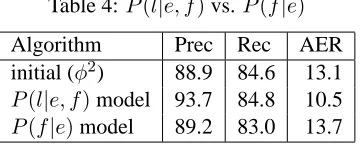
Without using any features, our model is similar to IBM’s Model 1, in that they both take into account only the word types that participate in a given link. IBM Model 1 usesP(f|e), the probability off be-ing generated bye, while our model usesP(l|e, f), the probability of a link existing between eandf. In this experiment, we set Model 1 translation prob-abilities according to our initialφ2 alignment, sam-pling as we described in Section 4.2. We then use the
Qn
Table 4:P(l|e, f)vs.P(f|e)
Algorithm Prec Rec AER
initial (φ2) 88.9 84.6 13.1 P(l|e, f)model 93.7 84.8 10.5 P(f|e)model 89.2 83.0 13.7
recorded the best results that it achieved.
It is clear from Table 4 that refining our initialφ2 alignment using IBM’s Model 1 is less effective than using our model in the same manner. In fact, the Model 1 refinement receives a lower score than our initial alignment.
6 Related Work
6.1 Probability models
When viewed with no features, our proba-bility model is most similar to the explicit noise model defined in (Melamed, 2000). In fact, Melamed defines a probability distribution P(links(u,v)|cooc(u,v), λ+, λ−)which appears to make our work redundant. However, this distribu-tion refers to the probability that two word types u and v are linkedlinks(u,v)times in the entire cor-pus. Our distribution P(l|e, f) refers to the proba-bility of linking a specific co-occurrence of the word tokenseandf. In Melamed’s work, these probabil-ities are used to compute a score based on a prob-ability ratio. In our work, we use the probabilities directly.
By far the most prominent probability models in machine translation are the IBM models and their extensions. When trying to determine whether two words are aligned, the IBM models ask, “What is the probability that this English word generated this French word?” Our model asks instead, “If we are given this English word and this French word, what is the probability that they are linked?” The dis-tinction is subtle, yet important, introducing many differences. For example, in our model, E andF are symmetrical. Furthermore, we modelP(l|e, f0) andP(l|e, f00)as unrelated values, whereas the IBM
model would associate them in the translation prob-abilities t(f0|e) andt(f00|e) through the constraint
P
ft(f|e) = 1. Unfortunately, by conditionalizing
on both words, we eliminate a large inductive bias.
This prevents us from starting with uniform proba-bilities and estimating parameters with EM. This is why we must supply the model with a noisy initial alignment, while IBM can start from an unaligned corpus.
In the IBM framework, when one needs the model to take new information into account, one must cre-ate an extended model which can base its parame-ters on the previous model. In our model, new in-formation can be incorporated modularly by adding features. This makes our work similar to maximum entropy-based machine translation methods, which also employ modular features. Maximum entropy can be used to improve IBM-style translation prob-abilities by using features, such as improvements to P(f|e)in (Berger et al., 1996). By the same token we can use maximum entropy to improve our esti-mates ofP(lk|eik, fjk, Ck). We are currently inves-tigating maximum entropy as an alternative to our current feature model which assumes conditional in-dependence among features.
6.2 Grammatical Constraints
There have been many recent proposals to leverage syntactic data in word alignment. Methods such as (Wu, 1997), (Alshawi et al., 2000) and (Lopez et al., 2002) employ a synchronous parsing procedure to constrain a statistical alignment. The work done in (Yamada and Knight, 2001) measures statistics on operations that transform a parse tree from one lan-guage into another.
7 Future Work
The alignment algorithm described here is incapable of creating alignments that are not one-to-one. The model we describe, however is not limited in the same manner. The model is currently capable of creating many-to-one alignments so long as the null probabilities of the words added on the “many” side are less than the probabilities of the links that would be created. Under the current implementation, the training corpus is one-to-one, which gives our model no opportunity to learn many-to-one alignments.
of the IBM models. Features that are related to multiple links should be added to our set of feature types, to guide intelligent placement of such links.
8 Conclusion
We have presented a simple, flexible, statistical model for computing the probability of an alignment given a sentence pair. This model allows easy in-tegration of context-specific features. Our experi-ments show that this model can be an effective tool for improving an existing word alignment.
References
Hiyan Alshawi, Srinivas Bangalore, and Shona Douglas. 2000. Learning dependency translation models as col-lections of finite state head transducers. Computa-tional Linguistics, 26(1):45–60.
Adam L. Berger, Stephen A. Della Pietra, and Vincent J. Della Pietra. 1996. A maximum entropy approach to natural language processing. Computational
Linguis-tics, 22(1):39–71.
P. F. Brown, V. S. A. Della Pietra, V. J. Della Pietra, and R. L. Mercer. 1993. The mathematics of statistical machine translation: Parameter estimation.
Computa-tional Linguistics, 19(2):263–312.
Jaime Carbonell, Katharina Probst, Erik Peterson, Chris-tian Monson, Alon Lavie, Ralf Brown, and Lori Levin. 2002. Automatic rule learning for resource-limited mt. In Proceedings of AMTA-02, pages 1–10.
Ted Dunning. 1993. Accurate methods for the statistics of surprise and coincidence. Computational
Linguis-tics, 19(1):61–74, March.
Heidi J. Fox. 2002. Phrasal cohesion and statistical machine translation. In Proceedings of EMNLP-02, pages 304–311.
W.A. Gale and K.W. Church. 1991. Identifying word correspondences in parallel texts. In Proceedings
of the 4th Speech and Natural Language Workshop,
pages 152–157. DARPA, Morgan Kaufmann.
Rebecca Hwa, Philip Resnik, Amy Weinberg, and Okan Kolak. 2002. Evaluating translational correspondence using annotation projection. In Proceeding of ACL-02, pages 392–399.
Sue J. Ker and Jason S. Change. 1997. Aligning more words with high precision for small bilingual cor-pora. Computational Linguistics and Chinese Lan-guage Processing, 2(2):63–96, August.
Adam Lopez, Michael Nossal, Rebecca Hwa, and Philip Resnik. 2002. Word-level alignment for multilingual resource acquisition. In Proceedings of the Workshop
on Linguistic Knowledge Acquisition and Representa-tion: Bootstrapping Annotated Language Data.
I. Dan Melamed. 1996. Automatic construction of clean broad-coverage translation lexicons. In Proceedings
of the 2nd Conference of the Association for Machine Translation in the Americas, pages 125–134,
Mon-treal.
I. Dan Melamed. 2000. Models of translational equiv-alence among words. Computational Linguistics,
26(2):221–249, June.
Igor A. Mel’ˇcuk. 1987. Dependency syntax: theory and
practice. State University of New York Press, Albany.
Arul Menezes and Stephen D. Richardson. 2001. A best-first alignment algorithm for automatic extraction of transfer mappings from bilingual corpora. In
Proceed-ings of the Workshop on Data-Driven Machine Trans-lation.
Franz J. Och and Hermann Ney. 2000. Improved sta-tistical alignment models. In Proceedings of the 38th
Annual Meeting of the Association for Computational Linguistics, pages 440–447, Hong Kong, China,
Octo-ber.
S. Vogel, H. Ney, and C. Tillmann. 1996. Hmm-based word alignment in statistical translation. In
Proceed-ings of COLING-96, pages 836–841, Copenhagen,
Denmark, August.
Dekai Wu. 1997. Stochastic inversion transduction grammars and bilingual parsing of parallel corpora.
Computational Linguistics, 23(3):374–403.
Kenji Yamada and Kevin Knight. 2001. A syntax-based statistical translation model. In Meeting of the