Proceedings of the 45th Annual Meeting of the Association of Computational Linguistics, pages 480–487,
Finding document topics for improving topic segmentation
Olivier Ferret CEA LIST, LIC2M 18 route du Panorama, BP6 Fontenay aux Roses, F-92265 France
Abstract
Topic segmentation and identification are of-ten tackled as separate problems whereas they are both part of topic analysis. In this article, we study how topic identification can help to improve a topic segmenter based on word reiteration. We first present an unsu-pervised method for discovering the topics of a text. Then, we detail how these topics are used by segmentation for finding topical similarities between text segments. Finally, we show through the results of an evaluation done both for French and English the inter-est of the method we propose.
1 Introduction
In this article, we address the problem of linear topic segmentation, which consists in segmenting doc-uments into topically homogeneous segments that does not overlap each other. This part of the Dis-course Analysis field has received a constant interest since the initial work in this domain such as (Hearst, 1994). One criterion for classifying topic segmen-tation systems is the kind of knowledge they de-pend on. Most of them only rely on surface features of documents: word reiteration in (Hearst, 1994; Choi, 2000; Utiyama and Isahara, 2001; Galley et al., 2003) or discourse cues in (Passonneau and Lit-man, 1997; Galley et al., 2003). As such systems do not require external knowledge, they are not sensi-tive to domains but they are limited by the type of documents they can be applied to: lexical reiteration is reliable only if concepts are not too frequently
ex-pressed by several means (synonyms, etc.) and dis-course cues are often rare and corpus-specific.
To overcome these difficulties, some systems make use of domain-independent knowledge about lexical cohesion: a lexical network built from a dic-tionary in (Kozima, 1993); a thesaurus in (Mor-ris and Hirst, 1991); a large set of lexical co-occurrences collected from a corpus in (Choi et al., 2001). To a certain extent, these lexical networks enable topic segmenters to exploit a sort of concept reiteration. However, their lack of any explicit topi-cal structure makes this kind of knowledge difficult to use when lexical ambiguity is high.
The most simple solution to this problem is to ex-ploit knowledge about the topics that may occur in documents. Such topic models are generally built from a large set of example documents as in (Yam-ron et al., 1998), (Blei and Moreno, 2001) or in one component of (Beeferman et al., 1999). These sta-tistical topic models enable segmenters to improve their precision but they also restrict their scope.
Hybrid systems that combine the approaches we have presented were also developed and illus-trated the interest of such a combination: (Job-bins and Evett, 1998) combined word recurrence, co-occurrences and a thesaurus; (Beeferman et al., 1999) relied on both lexical modeling and discourse cues; (Galley et al., 2003) made use of word reitera-tion through lexical chains and discourse cues.
The work we report in this article takes place in the first category we have presented. It does not rely on any a priori knowledge and exploits word usage rather than discourse cues. More precisely, we present a new method for enhancing the results
of segmentation systems based on word reiteration without relying on any external knowledge.
2 Principles
In most of the algorithms in the text segmentation field, documents are represented as sequences of ba-sic discourse units. When they are written texts, these units are generally sentences, which is also the case in our work. Each unit is turned into a vector of words, following the principles of the Vector Space model. Then, the similarity between the basic units of a text is evaluated by computing a similarity mea-sure between the vectors that represent them. Such a similarity is considered as representative of the top-ical closeness of the corresponding units. This prin-ciple is also applied to groups of basic units, such as text segments, because of the properties of the
Vec-tor Space model. Segments are finally delimited by
locating the areas where the similarity between units or groups of units is weak.
This quick overview highlights the important role of the evaluation of the similarity between discourse units in the segmentation process. When no exter-nal knowledge is used, this similarity is only based on the strict reiteration of words. But it can be en-hanced by taking into account semantic relations be-tween words. This was done for instance in (Jobbins and Evett, 1998) by taking semantic relations from Roget’s Thesaurus. This resource was also used in (Morris and Hirst, 1991) where the similarity be-tween discourse units was more indirectly evaluated through the lexical chains they share. The same ap-proach was adopted in (Stokes et al., 2002) but with WordNet as the reference semantic resource.
In this article, we propose to improve the detec-tion of topical similarity between text segments but without relying on any external knowledge. For each text to segment, we first identify its topics by per-forming an unsupervised clustering of its words ac-cording to their co-occurrents in the text. Thus, each of its topics is represented by a subset of its vocab-ulary. When the similarity between two segments is evaluated during segmentation, the words they share are first considered but the presence of words of the same topic is also taken into account. This makes it possible to find similar two segments that refer to the same topic although they do not share a lot of
words. It is also a way to exploit long-range rela-tions between words at a local level. More globally, it helps to reduce the false detection of topic shifts.
3 Unsupervised Topic Identification
The approach we propose first requires to discover the topics of texts. For performing such a task with-out using a priori knowledge, we assume that the most representative words of each of the topics of a text occur in similar contexts. Hence, for each word of the text with a minimal frequency, we col-lect its co-occurrents, we evaluate the pairwise simi-larity of these selected text words by relying on their co-occurrents and finally, we build topics by apply-ing an unsupervised clusterapply-ing method to them.
3.1 Building the similarity matrix of text words
The first step for discovering the topics of a text is a linguistic pre-processing of it. This pre-processing splits the text into sentences and represents each of them as the sequence of its lemmatized plain words, that is, nouns (proper and common nouns), verbs
and adjectives. After filtering the low frequency
words of the text (frequency < 3), the co-occurrents of the remaining words are classically collected by recording the co-occurrences in a fixed-size win-dow (15 plain words) moved over the pre-processed text. As a result, each text word is represented by a vector that contains its occurrents and their co-occurrence frequency. The pairwise similarity be-tween all the selected text words is then evaluated for building their similarity matrix. We classically apply the Cosine measure between the vectors that represent them for this evaluation.
3.2 From a similarity matrix to text topics
year yearly
bovine case become
BES
human
market pair
ski swiss
animal
carcass declare
federal
infect disease
director indicate
shaking cow
maker production streule
last
mad
[image:3.612.86.294.78.253.2]company stockli
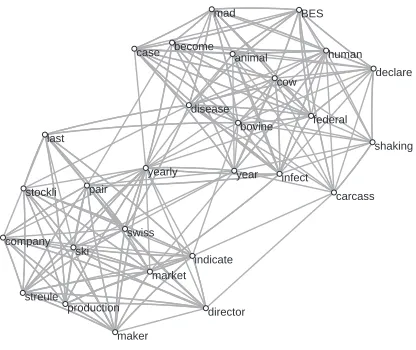
Figure 1: Similarity graph after its sparsification
(see Algorithm 1) performs clustering by detecting high-density areas in a similarity graph. In our case, the similarity graph is directly built from the simi-larity matrix: each vertex represents a text word and an edge links two words whose similarity is not null. The SNN algorithm splits up into two main stages: the first one finds the elements that are the most rep-resentative of their neighborhood. These elements are the seeds of the final clusters that are built in the second stage by aggregating the remaining elements to those selected by the first stage. This first stage
Algorithm 1 SNN algorithm
1. sparsification of the similarity graph
2. building of the SNN graph
3. computation of the distribution of strong links
4. search for topic seeds and filtering of noise
5. building of text topics
6. removal of insignificant topics
7. extension of text topics
starts by sparsifying the similarity graph, which is
done by keeping only the links towards thek(k=10)
most similar neighbors of each text word (step 1). Figure 1 shows the resulting graph for a two-topic document of our evaluation framework (see Sec-tion 5.1). Then, the similarity graph is transposed into a shared nearest neighbor (SNN) graph (step 2). In this graph, the similarity between two words is given by the number of direct neighbors they share
in the similarity graph. This transposition makes the similarity values more reliable, especially for high-dimensional data like textual data. Strong links in the SNN graph are finally detected by applying a fixed threshold to the distribution of shared neigh-bor numbers (step 3). A word with a high number of strong links is taken as the seed of a topic as it is representative of the set of words that are linked to it. On the contrary, a word with few strong links is supposed to be outlier (step 4).
The second stage of the SNN algorithm first builds text topics by associating to topic seeds the remaining words that are the most similar to them provided that their number of shared neighbors is high enough (step 5). Moreover, the seeds that are judged as too close to each other are also grouped during this step in accordance with the same crite-ria. The last two steps bring small improvements to the results of this clustering. First, when the num-ber of words of a topic is too small (size < 3), this topic is judged as insignificant and it is discarded (step 6). Its words are added to the set of words with-out topic after step 5. We added this step to the SNN algorithm to balance the fact that without any ex-ternal knowledge, all the semantic relations between text words cannot be found by relying only on co-occurrence. Finally, the remaining text topics are extended by associating to them the words that are neither noise nor already part of a topic (step 7). As topics are defined at this point more precisely than at step 4, the integration of words that are not strongly linked to a topic seed can be safely performed by relying on the average strength of their links in the SNN graph with the words of the topic. After the SNN algorithm is applied, a set of topics is associ-ated to the text to segment, each of them being de-fined as a subset of its vocabulary.
4 Using Text Topics for Segmentation
4.1 Topic segmentation using word reiteration
pre-processing described in Section 3.1 for the discover-ing of text topics. The evaluation of the lexical cohe-sion of a text relies as for TextTiling on a fixed-size focus window that is moved over the text to segment and stops at each sentence break. The cohesion in the part of text delimited by this window is evalu-ated by measuring the word reiteration between its two sides. This is done in our case by applying the
Dice coefficient between the two sides of the focus
window, following (Jobbins and Evett, 1998). This cohesion value is associated to the sentence break at the transition between the two sides of the window. More precisely, ifWlrefers to the vocabulary of the
left side of the focus window and Wr refers to the
vocabulary of its right side, the cohesion in the
win-dow at positionxis given by:
LCrec(x) =
2·card(Wl∩Wr) card(Wl) +card(Wr)
(1)
This measure was adopted instead of the Cosine measure used in TextTiling because its definition in terms of sets makes it easier to extend for taking into account other types of relations, as in (Jobbins and Evett, 1998). A cohesion value is computed for each sentence break of the text to segment and the final result is a cohesion graph of the text.
The last part of our algorithm is mainly taken from the LCseg system (Galley et al., 2003) and is divided into three steps:
• computation of a score evaluating the
probabil-ity of each minimum of the cohesion graph to be a topic shift;
• removal of segments with a too small size;
• selection of topic shifts.
The computation of the score of a minimumm
be-gins by finding the pair of maximalandraround it.
This score is then given by:
score(m) = LC(l) +LC(r)−2·LC(m)
2 (2)
This score, whose values are between 0 and 1, is a measure of how high is the difference between the minimum and the maxima around it. Hence, it fa-vors as possible topic shifts minima that correspond to sharp falls of lexical cohesion.
The next step is done by removing as a possible topic shift each minimum that is not farther than 2 sentences from its preceding neighbor. Finally, the selection of topic shifts is performed by applying a threshold computed from the distribution of
mini-mum scores. Thus, a minimini-mummis kept as a topic
shift ifscore(m)> µ−α·σ, whereµis the average
of minimum scores,σtheir standard deviation andα
is a modulator (α= 0.6in our experiments).
4.2 Using text topics to enhance segmentation
The heart of the algorithm we have presented above is the evaluation of lexical cohesion in the focus win-dow, as given by Equation 1. This evaluation is also a weak point ascard(Wl∩Wr)only relies on
word reiteration. As a consequence, two different
words that respectively belongs to Wl andWr but
also belong to the same text topic cannot contribute to the identification of a possible topical similarity between the two sides of the focus window.
The algorithm F06T is based on the same princi-ples as F06 but it extends the evaluation of lexical cohesion by taking into account the topical proxim-ity of words. The reference topics for judging this proximity are of course the text topics discovered by the method of Section 3. In this extended version, the evaluation of the cohesion in the focus window is made of three steps:
• computation of the word reiteration cohesion;
• determination of the topic(s) of the window;
• computation of the cohesion based on text
top-ics and fusion of the two kinds of cohesion.
the window and the vector that represents the topic1 and by testing if the resulting value is higher than a fixed threshold (equal to 0.1 in the experiments of Section 5). It must be noted that several topics may be associated to the focus window. As the discov-ering of text topics is done in an unsupervised way and without any external knowledge, a theme of a text may be scattered over several identified topics and then, its presence can be characterized by sev-eral of them.
The last step of the cohesion evaluation first con-sists in determining for each side of the focus win-dow the number of its words that belong to one of the topics associated to the window. The cohesion of the window is then given by Equation 3, that es-timates the significance of the presence of the text topics in the window:
LCtop(x) =
card(T Wl) +card(T Wr)
card(Wl) +card(Wr)
(3)
whereT Wi∈{l,r}= (Wi∩Tw)−(Wl∩Wr)andTw
is the union of all the representations of the topics
associated to the window. T Wi corresponds to the
words of theiside of the window that belong to the
topics of the window (Wi∩Tw) but are not part of the
vocabulary from which the lexical cohesion based
on word reiteration is computed (Wl∩Wr).
Finally, the global cohesion in the focus window is computed as the sum of the two kinds of cohesion, the one computed from word reiteration (see Equa-tion 1) and the one computed from text topics (see Equation 3).
5 Evaluation
5.1 Evaluation framework
The main objective of our evaluation was to verify that taking into account text topics discovered with-out relying on external knowledge can actually im-prove a topic segmentation algorithm that is initially based on word reiteration. Since the work of Choi (Choi, 2000), the evaluation framework he proposed has become a kind of standard for the evaluation of topic segmentation algorithms. This framework is
1
Each word of the topic vector has a weight equal to 1. In the window vector, this weight is equal to the frequency of the word in the corresponding side of the window.
based on the building of artificial texts made of seg-ments extracted from different docuseg-ments. It has at least two advantages: the reference corpus is easy to build as it does not require human annotations; parameters such as the size of the documents or the segments can be precisely controlled. But it has also an obvious drawback: its texts are artificial. This is a problem in our case as our algorithm for discovering text topics exploits the fact that the words of a topic tend to co-occur at the document scale. This hypoth-esis is no longer valid for documents built accord-ing to the procedure of Choi. It is why we adapted his framework for having more realistic documents without losing its advantages. This adaptation
con-French English
# source doc. 128 87
# source topics 11 3
segments/doc. 10 (84%) 10 (97%)
8 (16%) 8 (3%)
sentences/doc. 65 68
[image:5.612.326.524.274.374.2]plain words/doc. 797 604
Table 1: Data about our evaluation corpora
5.2 Topic identification
As F06T exploits document topics, we also ated our method for topic identification. This evalu-ation is based on the corpus of the previous section. For each of its documents, a reference topic is built from each group of segments that come from the same source document by gathering the words that only appear in these segments. A reference topic is associated to the discovered topic that shares with it the largest number of words. Three complementary measures were computed to evaluate the quality of discovered topics. The main one is purity, which is classically used for unsupervised clustering:
P urity=
k
X
i=1
vi
VP(T di) (4)
where P(T di), the purity of the discovered topic
T di, is equal to the fraction of the vocabulary ofT di
that is part of the vocabulary of the reference topic
T diis assigned to,V is the vocabulary of all the
dis-covered topics andvi is the vocabulary ofT di. The
second measure evaluates to what extent the refer-ence topics are represented among the discovered topics and is equal to the ratio between the num-ber of discovered topics that are assigned to a refer-ence topic (assigned discovered topics) and the num-ber of reference topics. The last measure estimates how strongly the vocabulary of reference topics is present among the discovered topics and is equal to the ratio between the size of the vocabulary of the assigned discovered topics and the size of the vo-cabulary of reference topics. Table 2 gives the mean
purity reference topics (%)
ref. topic vocab. (%)
French 0.771 (0.117) 89.5 (23.9) 29.9 (7.8) English 0.766 (0.082) 99.0 (10.0) 31.6 (5.3)
Table 2: Evaluation of topic identification
of each measure, followed by its standard deviation. Results are globally similar for French and English. They show that our method for topic identification builds topics that are rather pure, i.e. each of them is strongly tied to a reference topic, but their content is rather sparse in comparison with the content of their associated reference topics.
5.3 Topic segmentation
For validating the hypothesis that underlies our work, we applied F06 and F06T to find the topic bounds in the documents of our two evaluation cor-pora. Moreover, we also tested four well known seg-menters on our corpora to compare the results of F06 and F06T with state-of-the-art algorithms. We clas-sically used the error metricPkproposed in
(Beefer-man et al., 1999) to measure segmentation accuracy.
Pk evaluates the probability that a randomly
cho-sen pair of cho-sentences, separated by k sentences, is
wrongly classified, i.e. they are found in the same segment while they are actually in different ones (miss) or they are found in different segments while they are actually in the same one (false alarm). We also give the value of WindowDiff (WD), a variant of
Pkproposed in (Pevzner and Hearst, 2002) that
cor-rects some of its insufficiencies. Tables 3 and 4 show
systems Pk pval(F06) pval(F06T) WD
U00 25.91 0.003 1.3e-07 27.42 C99 27.57 4.2e-05 3.6e-10 35.42 TextTiling* 21.08 0.699 0.037 27.43 LCseg 20.55 0.439 0.111 28.31
F06 21.58 0.013 27.83
F06T 18.46 0.013 24.05
Table 3: Evaluation of topic segmentation for the
French corpus (Pkand WD as percentages)
the results of our evaluations for topic segmentation (smallest values are best results). U00 is the sys-tem described in (Utiyama and Isahara, 2001), C99 the one proposed in (Choi, 2000) and LCseg is pre-sented in (Galley et al., 2003). TextTiling* is a vari-ant of TextTiling in which the final identification of topic shifts is taken from (Galley et al., 2003). All these systems were used as F06 and F06T without fixing the number of topic shifts to find. Moreover, their parameters were tuned for our evaluation cor-pus to obtain their best results. For each result, we also give the significance levelpvalof its difference
forPk with F06 and F06T, evaluated by a one-side
systems Pk pval(F06) pval(F06T) WD
U00 19.42 0.048 4.3e-05 21.22 C99 21.63 1.2e-04 1.8e-09 30.64 TextTiling* 15.81 0.308 0.111 19.80 LCseg 14.78 0.043 0.496 19.73
F06 16.90 0.010 20.93
[image:7.612.73.299.72.177.2]F06T 14.06 0.010 18.31
Table 4: Evaluation of topic segmentation for the
English corpus (Pkand WD as percentages)
F06T has significantly better results than F06, both for French and English. Hence, it confirms our hy-pothesis about the interest of taking into account the topics of a text for its segmentation, even if these topics were discovered in an unsupervised way and without using external knowledge. Moreover, F06T have the best results among all the tested algorithms, with a significant difference in most of the cases.
Another notable point about these results is their stability across our two corpora, even if these cor-pora are quite similar. Whereas F06 and F06T were initially developed on a corpus in French, their re-sults on the English corpus are comparable to their results on the French test corpus, both for the dif-ference between them and the difdif-ference with the four other algorithms. The comparison with these algorithms also illustrates the relationships between them: TextTiling*, LCseg, F06 and F06T share a large number of principles and their overall results are significantly higher than the results of U00 and C99. This trend is different from the one observed from the Choi corpus for which algorithms such C99
or U00 have good results (Pkfor C99, U00, F06 and
F06T is respectively equal to 12%, 10%, 14% and 14%). This means probably that algorithms with good results on a corpus built as the Choi corpus will not necessarily have good results on “true” texts, which agrees with (Georgescul et al., 2006). Finally, we can observe that all these algorithms have better results on the English corpus than on the French one. As the two corpora are quite similar, this difference seems to come from their difference of language, perhaps because repetitions are more discouraged in French than in English from a stylistic viewpoint. This tends to be confirmed by the ratio between the size of the lemmatized vocabulary of each corpus
and their number of tokens, equal to 8% for the French corpus and to 5.6% for the English corpus.
6 Related Work
One of the main problems addressed by our work is the detection of the topical similarity of two text units. We have tackled this problem following an endogenous approach, which is new in the topic seg-mentation field to our knowledge. The main advan-tage of this option is that it does not require external knowledge. Moreover, it can integrate relations be-tween words, such as proper nouns for instance, that are unlikely to be found in an external resource.
Other solutions have been already proposed to solve the problem we consider. Most of them consist of two steps: first, they automatically build a seman-tic representation of words from the co-occurrences collected from a large corpus; then, they use this representation for enhancing the representation of each text unit to compare. This overall principle is implemented with different forms by several topic segmenters. In CWM (Choi et al., 2001), a variant of C99, each word of a sentence is replaced by its representation in a Latent Semantic Analysis (LSA) space. In the work of Ponte and Croft (Ponte and Croft, 1997), the representations of sentences are ex-panded by adding to them words selected from an external corpus by the means of the Local Context
Analysis (LCA) method. Finally in (Caillet et al.,
2004), a set of concepts are learnt from a corpus in an unsupervised way by using the X-means clus-tering algorithm and the paragraphs of documents are represented in the space defined by these con-cepts. In fact, the way we use relations between words is closer to (Jobbins and Evett, 1998), even if the relations in this work come from a network of co-occurrences or a thesaurus rather than from text topics. In both cases the similarity of two text units is determined by the proportion of their words that are part of a relation across the two units.
identi-fication. (Purver et al., 2006) is closer to our work than (Blei and Moreno, 2001) because it does not re-quire to build topic models from a corpus but as in our case, its results do not outperform LCseg (Galley et al., 2003) while its model is far more complex.
7 Conclusion and Future Work
In this article, we have first proposed an unsuper-vised method for discovering the topics of a text without relying on external knowledge. Then, we have shown how these topics can be used for im-proving a topic segmentation method based on word reiteration. Moreover, we have proposed an adapta-tion of the evaluaadapta-tion framework of Choi that aims at building more realistic evaluation documents. Fi-nally, we have demonstrated the interest of the method we present through its evaluation both on a French and an English corpus.
However, the solution we have proposed for im-proving the identification of topical similarities be-tween text excerpts cannot completely make up for not using any external knowledge. Hence, we plan to use a network of lexical co-occurrences, which is a source of knowledge that is easy to build automati-cally from a large corpus. More precisely, we intend to extend our method for discovering text topics by combining the co-occurrence graph of a document with such a network. This network could also be used more directly for topic segmentation as in (Job-bins and Evett, 1998).
References
Doug Beeferman, Adam Berger, and John Lafferty. 1999. Statistical models for text segmentation.
Ma-chine Learning, 34(1):177–210.
David M. Blei and Pedro J. Moreno. 2001. Topic seg-mentation with an aspect hidden markov model. In
24th
ACM SIGIR, pages 343–348.
Marc Caillet, Jean-François Pessiot, Massih Amini, and Patrick Gallinari. 2004. Unsupervised learning with term clustering for thematic segmentation of texts. In
RIAO’04, pages 1–11.
Freddy Y. Y. Choi, Peter Wiemer-Hastings, and Johanna Moore. 2001. Latent semantic analysis for text seg-mentation. In EMNLP’01, pages 109–117.
Freddy Y. Y. Choi. 2000. Advances in domain inde-pendent linear text segmentation. In NAACL’00, pages 26–33.
Levent Ertöz, Michael Steinbach, and Vipin Kuma. 2001. Finding topics in collections of documents: A shared nearest neighbor approach. In Text Mine’01,
Work-shop of the 1st SIAM International Conference on Data Mining.
Michel Galley, Kathleen McKeown, Eric Fosler-Lussier, and Hongyan Jing. 2003. Discourse segmentation of multi-party conversation. In ACL’03, pages 562–569.
Maria Georgescul, Alexander Clark, and Susan Arm-strong. 2006. An analysis of quantitative aspects in the evaluation of thematic segmentation algorithms. In 7th
SIGdial Workshop on Discourse and Dialogue,
pages 144–151.
Marti A. Hearst. 1994. Multi-paragraph segmentation of expository text. In ACL’94, pages 9–16.
Amanda C. Jobbins and Lindsay J. Evett. 1998. Text seg-mentation using reiteration and collocation. In
ACL-COLING’98, pages 614–618.
Hideki Kozima. 1993. Text segmentation based on sim-ilarity between words. In ACL’93 (Student Session), pages 286–288.
Jane Morris and Graeme Hirst. 1991. Lexical cohe-sion computed by thesaural relations as an indicator of the structure of text. Computational Linguistics, 17(1):21–48.
Rebecca J. Passonneau and Diane J. Litman. 1997. Dis-course segmentation by human and automated means.
Computational Linguistics, 23(1):103–139.
Lev Pevzner and Marti A. Hearst. 2002. A critique and improvement of an evaluation metric for text segmen-tation. Computational Linguistics, 28(1):19–36.
Jay M. Ponte and Bruce W. Croft. 1997. Text segmen-tation by topic. In First European Conference on
re-search and advanced technology for digital libraries.
Matthew Purver, Konrad P. Körding, Thomas L. Grif-fiths, and Joshua B. Tenenbaum. 2006. Unsupervised topic modelling for multi-party spoken discourse. In
COLING-ACL 2006, pages 17–24.
N. Stokes, J. Carthy, and A.F. Smeaton. 2002. Segment-ing broadcast news streams usSegment-ing lexical chains. In
STAIRS’02, pages 145–154.
Masao Utiyama and Hitoshi Isahara. 2001. A statistical model for domain-independent text segmentation. In
ACL’01, pages 491–498.