DRTRMRTIIaN
®
November
SOFTWARE MANAGEMENT
Staying on Target
1~<mn>:mlH)! rK§:L~!)1.!t~l ~ t~lfJ)
iijlmutmmm
t=Ij
(!J
i i¥J!t€ri~tli\D tEJII~!1;~ ai,~m:!i ~ml~1 f3J~it!@B 1m I~ ~lI!D.H:ih
!::1:~.H~lfEl~H~;J.i~:r It!) ;H~l~lfimimtHl9
lEl€)lilm§
\W~I?JHISl.r"itr!
§~'iH::,4?r~hH1H; (i)ihi!lltI[~ 1.!I~J~~J~)in
i0JiltID1'§
ft.,
@~Hilililili(;I£!H:mw
~)fi1.tHt'ilitl12Jr'
l!l:'~(mlmWI~Ttim,l~ t,Di~J (~HUhm jrf!>J}ll~J£lilt (!!!In{~ltH21it£l!1 ftH21~Jll~:tb
iIi)
(filum1
!!H1lt~' f~1i,~Jiri !!1llit~l!t!.at!J,) u~ itj'(!J.u:11rt~urI
@It£llliH:tJ
fi!il~}li-:.1
.,_ t~ ~~" ,'IU
,::,41 ''lit:E'l ' ~~ 1_'EY;'t!l;l}:IilU
,;..~.:;? ... , ". • ~;:Jl ,,~, ~l1:'lt~>1 ~.tII'
\ ..>': tt!1·~~ ~n't'· ,> >, J ,;,11.
r'tt:!!liliE,U ., ,J>, ,_f,) r;§taB,!filtn;~1
(tm:llli!1f
€ITt!.!
[1!'X!luI~Ut~I::J:(!XIt~m) f~ri(!J(t!rr \vJtfl:illi:U~'l (§J~121~7 (3.mID!?))fHm) tIl
H:€llm:l
~t€m~i \~I~Ji\:Jr3~tUlir€fili)
0i~1 rml~y fil ((;l'{l(!1
rU,@
\!I:€l!HH 1it~l~~ :::~lil!.1 ii{eJ~lttfX:.J] tmEiI
I
/
./
•... ,
.... ,J
....
~
.•. '
,
:;:~~
Talk to us,
Signaling a new era
in data entry communications, CMC's TeleBatch™ option does it all- remote data entry, remote job entry, and remote printing - all concurrent with a full complement of active keystations.
The KeYProcesslng Family
offers the widest range of data entry systems available today. With features and options thatwill serve you tomorrow too. Like TeleBatch, and the industry's most comprehensive array of manage-ment control reports.
TeleBatch
provides decentralized data entry with-out sacrificing centralized control over quality and procedures. TeleBatch is fast. with speeds up to 19,200 bps. And it's simple to operate - with unique Communications Control Batches auto-matically performing all operator and remote batch terminal functions.
Our customers say
that CMC's Management Control Reports are outstanding. The TeleBatch Log, for example, improves the effec-tiveness of communications by provid-ing an audit trail of important com-munications statistics .
you'll be pleased you did. Call or write today for more information.
KeyProcessing and TeleBatch are trademarks of
SI:
classifies
crops over26 times faster
for
NASA . .
When NASA installed
Goodyear's STARAN® as·sociative
processor at the Johnson Space
Center, their goal was to improve
speed and volume of image
processing for the LACIE (Large
Area Crop Inventory Experiment)
program. The challenge was
classifying billions of data bits
from satellite images to help
LACIE personnel determine wheat
acreage.
Now STARAN has proven it
can do the job over 26 times faster
than was ever possible before.
In only 8 minutes, STARAN
classifies approximately 7.6 million
acres into 10 distinct classes
of data. Previously, it had taken
conventional computers over
3
Vz
hours to categorize these
same images.
By combining content
addressability with parallel array
arithmetic, a unique capability to
process thousands of picture
elements at once produces dramatic
improvements in image
throughput. That's why the
STARAN processing system is
GOODIYEAII
DIGITAL SYSTEMS
unmatched in
it~ability to solve
complex problems involving
operations on many similar data
streams or high-speed searches of
many similar file records.
So before you invest a-Iot of
money in a high data rate digital
system, invest a little time to look
into ST ARAN.
It
works for
NASA.
It
can work for you too.
For complete information,
write to Wayne Brubaker,
Goodyear Aerospace Corporation,
Akron, Ohio 44315. Or call him at
(216) 794-3631.
VOLUME 22 NUMBER 11 This issue 127,724 copies NOVEMBER 1976 FEATURES
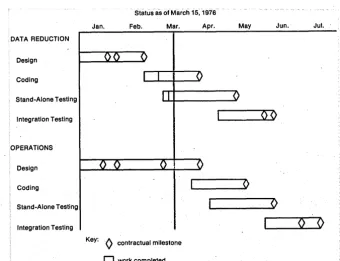
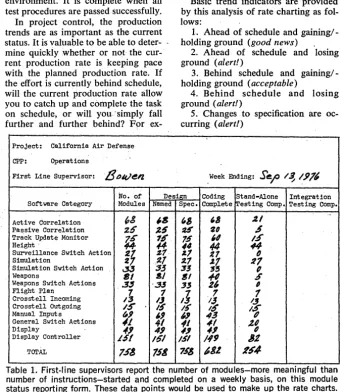
44 RATE CHARTING
Terry R. Snyder. An impor-tant tool for alerting man-agers to production trends and potential problems.
48
MANAGING ASOFT-WARE EMERGENCY
David Elliot Shaw. Steal what's needed, exploit ab-surd alternatives, and waste the proper resources.
o ~TI=1 1.·1 PoTI D N
~< " ' <
r.,
~
I
~
51 A LOOK AT SOFTWARE MAINTENANCE
Chester C. Liu. Maintenance doesn't have to be a Hsecond class" dp activity.
61
DP SALARY SURVEYR. A. McLaughrin. Your mother was right; you shou Id have been a doctor.
NEWS IN PERSPECTIVE
136 ITEL ANNOUNCES THE 360/370
This time the idea is to unplug the peripherals and re-move the cpu.
138 COMMUNICATIONS
Some opponents are skeptical over Bell's motives even after thr~e days of hearings on the subject.
144
TRADE SECRETSIBM's use of trade secrets allegations may be challenged in West Coast cases.
146 CREDIT CHECKING
An unsophisticated computer crime.
149 RETAILING
Poi nt-of-Sa Ie: retailers are getting there. 0 Universal vendor marking is not quite universal but it's coming.
DEPARTM ENTS
7 LETTERS
Brandon's ups and downs, Transactional Analysis vs. Transcendental Meditation, another tale out of school.
13 PEOPLE
William Hoover: he's done everything; Gerry Fisher: pro-fessionalism and politics; others in new posts.
17
LOOK AHEAD22
CALENDARMidwinter meetings, a look at the ACM, and papers wanted.
27
SOURCE DATAReports and references (computer abuse, interactive computing, dp solutions, etc.); vendor literature, courses.
86 IS DECENTRALIZATION INEVITABLE?
Frank V. Wagner. Large centralized computers are no longer the most cost effective.
102 CONVERTING A MAXI PACKAGE TO A MINI SYSTEM
Jean Francois. A researcher, a programmer, a summer-time student employee, and 50,000 FORTRAN instruc-tions.
105 FACTORY MANAGEMENT ON A < MINI
Sam Cogar. It's amazi ng what you can do if you don't know any better.
121 BOOK SUPPLEMENT
Joel Aron on Kernighan and Plauger, Granholm on the "Encyclopedia of Computer Science," Hicks on Mc-Cracken and Yourdon, Greenroyd on managers, and more.
197 THE FORUM
Herbert J. Bernstein. There are some excellent services to users that can keep them coming to "that obsolete computing center."
154 LITIGATION
The Catamore case: somewhat like Telex?
156 MEMORIES
EM&M's commitment to users.
159 EFTS
There's considerable opposition but a lot of progress.
162
APPLICATIONSThe French skipper who sailed across the sea with help from a computer system.
164 BENCHMARKS
. Third quarter; Amdahl reports; New gag order; Transfer . complete; In at McDonald's; Datapoint acquisition;
Com-puter services growth; Not a time-sharing company.
176
HARDWAREVarian's new mini line will attempt to further its share of the scientific/real-time market sector.
184
SOFTWAREA new programming methodology by one of the acknowl-edged giants in the field. Also, intelligent dumps.
190 MARKETPLACE
194 ADVERTISERS' INDEX
About the- Cover
4
DRTRMRTION.
EDITORIAL STAFF Editor
Articles Editor International Editor European Editor Products Editor Source Data Editor Calendar Editor News Editor Bureau Manager.
San Francisco Los Angeles. New York New England Washington, D.C. Correspondents
Minneapolis Southwest Australia Editorial Advisor Technical Advisor Contributing Editors
EDITORIAL OFFICES
John L. Kirkley . Richard A. McLaughlin
Angeline Pantages Nancy Foy Michael Cashman Daniel P. Schlosky Gloria Tldstrand Tom McCusker Edward K. Yasakl Edith D. Myers Angeline Pantages W. David Gardner Linda J. Flato James K. Johnson Robert F. Alexander Ken McGregor Robert L. Patrick Lowell Amdahl Paul Armer, Howard Bromberg, Philip H. Dom, Louis B. Marienthal, Carl Reynolds . F. G. Withington
Headquarters: 1801 S. La Cienega Blvd., Los An~ geles, CA 90035. Phone (213) 559-5111. Eastern: 35 Mason St., GreenWich, CT 06830, (203) 661-5400. 6605 Burlington PI., Springfield, VA 22152, (703) 569-3383. Southwestern: 2711 Cedar Springs, Dallas, TX 75201. (214) 744-0161. Western: 2680 Bayshore Frontage Rd., Suite 401, Mountain View, CA 94043, (415) 965-8222. Foreign: 8 Pellerin Rd., London N. 16; (01) 249-1177; 24 Stafford Road, Artarmon, Sydney, NSW 2064, Australia, 41-5748.
GRAPHIC DESIGN a PRODUCTION .' Art a Production
Director Advertising Production Manager Production Assistant CIRCULATION
Cleve .Marle Boutell Marilee Pitman Alberta R. Martin
35 Mason Street, Greenwich, CT 06830 Circulation Manager Suzanne A. Ryan Marketing Re •• arch
Manager Publisher A.sl.tant Publlsh.r Circulation audited
Deborah Dwelley James M. Morrla F. Douglas De Carlo by Business Publications
Audit
-Member
Y:lABP
American Business Press, Inc.
DATAMATION la
pub-1
4 ...
1 Iished monthly ·on orIf!'
about the first day of every month by Tech-nical Publishing Company, 1301 South Grove Ave., Barrington, Illinois 60010; Arthur L. Rice, Jr., Chairman of the Board; James B. Tafel, President; Gardner F. Landon, Executive Vice President. Executive, Circulation and Advertising offices, 35 Mason Street, Greenwich, CT 06830, (203) 661-5400. Editorial offices, 1801 S. La Clenega Blvd., Los Angeles. CA 90035. Published at Chicago, III. DATAMATION Is circulated without charge by name and title to certain qualified Individuals In the United States .and Canada who are employed by companies involved with automatic information handling equipment. Available to others by sub-scription at the rate of $24. Reduced rate for qualified students, $14. Foreign subscriptions are available for £20.00 or for the equivalent of $40 U.S. in most West European currencies. Sole agent for all subscriptions outside the U.S.A. and Canada is J. B. Tratsart, Ltd. 154 A Greenford Road, Harrow, Middlesex HA13QT, England. No subscription agency is authorized by us to solicit or take orders for subscriptions. Controlled circu-lations paid at Columbus, OH and Form 3579 to be sent to Technical Publishing Company, P.O. Box 2000, GreenWich, CT 06830. © Copyright 1976 Technical Publishing Company. ® "Datamation" registered trademark of Technical Publishing Company. Microfilm copies of DATAMATION .may be obtained from University Microfilms, A Xerox Company, 300 No. Zeeb Road, Ann Arbor, Michi-gan 48106. Printed by Beslow Associates, Inc.This computer is
simultaneously handling
20 interactive foreground jobs,
16 batch background jobs, and
2 printer spooling jobs,
while talking with a large mainframe
and
4
other computers
like itself.
Of course, at $99,600
it's one of our more expensive models.
November, 1976
The computer is Sy FA.
The creator is ComputerAutomation.
And the way it can handle your own specific distributed data
processing problems is another price/performance story in itself.
;-For the complete, unabridged Sy FA story, write:
ComputerAutomation, Commercial Systems Division,
18651 Von Karman, Irvine, California 92713.
ComputerAutomation
Commercial Systems Division
"We'll 'sell
you,
the best, lowest
priced 132-column
, printer'
, ilable
a
"re!'
Bob Howard, President, Centronics
But the low initial
price for the Centronics 700 Series
132-column printer isn't the whole story.
It's the lower cost of ownership based on the 700's
inherent reliability and simplified construction.
The 700's unique modular construction using four different modules
-print-ing, electronics, forms handling and keyboard - and less moving parts mean easier
maintenance, lower cost and a smaller spares inventory.
Write for the full details of this tremendous offer . . . and infonnation on the
rest of the printers and teleprinters in the new Centronics 700 Series.
Centronics means more than low price.
And more than hardware. It's the widest range of models, features, options
• Financially strong· Proven delivery response • Over 70,000 printers installed • 109
world-wide sales/service locations • Stringent quality control· Advanced R&D and
manufacturing • Long-term spare parts. availability • Customizing for specific needs.
,:I:EnTROnII:S®
IS PRinTERS
Centronics Data Computer Corp., Hudson, N.H. 03051, Tel. (603) 883·0111, Twx. 710·228-6505, Tlx. 94·3404; Eastern Region: (617) 272-8545 (MA); Central Region: (513) 294-0070, Twx. 810-459·1784 (OH); Western Region: (714) 979-6650, Twx. 910-595-1925 (CA) Centronics Data Computer (Canada) Ltd., Ontario, Tel. (603) 883-0111 ,Twx.
710-228-6505; Centronics Data Computer (UK) Ltd., Cheam, Surrey, England, Tel. 643 0821-4, Tlx. 851945756; Centronics Data Computer, GmbH, 6 Frankfurt/Main.,
West Ge~any, Tel. 663321/22, Tlx. 841 413224; Centronics of Puerto Rico, Dorado, Puerto Rico, Tel. (809) 796-1881. Tlx. 3859349
letters
A co-rporate misunderstanding?
As a stockholder of Brandon Applied
Systems Inc., I was amazed to read
Mr. Arnold Palley's letter in your June issue (p. 188). In it he stated that since Dick Brandon, founder and former chairman, resigned from the company, it has been "vigorous" and is "alive and well."
I would prefer to believe the
com-pany's auditors who, in their recently released annual report state: "The company has sustained substantial op-erating losses during the year which have resulted in a negative consoli-dated working capital position and substantial elimination of stockholders' equity." " . . . the continuation of the Company's operations and the realiza-tion of its assets (primarily accounts and unbilled receivables on contracts in progress) are contingent upon its ability to generate sufficient financial resources and to resume profitable op-erations. "
Many companies fell victim to the recession of the early 1970s, and the acquisition of Rand Teleprocessing gave BAS the necessary financial shot-in-the-arm to keep it alive, with the subsequent increase in revenues from $2,000,000 to $7,000,000 and -growth to 200 employees. But in noting the upswing, Mr. Palley forgot to give
credit to the operating abilities of Mr~
Brandon which caused this turn-around. Nor did he mention that fol-lowing the resignation of Mr. Brandon, the key figures of Messrs. Bob London, Ed Klein, and Mike O'Reilly decided to follow suit. Was that another mis-understanding?
J. R. RADLEY
New York, New York
Mr. Arnold D. Palley, President of Brandon Applied Systems Inc., San Francisco, replies: We stand by our original statement that our company is "alive, well, and vigorous." We are currently in a hiring mode, and our fi-nancial report just submitted to the Securities and Exchange Commission shows earnings of over $300,000 for the six month period ending in August.
COBOL
vs.
APLI wish to comment on Mr. Lurie's let-ter in the July issue (p. 8). I think he is doing" the COBOL programming com-munity an injustice. As a user of both COBOL and APL, I can make the follow-ing points:
1. Most COBOL programmers are not operating in an interactive environ-ment. A batch environment forces more work to be done off-line (with
flowcharts and program listings) than on-line due to the long turnaround time that a batch job may have. At this :level -of computer access, every run counts!
2. Users of time-sharing systems such as the DEcsystem-l0 (myself in-cluded) have an interactive COBOL available. Such users can spend more time on-line, and can use the machine as a debugging aid to a greater extent. Therefore, they can often get more than the quoted 11 lines per hour. In addition, their program editing facili-ties are often far more advanced than the editing feature in APL.
3. A,PL is a poor language for the precise capabilities that COBOL excels
in. Many important functions for
a
business program which are primitive to COBOL are absent in APL. Report generation, alphanumeric sorting,
for-matted 1/0, and ISAM-type access to
large data bases, are operations which are "built into" COBOL, but would have involved and complicated functions written for them in APL that- would still not run as efficiently as they would in COBOL.
4. Development costs include debug-ging costs. Debugdebug-ging on an interac-tive system with existing advanced
de-bugging facilities is easier than _
ging in APL. Especially when debug-ging someone else's programs, it is much easier to debug COBOL than APL programs.
5. Finally, production costs of run-ning a COBOL program as opposed to an APL program are less due to the efficient object code generated by the COBOL compiler, while APL grinds as an interpreter.
APL is a nice language when used as a programmable calculator. Similarly, COBOL is best for large business data base crunching. Neither is very good for the other's type of usage. Let us recognize this rather than try to have the seminationalistic banner of abso .. lute superiority of one over the other! MARK R. CRISPIN
Systems Programmer MIT Arti/icialIntelligence Laboratory Cambridge, Massachusetts
Try this on your CE
For your humorous information, I re-iate the following true story.
The Washington Dept. of Human Resources owns an IBM 370/145. On July 21 at 11 p.m., the cpu logged out 48 hard machine checks within a 21/2 hour period. Then, for two weeks: nothing. On Monday, August 2, they came back with a vengeance.
Everyone has heard of .the old joke about the customer leaning over the customer engineer's shoulder (who is wrestling with a knotty cpu prob-lem)-"Think you got a mouse run-ning around in there?" Well, by
Satur-day August 7, this was no longer just an old joke. We actually had a mouse attempting to build a nest inside the cpu-specifically, inside the A-gate.
She had chewed the plastic coating off tri-Ieads exposing bare wires, dragged in fuzz and paper for nesting materials, and distributed her little pel-lets everywhere. Worse-uric acid eats gold. Total damage-41 tri-Ieads and 1 MST board.
SUSAN E. MITCHELL
Systems Programmer Department of Human Resources Washington, D.C.
A Maxi·Tale
Mr. Raskin's letter. ("A Mini Tale," August p. 8) sounds a familiar note. I'd like to tell a Maxi Tale from here at UW-Madison. Seems that during slim-mer 1975, somebody decided to bring computer power to the people, espe-cially undergrads without research ac-counts. Some modems were hung on a mini, and terminals installed at the center, at library locations, and at the dorms, including' mine. For some ob-scure reason, this mini was a front end to the computer center's 2 x 2 (when-fully up) B-ll10, rather than a stand-alone with perhaps a disc drive. The teaching staff was .encouraged to place pedagogical programs on the system.
Came the opening of semester. The operation happened in true, first class computer center style. First the student had to wait for the previous user to clear the terminal-up to half an hour. Then an additional, random wait was provided by the wizards-the number of (dial-up) ports was substantially less than the number of terminals. The equipment had the reliability of Canal Street sidewalk-stall surplus-on occa-sion it would just sit there inertly, or, worse, spontaneously hang _ up and provide another long, random wait. And when all other hurdles were passed, there was always the possibility of having the session's work consigned to oblivion by a system crash.
Needless to say, the primary initial use of the system was to play Startrek while the washing machine did its thing. At least until this was discov .. ered, and Startrek (the official copy, anyway) was deleted.
Around midsemester it was decided that the usage of this system was "overloading the center" - (!! !-any-body from our center want to run benchmarks against an Altair 8080?) -and the terminals were closed dur-ing weekday business hours. One must wonder how those who came in on
bus lines that _ only got you here for
letters
next semester.
It is, of course, difficult to run pro-grams on a medium consisting entirely of reasonable explanations. By the end of the semester, the terminal in my building had definitely not caught on. Under the circumstances, and with sophisticated calculators available at a store across the street, how could it? What the computer center buffs have lost track of as they busied them-selves with lousing up the system and
TA, TM, or .•.
Mr. Kirkley's article "You're OK, But I'm Still the Boss" (Augustp. 58) was an interesting summary of the latest and most popular new approach to understanding human behavior and applying the techniques to organiza-. tional relationshipsorganiza-.
Certainly T A, or any other tech-nique that can offer creative solutions to problems, is welcome. But I feel that the reason stated in the article for the need for TA is erroneous. Mr. Kirkley refers in several places to the' needs of employees for "job satisfac-tion." Reference was also made to Studs Terkel and his thoughts on em-ployees searching for a greater mean-ing. All these references indicate that it is the job or the working environ-ment that causes the problems or needs.
I contend that modern theories of organization do not restrict them-selves to the idea of "job satisfaction" as the only, or even main, criterion for motivating and understanding em-ployees' needs. For example, Charles F. McDermid in "How Money Moti-vates M'en" has suggested that money could be used to help satisfy all the need levels in Abraham Maslow's classic hierarchy of needs theory.
pointing out the hidden costs of 3 a.m. unpaid fixit sessions on the minis, is the' condition of their own backyard. Ei-ther on batch or on terminal, the typi-cal student has to contend' with min-utes to hours of guff -standing on line, waiting for a port, waiting for glacially slow interactive response, often ap-proaching five minutes fpr some trivial operation-for the use of a second or two of cpu, much of which is over-head. And the researcher watching the budget winds up with turnaround of many days and routine owl sessions at the terminal, for the sake of nighttime and convenience rates.
George Strauss' in discussing "The Personality vs. Organization. The-ory," suggested that it is erroneous to assume that workers seek to satisfy their esteem and self-actualization needs on the job. Many people find enough satisfaction in raising a fami-ly, participating in community proj-ects, or passing the time with a hob-by. Certainly TA is a means of identi-fying these tangible and off-the-job motivators. But to consider the job as the whole basis for behavior, in my opinion, is a false assumption.
Despite this minor criticism, it is good to see this type of article in your publication ....
HAROLD S. MALEN
Systems Staff Analyst Allstate Insurance Company Northbrook, Illinois
Being responsible for a multimil-lion dollar financial system and the people who run it, I have been searching for effective ways to solve the "people problems" just as dis-cussed in John Kirkley's article, "You're OK, But I'm Still the Boss." In my search, I completed a one year training in Transactional Analysis at a cost of over $1,000, and I learned
Let's see what my incentives chart says for today .... there's a friendly clap on the back for Johnson ... share a joke with Gleeson ...
© DATAMATION II
8
_ Meanwhile, administration sees a computer center clogged with traffic, with lots of queues, and they are there-fore happy.
In summary, what the typical small to medium user sees at the center is a machine that approximates an Altair 8080 clocked by a rusty 10-kHz crys.;. tal, with the power line periodically disconnected and run over a rasp sol-dered to B+. This is why we have a central computer committee to "bal-ance central and distributed comput-ing;' (see Science, 6 August 1976, p. 472)-Le., in the opinion of many
(Continued on page 188)
Transcendental Meditation a few years back at $125 .. There is no ques:.. tion that TM is by far the better buy! I did find TA very fascinating as a model of human behavior and useful in daily' life. Despite the apparent simplicity of the language and basic concepts, TA is more, complex and technical than an initial encounter might convey. Also, as pointed out in the article, the immediate insights . gained usually do not have a lasting effect. My experience indicates that it takes a lot of time, effort, and money for' proper therapy and training to root out long ingrained behaviors, scripts, and game patterns which of-ten make life miserable.
By contrast, TM was learned very easily, worked . from the start, and is becoming increasingly effective day after day. This effectiveness is not just my personal experience, but is objectively demonstrated through hard scientific research in many uni-versities and medical facilities here and overseas. I found the $125 fee negligible considering what the TM technique did for me. It dissolves the stress, tension, and frustration which accumulates in this hectic life. Even better, it makes one increasingly re-sistant to stress. .
These kinds of benefits certainly remove many obstacles to effective management. They also provide an excellent basis for using T A-just be-cause feeling OK and being energetic makes it so much easier to under-stand and change old non-productive behavioral patterns. TM is also a po-tent mental technique ....
A number of small and medium sized companies already pay for their employees to learn TM because the cost is modest and productivity goes up-nothing metaphysical, just cost-effective ....
F. G. SAUER F~rd Parts and Service Division Ford Motor Company Dearborn, Michigan
Jacquard's J1 00 Videocomputer is the best of both worlds. California creativity resulted in balanced
hard-ware and softhard-ware with a
cost!
powerratio and flexibility you can't get any-where else. Interscan Data Systems and their conservative Briti"sh cus-tomers proved the J100 in use. Ax for congested mainframes. The data-base management and communi-cations capabilities of the J 100 make it ideal for distributed processing. Individual units of large DP networks . can use the power of the J 100 to
bring direct control to their operations. J100 stand-alone capabilities stand alone. You can enter orders, run a payroll and write a new program at the
same time on J1 OO's CRT terminal-oriented, real time, mUlti-tasking operating system. And each user has full power available.·
Software is the key. The heart of Jacquard's flexibility lies in its unique software. In addition to a time sharing operating system, we've designed an extended BASIC compiler which generates re-entrant code for efficient use of memory and fast running pro-grams. Our keyed-indexed file handling results in very fast response to inquiries, regardless of file size . A comprehensive range of software tools, operating systems, languages, communications emulators and over 60 utilities are available.
Check the specs. Then write for our brochure. The best of both worlds, at the best price.
SPECIFICATION CHART
J100 Processor:
16 bit word, up to 128K bytes, DMA, APL, Power Fail Auto Restart, Real Time Clock, 1920 ch CRT and Keyboard, built in Floppy Disks. Peripherals:
Up to 30 satellite CRTs, 5 Megabyte Cartridge Disks and 80 Megabyte Drives, 800 and 1600 BPI Tape Drives, Multiple Printers: 30cpsto900 Ipm, Async/Bisync communications. All software supported, available now.
.
Jacquard
)100.
British conservatislD proved
our California creativity.
Manufactured by
JACQUARD
SYSTEMS
2502 Broadway Santa Monica, CA 90404 (213) 829-3493 TWX (910) 343-6967
Distribution in North, Central
& South America, Japan.
Distributors Please write Jacquard Systems
~rnl"
,I
,I
i
[
:'..
i :In",., :,.,
I i ;I t J ,
I
i ! L'
lJJ
INTERSCAN
DATA SYSTEMS
(UK) LID.
Hoechst House ..
Salisbury Road Hounslow, Middlesex 01-572-2871 TWX 851-934-135
Distribution in Europe, Africa
& Australasia
10
It wasn't easy, but we did it. We took IBM's best concepts-and improved them.
The result is the all-Itel Advanced System. The computer system that not only gives you everything its IBM counterpart does (in. some cases,
even more), but gives it to you at an enormous sa\{ings. A savings so significant that it makes the Advanced System the absolute number one price performer on the market today.
Still, we couldn't have done it alone. Not without the dramatic advances made by the semi-conductor industry. Advances. that allowed us to build a more
reliable, more powerful CPU using about half the components of its IBM counterpart. Which means our Advanced System runs approxi-mately 10 degrees cooler, doubling the reliability of its integrated circuits.
Moreover, the Advanced System comes complete (including a 180 cps printer. not shown). No optional "special features" that wind up costing almost as much as the original system itself.
To prevent obsolescence (and
protect your investment), all of our Advanced System models can be either upgraded or downgraded-as the situation demands.
It's this kind of all-out creative effort that has put us right up there with IBM. Not only in total computer capability. But in systems and software. In computer peripherals. In field engineering. In financial packaging.
When it comes to experience and reputation, it's either us. Or IBM.
And when it comes to price/ performance, there's only our Advanced System.
Itel. The only sensible alternative.
ITEL
CORPORATlON
Data Products Group
One Embarcadero Center. - San Francisco. California 94111
!:
",
\;,<';<:,
, ~:I
""' ... '
. ;;
\ '
",'
' f
\ (
"1: ... ,
"
., r' I"~ ~' ". ! 1 ;'." .... r:
~~ r~ ~": L1 ~,~ ,: 1
tj
U ~~~ J . ~ ~ . ~; \ /:
[,
Informatics . .. rhe \~'o((1 is synonymous ihrouoilOu! the world with the ultirnate in modern data procGs::,in!!, In the
United States and marlY oUI(:j' COUl1i,'ic::::, it rn(:c1ns thc; people, procJucts and services cf Informatics Inc. One part of Uw Informatics' famil'y' .. ' PHODUCT10i\! IV ,
,I
rnodul2r. integ!ated software system for rnamif,\ctllr'inq 1l1<llliJeJtJrili:;rlt.to ~;lJpport master schedulirl(1, rn~1!f.~ri2! c\W '
;~~li)(]cit\/ i'(~
qui r c:: rl1 Cfl t~; p! :Jrl n i n~J. rcs() u (CC pI ar i f"1 i n ~l. ~;flC) P flc/c) r cin d cost control, purchasinq and invHltoty f'nanaC]Gment.
• I' • • • • • . . _ . . .
liiiUiiiidliC.~i iih", lilt.: VVUlilJ::.i i~;dUIII~l l:iU'_:!.il:ilUt:r:l ~-;uii\'/ar(}
supplier', with ovc;r 2,O()() in~;tallation~~ in <12 countt'ies ...
helping to fulfill the computer's promise.
: I
, r
Ii U
I:
I' II
0nrTIAIII n r nnr\l',,\III"T0
Jur I VVf~I\L r I\uuu\.J I ,)
PROFESSiOfUIL SERVICES i f'-IFDHrv1f1TION PfWCESSI NG SERVI CES
[ ' ('\ i
hi
I:, I,
II
~~~
I! '
.
~r:
ul
Corporate Offices/~-I 03'1 Veniur'-l Bou!m'tlrd/V}oodland I-nils, Californio 913641 (213} 387-904,0/ Telex 69-8473
people
The Manager
esc
Wanted
Near the mid-'60s, the two co-founders of Computer Sciences Corp., Fletcher Iones and Roy Nutt, decided that nei-ther was a very great manager-at least of the stature of someone who could run a fast-growing high technol-ogy company whose only product was brains. They had in mind a young manager of computer data systems at Cal Tech's Jet Propulsion Laboratory
in Pasadena by the name of William
Hoover.
Hoover had joined JPL after getting
a B.S. and M.s. in mathematics from the Univ. of Utah. In his 10 years at
JPL he had directed the implementation
of advanced computer systems, includ-ing the first multiprocessor for com-mand and control of unmanned space-craft. A contractor on some of the
projects was Computer Sciences Corp.~
of Los Angeles, a fast growing compa-ny providing computer and communi-cations services to most major main-framers and to advanced government-sponsored projects.
At the age of 34, Hoover, now 46, joined csc in 1964 as manager of the .Los Angeles Div. when the company was doing about $4 million a year. Since then the company revenues, de-spite serious financial problems, have soared past the $200 million a year mark (in its F.Y. 1976 ended last April 2). That was an increase of 24% over the previous year and its profits
dou-bled to more than $7 million. It has
7,000 employees, three-quarters of which are professional people. And the company, which began as a developer of operating systems, compilers and utility software for such mainframers as IBM, Philco, Univac and Philips,
systematically has expanded into sys-tems engineering and analysis, com-munications engineering, facilities management and the development of turnkey operational computer-com-munications systems . . . along with such also-rans as Computicket, a reser-vations system which it wfote off in
1970, and the New York off-track bet-ting system which also bombed in the early '70s.
But its most exciting venture was Infonet, an ambitious network services offering which it began building in 1970 and which nearly died a thou-sand deaths before it became profitable
in 1974. The network today, with some 3,000 users in industry and gov-ernment, contributes to 22 % of the company's gross revenue and to half of its profits. Productivity per person is $73,000, a remarkable figure when compared with such other industries as manufacturing, $50,000 to $60,000,
and $28,000 in the CPA field. The
net-work owes a considerable amount of its credibility to a huge order in 1972 from the General Services Administra-tion in which government agencies were required to use the Infonet ser-vice for network processing. But today, at $30 million a year, it represents a healthy but much smaller proportion of Infonet's total revenues of more than $50 million.
Hoover, who's been chairman and chief executive officer since Fletcher
WILLIAM R. HOOVER
"He's done everything"
Jones' death in aprivate airplane crash in the fall of 1972, says the company at present has no plans to launch an-other major undertaking the extent of Infonet. He says that csc will build on what it now has and he describes what it now has as "the strongest technical
team
in
computer andcommunica-tions in the world, outside of computer and communications manufacturers." Sitting in a huge but unpretentious office in the company's Los Angeles headquarters, Hoover rattles off the . company's accomplishments, from the ". day when it began in 1959 providing programming and related services to mainframers, to its many government and industry contracts providing com-puter and communications services in space exploration and missile projects, to Infonet, to its aCtivities in facilities management. "Facilities management is a growth area," he says, noting that the company now provides the data processing rvanagement and functions for Orange County in California, Price County in Washington, and the cities of Torrance, Calif., Newark and Cleve-land, and has bids on several other
local and county government offices. "We go after the major programs," says Hoover. To do this, the company has had to build a vast resource of technical competence. "We constantly are on a search and quest for technical excellence." Hoover says, though, that it isn't all that difficult. "First, we al-ready have high caliber people and high caliber people attract others of high caliber. When recruiting in the schools, we look for the top students. Second, we provide them with a career path in computing," something that isn't always available in such businesses as banking, government and insurance where data processing is in heavy use, . but is not their primary business.
He travels constantly. Getting new business is the name of the game, says Hoover, who supports the efforts of his people in signing up new accounts and in hand-holding others. "My technical background is useful in such endeav-ors," he says, adding that "in the high technology business, managers are ex-pected to be able to address, and some-times lead in, all aspects of technical questions." But he's also amazed his financial people with his grasp of fi-nancial problems, having had no for-mal financial or management training.
The company's stock has been hov-ering at about $6 for some three years, due to many factors, one of which was the company's huge bank debt that had soared to close to $30 million in 1972. Hoover has chopped away at that debt, raising stockholder equity and working capital. Last July he prepaid a $1.5 million bank installment due in September, leaving bank debt at $3 million which might be paid this year. Increased working capital, which rose 31 % in its last fiscal year to $30.9 million, is allowing the firm to acceler-ate its expansion. For example, the Infonet division has boosted its mar-keting staff 20%, primarily in the gov-ernment market.
Says corporate vice president Roy Nutt: "We found in· Hoover many years ago a man who understood the whole problem, something which is unique in the programming business. He had it and he was smart."
Hoover was elected to the csc board in 1968, was named executive vice president the following year, and nine months later became president. He added Jones' title of chairman and chief executive officer in 1972.
"Fletcher Iones and I agreed that neither of us was a great manager," recalls Nutt. "Jones was a promoter and I could manage small technical groups," explains Nutt who is recog-nized as csc's-and in some circles the world's-computer programming genius."
people
Professionalism
and Politics
Last month the British Computer So-· ciety installed a new president who is a computer user, a Scot, a politician and an antique collector.
Gerry Fisher started his life at Proc-tor & Gamble in industrial engineering, which he calls "the best training in the world." He says: "I learned there that an attitude of mind to method study was more important than anything else-and that's true of systems analy-sis as well. That means we should be concerned not only with how to do what we're doing, but also working out what we ought to be doing."
Fisher believes the British Computer Society should work to improve the
GERRY FISHER A political animal since birth.
Level of professionalism of people with-in the with-industry with-in general and BCS
members in particular. Like itsl new president, the BCS has a mixed back-ground. Most other countries have separate computer societies for the sci-entific academic and user communi-ties. As Fisher tells it: "BCS started as a
mix between a learned society and a cooperative self-help group. In London in the early days, one group met to talk about problems with these damned new machines, and the other talked about Fourier analyses and theoretical program thinking. Somehow they amalgamated, and that amalgamation gives it strength and a unique span of interests." With 22,000 members now, the society is presently organized through four boards (technical, mem-bership, education, and branches) . The technical board currently is study-ing software portability in order to prepare a submission to the European Economic Community (EEC) group
14
which is studying the subject. "There's no doubt that the people who are in-terested in this issue should be users," says Fisher. "The vendors are obvious-ly less interested."
One theme for his term of office will be "people." He says: "It's an oddity of our business-we're the only one I can think of that is dominated by the sell-ers, not by the buyers. The hardware boys are getting about 20 to 35% of our budgets now, and the software boys are still under 5 %. Almost all the rest is people costs, for analysts, pro-grammers, operators, data prep people.
If you look at all our discussion points, you find they mainly revolve around the hardware or software-the subjects hardware and software men talk about. One reason for the imbalance is that users only have individual views, and, in the vast majority of cases or issues, they don't come together to force ac-ceptance of their individual views. So user groups and even bodies like the
BCS are not as representative as· they could be, because a lot of users say they can't afford the time. The· net result is that they waste time doing the same things· they've been doing for 20 years, under the influence of the sellers of their hardware and software." He believes the BCS can redress the
imbal-ance a little by such activities as its portability study, and by pushing its views more firmly in government areas. This kind of thinking comes easily to Gerry Fisher, who has been a politi-cal animal since his birth 46 years ago on Scotland's west coast at Ayrshire. "We moved to Glasgow the Friday night before war was declared, when everyone else was moving out," he says. "That's the sort of family we were."
He was educated in Scottish public schools "which are like American pub-lic schools-publi<>-unlike English public schools which are private," he explains. Then, at Glasgow University, he polished up his argumentative style on the debating team and became a member of the Student Representative Council. He already was speaking for Liberal, Scottish Nationalist, and Home Rule candidates.
Following service in the Royal Air
In New Posts
PHIL CLEVELAND and JAMES C. FOSBERG were promoted to senior vice president posts by Microdata Corp., Irvine, Calif. . . . RICHARD C. FURNIV AL, former vice president of operations at Datran, joined Telenet Communications in the same capacity . . . ALLAN KARSON was elected vice president, marketing for Timeplex Inc., Hackensack, N.J . . . . ROBERT H. SOMMERS was appointed vice
Force, his life settled down. Proctor &
Gamble and later Wall's ice cream company absorbed much of his con-siderable energy. He became computer manager at Walls in 1961, spent a year at Plessey, and moved to Associated British Foods in 1968, where he is now head of management services, coordi-nating a decentralized group of com-puter-using companies with ICL,
Bur-roughs and Univac equipment.
Politics became a focus in his life again in 1967 when the Scottish Na-tionalist Party won its first seat in Brit-ain's Parliament. It since has increased this representation to eleven seats and hopes for more. Fisher is an active campaigner for the party, organizing, canvassing and debating.
How does he manage· to find time for a full-time job, the BCS (which
already takes at least 12 hours a week), and politics as well? He sees no problems. "I wear a number of hats, and some of the things I do are contig-uous," he says. "My first task is to help my employer do an efficient job in computer services. Such things as the
BCS involvement with the EEC on the
portability of software have long-term but very valuable relevance to the budgets of computing departments of every user, including ABF. On the other
hand, my political activities have no relevance to the BCS or ABF. That's a
third hat, to be fitted in as and when possible. "
Fisher came to his Bes post the' hard way. He was elected treasurer in 1972 when the society suffered difficult bud-get problems. Most members give him
more credit then he would claim for the thankless task of tightening the purse-strings and sorting things out. Today the Bes he presides over is financially sound and more active than ever.
Gerry Fisher still finds time to climb mountains in the north with his wife and three daughters, and to browse through antique stalls for an elusive mustard spoon or two to round out his collection. He bargains for mustard spoons with the same energy and en-thusiasm he pours into distributed computing, electioneering, or Bes pro-fessionalism issues.
president marketing support for Infor-matics System Products organization . . . THOMAS T. ~HARDING joined Interdata, Inc., Oceanport, N.J., as vice president, marketing and sales ... ROBERT R: GOERNER joined Cour-ier Terminal Systems, Inc., Phoenix, as associate marketing director for the company's 270 information display system ... EARL R. GATES was ap-pointed. division systems manager for GTE Data Services' Everett, Wash. data center. . :0
Which
way
is
up?
In business data processing,
it depends on who you
ask.
As corporate data bases grow
ever larger, many data
processing managers are
striving to free central
computer processing capacity
for use in exploiting the
opportunities a larger data
base presents. As you'd expect,
each hardware manufacturer
proposes a different solution to
this workload reduction
problem.
At Four-Phase, we believe the
most promising solution to be
distributed processing . ..
maintaining local records
locally and passing only data
necessary to corporate
plamling and control upward to
the central computer. We've
been building distributed
processing networks since
1969, and our product line is
designed to permit their
implementation in a planned
sequence of rational,
cost-efficient steps.
This sequence begins with the
replacement of existing IBM
3270 displays, keypunches or
remote batch terminals with
compatible Four-Phase.
systems at a few key sites. On
these pilot installations,
field-proven software speeds
the implementation of local
transaction processing, local
data base management, report
generation and communication
with the central computer.
Production systems are then·
installed at the remaining
network locations. Because the
Four-Phase product line is
hierarchical in organization,
each distributed processing
site can be equipped with a
system configured to its precise
workload and communications
requirements.
Once the basic distributed
processing network is on-line,
a stratified network structure
(with geographically
distributed files and display
access at branch, district and
regional offices) is slowly
evolved to "tune" operations
to measured processing and
communications volume.
Thus the network evolves
along an orderly growth path
... a process made possible
by Four-Phase hardware,
software, systems engineering
and maintenance support
developed and proven over
seven years for the present era .
of distributed processing. For
further information, contact
your local Four-Phase office or
Four-Phase Systems
19333 Valleo Parkway
Cupertino, CA 95014
408-255-0900
Introducingthe data sy'stem for people
.
who know how hard it is
t6 get
a data
system up and running.
Anyone who's ever put in a data system will tell you
how hard it is to get it up and running. And how expensive.
But it doesn't have to be that way anymore. Because
Data General has developed a new interactive data entry
and access system that's a lot easier to work with. Which
makes your programmers more productive.
The ECLIPSE Idea system.
The Idea system has screen formatting and a data
access/retrieval capability that's hard to believe. Because
it's incredibly easy and economical to get it up and running.
What makes it possible is the Idea software. It's so
powerful and easy to use, you <;an probably do interactive
screen formatting and Idea compiling the day the system is
installed.
And you won't have to worry about multi terminal
control. Because the software to handle up to 16 terminals
is already written. For single applications. Or for as many
applica~ions
as there are terminals.
.
The Idea software is designed to work with INFOS (our
data management software ).It's so powerful that all your
users can get at the same data at the same time. And so
easy to use that they can access data records even
ifthey
know only half a reference.
And you won't have to worry about a lot of duplicate
data. Because INFOS is designed to provide a single source
of information that's always up to the minute.
Also, Idea software runs on our new ECLIPSE C/330 and
C/300 commercial computers. They have just what's
needed to keep all your users' information up to the minute.
Because they run the Real-time Disc Operating System that
controls multiterminal applications concurrently with batch
or telecommunications jobs. And the commercial ECLIPSE
computers include ADD, MOVE, COMPARE and decimal
arithmetic instructions designed specifically for
commer-cial applications.
·With the ECLIPSE C/330 and C/300, you won't have to
worry about compatibility either. Because they come with
large systems languages like IBM-compatible RPG II and
ANSI '74 COBOL implemented at the highest levels. Plus
industry compatible nine-track magnetic tape units and
communications controllers that let you pass data between
. computers.
And because Idea systems come from Data General,
they come with the full support, range of field and systems
services, and financial alternatives only a major computer
manufacturer can offer.
Write for our brochure on the ECLIPSE Idea systems.
It won't tell you anything you don't already know about
how data systems work. But it will tell you about one that'll
take less work.
ECLIPSE Idea systems
~
, Data General
ECLIPSE is a registered trademark of Data General Corporation. INFOS is a trademark of Data General Corporation.Data General, Route
9,
Southboro, Mass.
01772, (617) 485-9100.
Data General (Canada) Ltd., Ontario.
Data General Europe,
15
Rue Le Sueur, Paris
75116,
France. Data General Australia, Melbourne
(03) 82-1361
~~
~
~,,!.: ~~~
LOOK
ArEAD
~""
,""",""
'." .. ~ ".'
THE WE IGBT OF MA BELL
AT&T is no stranger in Washington's world of politicking and influence peddling.
An
old hand at behind the scenes lobbying, the giant communications company has managed
to wangle substantial membership leverage on key federal advisory committees. A
recently released index of 1975 federal advisory committees ranks AT&T and its
affili-ated companies number one in the corporate column, with 130 representatives serving
on various federal committees, boards, commissions, councils and panels. IBM, which
fell considerably behind Bell, came in seventh, with 45 members.
Designed to function as advisory arms to the federal agencies, the 1,267 government committees dole out recommendations in virtually every area of federal policymaking.
Ma Bell's significant membership base on these committees, up more than 36% over 1974
when the company had 95 committee seats, represents a potentially powerful pressure
tool. A likely area in which Bell could apply this squeeze to its advantage would be
on the Consumer Communications Reform Act~ now pending in Congress (p. 138). With
just the right amount of arm twisting through these committees AT&T, government insiders concede, could exert considerable influence on all present and future govern-ment decisionmaking in telecommunications.
SUPERCOMPUTER MARKET CROWDING UP
The onesy, twosy supercomputer market became a little crowded last month when Burroughs
Corp. announced it will offer a supercomputer for delivery at the end of 1978. The
Detroit company said its machine will operate at speeds faster than any competing equipment "believed to be under development."
That would mean it will perform faster than Control Data's array processor, the
STAR, which is being enhanced to operate at 2 to 30 times that of the CDC 7600
(September, p. 168). It also would outperform SeymourCray's Cray-l, described
re-cently by the ERDA's Los Alamos laboratory in New Mexico as being in a class by itself
among supercomputers (Octoher,p. 17). The lab recently completed an evaluation of
Cray's first SOOK 64 bit word machine there and began renting it Oct. 1 on a short term lease of $156,000 a month, pending delivery of another 500K words of memory next
fall. A Fortran compiler is to be delivered in January.
The Burroughs machine had been rumored for more than a year to be under development. Burroughs' previous venture in that market was the Illiac IV of which one was built. It' sgiven a better chance this second try, if it is able to provide extensive software
and thus broaden the supercomputer market beyond the present 90 customers who
tradi-tionally provide their own software development.
UNION WANTS AUTOMATION WITH PROTECTION
A series of one-day strikes hit five Canadian post offices last month in an attempt by the Canadian Union of Postal Workers to call attention to their contention that the post office is implementing a $1 billion automation program without certain protective
mechanisms provided for in a contract signed last December. Among them was retraining.
"We have no objections to automation," said a union spokesman. "We just want it
intro-duced in a way that won't hurt ,our members." By late October the strike was over and the union was waiting for the appointment of a mediator by the Public Service Staff Relations Board. Post offices struck were in Vancouver, British Columbia; St. Johns
and London, Newfoundland; and Ottawa and Muncton, Ontario. "We didn't want to hurt
the public," the spokesman said. Only 4,000 out of the union's 23,000 members actually struck.
EXEMPT VS. NON-EXEMPT REVISITED
Lengthy hearings in December 1971 by the Wages and Hours Div. of the Dept. of Labor
led to'a ruling by the division that programmers are not professionals and thus ,are
not exempt from the overtime provisions of the Fair Labor Standards Act (March '72,
p. 97). DPprofessional societies were vocal at the hearings. Data processing,mana-gers were clamoring to get copies of revisions to Section 541 of the Fair Lahor
Standards Act as published in the Federal Register for Dec. 2, 1971. Theserevisions
provide guidelines as to specific instances wheredp personnel might be considered professional but they do not exempt them as a class.
After a brief flurry, interest died down. But now a case has been published which
may rekindle it. It'sPezzillo vs. GT&E Information Systems in which JudgeClure
Morton of the Federal District Court in Nashville, Tenn~held that nine programmers
LOOK ArEAD
not exercise discretion and independent judgment, and therefore ate not exempt from
the overtime provisions of the Fair Labor Standards Act. The publication Computer
Law and Tax Report has advised employers of programmers to review both the Pezzil10
case and the Labor Dept.'s regulations. GT&E has appealed the Pezzillo decision to
the Sixth Circuit Court of Appeals in Columbus, Ohio.
A TURN ABOUT ON EFT
Undaunted by a Supreme Court decision not to hear electronic funds transfer (EFT)
cases (p. 159) EFT enthusiasts have taken their case to Congress. After several
years of inaction on EFT moratorium measures, the federal legislators have done a
quick about face and have decided to push EFT experimentation. The latest evidence
of this turn about comes from the Senate Financial Institutions Subcommittee which
plans to hold exploratory hearings Dec. 6-8 on the impact of EFT on branching. The
subcommittee plans to come up with its own bill to liberalize the McFadden Act to .allow bank terminal hookups.
Chairman Thomas J. McIntyre, of New Hampshire, also is reported to have urged the
National Commission on Electronic Fund Transfers to speed up its deliberations on the
branching question and to come out with a concrete recommendation by Dec. 1. The
commission, which held hearings on the subject at the end of last month, was originally expected to comment on the branching problem in its interim report to Congress due
Feb. 23. The group's feedback to Congress is expected to be crucial in laying the
groundwork for any bill that's likely to surface next year. One such bill, labeled
the Remote Electronic Facilities Act of 1976, was targeted for introduction last summer by Sen. Adlai E. Stevenson of Illinois but the legislative proposal, reported-. lybrainstormed by former Federal Reserve Board vice-chairman George Wreported-. Mitchell,
never got off the drawing board.
DATA GENERAL-DCC QUESTION MARK
There was one important item that was lost among all the hoopla of Data General's announcement to acquire Digital Computer Controls. The Delaware Supreme Court was on the verge of announcing a verdict in the lengthy and bitter litigatfonbetween the two firms when Data General announced it would pay more than $11 million for DCC. Data General had previously won a Delaware chancery court decision against DCC and if
that decision held up, DCC probably would have been forced into bankruptcy. So, why
the acquisition? It's obviously a good deal for DCC, and Data General can build its
user base too. The move will unquestionably strengthen Data General's marketing
position too. Some saw a parallel in the IBM-Telex settlement reached just before
the U.S. Supreme Court was to rule on that case. Thus, the dilemma of just what
constitutes a computer industry trade secret continues to dog the industry .•. one interesting sidelight to the DG-DCC case was that there was a famous person involved: James St. Clair, ()f Richard Nixon fame, represented DCC in the case.
CAR WAXERS AND SOFTWARE COMPANIES TOGETHER IN NEW YORK
Tax hungry New York state is striking out in all directions. A bulky proposal to change interpretations of the state's sales tax laws effective last Sept.' 1, has sent representatives of the state's tax collecting body scurrying to unlikely places to
audit sales invoices going back three years. One target is software firms which
haven't had to impose sales taxes in the past. "They even want to tax custom
pro-gramming,lI said a spokesman for Informatics, one of the affected software firms. "They contend we.' re modifying tangible personal property."
But software companies aren't alone. The proposal would have college students who
wax cars impose sales taxes if they advertise; vending machine firms would have to collect sales taxes if there are any chairs within the vicinity of their machines; and company and/or buildings operating cafeterias at a loss would have to pay sales
tax on the loss. The proposal is just that so far. It will take several months of
hearings and appeals to make it official. "They've been getting letters from all sides," said the Informatics tax man, Hfrom the software industry, vending machine companies, and those who operate. cafeterias. So far I don't think they've heard from
any car waxing college students but maybe they have. II
LIFEGIVING 1800
IBM's venerable 1800, introduced more than 10 years ago, is involved in remote moni-toring of open heart surgery patients at an Air Force hospital at Lackland AFB in
Your Burroughs, Honeywell or
Univac terminal is as good as ever.
And that's the trouble.
Good as ever isn't good enough
when there's a terminal that's better than ever.
It's the Sanders interactive 8000. Emulates
your terminal and does more. Much more.
For example, does your terminal have built-in
diagnostics? Can it help you cut down on
down-time by quickly isolating problems?
The Sanders 8000 Series can.
Does your terminal have a commu- ,
nications monitoring capability to help
you debug software?
The Sanders 8000 Series has.
If you want to replace or add
ter-minals, will you get fast delivery? You
will with the Sanders 8000 Series.
Now something for your operators.
Sanders 8000 Series terminals are
compact. Smart looking. Easy to move and position,
because they're half the size and weight of most
other terminals. And they keep cool and quiet.
Finally, something for your treasurer. The
Sanders 8000 Series is priced lower-up to 25%
lower-than those other terminals.
The Sanders 8000, from the terminal
specialists. It makes your Univac,
Honeywell, or Burroughs
outdated-which can leave you with a fine kettle
of fish, unless you do something.
Like call us for details and a
demonstration.
SANDERS
OAT A SYSTEMS GROUP
Home Office: Daniel Webster Highway South. Nashua. New Hampshire 03061 (603) 885-6685 0 Sales Offices: California (415) 692-2485; (213) 641-4613 0
Colorado (303) 771-4380 0 Connecticut (203) 246-7289 0 Florida (305) 592-74240 Georgia (404)451-8815 ollIinojs(217) 529-0221; (312) 693-2087 0 Louisiana
(504) 887-7904 0 Massachusetts (617) 899-90610 Michigan (313) 649-3660 0 Minnesota (612) 854-5695 0 Missouri (314) 647-1111 0 New Jersey (201) 636-0722;
(609) 665-3350 0 New York (212) 489-7750 0 North Carolina (704) 527-2642 0 Ohio (216) 888-7300 0 Oklahoma (405) 235-1421 0 Pennsylvania (412) 563-3313 0
Texas (713) 681-5821; (214) 233-0691 0 Virginia (804) 270-0602; (703) 920-5204 0 Washington (206) 363-3930 0 Wisconsin (414) 543-6240 0 International Subsidiaries; Germany [Frankfurt) 67 80 39 0 UK [London) (01) 499-9452; [Manchester) (061) 228-3565 0 International Distributors: Australia [North Ryde NSW) 888-8111 0
'.~ ...
.-.,.,...~--"--'----'-.-I
I
,
I
1I
I
f
l
i
... ~v." .. " " ~_.,j
, I
I , {
, J
/
; I
f
!
i I
f
I
! , f /
j: t
I