A Big Inventory Problem and the IBM 702
· .. Neil Macdonald
Publications for Business on Automatic Computers: A Basic Listing
... Ned Chapin
Franchise
· ..
Isaac Asimov
Automatic Coding for Digital Computers
· ..
G. M. Hopper
Automatic Programming: The A 2 Compiler System -
Part 1
©A-MP
A-MP's new Miniature Taper Pins, shown here actual size, provide the same uniformly reliable wire connections for your miniature components, as the larger, widely used and accepted A-MP Taper Pins. Miniature Taper Pins are applied to wire with A-MP Automatic Machines at speeds up to 4000 per hour. They are then inserted into compo-nents quickly and easily with A-MP CERTI-LoK Insertion Tools. Miniature Taper Pins are available for wire sizes #26 to #20.
Send today for Your copy of "A-MP's Creative Approa~h to Better Wiring".
AI RCRAFT- MARINE PRODUCTS, INC.,' 2100 Paxton Street, Harrisburg, Pa.
ln Canada: AIRCRAFT-MARINE PRODUCTS OF CANADA, LTD., 1764 Avenue Road, Toronto 12, Ontario, Canada
2
COMPUTERS
AND
CYBERNETICS
•
ROBOTS
•
AUTOMATION
AUTOMATIC CONTROL
Vol. 4, No.9
Septemher. 195')
ESTABLISHED SEPTEMBER, 1951
ARTICLES
A Big Inventory Problem and the IBM 702
Automatic Coding for Digital Computers
FICTION
Franchise
PAPERS
•••• Neil Macdonald
•••• G.M. Hopper
•••• Isaac Asimov
Publications for Business on Automatic
•••• Ned Chapin
Computers: A Basic Listing
Automatic Programmdng: The A 2 Compiler System -- Part I
REFERENCE INFORMATION
Books and Other Publications
FORUM
National Conference on "The Practical Utilization •••• Western Reserve
of Knowledge"
University
Conference on Instrumentation for Data Handling,
•••• D.L. Finn
Atlanta, Nov., 1955
Eastern Joint Computer Conference, Boston, November, 1955
Computer Session at the Conference on Industrial Hydraulics,
Chicago, October, 1955
Proposed Symposium on Numerical Analysis
•••• F.J. Maginniss \
Program Association for Computing Machinery National Meeting
-September, 1955, Philadelphia
"Square Root to Eight Decimals"
•••• Bill Danch
The Editor's Notes
Index of Notices
Advertising Index
6
21
17
13
25
36
30
30
30 30
31
32
40
4
4
50
Editor: Edmund C. Berkeley
Assistant Editors: Eva DiStefano, Jewell Bown, Neil Macdonald, Jack Moshman, Gordon Spenser, F. L. Walker
Advisory Committee: Samuel B. Williams, Herbert F. Mitchell, Jr., Justin Oppenheim
Con tri bu ting Edi tors: Andrew
n.
Booth, John ).t. Breen, John W. Carr, III, Alston S. Householder, Fletcher PrattPublisher: Berkeley Enterprises, Inc. ~6 West 11 St., New York 11, N. Y. - Algonquin 4 7675
A 1!l Washington St., Newtonvill e 60, Mass. - Decatur 2 54!l~ or 2 3<) 28
Advertising Representatives: San Francisco - W. A. Babcock 605 Market St., San Francisco 5, Calif. Los Angeles - Wentworth F. Green, 439 So. Western Ave., Los' Angeles 5, Calif elsewhere - the Publisher
m~1PurERs AND AUTOMATION is publ ished monthl y. Copyright, 1955 by Berkel ey En terp ri ses, Inc. Subscrip t ion rates: ~4o 50 for one year, $8.50 for two years, in the United States: $;5.00 for one year, ~9. 50 for two years, in Canada; $5. fiO for one yea r, S10.50 for two years el sewhere. Bulk subscript iOll rates: see page 3 H I . Adver
tis-ing ra tes: see page 4 fl .0
Entered as second class matter at the Post Office, New York, N. Y.
-TH.E
EDITOR'S N.OTES
AUTOMATIC PROGRAMMING
In this issue we commence publication as a paper,of a manual on automatic programming, "The A 2 Compiler System", written by the Programming Research Section of the Eckert -Mauchly Division of Remington Rand. As we say at the start of the paper, "the subj ect of automatic programming is so interesting and important that it seems desirable to re-print in these pages a large section" of that manual.
We are interested in printing or reprint-ing authori tati ve information on auto mat i c progrannning. The "educ ation of a computer", to use the phrase of Dr. G.M. Hopper, is in our opinion certainly as important as the cre-ation and propagcre-ation of computers.
THE MARKETING OF A COMPUTER
One of the problems which every company that makes a computer faces is "How shall we market this computer?"
It is not an easy question to answer. It
has many parts: finding prospective customersi meeting competitioni satisfying all the mem-bers of the prospective customer's buying com-mitteei keeping the machine sold -- there are examples of contracts that have been signed and agreed to, and then later on the customer says "I don't want this computer and I want my advance payments back,"i keeping the machine operatingi provision for changes to meet scien-tific developments, such as the shift from m~
cury tank memory to magnetic core memory. And more besides. These are easy things to saYi and very hard things to carry out in concrete fashion.
Nor can many manufacturers rest in the position where they have at least dozens of orders for nearly every kind of machine they can deliver.
CORRECTIONS
In the July issue, in Part I of "Linear Programming and Computers," by Chandler Davis, the statement of "The First Problem" on page 10 was unfortunately garbled. It should read as follows:
"The first problem: Suppose we have a plant equipped to produce bottled gin sour or Tom Collins in any amounts. The only materials whose supply is limited are gin, sugar and bottles. Enough sugar is available daily to allow production of 1200 bottles of gin sour, but a bottle of Collins uses twice as muc h sugar as a bottle of sour. Enough gin is ~l
able daily to fill 225 bottles; the gin sour
is 3/8 gin, the Collins is 1/8 gin. Only 800 bottles are available daily. The profit per bottle of Collins is $1.00; per bottle of sou~
$2.00. To maximize total daily profit, how many bottles of each should be produced daily?"
The problem was restated correctly in Part II in the August issue on page 10.
The heading of the article "The Automa-tion of Bank Check Processing" by R. Hunt Brown, on page 6 of the August issue, should have contained the following note preceding the text: "Taken from chapters in a forth-coming book entitled 'Office Automation' by R. Hunt Brm'ln."
INDEX OF NOTICES
For information on:
Advertising Index Advertising Rates
Advertising.Specifications Back Copies
Bulk Subscription Rates Manuscripts
Roster Enify-Forms-Special Issues
See Page:
50 46 46 46
38
31 42
38
Address Changes: If your address c han g es, please notify us giving both old and new ad-dress, and allow three weeks for the change. Many people believe that the trend of
de-velopment in the computer field will be to-wards fewer and fewer companies -- and these
the big ones -- making and selling computers. The basic answer to marketing a computer would then be,to be part of a big company, or to be
bought up by a big company.
*
*
*
But the electronic handling of informa-tion, pulses of ones and zeros, basically does not require a huge or very expensive machine. Computers may be expected to develop so that continually less expensive hardware is re -quired for each binary digit of information handled. So some of the market for computers will very likely go to small manufacturers of computers, as well as big manufacturers. The
b~sic answer to marketing a compute~ made by
(contin"~d in next column)
4
-a
small manufacturer, will depend on the usual advantages of small companies -- when they have advantages --:in a phrase perhaps, su-peri or adaptability. And not the least of this adaptability is the capacity to tell the facts about the manufacturer's computer to many people in terms that they can understand and are interested in.One of the important functions of "Com-puters and Automation" is to help in this job.
-Gauged To Perfection
Perfection of the finished product re-quires precise control in the manufac-ture of jet fuel. Such control is vital in the refining of oil, as it is in most indus-tries. And, with the coming of age of au-tomation, the controls must not only be precise- they must also be supervised automatically.
That's the function of such electronic computing systems as the Remington
Rand Univac Scientific. Its ability to control, simultaneously and automati-cally, a wide variety of input-output de-vices makes the Univac Scientific ideally suited to on-line operations.
Fully automatic control requires a computing system which is able, for ex-ample, to take a met'h reading, then-acting on its own instantaneous decision -throw a switch, set a rheostat, or adjust
The Univac Scientific Computing System
a ,'alve. This the Univac Scientific can do easily-and much more. Operating at extremely high speeds with superb efficiency, the Univac Scientific provides large storage capacity, great program-ming versatility, and far greater reliabil-ity than any computer in its class.
For information about how a Univac Scientific system might be applied to your particular problem, write to ...
ELECTRONIC COMPUTER DEPARTMENT
~
~
ROOM 1960,315 FOURTH AVE., NEW YORK 10 DIVISION OF SPERRY RAND CORPORATION-A BIb-
INVENTORY PROBLEM AND THE IBM 702
Neil Macdonald New York, N. Y.
On July 20, 1955, International Business Machines Corporation opened its new center for automatic electronic processing of data on the main floor of the company's headquart e r sin New York. This center has as one of its main purposes the helping of organizations planning to obtain an EDPM (an Electronic Data Proce~
ing Machine) such as the IBM 702, IBM 701, or IBM 650. There a customer can bringms prob-lems and make completely sure that his program-ming is correct in advance of the delivery of the machine he has ordered.
Of the several new automatic data process-ing machines operatprocess-ing at the center, the larg-est, most powerful, and one of the newest ma-chines was the IBM 702. It was busy with cal-culations of the IBM inventory problem fo r manufacturing operations in Poughkeepsie. Both the machine and the problem are remarkable and have considerable interest.
1. The Type 702
The machine consists of the follow i n g units:
Type 702, Arithmetic and Logical Unit (containing also the E 1 e
c-trostatic Memory and the Accumulator)
Type 712, Card Reader
Type 717, High Spee~ Printer Type 722, Card Punch
Type 727, Magnetic Tape Uni ts (up t 0
eight units)
Type 732, Magnetic Drum Storage Un i t (one or two)
Operator's Console
The machine is completely serial, us i n g one million pulses a second, I.e. one micro-second pulses. The basic character rate is 23 microseconds. There is no fixed field length or "machine word" length: a field -- a grou p of characters to be treated as a unit, a "ma-chine word", -- can·be as long or as short as desirable or necessary. A character consists of seven binary dig! ts, yeses or noes, 0 n e s
or zeroes; the code may represent a letter of t:le alphabet, a decimal number, or any of eleven different pun~tuation marks or symbols used in printing ~eports.
6
-The Rapid Memory
The high-speed memory of the Type 702 con-sists of electrostatic storage, dots or dashes stored electrostatically on cathode ray tube s of IBM's own manufacture.
Each one of the 10,000 pos i tions of th i s memory is numbered from 0000 to 9999, and each stored character occupies one of these po s i-tions, known as its "address". (Incidentally, all memory positions in the machine are address-able, and therefore data can be handled in non-uniform record lengths, blocks, or words.) In the 702 there are two accumulator storage units, each with a capacity of 512 character positrons. An accumulator storage unit is used for temporm.y storage of information from the electrostatic memory while such information is being act e d upon either logically or arithmetically'.
The reading and interpretation of a n i n-struction calling for the location of information in the memory is performed in 138 microseconds. Characters are read or stored at the rate of 23 microseconds each. Therefore, a record 0 f 100
characters can be located and transferred to accumulator storage from memory in 2.438 mi 11 i -seconds.
The Magnetic Drum Memory
The magnetic drum contains 60,000 charac-ters. The access time to any character stored on it is 40 microseconds.
The Magnetic Tape Memory
The principal medium for storage of records is magnetic tape. This is plastic tape contain-ing magnetizable particles. The machine and the
magnetic tapes communicate at the rate of 15,000 characters per second, or 67 microsec 0 n ds per
character: this is the rate for input and out-put. The magnetic tape can be brought from rest up to full speed in 5 milliseconds, and similarly can be stopped in 5 milliseconds.
Programming and Operations
--:J
I
-
---_
...----V'''~~_~
-
--
-A feature of IBM's new Data Processing Center at its New York City headquarters is this 702 Electronic Data
Pro-cessing Machine. An operator is shown here giving instructions to this "giant brain." In the background are eight
magnetic tape
units~through which information is fed to and delivered from the machine. Each 2,400-foot reel of tapeINVENTORY
A single instruction or program step con-sists of two separate parts. The first pa r t is the "operation" part of a character, and it determines the operation to be performed. The second part of the instruction is the "a<ilress" part cons isting of four digits.. This is the address of some position in the memory, an in-put-output device1 a drum section or an'lndi-cator" (such as the instruction check indica-tor, machine check indicaindica-tor, read-wri te chrek indicator, etc.). The machine automatically checks the. validi ty of each character handled. In addi tion, of course, programming can b e arranged to check consistency of res u 1 t s • When an error is detected, the signal may be used either to stop the machine, or to cause it to take corrective steps, at the choice of the programmer.
The speed of the machine is: 3950 ad di-tions or subtracdi-tions per second (5 dig it) ; 833 multiplications per second (5 digits by 5 digi ts); 400 di vis ions per second (6 dig i t dividend divided by 4 digit divisor); and 7233 logical decisions per second.
The input speed is 15,000 characters per second from magnetic tape, or 4 and 1/6 punch cards per second. The speed of out put i s 15,000 characters per second to magnetic tape, 1 and 2/3 punch cards per second to the c ar d punch, 2 and ~ lines of characters per second to the regular printer, and 16 and 2/3 1 in e s of characters per second to a new high-spee d printer (Type 719 or 730, operating thr 0 ugh
the use of wire-printing).
2. Applications
The first IBM Type 702 was install e din March, 1955, at the Monsanto Chemical Co. i n St. Louis. There it is leading to a f u 1 1 y automatic accounting system. Another 702 i n use at the Poughkeepsie plant of IBM calculates an 8,000-employee payroll in 24 minutes, and does other work besides. A 702 install e d at the atomic energy plant of General Elec t ric in Hanford, Washington, is devoted part ill the time to payroll preparation, inventory control, and general accounting, but is also being~ed
to solve scientific problems. At Poug~keepsi;
International Harvester ran an engi nee r in g problem on a 702, preparation of cam de s i g n reference tables. A single engineer do i n g nothing else and using manual methods w 0 u 1 d
have completed the tables in 75 weeks. Th e 702 required a total 20 minutes, a factor 0 f
advantage of 9000 to 1.
3. The Big Inventory Problem of IBM
An outstanding application of the T y P e 702, however, is its use in the in ve n tory
- 8
PROBLEM
problem of the IBM plant in Poughkeepsie. The machine is now used to control the invent or y on approximately 40,000 part numbers. These consist of detail parts, assemblies, purchased parts ', and parts manufactured at the Poughkeep-sie plant. The requirements planning for com-ponent parts is generated from some 2400 major assemblies.
of:
of:
Input
The monthly input into Type 702 consists
the new production schedule, on punch cards;
the engineering changes, 0 n pun c h
cards;
the information as to "where used", on magnetic tapes.
The daily input into Type 702 co ns is t s
the "old balance" inventory, on magnet-ic tape;
the day's transactions, about 9000 per day.
Materials Requirement Planning
The master magnetic tape showing part s -usage contains a 511 character record for each part. Each record contains all indicativedma, each machine in which the part is used, and the quanti ty required for each machine. Tills quan-ti ty is shown in thirteen secquan-tions to indicate the effect of engineering changes for the pre-vious and the next twelve months. Engineering changes affecting the number of parts to be used in a machine are automatically reflect e d t 0
show in which month the use of the new par t should be started. This permits a reductio n of inventory of the part presently used, prior to the new part being used in a machine. Each month the thirteen periods are all moved 0 n e
section to the left, replacing the old previous month with last month and adding a new twelfth month to the forecast. In this way, all engin-eering changes are reflected in the mas t e r parts-usage tape; it presents a "parts \p e r machine" picture for the next twelve months.
After up-dating the master parts-us age tape, the calculation of material requirements begins.
INVENTORY
parts-usage tape for the first part number are compared with the machines scheduled. Thequan-ti ty scheduled is then mulThequan-tiplied by the quantity of parts required for each machine. This ex-tension is made by part number for each mcchioo which is scheduled for this period. The re-quirements are accumulated and then wr itt e n on the material requirements summary tap e record for that part number. Material requis-ition cards are automatically punched for re-quirements of the month's production schedule.
The material requirements summary tape is now ready for use in the inventory con t r 0 1
procedure.
Inventory Control
The summary tape for the master bal anc e forward inventory control summary tape contains 394 characters for each of 40,000 part records. Information contained in this record gi v e s a complete part description, indicative data,and all quantities - current, monthly and ye a r-to-date -- necessary for complete contro 1 0 f
inventory movement to support manufac t uri ng requirements. Twelve months' spread mmater-ial requirements, plus quantities of scrapfor analysis, are also available. This recordoon-tains information at one centralized point wch would otherwise require several different files at various locations. Each month the new mater-ial requirements are reflected in the mas te r inventory control 'tape. At this time all nnnth-ly inventory calculations are made, in addition to evaluating the inventory, punching overage notices, and requirements variance reports.
Each day the balance forward inve n tor y control summary record, plus all transact io n cards for every entry affecting the inventory, are put into the daily inventory control pro-cedure. The trans action cards are i n par t number sequence like all parts on the magne~
tape. The first part number on the tap e is compared wi th the part number on the f i r s t transaction card. If they agree, the 702 per-forms all necessary tests and calculat ion s , prints the summary of transactions, and records . the transactions on the new balance forwa r d inventory control summary tape. Ail transac-tions for that part thus are entered. Inactive items are wri tten unchanged on the new balance forward inventory control summary tape. I n this way the complete inventory is re cord e d and controlled each day. The new b a 1 an c e forward inventory control summary tape is the master input for the next day.
Output
The monthly output of the Type 702 c 0
n-sists of the following:
PROBLEM
-- the "where used" tape, up-d ate d for the engineering changes; a new material requirements tape; inventory overage notices;
requirements variance notices.
The daily output is:
-- the "new balance" inventory tape; -- order cards;
-- expediting cards;
-- the inventory summary register.
Economic Order Quantity
In determining orders, the machine c a
1-culates the "economic order quantity" in the case of those parts where this is needed. The formula used is:
24xRx(s+0)
2 x V x F+I x C
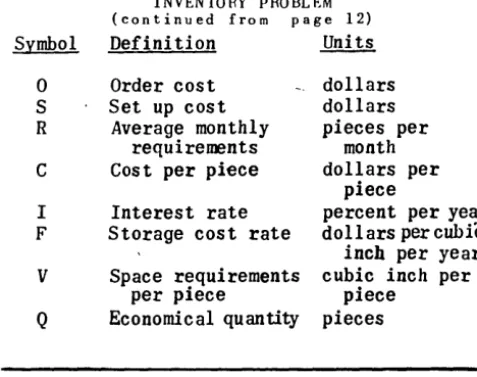
the formula is explained in the last part 0 f
this report (quoted from a memorandum fro m Plant 1 of IBM at Endicott, N. Y.). Because of the speed of the computer, the formula,even with its square root, which is carried out by an iterative process of successively improved approximations, is no barrier to swift inven-tory calculation.
Generality of the Inventory Program
The appl ic ation of the Type 702 t o t h e IBM inventory calculation is according to the company
"qui te flexible and could very eas i ly be used by almost any large manufac-turer. In discussing the processing of our inventory 'with a wide variety of customers (aircraft, automotive, machine tool, Air Force, Navy, Ar~,
mail order house, etc.) each expressed the opinion that with slight modifi-cations the application could be used nicely in their operations."
4. Formula to Calculate
"Economical ManUfacturing Quantities"*
Definition. An economical manufacturing quanti ty is that order quantity w hi c h tIT i 11
yield the lowest ultimate cost per piece, all relevant costs considered.
Explanation. In the manufacture of a par-ticular part, certain costs will result. The more pertinent are:
INVENTORY PROBLEM
1. The cost of preparing, process i n g , and controlling the order.
2. The cost of setting-up, or changi n g over, the manufacturing facilities.
3. The cost of running these facilities.
4. The cost of carrying the inventory.
That portion of the unit cost ari sin g from costs #1 and #2 can be minimized by i n-creasing the lot size. The lot size does not affec t #3. That portion of the unit cost causal by #4 can be reduced only by decreasing the lot size. Thus, attempts to reduce cost #1 and #2 conflict with a reduction of #4. To resolve this conflict, formulas have been develo p e d to yield the minimum cost per piece.
This paper will consider just one of many possible formulas. Others may be found in the books listed under bibliography. (For a num-ber of general formulas and their variations, consult "Quantity and Economy in Manufacture" -- F. E. Raymond -- McGraw Hill Book Company). Generally, these differ by the number of cost factors considered. The character of the par-ticular business will determine which must be considered.
For instance, if the manufacturing 1 e a d time is usually longer than six months, carry-ing charges pn the work in process should b e included. However, to facilitate its use, the formula should be as simple as possible. The addi tion of several factors to make the formu-la applicable to every part may not be justi-fied if the formula becomes cumbersome touse.
Cautions. The use of economical 0 rd e r
quanti ties may not increase the in v e n tor y turnover. The formulas are designed to yield the lowest total cost of all factors consider-ed in the formula, not just the dollar inven-tory.
The formulas give the best re suI t s i n plants manufacturing to a level schedule on a lot size basis. If the parts requirements 0 r
other factors considered in the formula are _subject to tV'ide fluctuations, the expense of maintaining up-to-date information may be pro-hibitive.
The formula cannot account for many prac-tical cons iderations. If tools m u s t be re-paired or cutting tools sharpened before a run is completed, ei ther the computed qua n tit Y must be reduced or better tools purchased. The latter action is often indicated but might not be possible. Limitations of storage for work in process may also necessitate reduc in g the calculated quantity.
Factors in IBM Formula
Order Cost. Actual departmental and ac-tivi ty costs were studied to obtain this figure. It includes the cost of automatically schedul-ing and printschedul-ing the order, obtainschedul-ing the part print, processing and expedi ting the 0 r d e r
through the shop, and closing it out. It also includes an allocation of production contro 1 expense. It is constant.
Setup Cost. This figure is determ i ne d from experience. It includes all expenses in-volved in gathering tools and preparing mach-ines for the job.
Requirements. This figure is com p u ted by extending a master parts lis t for e a c h product by the requirements of that pr 0 duct.
The lists are then summarized by part number.
Cos t Per Piece. This includes all mater-ial, direct labor, and burden expenses associ-ated with the part. .
Interest Rate. This includes those inven-tory possession charges which vary with the cost of the part -- insurance, desired return on investment, and obsolescence. A return on investment rate was used rather than the cur-rent borrowing rate because it was felt t hat the inventory investment should be made to earn as much as any other investment in the busi-ness. Actually, inventory earns no m 0 n e y .•
But, charging it with this theoretic cos t tends to reduce the size of the order and the size of the inventory.
Space Charge. This is the product of a constant, the storage cost per cubic inch, and a variable, the space required for the partic-ular part. The constant was determined by div-iding the annual storage costs not depende n t on unit cost by the number of cubic inches of
~vailable bin space. These costs inc 1 u ded handling, equipment and building depreciation, and moving expenses. The variable was deter-mined for each part by using variable volume boxes to determine the space occupied b y a number of parts and di vid~ng that space by the number of parts. The resul t is the st ora g e space requirements of each. This latter fig-ure was not expensive to obtain and permitted a later determination of the proper bin size needed for each part.
Q=.
where:
THE FORMULA
24 x R x (s
+
0)2 x V x F+I x C
(continued on page 38)
-Publications For Business On Automatic Computers: A Basic Listing
Lecturer, Illinois Ned Chapin In~titute of Technology Chicago, Ill.
The man who has a business background and business interests is faced with a problem which has become worse and worse as time has pass ed. To learn about automatic computers and how they can be used in business, he is advised from all sides to read books and articles. But whichboo~
and articles? Much of what has been published in the field of automatic computers is repetitiousj much is not germane to businessj of the remain-der, some is well worthwhile and some is not. A few words of guidance appear to be in order.
This paper lists for business men what a p-pears to the author to be a basic reading 1 is t of public ations in the field of automatic com-puters. The comments are based on the author's own opinions and experiencej the basis for th e selections of these publications has bee nth e author's background in explaining automatic com-puters to businessmen and in advising businesses on automatic computer applications. So me 0 n e elise with a different background however w 0 u 1 d
probably make different choices and different com-ments.
The publications listed in this paper are grouped by subject matter. Within each group, 'Ire
publications are listed approximately in the or-der of scope and depth of coverage, the more el-ementary being listed first, the more advancedre-ing listed last. In a few groups, some good back-ground material has been included, and these
nems
have been identified as such.Most of the books and most of the magazines that carry the articles listed can be found fufue business departments of most state libraries, of most university and college librari~s, and of fue larger municipal libraries. Most of the proceed-ings of conferences can be purchased from the or-ganization cited in the listing of the item. Many of the authors whose articles are cited here send out reprints of their articles upon request. Ad-dresses of the authors can be obtained by reference to Computers and Automation's Computer Di -rectory (the June 1955 issue), or if missing fuere, by writing to the magazine or organizations that published the article.
Basic Sources
The following two books appear to be basic sources, and provide a solid foundation for fur-ther reading:
Elizabeth Marting, Editor, Electronic Data Pr 0
13
-cessing in Industry (New York: American Manage-ment Association, Inc., 330 West 42nd St., New York 36, N. Y., 1955), 257 pgs., $7.75
A very good collection of papers on automatic computers. The general level of the p a -pers is well above average. The pa-pers i n the book that are part of this bibliography are cited individually in later listings. Ned Chapin, An Introduction to Automatic Cbmpu~:
A Systems Approach for Business (Chicago: Tech-nology Center, 1955j available from Publication Sales, 407-C Gunsaulus Hall, 3140 So. Michigan Ave., Chicago 16, Ill.), 245 pgs., $9.00
A comprehensive introductory book. Business systems, programming, computer funct ioning, and compari ti ve data on avail able auto m a tic computers are included.
A third book is suggested for those who wis h to build a library, although it covers little not covered in the two books just cited:
Staff of "Management Methods" as Editors, Work-shop for Management: Proceedings of the Seventh Annual Systems Meeting of the Systems and Pro-cedures Association of America (New York: Man-agement Magazines, Inc., 141 E. 44 St., New York 17, N. Y., 1955), pg. 294-436, $19.00
Part of this book is a collection of papers on automatic computers. Some of the papers are very goodj most are average. The papers in the book that are part of this bibliogra-phy are cited individually in later listings. Use of Computers in General
Simon Ramo, "Futu.re Possibilities and Limitations of Electronics in Management", General M anage-Series Number 164 (New York: Americ.an Management Association, Inc., 1953), Pg. 3-11.
Some sound argument on the ,so-called "Second Industrial Revolution".
John C. Windsor, et. a1., The Autbmatic Of-fice (Westboro, Mass: Alden Systems Co., 1952-), 48 pgs. Appears in condensed form in: The Offire,
V 35, #5 (May 1952), pg. 110--124.
Some good philosophy on how automatic compu-ters can best be used in business.
John F. Feagler, "Making a Feasibility .Study.: The . .Q.ne--Shot,Proce~s", Electronic Data
Processing-in Industry (New York: American Management As-sociation' Inc., 1955), pg. 74-83.
PUBLICATIONS ON AUTOMATIC COMPUTERS
Roddy F. Osborn, "GE ness Review, V 32, 107.
and Univac," Harvard Bus i - #1 (Feb .• 1953), pg 12-18.
#4 (July-Aug. 1954), pg. o/t- What every system man should be aware of a-bout using an automatic computer in business. Some popular misconceptions are
in this article based upon some tric applications.
laid to rest General Elec-Jay
w.
Forrest~r, "Computer Applications toMan-agement ProbYems", General ManMan-agement S e r i e s Number 178 (New York: American Management ~
iation, Inc., 1955), pg. 22-31
Some illuminating ideas on how to use an auto-,
matic computer in business. Feasibility Studies
Joseph Pelej, et aI, Electronics--A Company Pro-gram (New York: Price Waterhouse and Co., l%fl, 16 pgs. Also in: Electronics Data Processing in Indus try (New York: Americ-an Management
As-sociation, Inc., 1955), pg. 55-64.
A general outline is presented on how mmake a feasibility study. Cost matters are only lightly touched upon.
Price, Waterhouse and Co., How to Analyze Your Financial Operations for the Application ofEk£-tronics (New York: Price Waterhouse and Co.,l%D, 16 pgs.
This is just another name for the-Pelej art-icle cited above.
Beardsley Graham, "Reduction of Clerical Cos ts Through Mechanized Processing", General Manage-ment Series Number 164 (New York: American Man-agement Association, rnc.~ 1953), pg. 12-21.
A discussion of some of the requirements of a sound feasibility study. Some case mater-ial is used to illustrate the points. Ned Chapin, "Determining Automatic Computer
Pro-fi tabili ty," Automation, V 2, #? (Sept.?, 1935), pg. unknown.
A presentation, illustrated with a case st1rly,
of how to show whether or not an auto ma tic computer will pay for itself.
Richard F. Clippinger, et aI, "Automatic Digital Computers in Indus trial Research", Journal 0 f
Machine Accounting Systems and Managemel11, V 6,
#2 (Feb. 1955), pg 7-11, 14-17, and #3 (March 1955), ~g 9-11, 19.
A brief but thorough discussion of computer characteristics and computer costs by three experts in the field.
L. R. Johnson, "Installation of a Large Electron-ic Computer," Proceedings of the Association for Computing Machinery' (Washington, D. C.: Sa u Is Lithograph Co., 1952), pg. 77-81.
An excellent discussion of physical consid-erations in ins taIling an automatic computer. Systems Analysis
William B. Worthington, "Application of Electron-ics to Administrative Systems," Systems and
Pro-cedures Quarterly, V 4, #3 (Aug. 1953), pg 3 - 9. Also in: Systems and Procedures Quarterly, V 4,
Arthur A. Brown and Leslie G. Peck, "How Electron-ic Machines Handle ClerElectron-ical Work," Journal of Accountancy, V 99, #1 (Jan. 1955), pg31-37.
A simple comparison of doing a task by hunm labor, by an automatic computer, and by JlIrlEd
cards.
A. B. Toan, "Auditing, Control, and Electronics," Journal of Accountancy, V 99, #5 (May, 1955), pg 40-45.
Al though there are a-number of articles 0 n
this general subject, this one covers more ground than most. The reader will probably be impressed with how much thinking is still to be done on auditing and control by elec-tronics.
Dean E. Wooldridge, "Trends in Electronic Bu s i-ness Data Systems Development," Trends in Com-puters (New York: Institute of Radio Engineezs, Inc., 1954), pg 16-22.
High quality systems work on possible auto-matic computer applications is needed but~
lacking. Many systems men seem still to be unprepared for such work.
William B. Worthington, "Business Decisions by Electronic Choice," Office Management S e r ies Number 131 (New York: American Management A s-sociation, Inc., 1952), pg 22 -29
A brief presentation of how applying an auto -matic computer could help solve troublesome sys tems problems.
Claude E. Shannon, "Computers and Automata,"
Pr0-ceedings of the IRE, V 41, #10 (Oct. 1953), pg 1234-1241
A background article. need not be restricted ness-applications like their logical ability, wide area of potential
Automatic com pu ters to the obvious busi-payroll. Because of computers have a very application.
H. John Ross, Technique of Systems and ~dures
(New York: Office Research Institute, 1948) A background book. Although this book says nothing about automatic computers, yet it gives an excellent statement of the princi-ples of systems analysis.
Francis Bello, "Information Theory," Fortune, V
48, #6 (Dec. 1953), pg. 136-158.
A background article. Automatic computers are machines that in effect handle informa-tion. This article discusses in readable terms the theory of information itself. Human ReI ations
Marion A. Bills, "Human Relations Aspect, ""Office Management Series Number 135 (New York: Ameri-can Management Association, Inc., 1953) pg 32-35.
Sound practical advice illustrated with ex-,amples drawn from the writer's own
PUBLICATIONS ON
changes in methods and equipment.
J. Douglas Elliott, "Will Electronics Make People Obsolete?" Office Management Series Number 136
(New York: American Management Association, Inc., 1954), pg 47-60.
A practical discussion of the employee rela-tions problems that arise from the use of an automatic computer, and some suggestions for dealing with the problems.
Examples of Automatic Computer Applications W. W. Smith, "Impact of the Computer on Methods,"
Office. Management Series Number 136 (New York: American Management Association, Inc., 1954), pg 3-16. Also in: Automation, V 2, #5 (May 195@, pg 107-110.
A discussion of the benefits expected from the use of an automatic computer by General Electric, in terms of how various clerical tasks are to be performed.
Byron F. Burch, "The Computer at Work on Payrolls," Office Management Series Number 136 (New York:
A~rican Management Association, Inc., 1954),pg
l6~25.
A discussion of the General Electric payroll application with some comparisons of systems before and after the use of the computer. A. C. Vanselow, "Programming the Computer for
Cleri-cal Production," Office Management Series Number 136 (New York: American Management Association, inc., 1954), pg 26-40.
A discussion of the Franklin Life automatic computer applications and the steps that were taken to put the computer into productive rer-vice.
E. 'J. Cunningham, "A Case Study in Electronic Ac-counting," Office Management Series Number 131
(New York: American Management Association, Inc.,' 1952), pg 3-8.
One of the early users of automatic computers reports on his company's feeling toward and use of automatic computing equipment. Integrated Data Processing
Harold F. Van Gorder, et al~ A New Approach to . Office Mechanization (New York: American Manage-ment Association, Inc., 1954), 62 pgs. Also in, in somewhat condensed from: The Office, V 39,#4
(April 1954), pg 66-101.
Integrated data processing presented by the pioneers in the field, with extensive illus-tmtive material on just how the paper tape is
used.
Automatic Computer Fundamentals
Arthur L. Samuel, ~'Digi tal Computers Made Easy," Proceedings of the IRE, V 41, #10 (Oct. 1953), pg 1223-1230.
An excellent presentation in very readable language of the machines called "automatic computers. "
AUTOMATIC COMPUTERS
Staff of Cresap, McCormick, and Paget, "Evolution of Data Processing," Electronic Data Processing in Industry (New York: American Management Asso-ciation, Inc., 1955), pg 17-53. '
An easily read presentation of the history of data-handling.
William B. Elmore, 'i'Reliabili ty in Electronic Data Processors," Computers and Automation, V 4, #5
(May 1955), pg 6-9, 38. Also in, in modified form: Electronic Data Processing in Industry
(New York: American Management Association,Inc., 1955), pg 139-147.
Automatic computing equipment is very relia-ble when properly maintained. The writer illustrates the point with some easily under-stood comparisons.
J. Melvin Jones, "Marginal Checking-An Aid in Preventive Maintenance of Computers," Computers and Automation, V 4, #4 (April 1955), pg 10-14. An easily read discussion of what marginal checking is, how it is done, and what can be expected of it.
R. K. Richards, Arithmetic Operations in Digital Computers (New York: D. Van Nostrand Co., Inc., 1955), 397 pgs.
This book gives a good statement in rather simple language of how arithmetic operations
are done in automatic computers.
John G. Kemeny, "Man Viewed as a Machine," Scien-tific American, V 192, #4 (April 1955), pg 58-67.
A background articl~. An important part of the article °is the information and explana-tion supplied on how automatic machines are able to be automatic.
E. C •. Nelson, "An Algebraic Theor~ for Use ip Di-gital Computer Design," Transactions of the IRE Professional Group on Electronic Computers, V EC-3, #3 (Sept. 1953), pg 12-2l.
A background article. The basic point of the article is the relation between the in-put and outin-put of an automatic comp~ter. Al-though the diagrams and tables are simple, the writing is rather technical.
Arnold Tustin, "Feedback," Scientific American, V 187, #3 (Sept. 1952), pg 48-54.
A background article. Feedback is fundamen-tal both in the operation and application of automatic computers. The article expla~ns
and discusses feedback in si~ple language. Programming
Walker H.' Thomas, "Fundamentals of Digital Compu-ter Programming," Proceedings of the IRE, V 41, #10 (Oct. 1953), pg 1245-1249.
An excellent presentation in rather readable language of the basic aspects of programming, with a few short examples worked out for
il-lustration.
Everett C. Yowell, "Some General Precepts for
-PUBLICATIONS ON Engineers-~Professional Group on Eleetronic Com-puters, 1952), pg X:I-X:6.
AUTOMATI~ COMPUTERS
Although the precepts are common sense, they are easy to forget when programming.
Grace M. Hopper, "Education of a Computer,"
Pro-ceedings of the Association for ComputIng Ma
-chinery (Pittsburgh, Pa.: Richard Rimback Asso-ciates, 1952), pg 243-249.
A discussion of programming in terms of the contents of a prograrmner's possible "set of tools" • Alit tle technical.
Grace M. Hopper, "Compiling Routines," Computers and Automation, V 2, #4 (May 1953), pg 1-5.
A discuss ion of advanced programming tec h -niques by an expert. The writer assumes the reader has a good knowledge of computer ter-· minology.
Storage Devices
Louis Ridenour, "Computer Memories," Scientific American, V 192, #6 (June 1955), pg 92-100.
A well illustrated and somewhat popular presentation of storage devices with some e m -phasis on magnetic cores.
Isaac L. Auerbach, "Fast-Acting Digital Me'm ory Systems," Electrical Manufacturing, V 52, #4
(Oct. 1953), pg 100-107, and V 52,#5 (Nov.1953) , pg 136-143.
A well illustrated survey article discussing the characteristics of storage devices. Jasper P. Eckert, '''A Survey of Digital Computer
Memory Systems," Proceedings of the IRE, V 41, #10 (Oct. 1953), pg 1393-1406.
An authority discusses available types 0 f
storage devices in a rather readable way. Input-output Devices
Arthur W. Tyler, "Recording Techniques for Digi-tal Coded Data," Review of Input-Output Equip-ment (New York: Institute of Radio Engineers, Inc., 1953), pg 3-7.
An introductory discussion of input-output devices, and the characteristics needed in such equipmept:
S. N. Alexander, "Summary and Forecast," Review of Input-output Equipment (New York: Institute of Radio Engineers, Inc., 1953), pg 137-139.
Some thoughtful comments on the general area of input-output equipment in terms of data-handling needs.
G. B. Bower, "Versatility in Analog to Digital Conversion," Automation, V 1, ft5 (Dec. 1954), pg 98-102.
A good introduction to analog-digital devices. Although work is still not far advanced in this area, the importance of devices like these will increase. -David H. Shepard and Clyde C. Heasly,
"Photoelec-tric Reader Feeds Business Machines, "Electronics,
V 28, ft5 (May 1955), pg 134-138.
16
-The use of the printed word as eith~r stor-age or input-output for an automatic compu-ter still lies in the future. This article tells of the efforts of one company to bring that future closer to the present.
Particular Automatic Computers
John M. Carroll, "Electronics for the Business
M~n," Electronics, V 28, #6 (June 1955), pg 122-131.
A survey of computer manufacturers was made and the results tabulated. The data presen-ted suffers somewhat from a· lack of thorough editing, but it is still worthwhile. (For other surveys, see the Controllership bib-liography cited later, and the Chapin book cited earlier.
Lawrence Wainwright, "Digital Computer Question-naire," Computers and Automation, V 2, #6 (Sept. 1953), pg 3-7.
This very comprehensive questionnaire lists the areas of importance in learning about any particular automatic computer, and sug-gests important questions to ask.
Office of Naval Research, A Survey of Automatic Digital Computers (UpBll1293) (Washington,D.C.: Office of Technical Services, Department of Commerce, 1953), 109 pgs.
A comprehensive survey in technical terms of over 90 scientific and commercial automatic computers.
John Plain Company, 140 GP Distributon, (Chicago: John Plain Co., 1953), 24 pgs.
A widely publicized example of special pur-pose magnetic drum equipment, told in the company's own words and pictures.
Argument on "Can Machines Think?"
Elliot Gruenberg, '~at are the Possibilities for Reflective Thinking, ~n M~chinest" Comput~rs , and Automation, V 3, #2 (Feb. 1954), pg 12-19, 26, 28. Also in: Systems and Procedures Ouar-terly, V 5, #3 (Aug. 1954), pg 10-19.
A well presented defense of the "machines can think" position.
M. V. Wilkes, "Can Mathines Think?" Proceedi n g s of the IRE, V 41, #10 (Oct. 1953), pg 1230-1234.
A well presented defense of the "rna chi n e s' cannot think" position.
General Reference Information
The magazine Computers and Automation/make s a specialty of regular publication of useful reference information. To cite one example: Staff of Computers and Automation, "Glossary of Terms in the Field of Computers and Automatio n, " Computers and Automation, V 3 #10 (Dec. 1954) p g 8-23.
·One of the two most extensive g los sa r i es presently available.
FRANCHISE
Isaac Asimov Waltham, Mass.
It was two days before Election Dayan d Norman Muller swayed with shock as he stared at the Secret Service man who had entered the house. As though from a distance, he hear d the man say with ritualistic formality: "Mr. Norman Muller, it is necessary for me to in-form you on behalf of the President 0 f the
Uni ted States that you have been computed a s one of those who will represent the Americ an electorate on Tuesday, November 4, 2008."
So the lightning of Multivac, that giant computing machine, had struck. Nor man had been computed out of the millions and was cho-sen.
And in a presidential year at that. Norman managed, with difficulty, to walk unaided to his chair. He sat there, whi te-faced and almost insensible, while his wife, Sarah, brought water, and slapped his hands.
The agent said, "Now you're going to have me wi th you for a while. My name is Phil Hand-ley. None of you will be able to leave the house from now on till Election Day is over. We will transact your business for you, or it will have to wait. You understand?"
Norman, recovering a remnant of self-con-trol muttered, ''Yes.''
"Your daughter will stay home from school, too. I'll try to be as little a nuisance as possible. The government will pay for my mmn-tenance of course. I'll be relieved ec£h night by someone who will sit up in this room, so there will be no problem about sleeping accom-modations. Now,
Mr.
Muller---""Sir?"
"You have two days in which to grow a c-customed to the situation. We want to have you face Mul ti vac in as normal a state of mind as possible. Just relax."
But Norman shook his head violently. "Why me? All that responsibility."
"Well," said IIandley, "let's get that straigh t to begin with. Mul ti vac is a computer which can handle in a moment the am 0 un t 0 f
data the entire human population of the country couldn't deal with in a year-"
"Yes, yes. I understand that."
"Good. Multivac can weigh all sorts of known factors, trillions of them, in attemptfug to judge for which of the various nominees the American electorate will vote for in -all the various elections, federal, s tate and 10 cal. One factor only cannot be handled by Multivac without special conditions because the men who service it cannot evaluate it into nume ric a 1 relationships.
"This factor is referred to as the 'i r-rational component' of- the human mind.. Af t e r all, minds can be swayed by impulses, emotions, whims, superstitions and so on. To judge the effect of these irrationals, Multivac m u s t study a number of men and women directly. From those minds, the bent of all other minds in the country can be estimated. At any given time, some men and women are more representative than others. Mul ti vac computes the most represent-ative and you are included among them. Surely you don't question Mul tivac 's competenc e i n making the selection~"
"Couldn't it make a mistake?" asked Norman, wildly.. "Couldn't it?"
"Yes, it can," admitted the agent. "I n 1993, a selected Voter died of a stroke two hours before it was time for him to be notified. Multivac could not foresee that. Mult i v a c can 't know everything about everybody un 1 e s s it is fed all the data in existence. T hat I s
why al ternate selections are alway she 1 d in readiness. They rarely need be used, however. So take it easy,
Mr.
Muller,---and Vote."In bed that night, Norman Muller st a red blankly up into the darkness ~ Elec t ion time had always been exciting for him as for every-body. There were the Election guesses concern-ing the states and town~ in which the various Voters would live; the excitement as rum 0 r struck close; the political rallies i n k e y areas i the speculations and guesses; the under-cover gambling
pools----It was such a pleasant time in which to be a spectator. Norman Muller' had never aspired to anything more. He was a small, quiet man with a thin, blonde mustache that had 0 n c e
-FRANCHISE
born of the gradual realization that his life unfriendly dawn did not help. (The TN eat her
as clerk in Kendall Department Store had crys- prediction was for a raw, cloudy day tvith pros-tallized and fixed itself into permanence. pects of rain before noon.)
"Well; he had never thought he was b 0 r n
great or t'Jould, under any c.ircumstances, achieve (greatness. A jOP, a wife, a little girl--- It : tIlas an adequate,/bargain he had struck with life. , ,
But now his wife stirred sleeplessly next to him and murmured, "Oh, Norman, I can't be-lieve ,it. All the excitement and your name in the papers. They'll come to you for endorse-ments and for articles in magazines. Yo u 're sure to get a promotion. Or maybe yo u can leave Kendall's and start a little business of your own, the way we always wanted---"
But none of that really penetrated. He knew only that he dreaded Multivac.
Less than a we~k ago, in the growing hub-bub of approaching Election, he had tal ked about it to Linda, his daugh ter, who at 10 was beginning to take an interest.
He had said, "In the old days, Lind a, everybody voted. We'd all say which man we wanted. Then they'd count how many said this man and how many that man and the man who got the most votes was elected."
Linda nodded and had said, "How did all the people know who to vote for? Did Multivac tell them?"
Norman had shaken ,his head, "They jus t decided for themselves. But you see, s 0 m
e-times it took all night to count all the votes and people were impatient to know who wo u 1 d win. So they invented special computers which could consider the first million vote san d compare them wi th the votes from the sam e places in previous years. That way the machine could compute how the total vote would be and who would be elected."
"Like Mul tivac. "
"The first computers were much smaller than Multivac. But the machines grew bigger and they could tell how the electio~ would go from fewer and fewer votes. Now Mul t i v a c needs only a dozen voters from diffezent parts of the country."
That was it. It had seemed so normal to -Norman. But that had been before he had the slightest notion that he himself would become one of the dozen. Who could have dreamed it?
Now it was everything but normal! The whole country would be staring at him!
It was early breakfast, the morning of the 4th. Norman Muller ate mechanically. The grey,
The Secret Service agent was in full uni-form now, including side-arms ,in heavily-brassed holsters.
"We'll keep this house insulated t i l 1
Mr.
Muller is back," he said to Sarah. "After that, we'll be off your necks."Norman completed his second cup 0 f black
coffee, wiped his lips with a napkin, stood up and said haggardly, "I'm ready."
The armored car purred down empty streets. They were empty even for that hour of the morn-ing.
Handley indicated that and said, "T hey always shift traffic away from the line of drive ever since the attempted bombing that n ear 1 y killed a Voter in '92."
The car stopped in an underground d r i v e whose walls were lined with soldiers at atten-tion.
Norman was led into a brightly-lit ro 0 m,
in which three white-uniformed men greeted him smilingly.
Norman said, sharply, "But this is t h e hospital?"
One of the three men in white said at once, "There's no significance to that. It's jus t that the hospital has the necessary facilities." He nodded toward Handley, "I'll take over now, agent."
Handley saluted and left the room.
The man in white said, "Won't you sit down,
Mr.
Muller? I'm John Paulson, Senior Computer. These are Samson Levine and Peter Dorogobu z h,my assistants."
Norman shook hands numbly all about. Paul-son was a man of middle height with a s 0 f t
face that seemed used to smiling and, a v e r y obvious toupee.
Paulson said, "In the first place, Mr.
Mul-ler, I want you to feel at ease. Get used to the surroundings. If you wish, we nee d 'n t start proceedings till noon."
"It's all right," said Norman. "I jus t want it to be over." He remained rigidly erect, wondering how the other eleven Voters were feel-ing at this moment.
"I understand your feelings," said Paulson. "Well, let's run through some things. In the
-FRANCHISE
first place, Multivac isn't here."
"It isn't?" Somehow through all his anx-ieties, Norman had yet looked fOrt\Tard to see-ing Mul ti vac • It was s aid to be half ami 1 e long, three stories high. Fifty technicians were supposed to patrol the corridors with i n its structure at all timES. It was the wonder
of the world.
-Paulson smiled. "It's not portable, you know. It's located underground, in fact, and very felIT people know exactly where. You can understand that, since it is our greatest nat-ural resource. Believe me, elections aren't the only things it's used for."
Norman said, "Then how---"
"How is it done? Well, we are plug g e d into Multivac right here by beam transmission, as are the other Voters. In a sense, we're in its presence."
Norman looked about. The machines within the room were all meaningless to him.
"But to continue, Mr. Muller," Paul son went on, "Mul tivac must check certain impon-derable attitudes of mind and we cannot p r e-dict how it will go about that. We .do not know
in advance what questions it will ask, and they may not make much sense to you, or even to us. It may ask how you feel about garbage-disposal in your town; whether you favor central incin-erators. It might ask you whether you have a doctor of your own or whether you make use of National Medicine, Inc. Do you understand?"
"Yes, sir."
"Whatever it asks, answer in your own words in any way you please. If you feel you m u s t explain a bit, do so."
"Yes, sir."
"One more thing. We will have to m a k e use of some simple devices which will automat-ically record your blood pressure, heart beat, skin conductivity, and brain wave pattern as you speak.- Jhe machinery will seem formidable, -but it's all absolutely painless. You won·t even know it's going on."
The other two technicians were al re ad y busying themselves with apparatus on 0 i l e d
wheels.
Norman said, "Is that to check on whether I'm lying or not?"
""Not at all, Mr. Muller. There's no ques-tion of lying. It's only a matter of emoques-tional intensity. If the machine asks you your
opin-ion of your child's school, you may say, 'I think it is overcrowded.' Those are only words. Fl'OOl the way your brain, heart, and stITeat 91 and s work, Multivac can judge exactly how' intensely you feel about the matter. It will understand your feelings better than you yourself."
"I never heard of all this," said Norman.
"I'm sure you didn't. Most of the details of Multivac's workings are top secret. For in-stance, when you leave, you will be as ked to sign a paper swearing that you will never re-veal the nature of the questions you were asked, the nature of your responses, what was done or how it was done. The less is known about th e Multivac, the less chance of attempted outside pressures upon the men who service it,." H e smiled, grimly, "Our lives are hard enough a s it is."
Norman nodded. "I understand."
"Are you ready, then?"
Norman swallowed wi th difficulty. ''Yes, sir."
Paulson nodded, and raised his hand" in a gesture to the others.
They advanced with their frightening equip-ment and Norman Muller felt his breath come a little quicker as he watched.
The ordeal lasted nearly three hours, with one short break for coffee. During all t his time, Norman Muller remained encased in machin-ery. He was bone-weary at the close.
He thought sardonically that his promi s e to reveal nothing of what had passed would be an easy one to keep. Already the ques t ion s were a hazy mish-mash in his mind.
Somehow he had thought Mul tivac would speak in a sepulchral, superhuman voice, res 0 nan t
and echoing, but that, after all, was just an idea he had from seeing too many telev i s i 0" n
shows, he decided. The truth was distressingly undramatic. The questions were slips of akind of metallic foil patterned with numerous punc-tures. A second machine converted the pattern into words and Paulson read the words to Nor-man, then gave him the ques tion and let him read it for himself.
Norman's answers were taken down by a re-cording machine, played back to Norman for con-firmation, with emendations and added remark s also taken down. All of that was fe'd in to a pat tern-making ins trument and that, in t urn, was radiated to Multivac.
The one question Norman could remember at
-FRANCHISE
the moment. was an incongruously gossipy: "What "Payment?" Norman seemed stunned. do you think of the price of eggs?"
He had answered, blankly, "I don't k no w the price of eggs."
Now it was over, and gently they removed the electrodes from various portions 0 f his
body, untlfrapped the pulsating band fro m his upper 'arm, moved the machinery away.
Be stood up, drew a deep, shudde r i n g breath and said, "Is that all? Am I through?"
"Not quite," Paulson hurried to him, smil-ing in reassursmil-ing fashion. "We'll have to ask you to stay another hour."
"Why?" as~ed Norman, sharply.
"It will take that long for Mul tivac to weave its new data from you and th~ other Vot-ers into the trillions of items it has. Thou-sands of elections are concerned, you k now. It's very complicated. It may be that an odd contest here or there, a comptrollers hip i n Phoenix, Arizona or some council seat in Wilkes-Barre, North Carolina, may be in doubt. I n that case, Mul tivac may be compelled to ask you a deciding question or two."
"Oh, no," groaned Norman.
"It probably won't happen," Paulson said, soothingly. "It rarely does. But jus t i n case, you'll have to stay." A touch of steel, just a touch, entered his voice. "You h a ve no choice, you know. You must."
Norman sat down wearily. "Very well."
The door opened, snapping him to 0 p e
n-eyed attention. For a moment, his s to mach constricted. More questions?
But Paulson was smiling. "That wi 11 be all,
Mr.
Muller.""No more questions, sir?"
"None needed. Everything was quite clear-cut. You will be escorted back to your home and then you will be a private citizen onc e roore. Or as much so as the public will allow."
"Thank you. Thank you."
"But first--"
Norman froze instantly. "What else?" he asked sharply.
i'Why, the question of payment,."
"Oh, not money, of course. We can't pay money for a civic duty. Still, it was a great responsibility and you were put to considerable inconvenience and may be put to more. Multi-vac has, in the course of quest ion in g you, learned a great deal about your aptitudes and attitudes, your emotions and intelli g en c e. Also, as a resul t of our investigat ion, i t knows a great many facts about you."
"Well, what about it? Is there anything wrong?"
"Nothing. It is just that we know from past experience that for a period of tim e to come, you will be of great publicity value to others. You will be asked to endorse and ad-vertise; you will be asked to speak, w r it e , and dedicate buildings. You will be offer e d business opportunities, chances far investment. Your name is valuable; this year, at any rate."
"I know all that," said Norman, uneasily_.
"From pas t experience, Mul ti vac can evalu-ate the types of offers you are likely toget. Knowing you, it can estimate the probabilities of success in each of these cases. The 1 as t hour has been spent by part of Multivac's vast potential in analyzing your situation. It is customary to advise the Voter on his fu t u r e actions. "
Norman looked astonished. "Do you me a n Multivac can foretell the future?"
"Not at all." Paulson smiled wistfully. "It can merely compute probabilities. For in-stance,
Mr.
Muller," and he handed a piece of onion-skin paper to Norman, "the probabilities of your attaining appreciable success or hap-piness in any venture Which will be opened to you is quite low. The probability of a c on-tinued reasonable happiness in your pres e n t position is 0.923. The chances of a rise i n happiness with time is 0.841, a moderate rise, of course. The chances of a fall are 0.123. Keep your present position,Mr.
Muller~"Norman's face fell. "That's not much of a prediction, is it?"
Paulson looked stern, "You are not obli-gated to follow Multivac's advice. You can open your own haberdashery and take a 0.052 chance of remaining solvent after five years. That is your privilege. I jus t want you t 0
realize that your present glimpse of the future is one which is available to very few. The President of the United States himself couldn t
get one for his own son unless it invo 1 v e d the public good."
(continued on page 31)