warwick.ac.uk/lib-publications
Original citation:Ortega, Francisco J., Navarro, Francisco J., García-Morales, Moisés and McNally, Tony. (2017) Effect of shear processing on the linear viscoelastic behaviour and microstructure of
bitumen/montmorillonite/MDI ternary composites. Journal of Industrial and Engineering Chemistry.
Permanent WRAP URL:
http://wrap.warwick.ac.uk/84825
Copyright and reuse:
The Warwick Research Archive Portal (WRAP) makes this work by researchers of the University of Warwick available open access under the following conditions. Copyright © and all moral rights to the version of the paper presented here belong to the individual author(s) and/or other copyright owners. To the extent reasonable and practicable the material made available in WRAP has been checked for eligibility before being made available.
Copies of full items can be used for personal research or study, educational, or not-for-profit purposes without prior permission or charge. Provided that the authors, title and full bibliographic details are credited, a hyperlink and/or URL is given for the original metadata page and the content is not changed in any way.
Publisher’s statement:
© 2017, Elsevier. Licensed under the Creative Commons Attribution-NonCommercial-NoDerivatives 4.0 International http://creativecommons.org/licenses/by-nc-nd/4.0/ A note on versions:
The version presented here may differ from the published version or, version of record, if you wish to cite this item you are advised to consult the publisher’s version. Please see the ‘permanent WRAP URL’ above for details on accessing the published version and note that access may require a subscription.
Accepted Manuscript
Title: Effect of shear processing on the linear viscoelastic behaviour and microstructure of
bitumen/montmorillonite/MDI ternary composites
Author: <ce:author id="aut0005"
author-id="S1226086X17300060-4f36759cb55ba066ecfb5a1f13867900"> Francisco J. Ortega<ce:author id="aut0010"
orcid="0000-0002-8277-1073"
author-id="S1226086X17300060-33cfe0c9d5c537178f20a446acfd05eb"> Francisco J. Navarro<ce:author id="aut0015"
author-id="S1226086X17300060-5b52e3df441b49e50550689d6e7bc223"> Mois´es Garc´ıa-Morales<ce:author id="aut0020"
author-id="S1226086X17300060-ff4d040e0620c35497258c4e5653d909"> Tony McNally
PII: S1226-086X(17)30006-0
DOI: http://dx.doi.org/doi:10.1016/j.jiec.2017.01.004
Reference: JIEC 3248
To appear in:
Received date: 31-5-2016 Revised date: 3-1-2017 Accepted date: 3-1-2017
Please cite this article as: Francisco J.Ortega, Francisco J.Navarro, Mois´es Garc´ı a-Morales, Tony McNally, Effect of shear processing on the linear viscoelastic behaviour and microstructure of bitumen/montmorillonite/MDI ternary composites, Journal of Industrial and Engineering Chemistry http://dx.doi.org/10.1016/j.jiec.2017.01.004
1
Effect of shear processing on the linear viscoelastic
behaviour and microstructure of
bitumen/montmorillonite/MDI ternary composites
Francisco J. Ortega1, Francisco J. Navarro1, Moisés García-Morales1, Tony McNally2
1Departamento de Ingeniería Química, Centro de Investigación en Tecnología de
Productos y Procesos Químicos (Pro2TecS), Campus de ‘El Carmen’, Universidad de
Huelva, 21071, Huelva (Spain)
2International Institute for Nanocomposites Manufacturing (IINM), WMG, University of
Warwick, CV4 7AL, Coventry (United Kingdom)
Author to whom correspondence should be addressed:
E-mail: [email protected]
Phone: +34 959218205
2
Graphical abstract
ABSTRACT
Polymer modified bitumens (PMBs) have largely been utilized as a construction
material. However, lack of affinity between bitumen and polymer leads to phase
separation, and eventually, performance depletion. In this paper, alternative
formulations of bitumen with an organically-modified montmorillonite (OMMT)
Cloisite 20A® and polymeric methylene diphenyl diisocyanate (MDI) were prepared by
melt blending. Their comprehensive rheological characterization evidenced improved
linear viscoelastic properties when OMMT is added, revealing a noticeable structural
reinforcement and thermal stability. Rheological data also showed that MDI-involved
reactions control the composite end properties, being greatly influenced by the shear
conditions applied.
3
1. INTRODUCTION
Bitumen has been largely used in the fields of pavement construction and roofing
membrane manufacture. In this regard, its mechanical behaviour is highly influenced by
the temperature, in such a way that, at low temperature, bitumen becomes fragile
(thermal cracking), whilst at high temperature, it may undergo permanent deformation
(rutting) [1]. Additionally, bitumen can also undergo ageing provoked by oxygen
diffusion and UV radiation, which increases its thermal susceptibility and provoke
premature fail [2,3].
Accordingly, bitumen has traditionally been modified by the use of different kinds of
polymers, commonly copolymers like styrene-butadiene-styrene (SBS) and
ethylene-vinyl acetate (EVA) which improve its mechanical performance by reducing the
effective glass transition temperature and displacing the flow region to higher
temperatures [4,5]. However, very often, the lack of affinity between polymer and
bitumen results in an eventual phase separation at the macroscopic level with the
consequent depletion in expected performance.
In this sense, some recent investigations have focused on the search for new bitumen
modifiers. In particular, the use of reactive pre-polymers of functionalized polyols end
capped with isocyanate groups have shown to be effective at noticeably enhancing
bitumen properties [6–9]. As reported, these pre-polymers, with free -NCO groups, link
to bitumen molecules containing active hydrogen groups (-OH and >NH) through
urethane and urea covalent bonds, in accordance with reactions R1 and R2, respectively,
in such a way that the size of the bitumen molecules/pre-polymer adducts continues to
4 2 1 2 1 R COO NH R OH R NCO
R (R1)
1 2 2 1 2
R
NH
CO
NH
R
NH
R
NCO
R
(R2)If water is present, it can also react with –NCO groups, forming carbon dioxide as well
as a highly reactive amine, according to reaction R3:
1 2 22 1
CO
NH
R
O
H
NCO
R
(R3)Next, this amine can further react with the remaining isocyanate groups following the
above reaction R2. This set of reactions leads to the formation of larger molecules
through urethane and urea linkages, giving rise to the development of more complex
structures.
On the other hand, layered silicates (nanoclays) have recently attracted the interest of
scientists in the polymer [10] and bitumen [11] fields, given their great potential for
interactions at the nanometre scale. In particular, montmorillonite is a naturally
occurring mineral mostly consisting of alumina-silicates with a layered structure,
corresponding to sheets of silica tetrahedrons bonded to alumina octahedrons in a 2:1
ratio. In the interlayer space, inorganic cations are found to compensate the negative
charge of the ions present in the silica-alumina layers. However, the inorganic nature of
this cation leads to low compatibility when mixed with hydrophobic substances. Thus,
ion-exchange reactions with quaternary ammonium salts with alkyl chains are required
in order to render the nanoclay compatible with bitumen. Furthermore, a larger
interlayer distance facilitates the insertion of the bitumen molecules in-between the
5
morphologies are distinguished (from poor to high quality): flocculated silicate
platelets, intercalated and exfoliated structures [10,11,13].
The optimization of formulation/processing of nanocomposites with tailored properties
requires a feedback process which includes their comprehensive rheological
characterization [10,14]. In general, addition of clay to bitumen has yielded
nanocomposites characterized by shear thinning behaviour at low shear rates, with
noticeably increased viscosities with respect to their parent bitumen [3,11,13,15,16].
This has been attributed to hydroxylated edge-to-edge interactions between the
dispersed nanoclay platelets [10,17], which tend to form an anisotropic continuum,
disrupted by the application of large shear deformations [15]. In previous work with an
organo-modified montmorillonite (Cloisite 20A®) [15,16], we reported a remarkable
solid-like plateau which extended over a wide interval of high temperatures (100 ─ 165
ºC) for a nanoclay concentration of 10 wt.%. However, further addition of 2 wt.%
polymeric MDI, followed by 24 hours of curing, led to the disruption of the above
structure and turned the solid-like plateau into a viscous flow region.
Accordingly, the main goal of the work described in this paper is to gain a deeper
insight into the effects that an organo-modified montmorillonite (OMMT), by itself and
combined with polymeric MDI, exerts on the thermo-rheological behaviour of the
resulting bitumen composites under different shear conditions. Temperature-time sweep
tests, chromatographic analysis (SARAs fractions) and modulated differential scanning
calorimetry (MDSC) on bitumen/OMMT/polymeric MDI ternary formulations shed
some light on the interactions involved.
2. EXPERIMENTAL
6
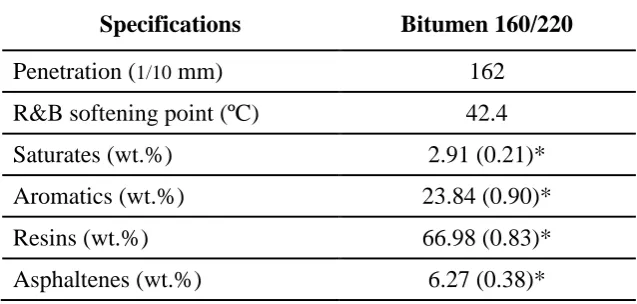
Composites were formulated using bitumen 160/220 as base material. Its specifications
appear in Table 1, defined in terms of penetration degree (EN 1426:2007), softening
temperature (EN 1427:2007) and composition, shown as “SARAs” fractions.
In addition to bitumen, formulations were prepared using the following additives as
modifying agents:
Cloisite® 20A (“C20A”, hereinafter), corresponds to a whitish, natural
montmorillonite (MMT), organically modified with N,N-dimethyl di-hydrogenated
tallow (C14-C18) quaternary ammonium cations in the interlayer space, characterised by
a hydrogenated tallow consisting of a combination of octadecyl (65 wt.%), hexadecyl
(30 wt.%) and tetradecyl (5 wt.%) groups. Besides the interlayer cations, MMT clays
also contain hydroxyl groups on the edges of the platelets, which are liable to interact
with other groups. Additional specifications: cation exchange capacity (CEC) of 92.6
meq/100 g clay, weight loss on ignition of 38 wt.%, moisture content lower than 2
wt.%, and according to X-Ray Diffraction, the interlayer distance is 2.42 nm. Platelets
are approximately 1 nm in thickness, and the size distribution of dry platelets in their
largest dimension ranges from values lower than 2 µm (10 vol.%) to lower than 13 µm
(90 vol.%), with an average value of 8 µm, resulting in aspect ratios higher than 50.
Polymeric MDI (4,4’-diphenylmethane diisocyanate), supplied by T.H. Tecnic
(Spain), and characterised by an –NCO content of 30 wt.% [18]. It consists of an
oligomeric mixture of 4,4’-diphenylmethane diisocyanate, 2,4’ and 2,2’ isomers, along
with condensation products with more than two aromatic rings. Its typical composition
contains approximately 50 wt.% pure MDI, 30 wt.% triisocyanate, 10 wt.%
tetraisocyanate, 5 wt.% pentaisocyanate and 5 wt.% higher homologues.
7
Two different processing devices were used depending upon the nature of the
substances to be blended: for clay blending, a low-shear mixer, consisting of a 50 mm
four-bladed impeller coupled to the blending device “IKA RW20”, which allowed
processing at rotation speeds of 800 ─ 1000 rpm; and for polymeric MDI mixing, a
high-shear mixer, based on the rotor-stator principle, composed of a dispersing
accessory with a 25 mm diameter stator coupled to an “Ultraturrax™ T25 digital”,
which reached rotation speeds ranging from 16000 to 18000 rpm. Both devices were
purchased from IKA (Germany). Metal containers (109 mm diameter and 131 mm
height), immersed into a bath with circulating oil, were used for the processing of
samples.
The procedure of modification was applied according to the following sequence:
1) C20A pre-dispersion: 10 wt.%. C20A was progressively added to bitumen,
previously heated up to 150ºC, and stirred during approximately 10 min., using the
low-shear mixing device, to ensure a homogeneous macroscopic dispersion. Afterwards, a
part of the so-called “bitumen/C20A pre-dispersion” was used as such, whilst the rest
was subjected to the following stage, part 2).
2) High shear blending (“HSB” in figure legends): the previous system was blended at
high shear for 20 min. at 150ºC, applying rotation speeds ranging from 18000 to 20000
rpm, in order to obtain a higher degree of dispersion. After this stage, the resulting
“bitumen/C20A composite” was divided into three parts, so that one was used as such,
another one subjected to low-shear mixing for 24 h, which resulted in the
8
3) Reaction with MDI: 2 wt.%. polymeric MDI was added to the composite and
low-shear mixed at 150ºC while curing for 1 h and 24 h (“1h-bitumen/C20A/MDI” and
“24h-bitumen/C20A/MDI” composites, respectively).
In our previous results, the reactive interaction between –NCO in polymeric MDI and –
OH in C20A was demonstrated, with a reaction mass ratio of 1.33 g of polymeric MDI
per 10 g of C20A. Thus, for a formulation with 10 wt.% C20A, 2 wt.% polymeric MDI
was added in order to ensure its reaction with the bituminous matrix, providing 2/3 –
NCO for C20A and 1/3 –NCO excess. In relation to processing times, the properties of
the resulting materials were evaluated after two different (short and long) curing periods
(1 h and 24 h, respectively), envisaging a potential application.
Finally, any specific effect of the processing conditions on the resulting properties was
also assessed by processing, according to the previous procedure, different blank
samples of neat bitumen without modifiers.
2.3.Rheological Measurements and Material Characterisation
All the rheological tests were performed in a controlled-stress Physica MCR-301
rheometer (Anton Paar, Austria). Smooth plate-and-plate geometry of 25 mm in
diameter, with 1-2 mm gap, was used for the entire set of samples. In every case, before
testing, samples were equilibrated for at least 20 minutes at the test temperature.
Oscillatory-shear stress sweep tests were performed at a frequency of 1 rad/s, at
temperatures ranging from 30 to 150 ºC.
Oscillatory-shear frequency sweep tests were carried out at different temperatures
9
measurements. At each temperature, values of stress within the linear viscoelastic
response were selected.
Oscillatory-shear temperature sweep tests, at a frequency of 10 rad/s, were carried out
applying a heating ramp at a continuous rate of 1 K/min, from 30 ºC up to the maximum
possible temperature for reliability in the measurements. Moreover, in each case, strains
were selected so as to ensure a linear viscoelastic response within the entire range of
temperature tested.
Modulated differential scanning calorimetry (MDSC) was performed in a TA Q-100
(TA Instruments, USA) on 5 ─ 10 mg of sample inside hermetic pans. Every sample was
submitted to the following procedure before testing, so that all of them were
characterised by the same thermal history. Hence, initially, samples were heated up to
150 ºC and left at that temperature for 30 minutes. Then, after a cooling period from the
melt, they were annealed at room temperature for 24 h. Once annealed, a two-stage
testing procedure was applied as follows, under nitrogen atmosphere. The first stage
consisted on quenching to a temperature of -70 ºC, keeping the sample at that thermal
condition for 5 minutes. In the second stage, the temperature was risen at a rate of 5
K/min up to 150 ºC in modulated mode, with a period of 60 s and an amplitude of 0.5
ºC.
The compositional characterisation of bitumen was obtained by thin layer
chromatography coupled with a flame ionization detector (TLC/FID), using an Iatroscan
MK-6 analyser (Iatron Corporation Inc., Japan). Accordingly, the so-called “SARAs”
fractions were eluted following the method outlined elsewhere [19], based on the
10
Every sample was subjected to testing at least three times in order to ensure the
accuracy of the results obtained, which are shown as the average of the data gathered in
each set of tests.
3. RESULTS AND DISCUSSION
3.1.Linear viscoelastic behaviour
In order to analyse general aspects of the effect that C20A and MDI addition exerts on
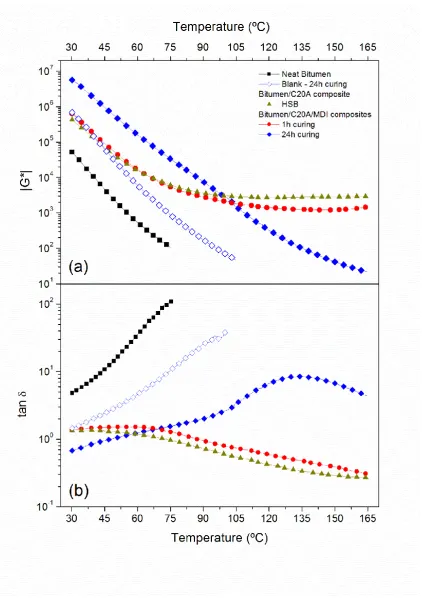
the bitumen viscoelastic properties, Fig. 1A and 1B show the evolution of the complex
modulus and loss tangent with temperature, at a constant frequency of 10 rad/s, for neat
bitumen and, bitumen/C20A and bitumen/C20A/MDI composites, cured for 1 h and 24
h. For the sake of clarity, only one specific blank is presented (Blank 24h-curing),
corresponding to neat bitumen with no additives, subjected to high shear blending and
24 h low shear stirring, because this is the only system that underwent a noticeable
change in its thermo-mechanical properties. As depicted in Fig. 1A, neat and blank
bitumen show steadily decreasing complex modulus values as temperature increases,
with a dominating viscous response, according to the loss tangent values in Fig. 1B. The
blank sample only shows a vertical shift of the curves (upwards for G* and downwards
for tanδ), pointing out a marked rise in stiffness, as a consequence of oxidative aging
processes (“primary ageing”) that bitumen undergoes during processing at high
temperature [1,6,8,20,21].
The addition of C20A to bitumen yields a considerable alteration of its viscoelastic
behaviour. The complex modulus undergoes an increase of roughly one decade at
around 30 ºC (with respect to that of neat bitumen), showing a steady decrease with
temperature up to a plateau of G*, reached at approximately 105 ºC. This plateau
11
hypothesis related to the formation of some kind of reinforcing clay-based network,
attributable to the intercalation/exfoliation of clay [15–17,22–24]. The loss tangent
remains almost independent of temperature, with values barely greater than unity up to
approximately 60ºC, and then begins to steadily decrease as temperature was raised.
After MDI addition and 1 h curing, only minor changes were observed with respect to
the bitumen/C20A composite up to 65 ºC. Above that temperature, the system shows
lower complex modulus values, and a plateau in G* appears at approximately 130 ºC.
Analogously, the loss tangent exhibits values slightly higher than those of the
bitumen/C20A system (Fig. 1B), pointing out that stirring during curing leads to a
slightly less elastic sample.
After 24 h curing, the bitumen/C20A/MDI composite exhibited a markedly different
behaviour. In the low temperature range, the complex modulus increased by two
decades with respect to that of neat bitumen, maintaining a monotonic decrease in the
entire temperature range examined. At higher temperatures, noticeable lower values
than those corresponding to the rest of composites were obtained, seemingly attributable
to the effects that the promotion of MDI-related reactive processes exert at longer
curing times [7–9,25,26]. Fig. 1B also showed lower loss tangent values in the low
temperature range, indicating a mostly elastic response, which rapidly becomes mainly
viscous as temperature increases. It is also important to note that in the low temperature
region (<50ºC), the complex modulus of the bitumen blank (24 h curing) is similar to
that of the bitumen/C20A and 1h-bitumen/C20A/MDI composites, clear indication that
oxidation has some relevancy after 24 h high temperature processing.
In order to gain a deeper insight into the linear viscoelastic behaviour, Fig. 2 shows
12
shown, all the systems differ noticeably in their behaviour. The moduli of neat bitumen
display the typical direct transition to the terminal flow zone, with a predominantly
viscous behaviour in the entire range of applied frequency. The addition of C20A to
bitumen yields a system with a mostly elastic response below the crossover frequency
(~10 rad/s) at the lowest temperature (30 ºC), shifting towards higher frequencies as test
temperature increases, even disappearing at 90 ºC. In correspondence with the
temperature sweep data in Fig. 1, a rubbery “plateau-like” region seems to arise at low
frequencies, indicating that the nanoclay is the main contributor to the linear
viscoelastic rheology of the composite at temperatures at which bitumen softens,
providing the material with an enhanced elastic response. Thereby, strong filler–filler
interactions, as well as a high compatibility between C20A and bitumen play major
roles in giving rise to a very highly-reinforced composite structure [22,27].
The addition of MDI to the previous composite and curing for 24 h provoked further
changes in the linear viscoelastic functions. Hence, whereas at 30 ºC the response is
mainly elastic in the entire frequency range studied, with both curves nearly parallel; at
higher temperatures, this behaviour turns predominantly viscous, leading to a
remarkable drop in both moduli and, unlike the composite without MDI, the solid-like
behaviour is no longer observed, just only a flattening of the low-frequency slopes.
As widely reported for composite materials [10,12–17,22–24,27–29], a better nanoclay
dispersion yields an increase in interfacial area, allowing for optimal mechanical stress
transfer between the filler and the matrix and, therefore, an enhancement in mechanical
behaviour. In this regard, as discussed in previous works [15,16], the disappearance of
the rubbery plateau region in the 24 h-bitumen/C20A/MDI composite has been
attributed to the effects of MDI-related reactions under low shear processing, which, in
13
interactions between hydroxyl groups located on the edges of the clay platelets
[10,12,15–17]. Moreover, in addition to the reactivity of –NCO groups in MDI with
active hydrogen groups in bitumen, isocyanate groups can also react with pendant
hydroxyl groups in C20A to form urea/urethane bonds [15], which may further
contribute to the agglomeration of clay tactoids/platelets. As a consequence, large-sized
aggregates containing new urea/urethane linkages would tend to form, reducing the
degree of dispersion of clay platelets/tactoids, which causes the disruption of the
clay-based reinforcing network, hence decreasing the bitumen/clay interfacial area, and so
doing the strength of the material [12,15,16].
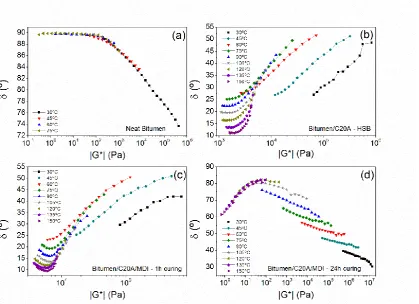
Fig. 3 depicts the phase angle versus the corresponding absolute value of the complex
shear modulus from the dynamic rheological data (black diagram or Van Gurp–Palmen
plot). These plots have been widely used not only for verifying the time–temperature
superposition principle (TTS) in polymer blends and nanocomposites, but also for the
evaluation of the topological structures in polymer-clay nanocomposites, given its
sensitivity to structural or compositional changes [30].
Neat bitumen shows a well-known pattern consisting of a wide Newtonian viscous flow
region at G*<100 Pa and a steady decrease of the phase angle at higher complex shear
modulus values [20,31]. Only in the case of neat bitumen, all isothermal frequency data
merge into a single common curve indicating that, at least empirically, the
Time-Temperature-Superposition Principle holds.
The addition of C20A gives rise to a markedly different behaviour and a clear
thermo-rheological complexity, which is further retained after MDI addition and curing for 1 h,
as seen from the absence of superposition in the curves (Figs. 3b and 3c). The results
14
viscoelastic moduli when bitumen softens, given that the ranges of phase angle strongly
shift towards low-to-intermediate values, indicating an increase in the elastic component
of the system, especially at low frequencies (or high temperatures). Moreover, the flow
region is not reached, and at temperatures higher than 60 ºC, local minima clearly
appear, for which the plateau modulus GN0 might be estimated [32], pointing to the
presence of the rubbery plateau zone of the mechanical spectrum.
Increasing curing time up to 24 h led to the evolution of a completely different curve, as
well as to the disappearance of the rubbery plateau zone. From 30 to 105 ºC, the phase
angle steadily diminishes as the complex modulus increases, reaching values of 107 Pa
at 30 ºC. At temperatures greater than 105ºC, the curves tend to overlap, defining a
maximum at a phase angle value of nearly 85º. This result indicates the material
becomes less structured, displaying more liquid-like behaviour, and supports the
structural destabilization previously stated.
In general, the observed rheological behaviour hints at the development of a complex,
clay-based micro- and nano-structured continuum that reinforces the system structure
and derives from the intercalation/exfoliation of clay tactoids in the bituminous matrix
[14–16,23,24].
3.2.Linear and non-linear viscoelastic behaviour
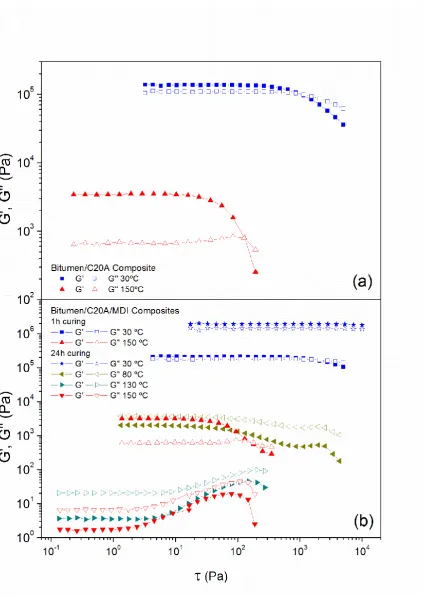
Composites were also subjected to stress sweep tests, carried out in the temperature
range from 30 to 150 ºC, at 1 rad/s (Fig. 4). As reported in the literature [33,34], this
type of oscillatory shear test is not only useful for determining the linear viscoelastic
range (LVR), but also for obtaining valuable information about the material’s
microstructure. In this sense, the linear viscoelastic model states that both moduli lose
15
linear viscoelastic range, since the output signal is no longer sinusoidal. However, the
non-linear viscoelastic response is not substantially different from the moduli calculated
by means of the linear viscoelastic equations and, therefore, can still be useful in
providing relevant information about the microstructure of the system [33,35]. In this
regard, different kinds of non-linear viscoelastic responses have been reported [33,34],
which may be used to classify complex fluids, depending on the pattern traced by their
non-linear viscoelastic functions: strain thinning (G’, G’’ both decrease); strain
hardening (G’, G’’ both increase); weak strain overshoot (G’ decrease, G’’ increase
followed by decrease); strong strain overshoot (G’, G’’ both increase followed by
decrease); as well as other intermediate behaviours.
Thereby, the resulting patterns for the viscoelastic moduli of the systems in this study,
shown in Fig. 4, reveal a remarkable modification of the rheological response,
especially in the non-linear regime, a fact that hints at morphological changes in the
composites. In the case of the bitumen/C20A composite (Fig.4a), the linear viscoelastic
range (at the lowest and highest temperature bounds considered) are both characterized
by a predominantly elastic response, until a crossover shear stress value is reached.
Beyond the critical stress, which sets the end of the LVR, the non-linear viscoelastic
response arises as a steady decrease in both moduli (especially the elastic modulus),
pointing out the stress thinning behaviour previously mentioned. This behaviour derives
from the partial contributions of the bituminous matrix and C20A to the overall
viscoelastic response. The presence of C20A, probably with a mostly-intercalated,
hybrid structure [15,36,37], contributes to retain the elastic response over the viscous
one, since it restricts the ‘flowability’ of the surrounding bitumen molecules
[10,15,16,27,38,39]. Once the critical stress value is reached, the clay-based structural
16
test temperature reduces bitumen’s partial contribution to the response, provoking a
diminution in both dynamic moduli, widening the gap between them, as well as shifting
the critical stress to a lower value.
By contrast, the viscoelastic response of the 1h and 24h-bitumen/C20A/MDI
composites were more complex, as it depends on both the curing time and the test
temperature (Fig. 4b). In the case of the 1 h-cured set of systems, a similar viscoelastic
behaviour to that of the bitumen/C20A composite was observed. However, after being
subjected to a longer curing time of 24 h, the viscoelastic response is noticeably
modified. At low temperature (30 ºC), the applied experimental stresses are not high
enough to provoke a non-linear response, most probably due to the stiffening of the
composite as a consequence of the reactions involving –NCO groups. As temperature
was increased (≥80 ºC), a completely different behaviour was observed. The
viscoelastic response of the system turns predominantly viscous in the whole stress
range applied, with a noticeably narrowing of the linear viscoelastic range, and upon
exceeding the critical stress value, at 80ºC, an intermediate non-linear response was
obtained, with a local minimum in G’ and G’’ followed by a weak overshoot, to finally
decrease again. At higher temperatures (130 and 150 ºC, Fig. 4b), the viscoelastic
response of the composite exhibits a remarkable stress thickening behaviour,
represented by a rise of almost one order of magnitude in both moduli, followed by a
decrease.
In this context, different types of structural network models have been proposed to
predict and better understand the mechanism of strain hardening behind the non-linear
viscoelastic response obtained. All consider the composite system structure to be
represented by a network consisting of a combination of segments and junctions, whose
17
loss terms increase, but the speed of creation is slightly greater than that of destruction,
a higher electrostatic interaction develops between the molecular chains in the system
structure, which is eventually reinforced, showing a strong strain overshoot response in
both viscoelastic moduli [33,34]. Therefore, in the case of the ternary system studied,
when the complex molecular structure was subjected to dynamic oscillatory shear,
intramolecular groups become available for intermolecular interaction with groups from
other molecules in the structure, increasing the number of junctions and the effective
volume occupied by the network [40]. The sum of these processes results in the
observed increase in both viscoelastic moduli. However, as stress was increased,
intermolecular junctions are progressively disrupted, leading to greater values of the
loss rate parameter with respect to those of creation. Eventually, the network reaches
such a degree of deformation that the intermolecular link distribution is unable to
maintain the stability of the structure, giving rise to its collapse and the sudden decrease
of both moduli [34,40], observed in Fig. 4b.
3.3.Effect of shear processing
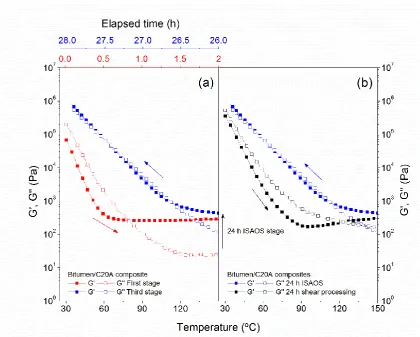
With the aim of assessing the effect of shear during processing on the rheological
properties of the composite systems, temperature sweep data collected for samples
processed in a low shear mixing device for 24 h (as described in section 2.2) were
compared to data recorded for samples of the same systems, which were instead
subjected to a dynamic oscillatory shear testing protocol within the linear viscoelastic
range, with an intermediate isothermal stage of duration and temperature comparable to
those applied in the low-shear stirring procedure. This testing protocol consisted of a
temperature sweep test in oscillatory shear from 30 to 150 ºC (first stage), followed by
an isothermal small-amplitude-oscillatory-shear (ISAOS) stage at 150 ºC for 24 h, and
18
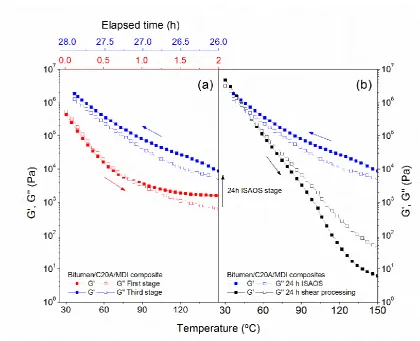
portrayed in Fig. 5a, for the non-MDI-containing formulation; and Fig. 6a, for that
containing MDI. Thermo-rheological data collected for each system after these two
testing procedures are compared in Fig. 5b, in absence of MDI; and Fig. 6b, with MDI
added to the formulation.
In Fig. 5a, the bitumen/C20A binary system (red pattern) is characterised by a mainly
viscous response in the low-to-intermediate temperature range, with both moduli
steadily decreasing down to a crossover point reached at 80 ºC, and a rubbery plateau at
higher temperatures. Once 150 ºC was reached, the system was kept at that temperature
in the LVE for 24 h (ISAOS stage), yielding a rise in both moduli, especially in G´´.
This might be partially attributed to the previously mentioned effect of oxidation on the
bituminous matrix. Nevertheless, given that the presence of nanoclay confers some
protection against oxidation by hindering both the oxygen diffusion into bitumen and
the release of volatile compounds [2,3], such a modification would mainly stem from
structural changes in the extent of nanoclay dispersion. In fact, after the ISAOS stage,
the temperature sweep data for the resulting system (blue pattern in Fig. 5a) shows a
notable improvement in the linear viscoelastic response, with a rise in both moduli of
approximately one decade over the entire temperature range, more intense in G´, and
with the rubbery plateau appearing after a crossover, at approximately 110ºC.
By contrast, when the bitumen/C20A system is low shear stirred for 24 h, the
viscoelastic moduli did not only not improve, but actually slightly deteriorated, as
shown in Fig. 5b (black pattern). The viscoelastic properties of the composite reveal a
marked negative influence of the shear processing, since the system becomes
19
Accordingly, these results suggest that the nanoclay intercalation/exfoliation process
would be favoured at high temperature in the absence of stirring [28], probably allowing
to achieve a higher degree of interaction between the bitumen matrix and nanoclay,
which leads to such reinforcement of the system structure. However, under low shear
stirring, the agglomeration/re-aggregation of clay tactoids would be promoted [12,15–
17], yielding a higher presence of aggregates, accompanied by a lower degree of
dispersion, and therefore, lower interaction between the clay and the bituminous matrix,
which eventually decreases the structural reinforcement provided by the former.
In the case of the bitumen/C20A/MDI composites submitted to the same testing
protocols, some differences can be found (Fig. 6a and Fig. 6b). As depicted in Fig. 6a,
the system initially shows a crossover at intermediate temperatures, with Gˈ slightly
below G˝ (red pattern in Fig. 6a). However, after the subsequent ISAOS stage at 150 ºC
for 24 h, the temperature sweep data from 150 to 30 ºC (third stage) shows a notable
increase in both moduli, with G’ prevailing in the entire range of temperature (blue
pattern in Fig. 6a). On the other hand, when the system was subjected to low shear
stirring, a remarkable worsening of the linear viscoelastic behaviour was obtained
(black pattern in Fig. 6b), still more pronounced than in the absence of MDI (black
pattern in Fig. 5b). This brings about a notable shift of both moduli to lower values,
with a viscous dominance of the LVE response, which is accompanied by the complete
disappearance of the rubbery plateau.
Consequently, MDI content seems to further intensify the improvement derived from
the intercalation/exfoliation of clay tactoids when no stirring is applied, which arises
from the reactivity between isocyanate groups in MDI and active hydrogen groups, both
in bitumen and C20A, yielding urea/urethane bonds [9,15,16,26], and a more complex,
20
processing continues destabilizing the clay-based network, and its effect is now
enhanced, as NCO-involved reactions seemingly promote the
agglomeration/re-aggregation of clay tactoids/platelets, further reducing their degree of dispersion and the
thermo-mechanical stability of the system structure.
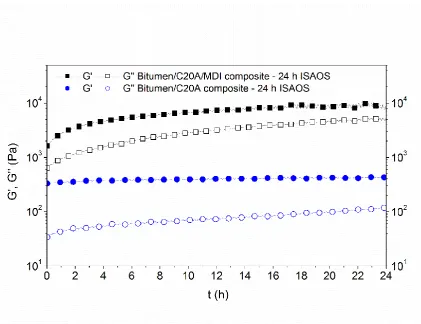
It is also worth mentioning that data collected during the ISAOS stage in the dynamic
oscillatory shear testing protocol provide some relevant information on the evolution of
the LVE properties of both systems with time during 24 h at 150 ºC, as depicted in Fig.
7. These data reflect the progress of chemical and physical processes behind the
microstructural modification of the composites to reach the end properties. Accordingly,
the variation observed in the moduli of the bitumen/C20A/MDI composite indicate that
properties mainly develop within a time span of 4 h from the beginning of the ISAOS
stage, and then slowly progress to reach roughly the final values after 18 h. In the case
of the bitumen/C20A composite, G’ remains practically unchanged over the entire
curing period, whilst G’’ increases slowly and steadily during the very same period of
time. At the end of this stage, the values attained become the starting data of the
following stage, as depicted in Figs. 5b and 6b. Therefore, in absence of reactive
processes, the evolution of the properties merely results from physical interactions, as
represented by data for the bitumen/C20A composite, which mainly arise from the
initial high shear blending of C20A, with the ISAOS stage favouring aggregation
processes that bring about an increase in the viscous modulus. By contrast, if reactive
processes are also involved, curing during the ISAOS stage considerably affects the
microstructure of the composite, and seemingly, no further relevant change is observed
after 18 h. Hence, a steady state is approximately reached before 24 h curing, indicating
that NCO-involving reactions proceed to such extent that their virtual completion can be
21
3.4.Differential scanning calorimetry and chemical composition
The influence that the addition of clay and MDI to bitumen induces on its
microstructure was also assessed by means of modulated differential scanning
calorimetry (MDSC), a technique that allows investigation of the thermal behaviour of
bitumen fractions, differentiating between reversing and non-reversing thermal events,
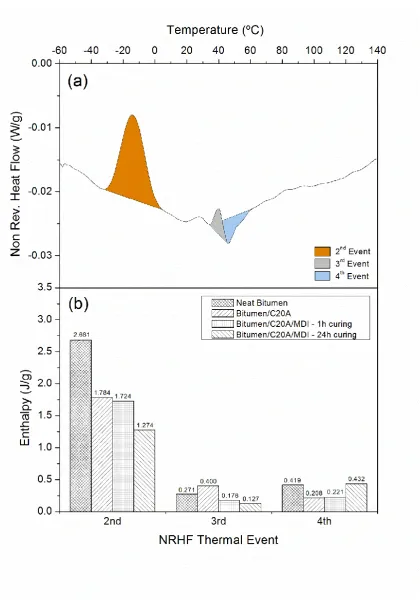
like oxidation, evaporation or decomposition [41]. As depicted in Fig. 8a, four events
can normally be distinguished in the non-reversing heat flow curve, as the different
bituminous fractions order upon cooling from the melt: the first event, a broad
endothermic background appearing from -60 to 90 ºC; the second and third events, two
exotherms usually centred at -15 ºC and 40 ºC, respectively; and the fourth event, an
endotherm located at around 50 ºC [42].
Thus, according to the data for the non-reversing heat flow enthalpies shown in Fig. 8b,
the addition of clay provokes a marked change in the enthalpy of all the thermal events.
The variation observed suggests that the molecular ordering of saturated segments that
gives rise to cold crystallization (exotherms), as well as that related to the isotropization
of resins and asphaltenes in an ordered amorphous phase (a mesophase) [41] are
somewhat hindered, due to the molecular constraints that the intercalated/exfoliated clay
tactoids exert on the mobility of the bitumen molecules [43].
Further addition of MDI and 1 h curing enhanced to a greater extent the hindering of
molecular ordering, especially after 24 h curing, as deduced from the reduction in the
enthalpy values for both cold crystallization exotherms [41] (second and third events in
Fig. 8b). Moreover, MDI-related reactions contribute to form more complex molecular
arrangements, which would raise the amorphous content, hence reducing the extent of
22
As for the fourth event, this is related to the melting of slowly-ordered, high molecular
weight compounds (mainly asphaltenes), in order to form mesophasic structures [42].
After 24 h curing, its value doubles to that of the 1 h-cured system, which may result
from the combination of two effects. Firstly, oxidation processes that bitumen
undergoes during shear processing at high temperature, which contribute to raise the
asphaltene concentration in the system [1,6,8,20,21]. Second, the reported reactive
interaction and linkage of –NCO groups to active hydrogen groups in the most polar
fractions of bitumen, which yields compounds with higher molecular weight [25], hence
increasing the asphaltenic content.
In general, these results are consistent with the progressive formation of urea/urethane
linkages between MDI, C20A and the most polar bituminous fractions. However, even
though larger and more complex molecules are formed, the type of shear applied (small
amplitude oscillatory shear or low shear stirring) determines if those new molecules
contribute to a better nanoclay dispersion (see Fig. 6a) or tend to destabilise the system
(see Fig. 6b).
Regarding the reversing component of the heat flow, data for its main contributor, the
derivative of heat capacity [25], were also assessed (Fig. 9b). The peaks found in this
signal arise from the glass transitions of the different amorphous phases present in
bitumen (Fig. 9a). The glass transition temperature (Tg) depends on the stiffness,
polarity, aromaticity and molecular weight of the molecules within the system, Tg
increasing the greater the influence of these properties. In the case of the systems
considered, four different peaks can be observed, exhibiting the characteristic pattern
depicted in Fig. 9a. The first peak, located at -35 ºC, is related to a phase rich in flexible
paraffinic segments (saturates); the second, at around -5 ºC, arises from the maltenic
23
mixed maltenes and asphaltenes, likely highly concentrated in resins. Finally, the fourth
peak is associated with the asphaltenic phase [41,45].
As portrayed in Fig. 9b, after C20A addition, only Tg3 is shifted towards a lower
temperature, decreasing by approximately 7 ºC. This variation in Tg3 hints at some
hurdle to the formation of the interfacial region between maltenes and asphaltenes.
From the nano- up to micro-metre scale, the presence of intercalated/exfoliated clay
tactoids hampers the interaction between asphaltenes and the surrounding molecules
(mainly resins), reducing the presence of the former in the interphase. Hence, this region
is enriched with maltenes, moving Tg3 away from Tg4, which is associated with the
asphaltenic fraction, leading to what can be regarded as a plasticizing effect [45].
The addition of MDI to the system, along with 1 h curing does not seem to modify the
four glass transitions studied. However, increasing curing time up to 24 h gives rise to
additional shifts in Tg1 and Tg2, diminished by around 8 ºC and 2 ºC, respectively, with
respect to those of neat bitumen. In this regard, the bitumen/clay/MDI molecular
structural arrangements, formed as a result of the NCO-involved reactions, are assumed
to possess enhanced relaxation dynamics, likely increasing the molecular dynamics of
low molecular weight compounds, and consequently lowering the Tg’s results [46].
Moreover, as reactions proceed, the alignment and probable confinement of the
molecular structures between the intercalated/exfoliated clay platelets might have also
given rise to a lower degree of molecular density near the clay surface, thus, increasing
the local free volume at the clay/bituminous matrix interface, as well as the amorphous
fraction [43,46]. At longer curing times, the greater presence of these structural
arrangements would also contribute to the hindrance of the ordering of certain
bituminous fractions, as observed in the non-reversing heat flow thermal events (Fig.
24
Besides the studies described above, the so-called “SARAs” fractions (saturates,
aromatics, resins and asphaltenes) were also assessed by means of thin layer
chromatography (TLC/FID), in order to ascertain what influence C20A and MDI
addition had on the chemical composition of bitumen and its microstructure.
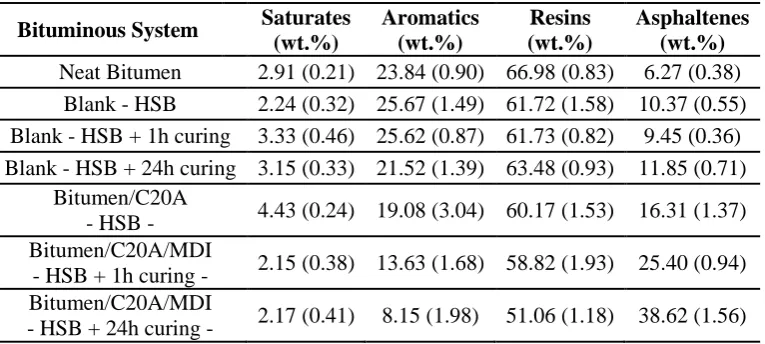
As shown in Fig. 10 (values also included in Table 2), blanks point out that bitumen
undergoes some oxidation during processing, also called “primary ageing”, by which
aromatics are transformed into resins, and resins into asphaltenes [1,8]. Thereby, a
slight decrease of around 5 wt.% was obtained in resins content, accompanied by a rise
in asphaltenes of 4 wt.%. This oxidation tends to result in an increase in the values of
the viscoelastic functions for bitumen, as observed in the rheological results,
deteriorating its performance at low in-service temperatures [6,21].
When C20A was added to bitumen, a further evolution was clearly observed. The
concentration of aromatics and resins decreased by nearly 5 and 7 wt.%, respectively, in
favour of a rise in the asphaltenic fraction of around 10 wt.%. Apart from the
contribution from certain oxidation, the variation obtained might result from the fact
that the C20A cannot be eluted by any of the solvents employed in the chromatographic
method used to separate the different bituminous fractions. Non-eluted C20A, in turn,
may also interact with other compounds, especially high molecular weight molecules
like those found in aromatics and resins, provoking their retention, and so lowering their
concentration in the chromatographic separation in favour of the asphaltenic content.
As reported in the literature [47,48], it would be expected that the subsequent addition
of MDI, followed by curing, led to a further similar modification of the system
composition, i.e. a decrease in the aromatic fraction, along with a rise in the asphaltene
25
bitumen/MDI chemical interactions, since aromatics and resins markedly decrease,
whilst asphaltenes rise by up to 32 wt.%, after 24 h curing. The evolution observed for
the different fractions is mainly attributable to the reactive interaction of free –NCO
groups in MDI with polar bitumen constituents, and with the hydroxyl groups that
MMT clays naturally contain on the edge of the platelets [10,16]. The resulting
modified bitumen compounds, with higher molecular weights, either inserted between
the clay platelets or attached onto their surface, would not be eluted during the
chromatographic separation, giving rise to the observed marked increase in asphaltene
content [9,26]. This result points to the strong reactive interaction between the different
constituents, yielding notable changes in the bituminous matrix microstructure and
composition, in agreement with the results obtained from the rheological and thermal
characterization.
4. CONCLUSIONS
The addition of 10 wt.% C20A to bitumen yielded a considerable alteration of the
thermo-rheological behaviour with respect to those of neat bitumen, revealing a more
thermally stable composite structure, manifest by the “rubbery” plateau-like zone
defined by the viscoelastic functions, confirming the C20A was mostly intercalated
within the bituminous matrix. The intercalated C20A facilitates the development of a
more complex multiphasic structural arrangement that acts as a reinforcing clay-based
network, contributing to the retention of structural stability at temperatures at which
bitumen normally softens.
Further addition of 2 wt.% MDI to the bitumen/C20A composite and 1 h curing led to a
decrease in the global elasticity of the sample, accompanied by a small diminution of its
agglomeration/re-26
aggregation of clay platelets/tactoids. Longer curing times provoked a marked change in
the thermo-rheological response. First, oxidation processes of bitumen molecules led to
increased asphaltenic fraction. Secondly, -NCO-involved reactions, which bring about
the progressive formation of larger and more complex compounds containing
urea/urethane linkages, further promoted the clustering of clay platelets/tactoids,
destabilizing their reinforcing effect when the bituminous matrix softens, despite
properties at medium in-service temperatures (30 – 40 ºC) having been improved.
Moreover, the type of shear processing applied during curing has also been shown to
greatly affect the composite system end properties, with clay intercalation/exfoliation
processes being favoured in the absence of stirring, leading to a greater reinforcement of
the system structure. Contrastingly shear processing promoted the re-aggregation of
clay platelets/tactoids, diminishing their degree of dispersion, and therefore, the
structural reinforcement provided by the clay. In the presence of MDI, processing shear
effects were even more pronounced, as the –NCO-involved reactions determined
whether new larger and more complex molecules contribute to a better nanoclay
dispersion, if not stirred, or tended to destabilise the system, under shear processing.
Funding: This work is part of two research projects (CTQ2014-56980-R and
TEP-6689) sponsored by a MINECO-FEDER Programme and the “Consejería de
Innovación, Ciencia y Empresa, Junta de Andalucía” (“Projects of Excellence”
Programme), respectively. The authors gratefully acknowledge their financial support.
27
References
[1] J. Read,, D. Whiteoak, The Shell bitumen handbook, Fifth ed., Thomas Telford,
London, 2003.
[2] J.-Y. Yu,, P.-C. Feng,, H.-L. Zhang,, S.-P. Wu, Constr. Build. Mater. 23(7)
(2009) 2636–40. 10.1016/j.conbuildmat.2009.01.007.
[3] A. Zare-Shahabadi,, A. Shokuhfar,, S. Ebrahimi-Nejad, Constr. Build. Mater.
24(7) (2010) 1239–44. 10.1016/j.conbuildmat.2009.12.013.
[4] F.J. Navarro,, P. Partal,, F. Martı́nez-Boza,, C. Valencia,, C. Gallegos, Chem.
Eng. J. 89(1–3) (2002) 53–61.
http://dx.doi.org/10.1016/S1385-8947(02)00023-2.
[5] F.J. Navarro,, P. Partal,, F. Martı́nez-Boza,, C. Gallegos, Fuel 83(14–15) (2004)
2041–9. http://dx.doi.org/10.1016/j.fuel.2004.04.003.
[6] F.J. Navarro,, P. Partal,, M. García-Morales,, M.J. Martín-Alfonso,, F.
Martínez-Boza,, C. Gallegos,, J.C.M. Bordado,, A.C. Diogo, J. Ind. Eng. Chem. 15(4)
(2009) 458–64. 10.1016/j.jiec.2009.01.003.
[7] F.J. Navarro,, P. Partal,, M. García-Morales,, F.J. Martinez-Boza,, C. Gallegos,
Fuel 86(15) (2007) 2291–9. http://dx.doi.org/10.1016/j.fuel.2007.01.023.
[8] M.J. Martín-Alfonso,, P. Partal,, F.J. Navarro,, M. García-Morales,, C. Gallegos,
Eur. Polym. J. 44(5) (2008) 1451–61.
28
[9] V. Carrera,, P. Partal,, M. García-Morales,, C. Gallegos,, A. Pérez-Lepe, Fuel
Process. Technol. 91(9) (2010) 1139–45.
http://dx.doi.org/10.1016/j.fuproc.2010.03.028.
[10] S. Sinha Ray,, M. Okamoto, Prog. Polym. Sci. 28(11) (2003) 1539–641.
10.1016/j.progpolymsci.2003.08.002.
[11] G. Polacco,, P. Kříž,, S. Filippi,, J. Stastna,, D. Biondi,, L. Zanzotto, Eur. Polym.
J. 44(11) (2008) 3512–21. 10.1016/j.eurpolymj.2008.08.032.
[12] K.N. Kim,, H. Kim,, J.W. Lee, Polym. Eng. Sci. 41(11) (2001) 1963–9.
10.1002/pen.10892.
[13] S.G. Jahromi,, A. Khodaii, Constr. Build. Mater. 23(8) (2009) 2894–904.
10.1016/j.conbuildmat.2009.02.027.
[14] S.T. Lim,, C.H. Lee,, H.J. Choi,, M.S. Jhon, J. Polym. Sci. Part B-Polymer Phys.
41(17) (2003) 2052–61. 10.1002/polb.10570.
[15] F.J. Ortega,, F.J. Navarro,, M. García-Morales,, T. McNally, Compos. Part B
Eng. 76 (2015) 192–200. http://dx.doi.org/10.1016/j.compositesb.2015.02.030.
[16] F.J. Ortega,, C. Roman,, F.J. Navarro,, M. García-Morales,, T. McNally, Fuel
Process. Technol. 143 (2016) 195–203.
http://dx.doi.org/10.1016/j.fuproc.2015.11.011.
[17] S.S. Ray,, K. Okamoto,, M. Okamoto, Macromolecules 36(7) (2003) 2355–67.
10.1021/ma021728y.
29
[19] A. Eckert, Pet. Coal 43(3) (2001) 51–3.
[20] D. Lesueur, Adv. Colloid Interface Sci. 145(1–2) (2009) 42–82.
http://dx.doi.org/10.1016/j.cis.2008.08.011.
[21] A. Pérez-Lepe,, F.J. Martı́nez-Boza,, C. Gallegos,, O. González,, M.E. Muñoz,,
A. Santamarı́a, Fuel 82(11) (2003) 1339–48.
http://dx.doi.org/10.1016/S0016-2361(03)00065-6.
[22] A.K. Barick,, D.K. Tripathy, Appl. Clay Sci. 52(3) (2011) 312–21.
10.1016/j.clay.2011.03.010.
[23] B. Hoffmann,, C. Dietrich,, R. Thomann,, C. Friedrich,, R. Mulhaupt, Macromol.
Rapid Commun. 21(1) (2000) 57–61.
10.1002/(sici)1521-3927(20000101)21:1<57::aid-marc57>3.0.co;2-e.
[24] B. Hoffmann,, J. Kressler,, G. Stoppelmann,, C. Friedrich,, G.M. Kim, Colloid
Polym. Sci. 278(7) (2000) 629–36. 10.1007/s003960000294.
[25] F.J. Navarro,, P. Partal,, F. Martinez-Boza,, C. Gallegos,, J.C.M. Bordado,, A.C.
Diogo, Mech. Time-Dependent Mater. 10(4) (2006) 347–59.
10.1007/s11043-007-9029-2.
[26] A.A. Cuadri,, M. García-Morales,, F.J. Navarro,, P. Partal, Fuel 118 (2014) 83–
90. 10.1016/j.fuel.2013.10.068.
[27] K. Wang,, S. Liang,, J. Deng,, H. Yang,, Q. Zhang,, Q. Fu,, X. Dong,, D. Wang,,
C.C. Han, Polymer (Guildf). 47(20) (2006) 7131–44.
30
[28] J.T. Yoon,, W.H. Jo,, M.S. Lee,, M.B. Ko, Polymer (Guildf). 42(1) (2001) 329–
36. 10.1016/s0032-3861(00)00333-5.
[29] J. Yu,, X. Zeng,, S. Wu,, L. Wang,, G. Liu, Mater. Sci. Eng. A 447(1–2) (2007)
233–8. 10.1016/j.msea.2006.10.037.
[30] M. Kracalik,, S. Laske,, A. Witschnigg,, C. Holzer, Rheol. Acta 50(11) (2011)
937–44. 10.1007/s00397-011-0545-2.
[31] F. Merusi,, F. Giuliani,, G. Polacco, Procedia - Soc. Behav. Sci. 53 (2012) 335–
45. 10.1016/j.sbspro.2012.09.885.
[32] S. Trinkle,, C. Friedrich, Rheol. Acta 40(4) (2001) 322–8.
10.1007/s003970000137.
[33] K. Hyun,, S.H. Kim,, K.H. Ahn,, S.J. Lee, J. Nonnewton. Fluid Mech. 107(1–3)
(2002) 51–65. 10.1016/s0377-0257(02)00141-6.
[34] H.G. Sim,, K.H. Ahn,, S.J. Lee, J. Nonnewton. Fluid Mech. 112(2–3) (2003)
237–50. 10.1016/s0377-0257(03)00102-2.
[35] S.R. Raghavan,, S.A. Khan, J. Colloid Interface Sci. 185(1) (1997) 57–67.
10.1006/jcis.1996.4581.
[36] R.A. Vaia,, E.P. Giannelis, Macromolecules 30(25) (1997) 8000–9.
10.1021/ma9603488.
[37] R.A. Vaia,, K.D. Jandt,, E.J. Kramer,, E.P. Giannelis, Chem. Mater. 8(11) (1996)
2628–35. 10.1021/cm960102h.
31
10.1021/ma051841z.
[39] D. Wu,, C. Zhou,, W. Yu,, X. Fan, J. Polym. Sci. Part B Polym. Phys. 43(19)
(2005) 2807–18. 10.1002/polb.20568.
[40] V. Tirtaatmadja,, K.C. Tam,, R.D. Jenkins, Macromolecules 30(5) (1997) 1426–
33. 10.1021/ma960098v.
[41] J.F. Masson,, G.M. Polomark, Thermochim. Acta 374(2) (2001) 105–14.
http://dx.doi.org/10.1016/S0040-6031(01)00478-6.
[42] J.F. Masson,, G.M. Polomark,, P. Collins, Energy & Fuels 16(2) (2002) 470–6.
10.1021/ef010233r.
[43] P. Collins,, J.F. Masson,, G. Polomark, Energy & Fuels 20(3) (2006) 1266–8.
10.1021/ef050403q.
[44] C.E. Corcione,, A. Maffezzoli, Thermochim. Acta 485(1–2) (2009) 43–8.
http://dx.doi.org/10.1016/j.tca.2008.12.009.
[45] J.F. Masson,, G. Polomark,, P. Collins, Thermochim. Acta 436(1–2) (2005) 96–
100. 10.1016/j.tca.2005.02.017.
[46] S. Bandi,, D.A. Schiraldi, Macromolecules 39(19) (2006) 6537–45.
10.1021/ma0611826.
[47] M.A. Izquierdo,, M. García-Morales,, F.J. Martínez-Boza,, F.J. Navarro, Mater.
Chem. Phys. 146(3) (2014) 261–8.
http://dx.doi.org/10.1016/j.matchemphys.2014.03.018.
32
Chem. 19(2) (2013) 704–11. 10.1016/j.jiec.2012.10.025.
Figure captions
Fig. 1. (a) Evolution of the complex modulus with temperature, and (b) evolution of the
loss tangent with temperature, at 10 rad/s, for neat bitumen, and for bitumen/C20A and
bitumen/C20A/MDI composites. Blank for high shear blending, followed by 24h
33
Fig. 2. Frequency sweep tests, at 10 rad/s, in the temperature range from 30 ºC to 75 ºC,
34
150 ºC, with a step size of 30 ºC between data series, for (b) bitumen/C20A and (c)
35
Fig. 3. Black diagrams, at 10 rad/s, with a step size of 15 ºC between data series, for (a)
neat bitumen, within the range of temperature from 30 ºC to 75 ºC; (b) bitumen/C20A
composite, from 30 ºC to 150 ºC; and (c), (d) bitumen/C20A/MDI composites, from 30
[image:37.595.91.511.185.489.2]ºC to 150 ºC.
Fig. 4. Stress sweep tests, at 1 rad/s, for (a) bitumen/C20A composite, at 30 and 150 ºC;
36
Fig. 5. Temperature sweep tests for bitumen/C20A composites: (a) dynamic oscillatory
shear testing protocol within the linear viscoelastic range, with an intermediate
37
processing at 150 ºC for 24 h (black pattern), and after the isothermal
small-amplitude-oscillatory-shear (ISAOS) stage (blue pattern). Arrows point out the temperature ramp
applied on each test.
Fig. 6. Temperature sweep tests for bitumen/C20A/MDI composites: (a) dynamic
oscillatory shear testing protocol within the linear viscoelastic range, with an
intermediate isothermal stage at 150 ºC for 24 h; and (b) temperature sweep patterns
after shear processing at 150 ºC for 24 h (black pattern), and after the isothermal
small-amplitude-oscillatory-shear (ISAOS) stage (blue pattern). Arrows point out the
[image:39.595.89.510.154.491.2]38
Fig. 7. Isothermal small-amplitude-oscillatory-shear (ISAOS) test at 150 ºC for 24 h, for
39
Fig. 8. (a) Typical pattern and thermal events for the non-reversing heat flow of the
systems studied. (b) Enthalpy values of the non-reversing heat flow thermal events for
[image:41.595.89.511.71.395.2]40
Fig. 9. (a) Characteristic pattern for the derivative of the heat capacity versus
[image:42.595.89.510.67.671.2]41
Tg’s found. (b) Tg values for neat bitumen, and for bitumen/C20A and
[image:43.595.89.512.123.671.2]bitumen/C20A/MDI composites in the range of temperature from -60 ºC to 150 ºC.
Fig. 10. Bitumen SARAs fractions for neat bitumen, and for bitumen/C20A and
43
Table 1. Penetration, R&B softening temperature and composition (SARAs fractions)
values for neat bitumen.
*Values given as mean (standard deviation)
Specifications Bitumen 160/220
Penetration (1/10 mm) 162
R&B softening point (ºC) 42.4
Saturates (wt.%) 2.91 (0.21)*
Aromatics (wt.%) 23.84 (0.90)*
Resins (wt.%) 66.98 (0.83)*
[image:45.595.138.457.148.300.2]44
Table 2. Bitumen SARAs fraction values for neat bitumen, and for Bitumen/C20A and
Bitumen/C20A/MDI composites. Data for the corresponding blanks are also included.
Bituminous System Saturates
(wt.%)
Aromatics (wt.%)
Resins (wt.%)
Asphaltenes (wt.%) Neat Bitumen 2.91 (0.21) 23.84 (0.90) 66.98 (0.83) 6.27 (0.38)
Blank - HSB 2.24 (0.32) 25.67 (1.49) 61.72 (1.58) 10.37 (0.55) Blank - HSB + 1h curing 3.33 (0.46) 25.62 (0.87) 61.73 (0.82) 9.45 (0.36) Blank - HSB + 24h curing 3.15 (0.33) 21.52 (1.39) 63.48 (0.93) 11.85 (0.71)
Bitumen/C20A
- HSB - 4.43 (0.24) 19.08 (3.04) 60.17 (1.53) 16.31 (1.37) Bitumen/C20A/MDI
- HSB + 1h curing - 2.15 (0.38) 13.63 (1.68) 58.82 (1.93) 25.40 (0.94) Bitumen/C20A/MDI
- HSB + 24h curing - 2.17 (0.41) 8.15 (1.98) 51.06 (1.18) 38.62 (1.56)