Munich Personal RePEc Archive
Industry Effects on Firm and Segment
Profitability Forecasting: Do
Aggregation and Diversity Matter?
Yim, Andrew and Schröder, David
Cass Business School, City University London, Birkbeck, University
of London
7 August 2013
Industry Effects on Firm and Segment Profitability Forecasting:
Do Aggregation and Diversity Matter?†
David Schröder, Birkbeck, University of London
Andrew Yim, Cass Business School, City University London
7 August 2013
Abstract. This paper analyzes the incremental advantage of industry-specific models of profitability forecasting, over economy-wide models, for business segments and firms. Some prior research suggests that industry-specific analysis has no advantage over economy-wide analysis in forecasting firm profitability. This seems puzzling because many studies in economics and strategic management have documented the importance of industry effects in explaining firm profitability. We reconcile this apparent inconsistency by showing that industry effects on profitability forecasting exist at the more refined business segment level, but can be obscured by aggregated reporting at the firm level. Industry-specific forecasts are significantly more accurate in predicting profitability for segments and undiversified firms. The limited usefulness of industry-specific forecasting models at the firm level can be explained by the existence of multiple business segments in firms. (JEL L25, G17, M21, M41)
Key words: Segment profitability, Earnings predictability, Earnings persistence, Aggregation, Diversity, Industry membership
D. Schröder. Postal: Department of Economics, Mathematics and Statistics, Birkbeck, University of London, Malet Street, London WC1E 7HX, UK. Phone: +44 20 7631-6408. E-mail: [email protected] .
A. Yim. Postal: Faculty of Finance, Cass Business School, City University London, 106 Bunhill Row, London EC1Y 8TZ, UK. Phone: +44 20 0933. Fax: +44 20 7040-8881. E-mail: [email protected] / [email protected] .
†
Industry Effects on Firm and Segment Profitability Forecasting:
Do Aggregation and Diversity Matter?
1. Introduction
Accurate forecasts of profitability, earnings or growth are essential ingredients in
company valuation. For example, valuation models such as those based on residual
income (Edwards and Bell 1961 and Ohlson 1990) often require precise estimates of a
firm’s expected earnings or profitability for different time horizons. Some prior research
has suggested that equity analyst forecasts are the best source for a firm’s expected
earnings (Brown et al. 1987). However, more recent studies conclude that model-based
forecasts significantly outperform analysts’ predictions (Hou, van Dijk, and Zhang 2012).
In general, the future of a firm may depend on economy-wide or industry-specific
factors. Several studies in the economics and strategic management literatures have
documented the importance of industry effects in future changes in profitability and
earnings (e.g., Schmalensee 1985, McGahan and Porter 1997, and Bou and Satorra
2007). Against the backdrop of these studies, recent research often favors
industry-specific more than economy-wide forecasting models. For example, Gebhardt, Lee, and
Swaminathan (2001) propose a residual income model that explicitly incorporates
industry-specific paths of expected long-term profitability.1
Yet, the preference for industry-specific forecasting models does not go
unchallenged. Fairfield, Ramnath, and Yohn (2009) find that there is no significant
1
Although firm-specific factors might be useful for forecasting, a firm-specific forecasting model
is undesirable because of the survivor bias resulting from the long-history data requirement (see Fama
and French 2000, p. 162, for more discussion). Indeed, Esplin (2012) shows that long-term growth
forecasts obtained from industry-specific prediction models are more accurate than firm-specific
forecast improvement of industry-specific over economy-wide analysis in predicting firm
profitability. The finding questions the suitability of the valuation model by Gebhardt et
al. (2001), which has enjoyed great popularity in the finance literature.2
This paper proposes an intuitive reconciliation of the seemingly inconsistent findings
of the economics and strategic management literatures and the Fairfield et al. (2009)
study. Many firms are conglomerates that operate in different industries. They often have
various lines of business organized into units reported as business segments. When the
segments of such diversified firms are associated with different industries, there is no
single industry accurately representing the whole firm. A firm-level industry-specific
forecasting model therefore cannot capture the firm’s inherent complexity – and
consequently fails to generate accurate predictions of future profitability. In contrast, the
individual business segments of a firm are by definition more homogenous than the firm
itself, and often operate mainly in one industry. Hence, for the firm’s business segments,
industry-specific forecasting models should generate more accurate profitability and
growth forecasts. In sum, we conjecture that industry effects on profitability forecasting
exist and are clearer at the segment level, but can be obscured when data are aggregated
to the firm level.
Using both firm and segment data from 1967 to 2011, this study finds strong
empirical support for the conjecture. In line with the literature, we employ various
versions of the persistence model to predict future profitability and growth. We show that
compared to economy-wide predictions, industry-specific forecasts are significantly more
accurate in predicting profitability and growth for individual business segments as well as
undiversified firms (with only one business segment). With regard to economic
2
The residual income model by Gebhardt et al. (2001) has been used extensively in the finance
literature to calculate a firm’s implied cost of capital, see e.g., Pastor, Sinha, and Swaminathan (2008),
significance, the forecast improvements (in terms of absolute forecast error) for large
industry sectors can be as high as around 10% of the actual profitability to be forecast.
We also address the effect of a significant change in the segment reporting standard
during our sample period. Starting from 1998, the Statement of Financial Accounting
Standards No. 131 (SFAS 131) superseded SFAS 14 to become the new standard. In line
with other studies that express concerns about segment data quality from 1998 onward,
we examine the implications of our conjecture using data from the SFAS 14 period only.3
We find stronger supporting evidence for the years prior to 1998.
Our analysis also reveals that industry-specific models are more accurate in
predicting a firm’s return on sales (ROS) or net profit margin, even at the firm level.
Consistent with our conjecture, the ROS forecast improvement is even larger when
considering individual business segments and undiversified firms. Taken together, our
results show that aggregation and diversity matter in revealing the industry effects on
profitability forecasting.
This study builds on the extensive literature on predicting earnings or profitability. In
practice, these tasks are equivalent to each other because earnings often are deflated by
total assets in regression analysis to mitigate the scale effect (Dechow, Ge, and Schrand
2010, p. 352). Researchers from different fields have contributed to this literature.
Accounting and finance scholars have examined the time-series properties and
3
Under SFAS 14, firms were asked to disclose segment information according to the industry
classification of the segments. Most important, reported segment profits must conform to the US
generally accepted accounting principles (GAAP). This guarantees certain level of comparability
across firms. With the implementation of SFAS 131, firms are only required to align the segment
reporting with the internal structure and accounting. Hence, segment profit data are not as comparable
across firms as before. Due to concerns like this, other studies focus their analysis on the SFAS 14
predictability of earnings.4 Economists and strategic management researchers have
studied the persistence and variability of profitability.5 Among the many models used to
forecast profitability, the first-order autoregressive model is a parsimonious choice with
the slope coefficient measuring the persistence of profitability. Therefore, it is sometimes
referred to as the persistence model. Fama and French (2000) modify such a model to
analyze non-linearities of firm profitability. They find that mean reversion is faster when
profitability is below its mean and when it is further from its mean in either direction.
Fairfield et al. (2009) obtain their findings using a similar modified model. Unlike
higher-order autoregressive models, the persistence model does not require long earnings
histories and therefore minimizes the survivor bias. The model is particularly useful when
non-earnings accounting variables are not available for use as predictors. In this paper,
the limited availability of segment-level data prevents the use of sophisticated models to
forecast profitability at the segment level.
Our study is also related to the growing literature that examines the usefulness of
providing less aggregated segment-level data to the public. Several studies find that
segment data allows stakeholders such as analysts, investors, and researchers to anticipate
future earnings more accurately (e.g., Ettredge et al. 2005, Berger and Hann 2003,
Baldwin 1984, and Collins 1976). In fact, it was analysts’ strong desire to have more
detailed segment data to supplement consolidated company data for use in forecasting
company performance that led to a change in the segment reporting standard in 1997
4
These studies include Dichev and Tang (2009), Frankel and Litov (2009), Penman and Zhang
(2002), Baginski et al. (1999), Ali, Klein, and Rosenfeld (1992), Bar-Yosef, Callen, and Livnat
(1987), Conroy and Harris (1987), Penman (1983), Brandon, Jarrett, and Khumawala (1983), Chant
(1980), Albrecht, Lookabill, and McKeown (1977), and Watts and Leftwich (1977).
5
Examples are Goddard et al. (2011), Bou and Satorra (2007), Glen, Lee, and Singh (2003),
Ruefli and Wiggins (2003), McGahan and Porter (2002, 1999, 1997), Waring (1996), Rumelt (1991),
(Botosan and Stanford 2005).
Finally, this study is related to research in the accounting and finance literature that
makes use of business segment data to analyze and explain important patterns that are
observable at the firm level. For example, the diversification discount has been
investigated in more detail using segment data (Berger and Ofek 1995, Lamont and Polk
2002, and Hund, Monk, and Tice 2010). Moreover, disaggregated segment-level data are
found to be more useful in predicting firm performance because they allow better
monitoring of agency problems such as overinvestment and cross-subsidization (Berger
and Hann 2007).
By using segment-level data to analyze the incremental advantage of
industry-specific profitability forecasting models over economy-wide models, this paper
contributes to the above-mentioned streams of research. Most of all, our results provide
an intuitive explanation to Fairfield, Ramnath, and Yohn’s (2009) no industry effect
finding. Thereby we reconcile the apparent inconsistency between their study and others
that observe industry effects in various contexts.
The paper is organized as follows. In the next section, we explain the two hypotheses
developed from our conjecture and the research design used to test the hypotheses.
Section 3 describes the data used and the sample construction procedure. Section 4
discusses the evidence from the firm- and segment-level analysis for the whole data
period and for the SFAS 14 period. Concluding remarks are given in section 5.
2. Hypotheses and Research Design
Our hypotheses are stated in terms of forecast improvement of industry-specific (IS)
over economy-wide (EW) analysis. To be concrete about the meaning of forecast
Details of the research design are provided after we have explained the two hypotheses.
2.1 Hypotheses
We use the standard persistence model (i.e., first-order autoregressive), as well as two
other augmented specifications, to forecast profitability. The segment/firm profitability
forecast improvement (of IS over EW analysis) is defined as the absolute forecast error
from the EW analysis minus its IS counterpart. For the standard persistence model, the
forecast used to define the forecast error is computed using the following regression:
xt = αt + βt xt–1 + εt,
where xt and xt–1 denote the profitability of the current and the previous year,
respectively. The model coefficients, αt and βt, are indexed by a year subscript t because
they are re-estimated each year based on the most recent 10 years of data. The estimated
coefficients from these in-sample regressions (Step 1) are used to compute the
profitability forecasts and the forecast errors used for out-of-sample tests (Step 2). Further
details of this two-step procedure are given in section 2.2.
Inspired by studies in the diversification and segment reporting literatures (e.g.,
Berger and Ofek 1995, Campa and Kedia 2002, Berger and Hann 2007, and Hund, Monk,
and Tice 2010), we conjecture that industry effects on profitability forecasting exist and
are clearer at the segment level but can be obscured when segment-level data capturing
the effects are aggregated to the firm level. To verify the conjecture, we examine two
implications of the conjecture elaborated below.
First, to the extent that single-segment firms on average are less diversified (more
homogenous) than multiple-segment firms, we can find industry effects at the firm level
H1: The firm profitability forecast improvement is positive for single-segment firms
but not for multiple-segment firms.
However, there is an opposing effect against this prediction. Prior studies suggest that
some firms lump together several segments to report as one segment externally (e.g.,
Botosan and Stanford 2005). Hence, a firm reporting to have a single segment cannot be
taken literally as a firm with only one relatively homogeneous internal unit. If many firms
lump together all segments to report as a single segment, such single-segment firms need
not be on average less diversified than multiple-segment firms. In such circumstances, we
may not be able to find significant industry effects at the firm level for single-segment
firms.
Therefore, the first hypothesis is a joint test of our conjecture and the maintained
assumption that not too many genuinely multiple-segment firms have reported as
single-segment firms. Confirming the hypothesis is a strong support to our conjecture. Failing to
confirm it could be due to the violation of the maintained assumption.
By definition a segment of a firm is more homogeneous in activities than the firm
itself. If as conjectured it is only because of aggregated reporting at the firm level that
obscures the industry effects on profitability forecasting, then we should see the effects
re-appearing at the segment level. This gives our second hypothesis for testing:
H2: The segment profitability forecast improvement is positive.
2.2 Research Design
Like Fairfield, Ramnath, and Yohn (2009), our procedure to construct forecast
firm/segment profitability. Three specifications are considered, ranging from the basic
first-order autoregressive specification stated below to two augmented versions to be
detailed shortly:
IS model: xi,t = αj,t + βj,t xi,t–1 + εi,t,
EW model: xi,t = αt + βt xi,t–1 + εi,t,
where xi,t is the profitability of firm/segment i in year t, j is the industry of the
firm/segment, and εi,t is the error term. The IS model estimates a regression for each
industry j separately, whereas the EW model pools all observations into one regression.
We estimate the year-indexed coefficients on a rolling basis using the most recent 10
years of data. For example, to estimate αt and βt, we use profitability data of all
firms/segments from year t back to year t – 9 and their lagged values from year t – 1 back
to year t – 10. To obtain reasonably reliable estimates, we require a minimum of 100
observations for each rolling regression. Some industries are excluded from the analysis
owing to too few observations. For equal-footing comparisons, we estimate the EW
model using only observations that are included to estimate the IS model.
Besides the basic specification, we consider augmented versions of the model by
adding first a dummy variable to capture nonlinear mean reversion of profitability and
then in the third specification also the predicted value of sales growth. This last version of
the in-sample regression that contains all the variables is as follows:
IS model: xi,t = αj,t + βj,t xi,t–1 + γ j,t Dj,i,t xi,t–1 + λ j,t PREDGSLi,t + εi,t,
EW model: xi,t = αt + βt xi,t–1 + γt Di,t xi,t–1 + λt PREDGSLi,t + εi,t,
where Dj,i,t in the IS model is a dummy variable equal to 1 if in year t – 1 the profitability
industry j, and zero otherwise. The dummy variable Di,t in the EW model is the
counterpart of Dj,i,t for all firms/segments in any industry. These dummy variables allow
the mean reversion of profitability to differ for firms/segments with above- and
below-average profitability. Fama and French (2000), among others, have documented a
non-linear pattern of the mean reversion of profitability.
Penman (2003) and Lundholm and Sloan (2007) suggest that predicted sales growth
should be important to profitability forecasting. Therefore, in the third specification we
also include the predicted sales growth of a firm/segment, PREDGSLi,t. This is the fitted
value of a first-order autoregressive regression of sales growth: gi,t = ηj,t + θj,t gi,t–1 + εi,t,
where gi,t is the percentage change in sales of firm/segment i from year t – 1 to year t and
ηj,t and θj,t are coefficients of the model. The regression is carried out for each industry j
separately because Fairfield, Ramnath, and Yohn (2009) have documented a significant
industry effect on sales growth forecasting.
In the second step of the procedure to construct forecast improvements, we use the
estimated coefficients of the in-sample regressions and the observed profitability of last
year to forecast the firm/segment profitability of the current year. For the basic first-order
autoregressivespecification, this means
IS model: EIS[xi,t]= aj,t + bj,t xi,t–1,
EW model: EEW[xi,t]= at + bt xi,t–1,
where a and b denote the estimated coefficients. The counterparts of the two augmented
specifications are defined analogously.
To perform an out-of-sample test on the relative accuracy of the two models, we first
difference between the profitability actually observed and the profitability forecast:
AFEIS = | xi,t – EIS[xi,t] |,
AFEEW = | xi,t – EEW[xi,t] |,
where AFEIS and AFEEW are the absolute forecast errors for a firm/segment of a year
based on the IS and EW models, respectively. Next, we calculate the forecast
improvement (FI) of the IS over EW model by deducting AFEIS from AFEEW:
FI= AFEEW – AFEIS.
If IS analysis can improve the accuracy of profitability forecasting compared to EW
analysis, the FI measure should be positive on average.
To assess the average magnitude of the firm/segment profitability forecast
improvement, we calculate the overall average across all firm/segment observations,
respectively. This is referred to as the pooled mean in the result tables. Following
Fairfield, Ramnath, and Yohn (2009), we also calculate another measure of average
forecast improvement by taking the mean of the yearly average forecast improvements.
This is referred to as the grand mean. Most of the results are robust to the two measures.
In our view, the pooled mean uses information more efficiently than the grand mean.
Thus, the latter is a more conservative measure for proving significant forecast
improvements. The p-values reported in the result tables are obtained from t-tests based
on robust standard errors.6
6
For the pooled mean, standard errors are clustered by firm and year following Rogers (1993); for
3. Data and Sample Selection
In this section, we give an overview of the data used and the sample constructed,
followed by a discussion of the summary statistics.
The firm and business segment data used in the analysis come from the Compustat
annual fundamentals and Compustat segments databases of the Wharton Research Data
Services (WRDS). Most of the analysis uses segment data, which are available from as
early as 1976. Because the data coverage in the initial year is not good, we use data from
1977 onward. Our in-sample regressions require 10 years of data to estimate the
coefficients of the models. So the earliest forecasts for the out-of-sample tests for
business segments are from 1987. In some of the analysis involving firm data, the
in-sample regressions require 20 years of data. Therefore, we use firm data from 1967
onward. This allows the earliest forecasts for the out-of-sample tests for firms to be
available from 1987 as well, facilitating comparing the results of the firm- and
segment-level analyses.
We use the two-digit primary Standard Industry Classification (SIC) code to define
the industry to which a firm or business segment belongs.7 Observations with missing
SIC codes are excluded from the sample. To avoid distortions caused by regulated
industries, we also exclude all firms and segments in the financial service and utilities
sectors (i.e., with SIC between 6000 and 7000, or between 4900 and 4950). Besides the
financial and utilities sector, we also exclude the U.S. postal service (SIC 4311) and
non-classifiable establishments (SIC above 9900).
7
Some studies (e.g., Fairfield, Ramnath, and Yohn 2009) use the Global Industry Classification
Standard (GICS) to classify industries. However, GICS codes are often unavailable for segment-level
Some firms in the sample change their internal structure from time to time, which
leads to changes in the number of the disclosed segments and possibly their SIC codes.
Such a restructuring requires firms to restate previous segment information to make them
comparable across years. We use the restated information in the in-sample regressions,
but not in the out-of-sample analysis to prevent look-ahead bias.
In some of the analysis, we distinguish between single- and multiple-segment firms.
Multiple-segment firms are firms that report more than one segment; single-segment
firms are those reporting only one segment. Following SFAS 131, some firms have
changed the number of reported segments from one in 1997 to more than one by 1999,
suggesting that they might not be genuinely single-segment firms prior to 1997. Owing to
the doubt in correctly classifying these firms, we exclude them from analyses that require
a differentiation between single- and multiple-segment firms.
Occasionally, some firm/segment has two observations per calendar year. We drop
identical duplicate entries. If the data of duplicate observations are diverging, e.g., due to
reasons like shortened fiscal years, we exclude them from the sample.8 To mitigate the
impact of small denominators on firm profitability measures, we exclude firm
observations with total assets, net operating assets, and sales below USD 10mn and book
value of equity below USD 1mn. For segment data, we exclude observations with total
identifiable assets and sales below USD 1mn.
To avoid the influence by outliers, observations with the absolute value of
firm/segment profitability exceeding one are excluded. To reduce the influence by
8
The deletion of double observations per calendar year reduces the sample size by 4 observations
mergers and acquisitions, we remove observations with growth in operating assets, net
operating assets, book value of equity, and sales above 100%. Recall that our analysis has
an in-sample regression step and an out-of-sample test step. Before the in-sample
regressions, we further exclude observations with the profitability measure in concern
falling in the top or bottom one percentile. However, we do not apply such an
extreme-value exclusion criterion again before the out-of-sample tests to avoid any look-ahead
bias in the analysis.
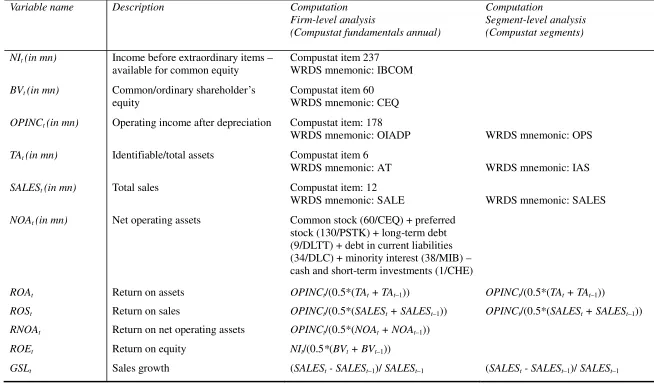
We focus on return on assets (ROA) and return on sales (ROS) as profitability
measures. Return on net operating assets (RNOA) and return on equity (ROE) are also
used as alternative measures in the firm-level analysis to be comparable to Fairfield,
Ramnath, and Yohn (2009). Due to data limitations, these measures cannot be
constructed at the segment level. Table 1 summarizes the definitions of the four
profitability measures and the variables used to compute the measures.
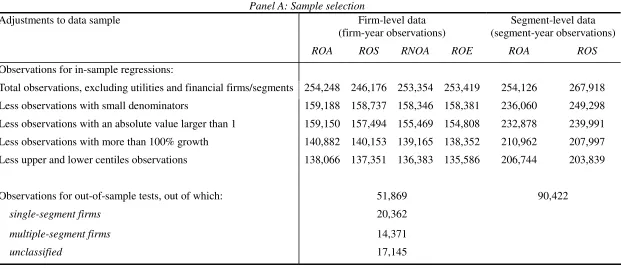
Panel A of table 2 summarizes the number of observations after applying each
exclusion criterion described above. The exclusion criteria are similar to those in
Fairfield, Ramnath, and Yohn (2009). For consistency, only observations with all four
profitability measures available are used in the firm-level analysis and only those with
both ROA and ROS measures available are used in the segment-level analysis.
Profitability forecasts are constructed from the estimated coefficients of in-sample
regressions based on the most recent 10 years of data (for segment-level analysis) or up
to 20 years (for firm-level analysis). So forecasts are available for out-of-sample tests
only from 1987 onward. Because segment data are required to classify firms into single-
segment data in early years.
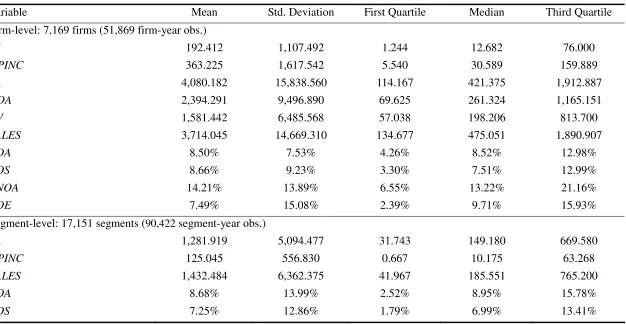
Panels B and C of table 2 give an overview of the firm and segment data used to
compute the average forecast improvements reported in section 4. The firm-level analysis
uses 51,869 observations of 7,169 unique firms, whereas the segment-level analysis is
based on 90,422 observations of 17,151 unique segments.
For firms, the ROA on average is 8.50%, while the mean ROS is slightly higher,
reaching 8.66%. With 14.21%, the mean RNOA is considerably higher. In contrast, the
average ROE is much lower: only 7.49%. These statistics are similar to those in prior
studies, such as Fama and French (2000) and Fairfield, Ramnath, and Yohn (2009). In
terms of ROA, the segment profitability is 8.68% on average, very similar to the firm
profitability. However, the segment ROS is somewhat lower, with an average equal to
7.25%.
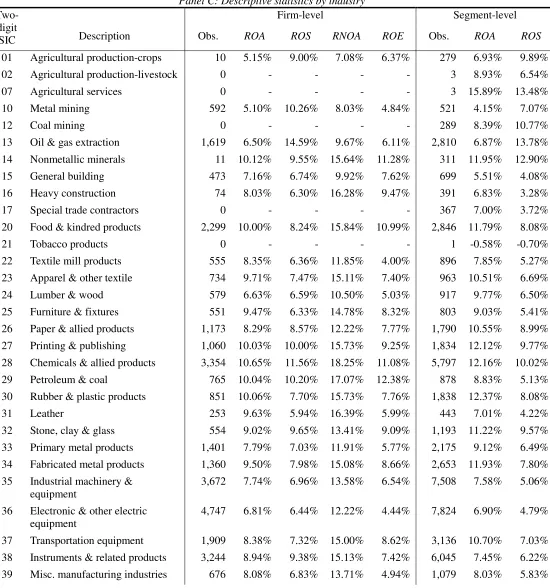
Panel C reports for each industry the number of observations, as well as average
profitability. With 4,747 firm-year and 7,824 segment-year observations, electronic &
other electric equipment (SIC 36) constitutes the largest industry in the sample. Other
large industries are chemicals & allied products (SIC 28), industrial machinery &
equipment (SIC 35), instruments & related products (SIC 38), and business services (SIC
73).
There is substantial variation in profitability across industries. For firms, chemicals &
allied products is the sector with the highest ROA (10.7%), whereas communications has
the highest ROS (19.7%). The lowest ROA is from auto repair, services & parking
(4.9%), and the lowest ROS is from food stores (3.4%). Apart from industries with only a
highest and second highest segment ROS are from pipelines, except natural gas (25.1%)
and communications (19.0%), respectively. Metal mining has the lowest segment ROA
(4.2%), and food stores has the lowest segment ROS (2.9%).
4. Results on Forecast Improvement of IS over EW Model
The results of our firm- and segment-level analyses for the whole data period and the
SFAS 14 period are discussed in this section. We conclude the section with an extension
of the analysis to sales growth forecast improvement of IS over EW model.
4.1 Firm-level Analysis
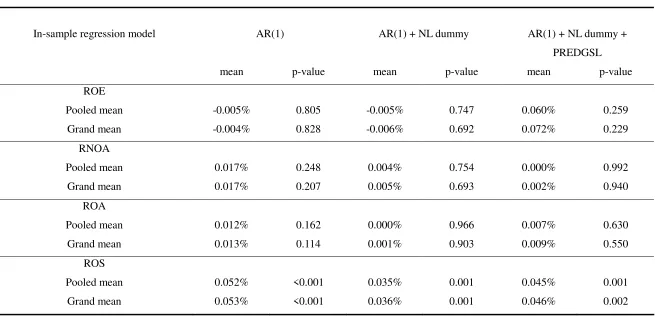
We begin with panel A of table 3 that verifies whether Fairfield, Ramnath, and
Yohn’s (2009) no industry effect result for profitability forecasting continues to hold for
our sample covering 1987-2011. As expected, firm profitability forecast improvements
(of IS over EW analysis) are not significantly different from zero for the two profitability
measures, namely ROE and RNOA, analyzed by Fairfield, Ramnath, and Yohn’s (2009).
The result holds regardless of the specifications considered or the way the mean forecast
improvements are computed. The no industry effect finding is further confirmed when
using ROA as the profitability measure. The use of this measure facilitates comparison
with the results based on segment-level analysis (where ROE and RNOA cannot be
computed owing to data limitations).
Interestingly, we also obtain a new finding: In terms of ROS, the firm profitability
forecast improvement is highly significantly positive, regardless of the specifications or
forecast improvement measures. This suggests that Fairfield, Ramnath, and Yohn’s
(2009) no industry effect result for profitability forecasting may be sensitive to the
consistent with our conjecture that industry effects on profitability forecasting are
stronger at the segment level than at the firm level. The results of our two tests presented
below provide evidence supporting the conjecture as well as the consistency with the new
finding based on ROS.
We argue that the lack of (or weaker) industry effect at the firm level is due to
aggregated reporting that obscures the relation between profitability and industry-specific
characteristics. Many firms do not operate in a single industry. Often they have different
lines of business organized into units reported as business segments. When the segments
of a multiple-segment firm are associated with different industries, there is no one single
industry that can accurately represent the whole firm. Describing a multiple-segment firm
with a primary industry ignores the relation between its profitability and the other
industries to which its segments belong. In contrast, for firms with a single business
segment, the firm-level reporting does not distort the truth – the only segment of a
single-segment firm is effectively identical to the whole firm. If industry effects on profitability
forecasting exist at the segment level, they should also be observed at the firm level when
confining to single-segment firms. However, for multiple-segment firms, the effects can
still be insignificantly different from zero.
To test this hypothesis (H1), we match the sample of firm profitability forecast
improvements with the business segment data. This allows partitioning the forecast
improvements into subsamples for single- and multiple-segment firms. The results are
presented in panel B of table 3. The reduction in the total sample size to 34,733 in the
panel is mainly due to the unavailability of segment data for matching. Moreover, we
segment sales to mitigate data quality concerns. Owing to the doubt in correctly
classifying firms that might not be genuinely single-segment, as suggested by the
increase in the reported number of segments to more than one immediately after SFAS
131, we also exclude such firms from the analysis.
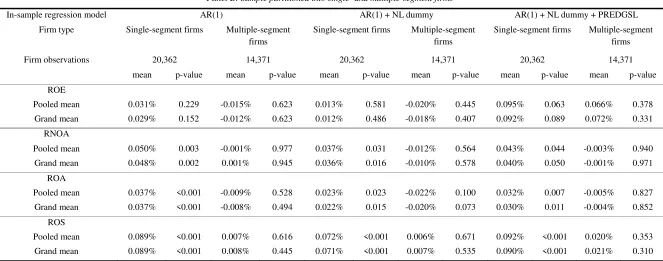
By partitioning the sample, we find evidence strongly supporting H1. First of all,
except for one case (namely, ROA with the second specification), all the forecast
improvements for multiple-segment firms are statistically indistinguishable from zero. So
EW analysis remains as good as IS analysis in forecasting firm profitability for
multiple-segment firms, as predicted by the hypothesis.
In contrast, the forecast improvements for single-segment firms generally are
significantly positive. Many are at the 5% or even 1% significance level. Although in
terms of ROE the forecast improvements for single-segment firms are insignificant in the
first two specifications, they become significantly positive at the 10% level when
predicted sales growth (PREDGSL) is included in the third specification. Overall, the
evidence provides solid support for the prediction that IS analysis is useful for
profitability forecasting even at the firm level when confining to single-segment firms.
Consistent with our conjecture, the point estimates of the forecast improvements for
single-segment firms in panel B of table 3 are all markedly greater than their counterparts
in the full sample in panel A. This holds even for ROS, which unlike the other
profitability measures shows strong industry effects on profitability forecasting at the
firm level even for the full sample that contains both single- and multiple-segment firms.
The fact that for ROS the industry effects appear only in the subsample of single-segment
we conclude that the findings above broadly confirm H1.
Although the forecast improvement for single-segment firms on average is not large,
the economic significance of the improvement is material for certain industries. For
example, one of the largest industry sectors is communications (SIC 48). This industry
sector has an ROE forecast improvement of 1.3%. Given that the single-segment firms in
this sector on average have an ROE of about 13.8%, the forecast improvement of 1.3%
means IS forecasts on average being 9.4% (= 1.3% / 13.8%) closer to the actual ROE
than EW forecasts. Other industries with material forecast improvements for
single-segment firms include chemicals & allied products (SIC 28), railroad transportation
(SIC40), and transportation services (SIC 47).
As already explained, we have doubt in correctly classifying firms that might not be
genuinely single-segment firms prior to 1997 and thus exclude them in the analysis
above. To verify that the nature of these “non-classified” firms is consistent with our
suspicion, we also analyze the forecast improvements for this group of firms. Since we
suspect that they are disguised multiple-segment firms, we expect no significant forecast
improvements for these firms. The results tabulated in appendix table 1 (available upon
request) confirm the expectation. None of the forecast improvements is significant,
regardless of the profitability measure and the regression specification used. As such, the
finding also provides further indirect evidence for the hypothesis that under SFAS 14,
managers hid important segment information from analysts and investors (Botosan and
Stanford 2005).
In the next subsection, we turn to the segment-level analysis to obtain more direct
evidence to support our conjecture.
4.2 Segment-level Analysis
forecasting at the segment level, we should also observe forecast improvements of IS
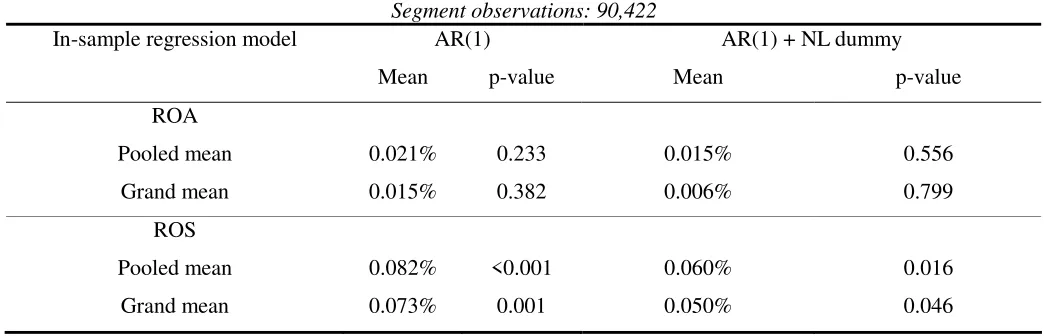
over EW analysis for segment profitability. Table 4 shows the results of this hypothesis
(H2). Only the first two specifications of in-sample regression are considered here
because the segment predicted sales growth (PREDGSL) of the third specification
requires 20 years of data to construct. Given that our segment data start from 1977, this
would leave too few years in the out-of-sample test period for the results to be reliable.
Moreover, even if considered, the results of the third specification would not be directly
comparable to other results based on the 1987-2011 out-of-sample test period.
The results in table 4 provide some support for H2. When profitability is measured in
terms of ROS, the segment profitability forecast improvements are significantly positive
at the 5% or even 1% level, regardless of the two specifications or the way the mean
forecast improvements are measured. In terms of the magnitude, the point estimates are
also in line with those of the firm profitability forecast improvements for single-segment
firms in panel B of table 3. Note that the segment-level analysis includes all segments,
whether they belong to single- or multiple-segment firms. The similar magnitude of the
point estimates of the forecast improvements suggests that a segment, regardless of where
it is from, behaves like a single-segment firm. This is consistent with the belief that what
drives our results of H1 is the existence of industry effects on profitability forecasting at
the segment level.
However, in terms of ROA, the forecast improvements are not strong enough to be
regarded as significant at the conventional level. This difference between the results for
ROS and ROA highlights an issue about segment data in the SFAS 131 period already
measure in the sense that sales unlike identifiable assets can be correctly assigned to
segments without ambiguity. The reliability of ROA decreases in the SFAS 131 period
because firms are only required to align the segment reporting with the internal structure
and accounting. Consequently, segment profits become less comparable across firms
owing to non-uniform definitions adopted by different entities (Berger and Hann 2003
and Berger and Hann 2007). In contrast, SFAS 14 asked firms to report segment
information according to industry classification. Most important, the segment profits
reported must conform to the US generally accepted accounting principles (GAAP),
ensuring certain level of comparability across firms.
Although the issue above also affects ROS, the impact is unlikely to be as severe
because the denominator, namely segment sales, can be more reliably measured than its
counterpart in ROA, namely the identifiable assets of a segment. Thus, the results in table
4 are consistent with the well-recognized problem of segment profit data in the SFAS 131
period. To provide further support of this explanation of the results in table 4 and for
robustness checking, we re-examine the two hypotheses using only data from the SFAS
14 period. The results are discussed in the next subsection.
4.3 Analysis for the SFAS 14 Period
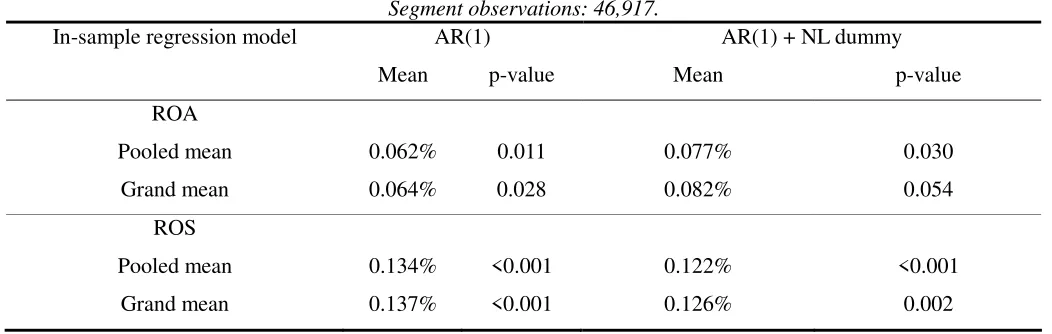
Table 5 shows the results of H2 using data from the SFAS 14 period. The sample
size decreases considerably to 46,917 segment-year observations, only about half of the
size of the full sample. By excluding observations with problematic segment profit data
from the SFAS 131 period, we find clear support to H2. Apart from one exception, all
the segment profitability forecast improvements are significantly positive at the 5% level,
forecast improvements are measured. The exception is also significantly positive, though
at the 10% level. For ROS, which arguably is the more reliable profitability measure, the
significance levels of the forecast improvements are uniformly at 1%. All of the
previously insignificant results for ROA now become significantly positive. Overall, we
conclude that the evidence in table 5 strongly supports H2.
As in the analysis for single-segment firms, communications (SIC 48) is the industry
sector with the largest forecast improvements. For instance, the segment ROS and ROA
forecast improvements are 1.5% and 0.7%, respectively. The segments in this sector on
average have an ROS of about 19% and an ROA of about 10%. Therefore, IS forecasts
on average are around 8% and 7% closer to the actual ROS and ROA, respectively, than
EW forecasts. Other industries with material forecast improvements are food & kindred
products (SIC 20), chemicals & allied products (SIC 28), rubber & plastic products (SIC 30), and railroad transportation (SIC40).
For completeness and robustness checking, we also revisit H1 using data from the
SFAS 14 period. To be more comparable with the results in table 5, we restrict to the
same in-sample and out-of-sample periods in table 6 and consequently only consider the
same two specifications. Excluding the observations from the SFAS 131 period reduces
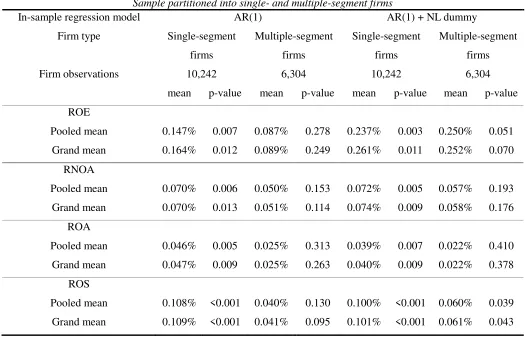
the total size of the sample to 16,546 firm-year observations. Among these, 10,242
observations are from single-segment firms, with the remaining 6,304 from
multiple-segment firms.
Again, table 6 strongly supports the prediction in H1 that IS analysis is useful for
profitability forecasting even at the firm level when confining to single-segment firms.
All the forecast improvements for single-segment firms are highly significantly positive
The results for multiple-segment firms also broadly support the prediction that EW
analysis remains as good as IS analysis in forecasting firm profitability for such firms.
Apart from a few exceptional cases (namely, ROE and ROS), all other forecast
improvements for multiple-segment firms are statistically indistinguishable from zero.
Taken together, the evidence in table 6 provides solid support for H1.
The difference in the results between the two accounting regimes highlights a
potential drawback of the new accounting standard SFAS 131. The new standard has
clearly brought many benefits, such as an increase in the number of reported segments
and a higher informative value of the segment data. On the other hand, under SFAS 131
the segment data are less comparable across firms. The increased noise in the segment
data limits the usefulness of the data in predicting profitability and hence reduces the
accuracy of industry-specific forecasting models at the segment level.
4.4 Extension: Sales Growth Forecasting
One of the in-sample regression specifications of the firm-level analysis in section 4.1
uses a firm’s predicted sales growth (PREDGSL) as an explanatory variable. As
explained in section 2.2, this variable is itself constructed from an IS forecasting model
because Fairfield et al. (2009) has documented a significant industry effect on sales
growth forecasting. However, it is a priori not clear that such an effect also exists in the
sample of this study. Moreover, it is interesting to know whether our conjecture on
profitability forecasting also applies to sales growth forecasting, i.e., industry effects on
sales growth forecasting exist and are clearer at the segment level, but can be obscured
when data are aggregated to the firm level. To examine these issues, we repeat the firm-
and segment-level analysis on sales growth forecasting using exactly the same empirical
The results presented in table 7 underline the importance of using IS models to
forecast firm and segment sales growth. Panel A of the table summarizes the results from
the firm-level analysis. Similar to Fairfield et al. (2009), we find a significant forecast
improvement of IS over EW model for the period from 1987 to 2011. This justifies the
inclusion of PREDSGL as an additional explanatory variable in forecasting firm
profitability in section 4.1.
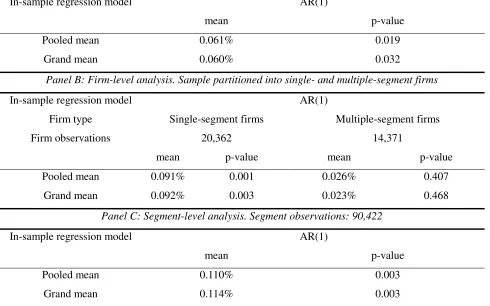
Next, we partition the sample of firms into single- and multiple-segment firms. Panel
B of table 7 shows the forecast improvements for these two subsamples. While for
single-segment firms, the forecast improvement of IS over EW model is highly significant at the
1% level, sales growth forecasts for multiple-segment firms cannot be significantly
improved using IS analysis. The finding supports the extension of H1 to sales growth
forecasting. Finally, panel C of the table shows that at the segment level the sales growth
forecast improvement of IS over EW model is significantly positive. This last result
supports the extension of H2 to sales growth forecasting.
5. Concluding Remarks
Fairfield, Ramnath, and Yohn (2009) have shown that there is no incremental
advantage of using IS analysis for predicting firm profitability, compared to EW analysis.
Yet, several studies have presented evidence that firm profitability is at least partly
governed by industry effects (e.g., Bou and Satorra 2007 and McGahan and Porter 1997).
This paper proposes an intuitive reconciliation of these seemingly conflicting findings,
based on the fact that many firms have multiple business segments operating in different
industries. We argue that when segment-level data are aggregated to the firm level for
external reporting, industry effects on forecasting profitability are obscured at the firm
Our empirical analysis shows that IS models are indeed significantly more accurate
than EW models in predicting profitability and growth at the segment level. We even find
higher accuracy in predicting profitability at the firm level when confining to
single-segment firms, which operate in one industry only. Taken together, the findings underline
that industry factors have an impact on profitability and growth forecasting. It is merely
because of the aggregated nature of firm-level data that prevents the industry effects from
standing out in firm-level analysis.
Besides the results above, we document that when profitability is measured in terms
of ROS, industry effects on profitability forecasting can be clearly seen at the firm level
even without focusing on single-segment firms. This interesting new finding strengthens
the conclusion that industry characteristics are indeed important to profitability
forecasting. The finding also serves as a support for the conventional wisdom that sales
convey valuable information about a firm’s future prospect.
The results of this study are relevant to the accounting disclosure literature as well.
Since we find that segment-level data can provide more accurate information about a
firm’s future profitability, this can be taken as evidence for the usefulness of less
aggregated accounting disclosure. The complication due to segment data under SFAS
131 however highlights the importance of ensuring comparability of the reported
References
Albrecht, W. Steve, Larry L. Lookabill, and James C. McKeown. 1977. “The
Time-Series Properties of Annual Earnings.” Journal of Accounting Research 15 (2)
(October 1): 226–244. doi:10.2307/2490350.
Ali, Ashiq, April Klein, and James Rosenfeld. 1992. “Analysts’ Use of Information
About Permanent and Transitory Earnings Components in Forecasting Annual
EPS.” The Accounting Review 67 (1) (January 1): 183–198.
Baginski, Stephen P., Kenneth S. Lorek, G. Lee Willinger, and Bruce C. Branson. 1999.
“The Relationship Between Economic Characteristics and Alternative Annual
Earnings Persistence Measures.” The Accounting Review 74 (1) (January 1): 105–
120.
Baldwin, Bruce A. 1984. “Segment Earnings Disclosure and the Ability of Security
Analysts to Forecast Earnings Per Share.” The Accounting Review 59 (3) (July 1):
376–389.
Bar-Yosef, Sasson, Jeffrey L. Callen, and Joshua Livnat. 1987. “Autoregressive
Modeling of Earnings-Investment Causality.” The Journal of Finance 42 (1)
(March 1): 11–28. doi:10.2307/2328416.
Berger, Philip G., and Rebecca Hann. 2003. “The Impact of SFAS No. 131 on
Information and Monitoring.” Journal of Accounting Research 41 (May): 163–
223. doi:10.1111/1475-679X.00100.
Berger, Philip G., and Rebecca N. Hann. 2007. “Segment Profitability and the
869–906. doi:10.2308/accr.2007.82.4.869.
Berger, Philip G., and Eli Ofek. 1995. “Diversification’s Effect on Firm Value.” Journal
of Financial Economics 37 (1) (January): 39–65.
doi:10.1016/0304-405X(94)00798-6.
Botosan, Christine A., and Mary Stanford. 2005. “Managers’ Motives to Withhold
Segment Disclosures and the Effect of SFAS No. 131 on Analysts’ Information
Environment.” The Accounting Review 80 (July): 751–772.
doi:10.2308/accr.2005.80.3.751.
Bou, Juan Carlos, and Albert Satorra. 2007. “The Persistence of Abnormal Returns at
Industry and Firm Levels: Evidence from Spain.” Strategic Management Journal
28 (7) (July 1): 707–722.
Brandon, Charles H., Jeffrey E. Jarrett, and Saleha B. Khumawala. 1983. “Revising
Forecasts of Accounting Earnings: A Comparison with the Box-Jenkins Method.”
Management Science 29 (2) (February 1): 256–263.
Brown, Ld, Rl Hagerman, Pa Griffin, and Me Zmijewski. 1987. “An Evaluation of
Alternative Proxies for the Markets Assessment of Unexpected Earnings.”
Journal of Accounting & Economics 9 (2) (July): 159–193.
doi:10.1016/0165-4101(87)90004-8.
Campa, Jose Manuel, and Simi Kedia. 2002. “Explaining the Diversification Discount.”
The Journal of Finance 57 (August): 1731–1762. doi:10.1111/1540-6261.00476.
Chant, Peter D. 1980. “On The Predictability of Corporate Earnings Per Share Behavior.”
The Journal of Finance 35 (1) (March 1): 13–21. doi:10.2307/2327177.
Related to Stock Returns?” Review of Financial Studies 23 (6) (June): 2523–
2559. doi:10.1093/rfs/hhp107.
Chen, Long, Zhi Da, and Xinlei Zhao. 2013. “What Drives Stock Price Movements?”
Review of Financial Studies 26 (4) (April): 841–876. doi:10.1093/rfs/hht005.
Collins, Daniel W. 1976. “Predicting Earnings with Sub-Entity Data: Some Further
Evidence.” Journal of Accounting Research 14 (1) (April 1): 163–177.
doi:10.2307/2490463.
Conroy, Robert, and Robert Harris. 1987. “Consensus Forecasts of Corporate Earnings:
Analysts’ Forecasts and Time Series Methods.” Management Science 33 (6) (June
1): 725–738.
Cubbin, J., and P. Geroski. 1987. “The Convergence of Profits in the Long Run:
Inter-Firm and Inter-Industry Comparisons.” The Journal of Industrial Economics 35
(4) (June 1): 427–442. doi:10.2307/2098581.
Dechow, Patricia, Weili Ge, and Catherine Schrand. 2010. “Understanding Earnings
Quality: A Review of the Proxies, Their Determinants and Their Consequences.”
Journal of Accounting and Economics 50 (2-3) (December): 344–401.
doi:10.1016/j.jacceco.2010.09.001.
Dichev, Ilia D., and Vicki Wei Tang. 2009. “Earnings Volatility and Earnings
Predictability.” Journal of Accounting and Economics 47 (1-2) (March): 160–181.
doi:10.1016/j.jacceco.2008.09.005.
Edwards, Edgar Owen, and Philip Wilkes Bell. 1961. The Theory and Measurement of
Business Income. Berkeley: University of California Press.
Growth.”
http://business.illinois.edu/accountancy/events/forum/papers/11-12/esplin.pdf.
Ettredge, Michael L., Soo Young Kwon, David B. Smith, and Paul A. Zarowin. 2005.
“The Impact of SFAS No. 131 Business Segment Data on the Market’s Ability to
Anticipate Future Earnings.” The Accounting Review 80 (July): 773–804.
doi:10.2308/accr.2005.80.3.773.
Fairfield, Patricia M., Sundaresh Ramnath, and Teri Lombardi Yohn. 2009. “Do
Industry-Level Analyses Improve Forecasts of Financial Performance?” Journal
of Accounting Research 47 (1) (March 1): 147–178.
Fama, Eugene F, and Kenneth R French. 2000. “Forecasting Profitability and Earnings.”
The Journal of Business 73 (2): 161–75.
Frankel, Richard, and Lubomir Litov. 2009. “Earnings Persistence.” Journal of
Accounting and Economics 47 (1-2) (March): 182–190.
doi:10.1016/j.jacceco.2008.11.008.
Gebhardt, W. R., C. M. C. Lee, and B. Swaminathan. 2001. “Toward an Implied Cost of
Capital.” Journal of Accounting Research 39 (1) (June): 135–176.
doi:10.1111/1475-679X.00007.
Glen, Jack, Kevin Lee, and Ajit Singh. 2003. “Corporate Profitability and the Dynamics
of Competition in Emerging Markets: A Time Series Analysis.” The Economic
Journal 113 (491) (November 1): F465–F484.
Goddard, John, Hong Liu, Philip Molyneux, and John O.S. Wilson. 2011. “The
Persistence of Bank Profit.” Journal of Banking & Finance 35 (11) (November):
Hou, Kewei, Mathijs A. van Dijk, and Yinglei Zhang. 2012. “The Implied Cost of
Capital: A New Approach.” Journal of Accounting & Economics 53 (3) (June):
504–526. doi:10.1016/j.jacceco.2011.12.001.
Hund, John, Donald Monk, and Sheri Tice. 2010. “Uncertainty About Average
Profitability and the Diversification Discount.” Journal of Financial Economics
96 (3) (June): 463–484. doi:10.1016/j.jfineco.2010.02.006.
Lamont, O. A., and C. Polk. 2002. “Does Diversification Destroy Value? Evidence from
the Industry Shocks.” Journal of Financial Economics 63 (1) (January): 51–77.
doi:10.1016/S0304-405X(01)00089-7.
Lee, Charles, David Ng, and Bhaskaran Swaminathan. 2009. “Testing International Asset
Pricing Models Using Implied Costs of Capital.” Journal of Financial and
Quantitative Analysis 44 (2) (April): 307–335. doi:10.1017/S0022109009090164.
Lundholm, Russell, and Richard Sloan. 2007. Equity Valuation and Analysis. 2nd ed.
McGraw-Hill/Irwin.
McGahan, Anita M., and Michael E. Porter. 1997. “How Much Does Industry Matter,
Really?” Strategic Management Journal 18 (July 1): 15–30.
———. 1999. “The Persistence of Shocks to Profitability.” The Review of Economics
and Statistics 81 (1) (February 1): 143–153.
———. 2002. “What Do We Know About Variance in Accounting Profitability?”
Management Science 48 (7) (July 1): 834–851.
Mueller, Dennis C. 1977. “The Persistence of Profits Above the Norm.” Economica 44
(176). New Series (November 1): 369–380. doi:10.2307/2553570.
Heteroskedasticity and Autocorrelation Consistent Covariance Matrix.”
Econometrica 55 (3) (May): 703. doi:10.2307/1913610.
Ohlson, James A. 1990. “A Synthesis of Security Valuation Theory and the Role of
Dividends, Cash Flows, and Earnings*.” Contemporary Accounting Research 6
(2): 648–676. doi:10.1111/j.1911-3846.1990.tb00780.x.
Pastor, Lubos, Meenakshi Sinha, and Bhaskaran Swaminathan. 2008. “Estimating the
Intertemporal Risk-Return Tradeoff Using the Implied Cost of Capital.” Journal
of Finance 63 (6) (December): 2859–2897.
doi:10.1111/j.1540-6261.2008.01415.x.
Penman, Stephen. 2003. Financial Statement Analysis and Security Valuation. 2nd ed.
McGraw-Hill/Irwin.
Penman, Stephen H. 1983. “The Predictive Content of Earnings Forecasts and
Dividends.” The Journal of Finance 38 (4): 1181–1199. doi:10.2307/2328019.
Penman, Stephen H., and Xiao-Jun Zhang. 2002. “Modeling Sustainable Earnings and
P/E Ratios with Financial Statement Analysis.” SSRN eLibrary (June 1).
http://papers.ssrn.com/sol3/papers.cfm?abstract_id=318967.
Rogers, W. H. 1993. “Regression Standard Errors in Clustered Samples.” Stata Technical
Bulletin 13: 19–23.
Ruefli, Timothy W., and Robert R. Wiggins. 2003. “Industry, Corporate, and Segment
Effects and Business Performance: A Non-Parametric Approach.” Strategic
Management Journal 24 (9): 861–879.
Schmalensee, R. 1985. “Do Markets Differ Much.” American Economic Review 75 (3):
Waring, Geoffrey F. 1996. “Industry Differences in the Persistence of Firm-Specific
Returns.” The American Economic Review 86 (5) (December 1): 1253–1265.
Watts, Ross L., and Richard W. Leftwich. 1977. “The Time Series of Annual Accounting
Earnings.” Journal of Accounting Research 15 (2) (October 1): 253–271.
Table 1 Variable definitions
Variable name Description Computation
Firm-level analysis
(Compustat fundamentals annual)
Computation
Segment-level analysis (Compustat segments)
NIt (in mn) Income before extraordinary items –
available for common equity
Compustat item 237 WRDS mnemonic: IBCOM
BVt (in mn) Common/ordinary shareholder’s
equity
Compustat item 60 WRDS mnemonic: CEQ
OPINCt (in mn) Operating income after depreciation Compustat item: 178
WRDS mnemonic: OIADP
Compustat item: XXX
WRDS mnemonic: OPS
TAt (in mn) Identifiable/total assets Compustat item 6
WRDS mnemonic: AT
Compustat item: XXX
WRDS mnemonic: IAS
SALESt (in mn) Total sales Compustat item: 12
WRDS mnemonic: SALE
WRDS mnemonic: SALES
NOAt (in mn) Net operating assets Common stock (60/CEQ) + preferred
stock (130/PSTK) + long-term debt (9/DLTT) + debt in current liabilities (34/DLC) + minority interest (38/MIB) – cash and short-term investments (1/CHE)
ROAt Return on assets OPINCt/(0.5*(TAt + TAt–1)) OPINCt/(0.5*(TAt + TAt–1))
ROSt Return on sales OPINCt/(0.5*(SALESt + SALESt–1)) OPINCt/(0.5*(SALESt + SALESt–1))
RNOAt Return on net operating assets OPINCt/(0.5*(NOAt + NOAt–1))
ROEt Return on equity NIt/(0.5*(BVt + BVt–1))
GSLt Sales growth (SALESt - SALESt–1)/ SALESt–1 (SALESt - SALESt–1)/ SALESt–1
Table 2
Sample selection and descriptive statistics Time period: 1987-2011
Panel A: Sample selection
Adjustments to data sample Firm-level data
(firm-year observations)
Segment-level data (segment-year observations)
ROA ROS RNOA ROE ROA ROS
Observations for in-sample regressions:
Total observations, excluding utilities and financial firms/segments 254,248 246,176 253,354 253,419 254,126 267,918
Less observations with small denominators 159,188 158,737 158,346 158,381 236,060 249,298
Less observations with an absolute value larger than 1 159,150 157,494 155,469 154,808 232,878 239,991
Less observations with more than 100% growth 140,882 140,153 139,165 138,352 210,962 207,997
Less upper and lower centiles observations 138,066 137,351 136,383 135,586 206,744 203,839
Observations for out-of-sample tests, out of which: 51,869 90,422
single-segment firms 20,362
multiple-segment firms 14,371
unclassified 17,145
Table 2
Sample selection and descriptive statistics (Continued)
Panel B: Summary statistics
Variable Mean Std. Deviation First Quartile Median Third Quartile
Firm-level: 7,169 firms (51,869 firm-year obs.)
NI 192.412 1,107.492 1.244 12.682 76.000
OPINC 363.225 1,617.542 5.540 30.589 159.889
TA 4,080.182 15,838.560 114.167 421.375 1,912.887
NOA 2,394.291 9,496.890 69.625 261.324 1,165.151
BV 1,581.442 6,485.568 57.038 198.206 813.700
SALES 3,714.045 14,669.310 134.677 475.051 1,890.907
ROA 8.50% 7.53% 4.26% 8.52% 12.98%
ROS 8.66% 9.23% 3.30% 7.51% 12.99%
RNOA 14.21% 13.89% 6.55% 13.22% 21.16%
ROE 7.49% 15.08% 2.39% 9.71% 15.93%
Segment-level: 17,151 segments (90,422 segment-year obs.)
TA 1,281.919 5,094.477 31.743 149.180 669.580
OPINC 125.045 556.830 0.667 10.175 63.268
SALES 1,432.484 6,362.375 41.967 185.551 765.200
ROA 8.68% 13.99% 2.52% 8.95% 15.78%
ROS 7.25% 12.86% 1.79% 6.99% 13.41%
Table 2
Sample selection and descriptive statistics (Continued)
Panel C: Descriptive statistics by industry
Firm-level Segment-level
Two-digit
SIC Description Obs. ROA ROS RNOA ROE Obs. ROA ROS
01 Agricultural production-crops 10 5.15% 9.00% 7.08% 6.37% 279 6.93% 9.89%
02 Agricultural production-livestock 0 - - - - 3 8.93% 6.54%
07 Agricultural services 0 - - - - 3 15.89% 13.48%
10 Metal mining 592 5.10% 10.26% 8.03% 4.84% 521 4.15% 7.07%
12 Coal mining 0 - - - - 289 8.39% 10.77%
13 Oil & gas extraction 1,619 6.50% 14.59% 9.67% 6.11% 2,810 6.87% 13.78%
14 Nonmetallic minerals 11 10.12% 9.55% 15.64% 11.28% 311 11.95% 12.90%
15 General building 473 7.16% 6.74% 9.92% 7.62% 699 5.51% 4.08%
16 Heavy construction 74 8.03% 6.30% 16.28% 9.47% 391 6.83% 3.28%
17 Special trade contractors 0 - - - - 367 7.00% 3.72%
20 Food & kindred products 2,299 10.00% 8.24% 15.84% 10.99% 2,846 11.79% 8.08%
21 Tobacco products 0 - - - - 1 -0.58% -0.70%
22 Textile mill products 555 8.35% 6.36% 11.85% 4.00% 896 7.85% 5.27%
23 Apparel & other textile 734 9.71% 7.47% 15.11% 7.40% 963 10.51% 6.69%
24 Lumber & wood 579 6.63% 6.59% 10.50% 5.03% 917 9.77% 6.50%
25 Furniture & fixtures 551 9.47% 6.33% 14.78% 8.32% 803 9.03% 5.41%
26 Paper & allied products 1,173 8.29% 8.57% 12.22% 7.77% 1,790 10.55% 8.99%
27 Printing & publishing 1,060 10.03% 10.00% 15.73% 9.25% 1,834 12.12% 9.77%
28 Chemicals & allied products 3,354 10.65% 11.56% 18.25% 11.08% 5,797 12.16% 10.02%
29 Petroleum & coal 765 10.04% 10.20% 17.07% 12.38% 878 8.83% 5.13%
30 Rubber & plastic products 851 10.06% 7.70% 15.73% 7.76% 1,838 12.37% 8.08%
31 Leather 253 9.63% 5.94% 16.39% 5.99% 443 7.01% 4.22%
32 Stone, clay & glass 554 9.02% 9.65% 13.41% 9.09% 1,193 11.22% 9.57%
33 Primary metal products 1,401 7.79% 7.03% 11.91% 5.77% 2,175 9.12% 6.49%
34 Fabricated metal products 1,360 9.50% 7.98% 15.08% 8.66% 2,653 11.93% 7.80%
35 Industrial machinery & equipment
3,672 7.74% 6.96% 13.58% 6.54% 7,508 7.58% 5.06%
36 Electronic & other electric equipment
4,747 6.81% 6.44% 12.22% 4.44% 7,824 6.90% 4.79%
37 Transportation equipment 1,909 8.38% 7.32% 15.00% 8.62% 3,136 10.70% 7.03%
38 Instruments & related products 3,244 8.94% 9.38% 15.13% 7.42% 6,045 7.45% 6.22%
40 Railroad transportation 401 7.08% 17.07% 11.53% 8.73% 424 6.93% 15.89%
42 Trucking & warehouse 669 9.18% 6.66% 15.03% 8.60% 953 8.65% 5.72%
44 Water transportation 307 6.42% 13.70% 8.80% 6.02% 644 6.95% 14.05%
45 Transportation by air 553 6.29% 7.84% 11.91% 5.60% 906 4.95% 4.92%
46 Pipelines, except natural gas 0 - - - - 59 8.38% 25.08%
47 Transportation services 78 9.72% 9.12% 19.07% 8.76% 456 9.65% 8.61%
48 Communications 2,746 10.22% 19.74% 15.49% 11.41% 3,716 10.27% 18.95%
49 Electric, gas & sanitary services 280 5.99% 12.58% 8.69% 4.64% 785 6.27% 9.27%
50 Wholesale trade-durable products 2,002 8.01% 4.86% 12.74% 7.28% 3,302 7.97% 3.73%
51 Wholesale trade-nondurable
goods
1,105 7.79% 5.20% 13.51% 8.27% 1,910 8.73% 4.56%
52 Building materials 133 7.97% 4.03% 12.08% 3.36% 285 6.99% 3.60%
53 General merchandise stores 723 8.80% 4.78% 14.58% 8.09% 901 7.28% 3.74%
54 Food stores 794 9.14% 3.36% 15.55% 9.04% 822 9.02% 2.90%
55 Automotive dealers & services 173 8.03% 4.18% 11.55% 8.10% 377 6.99% 3.76%
56 Apparel & accessory stores 776 9.83% 5.06% 19.81% 8.08% 1,088 11.74% 5.39%
57 Furniture stores 413 8.60% 4.60% 17.53% 5.92% 619 6.40% 3.49%
58 Eating & drinking places 1,100 10.31% 7.62% 15.10% 7.75% 1,795 8.27% 5.42%
59 Miscellaneous retail 1,155 8.48% 5.16% 14.23% 6.23% 1,786 8.31% 4.45%
70 Hotels & other lodging places 284 5.07% 9.69% 7.07% 2.46% 594 6.38% 10.68%
72 Personal services 27 5.74% 9.15% 9.56% 5.83% 245 10.84% 10.23%
73 Business services 3,281 7.53% 8.43% 15.65% 5.76% 6,982 5.98% 5.54%
75 Auto repair, services & parking 17 4.88% 6.99% 6.71% 3.33% 247 5.31% 6.56%
76 Misc. repair services 0 - - - - 4 16.70% 8.57%
78 Motion pictures 206 5.54% 6.58% 8.71% -1.47% 627 4.10% 4.18%
79 Amusement & recreation services
577 8.22% 12.58% 11.85% 3.56% 1,129 7.34% 9.39%
80 Health services 766 10.51% 10.27% 15.30% 7.66% 1,490 9.43% 8.00%
82 Educational services 0 - - - - 265 13.02% 10.48%
83 Social services 0 - - - - 75 12,31% 10.21%
86 Membership organizations 0 - - - - 1 13.16% 8.89%
87 Engineering & management services
787 8.33% 7.00% 16.25% 6.67% 1,643 9.35% 6.27%
Total 51,869 8.50% 8.66% 14.21% 7.49% 90,422 8.68% 7.25%
Table 3
Firm profitability forecast improvements of industry-specific analysis over economy-wide analysis Time period: 1967-2011 (out-of-sample: 1987-2011)
Panel A: Total sample, firm observations: 51,869
In-sample regression model AR(1) AR(1) + NL dummy AR(1) + NL dummy +
PREDGSL
mean p-value mean p-value mean p-value
ROE
Pooled mean -0.005% 0.805 -0.005% 0.747 0.060% 0.259
Grand mean -0.004% 0.828 -0.006% 0.692 0.072% 0.229
RNOA
Pooled mean 0.017% 0.248 0.004% 0.754 0.000% 0.992
Grand mean 0.017% 0.207 0.005% 0.693 0.002% 0.940
ROA
Pooled mean 0.012% 0.162 0.000% 0.966 0.007% 0.630
Grand mean 0.013% 0.114 0.001% 0.903 0.009% 0.550
ROS
Pooled mean 0.052% <0.001 0.035% 0.001 0.045% 0.001
Table 3 (Continued)
Firm profitability forecast improvements of industry-specific analysis over economy-wide analysis Time period: 1967-2011 (out-of-sample: 1987-2011)
Panel B: Sample partitioned into single- and multiple-segment firms
In-sample regression model AR(1) AR(1) + NL dummy AR(1) + NL dummy + PREDGSL
Firm type Single-segment firms Multiple-segment
firms
Single-segment firms Multiple-segment
firms
Single-segment firms Multiple-segment
firms
Firm observations 20,362 14,371 20,362 14,371 20,362 14,371
mean p-value mean p-value mean p-value mean p-value mean p-value mean p-value
ROE
Pooled mean 0.031% 0.229 -0.015% 0.623 0.013% 0.581 -0.020% 0.445 0.095% 0.063 0.066% 0.378
Grand mean 0.029% 0.152 -0.012% 0.623 0.012% 0.486 -0.018% 0.407 0.092% 0.089 0.072% 0.331
RNOA
Pooled mean 0.050% 0.003 -0.001% 0.977 0.037% 0.031 -0.012% 0.564 0.043% 0.044 -0.003% 0.940
Grand mean 0.048% 0.002 0.001% 0.945 0.036% 0.016 -0.010% 0.578 0.040% 0.050 -0.001% 0.971
ROA
Pooled mean 0.037% <0.001 -0.009% 0.528 0.023% 0.023 -0.022% 0.100 0.032% 0.007 -0.005% 0.827
Grand mean 0.037% <0.001 -0.008% 0.494 0.022% 0.015 -0.020% 0.073 0.030% 0.011 -0.004% 0.852
ROS
Pooled mean 0.089% <0.001 0.007% 0.616 0.072% <0.001 0.006% 0.671 0.092% <0.001 0.020% 0.353
Grand mean 0.089% <0.001 0.008% 0.445 0.071% <0.001 0.007% 0.535 0.090% <0.001 0.021% 0.310
Table 4
Segment profitability forecast improvements of industry-specific analysis over economy-wide analysis Time period: 1977-2011 (out-of-sample: 1987-2011)
Segment observations: 90,422
In-sample regression model AR(1) AR(1) + NL dummy
Mean p-value Mean p-value
ROA
Pooled mean 0.021% 0.233 0.015% 0.556
Grand mean 0.015% 0.382 0.006% 0.799
ROS
Pooled mean 0.082% <0.001 0.060% 0.016
Grand mean 0.073% 0.001 0.050% 0.046
Table 5
Analysis of the SFAS 14 Period -
Segment profitability forecast improvements of industry-specific analysis over economy-wide analysis Time period: 1977-1997 (out-of-sample: 1987-1997)
Segment observations: 46,917.
In-sample regression model AR(1) AR(1) + NL dummy
Mean p-value Mean p-value
ROA
Pooled mean 0.062% 0.011 0.077% 0.030
Grand mean 0.064% 0.028 0.082% 0.054
ROS
Pooled mean 0.134% <0.001 0.122% <0.001
Grand mean 0.137% <0.001 0.126% 0.002