ISSN Online: 2162-6006 ISSN Print: 2162-5999
DOI: 10.4236/ojsst.2019.91003 Mar. 7, 2019 22 Open Journal of Safety Science and Technology
A Comparative Analysis of the Two Main
Documents Used in Small and Medium-Sized
Enterprises in France and Québec as a
Framework for Improving Occupational
Health and Safety
Chloé Bignon
1, Adel Badri
2,3*1Department of Health Sector Engineering and Associated Bioproducts, Istia Graduate School
of Engineering, University of Angers, Angers, France
2Industrial Engineering Department, School of Engineering, Université du Québec à Trois-Rivières,
Trois-Rivières, Canada
3Research Institute on SMEs, Université du Québec à Trois-Rivières, Trois-Rivières, Canada
Abstract
Context and background: In France as in Québec, occupational health and safety (OHS) has become a national priority. While organizations in these two societies differ slightly, preventive measures are the same, and legislation requires that the chosen approach to improving OHS be reduced to writing, even in small and medium-sized enterprises. Prevention is managed through existing structures within companies and is documented by the employer. Such documentation is mandatory and allows the company to manage its risks and to monitor the hazards associated its activities. The principal docu-ment used for this purpose is known as the “Docudocu-ment unique” in France and the “Programme de prevention” in Québec. Motivation: The aim of this concise review of the literature is to compare the “Document unique” and the “Programme de prevention” and thereby help experts develop a universal document that combines the best features of the French and Québécois ver-sions. Methods: Differences between these two documents are noted. Through comparative analysis, we explain how prevention, the regulatory context and the field of application are defined in each case. We then discuss the helpful features and the limitations inherent in both documents and con-clude with a table of comparison. Results and conclusions: The advantages and inconveniences appear to be similar for both documents. There are nev-ertheless opportunities to combine the best features of the Document unique How to cite this paper: Bignon, C. and
Badri, A. (2019)A Comparative Analysis of the Two Main Documents Used in Small and Medium-Sized Enterprises in France and Québec as a Framework for Improving Occupational Health and Safety. Open Journal of Safety Science and Technology, 9, 22-36.
https://doi.org/10.4236/ojsst.2019.91003
Received: January 8, 2019 Accepted: March 4, 2019 Published: March 7, 2019
Copyright © 2019 by author(s) and Scientific Research Publishing Inc. This work is licensed under the Creative Commons Attribution-NonCommercial International License (CC BY-NC 4.0). http://creativecommons.org/licenses/by-nc/4.0/
DOI: 10.4236/ojsst.2019.91003 23 Open Journal of Safety Science and Technology and the Programme de prévention in order to obtain an improved guide for the writing of a complete accident prevention and OHS policy appreciated by employers and employees alike.
Keywords
Occupational Health and Safety, Prevention, Document Unique, France, Programme de Prévention, Québec
1. Introduction
Worker safety is essential for the success of any business. Small and me-dium-sized enterprises in particular face a variety of difficulties in their quest to reduce or eliminate occupational risks, due in large part to their scale of opera-tion and limited resources. In Europe, nearly 80% of workplace accidents leading to more than three days of absence and nearly 88% of fatal accidents occur in this business category [1]. In terms of economic and social costs, improving ac-cident prevention represents major savings [2].
Worker wellbeing and physical health are essential for business longevity [3]. Occupational health and safety (OHS) is the discipline of preventing workplace accidents and occupational illnesses through actions implemented in the work environment. Risk management is one of the principal activities undertaken in order to combat all types of occupational injury or illness [4].
According to article L.4121-1 of the French labor code, the workplace safety imperative obliges all employers to implement measures designed to ensure the safety and protect the health of their employees [5]. A key element of the ap-proach to meeting this obligation is risk evaluation. In France, this apap-proach is reduced to writing in a framework entitled “Document unique” [6], the purpose of which is to lessen or eliminate OHS risks by identifying them and imple-menting corrective actions.
Employers in Québec are required to do likewise using a framework entitled “Programme de prévention” [7]. Like the Document unique, the aim of this program is to list, monitor and eliminate potential hazards while proposing concrete actions in order to ensure worker safety and health. The Programme de prévention is intended as the principal tool to be used in order to achieve com-pliance with Québec occupational health and safety legislation [8]. Based on risk identification and corrective measures, its goal is thus prevention, indeed elimi-nation of work-related hazards.
In this article, some notable differences between these two documents are brought to light. Through comparative analysis, we explain how prevention, the regulatory context and the field of application are defined in each case. We then discuss the helpful features and the limitations inherent in both documents and conclude with a table of comparison.
me-DOI: 10.4236/ojsst.2019.91003 24 Open Journal of Safety Science and Technology thodology in Section 3 and the detailed comparative analysis in Section 4. Our intention is to help experts enrich these documents for application to prevent work-related accidents and illnesses in small and medium-sized enterprises.
2. Research Problem
With regard to small and medium-sized enterprises, we note three recurrent problems in the production and content of the in-house OHS documents cur-rently in use. To begin with, depending on the business size and priority catego-ry, the Programme de prévention may or may not be mandatory. A program should be required for nearly all businesses, since risks are present in several sectors of activity not listed as high-priority in the legislation [8]. Each business may create its own document, resulting in contents differing vastly in both form and substance. The current legislation proposes no model, and each employer writes as he or she sees fit [5][9]. Risks and the associated preventive actions are often described in generalities rather than in concrete terms that correspond to workplace activities. Such documents can contribute little to effective manage-ment of accident prevention. And finally, although the creation of the documanage-ment should involve the workers, these employees are rarely well informed or trained in the subject matter, and often consider the resulting content to be difficult to implement.
The Programme de prévention generates documents that are a very complex and often too theoretical, as well as lacking uniformity of presentation and rich-ness of content. Our goal is to make the framework simpler, readily adaptable to small and medium-sized industrial enterprises and designed to yield documents that are more easily understood and provide concrete examples of feasible ac-tions.
By comparing the contents of the principal OHS documents in France and Québec, it should be possible to propose an enriched prevention document framework for small industrial enterprises in Québec. Our intention is not to propose specific solutions, but to compare French and Québec experiences with prevention in the workplace, in order to move closer to the creation of a single type of document that enables small and medium-sized enterprises to implement effective actions more easily and thus eliminate hazards and improve their productivity.
3. Research Methodology
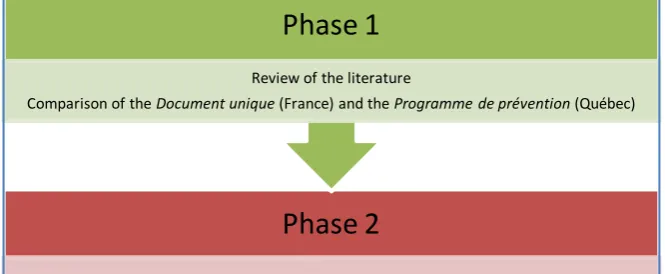
This research was conducted in two phases (Figure 1). The subject of the present article is the findings of our review of the literature (the first phase). The pro-posal of a universal document for the prevention of workplace accidents and work-related illnesses (the second phase) will be covered in a future article.
3.1. Literature Review
DOI: 10.4236/ojsst.2019.91003 25 Open Journal of Safety Science and Technology Figure 1. The phases of the research methodology.
in the following databases: Commission des normes, de l'équité, de la santé et de la sécurité du travail (CNESST, Québec), Institut de recherche Robert-Sauvé en santé et en sécurité du travail (IRSST, Québec) and Institut national de recherche et de sécurité (INRS, France). Among the documents thus retrieved, the follow-ing types were examined: articles in magazines and scientific journals, technical reports, standards, regulations and laws.
It should be noted that the search was conducted in French only, since only francophone organisations use the two OHS frameworks being compared. Fur-thermore, the documents were retrieved only from the literature published in French and therefore include relatively few scientific articles. The various searches nevertheless retrieved a sufficient number of articles to allow a com-parative analysis. Relevant publications were assessed for the clarity of their ob-jectives and results. We analyzed the titles, keywords and abstracts of more than 60 publications. We were able to extract definitions and fields of application as well as advantages and limitations associated with each of the two national OHS models. The helpful features and inconveniences of these frameworks are sum-marized in a table presented below.
3.2. Development of a Universal Prevention Program
A future goal of this research is to propose a model of the Programme de prévention enriched with elements drawn from the Document unique in order to obtain a framework better adapted to the needs of small and medium-sized enterprises in Québec.
This new framework will be developed in steps, the first of which will be com-pilation of the information gathered from the comparative analysis. In the second step, the advantageous features of the Document unique and the Pro-gramme de prevention approaches will be combined in order to produce an enriched, adaptable and user-friendly universal prevention program for small and medium-sized industrial enterprises. Risks will be grouped into industrial categories to allow businesses to determine quickly whether or not a risk or
cat-Phase 2
Proposal of a universal prevention document for small and medium-sized enterprises
Phase 1
Review of the literature
DOI: 10.4236/ojsst.2019.91003 26 Open Journal of Safety Science and Technology egory of risks and the associated recommendations are applicable to their situa-tion.
4. Results
4.1. Occupational Health and Safety in Small and Medium-Sized
Enterprises
The small and medium-sized enterprises category may be characterized as “hu-man-sized”. It generates a major portion of the national wealth and provides much of the employment [2][10][11]. The size of a business is defined primari-ly in terms of the number of employees and its annual sales. The exact definition may change from one country to the next [12]. In France, the small to me-dium-sized category refers to private companies employing no more than 250 individuals. Companies employing 10 to 50 individuals and generating annual sales not exceeding 10 million euros or employing 50 to 250 individuals and ge-nerating annual sales not exceeding 50 million euros are in this category [12]. The European commission recommends defining the category also in terms of social and financial characteristics [13]. In Canada, a small to medium-sized business employs no more than 500 individuals and has assets not exceeding 50 million dollars, of which no more than 25% are the property of a large company [14].
The small to medium-sized category thus includes a wide diversity of business models each requiring specific managerial methods. Depending on the sector of activity, such companies may face numerous risks in the workplace setting. If these are not reduced, occupational injuries, illnesses and infirmities will reduce worker efficiency and hence the productivity of the enterprise. Proper manage-ment of prevention is therefore fundamanage-mental for the success of a small or me-dium-sized business [15].
Fatal accidents are up to eight times more frequent in small enterprises than in large ones [16]. In Europe, 82% of workplace accidents and 90% of those causing death occur in small enterprises. The tools of accident prevention must be adapted to the size of the business and to its industrial setting. Business size of course has a major influence on the availability of financial resources for such tools [17], cost being one of the main obstacles to improving prevention. Small companies cannot afford to manage OHS using the means available to large corporations [2]. Paperwork, time constraints and lack of staff are among the factors that contribute to their poorer management of OHS. According to a study based on over 200 interviews, 9 out of 10 directors of such companies have insufficient knowledge in accident prevention and its integration into operations [17]. While large companies often have specialized staff dedicated to OHS risk management and accident prevention, such personnel are usually non-existent in small companies. OHS-related information is communicated rarely, the di-rector or CEO often being the only person who does this [2][17].
DOI: 10.4236/ojsst.2019.91003 27 Open Journal of Safety Science and Technology Most managers lack the skills needed to manage OHS in collaboration with company directors [17]. Quite often workers and employers alike are too preoc-cupied with production to spend time on accident prevention. Lack of training and lack of time appear to be obstacles for about 30% of the directors inter-viewed [17].
In a more recent study of the factors associated with inefficient management of OHS in smaller businesses, human conditions and economic uncertainty were found to play a significant role, followed by lack of sensitization of directors [2]. Managers and directors often simply lack the OHS reflex, creating barriers to the integration of OHS principles into workplace design and operations. In some businesses, OHS management continues to be regarded as optional and not es-sential for smooth operation and sustainable productivity. Finally, since the managers of such companies are not well informed on the subject, they often view the creation of a prevention document as an overly technical, constraining, expensive and ultimately unproductive effort.
Integration of OHS generally involves the development of a rigorous approach to prevention. A prevention program is indispensible if work-related infirmity is to be reduced and increases in productivity are to be sustainable in smaller en-terprises. However, managers of these enterprises do not always appreciate the connection between OHS and operational efficiency [2][11].
4.2. Prevention Documents in France and in Québec
4.2.1. The Document Unique in France
An effective approach to prevention is one that ensures the health and safety of employees in their workplace. The employer must therefore root out hazards associated with the work and reduce or eliminate these by implementing con-crete actions.
In the French system, the State and its ministerial staff have direct control over OHS, unlike in Québec, where the role of managing prevention in the small to medium-sized business category is delegated to independent agencies. Two ministries thus work in close collaboration: the ministry of labor and the minis-try of health. The general directorate of labor is responsible for preventive as-pects while the directorate of social security ensures worker compensation and participates in guiding prevention policy. The State does consult some external organizations [18].
DOI: 10.4236/ojsst.2019.91003 28 Open Journal of Safety Science and Technology long-term preventive actions. It takes into account the inherent characteristics of the business operations such as the number of salaried workers exposed to each risk (exposure) or the frequency with which the risk arises. These indicators are indispensible for improving accident prevention within a company [6].
The Document unique represents the application of articles L4121-2 and L4121-3 of the French labor code, as per decree number 2001-1016 issued on November 5, 2001 [5] and requiring all employers to reduce their risk evaluation to writing for compliance with the labor code [6]. However, the legislation sets forth only the minimal requirements and does not propose a model document. The employer can therefore choose the format best adapted to his enterprise. Although no rule has been issued for dating or signing, dating of updates is recommended in order to ensure the traceability of amendments [6].
The Document unique is not to be produced solely for compliance with regu-lations. It is designed to evolve and to be used as a tool in support of implemen-tation of preventive measures or actions for the purpose of improving OHS. Ar-ticle L4121-2 of the labor code specifies that the employer must base the imple-mentation of such measures or actions on “the general principles of prevention”, summarized in Table 1.
According to decree 2001-1016, updating of the Document unique is manda-tory and indispensible in order to allow it to evolve along with the business [21]. The document must be updated at least once a year as well as after each workplace accident report. It should also be reviewed each time a work task or activity is modified. It must be allowed to adapt to changes to the company and its enterprises. French inspectors are saddled with the task of verifying that en-terprises are compliant with their legal and regulatory frameworks as well as the terms of labor agreements.
In order to create a Document unique, an employer may use previous in-house documents. Written reports describing the sanitary, safety and working condi-tions overall may be used as references [22]. The employer may also enlist any person wishing to get involved in the company OHS and prevention initiative. In addition to contributions from employees, help from the sanitary, safety and working conditions committee (CHSCT), workplace health services committee or consulting and training organizations also may be sought [23]. Numerous consulting firms offer the service of writing the Document unique according to the specific needs of small businesses. Workplace medical doctors can also help with the writing. In any case, the employer remains responsible for the docu-ment.
The Document unique is to be used also as a base for writing the annual pre-vention program, a more general document that combines technical, organiza-tional and human aspects with reference to the nine general principles of pre-vention listed in Table 1.
4.2.2. The Programme de Prévention in Québec
DOI: 10.4236/ojsst.2019.91003 29 Open Journal of Safety Science and Technology Table 1. The nine general principles of prevention [20].
No. Principle Meaning
1 Avoiding risk Eliminating the hazard or exposure to it
2 Evaluating unavoidable risks Appreciating their nature and importance in order to determine actions that ensure worker health and safety
3 Tackling risks at the source Integrating prevention as early as possible, in the design of the workplace, equipment and tasks
4 Adapting work to people Designing workstations and choosing equipment and methods that minimize the monotony, drudgery and cadence of tasks
5 Allowing techniques to evolve Watching for opportunities to install preventive means in phase with technical and organizational evolution
6 Replacing hazardous means with safer ones Eliminating dangerous products or processes when the same result is obtainable using less hazardous means
7 Planning prevention Integrating work technique, structure and conditions, social relations and the environment into a coherent unit
8 Implementing measures of collective protection Giving priority to collective protection means, using personal protective devices only to enhance collective protection (not to compensate for inadequate collective means)
9 instructions to workers Giving appropriate Giving employees the information necessary to perform their tasks under conditions of optimal safety
planned and implemented in the continued effort to improve OHS in a business establishment [7].
The Programme de prévention is the principal tool of reference for the pur-poses of OHS legislation (LSST) in Québec [8][9]. Its aim is to prevent, indeed to eliminate hazards in the workplace. This program proposes a list of potential hazards and concrete actions for limiting them. These risks and hazards are based on work-related injuries and infirmities compiled by the CNESST [24].
Within the rather elaborate Québec regulatory framework, employers are ob-liged to identify, monitor and eliminate hazards that could affect their workers [8]. They must also verify that their workers are aware of and apply the preven-tive measures that ensure a safe and healthy work environment. Writing the Programme de prévention is an obligation for any establishment subject to this regulation, including small businesses. The criteria that determine who is subject to the regulation include the number of salaried employees and the presence of high-priority activities (high-risk jobs).
DOI: 10.4236/ojsst.2019.91003 30 Open Journal of Safety Science and Technology The Programme de prevention must be updated annually [9], must reflect changes and evolution within the business establishment and must include an evaluation of compliance with in-house standards from the previous year. The updating process thus provides proof that the document is dynamic and evolv-ing. The writing of this document is mandatory for all business establishments subject to the Programme de prévention [8][9]. Establishments active only in non-listed categories are certainly not discouraged from being proactive in this regard.
The CNESST thus highly recommends implementing a prevention program. As is the case for the Document unique, the employer is responsible for the Pro-gramme de prévention and may seek the assistance of consultants and agencies. Guides designed specifically for small enterprises propose a simple and practical approach to reducing the most common OHS hazards [26].
The principal steps to be followed in order to create a document suitable for the purposes of the Programme de prévention are shown in Figure 2.
4.3. Advantages and Drawbacks of Prevention Documents
4.3.1. The Document Unique in France
The Document unique is a tool that employers use to record and evaluate initia-tives undertaken to reduce risks faced by their employees. It thus constitutes at the same time an inventory of risks present in the workplace and a plan of action designed to reduce or eliminate them. Using the Document unique to monitor risks makes a company’s commitment to OHS more credible [6]. A statistical follow-up may be implemented in order to monitor the success of prevention in-itiatives.
By decreasing work-related hazards, the employer improves operations, uti-lizes know-how and reinforces social protection. Expenses due to workplace ac-cidents and absenteeism decrease and productivity increases. Annual updating provides indicators of effectiveness and thereby contributes to the dynamism of the document and of the business [21].
However, it is the employer who must write the Document unique, which is often perceived as making an already heavy workload insurmountable. This task therefore must not be left to the company director but rather should be a parti-cipative effort involving workers and specialized organizations. The legislation currently does not propose any model for the document, and the employer may use the support (paper, spreadsheet or dedicated software) best suited to com-pany needs and resources [23].
The advantages and drawbacks of two types of software support are listed in Table 2.
4.3.2. The Programme de Prévention in Québec
DOI: 10.4236/ojsst.2019.91003 31 Open Journal of Safety Science and Technology Figure 2. The 7 steps of the creation of an OHS plan based on the Programme de préven-tion[27].
Table 2. Advantages and drawbacks of using spreadsheets or dedicated software for pro-ducing the Document unique[28].
Support Advantages Drawbacks
Dedicated software
- Considerable masses of data are processed, sorted and ranked. - The criticality calculation system is
usually automatic.
- The evolution of the document is saved and archived.
- Generates other prevention tools: plan of action, analysis of accidents, etc. - Access is controllable; two or more
users may work simultaneously.
- Training of users is lengthy and constraining.
- Expensive.
- The client needs to be accompanied (file set-up and client service). - Sensitive to computer system bugs.
Spreadsheet
- Use is simple and flexible. - Inexpensive.
- Databases are accessible and easily integrated into other systems.
- Time required for modeling, set-up and construction of indicators and methods of calculation.
- Manual updating of data requires rigor and concentration (tedious). - Sensitive to computer system bugs.
encountered as well as regulations and standards to be met in responding to them. It also lists personal safety devices and protective equipment. Employers and workers participate in the production of this document [26]. Writing the Programme de prévention thus favors the commitment of company directors and staff. This improves wellbeing in the workplace, allowing workers to feel sa-fer and valued by their employer [29].
[image:10.595.200.540.323.540.2]DOI: 10.4236/ojsst.2019.91003 32 Open Journal of Safety Science and Technology An annual update must be filed with the CNESST as a sign that company is active and dynamic in its approach. The document thus reflects the evolution of the business and its prevention initiative [26][27]. These benefits lead to satis-faction with the Programme de prévention among employers and workers alike. By ensuring worker wellbeing, the company improves its work climate and the-reby decreases absenteeism and improves its productivity [29].
Since it is known that OHS is fundamental for the proper functioning and productivity of a business, a prevention program should be an obligation for all enterprises. However, the legislation requires it only for a few categories consi-dered as high priority [9]. The Programme de prevention currently protects only about 26% of the Québec labor force [30]. Many small and medium-sized enter-prises are not subject to the requirements of the Programme de prévention. The risks present in several sectors not listed as high priority by the LSST are there-fore receiving less attention [9][26].
Although workers are involved in the management of accident prevention in their workplace, few are sufficiently informed with regard to the Programme de prévention. The employer therefore must work constantly to maintain or in-crease their participation in prevention initiatives [31]. Some workers find the document “too theoretical” or “impractical”, especially where machinery safety is concerned, often expressing the opinion that the regulation is not adapted to the reality of machinery [32]. Since writing the Programme de prevention is the employer’s responsibility, the actual ability of the company directors to produce by themselves an exhaustive list of the risks may be questioned, as may be their ability to propose feasible actions [33].
As in the case of the French document, no model is predefined in the legisla-tion for writing the Programme de prévenlegisla-tion, and the resulting document dif-fers from one company to the next. It is not clear what constitutes a compliant document or who is certified to help the employer produce it. The only guide provided by the CNESST is general and rather vague on these questions [26].
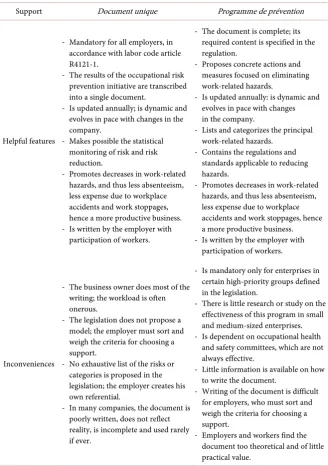
The Programme de prévention nevertheless contains a large amount of de-tailed information, which must be written by the employer and read by em-ployees, who may find the program to be tedious and confusing [2] [11], de-pending on their education, experience and other factors. Some of the helpful features and inconveniences of the French and Québec versions of the principal document used inenterprises for OHS management are listed in Table 3.
We found the advantageous features and inconveniences to be quite similar for both documents. There are nevertheless opportunities to combine the best features of the Document unique and the Programme de prévention in order to obtain an improved guide for the writing of a complete accident prevention and OHS policy appreciated by employers and employees alike.
5. Conclusions
DOI: 10.4236/ojsst.2019.91003 33 Open Journal of Safety Science and Technology Table 3.Document unique and Programme de prévention: helpful features and inconve-niences.
Support Document unique Programme de prévention
Helpful features
- Mandatory for all employers, in accordance with labor code article R4121-1.
- The results of the occupational risk prevention initiative are transcribed into a single document.
- Is updated annually; is dynamic and evolves in pace with changes in the company.
- Makes possible the statistical monitoring of risk and risk reduction.
- Promotes decreases in work-related hazards, and thus less absenteeism, less expense due to workplace accidents and work stoppages, hence a more productive business. - Is written by the employer with
participation of workers.
- The document is complete; its required content is specified in the regulation.
- Proposes concrete actions and measures focused on eliminating work-related hazards.
- Is updated annually: is dynamic and evolves in pace with changes in the company.
- Lists and categorizes the principal work-related hazards.
- Contains the regulations and standards applicable to reducing hazards.
- Promotes decreases in work-related hazards, and thus less absenteeism, less expense due to workplace accidents and work stoppages, hence a more productive business. - Is written by the employer with
participation of workers.
Inconveniences
- The business owner does most of the writing; the workload is often onerous.
- The legislation does not propose a model; the employer must sort and weigh the criteria for choosing a support.
- No exhaustive list of the risks or categories is proposed in the legislation; the employer creates his own referential.
- In many companies, the document is poorly written, does not reflect reality, is incomplete and used rarely if ever.
- Is mandatory only for enterprises in certain high-priority groups defined in the legislation.
- There is little research or study on the effectiveness of this program in small and medium-sized enterprises. - Is dependent on occupational health
and safety committees, which are not always effective.
- Little information is available on how to write the document.
- Writing of the document is difficult for employers, who must sort and weigh the criteria for choosing a support.
- Employers and workers find the document too theoretical and of little practical value.
workplace lies primarily with the employer. It is up to the employer to evaluate risks, to reduce them and to eliminate them wherever possible, by applying the formal and systematic approaches set forth in the Document unique (France) or the Programme de prévention (Québec).
DOI: 10.4236/ojsst.2019.91003 34 Open Journal of Safety Science and Technology based on a single universal document to work as legislators intend and taxpayers expect, the documentation procedure must be made easier and especially more accessible to workers, and the preventive actions must be made both easier to implement and better grounded in workplace reality. The goals must be to im-prove accident prevention processes and eliminate workplace hazards, and the-reby increase business productivity and viability.
Acknowledgements
The authors thank the Natural Sciences and Engineering Research Council of Canada (NSERC) for financial support through the Discovery Grants Program.
Conflicts of Interest
The authors declare no conflicts of interest regarding the publication of this pa-per.
References
[1] EUROGIP (2010) Prévenir les risques professionnels dans les PME: Quelles actions en Europe? Communiqué de presse, Les Débats du, 14 Octobre 2010, Paris.
http://www.eurogip.fr/docs/DP_DebatsEurogip2010_PME.pdf
[2] Tremblay, A. and Badri, A. (2018) Assessment of Occupational Health and Safety Performance Evaluation Tools: State of the Art and Challenges for Small and Me-dium-Sized Enterprises. Safety Science,101, 260-267.
https://doi.org/10.1016/j.ssci.2017.09.016
[3] Sabourin, G. (2016) L’efficacité des programmes de Mieux-Être au travail, ça se mesure! Prévention au Travail, Reportage.
http://www.preventionautravail.com/reportages/378-l-efficacite-des-programmes-d
e-mieux-etre-au-travail-ca-se-mesure.html
[4] Badri, A., Nadeau, S. and Gbodossou, A. (2012) Proposal of a Risk-Factor-Based Analytical Approach for Integrating Occupational Health and Safety into Project Risk Evaluation. Accident Analysis and Prevention: Construction and Engineering, 48, 223-234.https://doi.org/10.1016/j.aap.2011.05.009
[5] Légifrance (2018) Code du Travail. Version Consolidée.
https://www.legifrance.gouv.fr/affichCode.do?cidTexte=LEGITEXT000006072050
[6] Institut National de Recherche et de Sécurité (INRS) (2004) Évaluation des risques professionnels. Questions-Réponses sur le Document Unique, 20 p.
[7] Eckerl, G. (2014) Le programme de prévention, un outil méconnu. Prévention au Travail, Reportage.
http://www.preventionautravail.com/reportages/134-le-programme-de-prevention-un-outil-meconnu.html
[8] LégisQuébec (2018) Loi sur la santé et la sécurité du travail.
http://legisquebec.gouv.qc.ca/fr/ShowDoc/cs/S-2.1/
[9] LégisQuébec (2018) Règlement sur le programme de prévention (Loi sur la santé et la sécurité du travail).
http://legisquebec.gouv.qc.ca/fr/ShowDoc/cr/S-2.1,%20r.%2010/
Me-DOI: 10.4236/ojsst.2019.91003 35 Open Journal of Safety Science and Technology
dium-Sized Enterprises. Safety, 4, 1-20.
[11] Tremblay, A. and Badri, A. (2018) A Novel Tool for Evaluating Occupational Health and Safety Performance in Small and Medium-Sized Enterprises: The Case of the Quebec Forestry/Pulp and Paper Industry. Safety Science, 101, 282-294. https://doi.org/10.1016/j.ssci.2017.09.017
[12] Tremblay, J.-F. (2018) Définition d’une PME.
http://www.dip3.ca/category/pme/
[13] Commission Européenne (2005) Guide de l’utilisateur pour la définition des PME. 60 p.
[14] Institut de la statistique Québec (2018) Définition—Petite et moyenne entreprise (PME). Institut de la Statistique Québec.
http://www.stat.gouv.qc.ca/statistiques/science-technologie-innovation/financemen
t_pme/cdmi.html
[15] Marchesnay, M. (1991) La PME: Une gestion spécifique. Économierurale, 206, 11-17.https://doi.org/10.3406/ecoru.1991.4231
[16] Mendeloff, J., Nelson, Ch., Ko, K. and Haviland, A. (2006) Small Businesses and Workplace Fatality Risk an Exploratory Analysis. Kauffman-RAND Center for the Study of Small Business and Regulation, 104 p.
https://www.rand.org/content/dam/rand/pubs/technical_reports/2006/RAND_TR3 71.pdf
https://doi.org/10.7249/TR371
[17] Champoux, D. and Brun, J.-P. (2000) Occupational Health and Safety Management in Small-Size Manufacturing Enterprises. An Overview of the Situation and Orien-tations for Future Intervention and Research. PISTES, 2-2, 20 p.
[18] Ferre, N. (2010) Occupational Health Institutions and Actors in Québec and in France: New Comparative Perspective. PISTES, 12-1, 19 p.
[19] Davezies, Ph. (2008) Le document d’évaluation des risques: Une occasion unique pour débattre sur le travail. Santé & Travail, 63, 28-30.
[20] Institut National de recherche et de sécurité (INRS) (2018) Principes généraux de la démarche de prévention.
http://www.inrs.fr/demarche/principes-generaux/introduction.html
[21] APS (2018) Document unique d’évaluation des risques professionnels.
https://www.aps-prevention.com/document-unique/
[22] Observatoire de la sécurité et de l’accessibilité des établissements d’enseignement (2018) Le programme annuel de prévention. Registres et documents règlementaires, 2 p.
[23] SIST VO Santé au travail (2016) Guide d’aide à l’élaboration du document unique. 43 p.
[24] Secrétariat du Conseil du trésor (Québec) (2015) Guide d’application de la Loi sur la santé et la sécurité du travail. 36 p.
[25] LégisQuébec (2019) Règlement sur la santé et la sécurité du travail (Loi sur la santé et la sécurité du travail).
http://legisquebec.gouv.qc.ca/fr/showdoc/cr/S-2.1,%20r.%2013
[26] Commission des normes, de l’équité, de la santé et de la sécurité du travail (CNESST) (2016) Guide de prévention en milieu de travail à l’intention de la petite et de la moyenne entreprise. 2nd Editon, 40 p.
DOI: 10.4236/ojsst.2019.91003 36 Open Journal of Safety Science and Technology
[28] Perrot, M. (2018) L’essentiel à connaître sur le Document unique d’évaluation des risques professionnels.
https://www.blog-expertises-publiques.com/lessentiel-a-connaitre-sur-le-document
-unique-devaluation-des-risques-professionnels
[29] Affaires, R.H. (2018) LaBonté, D. Les principaux avantages des programmes de prévention.
http://www.affairesrh.ca/gestionnaires/coin-gestionnaire/fiche.aspx?p=459895
[30] Baril-Gingras, G., Vézina, M. and Lippel, K. (2013) Bilan relatif aux dispositions de la LSST: Vers une application intégrale? Industrial Relations, 68, 682-708.
[31] Allaire, E., Jauvin, N. and Duchesne, A. (2016) Démarche participative de prévention des problèmes de santé et sécurité au travail chez les auxiliaires de santé et de services sociaux du Centre intégré universitaire de santé et de services sociaux (CIUSSS) de la Capitale-Nationale. Centre de santé et de services sociaux (CSSS) de la Vieille-Capitale, 20 p.
[32] Champoux, D. and Brun, J.-P. (2010) Provisions, Capacities and OHS Practices in Small Businesses: Opinions of Employers, Employees and OHS Practitioners in Québec. PISTES, 12-2, 22 p.
![Table 1. The nine general principles of prevention [20].](https://thumb-us.123doks.com/thumbv2/123dok_us/9094405.406504/8.595.208.541.88.347/table-general-principles-prevention.webp)
![Figure 2. The 7 steps of the creation of an OHS plan based on the Programme de préven-tion [27]](https://thumb-us.123doks.com/thumbv2/123dok_us/9094405.406504/10.595.200.540.323.540/figure-steps-creation-ohs-plan-based-programme-preven.webp)