ISSN Print: 2327-5219
DOI: 10.4236/jcc.2018.68007 Aug. 31, 2018 92 Journal of Computer and Communications
Design and Implementation of E-Commerce
Platform Based on Android
Jie Shen, Guiling Sun
*, Yangyang Li
College of Electronic Information and Optical Engineering, Nankai University, Tianjin, China
Abstract
This paper introduces the basic functions of the e-commerce system imple-mented on Android, including user management functions, product search functions, product browsing functions, and product tracking functions, etc. It is necessary to use technologies in Android in order to implement each mod-ule function. For example, network communication requires Android’s net-work request technology and data analysis technology. The display of pictures requires the use of Android controls and cache technology. The traceability of products requires camera scanning technology. And RSA decryption tech-nology and so on. Through the above thread pool techtech-nology and the use of caching mechanism, the user experience of UI will be improved and unne-cessary network resources consumption will be avoided.
Keywords
Android, E-Commerce, Network Communication, Image Display, Product Traceability
1. Introduction
With the continuous development of mobile internet in recent years, more and more attention has been paid to the e-commerce platform and Android mobile users are also increasing.
First, in the e-commerce application, frequent requests will be initiated to the server, so that we will consume a lot of resources, and we know that Http com-munication can reduce a lot of resource consumption. At the same time, in or-der to improve performance, the thread pool technology is used in this system to manage each child thread that initiates a network request. In addition, consi-dering that a large number of load pictures are required in the e-commerce platform, if a network pull is required for each request, it will cause application How to cite this paper: Shen, J., Sun, G.L.
and Li, Y.Y. (2018) Design and Implemen-tation of E-Commerce Platform Based on Android. Journal of Computer and Com-munications, 6, 92-100.
https://doi.org/10.4236/jcc.2018.68007
Received: July 4, 2018 Accepted: August 28, 2018 Published: August 31, 2018
Copyright © 2018 by authors and Scientific Research Publishing Inc. This work is licensed under the Creative Commons Attribution International License (CC BY 4.0).
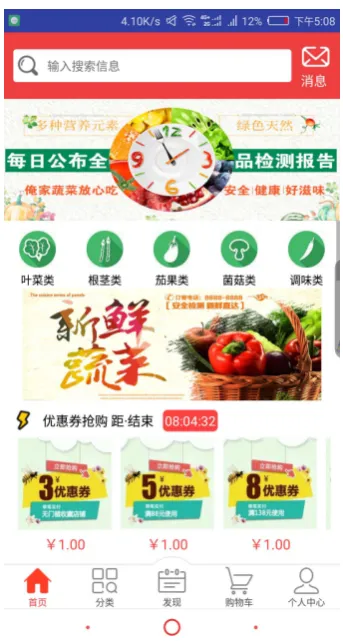
DOI: 10.4236/jcc.2018.68007 93 Journal of Computer and Communications delay and excessive consumption of traffic. Caching technology can help reduce the burden on mobile devices, improve the performance of applications, and at the same time reduce the consumption of traffic. Therefore, image caching technology is required in the picture display. Finally, because the product’s tra-ceability module contains all the information of the production process of the product, in order to encrypt the information of the two-dimensional code, we have enhanced the security through the encryption scheme of DES and RSA hy-brid encryption algorithm. Therefore, we have designed and implemented our current Android-based e-commerce platform. As shown in Figure 1.
2. Network Module Implementation
Since the entire system adopts a C/S architecture, the network communication between the Android device and the server is indispensable. In the network communication, the way of network communication and the unity of data for-mat are indispensable. Only when the specific communication method and data format are defined before the network communication, the client and server can communicate normally.
2.1. The Choice of Network Communication Method
[image:2.595.287.459.381.702.2]Use HTTP communication method in Android. Http is a hypertext transfer
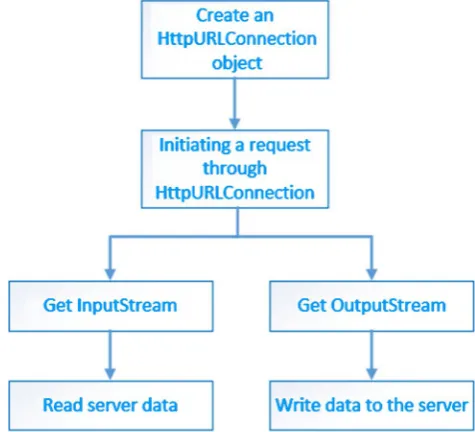
DOI: 10.4236/jcc.2018.68007 94 Journal of Computer and Communications protocol, and Http communication mode uses a “request-response” mode to es-tablish a connection. First the client initiates a data request. And then server re-sponds passively and feeds back the data to the client. After the data is transmit-ted, the connection is automatically disconnected. Therefore, fewer resources are required. In the e-commerce system, the mobile device initiates a large number of network requests to the server to obtain product information. Therefore, us-ing the Http communication method as the network communication method between the Android device and the server can reduce a lot of resource con-sumption. In our Android project development, there are two ways to achieve HTTP communication, and achieve data interaction with the server, one is using Http Client, and one is Http URL Connection. Each Http URL Connection in-stance can be used to generate a single request, but other inin-stances can transpa-rently share the underlying network that connects to the HTTP server. The process is shown in Figure 2 [1].
2.2. Network Thread Management
[image:3.595.252.490.490.706.2]Android uses the Reactor mode, or observer mode, because its read and write operations are non-blocking, allowing us to use only one thread to handle all IO events, this approach is synchronous. To improve performance, when a thread receives an event, it considers starting a new thread to handle it, and continues to wait for the next request. But the initiating network request must be in the child thread, network operations in the main thread will throw an exception and cause the program to crash. In e-commerce applications, frequent requests are initiated to the server. Creating a new thread for each request consumes a large amount of resources. Therefore, the thread pool technology is used in this sys-tem to manage each sub-thread that initiates a network request. There are sever-al non-stop child threads and a task queue running in the thread pool. Each
DOI: 10.4236/jcc.2018.68007 95 Journal of Computer and Communications request is put into the task queue, and then the child threads continuously pull requests from the task queue to execute.
2.3. Json Data Analysis
In this e-commerce system, the data format used to communicate with the serv-er is in the Json data format. Json is a form of data exchange in Google. It is in-dependent of language and inin-dependent of platform. Google provides multilgual implementation: Java, c#, c++, go and python. Each implementation in-cludes compiler and library files of the corresponding language. Because it is a binary format, data exchange is much faster than using XML. It can be used for data communication between distributed applications or data exchange in hete-rogeneous environments. As an excellent binary data transmission format, which is excellent in efficiency and compatibility, it can be used in many fields, such as network transmission, configuration file, data storage and so on [2] [3] [4] [5].
3. Implementation of Picture Display Module
In e-commerce applications, it is necessary to display a large number of pictures, and in a mobile device with limited resources and expensive traffic, if each re-quest needs to be pulled through the network, it will cause the delay of applica-tion and excessive consumpapplica-tion of traffic. In order to solve the OOM excepapplica-tion generated by the network picture [6]. We can first adjust the size of the picture, and then recover the unused picture resources in time. Finally, we can help re-duce the burden of mobile devices, improve the performance of the application and reduce the consumption of traffic by caching technology, so we need to use the picture caching technology in the picture display.
3.1. Adjust and Recycle Picture Data
First of all, in the image display of the network, many times the picture is li-mited, so we have to adjust the size of the picture to reduce the size of the re-sources. We can compress the bitmap through the “options. Injust Decode Bounds” method, so that the resources used in the pictures will be greatly re-duced and convenient to load. Then we can recover some of the unnecessary picture resources in time. For example, we can recycle these resources through the “bitmap.recycle” method and release the space in time to avoid OOM ano-malies.
3.2. Picture Caching Technology
DOI: 10.4236/jcc.2018.68007 96 Journal of Computer and Communications them again [7]. And when our application is broken back to the background by an application such as the phone, it may be destroyed by the system to recover the memory, and when the application is reentered, all the caching data needs to be reloaded. This scenario requires a memory cache. The memory cache can persist these loaded images and shorten the time of loading pictures again when the data in the memory cache is no longer available. Of course, loading pictures from memory will be slower than loading from memory. Because the time to read memory is unpredictable, background threads should be used to load them. In addition to loading and parsing data from the thread pool, the Image Loader framework can be used to replace the original Image Request framework to achieve specific image loading. The constructor of the Image Loader framework has a cache parameter that displays default images without pictures, which con-sumes no traffic at this time and when the request fails Callbacks to the corres-ponding images also check if the local cache is available when the request is loaded successfully to further optimize the UI carton and avoid a large amount of traffic loss.The image cache loading is shown as shown in Figure 3.
[image:5.595.285.466.365.704.2]In Android, a class of memory caching and disk caching based on the most recently used algorithm is provided. The memory cache class is the Disk Lru-Cache class. Obviously, every time we update (called the put method) or access
DOI: 10.4236/jcc.2018.68007 97 Journal of Computer and Communications the node in the map (called the get method), the inner part of the Linked Hash Map will move the node to the tail of the list. Therefore, at the end of the linked list is the recently used node, where the head of the linked list is the most re-cently used node, when our cache space should be removed from time to time to remove the head node of the list, until there is room for the rest of the list. As you can see, the core functionality in DiskLruCache is completed, and what re-mains to be done in DiskLruCache is to define the total capacity of the cache space, the current capacity to save the data, and the put and get methods. The implementation process is shown in Figure 4.
4. Product Traceability Module
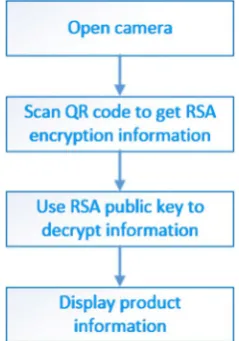
[image:6.595.240.508.325.502.2]The function of product traceability module is to use the QR code information of the scanned product to contain the information of the production process in the information of the QR code. Encryption algorithm is used to encrypt plain-text files, and RSA encryption algorithm is used to encrypt the key. The work flow of the entire traceability function is shown in Figure 5.
Figure 4. Write and read the disk cache data.
[image:6.595.313.433.534.705.2]DOI: 10.4236/jcc.2018.68007 98 Journal of Computer and Communications
4.1. The Realization of Camera Scan QR Code Function
The SDK in Android does not directly realize the class of QR code information using a camera, so it takes two steps to realize the function, one is to open the camera and the two is to analyze the information of the QR code by the image collected by the scanning camera. Google provides a class library that specializes in scanning and parsing QR codes. The method of using the class library is very concise [8]. Only the camera class Camera and the setting callback method “handle Decode ()” can open the camera and scan the QR code information and return the information to the callback method. But this method is not safe and easy to crack. Only through RSA encryption and other technologies to prevent malicious cracking or product information is modified, but also to achieve only professional reading equipment can read the encrypted information, to give us-ers accurate traceability information. At the same time, it can activate the trace-back code, only the tracetrace-back code can be read by the user. When the product is not sold, it can not read information even if it is illegally copied. The final im-plementation of a two-dimensional code is shown in Figure 6.
4.2. Implementation of Key Decryption Function of DES and RSA
1) Implementation steps of encryption scheme for DES and RSA hybrid en-cryption algorithm.a) To generate DES encryption key K, in order to improve the security of data, each key K is used only once.
[image:7.595.292.457.430.706.2]b) The key Ck used to encrypt plaintext is generated by using the public encryption
DOI: 10.4236/jcc.2018.68007 99 Journal of Computer and Communications key of RSA encryption algorithm to encrypt the key K of DES, and form the DES encrypted key Ck and save it.
c) Generate ciphertext C, use the generated key Ck to encrypt plaintext P DES and generate ciphertext.
2) The decryption principle of DES and RSA's hybrid encryption algorithm is decrypted by DES algorithm, and DES key is decrypted by RSA algorithm.
3) Specific implementation steps of decryption scheme based on DES and RSA hybrid encryption algorithm.
a) Get the encryption key Ck.
b) The key K used for DES decryption is generated. The key Ck of DES is de-crypted by the decryption key of RSA, and the key K of DES decryption is formed.
c) Generate plaintext P.
4) The implementation steps of DES RSA mixed encryption algorithm a) Private key generation.
b) Convert the RSA private key into PKCS8 format
c) Generate public key
d) As follows: the export can be derived
5. Conclusion
im-DOI: 10.4236/jcc.2018.68007 100 Journal of Computer and Communications ages and UI Carton to further optimize. Finally, in the traceability module of the product, the camera scanning technology and RSA decryption technology are adopted, and the user’s UI experience is further optimized by creating a multi-tasking thread pool technology and the use of caching mechanism. At the same time, the unnecessary network requests are avoided maximally.
Acknowledgements
This work was partially supported by Tianjin Science and Technology Major Project (2017ZXHLNC00100) and supported by Tianjin Rural Working Com-mittee and Tianjin Key Laboratory of Optoelectronic Sensor and Sensing Net-work Technology.
Conflicts of Interest
The authors declare no conflicts of interest regarding the publication of this paper.
References
[1] Cabir, Smartphone Malware (2004) http://www.f-secure.com/v-descs/cabir.shtml [2] GDATA, Mobile Malware Report (Threat Report: Q4/2015) (2016)
https://secure.gd/dl-us-mmwr201504
[3] Rieck, K., Holz, T., Willems, C., Düssel, P. and Laskov, P. (2008) Learning and Clas-sification of Malware Behavior. Proceedings of the 5th International Conference on Detection of Intrusions and Malware, and Vulnerability Assessment, Paris, 10-11 July, 108-125. https://doi.org/10.1007/978-3-540-70542-0_6
[4] Griffin, K., Schneider, S., Hu, X. and Chiueh, T.-C. (2009) Automatic Generation of String Signatures for Malware Detection. Proceedings of the 12th International Symposium on Recent Advances in Intrusion Detection, Saint-Malo, 23-25 Sep-tember 2009, 101-120. https://doi.org/10.1007/978-3-642-04342-0_6
[5] Joshua, A., Waziri, O.V., Abdullahi, M.B., Arthur, U.M. and Adewale, O.S. (2015) A Machine Learning Approach to Anomaly-Based Detection on Android Platforms. International Journal of Network Security & Its Applications, 7, 15-35.
https://doi.org/10.5121/ijnsa.2015.7602
[6] Allix, K., Bissyandé, T.F., Jérome, Q., Klein, J., State, R. and Traon, Y.L. (2016) Em-pirical Assessment of Machine Learning-Based Malware Detectors for Android. Empirical Software Engineering, 21, 183-211.
https://doi.org/10.1007/s10664-014-9352-6
[7] Georgiou, N., Konstantinidis, A. and Papadopoulos, H. (2016) Malware Detection with Confidence Guarantees on Android Devices. Proceedings of the 12th IFIP WG 12.5 International Conference and Workshops, Artificial Intelligence Applications and Innovations, AIAI 2016, Thessaloniki, 16-18 September 2016, 407-418. https://doi.org/10.1007/978-3-319-44944-9_35