113
Annotating Information Structure in Italian: Characteristics and
Cross-Linguistic Applicability of a QUD-Based Approach
Kordula De Kuthy SFB 833
University of T¨ubingen
Lisa Brunetti Universit´e de Paris,
LLF, CNRS
lisa.brunetti@
linguist.univ-paris-diderot.fr
Marta Berardi SFB 833
University of T¨ubingen
Abstract
We present a discourse annotation study, in which an annotation method based on Ques-tions under Discussion (QuD) is applied to Italian data. The results of our inter-annotator agreement analysis show that the QUD-based approach, originally spelled out for English and German, can successfully be transferred cross-linguistically, supporting good agree-ment for the annotation of central infor-mation structure notions such as focus and non-at-issueness. Our annotation and inter-annotator agreement study on Italian authentic data confirms the cross-linguistic applicability of the QuD-based approach.
1 Introduction
In this paper, we present a discourse annotation study of Italian data, which uses the annotation scheme and discourse-analytic method, the QUD-treeframework, developed in?,? and?. Its pur-pose is the cross-linguistic analysis ofinformation structure and discourse structureof textual data. On the theoretical side, the QUD framework has been applied to a number of different languages, such as German, English and French in (?), and various Austronesian languages as discussed in?
and?. On the applied side,?showed that the QUD
based method supports the successful annotation of discourse structure and information structure in German and English spoken language data. Here we want to broaden the crosslinguistic scope of the QUD framework and apply it to another Romance language, Italian. We will explore both the QUD annotation and the information structure annota-tion including all informaannota-tion structure labels that are part of the annotation scheme proposed in ?, such as focus, background, contrastive topic, nai
andtopic. Topic is regarded as a notoriously diffi-cult label in agreement studies (cf. ??). While the results of our study show that the question-based
annotation method supports the successful anno-tation of discourse structure and of information structure, in particular focus, we will also discuss, using the example of topic, some shortcomings of the QUD based annotation method.
2 The QUD framework
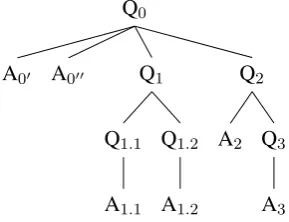
The QUD framwork introduced in? presents an explicit method for the reconstruction of QUDs which are usually only discussed as an abstract theoretical term. The center of the QUD frame-work is a compact representation format for QUD trees, in which the textual assertions (A) repre-sent the terminal nodes of a discourse tree (pre-serving the linear order of the text from left to right) while (implicit or explicit) QUDs (Q) form the non-terminal nodes. An abstract QUD tree is shown in Figure1.
Q0
Q2
Q3
A3
A2
Q1
Q1.2
A1.2
Q1.1
A1.1
A000
[image:1.595.344.489.503.614.2]A00
Figure 1: QUD tree
2.1 Segmentation
Raw texts are segmented into atomic assertions. Apart from orthographic sentence boundaries, segmentation also applies at (1) (information-structurally relevant) coordinations and(2)before (optional) syntactic adjuncts. (Obligatory) senten-tial arguments(3)are not split off.
(1) A4:Ho
I-have appena just terminato finished un a romanzo novel
’I just finished a novel’ A40: e
and sono am gi`a already al at lavoro work su on un a nuovo new progetto. project
’and I’m already working on a new project.’
(2) A700:Di
of recente recently ho I-have ripreso re-started a to leggere read i the romanzi novels di of formazione, coming-of-age A7000:senza
without mai ever tralasciare neglecting la the narrativa contemproray contemporanea fiction e and i the romance. romance’
(3) A250:[[Alek]T
Alex [`e is frutto result della of-the mia my
fantasia]F],
imagination A2500:[[nasce
he-is-born in in relazione relation a to
Dave]F] ,
Dave A26:[[ho
I-have voluto wanted che]NAI that fosse he-was [“forte” strong ma but non not “invincibile”]F].
invincible
2.2 QUD principles
The actual identification of a QUD for each asser-tion is guided by a number of explicit principles adapted from the formal literature on information structure (????), cf.?:
Q-A-CONGRUENCE: QUDs must be answer-able by the assertion(s) that they immediately dominate.
Q-GIVENNESS: Implicit QUDs can only consist
of given (or, at least, highly salient) material.
MAXIMIZE-Q-ANAPHORICITY: Implicit QUDs should contain as much given (or salient) material as possible.
Example (4) shows that from these principles we can derive QUD Q32for assertionA32in the
context of A31, whereas any of the questions in
(5), used in place of Q32, would violate at least
one of the QUD constraints in the same context.
(4) A31: Anche
even tra among i the bilingui early precoci bilinguals che who parlano speak due two lingue languages quasi almost mai never le the due two lingue languages sono are del tutto completely equivalenti, equivalent
’Even among the early bilinguals who speak two languages, the two languages are almost never completely equivalent,’
Q32: {What about the two languages instead?}
>A32: and and [[normalmente]NAI usually [[ogni each lingua]T language [si itself sviluppa develops in in un a contesto context
specifico]F]∼
specific
’and usually each language develops in a spe-cific context.’
(5) a.{What about speaking two languages?}
(#Q-A-CONGRUENCE)
b.{What about the specific context?}
(#Q-GIVENNESS) c.{What happens next?}
(#MAXIMIZE-Q-ANAPHORICITY)
Two or more assertions are defined as parallel if and only if they share some semantically iden-tical content and represent partial answers to the same QUD, see Example(6), where the semanti-cally shared content isAlek(omitted in the second assertion).
PARALLELISM: The background of a QUD with two or more parallel answers consists of the (se-mantically) common material of the answers.
(6) Q25: {What about the connection with
re-ality in Alek?}
>A250: [[Alek]T
Alek [`e is frutto the result della of-the mia my fantasia]F] ,
imagination >A2500:[[nasce
is-born in in relazione relation a to
Dave]F] ,
Dave
The resulting tree structure is shown in Figure2.
Q25
A2500
A250
Figure 2: Two coordinated (parallel) assertions.
3 QUDs and information structure
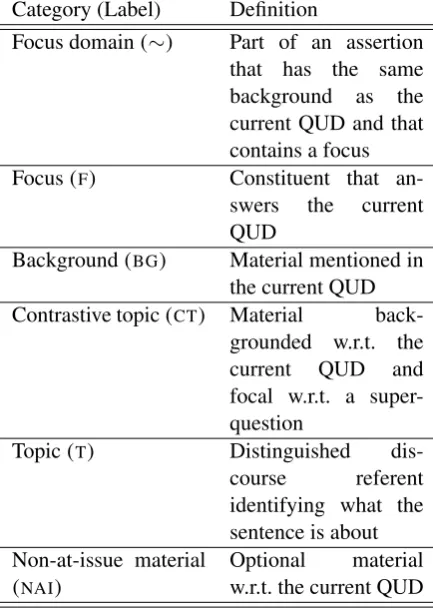
The basis of our annotation approach is an alternative-based definition of information struc-tural categories, in line with e.g. ?, ?, ?, ? or?. The Table in 1 shows the definitions for the in-formation structure categories as introduced in?. These are the basis for the labels used in our anno-tation study.
(7) Q7: {Cosa
Category (Label) Definition
Focus domain (∼) Part of an assertion that has the same background as the current QUD and that contains a focus
Focus (F) Constituent that
an-swers the current QUD
Background (BG) Material mentioned in the current QUD Contrastive topic (CT) Material
back-grounded w.r.t. the
current QUD and
focal w.r.t. a super-question
Topic (T) Distinguished
dis-course referent
identifying what the sentence is about Non-at-issue material
(NAI)
[image:3.595.72.289.67.372.2]Optional material w.r.t. the current QUD
Table 1: Information structure: Label inventory
’What do you like to read?’
>A7: [[Di of recente]NAI recently [[ho I-have ripreso re-started a to leggere]BG read [i the romanzi novels di of
formazione]F]∼
coming-of-age
’I recently started to read the novels of coming-of-age.’
(7) is an example demonstrating the assignment of information-structure labels in the context of a QUD (in curly brackets). Note that the indenta-tion (>) ofA7 in the textual representation marks
subordination in the discourse tree, as shown in Figure 2. The focus is i romanzi di formazione
‘coming-of-age novels’, which is labelled [ ]Fand
constitutes the answer to the QUD Q7. The
back-ground is linguistic content that is mentioned in this QUD. The question is about what books the interviewee reads or likes to read, so ho ripreso a leggere ‘I’ve restarted to read’ (labelled [ ]BG)
is clearly recoverable from the QUD. Focus and background together form the focus domain, la-belled [ ]∼. The sentence initial phrase Di re-cente‘recently’ is not relevant to answer the QUD Q7, which would still receive an answer without it,
therefore it is labelled [ ]NAI.
An example of the label TopicTis given in(8).
(8) Q32: Come
how puoi can-you riassumere summarize ai to-the tuoi your lettori readers questo this romanzo? novel
’How can you summarize this novel to your readers?’ [. . . ]
>A32: [[Senza Senza Etichette]T Etichette [`e is la the storia story di of
Dave]F]∼,
Dave
In A32, the clause initial phrase Senza etichette,
the novel’s title, is part of the background (in fact, it is the only background in that utterance) because it is mentioned in Q32. Since it is a referential
ex-pression, it is marked [ ]T.
In(9), an example of a contrastive topic (CT) is
given.
(9) Q10: Se
if dovessi you-had esprimere to-express tre three desideri? wishes [. . . ]
>Q10.1 {What is your first wish?}
>>A10.1:quindi
so [[il the primo]CT first-one sarebbe: would-be [la the libert`a freedom e and la the felicit`a happiness di of mio my figlio]F]∼;
son
>Q10.2: {What is your second wish?}
>>A10.2:[[il
the secondo]CT second `e is [riuscire to-succeed a to emozionare touch quanti as-much pi`u more lettori readers possibile]F]∼,
as-possible
The (explicit) question Q10 asks the interviewee
to tell three wishes. The speaker answers by utter-ing three different assertions each about one wish. Clearly, il primo‘the first (wish)’ in A10.1 andil
secondo ‘the second (wish)’ in A10.2 are
mem-bers of the alternative set mentioned in Q10 (tre
desideri‘three wishes’).
4 Evaluation: Discourse structure
In the present annotation study based on the above described QUD framework, our goal is to show that the discourse annotation in terms of QUDs can be applied reliably to naturally occurring data - in this particular case, Italian data. We conducted an empirical study, in which annotators followed the QUD guidelines described in ? to annotate two Italian blog interviews.
For the QUD-based annotation we use the tool
system-atically enhance them with implicitQuestions un-der Discussion (QUDs), and transform the data into a discourse tree calledQUD tree, as described in?.
4.1 Evaluation setup
Two trained annotators (and also native speakers of Italian) analyzed and annotated two short Ital-ian blog interviews downloaded from the internet 1. The first blog interview consists of 95 text
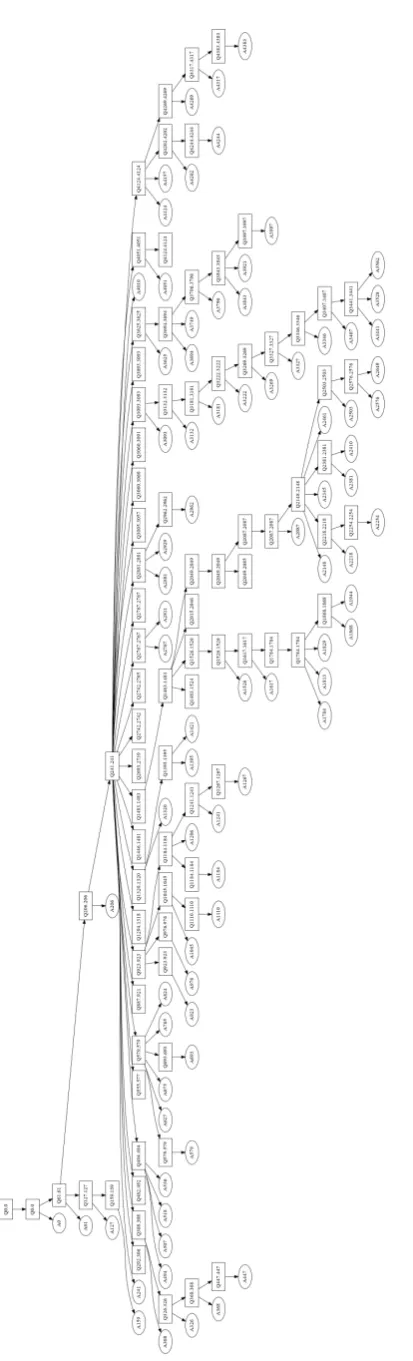
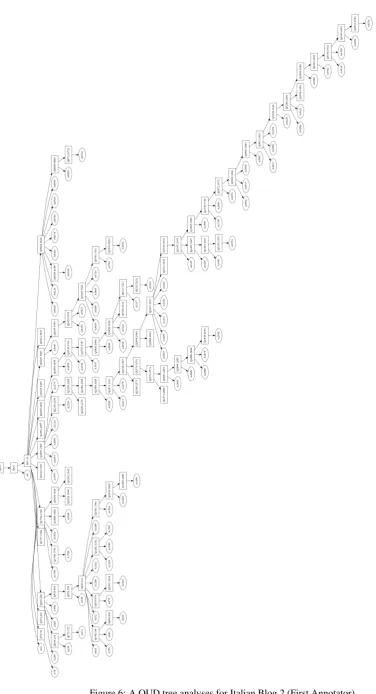
seg-ments, the second one of 113 segments. The QUD discourse tree for Blog 1 resulting from the first annotator is shown in Figure3, the other three dis-course trees are included in the Appendix.
4.2 Method and results
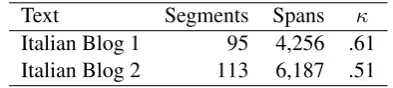
For the comparison of the two annotated doc-uments, we follow the method described in ?. The basic idea is that for the comparison of two QUD annotations one needs to calculate an inter-annotator agreement score that takes into account, for every segment and every possible span of seg-ments, whether a QUD is present or not. In order to compute aκ statistics (?) based on our QUD annotations,? propose to follow the method de-scribed in?, which was developed for measuring agreement in the labelling of rhetorical structure categories in texts. The method is based on the idea of mapping the hierarchical structure of a dis-course tree onto sets of units (i.e. text segments) that are a matrix or chart filled with categorical values. In our case, the values are whether there exists a (Q)uestion spanning the respective seg-ments – start to end – or (n)ot).
A κ statistics can then be computed between two charts that represent two different QUD anno-tations for the same text, more precisely between the two resulting sets of possible spans of seg-ments.2 For our two annotated documents we cal-culatedκvalues for the annotation charts derived from our QUD annotations, based on the above de-scribed method. For the textItalian Blog 1, con-sisting of 95 segments, we calculated theκ statis-tics based on 4,256 items (i.e. possible spans of segments), forItalian Blog 2 with 113 segments based on 6,187 items. The results are shown in Table2.
1
Blog 1 URL: http://purl.org/info-struc/
Italian-blog-1, Blog 2 URL:http://purl.org/
info-struc/Italian-blog-2
2
Generally, fornsegments contained in a document, the number of possible text spans isn×(n2+1).
Text Segments Spans κ
Italian Blog 1 95 4,256 .61
[image:4.595.317.514.64.108.2]Italian Blog 2 113 6,187 .51
Table 2: Kappa values for QUD-annotated Italian dia-logues
The values show moderate agreement between the annotator pairs. For Blog 1, theκ value is at .61, which is substantially higher than what (?) re-port for the QUD annotations of their German and English texts: theirκvalues are around .5. For our Blog 2, the κ value is at .51, which is thus very similar to the scores reported in (?) for texts of similar length. Our two annotated Italian texts are relatively short, only around 100 sentences each, so it is perhaps too early to interpret the results, in particular since this is a rather complex task. How-ever, since the results are comparable to those re-ported in (?), we take this as a further proof that the QUD-based annotation of discourse can suc-cessfully be applied cross-linguistically.
5 Evaluation: Information structure
The second major issue we are interested in is to evaluate the reliability of information-structure annotation based on the previous identification of QUDs.
5.1 Evaluation setup
For the evaluation of the information structural notation, the same two Italian blog texts were an-notated by the same two trained annotators, who still followed the guidelines of Riester et al. 2018). We aimed at annotating all five categories that are mentioned in?: focus (F), background (BG), non-at-issue material (NAI), contrastive topic (CT) and
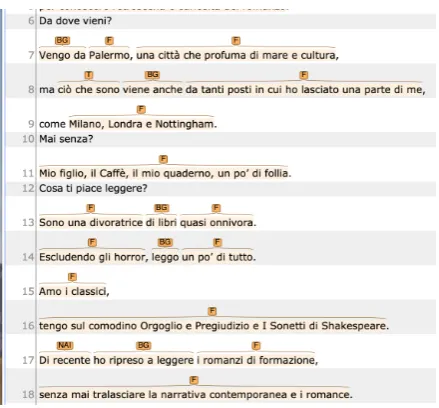
topic (T). Focus domain labels (∼) were not anno-tated, since each text segment (assertion) already corresponds to one focus domain. The annota-tors based their annotations on the previously per-formed QUD analysis in the TreeAnno tool. As an annotation tool for the token-based information-structure annotation, WebAnno (?) was chosen. Figure 4 shows a screenshot of the information-structure annotation of the beginning ofBlog 1.
5.2 Method and results
Figure 3: A QUD tree analyses for Italian Blog 1
Figure 4: Annotation in WebAnno
following previous work (???). In addition to the specifications in?, in particular the QUD-to-information-structure mapping from Table 1, we defined a number of heuristic (but potentially de-batable) rules in order to prevent disagreement due to theoretically unclear issues, such as:
• Discourse connectors (but, and, although, be-cause, thereforeetc.) at the beginning of dis-course segments are not annotated.
• Punctuation: Quotation marks around an ex-pression, commas within and at the right edge of an expression are part of the markable. Pe-riods, colons, semicolons, exclamation marks are not.
Results are shown in Table 3, divided into scores for all labels taken together, and individual scores for each of the four labels.
The results are rather heterogeneous in both texts but overall they show that the QUD-based method does contribute to a successful annotation of information structure in Italian for a range of labels. For the first text Blog 1, the overall agree-ment score for all annotated categories taken to-gether is at .7, which shows substantial agreement,
Text Label Tokens κ
Italian Blog 1 all 847 .70
F .72
BG .21
CT .85
NAI .53
T .45
Italian Blog 2 all 1243 .58
F .51
BG .1
CT .1
NAI .62
[image:5.595.72.292.161.365.2]T .35
Table 3: Kappa for information structure annotation
the score for focus annotation alone being at .72. The agreements scores for the second blog are overall lower, but with .58 for the overall agree-ment and .51 with agreeagree-ment for focus they are still at a relatively high level and still compara-ble to the scores that (?) report for the annota-tion of German and English data (which are at around .65). The category NAI, the classification of non-at-issue material, also received reasonable agreement scores at .53 in Blog 1 and .62 for Blog 2. The agreement scores for the other three cat-egories, BG and CT, differ a lot between the two texts. In Blog 1, the score for contrastive topic is very high with .85, in Blog 2 the score .1 shows that there was hardly any agreement between the two annotators. This might be due to the fact that there were only very few cases for which the label
assigning focus labels. The category topic (T) re-ceived relatively low agreement scores at .45 and .35, but still at a level which other studies report for categories like focus (cf.?report aκof .44 for focus). In the following section we will qualita-tively evaluate why the annotation scheme seems to better support the successful annotation of a cat-egory like focus, whereas there seems to be much more disagreement when annotating topic.
6 Qualitative Evaluation: The Case of Topics
In the question-based definitions of our informa-tion structure labels, the focus corresponds to those parts of an assertion that answer the current QUD. Especially in case of overt questions, but with implicit QUDs, the annotators agree on fo-cus.
The definition of topic in the QUD framework, however, is the only one that does not take the cur-rent QUD into account. As remarked by?, while potentially all referential expressions inside the background could be labelled as topic, one might argue that not all referential expressions inside the background are actually aboutness topics. But un-fortunately, the QUD method is not meant to sin-gle out the best topic candidate. And ? do not provide any rules that help to distinguish between better and worse topic candidates. The only cue that is given through the current QUD is that all focal expressions are excluded as topic candidates. A typical topic expression in Italian would be a clitic left or right dislocated phrase (seequel li-brobelow), but no dislocation was present in our data, probably due to the fact that a blog inter-view is less interactive than an spoken conversa-tion, and these construction are typically used in interaction.
(10)a. Quel that
libro, book
l’ho it I-have
dato given
a to
Giorgio. Giorgio b. L’ho
it I-have dato given
a to
Giorgio, Giorgio
quel that
libro. book
Clitic personal pronouns, such as le in A2 in
(11), are also typical candidates for (continuing) topics.
(11) A1:Abbiamo fatto quattro chiacchiere con Maria Ver-diana Rigoglioso per parlare diSenza Etichette, il romanzo che ha pubblicato con Libromania. ’We had a chat with Maria Verdiana Rigoglioso to talk aboutSenza Etichette, the novel she published with Libromania.’
Q2: {What did you do with her exactly?}
>A2:[[Le]T
to-her
[abbiamo
we-have
fatto
made
un
a
po’
little
di
of
domande]F]
questions
’We asked her a few questions’
>Q3:{What for?}
>A3:[per to
[conoscere
know
retroscena
ins-and-outs
e
and
curiosit`a
trivia
del
of-the
romanzo]F].
novel
’to get to know the background and trivia of the novel.’
What about cases where the topic is neither a dis-located expression, nor a clitic? Our annotation method should be able to single out such cases, but this is not always true. The example above nicely illustrates a case where our annotators disagreed about labelling a given referential expression as topic: the PPdel romanzoin A3, which is already
introduced in the previous sentence, A1. One
an-notator chose to nevertheless include it in the focus and label A3 as an all-focus assertion. The other
annotator, while annotating a similar QUD, chose to label the PP as a topic. Indeed, strictly speak-ing, this given PP should then also be part of the QUD (”What for, with respect to the novel?”).
(12) Q3: What for with respect to the novel?
>A3:[per
to
[conoscere know
retroscena ins-and-outs
e and
curiosit`a]F
trivia [del
of-the
romanzo]T] .
novel
It may be observed that the PPdel romanzois em-bedded inside the verb’s direct object NP. Our as-sumption is that informational categories are de-fined and identified solely by pragmatic means, in particular by the QUD-related properties given in Table 1. Despite such an assumption, we may sup-pose that it was the syntactically embedded posi-tion ofdel romanzothat led one annotator to con-sider it as part of the focus, or more precisely, the fact that the focus (retroscena e curiosit`a) did not form a constituent on its own without the PPdel romanzo. The relationship between the given-new structure and the syntactic structure has not been discussed by?, but it is something that might be worth addressing in the future. Of course, if the syntactic position of the topic must be invoked to complete the picture and arrive at its identification, then we expect different levels of complexity in the task of annotating aboutness topics depending on the language.
(13)A1: [Spesso]NAI often [si one pensa]NAI thinks [che that sia is bilingue bilingual solo only [chi who `e has stato been esposto exposed a to due two lingue languages fin since dalla tenera earliest
infanzia]F]
infancy
’It is often thought that only those who have been exposed to two languages since child-hood are bilingual.’
Q1.1: {One thinks that bilinguals are those who do
what, with such two languages?}
>A1.1: e and [[parla]F speaks [le the due two lingue]T languages [in in modo way perfetto perfect e and
equivalente]F].
equivalent
’and speak the two languages in a perfect and equivalent way.’
In this example syntax does not help to identify the topic status of the direct objectle due lingue. Such expression is mentioned in A1as part of the
focus, but instead of being promoted to topic in the subsequent utterance by some syntactic device for topic shift (such as left dislocation, cf. ?), it is left in situ. One reason for the speaker’s choice may be the fact that the topic expression is inside a free relative, a construction that seems to be in-compatible with dislocations, as the unacceptabil-ity of examples below shows:
(14)a.??Chi who l’italiano, the italian lo it conosce knows sa knows bene well dove where sta is l’errore. the mistake b.??Ho I-have dato given un a bel good voto note a to chi whom il the primo first esercizio, exercice lo it ha they-have fatto done bene. well
Since due lingue is mentioned in the previous sentence, the context tells us that this expression is clearly background. Since it’s a referential ex-pression, it has all that is required to be identified as topic. Note that a clitic pronoun might have been acceptable here (see example (15)), but this option is not chosen by the speaker/writer.
(15)A1.1: e
and [[le]T them [parla]F speaks [in in modo way perfetto perfect e and equivalente]F].
equivalent
The mechanism of identifying parallel struc-tures (multiple answers to the same question) is a strategy that our annotation tool provides to help recognizing ’hidden’ topics.
(16)A53: I
the genitori parents dovrebbero should lasciare leave spazio space al to-the bambino boy o or bambina girl che which c’`e there is in in loro them
’Parents should leave room for the child in them’
Q54: {To do what?}
>A54: [[per to giocare play con with i their
figli]F] ,
children
>Q55: {Parents should experience languages in
what way?}
>>A550: [dovrebbero
they-should [soprattutto]NAI above-all vivere live [le the lingue]T languages [come as
esperienza]F]
experience
’they should above all live languages as an experience’
>>A5500: e
and [[non not come as performance performance da to
misurare]F] .
measure
’and not as a performance to be measured.’
Clearly, the fact that le lingue (which again oc-cupies a canonical post-verbal position in A550) is
elided in A5500, shows that it represents shared
ma-terial between A550 and A5500, and therefore is part
of the background.
Cases of topic shift were easily recognized by the two annotators. One example is given be-low in (17). The referent la mamma che parla la lingua minoritaria per crescere i suoi bambini bilinguiis introduced in the overt question Q24.1
and then it continues as topic in the answer A24.1.
Then the topic changes and becomesi bambiniin A25. In A26, the topic changes back tola mamma
madrelingua.
(17)Q24.1: La
the mamma mother che who parla speaks la the lingua minority minoritaria language per to crescere raise i the suoi her bambini bilingual bilingui, children, cosa what fa? she-does
’The mother who speaks the minority lan-guage to raise her bilingual children what does she do?’
>A24.1: [[Parla she-speaks la the propria her-own lingua language ai to-the
figli.]F]
children’
’She speaks her own language to her chil-dren.’
>Q25: {What do the children do?}
>>A25: Solo only che that [molto very spesso]NAI often [[i the bambini]T children [pur even capendola understanding-her perfettamente]NAI perfectly [non not parlano speak attivamente actively la the sua her
lingua]F]
language
though they understand her perfectly, don’t actively speak her language.’
>>Q26: {What can the mother do then?}
>>>A26: Ecco there
quindi
then
che
that
[[la
the
mamma
mother
madrelingua]T
mothertongue
pu`o
can
[cominciare
start
ad
to
usare
use
la
the
creativit`a]F]
creativity
’This is where mother-tongue mother can begin to use her creativity.’
The fact that the topic is a preverbal subject also helped the annotators to recognize it. As dis-cussed in (?), preverbal subjects are typical sen-tence topics, and our two annotators agreed more often when the topic was in that position. The so-called hidden topics were more challenging.
And even if an expression was correctly in-cluded within the background, the two annotators still had to decide for every referential item that was part of the background whether to label it as a topic or not. Not surprisingly, they sometimes agreed, as in(13), and they sometimes picked dif-ferent elements. Since there are several character-istics of the text and the preceding discourse that have to be taken into account for the identification of possible topics, we hypothesise that this cate-gory will probably always be annotated with less accuracy than the other information structure cat-egories such as focus or non-at-issue material.
7 Conclusion
We have presented a novel method for the annota-tion of informaannota-tion structure which achieves good inter-annotator scores. In particular the agree-ment scores for focus are much higher than the results reported in other similar annotation studies on naturally occurring data (cf.?). The method is based on the reconstruction of QUDs, from which the annotation of IS categories is then derived. The results of our inter-annotator agreement anal-ysis show that the QUD-based approach, origi-nally spelled out for English and German, can suc-cessfully be transferred cross-linguistically, sup-porting good agreement for the annotation of cen-tral information structure notions such as focus
and non-at-issueness, with(contrastive) topicand
backgroundshowing lower levels of agreement for some texts due to underrepresentation of those in-formation structural categories in some of the data analysed. Thanks to the QUD-based method, at-tention was drawn to some interesting aspects of Italian information structure, and in particular of
Italian topics. Some difficulties of topic identifica-tion were shown to be reduced by the adopted an-notation procedure. We believe that the discussion of the problems occurring with the labelling of topics in Italian not only contributes to the analysis of topics in Romance languages, but also helps to refine the QUD annotation procedure in general, so that future annotators are more aware of prob-lematic cases which will hopefully lead to even more reliable annotations.