research communications
Acta Cryst.(2015).E71, 479–482 doi:10.1107/S2056989015006490
479
Received 21 March 2015 Accepted 31 March 2015
Edited by H. Stoeckli-Evans, University of Neuchaˆtel, Switzerland
†
Keywords:crystal structure; zinc(II) complex; benzoic acid; nicotinamide derivatives; hydrogen bonding
CCDC reference:1057121
Supporting information:this article has supporting information at journals.iucr.org/e
Crystal structure of poly[bis(
l
-nicotinamide-j
2N
1:
O
)bis(
l
-4-nitrobenzoato-
j
2O
1:
O
1000)zinc]
Gu¨lc¸in S¸efiye As¸kın,aHacali Necefog˘lu,bAli Murat Tonbul,bNefise Dilekcand Tuncer Ho¨keleka*
aDepartment of Physics, Hacettepe University, 06800 Beytepe, Ankara, Turkey,bDepartment of Chemistry, Kafkas
University, 36100 Kars, Turkey, andcAksaray University, Department of Physics, 68100, Aksaray, Turkey.
*Correspondence e-mail: [email protected]
The asymmetric unit of the title coordination polymer, [Zn(C7H4NO4)2
-(C6H6N2O)2]n, contains two 4-nitrobenzoate (NB) anions and two nicotinamide
(NA) ligands. The ZnIIatom has a slightly distorted octahedral coordination sphere. In the equatorial plane, it is coordinated by three carboxylate O atoms of the NB anions and one O atom of one of the two NA ligands. The axial positions are occupied by the pyridine N atoms of the two NA ligands. In the two NB anions, the carboxylate groups are twisted away from the attached benzene rings by 13.8 (2) and 13.4 (2), while the benzene rings are oriented at a dihedral angle of 11.5 (2). The dihedral angle between the NA rings is 10.3 (1). Only one of the two NB anions and one of the two NA ligands bridge adjacent ZnII ions through eight- and twelve-membered rings, respectively, forming polymeric chains running along thea-axis direction. In the crystal, N—H O hydrogen bonds link adjacent chains, enclosing R(16), R2
2
(20) and R6 6
(16) ring motifs, forming layers parallel to (011). The layers are linkedviaa number of C—H O hydrogen bonds, forming a three-dimensional network.
1. Chemical context
Nicotinamide (NA) is one form of niacin. A deficiency of this vitamin leads to loss of copper from the body, known as pellagra disease. Victims of pellagra show unusually high serum and urinary copper levels (Krishnamachari, 1974). The nicotinic acid derivative N,N-diethylnicotinamide (DENA) is an important respiratory stimulant (Bigoli et al., 1972). Transition metal complexes with biochemical molecules show interesting physical and/or chemical properties, through which they may find applications in biological systems (Antolini et al., 1982). Some benzoic acid derivatives, such as 4-amino-benzoic acid, have been extensively reported in coordination chemistry, as bifunctional organic ligands, due to the varieties of their coordination modes (Chen & Chen, 2002; Amir-aslanovet al., 1979; Hauptmannet al., 2000).
The structure–function–coordination relationships of the arylcarboxylate ion in ZnIIcomplexes of benzoic acid deriv-atives change depending on the nature and position of the substituent groups on the benzene ring, the nature of the additional ligand molecule or solvent, and the pH and temperature of synthesis (Shnulinet al., 1981; Nadzhafovet al., 1981; Antsyshkinaet al., 1980; Adiwidjajaet al., 1978). When pyridine and its derivatives are used instead of water mol-ecules, the structure is completely different (Catterick et al., 1974).
2. Structural commentary
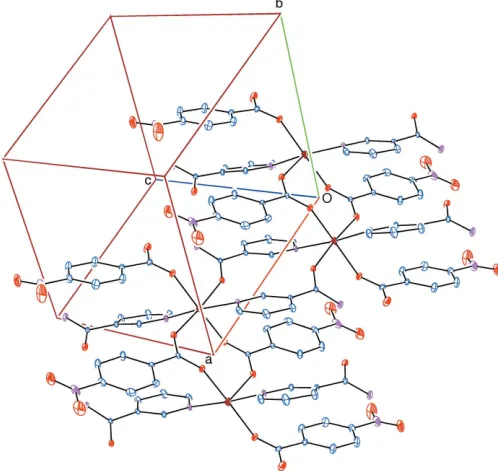
The asymmetric unit of the title polymeric compound contains two 4-nitrobenzoate (NB) anions and two nicotinamide (NA) ligands; the NB anions act as monodentate ligands (Fig. 1). Only one of the two NB anions and one of the two NA ligands bridge the adjacent ZnII ions through eight- and twelve-membered rings, respectively, forming polymeric chains running along the a-axis direction (Fig. 2). In the eight- and twelve-membered rings, the distances between the symmetry related ions [Zn1 Zn1a, N5 N5a, O10 O10a, and Zn1 Zn1b, O5 O5b, O6 O6b are 7.3237 (6), 5.855 (4), 4.480 (3) A˚ and 4.67 (6), 3.668 (4), 4.256 (4) A˚, respectively
[symmetry codes (a) =x+ 1,y,z; (b)x+ 2,y,z]; see Fig. 3.
The three carboxylate O atoms (O2, O5 and O6) of the three NB anions and one O atom (O10) of one of the two NA ligands in the equatorial plane around the ZnIIcation form a slightly distorted square-planar arrangement, while the slightly distorted octahedral coordination is completed by the two pyridine N atoms (N3 and N5) of the two NA ligands in the axial positions (Table 1 and Fig. 3).
The near equality of the C1—O1 [1.247 (4) A˚ ], C1—O2 [1.261 (4) A˚ ], C8—O5 [1.248 (4) A˚] and C8—O6 [1.255 (4) A˚] bonds in the carboxylate groups indicate delocalized bonding arrangements, rather than localized single and double bonds.
The average Zn—Ocarboxylate and Zn—N distances are
480
As¸kınet al. [Zn(C6H6N2O)2(C7H4NO4)2] Acta Cryst.(2015).E71, 479–482 [image:2.610.55.284.77.304.2]research communications
Table 1
Selected bond lengths (A˚ ).
Zn1—O2 2.140 (2) Zn1—O10ii 2.280 (2)
Zn1—O5i 2.142 (2) Zn1—N3 2.288 (3)
Zn1—O6 2.160 (2) Zn1—N5 2.282 (3)
Symmetry codes: (i)xþ2;y;z; (ii)xþ1;y;z.
Figure 1
[image:2.610.314.563.482.719.2]The asymmetric unit of the title molecule, with the atom labelling. Displacement ellipsoids are drawn at the 50% probability level [symmetry codes: (a)x+ 1,y,z; (b)x+ 2,y,z].
Table 2
Hydrogen-bond geometry (A˚ ,).
D—H A D—H H A D A D—H A
N4—H4B O1i 0.86 2.20 2.851 (4) 132
N6—H6A O1ii 0.86 1.98 2.814 (4) 164
N6—H6B O9iii 0.86 2.09 2.880 (4) 153
C15—H15 O6 0.93 2.45 3.079 (4) 125
C19—H19 O3iv 0.93 2.57 3.238 (7) 130
C21—H21 O10ii 0.93 2.38 3.058 (4) 130
[image:2.610.44.563.483.721.2]Symmetry codes: (i)xþ2;yþ1;zþ1; (ii)xþ1;y;z; (iii)xþ2;y;z; (iv)x1;y1;z.
Figure 2
[image:2.610.50.306.492.707.2]2.147 (2) A˚ and 2.285 (3) A˚, respectively, while Zn1—O10 distance is 2.280 (2) A˚ . The Zn1 atom lies 1.4330 (4) A˚ and 0.1897 (4) A˚ above the planar (O1/O2/C1) and (O5/O6/C8) carboxylate groups, respectively. The average O—Zn—O and
O—Zn—N bond angles are 89.93 (10) and 89.99 (10),
respectively.
The dihedral angles between the planar carboxylate groups [(O1/O2/C1) and (O5/O6/C8)] and the adjacent benzene rings [A (C2—C7) and B (C9—C14)] are 13.8 (2) and 13.4 (2), respectively, while the benzene rings are oriented at a dihedral
angle of 11.5 (2). The dihedral angle between the
nicotin-amide rings [C (N3/C15—C19) and D (N5/C21—C25)] is
10.3 (1), and they are oriented with respect to benzene rings
AandBat dihedral angles ofA/C= 17.3 (1),A/D = 7.7 (1),
B/C= 28.8 (1) andB/D= 18.9 (1).
3. Supramolecular features
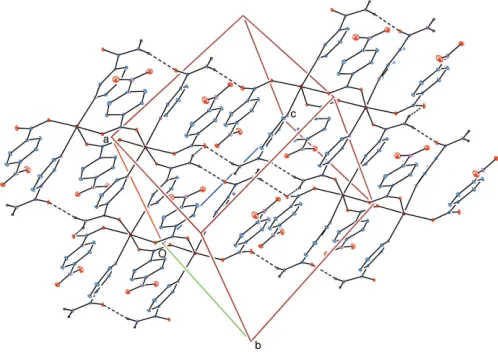
In the crystal, strong N—H Oc (c = carboxylate) and N—
H On (n = nicotinamide) hydrogen bonds (Table 2) link
adjacent chains throughR(16),R2
2(20) andR 6
6(16) ring motifs
(Bernstein et al., 1995) into layers parallel to (011) (Fig. 4). Weak intramolecular C—Hn Oc and intermolecular C—
Hn Onb (nb = nitrobenzoate) and C—Hn On hydrogen
bonds (Table 1) link the layers into a three-dimensional framework.
4. Synthesis and crystallization
The title compound was prepared by the reaction of ZnSO4H2O (0.89 g, 5 mmol) in H2O (25 ml) and nicotinamide
(1.22 g, 10 mmol) in H2O (25 ml) with sodium 4-nitrobenzoate
(1.90 g, 10 mmol) in H2O (150 ml). The mixture was filtered
and set aside to crystallize at ambient temperature for one week, giving yellow block-like crystals.
5. Refinement
The experimental details including the crystal data, data collection and refinement are summarized in Table 3. H atoms were positioned geometrically and constrained to ride on their parent atoms, with C—H = 0.93 A˚ and N—H = 0.86 A˚, and with Uiso(H) = 1.2Ueq(C,N). The highest residual electron
density and the deepest hole were found 0.29 A˚ and 0.48 A˚ from atoms N6 and Zn1, respectively.
research communications
[image:3.610.48.297.70.227.2]Acta Cryst.(2015).E71, 479–482 As¸kınet al. [Zn(C6H6N2O)2(C7H4NO4)2]
481
Table 3Experimental details.
Crystal data
Chemical formula [Zn(C6H6N2O)2(C7H4NO4)2]
Mr 641.87
Crystal system, space group Triclinic,P1
Temperature (K) 296
a,b,c(A˚ ) 9.5118 (3), 10.5591 (3), 14.5326 (5) ,,(
) 109.846 (4), 93.618 (3), 104.815 (4)
V(A˚3) 1309.11 (9)
Z 2
Radiation type MoK
(mm1) 1.01
Crystal size (mm) 0.500.370.33
Data collection
Diffractometer Bruker SMART BREEZE CCD
Absorption correction Multi-scan (SADABS; Bruker, 2012)
Tmin,Tmax 0.635, 0.705
No. of measured, independent and observed [I> 2(I)] reflections
34333, 6520, 5816
Rint 0.023
(sin/)max(A˚ 1
) 0.669
Refinement
R[F2> 2(F2)],wR(F2),S 0.073, 0.238, 1.09
No. of reflections 6520
No. of parameters 388
H-atom treatment H-atom parameters constrained
max, min(e A˚
3) 1.29,0.60
Computer programs:APEX2andSAINT(Bruker, 2012),SHELXS97andSHELXL97
(Sheldrick, 2008),ORTEP-3for Windows andWinGX(Farrugia, 2012) andPLATON
[image:3.610.315.564.72.251.2](Spek, 2009).
Figure 3
Part of the crystal packing of the title compound, showing the eight- and twelve-membered rings [symmetry codes (a)x+ 1,y,z; (b)x+ 2,
y,z]. H atoms have been omitted for clarity.
Figure 4
[image:3.610.44.294.449.717.2]Acknowledgements
The authors acknowledge the Aksaray University, Science and Technology Application and Research Center, Aksaray, Turkey, for the use of the Bruker SMART BREEZE CCD diffractometer (purchased under grant No. 2010K120480 of the State of Planning Organization).
References
Adiwidjaja, G., Rossmanith, E. & Ku¨ppers, H. (1978). Acta Cryst.
B34, 3079–3083.
Amiraslanov, I. R., Mamedov, Kh. S., Movsumov, E. M., Musaev, F. N. & Nadzhafov, G. N. (1979).Zh. Strukt. Khim.20, 1075–1080. Antolini, L., Battaglia, L. P., Corradi, A. B., Marcotrigiano, G.,
Menabue, L., Pellacani, G. C. & Saladini, M. (1982).Inorg. Chem.
21, 1391–1395.
Antsyshkina, A. S., Chiragov, F. M. & Poray-Koshits, M. A. (1980).
Koord. Khim.15, 1098–1103.
Bernstein, J., Davis, R. E., Shimoni, L. & Chang, N. L. (1995).Angew. Chem. Int. Ed. Engl.34, 1555–1573.
Bigoli, F., Braibanti, A., Pellinghelli, M. A. & Tiripicchio, A. (1972).
Acta Cryst.B28, 962–966.
Bruker (2012). APEX2, SAINT and SADABS. Bruker AXS Inc. Madison, Wisconsin, USA.
Catterick, J., Hursthouse, M. B., New, D. B. & Thornton, P. (1974).J. Chem. Soc. Chem. Commun.pp. 843–844.
Chen, H. J. & Chen, X. M. (2002).Inorg. Chim. Acta,329, 13–21. Farrugia, L. J. (2012).J. Appl. Cryst.45, 849–854.
Hauptmann, R., Kondo, M. & Kitagawa, S. (2000).Z. Kristallogr. New Cryst. Struct.215, 169–172.
Krishnamachari, K. A. V. R. (1974).Am. J. Clin. Nutr.27, 108–111. Nadzhafov, G. N., Shnulin, A. N. & Mamedov, Kh. S. (1981).Zh.
Strukt. Khim.22, 124–128.
Sheldrick, G. M. (2008).Acta Cryst.A64, 112–122.
Shnulin, A. N., Nadzhafov, G. N., Amiraslanov, I. R., Usubaliev, B. T. & Mamedov, Kh. S. (1981).Koord. Khim.7, 1409–1416.
Spek, A. L. (2009).Acta Cryst.D65, 148–155.
482
As¸kınet al. [Zn(C6H6N2O)2(C7H4NO4)2] Acta Cryst.(2015).E71, 479–482supporting information
sup-1 Acta Cryst. (2015). E71, 479-482
supporting information
Acta Cryst. (2015). E71, 479-482 [https://doi.org/10.1107/S2056989015006490]
Crystal structure of poly[bis(
µ
-nicotinamide-
κ
2N
1:
O
)bis(
µ
-4-nitrobenzoato-κ
2O
1:
O
1′)zinc]
G
ü
l
ç
in
Ş
efiye A
ş
k
ı
n, Hacali Necefo
ğ
lu, Ali Murat Tonbul, Nefise Dilek and Tuncer H
ö
kelek
Computing details
Data collection: APEX2 (Bruker, 2012); cell refinement: SAINT (Bruker, 2012); data reduction: SAINT (Bruker, 2012); program(s) used to solve structure: SHELXS97 (Sheldrick, 2008); program(s) used to refine structure: SHELXL97
(Sheldrick, 2008); molecular graphics: ORTEP-3 for Windows (Farrugia, 2012); software used to prepare material for publication: WinGX (Farrugia, 2012) and PLATON (Spek, 2009).
Poly[bis(µ-nicotinamide-κ2N1:O)bis(µ-4-nitrobenzoato-κ2O1:O1′)zinc]
Crystal data
[Zn(C6H6N2O)2(C7H4NO4)2]
Mr = 641.87
Triclinic, P1 Hall symbol: -P 1
a = 9.5118 (3) Å
b = 10.5591 (3) Å
c = 14.5326 (5) Å
α = 109.846 (4)°
β = 93.618 (3)°
γ = 104.815 (4)°
V = 1309.11 (9) Å3
Z = 2
F(000) = 656
Dx = 1.628 Mg m−3
Mo Kα radiation, λ = 0.71073 Å Cell parameters from 9922 reflections
θ = 2.5–28.4°
µ = 1.01 mm−1
T = 296 K Block, yellow
0.50 × 0.37 × 0.33 mm
Data collection
Bruker SMART BREEZE CCD diffractometer
Radiation source: fine-focus sealed tube Graphite monochromator
φ and ω scans
Absorption correction: multi-scan (SADABS; Bruker, 2012)
Tmin = 0.635, Tmax = 0.705
34333 measured reflections 6520 independent reflections 5816 reflections with I > 2σ(I)
Rint = 0.023
θmax = 28.4°, θmin = 1.5°
h = −12→12
k = −13→14
l = −19→19
Refinement
Refinement on F2
Least-squares matrix: full
R[F2 > 2σ(F2)] = 0.073
wR(F2) = 0.238
S = 1.09 6520 reflections 388 parameters 0 restraints
Primary atom site location: structure-invariant direct methods
Secondary atom site location: difference Fourier map
Hydrogen site location: inferred from neighbouring sites
supporting information
sup-2 Acta Cryst. (2015). E71, 479-482
w = 1/[σ2(F
o2) + (0.149P)2 + 3.1586P]
where P = (Fo2 + 2Fc2)/3
(Δ/σ)max < 0.001
Δρmax = 1.29 e Å−3
Δρmin = −0.60 e Å−3
Special details
Geometry. All esds (except the esd in the dihedral angle between two l.s. planes) are estimated using the full covariance matrix. The cell esds are taken into account individually in the estimation of esds in distances, angles and torsion angles; correlations between esds in cell parameters are only used when they are defined by crystal symmetry. An approximate (isotropic) treatment of cell esds is used for estimating esds involving l.s. planes.
Refinement. Refinement of F2 against ALL reflections. The weighted R-factor wR and goodness of fit S are based on F2,
conventional R-factors R are based on F, with F set to zero for negative F2. The threshold expression of F2 > 2sigma(F2) is
used only for calculating R-factors(gt) etc. and is not relevant to the choice of reflections for refinement. R-factors based on F2 are statistically about twice as large as those based on F, and R- factors based on ALL data will be even larger.
Fractional atomic coordinates and isotropic or equivalent isotropic displacement parameters (Å2)
x y z Uiso*/Ueq
supporting information
sup-3 Acta Cryst. (2015). E71, 479-482
C8 1.1944 (3) 0.1804 (3) 0.0309 (2) 0.0161 (5) C9 1.3506 (3) 0.2755 (3) 0.0529 (2) 0.0170 (6) C10 1.4151 (4) 0.3680 (4) 0.1489 (3) 0.0291 (7) H10 1.3613 0.3707 0.2004 0.035* C11 1.5580 (4) 0.4561 (5) 0.1691 (3) 0.0359 (9) H11 1.6008 0.5176 0.2333 0.043* C12 1.6357 (4) 0.4502 (4) 0.0910 (3) 0.0300 (8) C13 1.5764 (4) 0.3579 (4) −0.0052 (3) 0.0334 (8) H13 1.6314 0.3547 −0.0562 0.040* C14 1.4334 (4) 0.2706 (4) −0.0237 (3) 0.0269 (7) H14 1.3919 0.2079 −0.0879 0.032* C15 1.1025 (3) 0.2154 (3) 0.3102 (2) 0.0198 (6) H15 1.1637 0.2597 0.2758 0.024* C16 1.1542 (3) 0.2416 (3) 0.4080 (2) 0.0188 (6) C17 1.0644 (4) 0.1754 (4) 0.4601 (3) 0.0308 (8) H17 1.0946 0.1935 0.5266 0.037* C18 0.9282 (4) 0.0815 (5) 0.4100 (3) 0.0363 (9) H18 0.8671 0.0319 0.4417 0.044* C19 0.8841 (4) 0.0623 (4) 0.3123 (3) 0.0275 (7) H19 0.7920 0.0002 0.2799 0.033* C20 1.3046 (3) 0.3414 (3) 0.4512 (2) 0.0203 (6) C21 0.6540 (3) 0.0355 (3) −0.0750 (2) 0.0176 (6) H21 0.5976 0.0097 −0.0307 0.021* C22 0.5908 (3) −0.0170 (3) −0.1739 (2) 0.0154 (5) C23 0.6756 (4) 0.0196 (4) −0.2406 (3) 0.0247 (7) H23 0.6386 −0.0170 −0.3081 0.030* C24 0.8167 (4) 0.1120 (4) −0.2041 (3) 0.0299 (8) H24 0.8746 0.1411 −0.2466 0.036* C25 0.8706 (3) 0.1609 (4) −0.1032 (3) 0.0241 (7) H25 0.9651 0.2234 −0.0794 0.029* C26 0.4345 (3) −0.1097 (3) −0.2019 (2) 0.0156 (5)
Atomic displacement parameters (Å2)
U11 U22 U33 U12 U13 U23
supporting information
sup-4 Acta Cryst. (2015). E71, 479-482
N3 0.0121 (12) 0.0215 (13) 0.0204 (13) −0.0026 (10) −0.0018 (9) 0.0036 (10) N4 0.0171 (13) 0.0356 (17) 0.0186 (14) −0.0027 (12) 0.0024 (10) −0.0055 (12) N5 0.0084 (11) 0.0199 (12) 0.0218 (13) −0.0016 (9) −0.0011 (9) 0.0034 (10) N6 0.0143 (12) 0.0277 (15) 0.0193 (13) −0.0015 (10) 0.0047 (10) −0.0054 (11) C1 0.0163 (14) 0.0167 (14) 0.0266 (16) 0.0015 (11) 0.0037 (12) −0.0015 (12) C2 0.0168 (14) 0.0168 (14) 0.0223 (15) 0.0006 (11) 0.0027 (11) 0.0012 (11) C3 0.0270 (18) 0.038 (2) 0.0215 (16) −0.0058 (15) 0.0042 (13) 0.0036 (15) C4 0.030 (2) 0.041 (2) 0.0248 (18) −0.0070 (17) −0.0043 (15) 0.0061 (16) C5 0.0173 (15) 0.0241 (17) 0.039 (2) −0.0046 (13) −0.0007 (14) 0.0107 (15) C6 0.0282 (19) 0.037 (2) 0.034 (2) −0.0034 (15) 0.0099 (15) 0.0140 (16) C7 0.0275 (18) 0.0305 (18) 0.0213 (16) −0.0030 (14) 0.0043 (13) 0.0055 (14) C8 0.0091 (12) 0.0141 (13) 0.0211 (14) 0.0007 (10) 0.0018 (10) 0.0037 (11) C9 0.0098 (12) 0.0141 (13) 0.0237 (15) 0.0011 (10) 0.0036 (11) 0.0044 (11) C10 0.0178 (15) 0.0339 (19) 0.0231 (16) −0.0056 (13) 0.0014 (12) 0.0052 (14) C11 0.0220 (17) 0.037 (2) 0.0325 (19) −0.0087 (15) −0.0044 (14) 0.0066 (16) C12 0.0115 (14) 0.0246 (17) 0.053 (2) −0.0024 (12) 0.0013 (14) 0.0205 (16) C13 0.0211 (17) 0.036 (2) 0.047 (2) 0.0062 (15) 0.0187 (16) 0.0191 (18) C14 0.0214 (16) 0.0251 (16) 0.0289 (17) 0.0023 (13) 0.0110 (13) 0.0056 (13) C15 0.0125 (13) 0.0224 (15) 0.0176 (14) −0.0010 (11) 0.0008 (10) 0.0035 (11) C16 0.0115 (13) 0.0202 (14) 0.0176 (14) 0.0003 (11) −0.0003 (10) 0.0020 (11) C17 0.0218 (16) 0.041 (2) 0.0258 (17) −0.0033 (15) −0.0018 (13) 0.0171 (16) C18 0.0227 (17) 0.045 (2) 0.037 (2) −0.0087 (16) −0.0014 (15) 0.0245 (18) C19 0.0145 (14) 0.0291 (17) 0.0321 (18) −0.0062 (12) −0.0023 (12) 0.0133 (14) C20 0.0119 (13) 0.0220 (15) 0.0178 (14) 0.0015 (11) −0.0009 (10) −0.0009 (12) C21 0.0087 (12) 0.0214 (14) 0.0163 (13) −0.0003 (10) 0.0006 (10) 0.0028 (11) C22 0.0083 (12) 0.0182 (13) 0.0172 (13) 0.0027 (10) 0.0024 (10) 0.0041 (11) C23 0.0169 (15) 0.0356 (18) 0.0205 (15) 0.0023 (13) 0.0042 (12) 0.0129 (14) C24 0.0168 (15) 0.041 (2) 0.0340 (19) −0.0005 (14) 0.0056 (13) 0.0225 (16) C25 0.0106 (13) 0.0252 (16) 0.0347 (18) −0.0020 (11) 0.0005 (12) 0.0150 (14) C26 0.0085 (12) 0.0188 (13) 0.0142 (12) 0.0013 (10) 0.0008 (9) 0.0019 (11)
Geometric parameters (Å, º)
Zn1—O2 2.140 (2) C5—C6 1.377 (6)
Zn1—O5i 2.142 (2) C6—H6 0.9300
Zn1—O6 2.160 (2) C7—C6 1.389 (5) Zn1—O10ii 2.280 (2) C7—H7 0.9300
Zn1—N3 2.288 (3) C8—C9 1.509 (4) Zn1—N5 2.282 (3) C9—C10 1.392 (5) O1—C1 1.247 (4) C9—C14 1.399 (4) O2—C1 1.261 (4) C10—C11 1.385 (5)
O4—N1 1.208 (6) C10—H10 0.9300
O5—Zn1i 2.142 (2) C11—H11 0.9300
O5—C8 1.248 (4) C12—C11 1.384 (6) O6—C8 1.255 (4) C13—C12 1.384 (6) O9—C20 1.239 (4) C13—C14 1.384 (5) O10—Zn1ii 2.280 (2) C13—H13 0.9300
supporting information
sup-5 Acta Cryst. (2015). E71, 479-482
N2—O7 1.220 (7) C15—C16 1.383 (4)
N2—O8 1.210 (7) C15—H15 0.9300
N2—C12 1.469 (4) C16—C17 1.388 (5) N3—C15 1.342 (4) C16—C20 1.489 (4)
N3—C19 1.341 (4) C17—H17 0.9300
N4—H4A 0.8600 C18—C17 1.388 (5)
N4—H4B 0.8600 C18—H18 0.9300
N5—C21 1.345 (4) C19—C18 1.384 (5)
N5—C25 1.337 (4) C19—H19 0.9300
N6—C26 1.332 (4) C20—N4 1.329 (4)
N6—H6A 0.8600 C21—H21 0.9300
N6—H6B 0.8600 C22—C21 1.384 (4)
C1—C2 1.510 (4) C22—C23 1.391 (4) C2—C3 1.401 (5) C23—C24 1.387 (5)
C2—C7 1.384 (5) C23—H23 0.9300
C3—C4 1.383 (5) C24—H24 0.9300
C3—H3 0.9300 C25—C24 1.391 (5)
C4—H4 0.9300 C25—H25 0.9300
C5—N1 1.468 (5) C26—O10 1.233 (4) C5—C4 1.379 (6) C26—C22 1.497 (4)
O2—Zn1—O5i 170.95 (10) O5—C8—O6 125.6 (3)
O2—Zn1—O6 86.90 (10) O5—C8—C9 117.8 (3) O2—Zn1—O10ii 89.70 (10) O6—C8—C9 116.6 (3)
O2—Zn1—N3 87.21 (10) C10—C9—C8 121.1 (3) O2—Zn1—N5 99.61 (10) C10—C9—C14 119.0 (3) O5i—Zn1—O6 99.77 (10) C14—C9—C8 119.9 (3)
O5i—Zn1—O10ii 83.34 (9) C9—C10—H10 119.4
O5i—Zn1—N3 86.87 (10) C11—C10—C9 121.1 (3)
O5i—Zn1—N5 85.89 (10) C11—C10—H10 119.4
O6—Zn1—O10ii 175.66 (8) C10—C11—H11 120.9
O6—Zn1—N3 88.43 (10) C12—C11—C10 118.3 (4) O6—Zn1—N5 95.75 (10) C12—C11—H11 120.9 O10ii—Zn1—N3 88.71 (9) C11—C12—N2 119.1 (4)
O10ii—Zn1—N5 87.48 (9) C13—C12—N2 118.6 (4)
N5—Zn1—N3 172.16 (10) C13—C12—C11 122.3 (3) C1—O2—Zn1 135.7 (2) C12—C13—H13 120.7 C8—O5—Zn1i 138.9 (2) C14—C13—C12 118.5 (3)
C8—O6—Zn1 137.8 (2) C14—C13—H13 120.7 C26—O10—Zn1ii 147.3 (2) C9—C14—H14 119.6
supporting information
sup-6 Acta Cryst. (2015). E71, 479-482
C19—N3—C15 117.4 (3) C16—C17—H17 121.0 C20—N4—H4A 120.0 C18—C17—C16 118.0 (3) C20—N4—H4B 120.0 C18—C17—H17 121.0 H4A—N4—H4B 120.0 C17—C18—H18 120.3 C21—N5—Zn1 115.9 (2) C19—C18—C17 119.3 (3) C25—N5—Zn1 124.9 (2) C19—C18—H18 120.3 C25—N5—C21 117.3 (3) N3—C19—C18 122.9 (3) C26—N6—H6A 120.0 N3—C19—H19 118.5 C26—N6—H6B 120.0 C18—C19—H19 118.5 H6A—N6—H6B 120.0 O9—C20—N4 122.6 (3) O1—C1—O2 125.5 (3) O9—C20—C16 119.4 (3) O1—C1—C2 117.3 (3) N4—C20—C16 118.0 (3) O2—C1—C2 117.1 (3) N5—C21—C22 123.9 (3) C3—C2—C1 119.9 (3) N5—C21—H21 118.0 C7—C2—C1 120.6 (3) C22—C21—H21 118.0 C7—C2—C3 119.4 (3) C21—C22—C23 118.2 (3) C2—C3—H3 119.5 C21—C22—C26 117.5 (3) C4—C3—C2 120.9 (3) C23—C22—C26 124.3 (3) C4—C3—H3 119.5 C22—C23—H23 120.8 C3—C4—H4 120.9 C24—C23—C22 118.4 (3) C5—C4—C3 118.2 (4) C24—C23—H23 120.8 C5—C4—H4 120.9 C23—C24—C25 119.4 (3) C6—C5—C4 122.2 (3) C23—C24—H24 120.3 C6—C5—N1 119.2 (4) C25—C24—H24 120.3 C4—C5—N1 118.7 (4) N5—C25—C24 122.7 (3) C5—C6—C7 119.3 (3) N5—C25—H25 118.7 C5—C6—H6 120.4 C24—C25—H25 118.7 C7—C6—H6 120.4 O10—C26—N6 123.5 (3) C2—C7—C6 120.0 (3) O10—C26—C22 119.1 (3) C2—C7—H7 120.0 N6—C26—C22 117.4 (3) C6—C7—H7 120.0
O6—Zn1—O2—C1 −91.7 (3) C1—C2—C7—C6 −178.9 (4) O10ii—Zn1—O2—C1 85.6 (3) C3—C2—C7—C6 −0.7 (6)
N3—Zn1—O2—C1 −3.1 (3) C2—C3—C4—C5 −0.4 (7) N5—Zn1—O2—C1 173.0 (3) C4—C5—N1—O3 −175.7 (5) O2—Zn1—O6—C8 −138.6 (4) C4—C5—N1—O4 2.9 (6) O5i—Zn1—O6—C8 47.6 (4) C6—C5—N1—O3 3.8 (7)
N3—Zn1—O6—C8 134.1 (4) C6—C5—N1—O4 −177.6 (4) N5—Zn1—O6—C8 −39.2 (4) N1—C5—C4—C3 −179.4 (4) O2—Zn1—N3—C15 −59.4 (2) C6—C5—C4—C3 1.0 (7) O2—Zn1—N3—C19 108.8 (3) N1—C5—C6—C7 179.0 (4) O5i—Zn1—N3—C15 127.5 (2) C4—C5—C6—C7 −1.5 (7)
O5i—Zn1—N3—C19 −64.4 (3) C2—C7—C6—C5 1.3 (6)
O6—Zn1—N3—C15 27.6 (2) O5—C8—C9—C10 −167.0 (3) O6—Zn1—N3—C19 −164.2 (3) O5—C8—C9—C14 12.4 (4) O10ii—Zn1—N3—C15 −149.2 (2) O6—C8—C9—C10 14.2 (5)
supporting information
sup-7 Acta Cryst. (2015). E71, 479-482
O2—Zn1—N5—C21 −115.0 (2) C8—C9—C10—C11 −179.5 (4) O2—Zn1—N5—C25 81.2 (3) C14—C9—C10—C11 1.1 (6) O5i—Zn1—N5—C21 57.8 (2) C8—C9—C14—C13 179.4 (3)
O5i—Zn1—N5—C25 −106.0 (3) C10—C9—C14—C13 −1.2 (5)
O6—Zn1—N5—C21 157.2 (2) C9—C10—C11—C12 0.1 (6) O6—Zn1—N5—C25 −6.6 (3) N2—C12—C11—C10 177.2 (4) O10ii—Zn1—N5—C21 −25.7 (2) C13—C12—C11—C10 −1.3 (6)
O10ii—Zn1—N5—C25 170.5 (3) C14—C13—C12—N2 −177.2 (4)
Zn1—O2—C1—O1 −73.4 (5) C14—C13—C12—C11 1.2 (6) Zn1—O2—C1—C2 105.2 (4) C12—C13—C14—C9 0.1 (6) Zn1i—O5—C8—O6 −77.3 (4) N3—C15—C16—C17 0.4 (5)
Zn1i—O5—C8—C9 104.0 (3) N3—C15—C16—C20 −179.1 (3)
Zn1—O6—C8—O5 −7.5 (6) C15—C16—C17—C18 2.4 (6) Zn1—O6—C8—C9 171.2 (2) C20—C16—C17—C18 −178.1 (4) O7—N2—C12—C11 175.7 (5) C15—C16—C20—O9 −33.3 (5) O7—N2—C12—C13 −5.9 (6) C15—C16—C20—N4 145.8 (3) O8—N2—C12—C11 −5.8 (6) C17—C16—C20—O9 147.2 (4) O8—N2—C12—C13 172.6 (4) C17—C16—C20—N4 −33.7 (5) Zn1—N3—C15—C16 166.7 (3) C19—C18—C17—C16 −3.0 (7) C19—N3—C15—C16 −2.4 (5) N3—C19—C18—C17 1.0 (7) C15—N3—C19—C18 1.7 (6) C23—C22—C21—N5 0.9 (5) Zn1—N3—C19—C18 −166.4 (3) C26—C22—C21—N5 −178.9 (3) Zn1—N5—C21—C22 −163.3 (2) C21—C22—C23—C24 −3.0 (5) C25—N5—C21—C22 1.8 (5) C26—C22—C23—C24 176.8 (3) Zn1—N5—C25—C24 161.1 (3) C22—C23—C24—C25 2.3 (6) C21—N5—C25—C24 −2.6 (5) N5—C25—C24—C23 0.5 (6) O1—C1—C2—C3 13.6 (5) N6—C26—O10—Zn1ii −1.0 (7)
O1—C1—C2—C7 −168.2 (4) C22—C26—O10—Zn1ii 178.5 (3)
O2—C1—C2—C3 −165.0 (4) O10—C26—C22—C21 36.8 (4) O2—C1—C2—C7 13.1 (5) O10—C26—C22—C23 −142.9 (3) C1—C2—C3—C4 178.5 (4) N6—C26—C22—C21 −143.6 (3) C7—C2—C3—C4 0.3 (6) N6—C26—C22—C23 36.6 (5)
Symmetry codes: (i) −x+2, −y, −z; (ii) −x+1, −y, −z.
Hydrogen-bond geometry (Å, º)
D—H···A D—H H···A D···A D—H···A
N4—H4B···O1iii 0.86 2.20 2.851 (4) 132
N6—H6A···O1ii 0.86 1.98 2.814 (4) 164
N6—H6B···O9i 0.86 2.09 2.880 (4) 153
C15—H15···O6 0.93 2.45 3.079 (4) 125 C19—H19···O3iv 0.93 2.57 3.238 (7) 130
C21—H21···O10ii 0.93 2.38 3.058 (4) 130