warwick.ac.uk/lib-publications
A Thesis Submitted for the Degree of PhD at the University of Warwick
Permanent WRAP URL:
http://wrap.warwick.ac.uk/111305
Copyright and reuse:
This thesis is made available online and is protected by original copyright.
Please scroll down to view the document itself.
Please refer to the repository record for this item for information to help you to cite it.
Our policy information is available from the repository home page.
ON THE NORMAL SUBGROUPS OF THE GROUP OF VOLUME PRESERVING DIFFEOMORPHISMS
OF £ n FOR n » 3
by Francisca Mascaro de Si vera
A thesis submitted for the degree of Ph.D. at the University of Warwick.
Mathematics Institute
University of Warwick
C O N T E N T S
Introduction 1
Chapter 1: Some preliminaries 1
Chapter 2: General facts on the group Difffi ( IRn) 12
Chapter 3: Decomposition theorems 31
Chapter 4: Technical results 49
Chapter 5: Case of finite total volume 70
Chapter 6: Extra results for the case of infinite total
volume 74
Chapter 7: Case of infinite total volume 93
Chapter 8: Some additional results 98
Appendix 108
ACKNOWLEDGEMENTS
I wish to express my deep gratitude to , Dr. D. McDuff , for
introducing me to this subject and for her constant stimulus and
encouragement. Also to my supervisor , Dr. C.P. Rourke , for his help
in some difficult moments during the last years.
I would like to thank also the Ministerio de Universidades e
Investigación of Spain for its financial support during my stay at
\y-\
SUMMARY
Let « be a volume element on F n . Diffn(R n ) is the
group of «-preserving diffeomorphisms of F n . Diffy(Fn ) is the
subgroup of all elements whose set of non-fixed points has finite
«-volume. Difff(Fn) is the subgroup of all elements whose support
has finite «-volume. Diff“( F n) is the subgroup of all elements with
compact suport. Diff“0( F n) is the subgroup of all elements compactly
«-isotopic to the identity.
We prove, in case volfiF n < » and for n > , 3 *«/„ n,
that a
subgroup of Diffn ( F n) , N , is normal if and only if
Diffn ( F n ) c N c Diffn( F n) . If vol F n = <» and for n » 3 , there
CO C $7
is no normal subgroup neither between Diffy(Fn) and Diffn( F n)
nor between Diff^(Fn) and Diff^(Fn) .
INTRODUCTION
The final goal of this dissertation is the study of the normal
subgroups of the group of all smooth volume presewing diffeomorphisms of
]R n , Diffn( F n ) , for n > 3 and for any volume element fl. .
We were looking for similar results to the one on the group of
smooth diffeomorphisms of F n , D i f f ( F n) , got by Ling in [10] and
McDuff in [14] saying that any non-trivial normal subgroup N of
Diff(F n ) satisfies
Diffc0( F n ) c N c Diffc( F n)
where Diffc ( F n ) is the subgroup of all diffeomorphisms with compact
support and DiffCQ( F n) is the subgroup of all diffeomorphisms c o m p-*-tly
isotopic to the identity.
Since the groups of diffeomorphisms of a manifold preserving
equivalent volume elements are isomorphic we only have to study the
group Diffn ( F n ) for non-equivalent volume elements on F n .
Using Moser [18] ,we were able to reduce it two essentialy different
cases, the first one when q is a volume element on F n with
finite total volume and another one when q has infinite total volume.
In both cases we have the following chain of normal subgroups
of Diffn ( F n )
{id} c Diff£Q ( F n) c Diff“( F n) c DiffJ(Fn ) c Diffjj(Fn) c Difffi( F n)
where Diff£0 ( R n) 1S the subgroup of all elements isotopic to the
subgroup of all elements with compact support. Diff^(Fn) is the
subgroup of all elements with support of finite p-volume . Diff^(Fn)
is the subgroup of all elements with set of non-fixed points of finite
p-volume. Clearly, if p has finite total volume we have
Diffj?(Fn ) = Diffn( F n) .
Now we are going to describe the contents of this disertation
Chapter by Chapter.
Chapter 1 gives some results on volume elements on a smooth
manifold including the one mentioned above.
Chapter 2 contains some general facts on the group Diffs( F n) .
In particular, we give a direct proof of the fact that two volume elements
on F n with the same total volume are equivalent (2.1) .This result
can also be proved using [6] .
We also get a sufficient condition for a subgroup of Diffi2(F n )
to be normal, namely , any subgroup N of Difffi( F n) such that
Diffc0(F n) c N c Diff“( F n)
is normal.
We end this Chapter giving some examples that prove that all the
inclusions of the above chain are strict.
The aim of Chapter 3 is to decompose an element of Diff“(F n)
as a finite product of volume preserving diffeomorphisms each one with
support in a strip. This method owes very much to Ling |"10] who worked
i i i
of diffeomorphisms each one with support in a locally finite union of
disjoint cells. The modification has been necessary since two strips
with the same ^-volume are diffeomorphic by an element of Difffi( F n)
(3.4) while the same is not true for locally finite unions of disjoint
cells.
Chapter 4 contains several technical results. W e prove that the
subgroup of Diffn( F n ) of all elements with support in a given strip
is connected with respect to the compact-open C -topology (4.10). The
proof uses an extension to a smooth family of volume elements on F n
of a result of Greene and Shiohama [6] that is proved in the Appendix of
this dissertation .
Following McDuff [15] we prove that the subgroup of Diffn( F n)
of all elements with support in a strip is perfect (4.7)
Another result that proves to be crucial is that for any element
h of Diffn( F n) such that there is a disjoint union of cellb
11 C. satisfying i >1 1
(_LL c. ) n h(_LLc.) =<j)
i»l 1 i>l 1
we find a strip ,V , and an element lying in the normal subgroup of
Diffn( F n ) generated by h , h' , such that h'(V) n V =<j> .
This enable^us to get in Chapter 5 some results on the classification
of the normal subgroups of Diff^(Fn) when £1 has finite total
volume.
We prove that for n >, 3 , there is no normal subgroup between
Diff^(Fn) and Diffn( F n) (5.4) . Therefore, joining that theorem with
IV
-is normal if and only if
Diffc0(R n) c N c Diffc( R n ) •
Chapter 6 is a complement of Chapter 4 , proving some additional
results needed when n has infinite total volume .
We construct, for any volume preserving diffeomorphism , h ,
not lying in Diffjj(Fn) a disjoint union of cells , C.. , such that
(6.2) .
Also, we prove the last of the decomposition results, namely, we
see that any element of Diff“ ( F n) with support in a strip of finite
ii-volume can be written as a finite product of elements of D1ff^(Rn)
each one having support in a strip of finite n-volume (6.4) and (6.6) .
As before, this enables us to get in Chapter 7 some results on
the classification of the normal subgroups of Diff ( F n ) when n
has infinite total volume .
We prove that, for n » 3 , there is no normal subgroup neither
between Diffy(Fn) and Diffn( F n ) (7.2) nor between Diff“( F n)
and Diff^(Fn ) (7.5) . Thus, joining the above theorems with Thurston
[22] we get that the non-trivial subgroups of Diffn ( F n) , N , must be
either between Diff“Q( F n) and Diff£(Fn) or between Diff^(Fn)
and Diff“ ( F n) .
To study those normal subgroups we have tried two methods that
- V
The first one is taking the closures of the normal subgroups in the
above chain with respect to the compact-open C°°-topology and to the
Whitney C“-topology .
We prove that D i f ^ 0 ( R n) is dense in Diffn ( F n) with
respect to the first of the topologies (8.1) and Oiff^(Fn) and
Diff^(Fn) are both closed with respect to the second one (8.3) (8.4) .
A second one is studying different subgroups of Diffn ( F n)
between Diff^(Fn) and Diff^(Fn ) . We construct an example of a
subgroup normal in Diff^(Fn) but not in the whole group.
Notice that pages 3 to 9 and 32 to 35 have been deleted by
SI.- SOME PRELIMINARIES
This is an introductory chapter where we give the general definitions
and some results on volume elements on a manifold needed in the following
chapters.
If M is a connected n-dimensional smooth manifold we denote by
A* T* M the set of all differential forms of order n on M. We will
say that M is orientable if there is an element of \ * T* M which does
not vanish at any point of M. We denote by r* c A * T* M the subset
of all differential forms of order n which do not vanish at any point
of M.
If m and e are two elements of r* we have e = f u where
f is a real valued function on M which does not vanish at any point
of M and f is either positive for all points of M or negative for
all points of M. So, we define w and 0 to be equivalent if f > 0
giving an equivalence relation in r * with two equivalence classes.
A such class of r * is called an orientation of M. An oriented
manifold is a manifold with a chosen orientation. If M is assumed to be
oriented, a diffeomorphism ijj : M -*■ M is called orientation preserving
if the induced map i|>*: A * T* M -*• A * T* M sends any element of the
chosen orientation of M,ui, to an element equivalent to «.
A volume element a of an oriented manifold M is a differential
form of order n belonging to the chosen orientation. Let A be a subset
of M, we denote by vol^ A the integral of the n-form a along A
(see [13] ). A diffeomorphism h: M -► M is o-preserving or volume
and T on !•! are equivalent if there is an orientation preserving
transformation, M » M, such that ^*(
0
) = t*Now, we state a. result obtained by F'oser in [18] about the
equivalence of volume elements on com; act manifolds.
1.3 THEOREM [18].- Let M be a compact connected n-oincnsionr.1 manifold
and let a and T be tv.o volume elements on (4 such that
- 9 —
The folowing result give us a special extension of the above theorem
of Moser for volume elemtns on a particular type of non-compact manifolds.
1.4 THEOREM [16] .- Let M be a non-compact smooth manifold.
Let o and t be two volume elements on M« [-1, 1] . Then,
there is a diffeomorphism,
* : M x [-1, 1 ] + M x [-1, 1]
which equals the identity near 1} and on Mx { 0 } and
such that f*( t ) = o near M x { o }.
PROOF.- It suffices to prove the theorem when t is a product
t' a dt where t' is some volume element on M, because if we have
proved the theorem in the above case we have a diffeomorphism
4»1 : M * [-1, 1] + M * [-1, 13
which equals the identity near M x {-1, 1} and on Mx {0} and
<|<1
(t'a d t) » o near H x {0} . Also we have a diffeomorphism*2 : M x [-1, 1] -► M x [-1, l]
which equals the identity near M x {-1, 1} and on M x {0} and
11
-Along this dissertation we will need many times to extend embedding
to a volume preserving diffeomorphisms.
We will use the following result of Krygin proved in
I 9) . The proof is not included because it uses very different techniques
to the ones used in this dissertation like extension of vector fields and
Hodge's theory.
1.5.- THEOREM [9] Let M be a connected orientable closed n-manifold.
Let W be a n-dimensional submanifold with smooth boundary 3W. We denote by
by Wj the connected components of W and by the connected components
of M-W. Let a be a volume element on M. And let ft: 9W -*> M be a
family of embeddings such that fQ equals the identity on 3W,
vol W. = vol 7.(W.) and vol N. = vol f.(N.) where f. is some.
0 1 O i l 0 1 O i l L
extension of ft . Then, there is a family of
diffeomorphisms F^ : M -*• M such that F* (o) = o, Fq is the
identity and F^ equals fj on W .
Moreover, if ft is defined on some components V of
M - W and if it preserves o on V and preserves the total
volume of the other components of M - W either for all t or when
t = 1 , then, we may assume that Ft = f^ on V for those values
of t .
12
-§2.- GENERAL FACTS ON THE GROUP Diff^ F n ).
Let 0 be any volume element on F n . We denote by
Diff^( F n) the group of smooth diffeomorphisms of IFn which preserve
the given volume element fi.
To study the group Diff^( R n) one could expect to have a different
group for any volume element considered on IRn. But it is obvious that
if 0| and are two volume elements equivalent on IRn and if
V» : lRn -*■ F n is the diffeomorphism such that ip * ( n the map
n n
y: Diff c ( F n) -*■ Diff 1 ( IRn )
given by y(h) = ip ° ho-y^is an isomorphism.
Thus, it is very interesting to know when two volume elements are
equivalent anithe next theorem gives us a sufficient condition.
2.1. THEOREM.- Let ilQ and be two volume elements on IFn
such that vol n IFn = vol^ 1R0 . Then, there is a diffeomorphism,
o 1
13
-PROOF.- First of all we will reduce to prove this theorem for two
volume elements and with the same total volume and such that
«01
6, = vol0 , Bffor any i £ IN, where is the closed ball of IRn of centre
the origin and radius i.
There is a positive number X^ such that
Also, there is a positive number Xg such that X-| < X
2
andm \ ®2 ■ ,o1 n, B. . Thus, c inductively, we get 0 < X-| < X
2
<satisfying v°l„ 0 Bi =
CO
Now we will construct a diffeomorphism of IRn sending Bi into
. There is a positive number XQ < X^ such that XQ < 1 and
a diffeomorphism, f: IF+ -*• IR+ such that
f(x) = x for x ^ XQ and
f(i) = Xi for any i e IN,
14
-<l'(xl.... xn) =
n II (xi.... xn ) II)
II (xi.... xn )H
★
Therefore, the volume elements, and ip (n^) = nj satisfy
and
Thus, if we prove the theorem for and we will get a
diffeomorphism y' : F n ->• IRn such that = i2Q and the
diffeomorphism y = \p - v ' satisf£e>the desired property.
Now, we will construct, inductively, the diffeomorphism y ‘ .
Let = f-j fij . We choose a smooth function 7-| such that
7-| equals f.| on B ^ 2 * ^1 ecluals 1 on a neighbourhood of
We can apply 1.3 to the volume elements and 7-j fij and we
get a diffeomorphism g^: B2 ->■ B2 suc^ t*1a^ 9] is the identity
on a neighbourhood of 3B2 and g*(i2j) = 7^ il|. Therefore,
g*(il|) = i2Q on a neighbourhood of B^. 3B2 and
15
-Now, we assume that we have a diffeomorphism g.: lRn -*■ ]Rn
such that g*(fij) = on a neighbourhood of B^ and
“H I ■ vo's0 “H I and
BH 2 ■ vo\ BH 2 '
We will find a new diffeomorphism g! : B^+i ■+ B..+i satisfying
g-* o g*( ilj ) = i2Q on a neighbourhood of Bi+1 and g^ equals
the identity on B. . Then we will define g. , =» g. o g! .
J l =*1+1 3i 3i
We- call i2i+1 = g*( ) . Let be equal to f^fi.^ .
We can choose a smooth function, 7. , such that 7. Vl VI equals f. onM
Bi +(3/2) • equals 1 on a neighbourhood of 9Bi
+2
and,0V „ “l+2 ■ TO,a„ “i+2 •
T t,°Hl 0
We can apply 1.3. to the volume elements and
getting a diffeomorphism
q! : B. ■+ B.
s i 1+2 1+2
such that g! is the identity on B^ and on a neighbourhood of
3Bi+i and gj*( fii+1 ) - 7 ^ , . Therefore, g!*(il1+l) =
n
16
-Thus, inductively we have defined a diffeomorphism of ]Fn ,
y ' : F n F n , satisfying t'*( ftj ) = ftQ .
A generalization of this result is included in the work of Greene
and Shiohama in [ 6 J.
2.2 REMARK.- A consequence of the above theorem is that to study the group
Diff n ( ]Rn ) it is sufficient to consider two different cases only, namely
v°lfl = 00 and vo l^ F0 < «> . Furthermore, if vol^IF11 = <*>
we can assume
ft = d x, a. ..a d x
i n
the standard volume element on IRn and otherwise
n = p( ||X II2 ) d x1 A . . . A d x n
for some non-vanishing smooth function p .
Recall that an isotopy on IRn is a smooth map
F : IRn x [0,1] - IRn
such that, for any te [0,1] . the map Ft : lRn -► F n , defined by
Ft(x) = F(x.'t) ,
16
-Thus, inductively we have defined a diffeomorphism of lRn ,
Y* : K n -*■ R n , satisfying ¥'*( nl ) = .
A generalization of this result is included in the work of Greene
and Shiohama in [ 6 J.
2.2 REMARK.- A consequence of the above theorem is that to study the group
Diff lRn ) it is sufficient to consider two different cases only, namely
volfi IRn = “ and volfi F n < <*> . Furthermore, if vol^IRn = <»
we can assume
fi = d x, i a...a d x n
the standard volume element on IRn and otherwise
n = P( llx ||2 ) d x] a...a d x n
for some non-vanishing smooth function p .
Recall that an isotopy on IRn is a smooth map
F : lRn x [0,1] IRn
such that, for any te [0,1] . the map Ft : lRn + F n , defined by
Ft(x) = F(x , t) ,
17
-We call F-| isotopic to FQ and F an isotopy from FQ to F^.
We define an fi-isotopy as an isotopy F: ]Rn * [0,11 -*■ ® n
such that F^ preserves the volume element ft for any t e [0,1] .
In [8] it is proved that if we consider Diff( IRn ) with
the compact-open C^-topology, to have a smooth path
a : [0,1] - Diff ( ® n )
is equivalent to have an isotopy
F : F n x [0, 1] -*■ F n
where
F( x.t ) = a(t) (x)
and viceversa.
Now we will prove the fact that Diff^ ( IRn ) is path connected
with respect to the compact-open C°° - topology (see §8 for a description)
2.3. PROPOSITION.- [15 ].- Every element of Diff^ ( IRn ) is n-isotopic
to the identity.
18
-As we have seen we can assume that ft is the standard volume
element on P n . Let h be any element of Diffn ( IRn ) and let ^ be
the translation that sends h(0) to 0 (where 0 is the origin of IRn ).
Obviously i/, is ft-preserving. Then, the composition map g = ji« h
fixes the origin. The standard isotopy
9
t(x) * ( i/t ) g( t x ) if 0 < t s 1g (x) = lim ( 1/t ) g( t x ) 0 t-0
is an ft-isotopy from g to the linear map gQ .
As SL( n, 1R ) is path-connected we can join g^ to the
identity by a path in SL( n, IR ). So, we have an ft-isotopy from
ij/oh to the identity.
As the translation ^ is ft-isotopic to the identity by the linear
isotopy, h is ft-isotopic to the identity.
b) Case vol^ R n < » .
In this case we can assume that ft is spherically symmetric,
that is
a = p( ||x ||2 ) d xi a... a d x n .
(IRn , ft) is diffeomorphic to (D, ftg) where D is an open
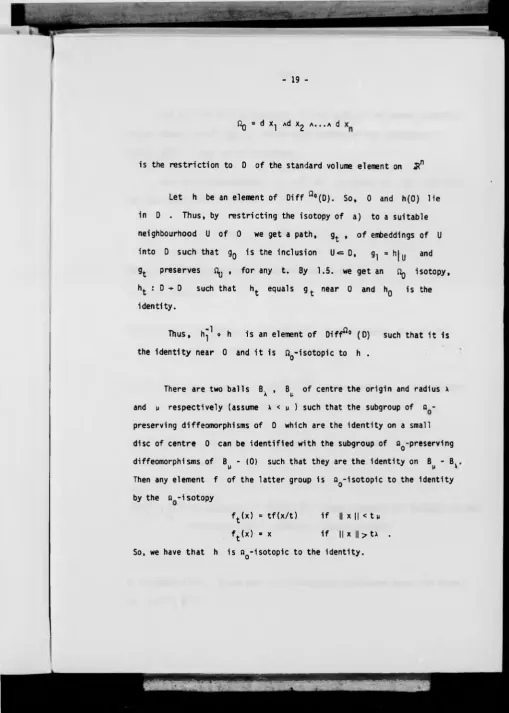
19
-fig = d xi acI X£ a* • • a d
is the restriction to D of the standard volume element on JRn
Let h be an element of Diff ii°(D). So, 0 and h(0) lie
in D . Thus, by restricting the isotopy of a) to a suitable
neighbourhood U of 0 we get a path, gt , of embeddings of U
into D such that gQ is the inclusion U<= D, g1 »hjy and
gt preserves ^ , for any t. By 1.5. we get an ijg isotopy,
ht : 0 ->■ D such that hfc equals g t near 0 and hg is the
identity.
Thus, h^1 o h is an element of Diff^0 (D) such that it is
the identity near 0 and it is QQ-isotopic to h .
There are two balls B , B A \1 of centre the origin and radius x
and u respectively (assume x < u ) such that the subgroup of a -
preserving diffeomorphisms of D which are the identity on a small
disc of centre 0 can be identified with the subgroup of aQ-preserving
diffeomorphisms of B^ - (0> such that they are the identity on B^ - Bx
Then any element f of the latter group is aQ-isotopic to the identity
by the a -isotopy
ft (x) = tf (x/t) if || x || < t u
ft (x) = X if II X II > tx .
[image:26.540.5.515.1.714.2]20
-The aim of this dissertation is the study of the normal subgroups
of the group Diffn ( ]Rn ). Now we will define obvious subgroups of
Diffn (IFn ) that we will consider .
For any diffeomorphism h of lRn we denote by Wh the set
of non-fixed points that is
Wh = { x e lRn : h(x) ^ x } .
Notice that the support of h is the closure of .
Then, we denote by
Diffy ( F n ) the subgroup of Diffn (IRn) whose elements h have the
set of finite ft-volume
Diffn ( IRn) the subgroup of Diffn ( IRn) whose elements h have support f
of finite ft-volume
Diff^ ( F n ) the subgroup of Diffn ( F n) whose elements have compact
support
and
Diff“ 0 ( ® n ) the subgroup of Diff*2 ( ]Rn ) whose elements are isotopic to the
identity by an n-isotopy of compact support.
2.4. PROPOSITION.- Every one of the subgroups considered above are normal
The aim of this dissertation is the study of the normal subgroups
of the group Diff^ ( F n ). Now we will define obvious subgroups of
Difffi (IPn ) that we will consider .
For any diffeomorphism h of IRn we denote by the set
of non-fixed points that is
Wh = { x e lRn : h(x) ^ x } .
Notice that the support of h is the closure of .
Then, we denote by
Diffy ( F n ) the subgroup of Diff^ (IRn ) whose elements h have the
set of finite fl-volume
Diffn ( IRn ) f
the subgroup of Difffi(IRn ) whose elements h have support
of finite ft-volume
Diff^ ( F n ) the subgroup of Diffn ( F n ) whose elements have compact
support
and
Diffjjo ( IRn ) the subgroup of Diff0 ( F n ) whose elements are isotopic to the
identity by an ft-isotopy of compact support.
2.4. PROPOSITION.- Every one of the subgroups considered above are normal
21
-The proof is an immediate consequence of the fact that for any
g and h, diffeomorphisms of lRn , the support of the composition
g o h » g-^ is exactly the image by g of the support of h.
Thus, we have then the following chain of normal subgroups of
Diffn ( F n ).
{id} c DiffJ0 (IRn ) c DiffJ(IRn ) c DiffJ( IRn) c DiffjJ(IRn) c Diffn (IRn)
where { id } is the trivial subgroup.
Notice that if il is a volume element on lRn such that
volfi lRn < » we have
DiffJ ( IRn ) = Diffn ( IRn ) .
If Gj and G2 are groups, we denote by [G^, G2j the group
generated by the elements of the form g-| g2 g^1 g^1 where g1 lies
in G-| and g2 lies in G2> We also denote
C9]» 92^ = 9] 9£ 9] 92
We have
2.5
PROOF.- Let g be an element of Diff^( F n ) and let h be any
element of Diff^ ( IRn ). By 2.3 there exists an fl-isotopy h^
from h to the identity. Then, Ft= [g ,ht] is an iHsotopy
from [g, h] to the identity. Furthermore, the support of that
fl-isotopy is compact since, for any t, we have
supp [g, hfc] c supp
9
u ht (supp g) cc H((supp g ) x [0,1] )
where H: lRn x [ 0,1 ] -► lRn is given by H( x,t ) = ht(x) . Since
the support of the ft-isotopy F is included in the closure of
u supp [g, h.]
t 1
we have
supp F c cl ( u supp [g, h.] ) c H((supp g )x [0,1] ).
t 1
So, since supp g is compact, F has compact support.
Therefore, any generator of [ Diff^ ( lRn), Diff^ ( IRn) ]
lies in Diff” ( )Rn). Then, we have the desired inclusion. cov '
As a corollary of this proposition we get a sufficient condition
24
-PROOF.- Let t^, h2 be two elements of Di ff*|?( IRn). We have, by 2.5 ,
that
h-j ®h2 °(h2 o h!) [h^, h2 ]
lies in Diff^o ( lRn ). Thus the above group is abelian.
2.8. PROPOSITION.- The groups
Diff^m'1) Diffc(IRn)
--- and
---Diff£0(lRn ) DiffCo (1Rn)
are isomorphic.
PROOF.- Let
Diff^(Rn ) Diffc(IRn;
<1* : --- ---+ ---Diff^0(IRn ) Diffco(IRn)
be the natural map ip Ch] = ChD .
Clearly it is well-defined and a homomorphism.
It is 1-1 , since if g and h are elements of Diff^( IRn)
such that i|> [g] = ^ [h] we have an isotopy, of compact support, Gt ,
from h-1 o g to the identity. Therefore, by [18] we get a compactly
supported fi-isotopy from h"^ o g to the identity. Then, h"^ ° 9
lies in Diff^ ( R n ) and [ g ] = [ h ] .
25
-It is onto, since if g is any element of Diffc(IRn ) we get
by 1.3 a diffeomorphism, <(>: IRn -*■ IRn , witn compact support and * ic
compactly isotopic to the identity such that g £2 = fi . Therefore,
g o { is an element of Diff^(IRn ) that satisfy
'l'[6o<(|] = [g * f] = [g] .
Notice that joining 2.7 and 2.8 we get, by a different way, the
result proved by Cerf in [3] that the group
Diffc( IRn )
DifW R ")
is abelian.
To finish this chapter we will remark that the inclusions of the
ffhain of normal subgroups of Diffn (IRn ) that we are considering are
strict inclusions.
In the case that fi is the standard volume element on IRn ,
any translation in F n is a volumen preserving diffeomorphisms lying
in Diff^( lRn ) but not in Diff^( lRn ). Thus,
Diffjj( F°) ^ Diff°( lRn ) .
Now, we will construct an element of Diffjj( lRn) not lying in
26
-We denote by B( r ) the closed ball of IRn of centre the
origin and radius r and by Sn_1( r ) its boundary, dropping r
when r = 1 . Recall that
a)
b)
c)
d)
vol^ B( r ) = r vol^ B
vol^ Sn-1( r ) = rn_1 Volfi Sn_1
'">'¡
1
B ■ 4 - “ 'a s"''voln Sn_1(r) /n/2) n-1
((n-2) /2)!
(See [2] )
Thus, we have
volfi B(R) - vol^ B(r) = (Rn - rn) vol^ B =
= (R-r)(Rn_1 + r Rn‘2+...+rn_1) vol^ B =
R-r n
R-r
n (R+r)2" (Rn-1+---+ rn_1) volj
Therefore, roughly speaking, we will construct a sequence of
27
-we will define a volume preserving diffeomorphism by rotating in a
particular way each annulus, so, the set of non-fixed points will be
the sequence of annuli.
Let {r.j}.j"j be any ordering of the positive rational
numbers greater than 1 and let us define
We call I.j the open interval of K,
and A-j the closed annulus of IRn
2
l
-) -) •
Let n„ be the smallest integer such that r t cl I, and let
Z "2
< i be a positive number such that
Z
n«2we will define a volume preserving diffeomorphism by rotating in a
particular way each annulus, so, the set of non-fixed points will be
the sequence of annuli.
Let be any ordering of the positive rational
numbers greater than 1 and let us define
27
-i =
We call I-j the open interval of F,
£
il - ( rr —I i 2 . i + - L )2
and A1 the closed annulus of F
£ H
A, = cl (B( r, + — — ) - B ( r , ----— ) ) .
1 1 2 1 2
Let n2 be the smallest integer such that rR { cl 1^ and let
l ' < l be a positive number such that
2 n2
n V t
( r„ --- » rn + --- ) n i l 3 (|>.
2
2
Then, we call
£i £i
I, * ( rn ---i - , rn + i
29
-We can define, for any r e IR the matrix
cos
' ♦(
r
)- sin *( r )
0 \
sin *( r ) cos ♦(
r
)and the diffeomorphism h : Rn -*• R n given by h(x)= x M(||x|| ).
Clearly h is smooth and volume preserving. Furthermore, W = u A n i i 1 and supp h = IFn - B. Therefore, h lies in Difi^ ( IRn> but not in
Diff^(Rn ). Then, DiffJ( R n ) c DiffJ( IRn) .
An example of a volume preserving diffeomorphism with support of
finite volume which is not compact can be constructed following the same
idea.
Let C.j be the open ball of IRn of centre (i,0,..., 0) and
radius 1/i . Then we have
v , ; , c<> V , , vo,‘> c' V > , ? V0,« B
29
-We can define, for any r e IR the matrix
cos \J»( r ) - sin r )
t
sin \j/( r ) cos ip( r )
M( r ) =
\
and the diffeomorphism h : F n -*• IRn given by h(x)= x M(||x|| ).
Clearly h is smooth and volume preserving. Furthermore, W = u A. n i a 1
and supp h = IRn - B. Therefore, h lies in Diff^ ( IRn ) but not in
Diff^( E n). Then, DiffJ( F n ) c DiffJ( IRn ) .
An example of a volume preserving diffeomorphism with support of
finite volume which is not compact can be constructed following the same
idea.
Let C.j be the open ball of ]Rn of centre (i,0.... 0) and
radius 1/i . Then we have
30
-v o U u C ) < “ . “ i H . 1
Repeating the construction above we get a volume preserving diffeomorphism
whose support is
u cl C. . i H 1
Therefore, DiffJ ( F n ) ÿ DiffJ( IRn ) .
Ling in [10] proved that DiffcQ( lRn ) ^ Diffc( IRn). Thus,
by 2.8 we have that by any volume element on IRn ,
Diff?0 < ( K "> •
Obviously,
(id) c Diff^0 ( IRn ) •
Thus, throughout this dissertation we will consider the following
chain of normal subgroups of Diff^i F n)
(id) c Diff^0 ( lRn ) c Diff^(IRn) ^DiffJ(IRn ) c Diffjj( IRn) e Diff” (IRn)
and the two last inclusions are also strict when o has'^finite total
30
-v o U u C ) < 1 i * 1 . 1
Repeating the construction above we get a volume preserving diffeomorphism
whose support is
u cl C. . i * 1 1
Therefore, Diff^ ( R n ) ^ DiffJ( IRn) .
Ling in [10] proved that DiffcQ( IRn ) / Diffc(IRn). Thus,
by 2.8 we have that by any volume element il on IRn ,
MffJo ( ( K ") •
Obviously,
(id> c Diff“0 ( IRn) .
Thus, throughout this dissertation we will consider the following
chain of normal subgroups of D i f f ^ R 11)
{id} c Diff^0 ( F n ) c 0iff^(IRn) ^Diff^(IRn ) c DiffJ(IRn) c Diff” (IRn)
and the two last inclusions are also strict when fl has'Vinite total
31
-§3.- DECOMPOSITION THEOREMS
The aim of this chapter is to prove that if n * 3 we can factor
each element of Diff^ lRn) as the product of five elements of the same
group each one with support in a strip (Theorem 3.8 ). To do that we
need several definitions
3.1. DEFINITION.- A straight strand in IRn is the line IR+ x { x }
where x is a point in F n ^ and ]R+= [0, »). A strand is the image
under an element of Diff^( F n) of a straight strand. A tangle is a
finite union of disjoint strands. A tangle, L, is said to be unknotted
or trivial if there is an element of Diffn(IRn) which straightens all the
strands in L simultaneously.
3.2. DEFINITION.- A strip in F n is the image under some element of
Diff( lRnj of the standard tube
_ n ,
T * {xeBT : I xf s 1, x, a 0 }
i*2 1 1
Notice that a strip may have finite -volume since the diffeo-
morphism used may not be volume preserving.
Now we state a result on trivial tangles proved by McDuff in
Lemma 1.4 of [17].
3.3 PROPOSITION [17j.- Let s^ and Sg be two disjoint strands in lRn.
Then, there is a strand, Sg , disjoint with both, such that the tangles
31
-S3.- DECOMPOSITION THEOREMS
The aim of this chapter is to prove that if n * 3 we can factor
each element of Diff^( lRn) as the product of five elements of the same
group each one with support in a strip (Theorem 3.8 ). To do that we
need several definitions
3.1. DEFINITION.- A straight strand in IRn is the line IR+ x { x }
where x is a point in Rn-^ and lR+= [0, ®). A strand is the image
under an element of Diff^( F n) of a straight strand. A tangle is a
finite union of disjoint strands. A tangle, L, is said to be unknotted
or trivial if there is an element of Diffn( IRn) which straightens all the
strands in L simultaneously.
3.2. DEFINITION.- A strip in F n is the image under some element of
Diff( ]Rnj cf the standard tube
n n ,
T = {x eIRn : l xf s 1, x, 2 0 }
i*2 1 1
Notice that a strip may have finite fi-volume since the diffeo-
morphism used may not be volume preserving.
Now we state a result on trivial tangles proved by McDuff in
Lemma 1.4 of [17] .
3.3 PROPOSITION [17j.- Let s-j and S£ be two disjoint strands in lRn.
Then, there is a strand, Sq , disjoint with both, such that the tangles
3
3
3 4
-Next proposition gives a condition in two strips, V 1 and V2 ,
to have a volume preserving diffeomorphism of IRn sending
v2 .
onto
3.4. PROPOSITION.- Let and V2 be two strips with the same
°° 35 °°
-Then, there is an element , h , of Diff^( ]Rn) such that h(V1)= V2 .
PROOF.- Let be V1 = g](T) and V?= g2 (T). Then, g = g2 0 g"1 is a
diffeomorphism of IRn such that g(V^)= V2 > Now, we will modify g
to be volume preserving.
First of all we modify g near
3
V2 in such a way that thevolume elements ft and ft'= g* ft are equivalent near 3V2> Let be
M= 3V2 and we identify M x [-1,1] with a small bicollar of M.
Then, by 1.4 we find a diffeomorphism <j>: M x [-1,1 ] -*• M x [-1,1]
that is the identity near Mx {-1,1} and such that <p*g*ft = ft near
M x {0} . We denote also by <j> its extension to IRn by the identity.
Now, we can apply Theorem 1 of the Appendix to the volume elements
ft and <j)*g* ft on V 2 and also on IRn - with the Same volume
elements. So,we get a diffeomorphism, t|/ : IRn ■+ IRn that is the
identity near 3V2 and such that ij>*<j>*g* ft = ft . Therefore,
h= g ■» <p o jpis the desired volume preserving diffeomorphism.
The following two propositions says us that we can modify a
diffeomorphism of ]Rn to be volume preserving but leaving it fixed
on a given strand.
3.5 PROPOSITION.- Let g be an element of Diff(IRn) with support
in a strip, V , containing a strand, s, in its interior. Then,
there is a volume preserving diffeomorphism, h, with support in V
36
-PROOF.- Without loss of generality we can assume that V is a tubular
neighbourhood of s .Then, there is an (n-1)-dimensional submanifold
M, of V containing s . We can assume that M is a closed subspace of
]Rn without boundary. Thus, applying 1.4 to M with the restriction
of the volume elements a and g*n on ]Rn and identifying M x £-1,1]
with a small bicollar neighbourhood of M we get a diffeomorphism
<p I M x [-1 ,!]-*• M X [-1,1] ,
that is the identity near M x {-1,1} and on M x {0} and is such that
<t>* g* ft= ft near M x {0} . The extension to IRn of this map by the
identity will also be denoted by $ .
Let Z be a small neighbourhood of s such that <j>* g* fl
on it. Since,
voln (V-Z) = v o l ^ (V-Z)
we can apply theorem 1 of the Appendix to ft and ij>*g*ft to get a
diffeomorphism, ^ : V-Z -►V-Z , such that g*ft = ft and it is
the identity near
3
(V-Z). Therefore, h= g ° $ » ip is a volumepreserving diffeomorphism that equals g on s.
3.6. PROPOSITION.- Let g be as in 3.5 and such that g is volume
preserving on a strip V' c V containing s in its interior. Then,
there is an element h of Diffn( IRn) with support in V which equals
37
-PROOF.- We have, g*ft = ft on V' , therefore, as in the proof of
3.5 we can apply theorem 1 of the Appendix to get a diffeomorphism
* : V -V ' V - V'
such that ijj*g*ft = ft and it is the identity near 3(V- V*). Then,
h= g o <|> satisfy this proposition.
Notice that if in 3.6 , vol^ V' = °° we can get the strip V"
also of infinite ft-volume.
Now, we want to prove that if we have a volume preserving
diffeomorphism of !Rn that it is the identity on a strand, it can be
modified to be the identity on a neighbourhood of the strand. Thus,
we have
3.7. PROPOSITION.- Let s be a strand and let h be any element of
Diff^( ]Rn ) that is the identity on s. Then, there is an element
h' e Diff^i F n) with support in a strip V of finite ft-volume and
equal to h on a strip V" c
v 1
containing s in its interior.PROOF.- Let V-j and V 2 be strips of finite ft-volume containing s
in its interior and such that V 2u h(V2) c V^. Both V., and V| are
tubular neighbourhoods of s.
Let T=(E,d> ) be a tubular neighbourhood of s where E is
38
-identity on s and <t>(E)- Vg. We apply the Uniqueness of Tubular
Neighbourhood Theorem of Mather (see [12] ) to the tubular neighbourhoods
T and h*T, where h*T = (h*E, h"'of), and we get an isotopy,
H R n x I -*• ]Rn , with support in V 1 such that T and h*T
are equivalent that is the vector bundles (H^)*E and h*E are
isomorphic and if we denote by T : (H^ )* E -*• h* E the bijection between
the total spaces of the corresponding vector bundles the following diagram
39
-is commutative. Therefore, f: E -*• E is an automorphism of vector
bundles such that <p o f = h <. H, 0 $ .
Since s is contractible the vector bundle E is trivial.
So, the automorphism 7 is isotopic to the identity. Let be
such isotopy with f 1 = f and ? is the identity.
Now, we will define a diffeomorphism $: IRn ■+ ]Rn that equals
f on a neighbourhood of s as follows. Let D' c £ be the disc bundle
of radius 2 and let D" be the disc bundle of radius 1. We define
*(x) = d, c f 0 f \ x ) f o r x * 0 .(D")
$(x) = <f> o f t o $ ' ](x) for x € <p (D‘) - d> (D")
with t = 2 -|| $ "1(x)||
$(x) = identity otherwise.
It is diffeomorphism of IRn with support in V2 and we have $« H^1
equals h on <p (D") c V
2
.Since h is volume preserving we can apply 3.6 to $ o
and we get an element h' of Diff^( IRn) with support in V1 and
40
-3.8. PROPOSITION.- Let s and h be as in 3.7 and let vol^ IRn= °°.
Then, there is an element h' e Diff^ IRn) with support in a strip V'
of infinite n-volume such that vol^( IRn- V ' ) = 00 and h' equal to
h on a strip V“ c V' also of infinite n-volume and containing s in
its interior.
PROOF.- The proof goes as in 3.7 once we have constructed two strips
of infinite fl-volume, and V2 , containing*in its interior and
such that h(V2) u V2 = V-j and voln ( R n_ V-|) 3 «.
Now we will construct and V^. Let be a point of s
and let be a cell containing x-j in its interior and vol^ C^= 1,
Let B, be the ball of centre the origin, radius A-j and such that
C.| u h(C^)c int . Let x2 be a point of s not lying in .
Since voln( R n-B^ )= «°, thera is a cell, C2 c IRn-B^ , containing
x2 in its interior and vol^ C2= 1. Let be the ball of centre
the origin, radius X2 with A-j < A2 and such that C2 u h(C2 )c int B^.
Thus, inductively, we get a locally finite sequence of disjoint cells
_|_[ C . , such that i a 1 1
voln( _LL C.) = » “ i i l 1
and s n int t $ for any i. If
41
-we consider the sequence _|_J_ C. . j= 2i J
Therefore, if V2 is the strip obtained by joining C. to Ci
J J
by a small bridge around
to h(C.) and h(C.) to
J J
the desired properties.
s and V, the strip obtained by joining C.
' J
Cj+i by small bridges around s, they satisfy
Now, we are able to prove the main factorization theorem
3.9. THEOREM.- Let h be any element of Diff^IR11). If n s 3 we can
decompose h as the product of five elements of Diff^ IRn), h-j, h2 , h3>
h^, hg, where h.. has support in some strip for any i.
PROOF.- Let s be a straight strand. By transversality [8] , there is
a diffeomorphism, hj, with support in an arbitrarily small strip, Vjf
containing h(s) in its interior and such that hj « h(s)n s = 4>.
Then, applying 3.5 to hj we get a volume preserving diffeomorphism,
h ^ , with support in V-| and such that h ^ o h(s)n s = <t>.
By 3.3 there is a strand, t, disjoint from both s and h^»h(s)
and such that both tangles, t u h ^ » h(s) and t u s are unknotted.
Let M be a surface in IRn diffeomorphic to IR+ x [0,1] and
bounded by t and s. Let be a neighbourhood of M that is a strip
of finite n*volume. There is a diffeomorphism of Rn , h3 ,with support
in V3 and sending s onto t. As above, we can assume, by 3.5 ,
42
-Repeating the same process with the trivial tangle tuh^»h(s)
we get an element, h2 , of Diffn( IRn) with support in a strip, V2 ,
sending t onto h ^ » h(s). Furthermore, we can get h^ such that
h ^ o h^ equal to hj'i h on s.
Let be g= h ^ « 1 ^ ° h ^ » h, we have that g equals the identity
on s. So, by 3.7 there is an element, h^e Diff^(lRn) with support
in a strip, V^, such that h4 equals g near s.
Let hg= h ^ o h ^ » h^1 <• h ^ o h. Since it is the identity on a
strip near s and the closure of the complement of a strip is contained- >-r> a.
strip, hg has support in a strip Vg.
Therefore, h= hg o h^ « hj » h^ • h^ is the product of five
volume preserving diffeomorphisms of the appropriate type. •
3.10. REMARK.- Notice that in the proof of the Theorem above we can get
the strips , V2 and Vg of n-volume as small as we like and we
can get also that the n-volume of is finite or vol^( IRn-V^)= ®
and volQ ( R n- Vg
)-Also, as an immediate consequence of the proof of 3.9 and since
the set W of non-fixed points of the composition of the 9] 092
diffeomorphisms g-| « g2 is included in the union of Wg and Wg ,
3.11. COROLLARY.- If n ;» 3, any element, h e Difff(IRn; can be
decomposed as the product of five elements of Diff^( ]Rn),
h= h5 o o h3 o h2 o h1 , with support in strips , for
i= 1,2,3,4,5 and such that volfi v.. < °° for i z 4.
3.12. COROLLARY.- If n > 3, any element, heDiffJ(IRn)
decomposed as the product of five elements of Diff^( ]Rn),
h= hj o h^ « hj o h^ • h| , with support in strips ,
can be
for i =1,2,
3,4,5 .
As a consequence of the following lemma we can prove the factorization
theorem for volume preserving diffeomorphisms with support in a strip of
finite n-volume.
3.13. LEMMA [15] .- If n £ 3, any diffeomorphism he Diff^ IRn) with
support in the interior of a cell C is the product, h= h^ o h2 <> h^
of three elements h^ e Diff^( F n) which are supported in the interiors
of cells where E^ c int C.. and
44
-voln M ” 3 yo1n c *
There is an open neighbourhood N of M in C such that
2
+• VOl^ N < — vol^ C .
Let pt be an isotopy with support in N which shrinks M so
close to 9C that h is the identity on p-|(M). Then, the isotopy
gt= h o p'1 o h'1 o p^ has support in N u h(N) and satisfies that
gQ is the identity and g^ equals h on M.
Applying 1.5 we can assume that the isotopy gt is an ft-isotopy
Thus, g ^ o h is a volume preserving diffeomorphism with support in
a cell (C-M) of volume less than (2/3)volfi C.
We will finish the proof by decomposing g1 as the product of two
factors of the appropriate type.
We apply Vitali Covering Lemma [21] to the covering of (int C)-
-(N u h(N)) by all open balls and we get a finite number of disjoint
balls, B-|,..., Bm , in (int C)-(N u h(N)) such that
m ,
B1 ■ T vol(i c •
45
-by a path a.., for 1 < i s m. Also we can construct such paths satisfying
0-j n Oj = ^> if i/j , a. n 3Bj = f if j/i-1, i , a. n S B . ^ <^(0),
“i n 3B. = ot^l)
m m
u a. n (M u u int B.) = ^ . i=l 1 i=l 1
Therefore, the complement in C of a suitable neighbourhood of
m m
u B. u u a. i=l 1 i=l 1
is a cell. Then we will modify g-j to be the identity near u ,
( already we have that g^ equals the identity near u B^).
Let kt be an isotopy with support in N which pushes the paths
g-j(ot^) outside M for any i=l,...,m . By 1.5 we can assume that kt
46
-diffeomorphism with support in N u h(N) such that the paths
k, o g o ) lie outside M, for any i. 1 1 1 i
Let f be a diffeomorphism of IRn which is the identity near
-1
u (B.j u u k-| o g-j o k^ (a^))u 8 C
and pushes the support of ^ • g t • kj' outside M. Thus
f o k| ° gt o k ^ ° f " l l*an isotopy with support in int(C-M) such that
f o ^ • 9j o kj' o f~^ = k^ ° g-j » k^
near
u (B. u a.) . i=l 1 1
Therefore, by 1.5 we find a volume preserving diffeomorphism
of IRn , q , with support in int(C-M) equals k-j ° g1 0 k-j1
near
Then,
u (B. u a.) i=l ' 1
* I m ni
supp q ° k, ° g, ° k, cint(C-( u B.u u a.))
1 1 1 i=l 1 i=l 1
47
-of two factors -of the appropriate type.
3.14. THEOREM.- Let V be a strip of finite o-volume and let h be
any element of Diffn( K n) n -isotopic to the identity by an O-isotopy
h^, with support in V . Then, if n 2 3 for any t > 0 we can
factor h as a finite product of volume preserving diffeomorphisms each
one having support in strips of O-volume less than e.
PROOF.- Let B be a closed ball in IRn such that
There is a cell C, in IRn such that hj.(B) c C for anY t 6 [0,1]
and C c B u V .
with support in C and equal to h on B. Thus, by 3.13 we can voln(V-(supp h n B)) < e/2 .
48
-write f| as a finite product of volume preserving diffeomorphisms
each one having support in a cell of il-volume less than e. Therefore,
since every cell is contained in a strip of fl-volume as near to the
fi-volume of the cell as we like, we can decompose f^ as a finite product
of elements of the appropriate type.
Let us define fg = f ^ 0 h . It is a volume preserving diffeomor-
phism with support included in V-B that is a strip of fi-volume less than
e .
49
-§4.- TECHNICAL RESULTS
In this chapter we prove the main technical results needed in
this dissertation. In particular we prove:
(4.7.) If n
2
. 2 , the subgroup of Diff^(IRn ) of all elementswith support in a fixed strip V is perfect.
and
(4.9.) If n
2
3 , for any element h e Diff^( IRn ) such thatthere is a disjoint union of cells ; JJ_ C. , satisfying i > 1 1
there is a strip V and a volume preserving diffeomorphism of IRn , h ‘,
lying in the normal subgroup of Diff^( ]Rn) generated by h and
satisfying h ' (V) n V = <t> .
Let X be any subset of F n . We denote by Gx the subgroup of
Diff^(JRn) of all elements with support in X.
Notice that in general, Gx is not a normal subgroup.
First of all let us prove
4.1. PROPOSITION.- Let V be a strip in IRn . Then Gy is p<jtk - conne.c te<L
50
-PROOF.- Let V be the image by g e Diff ( K n ) of the standard tube
of ]Rn . Let h be any element of Gy .
We will construct an ft-isotopy from h to the identity with
support in V.
Let Ht be the standard isotopy given by
Ht(x) = (1/t) g”1 o h « g(t for t > 0
HQ(x) = x
= (.a,, . . . } k„ )
So, Ft= g o Ht « g"1 is an isotopy from h to the identity with
support in V, but Ft is not an fi-isotopy. Thus, F* Q = ot is
a smooth family of volume elements on IRn such that oQ= 0= o-j
and
vol V = vol V , for any t e [0,1] . Ox
Therefore, by Theorem 2 proved in the Appendix of this dissertation
we get a smooth isotopy, R n IRn , with support in V such that
4>g = $>.| equal to the identity and 4^ ot = il, for any t e [0,1] .
Then, Ft . is an n-isotopy from h to the identity with
support in V. So, Gy is patK - canntc t « iL •
4.2. REMARK.- The above Proposition proves that any element h eDiffn( IRn )
50
-PROOF.- Let V be the image by g e Diff ( IRn ) of the standard tube
of ]Rn . Let h be any element of Gy .
We will construct an fi-isotopy from h to the identity with
support in V.
Let Ht be the standard isotopy given by
Ht(x) ■ (1/t) g-1 o h c g(t for t > 0
Hq(x) = x
* = [*,,.. )
So, Ft= g « Ht • g’^ is an isotopy from h to the identity with
support in V, but Ft is not an £2-isotopy. Thus, F* £2= ot is
a smooth family of volume elements on IRn such that aQ= £2=
and
vol V = vol0 V , for any t e [0,1] .
Ox ««
Therefore, by Theorem 2 proved in the Appendix of this dissertation
we get a smooth isotopy, 4>t: lRn -*■ IRn , with support in V such that
4>q = 4>i equal to the identity and ot = £1, for any t e [0,1] .
Then, Ft o is an n-isotopy from h to the identity with
support in V. So, Gy is p a t h - « n n u te<L .
4.2. REMARK.- The above Proposition proves that any element h «Diffn ( IRn )
51
-with support in V. Thus, in 3.14 the hypothesis that h must be
n-isotopic to the identity by an n-isotopy with support in V is not
necessary. We only need h having support in V.
4.3. REMARK.- As an immediate consequence of 3.9 , 3.14 and 4.2
we get that if vol^ lRn < °° and n s 3, any element of Diff^( TRn)
can be decomposed, for any e >
0
, as a finite product of volumepreserving diffeomorphisms each of them having support in a strip of
^-volume less than e .
Now, we want to prove that if V is a strip in IRn , Gy is
perfect. The proof is based on a modification of the proof that
Diff^( R n ) is perfect given by McDuff in [15] .
We say that an element h e Diffn ( IRn) has a Ling factorization
with p-factors if it can be decomposed as a product h= h^ » (^»...ohp,
where, for any i, h^ is a volume preserving diffeomorphism with
support in a locally finite union of disjoint cells. Usually we will
call these unions a disjoint union of cells.
In the proof that Gy is perfect, the special factoriza
tion given in the next Lemma Lb crucial .
4.4. LEMMA.- If n * 2, any element he Diffn( F n ) with support in
a strip V has a Ling factorization with two factors, h^ » \ n ^ = h,