http://wrap.warwick.ac.uk/
Original citation:Wong, J. and Wilson, Roland, 1949- (1990) Eigenvector decomposition of a multiresolution operator. University of Warwick. Department of Computer Science. (Department of Computer Science Research Report). (Unpublished) CS-RR-167
Permanent WRAP url:
http://wrap.warwick.ac.uk/60862
Copyright and reuse:
The Warwick Research Archive Portal (WRAP) makes this work by researchers of the University of Warwick available open access under the following conditions. Copyright © and all moral rights to the version of the paper presented here belong to the individual author(s) and/or other copyright owners. To the extent reasonable and practicable the material made available in WRAP has been checked for eligibility before being made available.
Copies of full items can be used for personal research or study, educational, or not-for-profit purposes without prior permission or charge. Provided that the authors, title and full bibliographic details are credited, a hyperlink and/or URL is given for the original metadata page and the content is not changed in any way.
A note on versions:
The version presented in WRAP is the published version or, version of record, and may be cited as it appears here.For more information, please contact the WRAP Team at:
EIGENVECTOR DECOMPOSITION OF A MULTIRESOLUTION OPERATOR
JUNE
WONG, ROLAND WILSON (RR167)pattern recognition using a multiresolution representation was investigated' This was addressed as an
eigenvalue problem. riglenvecror decomposition of a multiresolution operaor enabled a low-pass pyramid relresenration to be expressed in terms of the 'eigenpatlen$' of the operatc.
The findings show that different image features 'emerge' and can be recognised at different levels of the multiresolution structure, ie at different resolutions The level depends on tlre feanrre size'
This work has implications in fhe design of a neural network for pattem recognition, namely that a network could ,learn, the eigenpanem of a multiresolution operaror. Patrerns recognirion processing could proceed in a bpdow* hierarchical manner, beginning at a level of cmrse featr:res and usilig information from lower levels in the multiresolution strucnre to guide ttre processin! of finer detail
Depanment of ComPuter Science
University of 'Warwick
Coventry CV47lL
United Kingdom
{
Contents
1
Learning
in
Neural
Networks1.1
Multiresolutiou in Pattern Recognition2
Simple
objects
at
various resolutions3
Eigenvector
Analysis of
the
Low-Passtansform
3.1
Eigenvaiues of the Low-Pass Transform3.2
Oriented Patterns and the Low-Pass transform4
ConclusionsList
of
Figures
3 J 1 2 3 4 o 6 n t 8
I
10 11t2
Basic pattern recognition
paradigm
20Frequency response of one-dimensionai low-pass
frlter
20Original'girl'
image (256x
256pixels)
2LLow-pass pyrarnid represeotation of
the'girl'
it''age (levelsI
to6)
22Comparing spots with spots: distributiou of
similarities
23Comparing triangles with triangles: distribution of simil,arities Comparing spots with triangles: distribution of sirnilarities .
Level 1 eigenpatterns
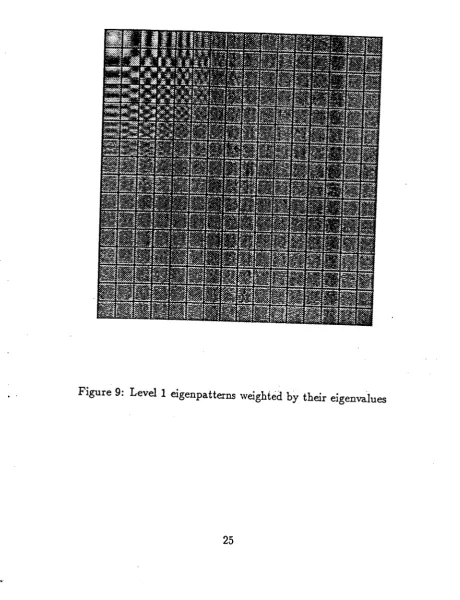
Level 1 eigenpatterns weight"d by their eigenvalues Level 3 eigenpatterns weighted by tbeir eigeovalues Level 6 eigenpatterns weighted by their eigenvalues
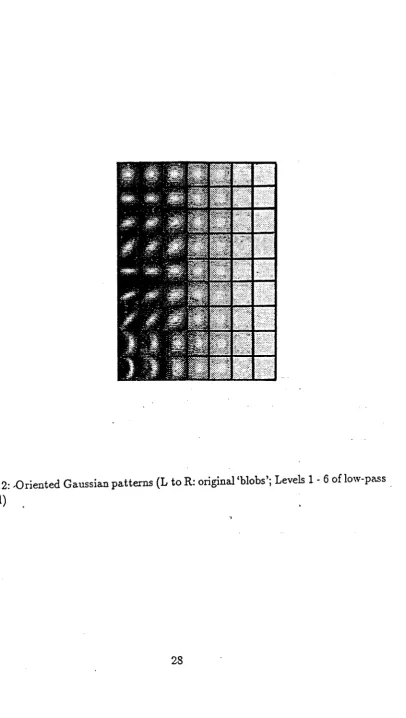
Oriented Gaussian patterns
(L to
R: original 'blobs'; LevelsI
-
6 of 7I
11 13 16 23 23 24 25 26 27low-pass
pyramid)
2813
Magnitudes of first threeeigenvalues
2914
Amount of eoergy retained in first feweigeovectors
3015
Magnitudes of .16 for N:
8,'16, 3216
Preservation of anisotropy for Gaussian ellipse andcurve
3217
Preservation of anisotropy for Gaussian ellipses at variousorientations
3318
Errors in various Gaussian blobs for N=
8
3419
Erors
in circular Gaussian blobs for N:
8 and N: 4
35Introduction
Vision seeE$ simple to us, tbe users. We are far better at perceiving objects in natulal
scenes than modern computers, yet we ate certainly not quicker or more precise'
people outperform today's computers because the braio employs
a
basiccom-putational architecture
that
is more suiied to deaiing with the natural information proce"riog tasks that we are so good at. These tasks geoerally require the simultane-ous consideratiou of many pieces of information or constraints. Each constraint may be imperfectly specified or ambiguous, yet each can play a decisive role in determiningthe outcome of
Processing-Artificial
oeural networks have received considerable interest in recent years sincethey are able to tolerate ambiguities-as is the human brain. Each 'neuron', in such systerns, is a very simple computational elerrent, yet a densely intercot''tected network
of these elements can achieve good performance
in
areas such as speech and imagerecognition.
The importance of multiresolution techniques
to
several image processing appli-cations is discussedin
Section 1, after a brief description of some of the principles behind neural networks.At
present, most neural network reseanch into image anal-ysis takes ao accorlntof
the need for multiresolution methods.It
is intended that this work should examine the potential application of a multiresolution approach topattern recogaition proble.',", with a view to implementing a neural network solution.
The
second section dealswith
experimental findingp arisingfrom
the useof
a multiresolution low-pass pyramid data structure to represent simple shapes.The
searchfor
patterns which are invariant to -the multiresolution operator is tackled from an eigenvector decomposition point of view in Section 3. Experimentalresults are presented to illustrate the points
-^de
concerning the way,pattern detail can be representedwithin
a pyramid of lorv-pass filtered images.The concludilg remarks
in
Section 4 comrnent on the way a mrrltiresolution aq-proach to pattern recognition could proceed.1
Learning
in
Neural
Networks
Artificial
neural net models arecbmpori
ofd"*ely
interconreected SimplecOmtuta-tional elements.
In
this respect their structure is ba.sed on present understanding of biological Dervous systerns. The computational elements, or nodes, are interconnectedvia weights that are typically adapted during use to improve performance b#ed on
current results. The simplest example of a node is one which sums N weighted inputs. and passes the result through a nonlinearity.
Generally speaking, the behaviour of a network of artificial neurons is as follows:
An
output
function (ofteo some sortof
threshold function)*tpt
the curreotstate of acti''ration to an output sigoal, o;(t)
That
is,o;(t)
-
f;@i?))
r
A
set of such units feed their output signals, via weighted connections, to a uaitin
the next layer. This unit, u;, sums the weighted signals comingin
toit
and combines themwith
its
current stateof
activationto
produce a new state ofactivation.
In
vector notation, the new state for the entire network is given by:a(r*
1)-
F(a(t),wo(t))
o The
'.'rtrix
W represents the pattero of connectivity; the absolute value of theentry ur;; represents the strength of the connection from
u;
to u;.Neural net models have greatest potential in applications involving many
compet-ing hypotheses which are pursued in parallel; one such application is visual pattern recogaition.
Adaptation, or learning, is a major focus
in
neural net research. The ability toadapt and continue learning is essential in pattern recognition, where training data
are
limited
and new images are constantly encountered. Learning,in
this context,requires the modification of the pattern of connectivity as a function of experience.
This entails adapting the strengths of the connections between uaits.
Neural net adaptation algorithrnq fall into two carnps: supervised and unsupervised learning.
1. Supervised Learoing
The net*'ork is proi-ided with side information or labels (Uv
"
'teachlr').
Nets.
trained with supervision act as either pattern classifiers or associative memories,and are typically used
with
incompleteinput
patterns,or
those bornrpted by noise or some other process.2.
Unsupervised LearniugNo
information conce*iog the correct classof
theinput
patterais
providedduring training. Nets trained without supeivision can be used to vector quantise
or
clusterthe
inputs.
They are capableof
compressing the amount of datawithout
losing important information. The net result isthat
individual units'learn' to 'specialise' on specific patterns and thus become'feature detectorst.
Lippman [8] has writtea a very comprehensible review article in which he describes
six neural net models that can be used for pattern classification. He gives examples
of
the
useof
both
supervised and unsupervissdf1aining.
See also the review byCarpenter [4], who uses adaptive filter notation to describe some basic neural network
modules.
The work of ner.rropsychologist Donald Hebb,
in
1949, has spawned many neuralnetwork training rules - see, for sl(:mple, [11]. Based on Hebb's ideas on memory and learning, these rules all employ the priaciple that the change in co''.ectioo strength contains a term proportional
to
the product of input audoutput
activitiesat
thatconnection, ie
Lu;5
=
la;o;where o; is the activation of u; aad o; is the output signal from u;.
Hebbian learning rules modify conaection strengths according
to
the degree ofcorrelated activity between the input and output units [7]; they tend to maximise the variance of the output units [12] [4].
Of particular note in the application of Hebbian-type rules in unsupervised learning has been the work of Linsker [7], io 1988, and Sanger [12],
in
1989.Linsker used a self-organisiog neural net to model how a perceptual system could develop
to
recogqise specific features of its environment,without
being told whichfeatures
it
should analyse. He used a Hebbian algorithmto
adapt the connectionstrengths and achieved minimum meatr squared error
in
the linear reconstructiou of the input patterns, givea the activities of the output nodes.Sanger employed the same basic Hebbian learning algorithm, based on one first
proposed by Oja
in
1982. EIe proved that his 'Generalised Hebbian Algorithm'com-putes the eigenvectors of the input autocorrelation me
trix.
Sanger discussed theuse-fulness of eigenvector decomposition applied to neural networks, and demonstrated
the power of networks trained according io Hebbiau priociples when applied to image -' coding, feature extraction and texture analysis.
1.1
Multiresolution in
Pattern Recoglition
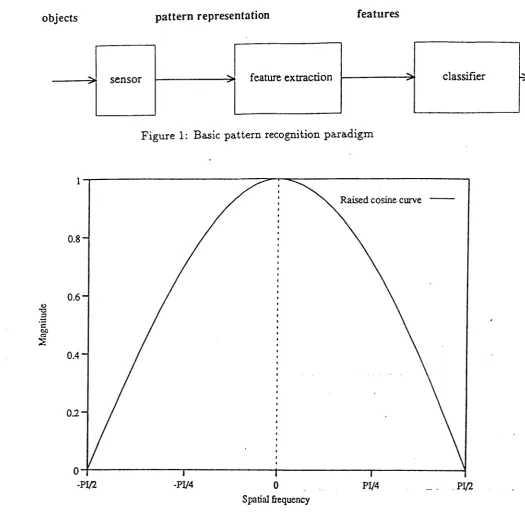
The basic paradigm of a visual pattern recognition slatem is shown
in
Figure1.
Ingeneral, the goal of such a system is to analyse images of a given scene and to recognise
the content of the scene [19]. The aim is to obtain a represexrtation consisting of a set
of
symbolswith
appropriate relationshipsr eB "the objectA
is of
classC
andis located
at
positionX".
It
is widely recognised that this fundamental problem of image aoalysis is affected by the Uncertainty Principle [18J[l4]-that
is, the ability toresolve features spatially is constrained by the extent to which they may be resolved
spectrally.
The derivatiou of a symbolic description of an image necessitat-es the extraction
of
_meaningf'ul features from the
i-age
data, such 35 line5, edges and texture elements.These features, which must capture the important characteristics of the input data,
Both
objects and features occurat
many spatial scales.Marr
[9J describes the'hierarchical organisation' of an image:
"The spatial organisation of a surface's reflectance function is often genet-ated by a number of difrerent plocesses, each operating at a differeot scale."
Marr explains the task of vision using oriented lines and
"dgo
and blobs (ie local features) as a basis. Ee points out that there is considerabie psychophysical and neu-rophysiological evidence to suggest the importrnce of oriented line and edge featuresin
low-level marnrnalian visual processing [6].The first step in detecting lines and udg* is to blur the image. This is achieved by
performing a low-pass filtering operation on the image, thereby imposing an upper
limit
on the rate at which inte''"ity changes can take place. Since these changes occurat different scales [9] in the original image, their optimal detection requires operators
of different sizes, ie fllters of different bandwidths.
This multiresolution approach enables the spatial consistency of the outputs from
several diferent scaies of filters to produce a more relable estimate of feature position
than is possible from a single fiitering operation.
A
pyramidal data structure is used to represent the image data over a range of spatial resolutions. This type of structure has found increasing usage in imageprocess-ing since
it
can match the multiresolution representation of irnages-a rel2resentationrecognised as valuable in a number of applications [2] [S] [16].
In
the
present work,a
'low-pass pyramid'is
generaied by filtering the imagewith low-pass filters having a two-dimensional 'raised-cosinet frequency response, and
then subsampling. The frequeacy response of the fllter is linearly separable; its one-dimensional form is shown in Fig. 2.
The base level of the pyramid is the original image; each higher level uses a filter
with
half the bandwidih of the precedinglevel
This obtains versions of an image atsuccessively lower spatial resolutions (but higher spatial frequency resolutions), which
require fewer spatial semples and are thus 'smaller,.
The irnege is therefore represeoted as a series of low-passed i",ages,
@d
sampledat
successively lower densities. The result is a self-similar structure which exhibitslocalisation
in
both space and spatial frequency. Each level of the low-passpyra-mid
contains a blurred version of the original image; the degree of blurring, whichvaries according to the pyramid level, is governed by the bandwidth of the
io*-p"",
filter.
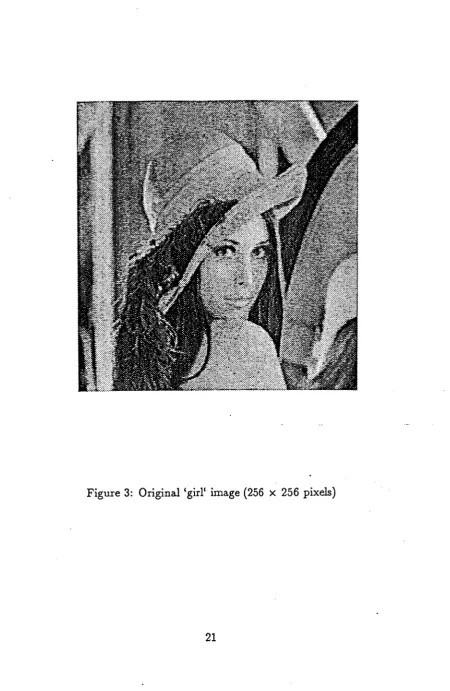
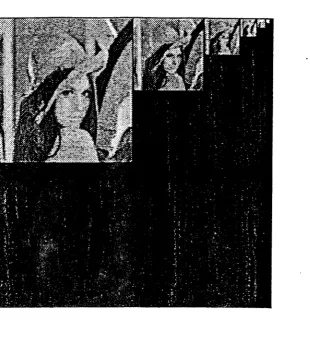
Fig. 3 shows the original image of thegirl,
and levels 1 to 6 of its pyramidal representation are grven in Fig. 4.On the whole, neural networks performing visual pattern recogqition tasks bave an
arbitrary
scale imposed upon thern- Horrever, the many examples of the importanceof scale
in
image processing and analpis [2] t3] t5] [16] [1b] suggest using a multires-olution pyramid as input to a neural net to enable pattern recognition in the mannerSchalkof comments: [13]
"A
hierarchical processing approach parallels the operation of the humanvisual system io that processing proceeds from a coarse descriptive level to
Ievels of increasiog reflnement. The hierarchicai approach is applicable to the tasks of segmentatioo, feature ecrtraction, description asd rnafqhing.'
One questioa of interest concerns the effects on patterns and features of this
mul-tiresolution operator. Intuitively, one would expect that a spatial scale exists at which
individual objects 'merge' and, therefore, at some levels of the pyrarnid single objects are indisti'' guishable.
Some elementary investigations into the behaviour of i-ages of several objects in
the low-pass pyramid representation are described in the following section.
2
Sirnple objects
at
various
resolutions
In order to investigate the properties of the low-pass pyramid representation, images were synthesized by placing a simple object, or pattern, at a number of spatial
posi-tions
within
a 512x
512 pixel area. Four classes of simple object were used: spots, squares, bars and triangles, of similal energy.For each 5L2
x
512 pixel image a low-pass pyramid of 7 levels was constructed: levei 0 (the original image) has greatest spatial resolutionl level 6 (8x
8 pixels) haslowest spatial resolution.
Each synthetic image of 512
x
512 pixels can be consideredto
be made up of an8
x
8 array of 'cells', each of size 64x
64 pixels. Thus, each pixel gt th9 top level of the pyramid (level 6) corresponds to one cell at the bottom level (level 0).Each cell 6qsfsins ooe simple object. The posiiion of the object in relation to its cell bouadaries was varied in a systematic way over the entire image. The'exemplar'
for each class of object was the cell with the object ceotred within it.
The low-pass pyramid representations were generated
in
orderto
address some fundamental questions:o do all objects in a given irnage'appear' at the same pyramid
leve{ , .
.
o do
all
the shapes 'appear' at the same level?oistheshapeoftheobjectrecogaizab]eatthislevel?
A quantitative measure of the similarity or 'overlap' between two n
x
n regions of pixels is given by thei''.er
product of their intensity values, say,f
(x,y)
and g(z,g),That
isR t
o
:
Yr;,;;,)
;fli",')i
(1)(",v)
where .Ryo denotes the similarity measure' or correiation.
The results which foilow were obtaioed by computing the inner product between
the exemplar and spatially shifted objects (for each class). In other words, we
inves-tigated how well objects
at
various spatial locationsin
a blurred image matched a 'prototype' flltered image.This was'repeated to ocamine the similarities between blurred objects from difer-ent classes, and
to
determine whether the magnitude of the inner product could beused as a criterion for diferentiating between such objects, given only their blurred representation io the low-pass pyramid.
Results
At
level 4 the image size was 32x
32 pixels and each cell occupied 4x
4
pixels;this was the lowest spatial resolution
at
which the objects were visible individually. However,at
this level the spots and squares were identical; the triangles and bars were seen as 'blobs', slightly different in each cell.It
was not possible to identify theiroriginal shape , although there were diferences between the triangles and the bars.
At
the next higher spatial resolution (ie image size of 64x
64 pixels) all of theshapes were recognizable.
The .R values (see Equation 1)
for
the spots and triangles are presented, sincethese two objects can be considered to have the least in corrmon of the classes used
here. The distribution of the .R values is given
in
histogram form for the followingcomparisons:
spots with
spots-Fig.
5; triangleswith
triangles-Fig. 6; spotswith
triangles-Fig. 7.The results shown were all computed using the representations from level 4 of the
pyramid; ie the objects were visible
but
their shape was indeterrninate dueto
theblurring by the low-pass filter.
It
is obvious from these histograrnsthat
a considerable spread of -Elralues wasob-tained, eveo when objects from the same class were compared. Elence, f,he magnitude
of the inner product did not convey suficient infor"'ation to differentiate objects from
different classes.
It
followsthat
a neuralunit
trained to ideniify one such patternwould be unable to discriminate this pattern from the other patterns.
they?) that rernain unchanged under low-pass filteriag and therefore could be
recog-nised at anY sPatial resolution.
3
Eigenvector Analysis
of the
Low-Pass
Trans-forrn
The question raised in the preceding section concerned patterns or objects which are
invariant
to
low-passfiltering.
Invariancein
this context meaDsthat
a pattern atlevel n of the low-pass pyramid can be projected down to level 0 (maximum spatial
resolution) by suitable interpolation, and theo taken back up to level n again without being changed'significantlY'.
Findingluch
patteros is an eigenvector problem which entafu representing thefi1tering operation as a linear
transforn
In
view of thefact
that the 2-d low-passfllter
is linearly separable,it
is possible to solve the eigenvalue/eigenvector problemin
the
one-dimensional case; the twedimensional solutions are then given by theproducts of the corresponding one-dimensional solutions.
Notation
Matrix notation is adopted as being the most concise. The following couventions have
been adopted:
are represented by capital letters and are taken to be
2
x 2^n
-
(o)n0
(
&,1<2^
2.
Signal vectors are2^ x 1 colu:nn vectors and are denoted by lower case boldfaceletters, eg v.
3.
Cornmon matrix operations are' :
transpose* :
adjoint (conjugate transpose)Thus, the inner product of two vectors will be written as: 2m-l
v'u:
D
u.ri
t=0
The
",atrix
F
is the discrete Fourier transform (DFT) operatorlF'
is the inverseDFT
operator.?iv is a truncation operator;
it
ensures spatial limiting and is defined by:Tnu: 6u 0<h<N
2^-N<k<2^
= 0
otherusiseNote also that Tft
-
TN.The low-pass pyramid transform, in ooe'dimensional space, can be modelled:
TkF
HZpFlyv:
)v
(2)Since
fiy
(the truncation operator) is also a projector [10] thenThT*:TNT|-Tn
emultiplying both sides of Equation 2 by
Tv
obtains:TyF
HlpFTyv
:
)?ivv
)v :
lTrvvThe non-trivial solution is
v: ?Nv
(3)This implies that
ur:O /V<&<2^-N
(4)Hpp is the frequency response operator of the low-pass
fllter.
Sinceit
is used trvice(as a low-pass and as an interpolation fi.lter)
it
appears as II2t p ia Equation 2.If
we writeF
HI.F=H
.
then(H)u
:
hz(k- t)
(5)where
o
h2(n),
0 Sn 12^
arethe filter impulse response coefrcients.
(f
-
l)
is calculated modulo-2^.Thus Equation 2 becomes
THTv
=
lv
(6)It
can be shown that(THT)H
-
(.F/)rr:
hz(k- t)
(7)o<k,l<rf,
2^--N<k,I<2^
In other words, the operator rePlesetrts the effect of taking a spatially localised or
truncated
pattern
(of 2N samples) at some level of the pyra'nid, projectingit
ontothe image aod then constructing the pyramid based on
that
image' Eigenvectors ofthese operators are 'eigenpatterns' of the multiresolution representation---oniy their
iength'.hrogo
whenll"y tr"
subjectedto
these operations' The eigeopatterns ofthJpyramiJ.r",
in a sense, invariants of the representation.tio*,
theI/
operator is a2-
x2-
matrix.If
all the zero-valued rows and columnsare removed we are left with a 2N x 2N matrix; corresPondingly, the eigenpattern v can be reduced to
2N
dimensions without any loss of information (see Equation 4)'In
fact,
these eigenpatterns are closely relatedto
a set of vectors well known in signai processing uJd*"d
in a number of image processing applications-the prolatespheroidal seguences. The finite prolate spheroidal segueDces (FPSS) [17] combine
spatial and frequency domain localiry
in
an optimal way, since they maximise the energyin
afinite
interval of one domain while truncating in the other' The FPSS is the eigenvector, go, in the following problem:BTgo
=
)ogo (8)where
?
is the truncation operator andB
is the bandlimiting operator, defined asB=FTF
(9)and
)6
is the
largest eigenvalue.In
this case,the
FPSSis
defined to be exactlybandlimited and optirnally concentrated in a finite spatial region.
The
probl.-.Jdrosed
in Equation 2 differsin
that bandlimiting is achieved byusing the low-pass fllter, Hpp,with,a traised-cosine'frequency response, whereas the
FpSb problem requires an 'ideal' rectangular
filter.
Althoughit
is possible to useideal low-pass .filters to construct a pyramid, these bave large sidelobes in
tle
spatialdomain which make them insuficieotly localised for most applications
3.1
Eigenvalues of the
Low-Pass
Transfbrm
The reduced operat
or
THT
is a real symmetricmatrix;
hence, the 2N eigenraluesand eigenvectors are purely real, and the eigenvectors form a mutually orthogonal
basis [10].
ThL eigenvectors are the one-dimensional patterns which undergo only
muitiplica-tion by a
."3la,
uoder the low-pass transform- The amount of energy retained by eacheigenvector after flltering is given by the magBitude of its corresponding eigenvalue,
in
the sensethat
v'Av:
)v*v
: )
The graph plotted
in
Fig. 13 shows the magnitudes of the first three eigen';a.lues ()0,)r,
)2) against the bandwidtb of the low-pass filter operaLgr, H7'p'These results were obtained using
2
:256
and N:
8; they show that, for a givenfiIter bandwidth, the magnitudes of the eigenvalues, |
).
l, decrease very quickly rvithincreasiag index,
k.
Therefore, most of the energy is concentratedin
thefirst
feweigenvecttrs; iodeed, at higher levels
in
the pyramid (ie narrower bandwidths) only the first eigenvalue,)s,
is'significant'-The transfonn as a whole passes a certain amount of the total signal energy.
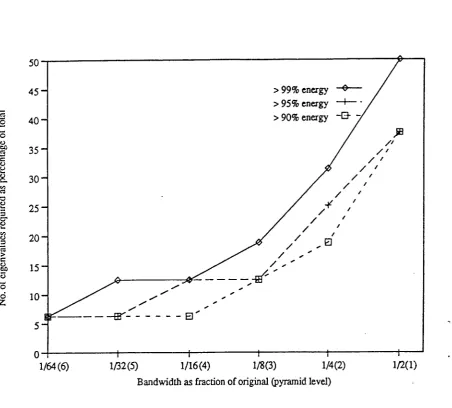
At
a particular pyramid level, this amount is giveo by the sum of all 2N eigenvalues. Apercentage of this 'transformed energ/' is passed by ea& eigenvalue, according to its magnitude. Previous findings (see Fig. 13) have shown that the number of eigenvalues
having 'significant'
-agnitude
is dependent on the py-ramid level. Therefore, mostof
the 'transformed energy' is passed by only a proportion of thetotal
number ofeigenvalues;
this
is shownin
Fig.14.
As an extreme example, consider the case at level6:
only about 6% of. the eigenvalues account for over 99Vo oI the'transformedenergy'. As might be expected, increasing the bandvridth require a larger proportion
of the number of eigeavalues in order to maintain the same percentage of 'transformed
energy'.
Fig. 15 shows the magnitude of
)s
as a functiou of bandwidth for N=
8, N:
16and N
:
32. These plots showthat
each doubling of N has the same effect asdou-bling the
bandwidth.
Therefore,for
a particular eigenvalue, the product ofN
andbandwidth is a constant.
This implies
that
there is more eoergy at higher pyramid levelsif
N is increased. The value of N indicates theinitial
level from which the pattern is projected onto theirnage in order to construct the pyramid. T'hus, a la,rger value of N is equivaleot to 'starting
of'
from a lower level of the p1'ramid structure.The
Two-Dimensional
Case
Because the 2-d operator
is
separable,its
eigenvalues and eigenvectors are easilyrelated to the
l-d
case.The two'dimensional eigenvalues are given by
1,,
=
)i)l
If,
in
the one'dimensional case, the 2N eigenvectors of the transform are given byvir 0<i<2/V
then the 2N
x2N
two-dimensional eigenvectors can be written ase;i(a,y)
-
u;(o)u;(y)These form a mutually orthogonal basis because any 2-d 'pattern' can be expressed
as a linear combination of these 2-d basis vectors. For a grveD bandwidth,
if
the 2-deigenvectors are weigbted by the corresponding 2-d eigenvalues, the result is equirm.lent
to passing the'patterns' through a low-pass fllter of that bandwidth. Oniy some of the
patterns 'survive', since the eigenvalue distribution favours the first few eigenvectors.
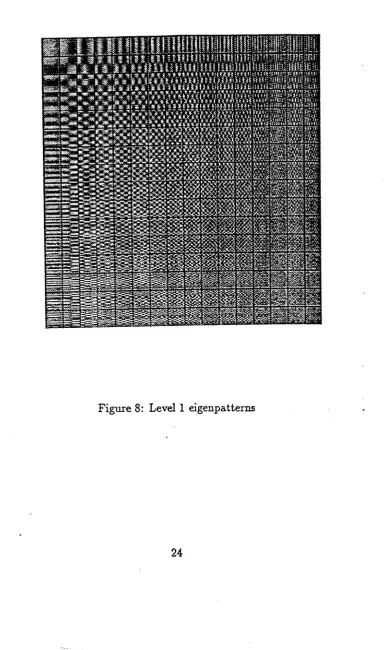
The 2-d eigenvectors wheu
N
:
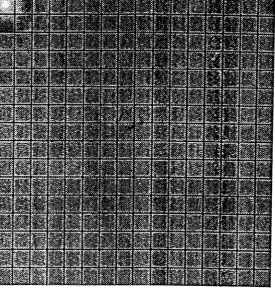
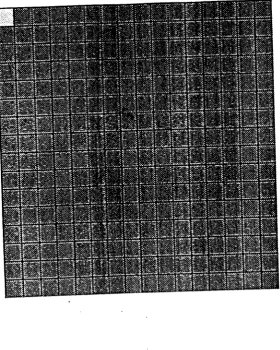
8 are shownin
Figs. 8-
11. Thefirst
of thesefigures shows
all
of
the eigenvectors (or eigenpatterns)at
level 1of
the pyramid.Tbe remaining figues show how the number of significant eigenpatterns varies with pyramid level when they are weighted by their correspooding eigenvalues; they a)so
give an indication of how
rnny
significant eigenpatterns there are at different pyramid levels.Thus
at
the lowest bandwidth, ie the highest pyramid level, only one significanteigenpattern is seen (Fig.
U).
As the bandwidth increases on successive levels, morepatterns having significaot residual energ/ can be seen. As might be expected, the effective dimensionality of the signal increases-more and more details become visible
(see Fig. 9). This is a direct consequeDce of the distribution of eigenvalues at different
bandwidths, as discussed in Section 3.1, since a greater proportion of the eigenvalues
are large enough
to
be 'significant' as the bandwidth increases. For example, athigh pyramid levels oniy the first eigenwalue is significant. Consequently the low-pass
filtering
at
this level'destroys' those eigenpatterns which convey detail.3.2
Oriented Patterns and
the
Low-Pass'transform
In
orderto
investigate the efectsof
the low-pass pyramid transform on orientedpatterns and objects, a set of synthetic images was designed, based on elliptical, curved elliptical, and circular Gaussian intensity distributions. Each pattern occupies
a
2N
x
2N
pixel area; the patterns are shown io the first coiumn of Fig. 12.Any
pattett, f
(srg), can be expressed as a rveighted sum of the orthonormal basis:f(r,y)-ta;ie;;(x,y)
(i"rl
with
, aii:
coeficients in the linear expansionl.
eij(.)
:
2-d eigenvector (orthonormal basis).The weights, a;1, are given by the inner product of the pattern and the 2-d
eigen-vectorl
that
is:aii =
<
f(r,y),r;i(r,y)
)
=
Dv,il
f(r',y')e;i(x',y'\
or, equi',ralently
Now,
if
the eigenvectors, e;y(c,y), are weighted by their 2-d eigenvalues, );y, theresulting pattern is given as
ib,il
=
!
c;;);;e;;(c,,y)(i':)
i
=gil\f
and shows how much of the shape and orieqtation of the origioal pattern,
/(c,
g), ispreserved under the low-pass
transform-with
reference toFig'
12, the representations at pparnid levels 1to
6 are shownin columns 1 to 6,
with
the original Gaussian patterns in column 0.As might be expected, at levels 3 and above all of the patterns are seen as roundish
'blobs'-the
low-pass operator has destroyed the 'orientedness' of the originals.It
has already been shown (Fig. 11) that eigenpatterns with small eigenvalues lose most energy uader the low-pass transform. This is the case for allbut
the first few eigenpatterns, particularlyat
higher levels (ie lower bandwidths)of
the
pyramid.Obviously, the eigenpatterns necessaxy t6 convey the 'orientedness' of an object are
lost after the first couple of levels, whereas enough eigenpatterns survive to indicate
the 'presence' of an object at much higher levels.
The next section deals
with
a more quantitative analysis of the pyramidrepre-sentation of oriented objects,
in
term.s of the errors iotroduced and the amount oforientedness lost due to the low-pass operator.
Preserrration
of Anisotropy
The theory of moments of inertia [1] permits analysis of a system, often encountered
in mechanics, of point rru$ses rotating about a fixed axis.
It
is possible to determinethe principal axes of such a system, and to obtain an estimate of the degree of mass
concentration. A related problem is an analynis of the dispersion of a set of (weighted)
points with respect to the centroid of the set, and the determination of the principal axes [3].
Thus, by viewing the Gaussian pattera as a set of weighted poiuts
it
is possible to use the moments of inertia to determine the principal axes of the filtered pattern and hence obtain a quantitative measure of anisotrop1f , or 'orientedness'.Define the set of points by the position vector [cy]'; the origin is assumed to be the
centre of the 2N
x
2N pixel area in which the Gaussian pattern,f
(r,y),
is located.The 'inertia tensor' is then givea by [t]
": I
@'vllf@,illlxvl,I"vl
rvhere
I
f(r,y) lir
the'weight'associatedwith
the point whose position vector isIrv)'.
Since T is real symmetric, its eigenvectors are orthogonal, and
it
can be shown thatthe priocipal axis is given by the eigenvector corresponding to the smallest eigenvalue,
)o;
it
defines the directioo of minimum dispersion. In other words, the principal axis is given by the eigenvector correspoDding to thelargei
eigenvalue, )1.A
measure of aaisotropy, 6, of the pattern can be obtained as follows:,-
=6
(lr-)o)
By
comparing the anisotropy measures before and after the pyrarnid operator,it
is then possible to see how much of theinitial
aaisotropy resrains after the operator.The
ratio
5,
P: 6
(10)rvhere
c
6':
anisotropy of the filtered patterno
6:
anisotropy of the original pattern.is a convenient measure of how much anisotropy of the Gaussian patterns is preserved
at
various levels in the low-pass pyramid.Similarly the overall error introduced by the pyramid operator can be defined to be the sum of the squared differences betn'een the original Gaussian pattern and the lorv-pass fiitered version, over all the pixels in the 16
x
16 area containing the pattern.That
is, the error, E is given by:E _
I(ori-a;;.\;i)z
(i''
_
D"?i(r-),;),
(i,t
E: llf-jll'
Results
The amount of 'orientedness' retained (cf Equation 10) at various levels of the pyramid
is shown
in
Fig. 16 for the Gaussian ellipse and curve (the orientation of a circularobject is zero both before and after
filteri"g.).
There is aknost no orientation left by level 3, and none at all at higher levels of the pyramid. This confirms the qualitative assessment of Fig. 12.(11)
Gaussian eliipses
at
tbree different orientations are comparedin
Fig.
17.
Theslight diference between these is due to tbe cartesiaa separable nature of the pyramid operator; if a more nearly circular filter had been used, this would not have been seen. As
nigbt
be expected, thinaer versionsof
the Gaussian patternsat
the same orientations gave riseto
identical results.The a'r,ount of error introduced (cf Equation 11) by the low-pass operator is showq
in
Fig. 18 for circular, elliptical and curved Gaussian 'blobs'. Unlike the anisotropy measurements, the orientation of the dliptical blob had no efect on the errors intro-duced. Unsurprisingly the thinner blobs sufered greater errors at all pyramid levelsin comparison to their 'Large' counterparts'
AII
of the above results relateto
a spatial dimension of N:
8, ie there were 16eigenvectors of 16 elements.
It
is of interest to note the effect of changing thedi-mensionaiity of the pattero: Fig. 19 compares the errors introduced into the low-pass
representations of circular blobs for N
=
8 and N:
4. (In the latter case the circularobject was scaled
to
fit
within
an 8x
8 pixel area.) Thus, twice the bandwidth isrequired to keep the error constant if the value of N is halved.
The most significant fiading is
that
there is a simple relation between the sizeof
an isotropic feature and the pyramid level at whichik
anisotropy emerges (the'orientation level') and this is not the same as the level at which the feature can be seen at all (the'detection level'). This may be expressed quantitatively as follows:
Detection
level
=
logr.lfOrientation level
=
detection level+
L4
Conclusions
In
mammals, visual information is processed in stages. Edges are detected and edge orientation is analysedin
the earlier stages; later processing is concerned with more complex aspectsof
form-
The intention of this work has beento
investigate howprogressively more and more detail caa be represented, such that pattern recognition processing could begin
at
a level of very coarse features and proceed, making use ofcurrent ioformation to guide the processing of finer detail.
wlth
thrsltr
rrunc[,a
multuesolutron uDear operator was examrneoto
nnd outwhat sort of patterns can and cannot be represented
at
various levels of a low-passWith
this
in
mind,
a
multiresolution linear operator examrneo.t to find outpyramid.
There is a pyramid level at which any simple inrage pattern--circle, line or
curve-will first appear.
At
this level, all such patterns appear as more or less circular blobs. The level depends only on the feature size, as one would expect. The relation between size and pyramid level is that, roughly speaking, halving the size of a feature requires going down one levelin
the pyramid in order for the feature to first appear.At
levels below this, features originally having some anisotropy are Preserved, sothat
orientation as a feature property can be defined and measuredin
a consistentrvay.
Stiil
further dowo, new properties, such as curvature emerge and so a broaderclass of patterns can be meaningfully represented.
It
follows that in designing neural networks for multiresolution pattern recognition,it
is necessary to allow patteras to'emerge'or be recognised in a top-down hierarchical manner, in which first the existence sf 'sensfhing' (ie a blob) is detected. This can be refined by adding patterns from lower levels, but now conditioned on those features already detected. This is sirnilarin
many ways to the segmeltation by Spann andWilson [16].
Proposals
for
future
work
A
network of artificial neurons could 'learn' the invariants of a multiresolutionoPer-ator.
It
is not yet apparent whether a supervised or unsupervised learning algorithm would be most appropriate in this context. Linsker [7] and Sanger [12] both usedun-supervised lgalning and succeeded in training networks to compute the eigenvectors
of the correlation matrix of the inputs to a layer of neurons. In this case, however, the
eigenpatterns of a multiresolution operator are sought, together
with
ways of usingthem
to
successively refine the pattern recognition process. The design and devel-opment of such a network andits
learning regimes offers scope for a great deal of interesting work to follow.References
11] A. I. Borisenko aod I. E. Tarapov. Vector ond Tensor Anolysis urith Applicatiotu.
Dover Publications, New York, 1968.
[2] P. J.
Burt
and E. H. Adelson. The Laplacian pyramid as a comPact image code.IEEE
Trons. Comp., COM-31:532-540' 1983.[3] A. Calway. The Multiresolution Fourier lTowJortn:
A
general Pur'pose TooI forImage Analysis. PhD thesis, Department of Computer Science, The University of Warwick,
UK,
September 1989.[4] G. A. Carpenter. Neural network models for pattern recognition and associative memory. Neurol Networks, 2:243-257, 1989.
[5] S. Clippingdale. Multiresolution Image Modelling ond Estimation. PhD thesis,
Department of Computer Science, The University of Warwick,
UK,
September 1988.[6]
D. H. Hubel.
Eye, Brain andVision
Scientific America! Library, Nelv York, 1988.t7] R.
Linsker.
Self-organizationin
a perceptuainetwork.
Computer. 21:105-117, 1988.[8] R. P.
Lippman. Ao
introduction to computingwith
neuralnets.
IEEE
ASSPMagazine, pages 4-22,
April
1987.[9] D.
Marr.
Vision. Freeman Press, San Fransisco, C.A., 1982.[10] E.
D. Nering.
Lineor Algebra ondMatric
Theory. John Wiley and Sons, NewYork, 1970.
[11] D. E. Rumelhart aod J. L. McClelland. PoraIIeI Dbtributeil Processizr.g, volume
l:Foundations.
MIT
Press, Cambridge, Massadusetts, 1986.[12] T. D. Sanger. Optimal unsupervised learning in a single-layer linear feedforward aeural network.
Netrol
Netuorks,(\:a59a73,
1989.[13J R. J. Schaliiotr. Digital Imoge Processing ond Compvter
Vision
John Wiley and Sons, New York, 1989.[14] D. Slepian. On bandwidth. Proceedings of the IEEE,6aQ):292-300, March 19?6.
[15J
M.
Spano.
Tex,tula Description onil Segmentationin
Irnage Processing. PhDthesis, Department of Electrical Engineering, The University of Aston in
Birm-ingham, UK, September 1985.
[16] M. Spann and R. G. Wilsou. A quad-tree approach to image segmentation which combines statistical and spatial
informatiot.
Pottert
Recognition,,IS(3la):257-269,1985.
[17] R. Wilsoo. Finite prolate spheroidal sequences and their applications
l,,lI.
IEEE ?rons. P.A.M.I., PAMI-IO' 1988'[18] R. G. Wilsoo asd
M.
Spann.
The Uncertointy Pinciplein
Imoge Processing.Pattern Recognition and Image Processing Series. Research Studies Press Ltd,
1988.
[1g]
T. Y.
Young andK.
S. Fu, editors. Handbook of Pottern Recognition and IrnageProcessing. Academic Press, San Diego, California, 1986'
objects pattern representation features
Figure 1: Basic pattern recognition paradigm
Figure 2: Frequency response of one-dimensional low-pass filter o
feature extraction
Figure 3:
Original'girl'
image (256x
256 pixels)Figure
4:
Low-pass pyrernid representation of the'girf
image (levels 1 to 6)Figure 8: Level
I
eigenpatternsFigure 9: Level
I
eigenpatterns rveighted by theireigenvalues
Figure J0: Level 3 eigenpatterns weighted by their eigenw.lues
Figure 11: Level 6 eigenpattbrns iveighied by their eigenvalues
Figure 12: Orieated Gaussian patterns (L to R: original'blobs'; Levels 1 - 6 of lorv-pass
pyramid)
- n o
= v.o
7
0.6o =
i
0.4 XO
aO A. GtJJ
Figur6 13: Magniiude of first three eigenvalues
k=
1
+-'
k=2
'&
-*******\*
--f-
=f,o,tu*#
*'^****
,*"'*
t4z€i'
1116(4)
l/8(3)Bandwidth as fracdon of original @yramid level)
c)
a
() E
O
o
4
c)
o o
z
50
45
40
5)
30
25
20
15
10
5
0
[image:31.595.89.542.90.498.2]r1z('
vr6(4) l/8(3)
rft Bandwidth as fraction of original @yramid level)Figure 14: Amount of energy retained in first few eigenvectors
> 991o energy
> 957o energ-Y
>90% enagy
\,
\,
\,
\,
\ .\
*. tr
q
\
a
;r
n
o
(.) =o C)
= Ot
C)
g
0.2t\,
E
\
l.,+
*.-.t
-]
I '\+
EEE6
I]_
[image:32.595.51.592.57.810.2]L:l-oB
Figure
lb:
Magnitudesof
le
for N:
g,
16, J2L
a
()
s
0.6c) q)
[image:33.595.79.537.132.655.2];.
0.4Figure 16: Preservation of anisotropy for Gaussian ellipse and curve
Bandwidth as fraction of original @yramid level)
o) 6t G) a)
E E
s
oo
lr 0
Figure. 1Z: Preserr"ation of anisotropy for Gaussian ellipses at various orientations ellipse(0dee)
-ellipsc (?25
eg +
ellipse (a5 dcg)
-El
-
,?rR2('
l/16(4)Bandwidth as fraction of original (pyramid level)
[image:34.595.73.524.132.532.2]a
3.
0.6{.)
G)
=
b
0.4 tr t4(
v&(q
Figure 18: Errors in various Gaussian biobs for
N
:
8rR2(s)
Bandwidrh as fraction of original (pyramid level)
[image:35.595.86.532.149.517.2]