Efficient Inference and Structured Learning
for Semantic Role Labeling
Oscar Täckström Google New York
Kuzman Ganchev Google New York
Dipanjan Das Google New York
Abstract
We present a dynamic programming algorithm for efficient constrained inference in semantic role labeling. The algorithm tractably captures a majority of the structural constraints exam-ined by prior work in this area, which has re-sorted to either approximate methods or off-the-shelf integer linear programming solvers. In ad-dition, it allows training a globally-normalized log-linear model with respect to constrained conditional likelihood. We show that the dy-namic program is several times faster than an off-the-shelf integer linear programming solver, while reaching the same solution. Furthermore, we show that our structured model results in significant improvements over its local counter-part, achieving state-of-the-art results on both PropBank- and FrameNet-annotated corpora.
1 Introduction
Semantic role labeling (henceforth, SRL) is the task of identifying the semantic arguments of predicates in natural language text. Pioneered by Gildea and Jurafsky (2002), this task has been widely investi-gated by the NLP community. There have been two shared tasks at CoNLL 2004 and 2005 focusing on this problem, using PropBank conventions to identify the phrasal arguments of verbal predicates (Palmer et al., 2005; Carreras and Màrquez, 2004, 2005). Since then, there has been work on SRL for nominal pred-icates (Meyers et al., 2004; Gerber and Chai, 2010) and variants that investigated the prediction of se-mantic dependencies rather than phrasal arguments (Surdeanu et al., 2008; Hajiˇc et al., 2009).
Here, we present an inference method for SRL, addressing the problem of phrasal argument structure
prediction (as opposed to semantic dependencies). In contrast to most prior semantic role labeling work focusing on PropBank conventions, barring notable exceptions such as Meza-Ruiz and Riedel (2009), our framework first performsframe identification, the subtask of disambiguating the predicate frame; this makes our analysis more interpretable. The focus of this paper, however, is the subtask ofsemantic role labeling, wherein we take a set of (potentially over-lapping) candidate sentential phrases and identify and label them with the semantic roles associated with the predicted frame. This treatment is commonly used in frame semantic parsing (Das et al., 2014; Hermann et al., 2014) and our two-stage framework is able to model both PropBank and FrameNet conventions.
Previous work focusing on semantic role labeling imposed several structural constraints warranted by the annotation conventions of the task and other lin-guistic considerations, such as avoiding overlapping arguments and repeated core roles in the final predic-tion. Such global inference often leads to improved results and more meaningful predictions compared to local unconstrained methods (Màrquez et al., 2008). A popular framework for imposing these constraints has been integer linear programming (ILP), wherein the inference problem is specified declaratively (Pun-yakanok et al., 2008). However, ILP-based inference methods often rely on generic off-the-shelf solvers that fail to exploit problem-specific structure (Martins et al., 2011). Instead, we present a dynamic program (DP) that exactly enforces most of the constraints examined by Punyakanok et al. (2008); remaining constraints are enforced by reverting tok-best infer-ence if needed. We show that this technique solves the inference problem more than four times faster than a state-of-the-art off-the-shelf ILP solver, while
I want to hold your hand . want.01
(wanter)
A0 (thing wanted)A1
I want to hold your hand . hold.01
A0
(holder)
A1
(thing held)
Figure 1: Example semantic role annotations for the two verbs in the sentence “I want to hold your hand.”, according to PropBank. The annotations on top show the frame structure corresponding to want, while the ones below reflect the annotations forhold. Note that the agent role (A0) is realized as the same word (“I”), but with the meaningwanterin one case andholderin the other.
being guaranteed to achieve identical results. In addition to being relatively slow, ILP-based methods only solve the maximum a posteriori (MAP) inference problem, which prevents the computation of marginals and feature expectations. The proposed DP, on the other hand, allows us to train a globally-normalized log-linear model, enforcing the structural constraints during training. Empirically, we show that such a structured model consistently performs better than training separate classifiers and incorpo-rating the constraints only at inference time. We present results on the Wall Street Journal develop-ment and test sets, as well as the Brown test set from the CoNLL 2005 shared task for verbal SRL; these show that our structured model — which uses a single dependency parse and no model averaging or rerank-ing — outperforms other strong srerank-ingle-model sys-tems and rivals state-of-the-art ensemble-based meth-ods. We further present results on the OntoNotes 5.0 corpora annotated with semantic roles for both verbal and nominal predicates (Weischedel et al., 2011) and strongly outperform the prior state of the art (Pradhan et al., 2013). Finally, we present results on FrameNet 1.5 data, again achieving state-of-the-art results.
2 Task Overview
We seek to predict the semantic argument structure of predicates in text. For brevity and practical rea-sons, the exposition and empirical study is primarily focused on PropBank-style annotations (Palmer et al., 2005). However, our approach applies directly to FrameNet-style annotations as well (Baker et al., 1998) and as shown empirically in §6, a similar trend
It is expected to rain .
expect.01
(thing expected)
A1 C-A1
The spy who knew me .
know.01 A0
(knower)
R-A0 A1
[image:2.612.96.265.54.128.2](thing known or thought)
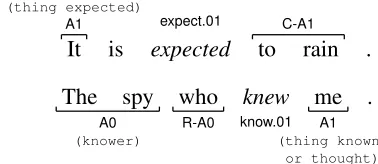
Figure 2: Examples showing continuation and reference roles according to PropBank. The role prefixC-indicates continuation of an argument, while the prefixR-indicates reference to another overt argument of the same predicate.
holds across both types of annotation.
In both cases, we are provided with a frame lexicon that containstype-level information forlexical units (a lemma conjoined with a coarse-grained part-of-speech tag).1 For each lexical unit, a list of senses, orframes, are provided, where each frame comes with a set of semantic roles that constitute the various participants in the frame. These roles can be either coreornon-coreto the frame.
In PropBank, a set of seven generic core role labels are defined (A0-A5and AA) that take on different semantics for each frame; each frame associates with a subset of these core roles. In addition there are 21 non-core role labels that serve as adjuncts, such as the temporal roleAM-TMPand the locative role
AM-LOC; these are shared across frames and assume similar meaning.
FrameNet similarly specifies a set of frames and roles, with two key differences. First, the semantics of the small set of core role labels in PropBank are local to each frame. In contrast, the several hundred role labels in FrameNet are shared across frames and they take on similar semantics in the frames in which they participate. Second, while frames in PropBank are just coarse-grained lemma-specific senses, the frame repository in FrameNet is shared across lem-mas. See Hermann et al. (2014) for examples of these differences.
Both PropBank- and FrameNet annotated data con-sist of sentence-level annotations that instantiate the respective frame lexicon with each predicate disam-biguated to its frame, as well as the phrasal argu-ments of each predicate labeled with their semantic roles. Figure 1 shows an example sentence with two verbs annotated according to PropBank conventions.
[image:2.612.325.514.57.139.2]In addition to such basic semantic role annotation, the PropBank-annotated data sets from the CoNLL 2004 and 2005 shared tasks and OntoNotes 5.0, repre-sent discontiguous arguments across multiple spans. These are annotated such that the first span is labeled with one of the 28 semantic role labels, while subse-quent spans have thecontinuationprefixC-attached to the role. The first sentence in Figure 2 shows such an annotation. Moreover, these data sets feature refer-enceroles for arguments, primarily relative pronouns, that refer to other overt arguments of the predicate. These roles are annotated by attaching the prefix
R-to the role of the co-referent argument. For exam-ple, in the second sentence of Figure 2, the relative pronounwhorefers to the argumentThe spyand is labeledR-A0. FrameNet annotations, on the other hand, contain neither continuation or reference roles according to conventions adopted by prior work.
3 Model
Before delving into the details of the structural con-straints enforced in the SRL task, we describe its two subtasks. Akin to most previous work, these subtasks are solved as separate steps in a cascaded fashion.
3.1 Classifier Cascade
To predict annotations such as those described in the previous section, we take a preprocessed sentence and first attempt to disambiguate the frame of each predicate (frame identification). In this work, as part of preprocessing, we use a part-of-speech tagger and a dependency parser to syntactically analyze the sen-tence; this diverges from most prior work on seman-tic argument prediction, which rely on constituency parses. Next, we take each disambiguated frame and look up the core and non-core (or adjunct) roles that can associate with the frame. Given the predicate token, we (over-)generate a set of candidate spans in the sentence, that are then labeled with roles from the set of core roles, from the set of adjunct roles, or with the null role∅(role labeling).2 Our system thus comprises a cascade of two statistical models. Note that most prior work on PropBank data only considered the latter task, remaining agnostic to the 2This setup differs from the related line of work that only
predicts semanticdependenciesbetween the predicate and the head words of semantic arguments; the latter task is arguably more straightforward (Surdeanu et al., 2008; Hajiˇc et al., 2009).
frame. Moreover, the semantic role labeling step has typically been divided into two stages: first identify-ing the spans that serve as semantic arguments and then labeling them with their roles (Màrquez et al., 2008). In contrast, we approach the semantic role labeling subproblem using a single statistical model.
3.2 Frame Identification
Given a preprocessed sentencexand a marked
pred-icatetwith lemma`, we seek to predict the frame f instantiated by the predicate. To this end, we use
different models in the PropBank and FrameNet set-tings. In case of PropBank, we define the probability of a framef under a conditional log-linear model:
p(f |x, t, `)∝exp (ψ·h(f, x, t, `)),
whereψdenotes the model parameters andh(·)is the feature function (see Table 1 for details on the features employed). The model’s partition function sums over all frames for the lemma`in the lexicon and we estimate the model parameters by maximizing regularized conditional log-likelihood.
In the case of FrameNet, to make our results di-rectly comparable to the recent state-of-the-art re-sults of Hermann et al. (2014), we instead use their embeddings-based WSABIE model (Weston et al.,
2011) for the frame identification step.
3.3 Unconstrained Semantic Role Labeling Given an identified frame f in a sentence x of n
words(w1, . . . , wn), we seek to predict a set of
ar-gument spans labeled with their semantic roles. We assume that there is a set of candidate spansSthat
could potentially serve as arguments oft.
Specifi-cally, we deriveSwith a high-recall rule-based algo-rithm that looks at the (dependency) syntactic context of the predicate wordt, as described in §6.3.
Let one candidate span be s ∈ S. The set of possible rolesRis composed of core rolesRC
asso-ciating withf, adjunct rolesRAand thenullrole∅.
In addition, in the PropBank setting, we have a set of continuation rolesRN and reference rolesRR; thus,
R= RC ∪ RA∪ RN ∪ RR∪ {∅}. We assume a
model that assigns a real-valued compatibility score
between the span-role pairs, prediction amounts to selecting the optimal role for each span. This gives us a global score which is a sum over all spans:
X
s∈S
max
r∈R g(s, r), (1)
with the solution being the correspondingarg max.
3.4 Semantic Role Labeling as an ILP
We can represent any prediction for the individual classifiers with a set of indicator variablesz={zs,r}
with one variable for each span s and roler. An
equivalent formulation to Equation (1) is then:
max
z X
s∈S
X
r∈R
zs,r×g(s, r)
s.t. z∈ {0,1}|S||R|
X
r∈R
zs,r= 1 ∀s∈ S,
(2)
where we have constrained the indicator variables to take on binary values, and required that we choose exactly one role (including the∅role) for each span. To further guide the inference, we add the following constraints to the ILP in Equation (2), as originally proposed by Punyakanok et al. (2008):3
No Span Overlap LetSibe the set of spans
cover-ing tokenwi. We want to ensure that at most one of
the spans inSihave an overt role assignment:
∀i∈[1, n], X s∈Si
X
r6=∅
zs,r≤1.
Unique Core Roles Each core roler∈ RCcan be
overt in at most one of the spans inS:
∀r ∈ RC,
X
s∈S
zs,r ≤1.
Continuation Roles Acontinuationrole, may only be assigned if the corresponding base (i.e. non-continuation, non-reference) role is assigned to an earlier span. To express this, we defines ≤ s0 to
mean thatsstarts befores0. For a continuation role r∈ RN, letbase(r)∈ RC∪ RAbe the
correspond-ing base role. Then the constraint is:
∀r∈ RN, ∀s∈ S, zs,r≤
X
s0≤s
zs0,base(r).
3Note that thecontinuation rolesandreference roles
con-straints below are only applicable to PropBank annotations, as these roles are not present in FrameNet annotations.
Reference Roles Similar to continuation roles, a span can only be labeled with areferenceroler ∈ RRif another span is labeled with the corresponding
base role,base(r)∈ RC∪ RA:
∀r ∈ RR, ∀s∈ S, zs,r ≤
X
s0∈S
zs0,base(r).
4 Dynamic Program Formulation
An advantage of the formulation in the previous sec-tion is that the constrained MAP inference problem can be solved with an off-the-shelf ILP solver. Un-fortunately, these solvers typically fail to exploit the problem-specific structure of the set of admissible solutions, which often leads to slow inference. As an alternative, we propose a dynamic program that takes advantage of the sequential and local nature of the problem, while directly enforcing all but the non-corecontinuation rolesconstraint and thereference rolesconstraint; the remaining constraints can be ef-ficiently enforced by a straightforward search over thek-best solutions of the dynamic program. The
resulting inference procedure is guaranteed to find the same optimal solution as the corresponding ILP (modulo rounding and tie breaking), while being sub-stantially faster. In addition, the forward-backward algorithm can be applied to compute marginals over the indicator variables, taking the constraints into account. This facilitates computation of confidence scores, as well as learning with a constrained globally normalized log-linear model, as described in §5.
We encode the dynamic program as a weighted latticeG = (V,E), whereV is the set of vertices and
Eis the set of (weighted) edges, such that the shortest
path through the lattice corresponds to the optimal ILP solution. The core of the lattice is the encoding of theno span overlapconstraint; additional constraints are later added on top of this backbone.
4.1 No Span Overlap
It
is
expected
to
rain
.
expected.01
A1 A0/C-A1
A0 A1
∅ ∅
C-A1
∅ ∅
∅ ∅ ∅
A0
[image:5.612.72.301.57.158.2]A0
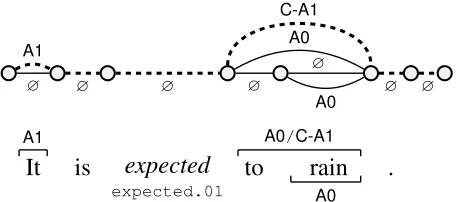
Figure 3: Lattice corresponding to the dynamic program for theno span overlapconstraint. The path of the correct argument assignment is indicated with dashed edges.
of mapping “It” toA1, “to rain” toC-A1and “rain” to∅. The dynamic program needs to ensure that re-gardless of the scores, either “to rain” or “rain” must be labeled with∅since they overlap in the sentence. We satisfy the latter by using a semi-Markov model formally described below. In order to ensure that the
∅role assignment scores are included correctly, they are given a special treatment in the scoring function.4 Lattice Structure The set of verticesV = {vj : j∈[0, n+ 1]}contains a vertex between every pair
of consecutive words. The edgesEare divided into null edges(between consecutive vertices) and argu-ment edges(which connect the vertices correspond-ing to the argument span endpoints). We will use the notationej,j+1,∅ for the null edge fromvj tovj+1. For each span and non-null role pair(s, r), r 6=∅,
we add an argument edgees,rbetweenvi−1andvj
where the spansis from worditoj. Figure 3
illus-trates the structure of the lattice. In this example, we assume that there are two possible roles (A0/C-A1) for the phrase “to rain”; consequently, there are two argument edges corresponding to this phrase.
A path through the lattice corresponds to a global assignment of roles to spans by assigning rolerto
spansfor every edgees,rin the path, and assigning
the∅role to all other spans. The length of a path is given by the sum of the weights of its edges. Lattice Weights The idea behind our weighting scheme is to include all the null scoresg(s,∅)at the
start, and then subtract them whenever we assign a role to a candidate span. Let us augment the lattice 4The resulting lattice corresponds to that of anaggressively
prunedsemi-Markov sequence model, modulo the special care given to the∅role in our case.
described above with a special nodev−1and a special edgee∗,∅betweenv−1andv0. Set the weight ofe∗,∅
toc∅∗ = Ps∈Sg(s,∅). We then set the weight of
the null edges ej,j+1,∅ to0 and the weight of the
argument edgeses,r tocrs=g(s, r)−g(s,∅).
Proposition 1. There is a one-to-one correspon-dence between paths in the lattice and global role assignments with non-overlapping arguments. Fur-thermore, the length of a path is equivalent to the ILP score of the corresponding assignment.
Proof Sketch We already described how to con-struct an assignment from any path through the lat-tice. For any role assignment without overlaps we can include all these edges in a single left-to-right path, and complete the path with null edges. Since there are no overlaps, we will not need to include incompatible edges. So there is a one-to-one corre-spondence between paths and valid assignments. To see that the score is the same as the path length, we can use induction on the number of non-null edges in the path.Base case:If there are no selected argu-ments, then the length of the path is justc∅∗ which
is exactly the ILP score.Inductive step:We add an overt argument to the solution. In the path, we re-place a sequence of null edges with an edgees,r. The
change in path length iscrs =g(s, r)−g(s,∅). In
the assignment, we need to changezs,∅from 1 to 0
andzs,rfrom 0 to 1. Thus, the change in ILP score
is alsog(s, r)−g(s,∅).
The above construction can be further simplified. Note that while the special edgee∗,∅is needed for the
direct correspondence with the ILP score, its weight is constant across variable assignments. Thus, this edge only adds a constant offset of c∅∗ to the ILP
solution. For the same reason, its presence has no influence on thearg maxor marginal computations
and we therefore drop it in our implementation.
4.2 Unique Core Roles
To incorporate theunique core rolesconstraint, we add state signatures to the vertices in the lattice and restrict the edges accordingly. This increases the size of the lattice byO(2|RC|), whereR
C is the set of
seek to train a structuredprobabilisticmodel, which requires the marginals with respect to the full set of constraints.5 While the number of signatures is expo-nential in|RC|, in practice this is a modest constant
as each frame only has a small number of possible core roles (two or three for many frames).6 Further-more, since many of the potential edges are pruned by the constraints, as described below, the added computational complexity is further reduced.
Lattice Structure The set of vertices are nowV=
{v0, vn+1, vjk : j ∈ [1, n], k ∈ {0,1}|RC|}, where v0 andvn+1 are the start and end vertices. The re-maining verticesvjkare analogous to the ones in §4.1
but are annotated with a bit vector encoding the sub-set of core roles that have been used so far. Therth bit in the superscriptkis set iff therth core role has
been assigned atvkj. The null edgesekj,j+1,∅connect
each nodevjkto its successorvjk+1. Since a null edge
does not affect the core role assignment, the signature
kremains unchanged betweenvk
j andvkj+1.
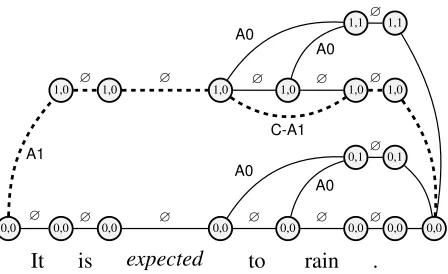
Figure 4 shows an example lattice, which in ad-dition to theno span overlapandunique core roles constraints encodes thecore continuation roles con-straint (see §4.3). For efficiency, we exclude vertices and edges not on any path fromv0tovn+1. For exam-ple,v1kexist only for|k| ≤1, sincev0corresponds to no core roles being selected and a single span can add at most one core role. Argument edgesek
s,r
connect-ing verticesvk
i−1 andvk
0
j corresponds to assigning
rolerto the spans =wi, . . . , wj. Ifr ∈ RC then k6=k0, otherwisek=k0. The edge is only included
if the roleris non-core, or ifkr 6= 1, to guarantee
uniqueness of core roles. By this construction, once a core role has been assigned at a vertexvjk, it cannot
be assigned on any future path reachable fromvjk.
Lattice Weights The edges are weighted in the same way as in §4.1. It is easy to verify that the structure enforces unique core roles, but is otherwise equivalent to that in §4.1. Since the weights are iden-tical, the proof of Proposition 1 carries over directly.
5We note that the approach of Riedel and Smith (2010) could
potentially be used to compute the marginals in an incremental fashion similar to Tromble and Eisner (2006).
6In the OntoNotes 5.0 development set, there are on average
10.4 core-role combinations per predicate frame.
0,0
It
0,0
is
0,0
expected 0,0
to
0,0
rain
0,0
.
0,0 0,0 0,1 0,1 1,0 1,0 1,0 1,0 1,0 1,0 1,1 1,1
A1
∅ ∅
C-A1
∅
∅ ∅ ∅ ∅ ∅ ∅
∅
∅ ∅
∅
A0 A0
[image:6.612.316.540.52.189.2]A0 A0
Figure 4: Lattice corresponding to theno span overlap, unique core rolesandcore continuation rolesconstraints. Each vertex is labeled with its signaturek∈ {0,1}|RC|;
in this example, “0,1” equals{A0}. This represents the subset of core-roles assigned on the path up to and includ-ing the vertex. Dashed edges indicate the correct path.
4.3 Core Continuation Roles
Recall that the constraint for continuation roles is that they must occur after their corresponding base role. We enforce this constraint for core roles by not including argument edgeseks,rwithr∈ RN from a
configurationkwhich does not have the
correspond-ing base role set (kbase(r) 6= 1). Figure 4 shows an example; here the edge corresponding to “to rain” with labelC-A1is included since the vertex signature
k={1,0}haskA1= 1, but there is no correspond-ing edge fork0 ={0,0}sincekA10 = 0.
4.4 Remaining Constraints
Unfortunately, enforcing the reference roles con-straint, and thecontinuation rolesconstraint for non-core roles, directly in the dynamic program is not practical, due to combinatorial explosion. First, while thecontinuation rolesconstraint almost only applies to core roles,7 every role inR
C ∪ RAmay have a
corresponding reference role. Second, even if we restrict the constraints to core reference roles, the lack of ordering between the spans in the constraint means that we would have to represent all subsets of
RC× {r|r∈ RR,base(r)∈ RC}.
However, these constraints are rarely violated in practice. As we will see in §6, these remaining con-straints can be enforced efficiently with k-best
in-ference in the constrained dynamic program from 7Less than 2% of continuation roles correspond to non-core
Frame identification features
•the predicatet •tag oft
•the lemma` •children words oft •tag oft’s children •tag oft’s parent •parent word oft •subcat. frame oft •dep. label oft •dep. labels oft’s children •word to the left oft •word to the right oft •tag to the left oft •tag to the right oft •word cluster oft •word clusters oft’s children
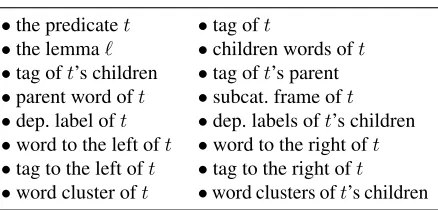
Table 1: Frame identification features. By subcategoriza-tion frame, we refer to the sequence of dependency labels oft’s children in the dependency tree.
the previous section, using the algorithm of Huang and Chiang (2005) and picking the best solution that satisfies all the constraints.
5 Local and Structured Learning
To train our models, we assume a training set where each predicatet(with lemma `) in sentencex has
been identified and labeled with its semantic frame
f, as well as with each candidate span and role pair
(s, r)∈ S × R. We first consider a local log-linear
model. Let the local score of spansand role rbe
given byg(s, r) =θ·f(r, s, x, t, `, f), whereθ
de-notes the vector of model parameters andf(·) the
feature function (see Table 2 for the specific features employed). We treat the local scores as the poten-tials in a multiclass logistic regression model, such thatp(r |s, x, t, `, f)∝exp (g(s, r)), and estimate
the parameters by maximizing the regularized condi-tional likelihood of the training set.
A downside of estimating the parameters locally is that it “wastes” model capacity, in the sense that the learning seeks to move probability mass away from annotations that violate structural constraints but can never be predicted at inference time. With the dynamic program formulation from the previous section, we can instead use a globally normalized probabilistic model that takes the constraints from §4.1-§4.3 into account during learning. To achieve this, we model the probability of a joint assignment
Features additionally conjoined with the frame
•starting word ofs •tag of the starting word ofs •ending word ofs •tag of the ending word ofs •head word ofs •tag of the head word ofs •bag of words ins •bag of tags ins
•a bias feature •cluster ofs’s head •dependency path betweens’s head andt •the set of dependency labels oft’s children •dependency path conjoined with the tag ofs’s head •dep. path conjoined with the cluster ofs’s head •positionofsw.r.t.t(before, after, overlap or same) •positionconjoined with distance fromstot •subcategorization frame ofs
•predicate use voice (active,passive, orunknown) •whether the subject oftis missing (missingsubj) •missingsubj, conjoined with the dependency path
betweens’s head andt
•missingsubj, conjoined with the dependency path betweens’s head and the verb dominatingt
Features only conjoined with the role
•cluster ofs’s head conjoined with cluster oft •dep. path conjoined with the cluster of the head ofs •word ofs’s head conj. with words of its children •tag ofs’s head conj. with words of its children •cluster ofs’s head conj. with cluster of its children •cluster oft’s head conj. with cluster ofs’s head •word, tag, dependency label and cluster of the words
immediately to the left and right ofs
•six features that each conjoin position and distance with one of the following:
[image:7.612.78.297.69.174.2]tag, dependency label and cluster ofs’s head, tag, dependency label and cluster oft’s head
Table 2: Semantic role labeling features. The argument span is denoted bys, whiletdenotes the predicate token. All features are conjoined with the roler. Features in the top part have two versions, one conjoined with the roler and one conjoined with both the rolerand the framef.
z, subject to the constraints, as
p(z|x, t, `, f)∝exp X
s∈S
X
r∈R
g(s, r)×zs,r
!
s.t. z∈ {0,1}|S||R|, Az≤b,
where Az ≤ b encodes the subset of linear
con-straints from §3.4 that can be tractably enforced in the dynamic program. In effect,p(z|x, t, `, f) = 0
for anyzthat violates the constraints. We estimate
the training set, using the standard forward-backward algorithm on the dynamic program lattice to compute the required normalizer and feature expectations.
There have been several studies of the use of con-strained MAP inference for semantic role labeling on top of the predictions of local classifiers (Tromble and Eisner, 2006; Punyakanok et al., 2008; Das et al., 2012), as well as on ensembles for combining the predictions of separate systems using integer linear programming (Surdeanu et al., 2007; Punyakanok et al., 2008).8 Meza-Ruiz and Riedel (2009) fur-ther used a Markov Logic Network formulation to incorporate a subset of these constraints during learn-ing. Another popular approach has been to apply a reranking model, which can incorporate soft struc-tural constraints in the form of features, on top of thek-best output of local classifiers (Toutanova et
al., 2008; Johansson and Nugues, 2008). However, none of these methods provide any means to perform efficient marginal inference and this work is the first to use a globally normalized probabilistic model with structural constraints for this task.
6 Empirical Study
We next present our experimental setup, datasets used, preprocessing details and empirical results.
6.1 Datasets and Evaluation
We measure experimental results on three datasets. First, we use the CoNLL 2005 shared task data an-notated according to PropBank conventions with the standard training, development and test splits (Car-reras and Màrquez, 2005). These were originally constructed from sections 02-21, section 24 and sec-tion 23 of the Wall Street Journal (WSJ) porsec-tion of the Penn Treebank (Marcus et al., 1993). The Prop-Bank I resource was used to construct the verb frame lexicon for the CoNLL 2005 experiments.
Second, we perform experiments on a substan-tially larger data set annotated according to PropBank conventions, using the recent OntoNotes 5.0 corpus (Weischedel et al., 2011), with the CoNLL 2012 train-ing, development and test splits from Pradhan et al. (2013). The frame lexicon for these experiments is
8While the dynamic program in §4 could be used to
effi-ciently implement such ensembles, since it solves the equivalent ILP, our focus in this work is on learning a single accurate model.
derived from the OntoNotes frame files. This corpus consists of nominal predicate-argument structure an-notations in addition to verbs. Specifically, we use version 12 downloaded fromhttp://cemantix. org/data/ontonotes.html, for which some errors from the initial release used by Pradhan et al. (2013) have been corrected.
Finally, we present results on FrameNet-annotated data, where our setup mirrors that of Hermann et al. (2014), who used the full-text annotations of the FrameNet 1.5 release.9 We use the same training, development and test splits as Hermann et al., which consists of 39, 16 and 23 documents, respectively.
For evaluation on PropBank, we use the script from the CoNLL 2005 shared task that measures role labeling precision, recall and F1-score, as well as the full argument structure accuracy.10 In the FrameNet setting, we use a reimplementation of the SemEval 2007 shared task evaluation script that measures joint frame-argument precision, recall and F1-score (Baker et al., 2007). For consistency, we use a stricter mea-sure of full structure accuracy than with PropBank that gives credit only when both the predicted frame and all of its arguments are correct.
The statistical significance of the observed differ-ences between our different models is assessed with a paired bootstrap test (Efron and Tibshirani, 1994), using 1000 bootstrap samples. For brevity, we only provide thep-values for the difference between our
best and second best models on the test set, as well as between our second and third best models.
6.2 Preprocessing
All corpora were preprocessed with a part-of-speech tagger and a syntactic dependency parser, both of which were trained on the CoNLL 2012 training split extracted from OntoNotes 5.0 (Pradhan et al., 2013); this training data has no overlap with any of the de-velopment or test corpora used in our experiments. The constituency trees in OntoNotes were converted to Stanford dependencies before training our parser (de Marneffe and Manning, 2013).
The part-of-speech tagger employs a second-order conditional random field (Lafferty et al., 2001) with the following features.Emission features: bias, the
9http://framenet.icsi.berkeley.edu.
word, the cluster of the word, suffixes of lengths 1 to 4, the capitalization shape of the word, whether the word contains a hyphen and the identity of the last word in the sentence. Transition features: the tag bigram, the tag bigram conjoined with, respectively, the clusters of the current and the previous words, the tag trigram and the tag trigram conjoined with, respectively, the clusters of the current and previous word, as well as with the word two positions back.
For syntactic dependencies, we use the parser and features described by Zhang and McDonald (2014), which exploits structural diversity in cube-pruning to improve higher-order graph-based inference. On the WSJ development set (section 22), the labeled attachment score of the parser is 90.9% while the part-of-speech tagger achieves an accuracy of 97.2% on the same dataset. On the OntoNotes development set, the corresponding scores are 90.2% and 97.3%. Both the tagger and the parser, as well as the frame identification and role labeling models (see Tables 1 and 2), have features based on word clusters. Specifi-cally, we use the clusters with 1000 classes described by Turian et al. (2010), which are induced with the Brown algorithm (Brown et al., 1992).
6.3 Candidate Argument Extraction
We use a rule-based heuristic to extract candidate arguments for role labeling. Most prior work on PropBank-style semantic role labeling have relied on constituency syntax for candidate argument extrac-tion. Instead, we rely on dependency syntax, which allows faster preprocessing and potential extension to the many languages for which only dependency annotations are available. To this end, we adapt the constituency-based candidate argument extraction method of Xue and Palmer (2004) to dependencies.
In gold PropBank annotations, syntactic con-stituents serve as arguments in all constructions. However, extracting constituents from a dependency tree is not straightforward. The full dependency sub-tree under a particular head word often merges syn-tactic constituents. For example, in the tree fragment
The man who knew too much root
det
rcmod nsubj
dobj advmod
the dependency tree has the full clause as the subtree headed by man, making it non-trivial to extract a
partial subtree underneath it that could serve as a valid argument (for example,The man).
In our candidate argument extraction algorithm, first, we select all the children subtrees of a given predicate as potential arguments; if a child word is connected via theconj(conjunction) or theprep
(preposition) label, we also select the corresponding grand-children subtrees. Next, we climb up to the predicate’s syntactic parent and add any partial sub-trees headed by it that could serve as constituents in the corresponding phrase-structure tree. To capture such constructions, we select partial subtrees for a head word by first adding the head word, then adding contiguous child subtrees from the head word’s right-most left child towards the leftright-most left child until we either reach the predicate word or anoffensive depen-dency label.11 This procedure is then symmetrically applied to the head word’s right children. Once a par-tial subtree has been added, we add the parent word’s children subtrees — and potentially grandchildren subtrees in case of children labeled asconjorprep— to the candidate list, akin to the first step. We apply this parent operation recursively for all the ancestors of the predicate. Finally, we consider the predicate’s syntactic parent word as a candidate argument if the predicate is connected to it via theamodlabel.
The candidates are further filtered to only keep those where the role of the argument, conjoined with the path from its head to the predicate, has been ob-served in the training data. This algorithm obtains an unlabeled argument recall of 88.2% on the OntoNotes 5.0 development data, with a precision of 38.2%.
For FrameNet, we use the extraction method of Hermann et al. (2014, §5.4), which is also inspired by Xue and Palmer (2004). On the FrameNet develop-ment data, this method obtains an unlabeled argudevelop-ment recall of 72.6%, with a precision of 25.1%.12
6.4 Baseline Systems
We compare our local and structured models to the top performing constituency-based systems from the
11All but the following labels are treated as offensive:advmod,
amod,appos,aux, auxpass,cc, conj,dep,det,mwe, neg,nn,
npadvmod,num,number,poss,preconj,predet, prep, prt, ps,
quantmodandtmod.
12The low recall on FrameNet suggests that a deeper analysis
Development WSJ Test Brown Test
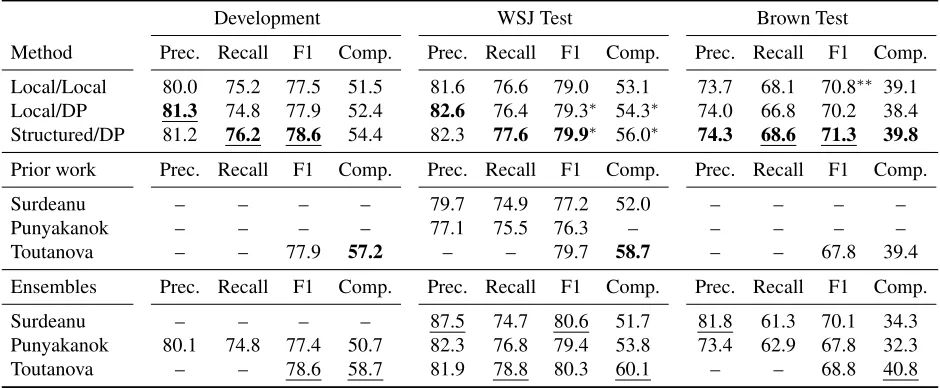
Method Prec. Recall F1 Comp. Prec. Recall F1 Comp. Prec. Recall F1 Comp. Local/Local 80.0 75.2 77.5 51.5 81.6 76.6 79.0 53.1 73.7 68.1 70.8∗∗ 39.1 Local/DP 81.3 74.8 77.9 52.4 82.6 76.4 79.3∗ 54.3∗ 74.0 66.8 70.2 38.4 Structured/DP 81.2 76.2 78.6 54.4 82.3 77.6 79.9∗ 56.0∗ 74.3 68.6 71.3 39.8 Prior work Prec. Recall F1 Comp. Prec. Recall F1 Comp. Prec. Recall F1 Comp.
Surdeanu – – – – 79.7 74.9 77.2 52.0 – – – –
Punyakanok – – – – 77.1 75.5 76.3 – – – – –
Toutanova – – 77.9 57.2 – – 79.7 58.7 – – 67.8 39.4
Ensembles Prec. Recall F1 Comp. Prec. Recall F1 Comp. Prec. Recall F1 Comp.
Surdeanu – – – – 87.5 74.7 80.6 51.7 81.8 61.3 70.1 34.3
Punyakanok 80.1 74.8 77.4 50.7 82.3 76.8 79.4 53.8 73.4 62.9 67.8 32.3
[image:10.612.71.541.55.249.2]Toutanova – – 78.6 58.7 81.9 78.8 80.3 60.1 – – 68.8 40.8
Table 3: Semantic role labeling results on the CoNLL 2005 data set. The method labels aretraining/inference. For example, Local/DP means training with the local model, but inference with the dynamic program. Bold font indicates the best system using a single model and a single parse, while the best scores among all systems are underlined. Statistical significance was assessed for F1 and Comp. on the WSJ and Brown test sets withp <0.01∗andp <0.05∗∗.
literature on the CoNLL 2005 datasets. To facilitate a more nuanced comparison, we distinguish between prior work based on single systems, which use a single input parse and no model combination, and ensemble-based systems. For single systems, our first baseline is the strongest non-ensemble system presented by Surdeanu et al. (2007) that treats the SRL problem as a sequential tagging task (see §4.1 of the cited paper). Next, we consider the non-ensemble system presented by Punyakanok et al. (2008) that trains local classifiers and uses an ILP to satisfy the structural constraints; this system is most similar to our approach, but is trained locally. Finally, our third single system baseline is the model of Toutanova et al. (2008) that uses a tree structured dynamic pro-gram that assumes that all candidate spans are nested; this system relies on global features in a reranking framework (see row 2 of Figure 19 of the cited paper). These authors also report ensemble-based variants that combine the outputs of multiple SRL systems in various ways; as observed in other NLP problems, the ensemble systems outperformed the single-system counterparts, and are state of the art. To situate our models with these ensemble-based approaches, we include them in Table 3.
For the OntoNotes datasets, we compare our mod-els to Pradhan et al. (2013), who report results with a variant of the (non-ensemble) ASSERTsystem
(Prad-han et al., 2005). These are the only previously re-ported results for the SRL problem on this dataset.
Finally, for the FrameNet experiments, our base-line is the state-of-the-art system of Hermann et al. (2014), which combines a frame-identification model based on WSABIE(Weston et al., 2011) with a
log-linear role labeling model.
6.5 Hyperparameters
The l1 and l2 regularization weights for the frame identification and role labeling models for all experi-ments were tuned on the OntoNotes development data. For frame identification, the regularization weights are set to0and0.1, while for semantic role
labeling they are set to0.1and1.0, respectively.
6.6 Results
Table 3 shows our results on the CoNLL 2005 de-velopment set as well as the WSJ and Brown test sets.13 Our structured model achieves the highest F1-score among the non-ensemble systems, outper-forming even the ensemble systems on the Brown
13We also experimented with a parser trained only on the WSJ
Development
Method Prec. Recall F1 Comp.
Local/Local 79.5 77.0 78.2 57.4
Local/DP 80.6 77.1 78.8 59.0
Structured/DP 80.5 77.8 79.1 60.1
CoNLL 2012 Test
Method Prec. Recall F1 Comp.
Local/Local 79.8 77.7 78.7 59.5 Local/DP 80.9 77.7 79.2∗ 60.9∗ Structured/DP 80.6 78.2 79.4∗ 61.8∗
Pradhan 81.3 70.5 75.5 51.7
[image:11.612.70.301.57.235.2]Pradhan (revised) 78.5 76.6 77.5 55.8
Table 4: Semantic role labeling results on the OntoNotes 5.0 development and test sets from CoNLL 2012. “Prad-han” is theOverallresults from Table 5 of Pradhan et al. (2013). “Pradhan (revised)” are corrected results from per-sonal communication with Pradhan et al. (see footnote 14 for details). Statistical significance was assessed for F1 and Comp. on the test set withp <0.01∗.
test set, while performing at par on the development set. Overall, using structured learning improves re-call at a slight expense of precision when compared to local learning. This leads to a higher F1-score and a substantial increase in complete argument structure accuracy (Comp.in the tables). The increase in recall is to be expected, since during training the structured model can rely on the constraints to eliminate some hypotheses. This has the effect of alleviating some of the label imbalance seen in the training data (recall that the model encounters roughly four times as many null roles as non-null role assignments). While the results on the WSJ test set are highly statistically sig-nificant, the small size of the Brown test set give rise to a larger variance; results here are only significant at a level ofp≈0.1for F1 andp≈0.2for Comp.
Table 4 shows the semantic role labeling results on the OntoNotes data. We observe the same trend as we did on the CoNLL 2005 data from Table 3. Adding constraints at inference time notably improves pre-cision at virtually no cost to recall. Structured learn-ing additionally increases recall at a small cost to precision and yields the best results both in terms of F1- and complete analysis scores. These results are all highly statistically significant. Compared to the results of Pradhan et al. (2013), our structured
Development
Method Prec. Recall F1 Comp.
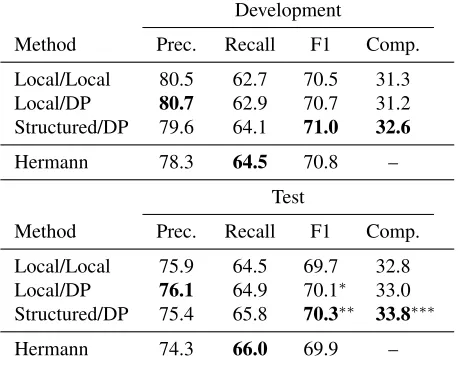
Local/Local 80.5 62.7 70.5 31.3 Local/DP 80.7 62.9 70.7 31.2 Structured/DP 79.6 64.1 71.0 32.6
Hermann 78.3 64.5 70.8 –
Test
Method Prec. Recall F1 Comp.
Local/Local 75.9 64.5 69.7 32.8 Local/DP 76.1 64.9 70.1∗ 33.0 Structured/DP 75.4 65.8 70.3∗∗ 33.8∗∗∗
Hermann 74.3 66.0 69.9 –
Table 5: Full structure prediction results (joint frame identification and semantic role labeling performance) for FrameNet. All systems use the WSABIEmodel from Hermann et al. (2014) for the frame identification step. “Hermann” is theWsabie Embeddingresults from Table
3 of Hermann et al. (2014). Statistical significance was assessed for F1 and Comp. on the test set withp <0.01∗, p <0.05∗∗andp <0.075∗∗∗.
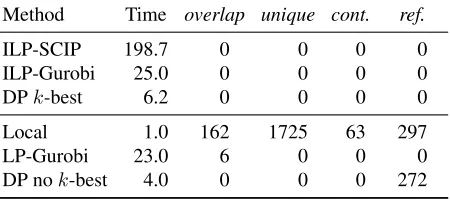
model yields a 15% relative error reduction in terms of F1-score and a 20% reduction in terms of com-plete analysis score.14The frame identification accu-racies on the OntoNotes development and test set are 94.5% and 94.9%, respectively, whereas Pradhan et al. (2013) report an accuracy of 92.8% on the test set; this represents almost a 30% relative error reduction. Finally, Table 5 shows the results on the FrameNet data. While structured learning helps less here com-pared to the PropBank setting, our model outper-forms the prior state-of-the-art model of Hermann et al. (2014) and we obtain a modest improvement in complete analysis score compared to local train-ing. Due to the small size of the FrameNet test set, similarly to the Brown test set, we observe a larger variance across bootstrap samples, but in this case the results are statistically significant to a larger degree. Table 6 relates the speed of the various inference algorithms to the number of constraint violations. The time is relative to local inference; it excludes the
14Unfortunately, these results are not strictly comparable, due
[image:11.612.313.542.59.242.2]time of feature extraction and computation ofg(s, r), which is the same across inference methods. Similar to Tromble and Eisner (2006), for all algorithms, we first use the local solution without constraints and only apply the constraints in the case of a violation. Removing this optimization results in a slowdown across the board by a factor of about 5 and does not change the ranking of the methods. Since the structured model has identical parameterization to the local model, optimality is guaranteed even when using this scheme with the former. We report the re-sults of two ILP solvers: SCIP15and Gurobi.16SCIP is a factor of 8 slower than Gurobi for this problem, while Gurobi is a further factor of about 4 slower than our dynamic program. The penultimate line of Table 6 shows the result of using an LP-relaxation in-stead of the ILP. This does not come with optimality guarantees, but is included for completeness.
Finally, when usingk-best inference to satisfy the
reference rolesand non-corecontinuation roles con-straints in the dynamic program (§4.4), the maximum value ofkis 80 on the OntoNotes development set.
Across data points for which suchk-best inference
is necessary, the averagekis found to be 1.8. If we
allow ourselves to ignore these constraints, we can avoidk-best inference and achieve a further speedup,
as shown in the last line of Table 6. The heuristics of Toutanova et al. (2008) could potentially be used as an alternative way of satisfying these constraints.
7 Conclusions
We described a dynamic program for constrained inference in semantic role labeling that efficiently enforces a majority of structural constraints, given potentially overlapping candidate arguments. The dy-namic program provably finds the optimal solutions of a corresponding ILP and in practice requires a frac-tion of the computafrac-tional cost compared to an highly optimized off-the-shelf ILP solver, which has typi-cally been used for this problem. Furthermore, the dynamic program facilitates learning with a globally normalized log-linear model and provides a proba-bilistic measure of confidence in predictions. Empir-ically, we showed a four-fold speedup in inference time compared to a state-of-the-art ILP solver and
15http://scip.zib.de/ 16http://www.gurobi.com/
Number of constraint violations Method Time overlap unique cont. ref.
ILP-SCIP 198.7 0 0 0 0
ILP-Gurobi 25.0 0 0 0 0
DPk-best 6.2 0 0 0 0
Local 1.0 162 1725 63 297
LP-Gurobi 23.0 6 0 0 0
DP nok-best 4.0 0 0 0 272
Table 6: Speed and constraint violation results on the OntoNotes 5.0 development set. Exact and approximate methods are shown above and below the line, respectively.
by using structured learning our model outperforms all comparable non-ensemble baselines on both Prop-Bank and FrameNet data sets.
Acknowledgments
We thank Ryan McDonald, Emily Pitler, Slav Petrov and Fernando Pereira for their detailed comments. In particular, Ryan pointed out a simplification that im-proved on our original dynamic program formulation. We also thank Sameer Pradhan for his corrections to the OntoNotes data. Finally, we thank André Mar-tins for numerous discussions on this subject and the anonymous reviewers for their insightful comments.
References
Collin F. Baker, Charles J. Fillmore, and John B. Lowe. 1998. The Berkeley FrameNet project. InProceedings of ACL.
Collin Baker, Michael Ellsworth, and Katrin Erk. 2007. Semeval-2007 task 19: Frame semantic structure ex-traction. InProceedings of SemEval.
Peter F. Brown, Peter V. deSouza, Robert L. Mercer, Vin-cent J. Della Pietra, and Jenifer C. Lai. 1992. Class-based n-gram models of natural language. Computa-tional Linguistics, 18(4).
Xavier Carreras and Lluís Màrquez. 2004. Introduction to the CoNLL-2004 shared task: Semantic role labeling. InProceedings of CoNLL.
Xavier Carreras and Lluís Màrquez. 2005. Introduction to the CoNLL-2005 shared task: Semantic role labeling. InProceedings of CoNLL.
[image:12.612.316.541.74.174.2]Dipanjan Das, Desai Chen, André F. T. Martins, Nathan Schneider, and Noah A. Smith. 2014. Frame-semantic parsing.Computational Linguistics, 40(1):9–56. Marie-Catherine de Marneffe and Christopher D.
Man-ning, 2013.Stanford typed dependencies manual. Bradley Efron and Robert J Tibshirani. 1994. An
intro-duction to the bootstrap. CRC press.
Matthew Gerber and Joyce Y. Chai. 2010. Beyond Nom-Bank: A study of implicit arguments for nominal predi-cates. InProceedings of ACL.
Daniel Gildea and Daniel Jurafsky. 2002. Automatic labeling of semantic roles.Computational Linguistics, 28(3):245–288.
Jan Hajiˇc, Massimiliano Ciaramita, Richard Johans-son, Daisuke Kawahara, Maria Antònia Martí, Lluís Màrquez, Adam Meyers, Joakim Nivre, Sebastian Padó, Jan Štˇepánek, Pavel Straˇnák, Mihai Surdeanu, Nianwen Xue, and Yi Zhang. 2009. The CoNLL-2009 shared task: Syntactic and semantic dependencies in multiple languages. InProceedings of CoNLL.
Karl Moritz Hermann, Dipanjan Das, Jason Weston, and Kuzman Ganchev. 2014. Semantic frame identification with distributed word representations. InProceedings of ACL.
Liang Huang and David Chiang. 2005. Better k-best parsing. InProceedings of IWPT.
Richard Johansson and Pierre Nugues. 2008. Dependency-based semantic role labeling of PropBank. InProceedings of EMNLP.
John Lafferty, Andrew McCallum, and Fernando Pereira. 2001. Conditional random fields: Probabilistic models for segmenting and labeling sequence data. In Proceed-ings of ICML.
Mitchell P. Marcus, Mary Ann Marcinkiewicz, and Beat-rice Santorini. 1993. Building a large annotated corpus of English: the Penn treebank. Computational Linguis-tics, 19(2):313–330.
Lluís Màrquez, Xavier Carreras, Kenneth C. Litkowski, and Suzanne Stevenson. 2008. Semantic role labeling: An introduction to the special issue. Computational Linguistics, 34(2):145–159.
André F. T. Martins, Noah A. Smith, Pedro M. Q. Aguiar, and Mário A. T. Figueiredo. 2011. Dual decomposition with many overlapping components. InProceedings of EMNLP.
Adam Meyers, Ruth Reeves, Catherine Macleod, Rachel Szekely, Veronika Zielinska, Brian Young, and Ralph Grishman. 2004. The NomBank project: An interim report. InProceedings of NAACL/HLT Workshop on Frontiers in Corpus Annotation.
Ivan Meza-Ruiz and Sebastian Riedel. 2009. Jointly iden-tifying predicates, arguments and senses using Markov Logic. InProceedings of NAACL-HLT.
Martha Palmer, Daniel Gildea, and Paul Kingsbury. 2005. The Proposition bank: An annotated corpus of semantic roles.Computational Linguistics, 31(1):71–106. Sameer Pradhan, Kadri Hacioglu, Valerie Krugler, Wayne
Ward, James H. Martin, and Daniel Jurafsky. 2005. Support vector learning for semantic argument classifi-cation. Machine Learning, 60(1-3):11–39.
Sameer Pradhan, Alessandro Moschitti, Nianwen Xue, Tou Hwee Ng, Anders Björkelund, Olga Uryupina, Yuchen Zhang, and Zhi Zhong. 2013. Towards robust linguistic analysis using OntoNotes. InProceedings of CoNLL.
Vasin Punyakanok, Dan Roth, and Wen-tau Yih. 2008. The importance of syntactic parsing and inference in semantic role labeling. Computational Linguistics, 34(2):257–287.
Sebastian Riedel and David A. Smith. 2010. Relaxed marginal inference and its application to dependency parsing. InProceedings of NAACL-HLT.
Mihai Surdeanu, Lluís Màrquez, Xavier Carreras, and Pere R. Comas. 2007. Combination strategies for semantic role labeling.Journal of Artificial Intelligence Research, 29(1):105–151.
Mihai Surdeanu, Richard Johansson, Adam Meyers, Lluís Màrquez, and Joakim Nivre. 2008. The CoNLL 2008 shared task on joint parsing of syntactic and semantic dependencies. InProceedings of CoNLL.
Kristina Toutanova, Aria Haghighi, and Christopher D. Manning. 2008. A global joint model for semantic role labeling.Computational Linguistics, 34(2):161–191. Roy W. Tromble and Jason Eisner. 2006. A fast
finite-state relaxation method for enforcing global constraints on sequence decoding. InProceedings of NAACL-HLT. Joseph Turian, Lev Ratinov, and Yoshua Bengio. 2010. Word representations: A simple and general method for semi-supervised learning. InProceedings of ACL. Ralph Weischedel, Eduard Hovy, Martha Palmer, Mitch
Marcus, Robert Belvin, Sameer Pradhan, Lance Ramshaw, and Nianwen Xue. 2011. OntoNotes: A large training corpus for enhanced processing. In J. Olive, C. Christianson, and J. McCary, editors, Hand-book of Natural Language Processing and Machine Translation. Springer.
Jason Weston, Samy Bengio, and Nicolas Usunier. 2011. WSABIE: Scaling up to large vocabulary image anno-tation. InProceedings of IJCAI.
Nianwen Xue and Martha Palmer. 2004. Calibrating features for semantic role labeling. InProceedings of EMNLP.