Context Tailoring for Text Normalization
Seniz Demir
TUBITAK BILGEM Kocaeli, TURKEY
Abstract
Language processing tools suffer from signif-icant performance drops in social media do-main due to its continuously evolving lan-guage. Transforming non-standard words into their standard forms has been studied as a step towards proper processing of ill-formed texts. This work describes a normalization system that considers contextual and lexical similari-ties between standard and non-standard words for removing noise in texts. A bipartite graph that represents contexts shared by words in a large unlabeled text corpus is utilized for ex-ploring normalization candidates via random walks. Input context of a non-standard word in a given sentence is tailored in cases where a direct match to shared contexts is not possible. The performance of the system was evaluated on Turkish social media texts.
1 Introduction
Social media has been an integral part of personal communication in the last decade. Everyday, peo-ple willingly produce millions of multilingual texts since they are free in the way how they express themselves. Grammatical rules and language struc-tures do not have to be all in place, even the words might not be properly written. However, free-style writing and ever-growing nature of the language hin-der the utility of social media texts in computa-tional linguistics studies. For instance, non-standard words (e.g.,“comin soon” for “coming soon”) and phonetic substitutions (e.g., “4u” for “for you”) that are often seen in social media texts degrade the per-formance of many NLP tools such as parsers and
named entity recognizers (Foster et al., 2011; Ku-cuk and Steinberger, 2014). Being trained on formal texts is the major drawback of these tools in pro-cessing ill-formed texts. In addition, different so-cial media genres have their own characteristics and various factors (e.g., demographic background and age) trigger linguistic changes in social media lan-guage over time (Eisenstein et al., 2014; Herdagde-len, 2013; Schwartz et al., 2013).
Normalizing ill-formed texts is a promising pre-processing step to address experienced accuracy drops in existing NLP tools. This paper proposes a normalization system that transforms non-standard out of vocabulary (OOV) words into their standard in vocabulary (IV) forms. We argue that contextual and lexical characteristics of words are of the great-est importance in normalization. To encode contex-tual similarities of words, a bipartite graph acquired from a corpus of formal and informal texts is uti-lized. The first bipartite of the graph consists of words that appear in the contexts represented by the second bipartite. This graphical representation not only captures the way how words are used in real texts but also presents lexical variants of the same word in similar contexts.
A non-standard word might be restored to differ-ent words depending on its context in a sdiffer-entence. In this work, one consideration that is exploited in de-termining the right form of a non-standard word is its input context and the similarity of this context to other contexts captured by the underlying graph. At the core of our normalization system lies a novel use of a tailoring approach on input contexts. Tailored input contexts are shown to be effective in finding
similar contexts in the graph. To normalize a non-standard word, our system determines contextually similar candidate normalizations by performing ran-dom walks through similar contexts. Additional nor-malization candidates are extracted from a word lex-icon by measuring their lexical distances to the ill-formed word via a well-known similarity metric. We evaluated our normalization system on 715 Turkish social media sentences with 1190 ill-formed words in total and our promising results revealed that we improve on state-of-the-art in Turkish.
2 Related Work
Text normalization has been extensively studied in the literature. Noisy channel model where poste-rior probabilities are used to find the most probable form of a non-standard word has pioneered normal-ization research (Brill and Moore, 2000; Tautanova and Moore, 2002; Choudhury et al., 2007; Cook and Stevenson, 2009). Handling the transformation in normalization as a translation from an ill-formed text to a formal text has also been experimented (Aw et al., 2006; Kaufmann and Kalita, 2010). These ear-lier studies have relied on hand annotated data and proper categorization of non-standard words.
A recent work has used a letter transformation ap-proach where the generation of a non-standard word from a standard word is modeled at the character level. Visual priming and string/phonetic similarity have also been incorporated into the transformation model (Liu et al., 2011; Liu et al., 2012). Generat-ing a confusion set of in-vocabulary word candidates for an out-of-vocabulary word and selecting the best candidate according to lexical string similarity and contextual features have been studied (Han et al., 2013). More recently, distributed word representa-tions (Kumar and Sridhar, 2015) and recurrent neu-ral networks (Chrupala, 2014) have been used to ad-dress the normalization problem.
Our work is closely related to the latter line of re-search which has used graphical representations to capture contextual similarities between words. The work of S¨onmez and ¨Ozg¨ur (2014) has addressed the normalization problem via a word-association graph where the graph represents POS tags of words and their relative positions to each other in written texts. The proposed approach has achieved a 94.1%
preci-sion on a shared English dataset by taking contex-tual, grammatical, and lexical features of words into account. Our work differs from their approach in several aspects. First, we take into account all words in the input context of an ill-formed word at once (if possible) rather than aggregating individual re-lations of an ill-formed word with each word in its context. Second, we do not benefit from the part-of-speech of an ill-formed word during normalization but it plays an important role in their unsupervised approach. In another approach, the underlying graph has been used to assess how contextually similar two words are (Hassan and Menezes, 2013). Randomly traversing the graph, a normalization lexicon was in-duced and later used to generate word confusion sets of non-standard words. This work, which generates the same confusion set for an OOV word in different input contexts, has achieved a precision of 92.43% on English social media texts.
Unfortunately, a few recent studies have focused on text normalization in Turkish. In the cascaded ap-proach (Toruno˘glu and Eryi˘git, 2014), seven differ-ent transformations (e.g., vowel restoration and ac-cent normalization) have been developed to restore OOV words to their IV word forms. The approach has achieved an accuracy of 71% on a set of 600 Turkish tweets. The most recent model (Yıldırım and Yıldız, 2015) has utilized a variety of techniques (e.g., lexical similarity and language model based contextual similarity) to handle different normaliza-tion problems and a precision of 80% has been re-ported on Turkish tweets.
3 Normalization Equivalences
We argue that an ill-formed word and its standard rendering (normalization equivalence) have some characteristics that should be considered in normal-ization. First, a standard word replaces its ill-formed version in any sentence without a loss in meaning. Therefore, shared contexts where standard and non-standard words both appear give important clues for normalization. Second, transformation from an ill-formed word to different standard words is possi-ble. For instance, the word ‘aaba’ in the sentence
“aaba annem de okulumu sevecek mi?”{I wonder if
my mother will also like my school?}should be
should be normalized as ‘araba’{car}in the sentence
“aaba s¨urmek benim ic¸in b¨uy¨uk keyif”{Driving car
is a great pleasure for me.}. Thus, input
con-text of an ill-formed word is of great importance and cannot be ignored in normalization. Third, character-based edit operations (i.e, insertion, dele-tion, or substitution) produce non-standard forms of a word. These operations might be phonetic, graphemic, typographic, etc. (Liu et al., 2012). For instance, the ill-formed word ‘ailelerne’ can be pro-duced from standard words ‘ailelere’ (with one in-sertion) and ‘ailelerine’ (with one deletion). There-fore, ill-formed words and their standard forms are lexically/phonetically similar.
3.1 Shared Contexts
We treat the context of a word as an n-gram word se-quence that has the word at its center. For instance,
consider the 5-gram word sequencew1w2w3w4w5.
Here, the context of the word w3 consists of the
two words on its left and the two words on its right
w1w2w4w5. Our system uses a bipartite graph to
represent words and their contexts. The first
bipar-tite contains words (word nodes) and the second
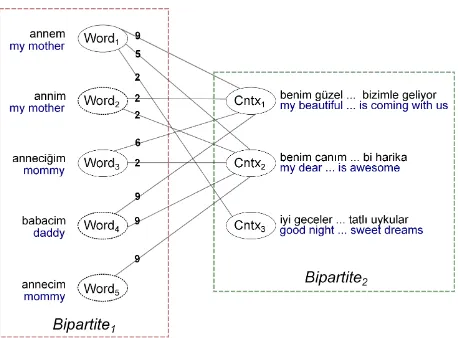
bipartite represents contexts where these words ap-pear (context nodes). A word node is connected to a context node with an undirected edge if the word appears in that context. For instance, Figure 1
shows a bipartite graph1 constructed from a set of
5-gram sequences where an edge weight represents co-occurrence count of the corresponding word and context in the set. A context node might be con-nected to more than one word node. We refer to these context nodes as “shared contexts” such as the
nodes Cntx1and Cntx2in Figure 1.
3.2 Context of an Ill-Formed Word
The input context of an ill-formed word is also represented as an n-gram word sequence. In our system, two kinds of contexts are used for an ill-formed word. The central context is an n-gram sequence which has the ill-formed word at its center. However, sliding contexts are those n-gram sequences which have the ill-formed word at any position but the center. An ill-formed word might have an incomplete central context with one or
1The word nodes Word
2, Word4, and Word5represent OOV
words whereas nodes Word1and Word3represent IV words.
Word1
annem
my mother
9
benim güzel ... bizimle geliyor
my beautiful ... is coming with us Cntx1
Word2
annim
my mother
Word3
anneci im
mommy
Word4
babacim
daddy
benim can m ... bi harika
my dear ... is awesome Cntx2
iyi geceler ... tatl uykular
[image:3.612.314.543.57.226.2]good night ... sweet dreams Cntx3
Figure 1:A bipartite graph built from a set of word sequences.
more missing words (∅2) due to its position in
a sentence. One or more sliding contexts are
always possible for an ill-formed word with/without missing words. For instance, consider the sen-tence “bug¨unn o˘glumu g¨osterisi ic¸in hazırlıyıp
foto˘graflarını c¸ekece˘gim”{Today, I will prepare my
son for his show and take his photos}. The contexts
extracted for the ill-formed words of the sentence using 5-gram sequences are shown below:
Word:‘bug¨unn’{today}
Central context:[∅,∅,o˘glumu, g¨osterisi]
Sliding contexts:[bug¨unn, o˘glumu, ic¸in, hazırlıyıp]
Word:‘hazırlıyıp’{prepare}
Central context: [g¨osterisi, ic¸in, foto˘graflarını,
c¸ekece˘gim]
Sliding contexts: [bug¨unn, o˘glumu, ic¸in hazırlıyıp],
[o˘glumu, g¨osterisi, hazırlıyıp, foto˘graflarını]
3.3 Edit Operations
In our system, only one-to-one word normalizations where an ill-formed word is restored to a single stan-dard word are considered. In such cases, a stanstan-dard word represents a number of edit operations (e.g., in-sertion or substitution) once aligned to its ill-formed lexical variant at the character level. We capture the operations that a standard word experience using a well-known lexical similarity metric.
4 Normalization Approach
Once a sentence is given, our system analyzes all words using a morphological parser and those that cannot be parsed are accepted as OOV words. For each OOV word, normalization candidates which re-flect all characteristics that we consider in this work are explored in the underlying graph. This explo-ration, performed by a number of random walks, can benefit from three pieces of information: the ill-formed word, its input contexts, and all kinds of in-formation captured by the underlying graph. A word lexicon that consists of standard IV words is also ex-amined to identify candidate normalizations that are lexically similar to the OOV word. Finally, one can-didate is selected from among all cancan-didates as the best normalization of the OOV word.
4.1 Contextual Similarity via Random Walks
A random walk starts from a node of a bipartite and consists of a number of sequential steps taken from one bipartite to another (from word node to context node and vice versa). A step cannot be taken within a bipartite since there are no connections between its nodes. Transition probabilities (TP) from the current node are used to determine which node(s) will be visited next.
TPab = TFreq1ab,2 / ∑ x∈
Neighs(a)
TFreq1ax,2
TFreq1
ab = Weightab / Freq(b)
TFreq2
ab = Weightab
TFreq1
ab measures the transition frequency from a
context node (a) to a word node (b) and TFreq2
ab measures the transition frequency from a word node
(a) to a context node (b). Weightab corresponds to
the weight of the edge connecting nodes a and b in the graph. Although moving to a common word is penalized by taking into account its frequency in the corpus (Freq(b)), no penalty is applied to contexts shared by many words.
In our system, the maximum number of steps that can be taken in a random walk is limited. A random walk ends when a word node representing a standard word is reached or the maximum number of steps is exhausted without reaching a standard word node.
For instance, assume that the graph shown in Fig-ure 1 is a subgraph of a larger bipartite graph where the word nodes have connections to other context nodes that are not shown in the graph. Assume also that two possible random walks of at most 4 steps
from Word2 are performed on the graph, which are
Word2-Cntx1-Word1 (with two steps) and Word2
-Cntx1-Word4-Cntx2-Word5(with four steps). In this
scenario, the first walk ends at Word1since it
repre-sents a standard word but the second walk ends at
Word5since the maximum number of steps is taken
without reaching a standard word node.
The node from where a random walk starts(initial
node)is of great importance in a graph with so many nodes and connections due to the limited number of steps. Since these walks are for identifying candi-date normalizations for an ill-formed word, all avail-able information about that word should be utilized in selecting the initial node. It is straightforward to select the node representing ill-formed word as the initial node and to explore normalization candidates by randomly walking from this node. However, this approach would fail in utilizing other valuable infor-mation sources, namely input contexts of the word. We argue that input contexts of the ill-formed word should be used in determining the initial node and restricting the space of neighbor nodes to be visited from the initial node. Our approach uses similarities between the central context of the ill-formed word and contexts represented by the graph to determine the initial node.
Two contexts are treated as similar if they are ex-actly the same or a match can be achieved if any of them is tailored by compromising from its con-textual content. A context can be tailored by re-laxing constraints put by contained words. In de-termining the initial node, only central contexts are tailored by replacing one or more contained words
with∅symbol, which in turn can match to any word.
For instance, the context [yemek, yaparken, fazla,
kullanmak]{using ... a lot while cooking} turns
to be similar to the context [yemek, yaparken, az,
kullanmak]{using ... a little while cooking}if it is
tailored to[yemek, yaparken,∅, kullanmak].
Relax-ing restrictions enables more contexts to be explored in the underlying graph but makes central context less beneficiary for reducing randomness. For
Figure 2:Context tailoring.
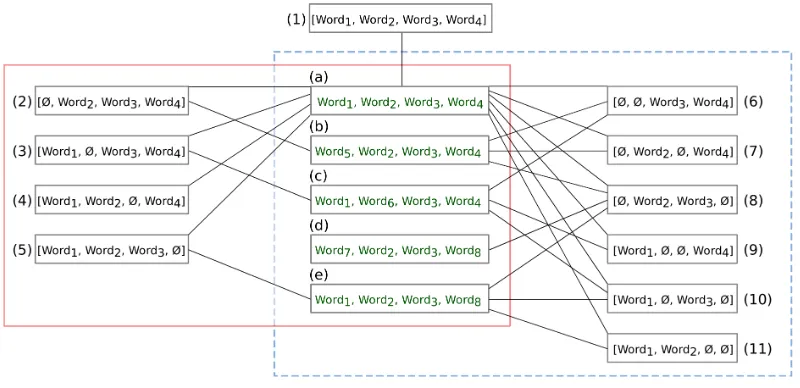
Word3, Word4]shown in Figure 2. This context
di-rectly matches Context (a) but not the Contexts (b) - (e). The central context can be tailored to Con-texts (2), (3), (4), and (5) by relaxing restrictions put by a single word whereas to Contexts (6), (7), (8), (9), (10), and (11) with two words. The more re-strictions are relaxed, the more similar contexts are found (e.g., Context (d)) in the underlying graph.
Our approach first identifies the node representing the ill-formed word and its neighbor context nodes. If any of these connected context nodes matches the central context of the word, it is identified as the ini-tial node. If a direct match is not possible, the central context is tailored in turns until similar contexts are found among the neighbors. At each turn, all possi-ble contexts obtained by relaxing the restriction put by a single word in tailored contexts of the previ-ous turn are used. The neighbor nodes that repre-sent contexts similar to a tailored form of the cen-tral context are identified as initial nodes. If a simi-lar context is not found until the tailoring threshold
is reached3, the node that represents the ill-formed
word is used as the initial node.
On the other hand, if the ill-formed word does not appear in the underlying graph, its central con-text is compared to all concon-texts represented in the graph using the same tailoring methodology. Con-text nodes that represent similar conCon-texts to tailored central context are identified as initial nodes. If more than one initial node is identified, random walks
3We limit the number of∅symbols in a context.
could be performed either from one or some, or even all nodes depending on the traversal strategy. For in-stance, assume that an ill-formed word is connected to the Contexts (a) - (e) shown in Figure 2. Initial nodes determined for that word in some representa-tive central contexts are shown below:
• Context:[Word1, Word2, Word7, Word4]
Initial Node: Context (a)
• Context:[Word1, Word2, Word4, Word9]
Initial Nodes: Context (a) & Context (e)
For an ill-formed word, a fixed number of random walks are performed starting from the same initial node(s) in order to find its normalization candidates. We treat a standard word where any random walk ends as contextually similar to the ill-formed word.
For instance, after the walk Word2-Cntx1-Word1 in
Figure 1, the words ‘annim’ and ‘annem’ are con-sidered as contextually similar.
4.2 Positional Similarity
the underlying graph is explored using the tailor-ing methodology in order to find similar contexts and to identify words that appear at the position of the ill-formed word in these contexts. We treat these words as positionally similar to the ill-formed word. For instance, assume that positionally similar words are searched for the word ‘hazırlıyıp’ in the sentence “bug¨unn o˘glumu g¨osterisi ic¸in hazırlıyıp foto˘graflarını c¸ekece˘gim”. Assume also that only the contexts shown below are identified as similar to the sliding contexts of that word (given in Sec-tion 3.2). In this scenario, posiSec-tionally similar words to the word ‘hazırlıyıp’ are shown below in bold:
[bug¨unn, o˘glumu, ic¸in,hazırlayıp] [o˘glumu, g¨osterisi,s¨usleyip, resimlerini] [o˘glumu, g¨osterisi,bezeyip, foto˘graflarını]
4.3 Lexical Similarity
Lexical similarity of normalization equivalences is as important as their contextual similarity. For an ill-formed word, we also explore a lexicon of standard words as an external resource in order to determine lexically similar words among them. In this work, two well-known metrics, namely Longest
Common Subsequence Ratio (LCSRab) and Edit
Distance (EDab) are used to assess how lexically
similar two words are (LexSimab):
LexSimab = LCSRab / EDab
LCSRab = LCSab / Max⟨Length(a), Length(b)⟩
For instance, consider the ill-formed word ‘k¨os¸lerine’ which can be produced from a standard
word ‘k¨oylerine’{to their town} by
substitut-ing the ‘y’ character with ‘s¸’ or from the word
“k¨os¸elerine”{to its corners} by dropping the ‘e’
character. Although the ill-formed word has the same edit distance to both words, its lexical similar-ity is 0.89 to ‘k¨oylerine’ and 0.9 to ‘k¨os¸elerine’.
4.4 Methodology
Our normalization methodology separately gen-erates normalization candidates that are (i) con-textually similar, (ii) positionally similar, and (iii) lexically similar to an ill-formed word. Contextu-ally and positionContextu-ally similar candidates whose edit
distance to the ill-formed word is greater than a pre-determined threshold are discarded. For each case, the remaining candidates are assigned a similarity score between 0 and 1. Contextual similarity score
(CSab) is computed using the hitting time between
two nodes (HTab). In this work, hitting time refers
to the minimum number of steps taken to visit one node starting from the other node in any performed
random walk4:
CSab = Min⟨HTax⟩ / HTab
Frequencies of contexts in the corpus on which the graph is built are used for computing positional similarity scores (PSab):
PSab = Freq(Contextb)/ Max⟨Freq(Contextx)⟩
Lexical similarity score (LSab) is computed using
the LexSim formula:
LSab = LexSimab / Max⟨LexSimax⟩
Finally, normalization scores of all candidates
(NSab) are computed and the candidate with the
highest score is selected as the normalized form of
the ill-formed word5:
NSab = λ1×CSab +λ2×PSab + λ3×LSab
5 Evaluation
In order to evaluate the performance of our language-independent system, we experimented with Turkish social media texts. For the study, we first collected a large corpus of noisy and clean Turk-ish texts from different resources. The corpus
con-sisted of tweets (∼11GB) that were retrieved via
Twitter Streaming API from April to October 2015,
20 million publicly available tweets6, and clean
Turkish texts (∼6GB). The corpus was preprocessed
by first discarding non-Turkish content as identified
4Here, a refers to the ill-formed word, b refers to an IV word candidate, and x refers to any other candidate.
5Different strategies could be followed to compute normal-ization scores such as defining a precedence order over the kinds of similarities.
by a language detection tool. Later, tweet-specific terms (e.g., # and RT), URLs, some punctuations, and repetitive characters were cleaned from the
cor-pus. Finally, the remaining sentences of∼9GB were
tokenized into 7,401,321 distinct words.
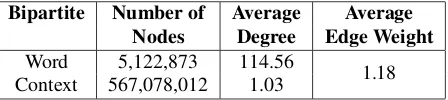
We constructed a bipartite graph from the col-lected corpus using 5-gram word sequences. The word sequences contained one or more OOV words and in cases where there was only one OOV word, it might not be at the center. Statistics about the con-structed graph is given in Table 1.
Bipartite Number of Average Average
Nodes Degree Edge Weight
Word 5,122,873 114.56 1.18
Context 567,078,012 1.03
Table 1:Statistics about the graph.
In the study, if more than one initial node was determined for an ill-formed word, an equal num-ber of random walks were performed from each of these nodes rather than selecting only one. 50 ran-dom walks with a maximum of 6 steps were per-formed from each initial node. Tailoring threshold was set to 1 for central contexts (a tailored context
might have at most three∅symbols) whereas to 2 for
sliding contexts. The edit distance threshold was set to 2 and contextually/positionally similar normal-ization candidates with a higher edit distance were discarded from consideration. Words were prepro-cessed before computing their edit distances. For in-stance, repetition of characters was reduced to a sin-gle character and words were deasciified to restore Turkish characters (if necessary). It is noteworthy to mention that our system do not normalize a word if an IV word candidate is not identified for that word. Our test set consisted of 715 sentences that were retrieved from Twitter. The ill-formed words in these sentences were manually identified and nor-malized by two native Turkish speakers. 483 of these sentences contained only one ill-formed word. However, the remaining 232 sentences had at least two ill-formed words at different positions. Some sentences even had a number of ill-formed words in sequence. Our test set consisted of 1190 ill-formed words in total. Moreover, we observed different kinds of transformations between ill-formed words and their normalized forms (e.g., asciified Turkish characters, omitted characters, and typos).
As an example, consider one of our test sentences where ill-formed words are underlined “insanıar k¨opr¨u kuracakıarı yerde duvar ¨ord¨ukıeri ic¸in yaınız
kaıırıar”{People remain alone since they put up
walls rather than building bridges}. The following
shows how that sentence is normalized by a native speaker and by our system using different kinds of similarities:
Normalized Sentence:“insanlar k¨opr¨u kuracak-ları yerde duvar ¨ord¨ukleri ic¸in yalnız kalırlar”
Contextual Similarity:“insanlar k¨opr¨u kuracakları yerde duvar ¨ord¨ukleri ic¸in yalnız kalırlar
Positional Similarity: “insanıar k¨opr¨u kuracakları yerde duvar ¨ord¨ukıeri ic¸in yaınız kaıırıar”
Lexical Similarity: “insanlar k¨opr¨u kuracakları yerde duvar ¨ord¨ukleri ic¸in yalnız karar”
To our best knowledge, there is only one pub-licly available Turkish text normalization sys-tem (Toruno˘glu and Eryi˘git, 2014) that we can use in this evaluation in addition to a dictionary based MsWord spell checker. Neither the normalization system (TE N) nor the spell checker (SP C) uti-lizes the context of an OOV word during normaliza-tion. Table 2 shows the normalization results that we achieved on the whole test set along with the results of other normalizers. The third row (Con. Sim.) shows the performance of our system once only contextual similarities were considered during
normalization (λ1 = 1, λ2 = 0, λ3 = 0). Similarly,
the fourth and fifth rows show the system’s perfor-mance once positional and lexical similarities were considered respectively. The sixth row presents our baseline where all kinds of similarities had an equal
effect on normalization (λ1 = 1, λ2 = 1, λ3 = 1).
The last row shows the results of our proposed
sys-tem whose λvalues were tuned on a development
set of 200 sentences.
Normalizers Precision Recall F-measure
SP C 73.7% 71.5% 72.6%
TE N 80.6% 77.3% 78.4%
Con. Sim. 73.6% 49.1% 58.9%
Pos. Sim. 88.1% 4.4% 8.3%
Lex. Sim. 86.1% 85.3% 85.7%
Con.+Pos.+Lex. Sim. 81.0% 80.3% 80.6%
[image:7.612.75.299.219.269.2]Our System 87.1% 86.3% 86.7%
As shown in Table 2, a very low recall and the highest precision were obtained once the system considered only positional similarities between an OOV word and its IV word candidates. Moreover, our system achieved the highest F-measure and re-call, and the second highest precision among all nor-malizers. Table 3 and Table 4 show the results ob-tained by our baseline and our system on sentences with only one OOV word and multiple OOV words respectively. Our system obtained higher scores in test sentences with multiple OOV words as com-pared to those with a single OOV word. This might be explained by the fact that a sentence written by the same person might contain multiple OOV words that underwent the same transformation (such as repetitive characters) which can be normalized by our system. On the other hand, several sentences might contain a single OOV word that experienced different kinds of transformations, some of which might not be handled by our system.
Normalizers Precision Recall F-measure
Con.+Pos.+Lex. Sim. 79.3% 78.9% 79.1%
Our System 81.9% 81.6% 81.8%
Table 3:Evaluation of sentences with one OOV word.
Normalizers Precision Recall F-measure
Con.+Pos.+Lex. Sim. 82.3% 81.3% 81.8%
Our System 90.7% 89.7% 90.2%
Table 4:Evaluation of sentences with multiple OOV words.
Overall, the evaluation results support our methodology for normalizing Turkish social media texts. It was our observation that replacing an OOV word with its normalized form before normalizing the next OOV word in the same sentence might end up with a totally different normalization. In the fu-ture, we will analyze the effects of such on-the-fly replacements on a large test set.
6 Conclusion
In this work, we describe a normalization system for social media texts. The system utilizes contex-tual and lexical similarities between non-standard and standard words for normalizing noisy texts. To encode contextual similarities, a bipartite graph is constructed from a large collection of texts where words and contexts that they appear in are connected
with weighted edges. The graph is traversed via ran-dom walks in order to determine contextually simi-lar normalization candidates for an ill-formed word. In determining the initial node(s) of these walks, in-put context of the ill-formed word is used either as is or after being tailored. An external word lexicon is used to explore normalization candidates that are lexically similar to the ill-formed word. The best candidate is selected based on its assigned similar-ity score. Our experiments on 715 Turkish tweets showed that our system achieved the state-of-the-art results. As future work, we plan to evaluate the sys-tem performance on other languages and to study how randomness in random walks can be reduced or totally eliminated to better gauge contextual similar-ities of words in real texts. Unfortunately, the mor-phological parser erroneously identifies some words (e.g., proper nouns) as OOV words and forces the system to treat these words as non-standard words. We will also study how this problem can be over-comed by using of other NLP tools such as named entity recognizers in the future.
References
AiTi Aw, Min Zhang, Juan Xiao, and Jian Su. 2006. A phrase-based statistical model for sms text normaliza-tion. InProceedings of the 21st International Confer-ence on Computational Linguistics, pages 33–40. Eric Brill and Robert C. Moore. 2000. An improved
error model for noisy channel spelling correction. In
Proceedings of the 38th Annual Meeting on Associa-tion for ComputaAssocia-tional Linguistics, pages 286–293. C¸a˘gıl S¨onmez and Arzucan ¨Ozg¨ur. 2014. A graph-based
approach for contextual text normalization. In Pro-ceedings of the Conference on Empirical Methods on Natural Language Processing (EMNLP), pages 313– 324.
Monojit Choudhury, Rahul Saraf, Vijit Jain, Animesh Mukherjee, Sudeshna Sarkar, and Anupam Basu. 2007. Investigation and modeling of the structure of texting language. International Journal on Document Analysis and Recognition, 10:157–174.
Grzegorz Chrupala. 2014. Normalizing tweets with edit scripts and recurrent neural embeddings. In Proceed-ings of the 52nd Annual Meeting of the Association for Computational Linguistics, pages 680–686.
Ap-proaches to Linguistic Creativity (CALC), pages 71– 78.
Jacob Eisenstein, Brendan O’Connor, Noah A. Smith, and Eric P. Xing. 2014. Diffusion of lexical change in social media. PLoS ONE, 9:71–76.
Jennifer Foster, ¨Ozlem C¸etino˘glu, Joachim Wagner, Joseph Le Roux, Stephen Hogan, Joakim Nivre, Deirdre Hogan, and Josef van Genabith. 2011. # hard-toparse: Pos tagging and parsing the twitterverse. In
Proceedings of the Workshop On Analyzing Microtext (AAAI), pages 20–25.
Bo Han, Paul Cook, and Timothy Baldwin. 2013. Lex-ical normalization for social media text. ACM Trans-actions on Intelligent Systems and Technology (TIST), 4:1–27.
Hany Hassan and Arul Menezes. 2013. Social text nor-malization using contextual graph random walks. In
Proceedings of the 51st Annual Meeting of the As-sociation for Computational Linguistics, pages 1577– 1586.
Amac Herdagdelen. 2013. Twitter n-gram corpus
with demographic metadata. Language Resources and
Evaluation, 47:1127–1147.
Max Kaufmann and Jugal Kalita. 2010. Syntactic nor-malization of twitter messages. InProceedings of the International conference on natural language process-ing.
Dilek Kucuk and Ralf Steinberger. 2014. Experiments to improve named entity recognition on turkish tweets. In Proceedings of the 5th Workshop on Language Analysis for Social Media, pages 71–78.
Vivek Kumar and Rangarajan Sridhar. 2015. Unsuper-vised text normalization using distributed
representa-tions of words and phrases. In Proceedings of the
North American Chapter of the Association for Com-putational Linguistics: Human Language Technolo-gies, pages 8–16.
Fei Liu, Fuliang Weng, Bingqing Wang, and Yang Liu. 2011. Insertion, deletion, or substitution?: Normaliz-ing text messages without pre-categorization nor su-pervision. InProceedings of the 49th Annual Meeting of the Association for Computational Linguistics: Hu-man Language Technologies (HLT), pages 71–76. Fei Liu, Fuliang Weng, and Xiao Jiang. 2012. A
broad-coverage normalization system for social media lan-guage. InProceedings of the 50th Annual Meeting of the Association for Computational Linguistics, pages 1035–1044.
H. Andrew Schwartz, Johannes C. Eichstaedt, Mar-garet L. Kern, Lukasz Dziurzynski, Stephanie M. Ra-mones, Megha Agrawal, Achal Shah, Michal Kosin-ski, David Stillwell, Martin E. P. Seligman, and Lyle H. Ungar. 2013. Personality, gender, and age
in the language of social media: The open-vocabulary approach.PLoS ONE, 8.
Katia Tautanova and Robert C. Moore. 2002. A pronun-ciation modeling for improved spelling correction. In
Proceedings of the 40th Annual Meeting on Associa-tion for ComputaAssocia-tional Linguistics, pages 144–151. Dilara Toruno˘glu and G¨uls¸en Eryi˘git. 2014. A cascaded
approach for social media text normalization of turk-ish. InProceedings of the 5th Workshop on Language Analysis for Social Media (LASM), pages 62–70. Savas¸ Yıldırım and Tu˘gba Yıldız. 2015. An