organic papers
Acta Cryst.(2005). E61, o819–o821 doi:10.1107/S1600536805005830 Roeland De Borgeret al. C
15H13NO2
o819
Acta Crystallographica Section EStructure Reports Online
ISSN 1600-5368
(
E
)-1-(4-Methylphenyl)-2-(4-nitrophenyl)ethene
Roeland De Borger,
Christophe M. L. Vande Velde and Frank Blockhuys*
Department of Chemistry, University of Antwerp, Universiteitsplein 1, B-2610 Wilrijk, Belgium
Correspondence e-mail: [email protected]
Key indicators
Single-crystal X-ray study T= 291 K
Mean(C–C) = 0.004 A˚ Rfactor = 0.052 wRfactor = 0.184
Data-to-parameter ratio = 10.7
For details of how these key indicators were automatically derived from the article, see http://journals.iucr.org/e.
#2005 International Union of Crystallography Printed in Great Britain – all rights reserved
The title compound, C15H13NO2, is a stilbene derivative with a
push–pull conjugated system. The molecules form sheets with a head-to-tail arrangement both within and between the sheets.
Comment
The title compound, (I), was synthesized as a precursor for longer poly(p-phenylenevinylene) oligomers with non-linear optical properties (Cheng, Tam, Stevensonet al., 1991; Cheng, Tam, Marder et al., 1991), and for use in organic memories (Bandyopadhyay & Pal, 2003). It was recently shown to be highly mutagenic (Ludolphet al., 2001).
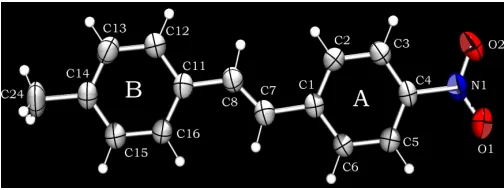
Once corrected for libration effects, the differences in the intramolecular distances and angles are as expected for a room temperature measurement of an (E)-stilbene. For a discussion on the bond lengths and angles in and around the ethenylic bond, see Ogawa et al. (1992). The methyl-substi-tuted ringBis slightly larger than the nitro-substituted ringA
(Fig. 1), with the longest aromatic bonds involving C1 and C11, which are connected to the ethenylic link.
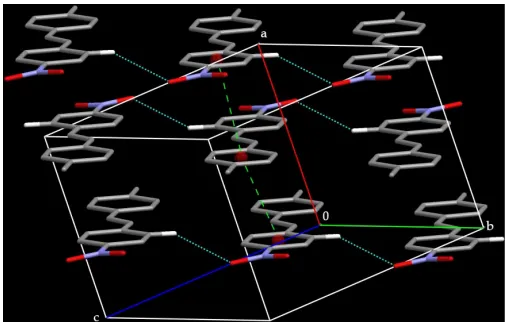
[image:1.610.229.435.323.389.2]By itself, the molecule is a push–pull conjugated system and therefore it comes as no surprise that the compound crystal-lizes in the space groupP1, with the dipoles arranged head-to-tail within and between sheets, as is clearly demonstrated in Fig. 2. These stacks of alternating dipoles also give rise to -stacking interactions, given by CgA CgBi = 3.920 (3) A˚ , 26.86 and perp = 3.497 A˚ , and CgA CgBii
= 3.898 (3) A˚ , 25.66and perp = 3.514 A˚ , in whichCgis the centroid of the
Received 12 January 2005 Accepted 23 February 2005 Online 4 March 2005
Figure 1
[image:1.610.206.458.620.715.2]ring, the angle is relative to the normal of the plane of ringA, and the distance indicated by ‘perp’ is the perpendicular distance between CgBand the least-squares plane of ringA
[symmetry codes: (i) 1x, 1y, 1z; (ii) 2x, 1y, 1z]. Only one intermolecular distance is shorter than the sum of the van der Waals radii, in this case by 0.18 A˚ , viz. H6 O2iii [symmetry code: (iii) x, y1, z; Table 2]. The interaction links the molecules in infinite chains along the b
axis, the direction in which no head-to-tail arrangement for the dipoles is possible due to the space-group symmetry. These two interactions are indicated in Fig. 2.
A TLS analysis with the programTHMA14(Schomaker & Trueblood, 1998) indicates that the librational componentL1, which coincides with the long axis of the molecule within 2.6,
is an order of magnitude larger than the two other ones (L1 = 39.272,L2 = 4.332andL3 = 2.782), whileTandSare close to zero, as can be expected for a centrosymmetric structure.
Experimental
Compound (I) (Pfeiffer, 1915, 1916) was synthesized starting from triphenyl(p-xylyl)phosphonium chloride, (II), which was obtained by reacting -chloro-p-xylene with triphenylphosphine in acetonitrile. Sodium (2.3 g, 0.1 mol) in dry ethanol (80 ml) was added dropwise to a stirred mixture of (II) (38.8 g, 0.1 mol) andp-nitrobenzaldehyde (15.1 g, 0.1 mol) in dry ethanol. The mixture was refluxed under nitrogen for 3 h. After cooling to room temperature, water (150 ml) was added to the reaction mixture and the precipitate filtered off. The yellow product was collected and redissolved in hot acetone (250 ml). This solution was poured into water (150 ml). The compound was then again collected by filtration. In order to obtain theEisomer, the compound was refluxed in toluene with a catalytic amount of iodine for 4 h. After cooling, prism-shaped crystals of (I) formed in the solution [yield 55%, m.p. (uncorrected) 422 K]. 1H NMR (CDCl
3,
400 MHz, TMS):2.38 (s, 3H, H24), 7.08 (d, 1H,J= 16.33 Hz, H7), 7.20 (d, 2H,J= 8.09 Hz, H13 and H15), 7.24 (d, 1H,J= 16.33 Hz, H8), 7.44 (d, 2H,J= 8.24 Hz, H12 and H16), 7.61 (d, 2H,J= 8.85 Hz, H2 and H6), 8.20 (d, 2H,J= 8.85 Hz, H3 and H5),13C NMR (CDCl
3,
100 MHz, TMS):21.35 (C24), 124.1 (C3—C5), 125.3 (C7), 126.7 (C2
and C6), 127.0 (C12 and C16), 129.6 (C13 and C15), 133.3 (C8), 133.5 (C11), 139 (C14), 144.1 (C6), 146.7 (C4).
Crystal data
C15H13NO2
Mr= 239.26 Triclinic,P1 a= 7.339 (1) A˚ b= 7.521 (1) A˚ c= 12.230 (4) A˚
= 98.66 (2)
= 99.26 (2)
= 111.13 (1)
V= 605.3 (2) A˚3
Z= 2
Dx= 1.313 Mg m
3 MoKradiation Cell parameters from 25
reflections
= 6.1–17.6
= 0.09 mm1
T= 291 (1) K Prism , yellow 0.260.130.13 mm
Data collection
Enraf–Nonius MACH3 diffractometer Profiled!/2scans Absorption correction: none 2520 measured reflections 2200 independent reflections 1055 reflections withI> 2(I) Rint= 0.012
max= 25.3
h= 0!8 k=9!8 l=14!14 3 standard reflections
frequency: 60 min intensity decay: 2%
Refinement
Refinement onF2
R[F2> 2(F2)] = 0.052
wR(F2) = 0.184
S= 1.01 2200 reflections 205 parameters
H atoms treated by a mixture of independent and constrained refinement
w= 1/[2(F
o2) + (0.0901P)2 + 0.1262P]
whereP= (Fo2+ 2Fc2)/3 (/)max< 0.001
max= 0.16 e A˚
3
min=0.21 e A˚
3
Table 1
Selected geometric parameters (A˚ ,).
C1—C6 1.389 (4)
C1—C2 1.392 (4)
C1—C7 1.471 (4)
C8—C7 1.312 (4)
C11—C12 1.391 (4)
C11—C8 1.465 (4)
C16—C11 1.390 (4)
C2—C1—C7 122.4 (3)
C6—C1—C7 119.4 (3)
C7—C8—C11 128.4 (3)
C8—C7—C1 127.1 (3)
C12—C11—C8 119.2 (3)
C16—C11—C8 123.4 (3)
[image:2.610.44.297.70.231.2]C2—C1—C7—C8 0.4 (5) C12—C11—C8—C7 179.4 (3)
Table 2
Hydrogen-bonding geometry (A˚ ,).
D—H A D—H H A D A D—H A
C6—H6 O2i 1.00 (3) 2.54 (3) 3.447 (5) 151 (2)
Symmetry code: (i)x;y1;z.
H atoms were located in difference density maps and refined freely [C—H = 0.94 (3)–0.99 (3) A˚ ]. The methyl H atoms on C24 were constrained to give angles of 109.5 andU
iso(H) = 1.5Ueq(Cmethyl),
with their distances free to refine, yielding 0.90 A˚ .
Data collection: CAD-4 EXPRESS (Enraf–Nonius, 1994); cell refinement: CAD-4 EXPRESS; data reduction: DREAR(Blessing, 1987); program(s) used to solve structure:SIR97 (Altomareet al., 1999); program(s) used to refine structure:SHELXL97(Sheldrick,
organic papers
o820
Roeland De Borgeret al. C15H13NO2 Acta Cryst.(2005). E61, o819–o821
Figure 2
[image:2.610.313.565.598.633.2]1997); molecular graphics:ORTEP-3 for Windows(Farrugia, 1997) and MERCURY (Bruno et al., 2002); software used to prepare material for publication: WinGX publication routines (Farrugia, 1999) andPLATON(Spek, 2003).
The authors thank Professor Dr R. Dommisse and J. Aerts for recording the NMR spectra. CVV thanks the FWO Vlaanderen for a grant as a research assistant.
References
Altomare, A., Burla, M. C., Camalli, M., Cascarano, G., Giacovazzo, C., Guagliardi, A., Moliterni, A. G. G., Polidori, G. & Spagna, R. (1999).J. Appl. Cryst.32, 115–119.
Bandyopadhyay, A. & Pal, A. J. (2003).Appl. Phys. Lett.82, 1215–1217.
Blessing, R. H. (1987).Crystallogr. Rev.1, 3–58.
Bruno, I. J., Cole, J. C., Edgington, P. R., Kessler, M., Macrae, C. F., McCabe, P., Pearson, J. & Taylor, R. (2002).Acta Cryst.B58, 389–397.
Cheng, L.-T., Tam, W., Marder, S. R., Stiegman, A. E., Rikken, G. & Spangler, C. W. (1991).J. Phys. Chem.95, 10643–10652.
Cheng, L.-T., Tam, W., Stevenson, S. H., Meredith, G. R., Rikken, G. & Marder, S. R. (1991).J. Phys. Chem.95, 10631–10643.
Enraf–Nonius (1994).CAD-4 EXPRESS. Enraf–Nonius, Delft, The Nether-lands.
Farrugia, L. J. (1997).J. Appl. Cryst.30, 565. Farrugia, L. J. (1999).J. Appl. Cryst.32, 837–838.
Ludolph, B., Klein, M., Erdinger, L. & Boche, G. (2001).Mutat. Res.491, 195– 210.
Ogawa, K., Sano, T., Yoshimura, S., Takeuchi, Y. & Toriumi, K. (1992).J. Am. Chem. Soc.114, 1041–1051.
Pfeiffer, P. (1915).Chem. Ber.48, 1796–1809. Pfeiffer, P. (1916).Chem. Ber.49, 2433–2440.
Sheldrick, G. M. (1997).SHELXL97. University of Go¨ttingen, Germany. Schomaker, V. & Trueblood, K. (1998).Acta Cryst.B54, 507–514. Spek, A. L. (2003).J. Appl. Cryst.36, 7–13.
organic papers
Acta Cryst.(2005). E61, o819–o821 Roeland De Borgeret al. C
supporting information
sup-1 Acta Cryst. (2005). E61, o819–o821
supporting information
Acta Cryst. (2005). E61, o819–o821 [https://doi.org/10.1107/S1600536805005830]
(
E
)-1-(4-Methylphenyl)-2-(4-nitrophenyl)ethene
Roeland De Borger, Christophe M. L. Vande Velde and Frank Blockhuys
(I)
Crystal data
C15H13NO2
Mr = 239.26
Triclinic, P1 Hall symbol: -P 1 a = 7.339 (1) Å b = 7.521 (1) Å c = 12.230 (4) Å α = 98.66 (2)° β = 99.26 (2)° γ = 111.13 (1)° V = 605.3 (2) Å3
Z = 2 F(000) = 252 Dx = 1.313 Mg m−3
Mo Kα radiation, λ = 0.71069 Å Cell parameters from 25 reflections θ = 6.1–17.6°
µ = 0.09 mm−1
T = 291 K Prism, yellow
0.26 × 0.13 × 0.13 mm
Data collection
Enraf–Nonius MACH3 diffractometer profiled ω/2θ scans 2520 measured reflections 2200 independent reflections 1055 reflections with I > 2σ(I) Rint = 0.012
θmax = 25.3°, θmin = 1.7°
h = 0→8 k = −9→8 l = −14→14
3 standard reflections every 60 min intensity decay: 2%
Refinement
Refinement on F2 Least-squares matrix: full R[F2 > 2σ(F2)] = 0.052
wR(F2) = 0.184
S = 1.01 2200 reflections 205 parameters 0 restraints
H atoms treated by a mixture of independent and constrained refinement
w = 1/[σ2(F
o2) + (0.0901P)2 + 0.1262P] where P = (Fo2 + 2Fc2)/3
(Δ/σ)max < 0.001 Δρmax = 0.16 e Å−3 Δρmin = −0.21 e Å−3
Special details
supporting information
sup-2 Acta Cryst. (2005). E61, o819–o821
Fractional atomic coordinates and isotropic or equivalent isotropic displacement parameters (Å2)
x y z Uiso*/Ueq
O1 1.1412 (4) 1.1714 (3) 0.9362 (2) 0.0863 (8)
O2 1.1132 (4) 1.3153 (3) 0.7991 (2) 0.0876 (9)
N1 1.0923 (4) 1.1693 (3) 0.8361 (2) 0.0599 (7)
C1 0.8366 (4) 0.6235 (4) 0.5986 (2) 0.0438 (7)
C2 0.8388 (5) 0.7936 (4) 0.5658 (3) 0.0514 (8)
C3 0.9218 (4) 0.9713 (4) 0.6428 (2) 0.0508 (8)
C4 1.0007 (4) 0.9790 (4) 0.7541 (2) 0.0458 (7)
C5 0.9998 (5) 0.8140 (4) 0.7907 (2) 0.0526 (8)
C6 0.9166 (5) 0.6373 (4) 0.7120 (2) 0.0515 (8)
C7 0.7511 (4) 0.4317 (4) 0.5182 (2) 0.0506 (7)
C8 0.6696 (4) 0.3935 (4) 0.4092 (3) 0.0504 (8)
C11 0.5835 (4) 0.2046 (4) 0.3269 (2) 0.0459 (7)
C12 0.5023 (4) 0.1957 (4) 0.2144 (3) 0.0530 (8)
C13 0.4173 (5) 0.0187 (5) 0.1347 (3) 0.0586 (8)
C14 0.4142 (4) −0.1523 (4) 0.1632 (2) 0.0537 (8)
C15 0.4948 (4) −0.1441 (4) 0.2749 (3) 0.0557 (8)
C16 0.5780 (4) 0.0308 (4) 0.3553 (3) 0.0516 (8)
C24 0.3235 (5) −0.3437 (5) 0.0744 (3) 0.0796 (12)
H2 0.779 (4) 0.787 (4) 0.491 (2) 0.057 (9)*
H3 0.916 (5) 1.087 (5) 0.619 (3) 0.088 (11)*
H5 1.046 (5) 0.816 (5) 0.870 (3) 0.079 (10)*
H6 0.922 (4) 0.521 (4) 0.740 (2) 0.061 (8)*
H7 0.753 (4) 0.324 (5) 0.553 (3) 0.071 (9)*
H8 0.666 (4) 0.499 (4) 0.370 (2) 0.060 (8)*
H12 0.507 (4) 0.315 (5) 0.192 (2) 0.069 (9)*
H13 0.367 (5) 0.017 (4) 0.058 (3) 0.069 (9)*
H15 0.496 (4) −0.261 (4) 0.301 (2) 0.056 (8)*
H16 0.631 (4) 0.026 (4) 0.433 (3) 0.067 (9)*
H24A 0.301 (3) −0.3193 (7) 0.0048 (15) 0.119*
H24B 0.207 (3) −0.421 (2) 0.0874 (13) 0.119*
H24C 0.409 (2) −0.405 (2) 0.0784 (14) 0.119*
Atomic displacement parameters (Å2)
U11 U22 U33 U12 U13 U23
O1 0.124 (2) 0.0570 (14) 0.0543 (15) 0.0253 (14) −0.0012 (14) −0.0061 (12)
O2 0.118 (2) 0.0353 (12) 0.0887 (19) 0.0207 (12) −0.0007 (15) 0.0035 (12)
N1 0.0666 (18) 0.0414 (15) 0.0598 (17) 0.0170 (12) 0.0054 (14) −0.0017 (13)
C1 0.0433 (16) 0.0382 (13) 0.0452 (17) 0.0132 (12) 0.0101 (13) 0.0037 (12)
C2 0.0591 (19) 0.0472 (17) 0.0424 (17) 0.0192 (14) 0.0031 (14) 0.0082 (14)
C3 0.0559 (18) 0.0414 (15) 0.0518 (18) 0.0193 (14) 0.0060 (14) 0.0079 (13)
C4 0.0467 (16) 0.0350 (14) 0.0488 (16) 0.0121 (12) 0.0102 (13) 0.0006 (12)
C5 0.062 (2) 0.0473 (17) 0.0437 (17) 0.0200 (14) 0.0074 (14) 0.0046 (13)
C6 0.067 (2) 0.0378 (15) 0.0482 (17) 0.0222 (14) 0.0083 (14) 0.0060 (13)
supporting information
sup-3 Acta Cryst. (2005). E61, o819–o821
C8 0.0534 (18) 0.0432 (16) 0.0508 (18) 0.0194 (14) 0.0073 (14) 0.0042 (13)
C11 0.0433 (16) 0.0453 (15) 0.0451 (17) 0.0173 (13) 0.0084 (13) 0.0015 (13)
C12 0.0588 (19) 0.0452 (16) 0.0505 (18) 0.0187 (14) 0.0079 (14) 0.0071 (14)
C13 0.062 (2) 0.0595 (19) 0.0439 (18) 0.0178 (15) 0.0049 (15) 0.0044 (15)
C14 0.0546 (19) 0.0465 (17) 0.0489 (18) 0.0126 (14) 0.0105 (15) −0.0011 (13)
C15 0.062 (2) 0.0460 (16) 0.0528 (18) 0.0194 (15) 0.0085 (15) 0.0033 (15)
C16 0.0570 (19) 0.0463 (16) 0.0445 (17) 0.0192 (14) 0.0035 (14) 0.0021 (13)
C24 0.092 (3) 0.0526 (19) 0.064 (2) 0.0093 (18) 0.0090 (18) −0.0167 (16)
Geometric parameters (Å, º)
N1—O1 1.215 (3) C8—H8 0.99 (3)
N1—O2 1.219 (3) C11—C12 1.391 (4)
N1—C4 1.470 (3) C11—C8 1.465 (4)
C1—C6 1.389 (4) C12—C13 1.388 (4)
C1—C2 1.392 (4) C12—H12 0.96 (3)
C1—C7 1.471 (4) C13—H13 0.95 (3)
C2—H2 0.94 (3) C14—C13 1.376 (4)
C3—C4 1.375 (4) C14—C24 1.516 (4)
C3—C2 1.376 (4) C15—C14 1.381 (4)
C3—H3 0.97 (3) C15—H15 0.98 (3)
C5—C4 1.379 (4) C16—C15 1.381 (4)
C5—C6 1.381 (4) C16—C11 1.390 (4)
C5—H5 0.97 (3) C16—H16 0.98 (3)
C6—H6 0.99 (3) C24—H24A 0.8997
C7—H7 0.98 (3) C24—H24B 0.8997
C8—C7 1.312 (4) C24—H24C 0.8997
O1—N1—O2 124.1 (3) C11—C8—H8 110.1 (17)
O1—N1—C4 118.3 (3) C11—C12—H12 118.9 (18)
O2—N1—C4 117.7 (3) C11—C16—H16 121.8 (17)
C1—C2—H2 120.0 (17) C12—C11—C8 119.2 (3)
C1—C6—H6 121.6 (17) C12—C13—H13 119.1 (18)
C1—C7—H7 113.7 (18) C13—C12—C11 120.7 (3)
C2—C1—C7 122.4 (3) C13—C12—H12 120.4 (18)
C3—C2—C1 121.1 (3) C13—C14—C15 118.0 (3)
C3—C2—H2 118.9 (17) C13—C14—C24 120.7 (3)
C2—C3—H3 119 (2) C14—C13—C12 121.5 (3)
C3—C4—C5 121.9 (3) C14—C13—H13 119.2 (18)
C3—C4—N1 119.0 (3) C14—C15—C16 121.0 (3)
C4—C3—C2 119.0 (3) C14—C15—H15 121.8 (17)
C4—C3—H3 121 (2) C14—C24—H24A 109.5
C4—C5—C6 118.2 (3) C14—C24—H24B 109.5
C4—C5—H5 123 (2) C14—C24—H24C 109.5
C5—C4—N1 119.0 (3) C15—C14—C24 121.3 (3)
C5—C6—C1 121.6 (3) C15—C16—C11 121.4 (3)
C5—C6—H6 116.7 (17) C15—C16—H16 116.8 (17)
supporting information
sup-4 Acta Cryst. (2005). E61, o819–o821
C6—C1—C7 119.4 (3) C16—C11—C8 123.4 (3)
C6—C5—H5 119 (2) C16—C15—H15 117.1 (17)
C7—C8—C11 128.4 (3) H24A—C24—H24B 109.5
C7—C8—H8 121.4 (17) H24A—C24—H24C 109.5
C8—C7—C1 127.1 (3) H24B—C24—H24C 109.5
C8—C7—H7 119.1 (18)
O1—N1—C4—C3 172.0 (3) C7—C1—C6—C5 179.5 (3)
O1—N1—C4—C5 −9.3 (4) C8—C11—C12—C13 −179.2 (3)
O2—N1—C4—C3 −7.5 (4) C11—C8—C7—C1 179.9 (3)
O2—N1—C4—C5 171.3 (3) C11—C12—C13—C14 −1.4 (5)
C2—C1—C7—C8 0.4 (5) C11—C16—C15—C14 0.0 (4)
C2—C1—C6—C5 −1.2 (4) C12—C11—C8—C7 179.4 (3)
C2—C3—C4—C5 0.3 (5) C15—C14—C13—C12 1.3 (5)
C2—C3—C4—N1 179.0 (3) C15—C16—C11—C12 −0.1 (4)
C4—C3—C2—C1 −1.0 (4) C15—C16—C11—C8 179.8 (3)
C4—C5—C6—C1 0.5 (4) C16—C11—C8—C7 −0.5 (5)
C6—C1—C2—C3 1.4 (4) C16—C11—C12—C13 0.8 (4)
C6—C5—C4—C3 0.0 (5) C16—C15—C14—C13 −0.7 (4)
C6—C5—C4—N1 −178.8 (2) C16—C15—C14—C24 179.7 (3)
C6—C1—C7—C8 179.7 (3) C24—C14—C13—C12 −179.1 (3)
C7—C1—C2—C3 −179.3 (3)
Hydrogen-bond geometry (Å, º)
D—H···A D—H H···A D···A D—H···A
C6—H6···O2i 1.00 (3) 2.54 (3) 3.447 (5) 151 (2)