Accepted Manuscript
Secure and Privacy-preserving Data Sharing in the Cloud based on
Lossless Image Coding
Fouad Khelifi, Tahar Brahimi, Jungong Han, Xuelong Li
PII:
S0165-1684(18)30063-X
DOI:
10.1016/j.sigpro.2018.02.016
Reference:
SIGPRO 6740
To appear in:
Signal Processing
Received date:
26 July 2017
Revised date:
27 November 2017
Accepted date:
12 February 2018
Please cite this article as: Fouad Khelifi, Tahar Brahimi, Jungong Han, Xuelong Li, Secure and
Privacy-preserving Data Sharing in the Cloud based on Lossless Image Coding,
Signal Processing
(2018), doi:
10.1016/j.sigpro.2018.02.016
ACCEPTED MANUSCRIPT
Highlights
• A new cloud model for secure and privacy-preserving data storage and sharing is presented.
• We propose to create room losslessly as image pixels do not undergo any lossy operations.
• An efficient wavelet-based image coder is used to reserve room before encryption.
ACCEPTED MANUSCRIPT
Secure and Privacy-preserving Data Sharing in the Cloud based on Lossless Image
Coding
Fouad Khelifi1, Tahar Brahimi2, Jungong Han*3, Xuelong Li4
Abstract
Image and video processing in the encrypted domain has recently emerged as a promising research area to tackle privacy-related data processing issues. In particular, reversible data hiding in the encrypted domain has been suggested as a solution to store and manage digital images securely in the cloud while preserving their confidentiality. However, although efficiency has been claimed with reversible data hiding techniques in encrypted images (RDHEI), reported results show that the cloud service provider cannot add more than1bit per pixel (bpp) of additional data to manage stored images. This paper highlights the weakness of RDHEI as a suggested approach for secure and privacy-preserving cloud computing. In particular, we propose a new, simple, and efficient approach that offers the same level of data security and confidentiality in the cloud without the process of reversible data hiding. The proposed idea is to compress the image via a lossless image coder in order to create space before encryption. This space is then filled with a randomly generated sequence and combined with an encrypted version of the compressed bit stream to form a full resolution encrypted image in the pixel domain. The cloud service provider uses the created room in the encrypted image to add additional data and produces an encrypted image containing additional data in a similar fashion. Assessed with the lossless Embedded Block Coding with Optimized Truncation (EBCOT) algorithm on natural images, the proposed scheme has been shown to exceed the capacity of3bpp of additional data while maintaining data security and confidentiality.
Keywords: Reversible data hiding, encryption, confidentiality, security, capacity, privacy-preserving cloud.
1. Introduction
Over the last decade, there has been a growing body of research on data analytics and processing technologies that deal with large amounts of data of different types and acquired from various sources [1, 2, 3]. However, privacy concerns have also been widely raised in the literature in signal processing applications that deal with user-related data. In fact, digital multimedia such as images and videos can be viewed as privacy-sensitive information in many service-based applications and hence can be abused if the processing or storage is conducted directly on plaintext data in the cloud. Such concerns about privacy protection have urged researchers to develop privacy-preserving systems in biometrics [4, 5],
1Department of Computer and Information Sciences, Northumbria University, NE2 1XE, UK. E-mail: [email protected] 2Department of Electronics, Jijel University, Jijel 18000, Algeria. E-mail:[email protected]
3School of Computing and Communications, Lancaster University, LA1 4YW, UK. E-mail: [email protected] (Jungong Han is the corresponding author)
4Xi’an Institute of Optics and Precision Mechanics, Chinese Academy of Sciences, Xi’an 710119, Shaanxi, P. R. China and also The University of Chinese Academy of Sciences, Beijing 100049, P. R. China. E-mail:xuelong [email protected]
ACCEPTED MANUSCRIPT
data compression [6, 7], and watermarking [8, 9]. On the other hand, Reversible Data Hiding (RDH) has emerged as an approach for embedding additional data into digital images imperceptibly with the ability to recover the host image losslessly after extracting the additional data [10, 11, 12]. This differs from older versions of data hiding and watermarking where the process generates robust watermarks at the expense of some loss of information in the image content [13, 14]. A number of attempts have also considered RDH in the compressed domain [15, 16, 17]. Moreover, inspired by existing works on information processing in the encrypted domain, encryption was initially used in RDH systems to protect the content of the host image [18, 19, 20]. An interesting feature of such systems, called separability, has then been introduced for potential use in areas where the confidentiality of the host image is protected from the data hiding/extraction system while the confidentiality of the hidden message is protected from the image encryption/decryption system [21]. That is, the data hider can only process an encrypted version of the host image in order to embed additional data without accessing the image visual content while the encyption/decryption system can only encode and recover the original image without knowing the additional data. Therefore, the challenge from the data hider’s perspective lies in the security and reversibility of the embedding process as well as the amount of data to embed in the encrypted domain. It is meant by reversibility here the ability of the decoder to recover the original host image in a lossless fashion.
A possible scenario for such systems in cloud computing has been suggested in many research papers [17, 22, 23, 24, 25]. Indeed, sensitive visual data such as biometric (face, fingerprint, iris, etc.) and medical images can be encrypted before they are sent to the cloud for storage. This ensures the confidentiality of the data since only the genuine cloud user can disclose the content of images through decryption. On the other hand, the Cloud Service Provider (CSP) may insert some meta data about the user and the date of upload in encrypted images to facilitate their management in the database (i.e. storage, search and retrieval [26, 27]). In the next section, we elaborate on this idea and provide a new model with complete analysis of security issues in cloud computing and how these can be addressed by such systems.
Existing RDH techniques in encrypted images, denoted here by RDH-EI, can be categorized in two classes depending on whether space for embedding the message is allocated before or after encryption [22]. The first attempts in the literature tend to find the embedding room after encryption. In [18], the authors adopted a block cipher method using the Advanced Encryption Standard (AES) algorithm to encrypt non-overlapping blocks, each consists of16gray level pixels. Each encrypted block is then used to embed one message bit by replacing a bit of the cipher text with the hidden bit. This system is, however, not separable because the location of the hidden bit in each block is required to recover the image at the decryption stage. The host image can be recovered by analyzing the local standard deviation of each block for two possible hidden bits (0and1). The idea of analyzing the neighborhood correlation to recover the host image was also explored in [19] and [20] where the stream cipher was used at the encryption stage. In [21], a separable RDH scheme operating in the encrypted domain was introduced. The technique creates room for embedding the additional data by compressing the least significant bits of the encrypted image. In [28], the idea of compressing half of the4thLeast Significant Bit
ACCEPTED MANUSCRIPT
the LDPC method has also been employed to compress the Most Significant Bits (MSB). In [31], the idea is to select a pixel among its four neighboring pixels in the encrypted image to embed a single bit. The reconstruction of the original image relies on an improved context adaptive interpolation technique. However, the results show that encrypted images could be recovered with some loss of information when the embedding rate increases up to0.16 bit per pixel (bpp). By adopting the bit flipping idea to embed the additional data and the statistical analysis of decrypted pixels for image recovery [19], the authors in [24] proposed to use a test on each block of encrypted pixels in order to decide on whether a bit could be embedded or not. This has been shown to improve the quality of the reconstructed image [32, 33, 34] if the receiver has only the encryption/decryption key. However, their system is not separable as it requires the decrypted image before the extraction of the hidden data. In [35], the authors adopted an asymmetric encryption system, called Paillier homomorphic encryption, to develop a RDH-EI technique. The technique operates on pairs of pixels and encrypts the nearest and smaller even number of each pixel with the corresponding parity bit separately. Nonetheless, although the asymmetric encryption offers higher security when compared to the widely used stream cipher in RDH, this technique is not separable and produces an encrypted marked image with larger bits representation6than the original one due to the
bandwidth overhead of the Paillier encryption system. The homomorphic encryption has also been adopted in [36] for separable RDH-EI but the problem of increasing the image bit budget was not addressed. In [37], the authors presented a non separable RDH technique. In this technique, both the content owner and data hider use stream cipher encryption in a cascade way (encryption by content owner followed by another encryption by the data hider). The authors used a number of public keys to conduct the data embedding process on encrypted image blocks byre-encryptingeach block with one of the keys. That is, each key is linked to a sequence of bits which will represent a portion of the message. Given the fact that only one of the public keys can decrypt an encrypted block, the message can be extracted by analyzing the uniformity of blocks decrypted with all possible keys where an SVM classifier, trained on encrypted and unencrypted blocks, is used in order to find the right public key. Once the right key is determined for each block, the message can be deduced and the image can be recovered through a double decryption (i.e., using the public key and the encryption key). More recently, the authors in [38] proposed a histogram shifting method to hide additional data in the encrypted image. The technique divides the encrypted image into non-overlapping blocks and selects two pixels in each block as the block histogram peaks. The histogram is then expanded from the peaks towards the borders so that a bit can be embedded by shifting the pixels that are equal to one of the peak values accordingly.
In the other category of RDH-EI, the embedding space is created before encryption. The techniques that fall under this category rely on a bit saving representation of the image to create room using a lossy compression-like technique that explores inter-pixel and psycho-visual redundancy. In [22], the authors classify the image into two parts A and B where each part is described by one type of blocks, i.e., textured or smooth blocks. Then, the LSB-planes of the textured part, denoted by A, are reversibly embedded into B by using a traditional RDH algorithm. The image is then encrypted
ACCEPTED MANUSCRIPT
with a standard stream cipher and additional data can finally be embedded in the available bit-planes of A. A similar system has also been proposed in [39] where a predictive filter was used to estimate a number of selected pixels from their neighborhood. The estimated pixels are then replaced with the corresponding estimation errors. Finally, the histogram of these errors is shifted to create the embedding space accordingly before encryption. In [25], the authors build upon the work of [39] and use an interpolation filter instead to predict pixels from their neighborhood. They also replace the predicted pixels with the corresponding prediction errors before encryption but the data hiding technique combines the idea of histogram shifting with expansion to create more room. The technique has been shown to deliver high capacity performance but this comes at the cost of slightly disclosing the visual content in the stego image due to un-encrypted interpolation errors. In [40], the authors adopted a sparse coding technique to create space for data hiding. The idea is based on the assumption that a patch in the image can be represented by a few atoms in an over-complete dictionary. Because sparse coding provides an approximate version of patches, each selected patch is described by its sparse code and a binary representation of the residual error in addition to a portion of the dictionary bits. The remaining bit space in each representation of the patch code is reserved for embedding the additional data.
ACCEPTED MANUSCRIPT
stream cipher encryption on the compressed bit-stream for high randomness and de-correlation of samples. By doing so, the system’s security can be significantly enhanced, and it turns out to be more suitable for cloud computing applications than the conventional pixel domain-based stream cipher method in current RDH-EI systems.
The paper is structured as follows. Section 2 presents the proposed model for secure cloud computing along with design requirements. In section 3, the proposed approach for secure and privacy-preserving data sharing and management in the cloud is described in detail. Section 4 gives an experimental evaluation of the proposed system in comparison with RDH-EI systems. Section 6 summarizes the contributions and concludes the paper.
2. Problem formulation
In order to describe the system architecture and derive design requirements, we first highlight the features of the proposed framework for potential use in cloud computing. Fig. 1(a) illustrates our proposed model where a cloud user sends an image along with a message in encrypted form to the cloud. In health care applications, the image could be medical and the message may contain the medical record of the corresponding patient. In the field of law enforcement, the image could be biometric (face, fingerprint, iris, etc.) and the message would represent the criminal record of the corresponding suspect. To serve authorized users, the CSP acts as a secure data insertion system by adding different
Encrypted image
Encrypted data
Cloud user
Cloud user 1 Unauthorized user
Encrypted image
Cloud user 2 Encrypted data Encrypted image Encrypted data
Cloud user 3
Cloud service Cloud storage
Image Message Encryption Cryptographic hashing Cryptographic hashing
User’s encrypted image
Encryption s ig n a tu re
Append User’s encrypted data
s ig n a tu re KI1 KI2 KM1 KM2 User’s credentials Data insertion Ki KEM2 Cryptographic hashing KEI2 Cryptographic hashing s ig n a tu re s ig n a tu re Append Meta data Pay load E n c ry p te d m a rk e d im a g e Data owner Cloud (a) (b)
Figure 1: Proposed model for cloud computing. (a) Full and restricted access to data by cloud users. (b) Encryption and data insertion in the cloud.
ACCEPTED MANUSCRIPT
• Data confidentiality: The data located in the cloud should be kept private. Indeed, any possible leakage of the stored data should not compromise its confidentiality. In the proposed model, confidentiality is guaranteed via encryption since all the data being handled in the cloud is already encrypted.
• Data integrity from the user’s perspective: Images and digital messages might be altered in the cloud without the owner’s consent. With the proposed solution, the image owner attaches a digital signature of the image and another signature of the message to the encrypted message data which will then be inserted in the reserved room of the encrypted image by the CSP. When the encrypted image and encrypted message are retrieved, the cloud user decrypts them and verifies their authenticity.
• Data integrity from the CSP’s perspective: If a cloud user claims that images and/or messages have been altered, the CSP should verify this by his own means to protect the service from false claims. To this end, the CSP creates a signature of the encrypted image and a signature of the encrypted message and inserts them in the reserved room of the encrypted image. This enables the CSP to check the integrity of the data transmitted to cloud users.
• Data access control: The data owner, who is a cloud user at one side, might designate other cloud users who can share his data at the other side. To this end, the CSP manages authorized access to the data and prevents unauthorized users from illegal access. This can be guaranteed by inserting credentials in the reserved room of the encrypted image. Such credentials describe the authorized users and the level of access they have been granted (i.e. access to original encrypted image and/or encrypted message). A cloud user is required to send credentials to the cloud in order to access the data. If the credentials match the ones inserted in the reserved room of the encrypted image, data access is authorized.
A detailed demonstration of the aforementioned encryption and data insertion process for cloud computing is given in Fig. 1(b). Note that the data insertion system also adds some meta data (tagging information) to facilitate the storage and management of images in the cloud. The features of the proposed cloud computing model suggest the following design requirements of our system:
• Bit budget constancy: One of the main design requirements the presented model is that the encrypted image con-taining additional data must be represented at the same bit cost as the original uncompressed image.
• High capacity: As shown before, the data insertion system adds different types of data in the encrypted image. The room for adding such data must be sufficiently large.
• Reversibility for authorized users with full access: Upon request, the CSP must reconstruct the original encrypted image and the owner’s encrypted data from the encrypted image containing additional data. This will allow autho-rized users to recover the original image and the message via decryption.
ACCEPTED MANUSCRIPT
can be recovered7from the encrypted image containing additional data without the CSP key. On the other hand, the
inserted data can be extracted without the image encryption key.
• Lossless image recovery without the CSP key: From the encrypted image containing additional data and by just using the image encryption key, authorized users who have been granted access only to the owner’s encrypted image must be able to reconstruct a lossless version of the original image. A lossy version would not be suitable in medical and biometric applications.
In the next section, the proposed system is described in detail.
3. Proposed approach
The proposed reversible and separable privacy-preserving data sharing scheme is illustrated by Fig. 2. First, the data
Image
Case 1: Receiver has the data extraction key Shuffling Shuffling key Lossless image coding Bit stream Stream cipher encryption Encryption key Encrypted image generator Encrypted bit stream Encrypted image Data insertion Data insertion key Additional data E n c ry p te d Im a g e w ith a d d iti o n a l d a ta
Data extraction key
Data extraction Image encryption and data insertion
Additional data Decryption key Encrypted bit stream reader Encrypted bit stream Case 2: Receiver has the shuffling and decryption key
Stream cipher decryption De-shuffling Shuffling key Bit stream Lossless image decoding Recovered Image (lossless)
Data extraction key
Data extraction
Additional data
Case 3: Receiver has all the keys
Decryption key Encrypted bit stream reader Encrypted bit stream Stream cipher decryption De-shuffling Shuffling key Bit stream Lossless image decoding Recovered Image (lossless)
Data extraction and image recovery
Figure 2: Proposed system for secure and privacy-preserving data management and sharing through the cloud.
insertion room is created before encryption via a lossless image coder. To secure the image content, the compressed bit stream is then shuffled and encrypted prior to the construction of the encrypted image. Since the compressed bit stream is expected to be smaller than the original one, the reserved space for data insertion corresponds to the difference in size. That is, the encrypted image is created by using a representation in bytes8 of the compressed bit stream and
ACCEPTED MANUSCRIPT
filling the remaining space (reserved insertion space) with a randomly generated sequence to obtain the same size in terms of resolution as the original one. It is worth noting here that the length of the bit stream is also included in the encrypted image so that the CSP knows the room reserved for inserting the additional data9. The CSP securely uses
the reserved space to insert the additional data using a secret CSP key. At the receiver end, the process is reversed to extract the additional data and/or recover the image depending on the available keys. Note that the proposed system uses alosslessoperation (i.e. lossless image compression) to reserve room. Indeed, thedata insertionroom is createdwithout modifyingthe image content. This is one of the key differences between our work and existing RDH-EI systems that reserve room before encryption such as [25, 22, 39, 40]. It also supports our claim in this paper that the RDH process is not required to achieve the design requirements for the cloud model listed above. The advantage of this property is twofold. First, the computational complexity is reduced since the reversible self-embedding of a portion of the image content is no longer needed for lossless image recovery. Second, the authorized cloud user can recover the original image without distortions using only the decryption key. Moreover, the current state-of-the-art lossless image coding constitutes an efficient alternative that can offer a significantly largerinsertionspace than theembeddingroom in the conventional RDH-EI approach.
3.1. Image encryption and data insertion
3.1.1. Lossless wavelet-based image coding
The proposed approach can operate with any lossless image coder. However, for high performance, the Embedded Block Coding with Optimized Truncation (EBCOT) algorithm, developed by Taubman [43] is adopted in this paper. Other powerful coders such as the Context-based Adaptive Lossless Image Coder (CALIC) [44] and LOw COmplexity LOssless COmpression for Images (LOCO-I) [45] could also be used but without the desirable properties of resolution and quality scalability offered by the wavelet transform in EBCOT. While exhibiting superior compression performance to existing standards and state-of-the-art coding techniques, EBCOT uses the wavelet transform and offers distinctive features such as lossless and lossy compression with a single bit-stream, progressive transmission (in quality and/or in resolution), region-of-interest (ROI) coding, open architecture, robustness to bit errors, and protective image security [46]. The wavelet transform has a de-correlating and compressive nature in the sense that the signal energy is mostly concentrated in a small number of coefficients in the low-frequency sub-band. In this work, we use EBCOT and adopt the reversible integer5/3
wavelet implemented in the lifting scheme (LS), since it enables to losslessly compress the image. The lifting structure, which is a spatial domain wavelet construction, simplifies the construction process of reversible wavelet transforms and ensures efficient hardware implementation without using the Fourier transform. Also, the concepts of translation and dilation of the mother wavelet are no longer used. In comparison with classical wavelets, the lifting scheme offers distinct advantages since it carries out a reduced number of arithmetical operations, with a significantly lower computational complexity [47]. This helps to speed up the implementation process, and regain the memory usage. Furthermore, the
ACCEPTED MANUSCRIPT
inverse wavelet transform can be achieved directly by undoing the operations of the forward transform. The integer version of the LS gains a significant advantage especially for designing efficient lossless progressive compression systems requiring a perfect reconstruction by means of rounding operators combined with lifting constructions. This ensures reversibility in the transform which maps integers to integers. Letxbe the input signal which can be split into two sample groups denoted by even and odd index signals, i.e.,xe=x(2j)andxo=x(2j+ 1), respectively. Each group comprises
half the size of the original signal. In this paper, the lossless implementation takes advantage of the bi-orthogonal Le Gall5/3 wavelet. The5/3transform belongs to the class of symmetric, bi-orthogonal wavelets, constructed from the
interpolating Deslauriers-Dubuc scaling functions [48]. The lifting structure of the5/3wavelet filter performs two lifting
steps only. The forward transform is obtained as follows
d(j) =xo(j)−
1
2(xe(j) +xe(j+ 1)) + 1 2
(1)
and
s(j) =xe(j) +
1
4(d(j−1) +d(j)) + 1 2
(2)
whereb·cindicates the floor operation. The multiplierless reversible5/3transform is also known as(2,2)with reference to its2vanishing moments for both the analyzing and the synthesizing high pass filters and exhibits a very low computa-tional complexity since only6additions and2shifts are involved. Compared to the Daubechies filter of the same order,
the5/3transform has been shown to offer better approximation properties [49]. To form a 2-D pyramid structure, the
transform is obtained by successively applying the one-dimensional transform in (1) and (2) along the rows and columns of the input image.
Denote byM ×N the size of an input image10 encoded withλbpp whereλis an integer. In the rest of the paper,
the length of the original binary sequence is denoted by`and is equal toM ×N×λ. The length of the compressed bit stream is denoted by`0. Obviously, if the image is compressible11,`0< `.
3.1.2. Shuffling and stream cipher
A shuffling process is conducted on the compressed bit stream so that the sequence bits are rearranged randomly according to a secret keyKsh. The shuffled sequenceSsh(i),(i= 1,· · ·, `0)can be expressed as
Ssh= Φ(Sc, Ksh) (3)
10Without loss of generality, we consider gray level images in this paper.
ACCEPTED MANUSCRIPT
whereΦdenotes the shuffling process andScis the compressed bit stream. IfSshis arranged column wise, then (3) can
be re-written as
Ssh= Υ×Sc (4)
whereΥis a sparse invertible matrix of size`0×`0with integers in[0,1]so that
∀i∈ {1, 2,· · · , `0},
`0
X
j=1
Υ(i, j) = 1 (5)
This matrix is pseudo randomly created and represents the shuffling keyKsh. It can be shown thatΥ×ΥT =I`0where
Tstands for the transpose operation andI`0 is the identity matrix. The shuffling process reduces the correlation that may
exist in neighboring samples. For the sake of illustration, denote byXha shifted version of the original imageX in the
spatial domain through the horizontal direction. Likewise,Xvrepresents its shifted version in the vertical direction, i.e.,
Xh(i, j) =X(i, j+ 1 modN) (6)
and
Xv(i, j) =X(i+ 1 modM, j) (7)
whereMandNrepresent the image size. Letρhandρvbe the correlation coefficients betweenXand its shifted versions
as
ρk=
E[(X−µX)(Xk−µXk)]
σXσXk
(8)
whereµXrepresents the statistical mean ofX andσXis the corresponding standard deviation whilek∈ {h, v}. Table 1
depicts the values ofρh andρv beforeandaftershuffling a number of standard images. As can be seen, the inter pixel
Table 1: Correlation coefficient before and after shuffling. Image Coefficient Before After
Lena ρh 0.9691 0.0006
ρv 0.9841 −0.0036
Barbara ρh 0.8940 −0.0013
ρv 0.9572 −0.0023
Peppers ρh 0.9755 −0.0011
ρv 0.9808 −0.0002
Baboon ρh 0.8653 −0.0007
ρv 0.7523 0.0002
correlation decreases significantly. Next,Sshis further subjected to encryption with a stream cipher as follows. By using
the encryption key, a random binary sequence, also called the key stream,r(i), (i = 1,· · ·, `0)can be generated. The
encrypted bit streamSen(i), (i= 1,· · ·, `0)is given by
ACCEPTED MANUSCRIPT
where⊕represents the bit-wise exclusive OR (XOR) operation.
Note that the Known Plaintext Attack [50] (KPA) cannot take place on the encryption scheme since the original image is not accessible by the CSP whereas both the original image and its encrypted version are needed to perform such an attack. The only attack that could be applied in this case is the Ciphertext Only Attack [51] where the attacker (i.e., CSP here) can access a number of encrypted images. This will be discussed in section 4.2. It is worth mentioning, however, that the process of shuffling followed by a stream cipher may not be sufficient for securing the data in other applications. Indeed, if the attacker had access to a number of original bit streams and their encrypted and shuffled versions, it would be possible to estimate the shuffling matrixΥand the key streamr(i)as follows. Letω be the number of pairs (i.e.,
original/shuffled sequences). SinceΥis a sparse invertible matrix with values in{0,1}and the stream cipher either keeps a shuffled bit or flips it, the attacker looks non zero values only in the shuffling matrix (i.e.Υ(i, j) = 1). Let us first define the probability that the value of the shuffling matrix at(i, j)corresponds to1under the assumption that the resulting bit is not flipped by the stream cipher
P rob(i, j) = 1
ω
ω
X
ν=1
Θi,j(ν) (10)
where
Θi,j(ν) =
1 if Sν
sh(i) =Sνc(j)
0 Otherwise
(11)
If the flipping process caused by encryption is taken into account, the probability in (10) could be either1or0for non zero values ofΥ(i, j)whereas for the values that are equal to zero it should be close to0.5. Therefore, one can estimate the shuffling matrix as
ˆ Υ(i, j) =
1 if j= arg (max (P rob(i, α),1−P rob(i, α))) α∈{1,2,···,`0}
0 Otherwise
(12)
wherei∈ {1,2,· · · , `0}. Finally, the stream keyrˆ(i)can be determined as
ˆ
r(i) = (
1 if max (P rob(i, ζ(i)))<max (1−P rob(i, ζ(i)))
0 Otherwise (13)
whereζ(i) = argΥ(ˆ i, α) = 1
α∈{1,2,···,`0}
.
3.1.3. Creation of encrypted image
Recall that the original bit stream is composed of`bits. That is, the encrypted image generator needs to add(`−`0)
ACCEPTED MANUSCRIPT
arrange the bit stream in the following way. First, since`0< `the number of bitsn
bto describe`0is fixed at
nb=blog2(`)c (14)
whereb·cdenotes the floor operation. LetS`0 be the binary representation of`0. The encrypted image generator creates a
sequenceSen0 by selecting`−`0−nbbits fromSenrandomly. The bit stream used to construct the encrypted image is
a concatenation ofSen,Sen0 andSnbas shown in Fig. 3. Note that the maximum number of bits which can be modified
without affecting the image content is`−`0. Finally, each byte in the bit stream corresponds to a pixel of the encrypted
image.
Sen S’en
ℓ’ ℓ-ℓ’-nb nb
Sℓ’
Figure 3: Structure of the bit stream used to generate the encrypted image.
3.1.4. Data insertion
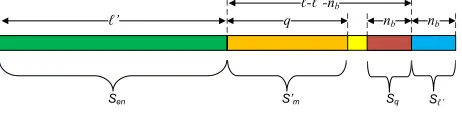
Given a binary message (i.e. additional data)Smof lengthq≤`−`0−2nb, the CSP encryptsSmwith the secret key
Kdito obtain a sequenceSm0 as
Sm0 = Ψ(Sm, Kdi) (15)
whereΨrepresents the encryption function. It is worth mentioning that the encryption method described in section 3.1.2 (i.e. shuffling and stream cipher) cannot be used here to encrypt the message because the cloud user can apply a ”Chosen Plaintext Attack” [52] (CPA) to estimate both the CSP key and the shuffling key since he has access to the encrypted image that contains additional data12. This is described as follows. If the shuffling and stream cipher are applied, then
Sm0 = (Γ×Sm)⊕V (16)
whereSmis the plaintext message arranged column wise andV is a random sequence (i.e. a random column vector) of
lengthqgenerated with the stream cipher key.Γis a sparse invertible matrix of sizeq×qwith integers in[0,1]so that
∀i∈ {1, 2,· · ·, q},
q
X
j=1
Γ(i, j) = 1 (17)
This is a pseudo random matrix that represents the shuffling key. Note thatΓ×ΓT =I
q. The matrix product(Γ×Sm)in
(16) describes the shuffling operation. Mathematically speaking, breaking the shuffling and stream cipher systems means
ACCEPTED MANUSCRIPT
the estimation ofΓandV. This is because from (16) one can estimate the plaintext message from the ciphertext as
Sm= ΓT ×(Sm0 ⊕V) (18)
Because the cloud user (acting as an attacker here) can have full control over the data to insert (see Fig. 1(b)), he may choose a message as follows. Denote bySn
m,n∈ {1, 2,· · ·, q}a sequence derived fromSmas
Smn(i) =
Sm(i) if i6=n
˜
Sm(i) Otherwise
(19)
where˜·represents the bit flipping operation andi∈ {1, 2,· · ·, q}. LetS0n
m be the shuffled and encrypted version ofSmn
with the same shuffling and encryption keys by using (16). That is,
Sm0n = (Γ×Smn)⊕V (20)
BecauseSm0 andS
0n
m differ in only one bit (and so is the difference betweenSm andSmn), one can deduce the only
non-zero value (that is equal to one) in thekthrow ofΓfor each value ofnas
Γ(k, j) =
0 if j 6=n
1 Otherwise
(21)
wherekis the index for whichSm0 (k)6=S
0n
m(k). In view of (21), it is clear that by varyingnin[1, q]the attacker can
constructΓcompletely. OnceΓis estimated, the attacker uses (16) to estimateV as follows
V = (Γ×Sm)⊕Sm0 (22)
In this paper, the Advanced Encryption Standard (AES) [53] is used for encrypting Smwith a key length of 128.
This is a symmetric block cipher with a block size of128bits. AES is nowadays broadly adopted and supported in both hardware and software. Furthermore, no practical cryptanalytic attacks against AES have been reported in the literature. The algorithm operates on blocks of4×4bytes through a number of rounds. (10rounds for a128-bit key). Each of these rounds makes use of a different128-bit round key, which is derived from the original AES key (This process is known
as key expansion). In each round, the bytes are substituted using a fixed table called S-box and then shifted. Next, the columns of the4×4bytes are combined using an invertible linear transformation before they are XORed to the128bits
of the round key. The decryption process follows the same steps in the reverse order [53].
Denote bySqthe binary representation ofq. We also propose to usenbbits to representSq. The CSP then reads the
encrypted image in binary form and substitutes the firstqbits ofS0
ACCEPTED MANUSCRIPT
[image:16.595.188.419.106.163.2]withSqso that the receiver knows the length of the inserted sequence. The encrypted marked bit stream is illustrated by
Fig. 4. In the same way as described in subsection 3.1.3, the creation of the encrypted image that contains additional data
Sℓ’
Sen S’m
ℓ’
ℓ-ℓ’-nb
nb
nb
Sq
q
Figure 4: Structure of the bit stream used to generate an encrypted image containing additional data.
uses the idea of byte representation in the bit stream to make pixels. The Insertion Rate (IR) measures the capacity of
data insertion in bits per pixel (bpp) and is defined as
IR= λ×(`−`0−2nb)
` (23)
3.2. Data extraction and image recovery
Upon receipt of the encrypted marked image, the receiver converts it into the corresponding bit stream and extracts the inserted data and/or recover the image according to the keys available as follows.
3.2.1. Data extraction
The receiver readsS`0 andSq to determine the start and end point of the encrypted sequenceSm0 in the received bit
stream. Here, the data extraction key represents the encryption key that was used to encrypt and append additional data. Therefore, the receiver applies the AES decryption algorithm usingKdito obtain the inserted sequenceSmas
Sm= Ψ−1(S0m, Kdh) (24)
whereΨ−1represents the AES decryption process.
3.2.2. Image recovery
The receiver reads`0 to determine the end point of the shuffled and encrypted bit streamS
en. Here, the decryption
key is the same as the encryption key (i.e., symmetric encryption). With the decryption key, the random binary sequence
r(i),(i= 1,· · · , `0)can be generated. The shuffled sequenceS
shcan be obtained by decryptingSenas
Ssh(i) =Sen(i)⊕r(i) (25)
Next,Sshcan be de-shuffled to get the compressed bit streamScas
ACCEPTED MANUSCRIPT
whereΦ−1 is the de-shuffling function. Finally, the lossless image decoder is used to decompressS
c and recover the
original image.
3.2.3. Data extraction and image recovery
If all the keys are available, the receiver can interchangeably extract the additional data and recover the original image. First, by readingS`0andSq, the receiver knows the start point and length of each of the sequences that represent the image
and additional data. The same keys that were used to encrypt the image and additional data will serve for data extraction and image recovery as follows. The AES decryption algorithm is used with the keyKdi to extract the sequenceSmas
given by (24). Then, the random binary sequencer(i),(i = 1,· · ·, `0)can be generated from the decryption key and
the shuffled sequenceSshcan be obtained by decryptingSenas in (25). OnceSshis obtained, a de-shuffling process is
conducted to deduce the compressed bit streamScas given by (26). Eventually, the decompression ofScwith the lossless
image decoder gives the original image.
4. Experimental analysis and discussion
In this section, the performance of the proposed system is analyzed in two different aspects: data insertion capacity
andsystem security.
4.1. Data insertion capacity
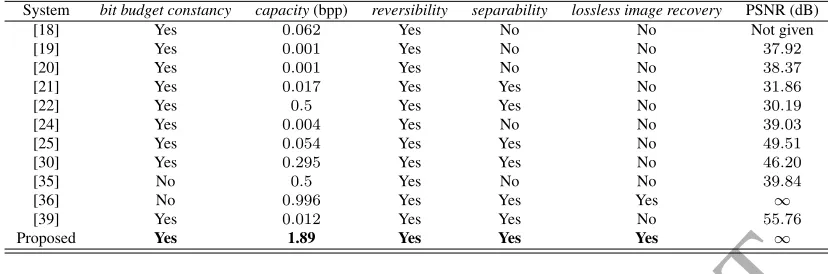
Here, the data insertion capacity, measured byIR, is evaluated on a number of512×512gray level standard images. It is worth noting that the insertion rate strongly depends on the performance of the lossless coder, i.e. the better the compression performance, the higher the insertion rate. Table. 2 depicts the values ofIRfor images of different contents. As can be seen, the insertion rate exceeds3bpp for all images except the ’Baboon’ image which is characterized by highly
Table 2: Obtained Insertion Rate on standard images.
Image Lena Barbara Peppers F-16 Baboon Goldhill Boat Couple Average
ER(bpp) 3.69 3.22 3.38 4.02 1.89 3.16 3.60 3.16 3.26
textured and edged regions. Such images are difficult to compress and hence the room reserved for data insertion is smaller when compared to smooth and less textured images. We note, however, that the obtained insertion rate for ’Baboon’ is significantly higher than the ones reached by existing RDH-EI systems as will be shown later. Fig. 5 illustrates the original ’Peppers’ image, its encrypted version, and the encrypted one containing additional data at an insertion rate of
ACCEPTED MANUSCRIPT
(a) (b) (c)
Figure 5: Data insertion in encrypted ’Peppers’ at3.38bpp. (a) Original image. (b) Encrypted image. (c) Encrypted image with additional data.
Table 3: Comparison between the proposed approach and existing RDH-EI systems on ’Lena’.
System bit budget constancy capacity(bpp) reversibility separability lossless image recovery PSNR (dB)
[18] Yes 0.062 Yes No No Not given
[19] Yes 0.004 Yes No No 37.94
[20] Yes 0.005 Yes No No 38.08
[21] Yes 0.017 Yes Yes No 39.00
[22] Yes 0.5 Yes Yes No 39.53
[24] Yes 0.004 Yes No No 38.59
[25] Yes 0.18 Yes Yes No 49.90
[28] Yes 0.101 Yes Yes No 38.30
[30] Yes 0.295 Yes Yes No 63.10
[31] Yes 0.062 Yes Yes No 33.06
[35] No 0.5 Yes No No 39.83
[36] No 0.996 Yes Yes Yes ∞
[39] Yes 0.04 Yes Yes No 55.87
[40] Yes 0.61 Yes Yes No 40.00
Proposed Yes 3.69 Yes Yes Yes ∞
worth mentioning here that the systems which rely on pixel variation in small spatial regions to recover the original image such as [19], [20], and [31] fail to produce a lossless version of ’Baboon’ and to extract additional data correctly at an embedding rate of0.016bpp even if the receiver possesses all the keys. This is mainly due to the content of this image
which is highly textured. As a result, the difference in neighboring pixel values appears similar before and after data hiding. In the tables provided below, the data insertion capacity of such systems is calculated so that the reversibility is guaranteed. As can be seen, the proposed approach offers significantly better performance than the RDH-based approach and provides suitable features for the aforementioned model of cloud computing. Observe that [36] is the
Table 4: Comparison between the proposed approach and existing RDH-EI systems on ’F-16’.
System bit budget constancy capacity(bpp) reversibility separability lossless image recovery PSNR (dB)
[18] Yes 0.062 Yes No No Not given
[22] Yes 0.5 Yes Yes No 42.19
[25] Yes 0.18 Yes Yes No 49.92
[31] Yes 0.156 Yes Yes No 32.38
[35] No 0.5 Yes No No 39.84
[36] No 0.996 Yes Yes Yes ∞
[39] Yes 0.04 Yes Yes No 58.25
[40] Yes 1.0 Yes Yes No 40.00
ACCEPTED MANUSCRIPT
Table 5: Comparison between the proposed approach and existing RDH-EI systems on ’Baboon’.
System bit budget constancy capacity(bpp) reversibility separability lossless image recovery PSNR (dB)
[18] Yes 0.062 Yes No No Not given
[19] Yes 0.001 Yes No No 37.92
[20] Yes 0.001 Yes No No 38.37
[21] Yes 0.017 Yes Yes No 31.86
[22] Yes 0.5 Yes Yes No 30.19
[24] Yes 0.004 Yes No No 39.03
[25] Yes 0.054 Yes Yes No 49.51
[30] Yes 0.295 Yes Yes No 46.20
[35] No 0.5 Yes No No 39.84
[36] No 0.996 Yes Yes Yes ∞
[39] Yes 0.012 Yes Yes No 55.76
Proposed Yes 1.89 Yes Yes Yes ∞
Table 6: Comparison between the proposed approach and existing RDH-EI systems on ’Peppers’.
System bit budget constancy capacity(bpp) reversibility separability lossless image recovery PSNR (dB)
[18] Yes 0.062 Yes No No Not given
[19] Yes 0.005 Yes No No 38.03
[20] Yes 0.005 Yes No No 38.05
[21] Yes 0.034 Yes Yes No 31.82
[22] Yes 0.5 Yes Yes No 36.87
[25] Yes 0.126 Yes Yes No 49.76
[35] No 0.5 Yes No No 39.83
[36] No 0.996 Yes Yes Yes ∞
Proposed Yes 3.38 Yes Yes Yes ∞
only system among existing ones in the literature that can provide lossless image recovery with the encryption key only. However, as mentioned earlier, this system uses an asymmetric encryption technique involving a bandwidth overhead and consequently the size of the ciphertext (i.e. encrypted image) is larger than the size of the plaintext (i.e. original image). The comparative results show that RDHEI techniques cannot offer an optimal solution for cloud applications that involve digital images. It is, however, worth mentioning that some techniques that use the RDH-based approach could be used effectively on uncorrelated signals, such as textual data, in which correlation within the adjacent samples cannot be exploited by compression-based methods. In this context, the techniques proposed in [35, 36, 37] could be applied effectively in such scenarios.
Further enhancements to the proposed system could be obtained in terms of the data insertion capacity. Indeed, the EBCOT lossless coder has been shown in [54][55] to perform better than CALIC and LOCO-I13 on color images.
It has also been adopted by the FBI for compression of high-resolution gray level fingerprint images. However, results reported in [56][57] have revealed the superiority of CALIC over EBCOT and LOCO-I on medical and biomedical images. Therefore, the type of images used in the cloud should be taken into consideration in order to optimize the performance of the system.
4.2. Security analysis
There are two main components in the proposed system for cloud applications: the cloud user who sends an encrypted image along with additional data to the CSP on one hand. On the other hand, the CSP who inserts additional data in
ACCEPTED MANUSCRIPT
(a) (b) (c)
Figure 6: Result of XORing two images. (a) Baboon. (b) Boat. (c) XORed images.
the encrypted image and grants access to the encrypted image that contains additional data upon request. Therefore, security requires that the image content cannot be disclosed by the CSP and the inserted data cannot be extracted by the cloud user [58]. Since the AES encryption system is adopted for encrypting additional data (see subsection 3.1.4), the cloud user will have to break the AES in order to extract the inserted data. To the best of our knowledge, the only attack on AES that has been reported in the literature is called the eXtended Sparse Linearization (XSL) attack [59] and this has been shown to be inefficient in practice [60]. Thus, the CSP side can be considered highly secure. As for the security of the could user’s data (image), the proposed technique takes advantage of the randomness and de-correlation that the compressed bit stream exhibits to enhance security. In fact, from the attacker’s perspective, encrypting a random uncorrelated sequence makes the task of estimating its content harder than a correlated and uniform sequence. In current systems that adopt the RDH approach [19, 20, 21, 22, 24, 28, 30, 31, 40], the stream cipher is applied on the image using its spatial representation. However, because the CSP can observe multiple encrypted images, he can apply an attack as follows. Denote bySi
o,i∈ {1,2}theithoriginal sequence and bySeiits encrypted version. Then
S1
e =S1o⊕Ke
S2
e =S2o⊕Ke
(27)
whereKeis the key stream. In view of (27), we have
S1e⊕S2e = So1⊕Ke⊕So2⊕Ke
= S1
o⊕So2 (28)
ACCEPTED MANUSCRIPT
content of the two images is partially disclosed. This illustrates a clear security weakness in previous works which can be remedied here in the compressed domain.
5. Conclusion
In this paper, a model for storing and sharing data securely through the cloud has been presented. RDH-EI has been recently suggested as an approach to ensure secure and privacy-preserving applications for data sharing and management in the cloud, limitations have been reported on the efficiency of conducting RDH in such applications. To address security issues in the cloud more efficiently, a new approach that does not use the process of RDH has been proposed. This is based on the idea of reserving room before encryption via a wavelet-based lossless image coder. Compared with state-of-the-art RDH-EI systems, the proposed approach has been shown to offer a significantly higher data insertion capacity with suitable features for the presented cloud model. Furthermore, our analysis shows that the CSP can perform an attack to partially disclose the content of images encrypted with a stream cipher in the existing RDH-EI approach. Alternatively, the proposed approach protects the image content in a more reliable way as the stream cipher is applied on the compressed bit-stream.
6. Acknowledgement
The authors
References
[1] H. Hu, Y. Wen, T.-S. Chua, X. Li, Toward scalable systems for big data analytics: A technology tutorial, IEEE Access 2 (2014) 652–687.
[2] Y. Luo, D. Tao, K. Ramamohanarao, C. Xu, Y. Wen, Tensor canonical correlation analysis for multi-view dimension reduction, IEEE Transactions
on Knowledge and Data Engineering 27 (2015) 3111–3124.
[3] Y. Luo, Y. Wen, D. Tao, Heterogeneous multitask metric learning across multiple domains, To appear in IEEE Transactions on Neural Networks
and Learning Systems, accessed on http://ieeexplore.ieee.org/document/8058002/.
[4] Y. Wang, K. N. Plataniotis, An analysis of random projection for changeable and privacy-preserving biometric verification, IEEE Transactions on
Systems, Man, and Cybernetics-Part B, Cybernetics 40 (2010) 1280–1293.
[5] M. Lim, P. Yuen, Entropy measurement for biometric verification systems, IEEE Transactions on Cybernetics 46 (2016) 1065–1077.
[6] M. Johnson, P. Ishwar, V. M. Prabhakaran, D. Schonberg, K. Ramchandran, On compressing encrypted data, IEEE Transactions on Signal
Pro-cessing 52 (2004) 2992–3006.
[7] W. Liu, W. Zeng, L. Dong, Q. Yao, Efficient compression of encrypted grayscale images, IEEE Transactions on Image Processing 19 (2010)
1097–1102.
[8] S. Lian, Z. Liu, Z. Ren, H. Wang, Commutative encryption and watermarking in video compression, IEEE Transactions on Circuits and Systems
ACCEPTED MANUSCRIPT
[9] X. Gao, C. Deng, X. Li, D. Tao, Geometric distortion insensitive image watermarking in affine covariant regions, IEEE Transactions on Systems,
Man, and Cybernetics-Part C 40 (2010) 278–286.
[10] Z. Ni, Y.-. Shi, N. Ansari, W. Su, Reversible data hiding, IEEE Transactions on Circuits and Systems for Video Technology 16 (2006) 354–362.
[11] L. An, X. Gao, X. Li, D. Tao, C. Deng, J. Li, Robust reversible watermarking via clustering and enhanced pixel-wise masking, IEEE Transactions
on Image Processing 21 (2012) 3598–3611.
[12] X. Li, W. Zhang, X. Gui, B. Yang, Efficient reversible data hiding based on multiple histograms modification, IEEE Transactions on Information
Forensics and Security 10 (2015) 2016–2027.
[13] C. Deng, X. Gao, X. Li, D. Tao, A local tchebichef moments-based robust image watermarking, Signal Processing 89 (2009) 1531–1539.
[14] X. Gao, C. Deng, X. Li, D. Tao, Geometric distortion insensitive image watermarking in affine covariant regions, IEEE Transactions on Systems,
Man, and Cybernetics, Part C 40 (2010) 278–286.
[15] Z. Qian., X. Zhang, Lossless data hiding in JPEG bitstream, The Journal of Systems and Software 85 (2012) 309–313.
[16] S.-W. Jung, Lossless embedding of depth hints in JPEG compressed color images, Signal Processing 122 (2016) 39–51.
[17] J.-C. Chang, Y.-Z. Lu, H.-L. Wu, A separable reversible data hiding scheme for encrypted JPEG bitstreams, Signal Processing 133 (2017) 135–143.
[18] W. Puech, M. Chaumont, O. Strauss, A reversible data hiding method for encrypted images, in: Proc. SPIE 6819, Security, Forensics,
Steganog-raphy, and Watermarking of Multimedia Contents, Vol. X-68191E, San Jose, CA, USA, 2008.
[19] X. Zhang, Reversible data hiding in encrypted image, IEEE Signal Processing Letters 18 (2011) 255–258.
[20] W. Hong, T.-S. Chen, H.-Y. Wu, An improved reversible data hiding in encrypted images using side match, IEEE Signal Processing Letters 19
(2012) 199–202.
[21] X. Zhang, Separable reversible data hiding in encrypted image, IEEE Transactions on Information Forensics and Security 7 (2012) 826–832.
[22] K. Ma, W. Zhang, X. Shao, N. Yu, F. Li, Reversible data hiding in encrypted images by reserving room before encryption, IEEE Transactions on
Information Forensics and Security 8 (2013) 553–562.
[23] S. Yi, Y. Zhou, Binary-block embedding for reversible data hiding in encrypted images, Signal Processing 133 (2017) 40–51.
[24] C. Qin, X. Zhang, Effective reversible data hiding in encrypted image with privacy protection for image content, Journal of Visual Communications
and Image Representation 31 (2015) 154–164.
[25] D. Xu, R. Wang, Separable and error-free reversible data hiding in encrypted images, Signal Processing 123 (2016) 9–21.
[26] Z. Lin, G. Ding, J. Han, J. Wang, Cross-view retrieval via probability-based semantics-preserving hashing, IEEE Transactions on Cybernetics 47
(2017) 4342–4355.
[27] Y. Guo, G. Ding, L. Liu, J. Han, L. Shao, Learning to hash with optimized anchor embedding for scalable retrieval, IEEE Transactions on Image
Processing 26 (2017) 1344–1354.
[28] X. Zhang, Z. Qian, G. Feng, Y. Ren, Efficient reversible data hiding in encrypted images, Journal of Visual Communications and Image
Represen-tation 25 (2014) 322–328.
ACCEPTED MANUSCRIPT
[30] Z. Qian, X. Zhang, Reversible data hiding in encrypted image with distributed source encoding, IEEE Transactions on Circuits and Systems for
Video Technology 26 (2016) 636–646.
[31] X. Wu, W. Sun, High-capacity reversible data hiding in encrypted images by prediction error, Signal Processing 104 (2014) 387–400.
[32] Y. Fang, K. Ma, Z. Wang, W. Lin, Z. Fang, G. Zhai, No-reference quality assessment for contrast-distorted images based on natural scene statistics,
IEEE Signal Processing Letter 22 (2015) 838–842.
[33] Y. Fang, C. Zhang, J. Li, J. Lei, M. da Silva, P. le Callet, Visual attention modeling for stereoscopic video: a benchmark and computational model,
IEEE Transactions on Image Processing 26 (2017) 4684–4696.
[34] Y. Fang, J. Yang, J. Liu, S. Wang, Q. Li, Z. Gou, Objective quality assessment of screen content images by uncertainty weighting, IEEE
Transac-tions on Image Processing 26 (2017) 2016–2027.
[35] Y.-C. Chen, C.-W. Shiu, G.Horng, Encrypted signal-based reversible data hiding with public key cryptosystem, Journal of Visual Communications
and Image Representation 25 (2014) 1164–1170.
[36] X. Zhang, J. Long, Z. Wang, H. Cheng, Lossless and reversible data hiding in encrypted images with public key cryptography, IEEE Transactions
on Circuits and Systems for Video Technology 26 (2016) 1622–1631.
[37] J. Zhou, W. Sun, L. Dong, X. Liu, O. C. Au, Y. Y. Tang, Secure reversible image data hiding over encrypted domain via key modulation, IEEE
Transactions on Circuits and Systems for Video Technology 26 (2016) 441–452.
[38] Z. Yin, A. Abel, X. Zhang, B. Luo, Reversible data hiding in encrypted image based on block histogram shifting, in: Proc. IEEE International
Conference on Acoustics, Speech, and Signal Processing (ICASSP), Shanghai, China, 2016, pp. 2129–2133.
[39] W. Zhang, K. Ma, N. Yu, Rversibility improved data hiding in encrypted images, Signal Processing 94 (2014) 118–127.
[40] X. Cao, L. Du, X. Wei, D. Meng, X. Guo, High capacity reversible data hiding in encrypted images by patch-level sparse representation, IEEE
Transactions on Cybernetics 46 (2016) 1132–1143.
[41] L. Wei, H. Zhu, Z. Cao, X. Dong, W. Jia, Y. Chen, Security and privacy for storage and computation in cloud computing, Information Sciences
258 (2014) 371–386.
[42] M. Ali, S. U. Khan, A. V. Vasilakos, Security in cloud computing: Opportunities and challenges, Information Sciences 305 (2015) 357–383.
[43] D. Taubman, High performance scalable image compression with EBCOT, IEEE Transactions on Image Processing 9 (2000) 1158–1170.
[44] X. Wu, N. Memon, Context-based, adaptive, lossless image coding, IEEE Transactions on Communications 45 (1997) 437–444.
[45] M. J. Weinberger, G. Seroussi, G. Sapiro, The LOCO-I lossless image compression algorithm: Principles and standardization into JPEG-LS, IEEE
Transactions on Image Processing 9 (2000) 1309–1324.
[46] A. Skodras, C. Christopoulos, T. Ebrahimi, The JPEG 2000 still image compression standard, IEEE Signal Processing Magazine 18 (2001) 36–58.
[47] W. Zhang, Z. Jiang, Z. Gao, Y. Liu, An efficient VLSI architecture for lifting-based discrete wavelet transform, IEEE Transactions on Circuits and
Systems II 59 (2012) 158–192.
[48] A. R. Calderbank, I. Daubechies, W. Sweldens, B. L. Yeo, Wavelet transforms that map integers to integers, Journal of Applied and Computational
Harmonic Analysis 5 (1998) 332–369.
ACCEPTED MANUSCRIPT
[50] E. Biham, P. C. Kocher, Fast Software Encryption, Lecture notes in Computer Science, Springer, 1995, Ch. A known plaintext attack on the PKZIP
stream cipher, pp. 144–153.
[51] A. Biryukov, E. Kushilevitz, Advances in cryptology, Lecture notes in Computer Science, Springer, 1998, Ch. From differential cryptanalysis to
ciphertext-only attacks, pp. 72–88.
[52] A. Biryukov, Encyclopedia of Cryptography and Security, Springer, 2011, Ch. Chosen Plaintext Attack, pp. 205–206.
[53] J. Daemen, V. Rijmen, The Design of Rijndael, AES - The Advanced Encryption Standard, Springer-Verlag, 2002.
[54] S. Kim, N. I. Cho, Hierarchical prediction and context adaptive coding for lossless color image compression, IEEE Transactions on Image
Processing 23 (2014) 445–449.
[55] Y. Liu, O. Deforges, K. Samrouth, LAR-LLC: a low complexity multiresolution lossless image codec, IEEE Transactions on Circuits and Systems
for Video Technology 26 (2016) 1490–1501.
[56] D. A. Clunie, Lossless compression of grayscale medical images: effectiveness of traditional and state-of-the-art approaches, in: Proc. SPIE 3980,
Medical Imaging, Vol. 12-386389, San Diego, CA, USA, 2000.
[57] J. Taquet, C. Labit, Hierarchical oriented predictions for resolution scalable lossless and near-lossless compression of CT and MRI biomedical
images, IEEE Transactions on Image Processing 21 (2012) 2641–2652.
[58] F. Khelifi, On the security of a stream cipher in reversible data hiding schemes operating in the encrypted domain, Signal Processing 143 (2018)
336–345.
[59] N. T. Courtois, J. Pieprzyk, Advances in Cryptology, Lecture notes in Computer Science, Springer, 2002, Ch. Cryptanalysis of Block Ciphers with
Overdefined Systems of Equations, pp. 267–287.
[60] C.-W. Lim, K. Khoo, Fast Software Encryption, Lecture notes in Computer Science, Springer, 2007, Ch. An Analysis of XSL Applied to BES, pp.