© 2019, IRJET | Impact Factor value: 7.211 | ISO 9001:2008 Certified Journal | Page 2207
DEVELOPING COST PREDICTION MODEL FOR BUILDING PROJECT :
CONCLUSION
Dr. S Kanchana
1, Ms. Sisira Ramesh
21
Head of the Department, Department of Civil Engineering, RVS Technical Campus, Coimbatore-641402, India,
2
PG Student, Department of Civil Engineering, RVS Technical Campus, Coimbatore-641402, India
---***---Abstract -
The critical problem in the construction industry
is that building projects are completed at cost much higher than estimated project cost, hence it is essential to develop a cost prediction model that imprison all factors affecting the project cost using regression analysis through set of objectives such as: to locate the factors affecting the project cost; analyze the significance of the factors and develop cost predictive model. Literature review on the study stipulates that nature of clients, professional involved in a project and their choice regarding design, function, duration, technology and execution have significant effect on the overall project cost. Data for the study are obtained through random sampling of building projects completed in various location. The study points out the seven most exceptional factors to project cost such as: design related factors, time or cost related factors, parties experience related factors, financial issues related factors, bidding situations related factors , project characteristics related factors and estimating process related factors. These selected key factors are to be used for cost predictive model. The cost prediction model is developed with the help of SPSS software.
Key Words
:
SPSS MODEL, Cost estimation, Cost
prediction model.
1. INTRODUCTION
1.1 Scope and Research objectives
The research goal is to provide investors in the construction business with a tool to predict and quantify substantial risk associated to change. A regression model is developed in this research to predict project delay and cost increment using real project data of different construction types and different sizes for each type. Many factors affect accuracy of construction projects cost estimating. Through this study, factors affecting building construction projects cost estimating are discussed. Design-bid-build projects, executed by private companies in an open tendering are selected for the scope of this study. The main objectives of this study are: [1] Identifying factors affecting the accuracy of the building
construction projects cost estimating process. [2] Determining and testing the severity of factors that
affect the accuracy of the building construction projects‟ cost estimating using analysis of data collected from questionnaire form.
[3] Measuring the effects of the factors that severely affect the accuracy of the cost estimates and trying to link them.
[4] Developing a model that can be used to assess the expected cost variance. Identifying such variance can help in accurately determining the risk premium that should be added to the estimated cost.
2. RESULTS AND DISCUSSIONS
[image:1.595.302.566.374.783.2]2.1Response result
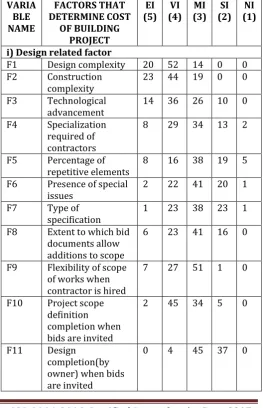
Table 3.1: Response Rate of Factors
VARIA BLE NAME
FACTORS THAT DETERMINE COST
OF BUILDING PROJECT
EI
(5) (4) VI (3) MI (2) SI (1) NI
i) Design related factor
F1 Design complexity 20 52 14 0 0 F2 Construction
complexity 23 44 19 0 0
F3 Technological
advancement 14 36 26 10 0 F4 Specialization
required of contractors
8 29 34 13 2
F5 Percentage of
repetitive elements 8 16 38 19 5 F6 Presence of special
issues 2 22 41 20 1
F7 Type of
specification 1 23 38 23 1 F8 Extent to which bid
documents allow additions to scope
6 23 41 16 0
F9 Flexibility of scope of works when contractor is hired
7 27 51 1 0
F10 Project scope definition
completion when bids are invited
2 45 34 5 0
F11 Design completion(by owner) when bids are invited
© 2019, IRJET | Impact Factor value: 7.211 | ISO 9001:2008 Certified Journal | Page 2208
F12 Design Decisionmade (by owner) when bids are invited
2 22 40 19 3
F13 Design completion when budget is fixed
23 43 20 0 0
ii) Time/cost related factors F14 Significance for
project to be completed within budget
34 46 6 0 0
F15 Importance for project to be delivered
2 29 48 7 0
F16 Time given to consultant to evaluate bids
0 27 40 19 0
F17 Extent to which contract period is allowed
to vary
6 36 33 11 0
F18 Importance for project to be completed on time
32 48 5 0 1
F19 Bidding
environment 2 29 42 13 0
F20 Consultant’s level of construction sophistication
19 46 21 0 0
F21 Owner’s level of construction sophistication
8 33 35 10 0
iii)Parties experience related F22 Contractor’s
experience with similar project
33 46 7 0 0
F23 Owners experience
with similar project 1 22 49 14 0 F24 Consultant staffing
level to attend to contractor
0 23 44 19 0
F25 Owners staffing level to attend to contractor
0 14 51 21 0
F26 Consultant’s experience with similar type of projects
1 26 48 11 0
F27 Contractor’s experience with similar size of projects
13 47 23 3 0
F28 Contractors
experience with 1 33 43 9 0
project in location F29 Subcontractor
experience and capability
3 29 34 18 2
F30 Communication among project team
36 43 6 1 0
F31 Contractor’s prior working
relationship with the owners
0 28 42 16 0
F32 Contractor prior working
relationship with consultant
0 21 51 13 1
F33 Contractor track record for completion on time
3 37 37 8 1
F34 Contractor track record for completion on quality
2 28 46 10 0
F35 Contractor track records for completion on budget
28 57 1 0 0
F36 Contractor staffing
level 0 20 44 22 0
F37 Adequacy of contractor plant and equipment
0 12 49 25 0
F38 Magnitude of change orders in contractor past project
4 46 33 3 0
iv)Financial issues F39 Accuracy of
estimated financing cost
2 54 28 2 0
F40 Availability of management and finance
plans
8 49 29 0 0
F41 Economic
instability 4 44 36 2 2
F42 Uncertainty of
taxes 1 23 45 17 0
F43 State of market 2 21 44 19 0 F44 Periodical
payments 2 36 39 9 0
F45 Currency exchange
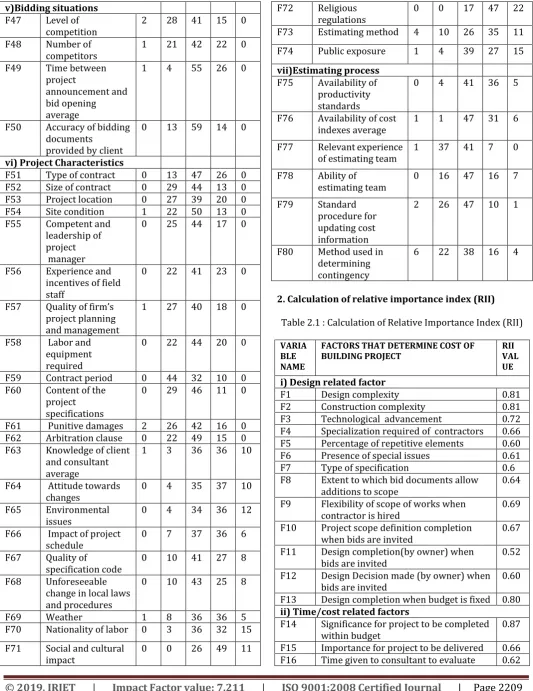
© 2019, IRJET | Impact Factor value: 7.211 | ISO 9001:2008 Certified Journal | Page 2209
v)Bidding situationsF47 Level of
competition 2 28 41 15 0
F48 Number of
competitors 1 21 42 22 0
F49 Time between project
announcement and bid opening average
1 4 55 26 0
F50 Accuracy of bidding documents
provided by client
0 13 59 14 0
vi) Project Characteristics
F51 Type of contract 0 13 47 26 0 F52 Size of contract 0 29 44 13 0 F53 Project location 0 27 39 20 0 F54 Site condition 1 22 50 13 0 F55 Competent and
leadership of project manager
0 25 44 17 0
F56 Experience and incentives of field staff
0 22 41 23 0
F57 Quality of firm’s project planning and management
1 27 40 18 0
F58 Labor and equipment required
0 22 44 20 0
F59 Contract period 0 44 32 10 0 F60 Content of the
project specifications
0 29 46 11 0
F61 Punitive damages 2 26 42 16 0 F62 Arbitration clause 0 22 49 15 0 F63 Knowledge of client
and consultant average
1 3 36 36 10
F64 Attitude towards
changes 0 4 35 37 10
F65 Environmental
issues 0 4 34 36 12
F66 Impact of project
schedule 0 7 37 36 6
F67 Quality of
specification code 0 10 41 27 8 F68 Unforeseeable
change in local laws and procedures
0 10 43 25 8
F69 Weather 1 8 36 36 5
F70 Nationality of labor 0 3 36 32 15 F71 Social and cultural
impact 0 0 26 49 11
F72 Religious
regulations 0 0 17 47 22
F73 Estimating method 4 10 26 35 11 F74 Public exposure 1 4 39 27 15 vii)Estimating process
F75 Availability of productivity standards
0 4 41 36 5
F76 Availability of cost
indexes average 1 1 47 31 6 F77 Relevant experience
of estimating team 1 37 41 7 0 F78 Ability of
estimating team 0 16 47 16 7 F79 Standard
procedure for updating cost information
2 26 47 10 1
F80 Method used in determining contingency
6 22 38 16 4
[image:3.595.31.565.98.790.2]2. Calculation of relative importance index (RII)
Table 2.1 : Calculation of Relative Importance Index (RII)
VARIA BLE NAME
FACTORS THAT DETERMINE COST OF
BUILDING PROJECT RII VAL
UE
i) Design related factor
F1 Design complexity 0.81
F2 Construction complexity 0.81
F3 Technological advancement 0.72 F4 Specialization required of contractors 0.66 F5 Percentage of repetitive elements 0.60 F6 Presence of special issues 0.61
F7 Type of specification 0.6
F8 Extent to which bid documents allow
additions to scope 0.64
F9 Flexibility of scope of works when
contractor is hired 0.69
F10 Project scope definition completion
when bids are invited 0.67
F11 Design completion(by owner) when
bids are invited 0.52
F12 Design Decision made (by owner) when
bids are invited 0.60
F13 Design completion when budget is fixed 0.80 ii) Time/cost related factors
F14 Significance for project to be completed
within budget 0.87
© 2019, IRJET | Impact Factor value: 7.211 | ISO 9001:2008 Certified Journal | Page 2210
bidsF17 Extent to which contract period is
allowed to vary 0.68
F18 Importance for project to be completed
on Time 0.85
F19 Bidding environment 0.64
F20 Consultant’s level of construction
sophistication 0.79
F21 Owner’s level of construction
sophistication 0.69
iii) Parties Experiences Related
F22 Contractor’s experience with similar
project 0.86
F23 Owners experience with similar project 0.62 F24 Consultant staffing level to attend to
contractor 0.61
F25 Owners staffing level to attend to
contractor 0.58
F26 Consultant’s experience with similar
type of projects 0.64
F27 Contractor’s experience with similar size of
projects
0.76
F28 Contractors experience with project in
location 0.66
F29 Subcontractor experience and
capability 0.63
F30 Communication among project team 0.86 F31 Contractor’s prior working relationship
with the owners 0.62
F32 Contractor prior working relationship
with consultant 0.61
F33 Contractor track record for completion
on time 0.67
F34 Contractor track record for completion
on quality 0.65
F35 Contractor track records for completion
on budget 0.86
F36 Contractor staffing level 0.59 F37 Adequacy of contractor plant and
equipment 0.57
F38 Magnitude of change orders in
contractor past project 0.72
iv)Financial issues
F39 Accuracy of estimated financing cost 0.73 F40 Availability of management and
finance plans 0.75
F41 Economic instability 0.72
F42 Uncertainty of taxes 0.62
F43 State of market 0.61
F44 Periodical payments 0.67
F45 Currency exchange fluctuation average 0.64
F46 Inflation pressure 0.62
v)Bidding situations
F47 Level of competition 0.64
F48 Number of competitors 0.6
F49 Time between project announcement
and bid opening average 0.55
F50 Accuracy of bidding documents
provided by client 0.59
vi) Project Characteristics
F51 Type of contract 0.57
F52 Size of contract 0.64
F53 Project location 0.62
F54 Site condition 0.62
F55 Competent and leadership of project
manager 0.62
F56 Experience and incentives of field staff 0.59 F57 Quality of firm’s project planning and
management 0.62
F58 Labor and equipment required 0.6
F59 Contract period 0.68
F60 Content of the project specifications 0.64
F61 Punitive damages 0.63
F62 Arbitration clause 0.62
F63 Knowledge of client and consultant
average 0.48
F64 Attitude towards changes 0.47
F65 Environmental issues 0.47
F66 Impact of project schedule 0.5 F67 Quality of specification code 0.52 F68 Unforeseeable change in local laws and
procedures 0.53
F69 Weather 0.52
F70 Nationality of labor 0.46
F71 Social and cultural impact 0.43
F72 Religious regulations 0.38
F73 Estimating method 0.51
F74 Public exposure 0.48
vii)Estimating process
F75 Availability of productivity standards 0.5 F76 Availability of cost indexes average 0.51 F77 Relevant experience of estimating team 0.67 F78 Ability of estimating team 0.56 F79 Standard procedure for updating cost
information 0.64
F80 Method used in determining
contingency 0.62
2.2 Position of rank in each factors
2.2.1. Design related factors
© 2019, IRJET | Impact Factor value: 7.211 | ISO 9001:2008 Certified Journal | Page 2211
Fig 2.1: RII value of design related factors2.2.2 Time or Cost related factors
The factor number TF1 that represents the factor, Significance for project to be completed within budget which has the highest RII Value i.e. 0.87therefore, it has highest rank i.e. 1.
Fig 2.2: RII value of Time/ Cost related factors
2.2.3 Parties experience related factors
[image:5.595.298.563.57.318.2]The factor number PF1 that represents the factor, Contractor’s experience with similar project, PF2 that Communication among project team and PF3 Contractor track records for completion on budget which has the highest RII Value i.e. 0.86(shown in red color in graph) therefore, it has highest rank i.e.1.
Fig. 2.3: RII value of parties experience related factors
2.2.4 Financial issues
The factor number FF1 that represents the factor, availability of management and finance plans which has the highest RII Value i.e. 0.75(shown in red color in graph) therefore, it has highest rank i.e.1
Fig. 2.4: RII value of financial issues related factors
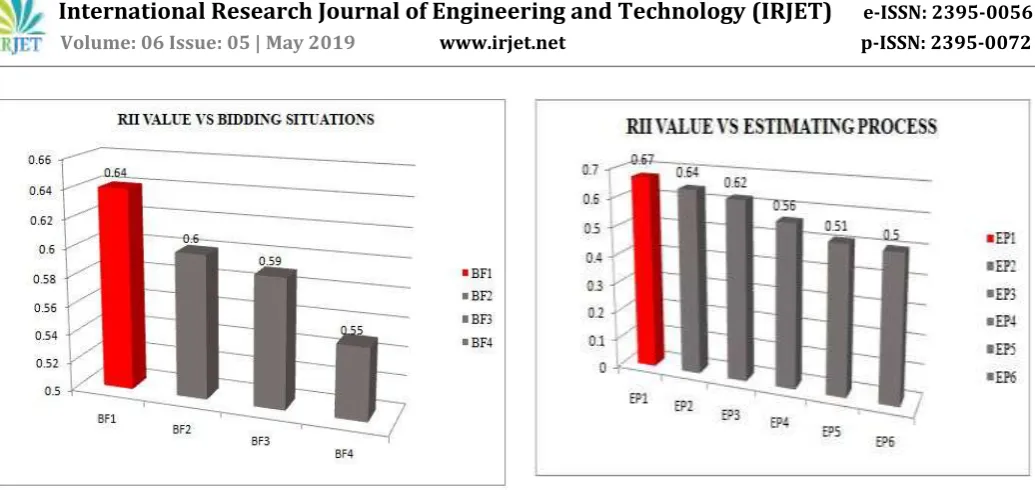
2.2.5 Bidding Situations
[image:5.595.35.265.416.588.2] [image:5.595.307.567.427.623.2]© 2019, IRJET | Impact Factor value: 7.211 | ISO 9001:2008 Certified Journal | Page 2212
Fig. 2.5: RII value of bidding situations related factors2.2.6 Project Characteristics
[image:6.595.42.560.50.295.2]The factor number PC1 that represents the factor, Contract period which has the highest RII Value i.e. 0.68, (shown in red color in graph) therefore, it has highest rank i.e.1.
Fig.2.6: RII value of Project characteristics
2.2..7 Estimating Process
The factor number EP1 that represents the factor, Relevant experience of estimating team which has the highest RII Value i.e. 0.67 (shown in red color in graph), therefore, it has highest rank i.e.1.
Fig.2.7: RII value of Estimating process
3.6 Ranking Result
From the above analysis first rank of Design related factor is Design complexity and construction complexity, first rank of Time/Cost related factors is Need for project to be completed within budget, first ranks of Parties experience related is Contractor’s experience with similar project, Contractor track records for completion on budget and Communication among project team, first rank of Financial issue related factors is Availability of management and finance plans, first rank of Bidding situation is Level of competition, first rank of Project Characteristics related factor is contract period, first rank of Estimating related factor is Relevant experience of estimating team.
FACTORS RII VALUE
1. Design complexity 0.81
2. Construction complexity 0.81
3. Significance for project to be completed
within budget 0.87
4. Contractor’s experience with similar project 0.86 5. Contractor track records for completion on
budget 0.86
6. Communication among project team 0.86 7. Availability of management and finance
plans 0.75
8. Level of competition 0.64
9. Contract period 0.68
10. Relevant experience of estimating team 0.67
[image:6.595.36.288.400.616.2]© 2019, IRJET | Impact Factor value: 7.211 | ISO 9001:2008 Certified Journal | Page 2213
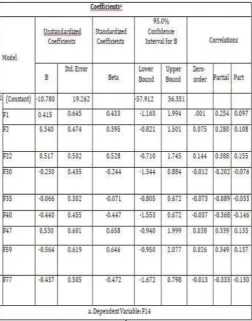
3.7 SPSS MODELFig 3.9: Regression Model Coefficients.
4. CONCLUSIONS
Studies and discussions were done on cost estimation in construction industry at various fields based on the journals collected. Eighty factors affecting cost estimation in construction fields are identified. The study indicates seven most significant factors as major contributor to cost of public building projects. Design related factors, Time or Cost related factors, Parties experience related, Financial issues, Bidding situations, Project Characteristics, Estimating Process. These amounts to seven factors and all these factors were used for the model estimation. The details regarding the topic is collected by questionnaire survey with the help of estimation engineer, site engineer, supervisor project manager, contractor and others and 86 questionnaire samples were obtained and were used for the study. The importance level and ranking of the factors were done by Likert’s scale method and RII technique. Most effective questionnaire was the Likert’s scale method in which each and every one can respond according to his/her will.
The research has shown that project cost depends largely on highest ranked factors such as Design complexity and Construction complexity having RII value 0.81, Significance
for project to be completed within budget having RII value 0.87, Contractor track records for completion on budget, Contractor’s experience with similar project and Communication among project team having RII value 0.86 Availability of management and finance plans having RII value 0.75 , Level of competition having RII value 0.64, Contract period having RII value 0.68, and Relevant experience of estimating team having RII value 0.67 .This study will be able to develop a predictive cost model using these selected factors that exhibit a significant effect on project cost and these factors accounted for the model. Further research is required for the model to be fully appreciated.
REFERENCES
[1] Afshin Firouzi, Wei Yang, and Chun-Qing.(2016), ‘Prediction of Total Cost of Construction Project with Dependent Cost Items’, Journal of Construction Engineering and Management, Vol. 142, No.12, pp.401-607.
[2] Amol Tatiya, Dong Zhao, Matt Syal,George H. Berghorn and Rex LaMore (2016), ‘Cost prediction model for building deconstruction in urban areas’, Journal of Cleaner Production, Vol. 195, No.15, pp.1572-1580. [3] Anthony K. Mason and Alice Smith (2013), ‘Cost
Estimation Predictive Modelling: Regression versus Neural Network’, The Engineering Economics, Vol. 42, No.2, pp.1-28.
[4] ChangYoonJi, TaeHoon Hong, and ChangTaek Hyun.(2014), ‘CBR Revision Model for Improving Cost Prediction Accuracy in Multifamily Housing Projects’, Journal of Management in Engineering, Vol. 26, No.4, pp.229-236.
[5] Cheong Peng Au Yong, Azlan Shah Ali and Faizah Ahmad (2013), ‘Establishing relationship between Characteristics of preventive maintenance and Cost performance’, RICS COBRA 2012, Vol. 11, No.13, pp.593-601.
[6] Faizah Ahmad, Cheong Peng Au-Yong and Azlan Shah Ali(2013), ‘Prediction cost maintenance model of offices Building based on Condition based maintenance’, Maintenance and Reliability, Vol.15, No.1, pp.309-314.
[7] Faizah Ahmad, Cheong Peng Au-Yong and Azlan Shah Ali(2014), ‘Prediction cost maintenance model of offices Building based on Condition based maintenance’, Maintenance and Reliabilty, Vol. 16, No.2, pp.319-324.