POUR POINT DEPRESSION AND ASPHA
NONIONIC SURFACTANTS
Khidr, T. T.,
Department of Analyses and
ARTICLE INFO ABSTRACT
Hexatriethanolamine monomyristate (HTAMM)
prepared by the reaction of hexatriethanol amine with myristic acid / laurate acid. The structure of the prepared compounds was confirmed by infrared spectroscopy. The prepared surfactants were investigated as pour point depressants (PPD)
pour point was obtained by
6ºC. HTAMM additive, show stronger interaction with wax tha
patterns of asphaltene in apsence and presence of investigated additives was studied. function of concentration of these surfactants in aqueous solutions was measured at 35, 45 and 55°C. measurements, the critical micelle concentration (CMC), the maximum surface excess concentration, Γ minimum area per molecule at the aqueous solution / air interface were calculated.
INTRODUCTION
If paraffin hydrocarbon liquids, including both crude oils and condensates, are cooled during transportation, the wax crystals tend to deposit on the cold pipe wall. If these deposits get too thick, they can reduce the capacity of the pipeline transportation and cause other problems. The temperature, at which the first crystal appears, called wax appearance temperature (WAT), which is considered as an important parameter(Misra et al., (2004). Waxy crude oils with high molecular weight paraffinic compounds at temperatures below WAT may separate as a wax phase, causing frequent shutdowns and operational problems during transportation, production, storage and consumption (Lashkarbolooki et al., 2011; Chen et al
et al. 2011; Deshmukh et al., 2008). In extreme cases, wax crystals may also cause oil to gel and lead to problems of restarting the pipeline, damaged zones in the formation, plugged tubing, and sludge deposits at the bottom of the tank. These deposits in the well bore can lead to restricted flow line pressure, decreased production and can cause mechanical problems (Mcclaflin, 1983). Indeed, pipe blockage removal can be very expensive (Nyvlt and Vevrka, 1997) Many methods have beenattempted for the prevention of the crystals mating together. Since, adding chemical additives, such as pour point depressants (PPDS), cold flow improvers, paraffin inhibitors or wax
crystal modifiers is the most convenient and economic waxy, it is widely used in the industry (Chen et al., 2009)
mechanism the aeries, adsorption, co-crystallization, nucleation and improved wax solubility are widely accepted by mechanism researchers (Zhang et al., 2004). Surface activity and micellar properties of surfactants (Osman et al. 2003; Al
Sugihara et al., 1995; Alxandridis et al., 1994; Voicu
Chatterjee et al., 2002; Burczyk et al., 2002) are one of the potential importance and scientific interest. Surfactants micellize in solution after a critical micelle concentration (CMC) depends on their
*Corresponding author: O.A.A. El-Shamy
Department of Analyses and Evaluation Egyptian Petroleum Research Institute EPRI, Nasr city 11727, Cairo, Egypt
ISSN: 0975-833X
International Journal of Current Research Vol.
Article History:
Received 28th
July, 2012 Received in revised form 10th
August, 2012 Accepted 14th
August 2012 Published online 30th
September 2012
Key words:
Surfactants, Surface activity, Pour point depressants, Crude oil, Wax, Asphaltene, X-Ray.
RESEARCH ARTICLE
POUR POINT DEPRESSION AND ASPHALTENE SOLUBILIZATION USING
NONIONIC SURFACTANTS
T. T.,
*O. A. A. El-Shamy and M. M. Doheim
Department of Analyses and Evaluation, Egyptian Petroleum Research Institute EPRI,
Nasr city 11727, Cairo, Egypt
ABSTRACT
exatriethanolamine monomyristate (HTAMM) and hexatriethanolamine monolaurate
prepared by the reaction of hexatriethanol amine with myristic acid / laurate acid. The structure of the prepared compounds was confirmed by infrared spectroscopy. The prepared surfactants were investigated as pour point epressants (PPD) for crude oil (PP= 21 ºC) from the evaluation, it was found that, the maximum depression of pour point was obtained by HTAMM (PP = 0 ºC) while minimum depression of pour point
6ºC. HTAMM additive, show stronger interaction with wax than HTAML additive. The X patterns of asphaltene in apsence and presence of investigated additives was studied. function of concentration of these surfactants in aqueous solutions was measured at 35, 45 and 55°C. measurements, the critical micelle concentration (CMC), the maximum surface excess concentration, Γ minimum area per molecule at the aqueous solution / air interface were calculated.
Copyright, IJCR, 2013, Academic Journals
If paraffin hydrocarbon liquids, including both crude oils and wax crystals tend to deposit on the cold pipe wall. If these deposits get too thick, they can reduce the capacity of the pipeline transportation and cause other problems. The temperature, at which the first crystal appears, called e (WAT), which is considered as an ., (2004). Waxy crude oils with high molecular weight paraffinic compounds at temperatures below WAT may separate as a wax phase, causing frequent shutdowns and transportation, production, storage and
et al., 2010; Aiyejina . In extreme cases, wax crystals may also cause oil to gel and lead to problems of restarting the damaged zones in the formation, plugged tubing, and sludge deposits at the bottom of the tank. These deposits in the well bore can lead to restricted flow line pressure, decreased production and can . Indeed, pipeline Nyvlt and Vevrka, 1997). attempted for the prevention of the crystals mating together. Since, adding chemical additives, such as pour point n inhibitors or wax crystal modifiers is the most convenient and economic waxy, it is ., 2009). Among the crystallization, nucleation and d by mechanism ., 2004). Surface activity and micellar . 2003; Al-Sabagh 1998; ., 1994; Voicu et al., 1994; are one of the potential importance and scientific interest. Surfactants micellize in solution after a critical micelle concentration (CMC) depends on their
Egyptian Petroleum Research
molecular structure and environmental conditions (Moulik, 1996; Clint, 1991). The concept of the CMC value is very useful and perhaps the most frequently measured and discussed mice parameter (Osman et al. 2003). Surface tension is one of the widely used physico-chemical property in aqueous / air interface to determine CMC value without serious difficulty (El
2005). Through surface tension versus concentration cur several parameters are derived (Zuo et al
2011). The present work deals with the synthesis and evaluation of some type of additive; hexatriethanolamine monomyristate (HTAMM) and hexatriethanolamine monolaurate ( HTAML) point depressants for crude oil, also the intend to study the interaction between two synthesized additives and wax constituent in crude oil through x- ray diffraction.
Experimental
Materials
Triethanolamine, Myristic and lauric acids were
Aldrich Chemicals. Isolation of the crude: Western waxy crude oil was used for evaluating the performance of the synthesized pour point depressants. Their physicochemical characteristic is given in Table 1. Asphaltene and wax were isolated from the crude by International petroleum (IP) procedure no. 143.
Esterification of hexa-triethanolamine (General procedure)
Hexatriethanolamine (HTA) was prepared according to the was mention method (El-Shamy 2008), the ester was prepared by the following method, 1mol of the prepared HTA was added to myristic acid (1mol) / lauric acid (1mol) in three necked flask in the presence of p- toluene sulfonic acid (0.005 mol, 0.086g) as a cata
reaction mixture was heated at 150 ºC with continuous stirring until the theoretical amount of water was collected. The product was purified by washing with a hot solution of 5 % sodium carbonate and then dissolved in petroleum ether (b.p. 40
was separated and the solvent was distilled off
ternational Journal of Current Research Vol. 4, Issue, 09, pp.201-205, September,2012
INTERNATIONAL
OF CURRENT RESEARCH
TENE SOLUBILIZATION USING
Egyptian Petroleum Research Institute EPRI,
hexatriethanolamine monolaurate (HTAML) have been prepared by the reaction of hexatriethanol amine with myristic acid / laurate acid. The structure of the prepared compounds was confirmed by infrared spectroscopy. The prepared surfactants were investigated as pour point from the evaluation, it was found that, the maximum depression of minimum depression of pour point of HTAML was PP = n HTAML additive. The X- ray diffractometer patterns of asphaltene in apsence and presence of investigated additives was studied. Surface tension as a function of concentration of these surfactants in aqueous solutions was measured at 35, 45 and 55°C. From these measurements, the critical micelle concentration (CMC), the maximum surface excess concentration, Γmax, the minimum area per molecule at the aqueous solution / air interface were calculated.
, Academic Journals. All rights reserved.
molecular structure and environmental conditions (Moulik, 1996; Clint, 1991). The concept of the CMC value is very useful and perhaps the most frequently measured and discussed micellar . 2003). Surface tension is one of the widely chemical property in aqueous / air interface to determine CMC value without serious difficulty (El-Gazawy et al., 2005). Through surface tension versus concentration curves (SVC),
et al., 2004; El-Shamy et al., 2011). The present work deals with the synthesis and evaluation of ; hexatriethanolamine monomyristate hexatriethanolamine monolaurate ( HTAML) as pour point depressants for crude oil, also the intend to study the interaction between two synthesized additives and wax constituent in crude oil
, Myristic and lauric acids were purchased from Aldrich Chemicals. Isolation of the crude: Western waxy crude oil was used for evaluating the performance of the synthesized pour point depressants. Their physicochemical characteristic is given in Table 1. rom the crude by International
thanolamine (General procedure)
Hexatriethanolamine (HTA) was prepared according to the was Shamy 2008), the ester was prepared by the following method, 1mol of the prepared HTA was added to myristic acid (1mol) / lauric acid (1mol) in three necked flask in the presence toluene sulfonic acid (0.005 mol, 0.086g) as a catalyst. The reaction mixture was heated at 150 ºC with continuous stirring until the theoretical amount of water was collected. The product was purified by washing with a hot solution of 5 % sodium carbonate and then dissolved in petroleum ether (b.p. 40-60 ºC). the organic layer was separated and the solvent was distilled off (Hafiz and Khidr,
2007; Hafizand Abdou, 2003). The products obtained was hexa-triethanolamine monomyristate (HTAMM) and hexahexa-triethanolamine monolaurate (HTAML) after collecting 18g of water.
Surface tension measurements
The surface tensions of the tested samples were measured in aqueous solution by DeNouy Tensiometer (kruss K6 type) at different temperature ranged from 35, 45 and 55 ºC. Freshly prepared aqueous solution of the product (HTAMM and HTAML) in deionized water was prepared with a concentration range 0.01-10 mmol/L. The ring was washed twice after each reading first by ethanol then distilled water. The critical micelle concentration (CMC) of the investigated surfactants were determined and listed in Table 2. The surfactant concentration above the CMC were adequately diluted so that only monomer surfactant solutions were analyzed (El-Feky, A.A. et al., 2010).
Structure confirmation the prepared additives
The structure of the prepared additive was confirmed by using Forier Trasimition Infrared FTIR spectroscopic analysis Egyptian Petroleum Research Institute (EPRI) using model Genesis series (USA) infrared spectro-photometer doping KBr technique.
Evaluation tests of the prepared compound as pour point depressants
Pour point measurement (ASTM D 97)
Solution of crude oil soluble samples in toluene contains 10% active materials are prepared according to ASTM D 97 method. Different concentrations (100, 250, 500, 1000 and 2000 ppm) of PPD solutions were injected into the crude oil and tested as pour point depressants.
X-Ray Diffraction Spectroscopy
The structure of the asphaltene isolates from crude oil and asphaltene + 2000 ppm (HTAMM) and asphaltene + 2000 ppm (HTAML) were characterized using X-ray powder diffractometer, PANalytical X'Pert PRO MPD (Netherland). Cu Kα radiation with wave length= 1.5418 Å was used at a rating of 40 kV, 40 mA. The diffraction patterns were recorded at room temperature in the angular range of 4-70º (2θ) with step size 0.02 º (2 θ) and scan step time 0.4 (s). The crystalline phases were identified using the ICDD-PDF database.
RESULTS AND DISCUSSION
Chemical structure
The chemical structure of the prepared nonionic surfactant was confirmed by the FTIR spectra of the synthesized nonionic surfactants showed absorption band that corresponding to the (HTAMM) and (HTAML) .The absorption band at 1730 cm1 indicates the formation
of ester group. The absorption band at 2930 cm1 is corresponded to the stretching of the two groups CH2, CH3 in the fatty chains and
other band appears at 1036 cm-1, 1153 cm-1 corresponded to C–O and C–N groups respectively illustrated Figure (1 a, b).
Surface properties
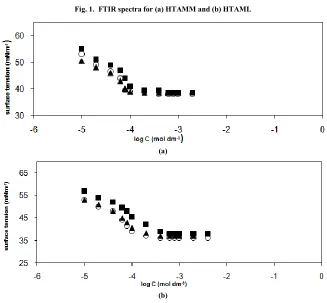
The CMC of the investigated surfactants at (35, 45 and 55 ºC) were determined by plotting the surface tension (γ) versus log concentration as shown in Figure (2 a, b). The abrupt change in the slope of (γ) versus log C. The CMC values are listed in Table together with other surface parameters. By carful inspection to the values of the CMC, it can be concluded that at 35 ºC the CMC increase as the hydrophobicity decrease. This increase may arise from the crowding that take place inside the micellar core leads to an increase in the surfactant – surfactant repulsion and hence alters the micelle formation (Rosen, 1978). The data listed in Table (2) shown decrease
in the CMC with temperature for all samples. This behavior may be due to increased temperature, which caused desolvation of the surfactant molecules. The surface tension data were used to calculate the surface excess concentration Γmax in mol / cm2 by applying Gibbs
equation (Rosen, 1978).
Γmax = -. (1)
Where R = universal gas constant (8.314 J/mol) and T = TC + 273.
The Γmax values in Table (1) were used to calculate the minimum area
per molecule, Amin in nm2/molecule at the aqueous phase interface
using the relationship:
Amin = (2)
[image:2.612.315.551.244.336.2]Where, NA: Avogadro's number, 6.023 x 10²³.
Table 1. Physical characteristics of crude oil
Properties Methods Result
Specific gravity at 60/60oF IP 160/87 0.8412 Kinematics viscosity at 40o
C (cst) IP 71/80 3.7
Pour point (pp), o
C IP 15/67(80) 21
Sulfur content (wt%) IP 266/87 0.723
Asphaltene content, (wt%) IP 143 0.828
Wax content, (wt%) UOP 46/64 12.822
Total paraffins content (wt%) ASTM D2887 (GLC) 95.180
n-paraffin (wt%) ASTM D2887 (GLC) 89.330
Iso-paraffins (wt%) ASTM D2887 (GLC) 05.850
The data obtained for Γmax and Amin were presented in Table (2). The
effect of temperature on surface area, generally increasing the temperature caused two opposite effects (Rosen, 1976) these are: 1-Decrease in the area per molecule at the interface resulting from the increase in the dehydration around the surfactant molecule upon increasing the temperature. Increase in the area per molecule due to orientation as a result of the thermal molecular motion at high temperature. For our surfactants under investigation, the dehydration effect has a priority over the orientation effect. Table 2 was shown the effectiveness (πcmc), which determines the surface activity of the
surfactant molecule at their CMCs. πcmc may be attributed to the
increase in the area occupied at the interface . It was found that for all surfactants under investigation, πcmc decrease with increase with
increase in temperature from 35, 45 and 55 ºC.
Influence of the synthesized additives on the pour point depression
The two synthesized additives were tested as pour point depressants through pour point determinations according to ASTM- 97 procedure at concentration 100, 250, 500, 1000 and 2000ppm. Results given in Table (3) show that almost all additives achieved moderate pour point depression at concentration 1000ppm. In case of the HTAMM compound achieved the preferred pour point depression for the crude oil (PP = 21oC ) at the concentration 1000 ppm than the additive HTAML at (PP = 15oC ). `This is due to the increase of the number
of carbon atoms which cause a decrease of the crystallization ability of pendant chain of myristate so inhibition of the wax crystal formation should be obtained accordingly, the matching average pendant chain length of additive with paraffin distribution of oil provided the greatest pour point depression.
Concentration effect on pour point depression
Table 2. The surface properties of the investigated surfactants
Surfactants Chemical Formula T ºC CMC
(mmol/L) πCMC (mNm-1
)
Гmax X10 10
(mol cm-2 )
Amin (Å) HTAMM [C13H27COOCH2CH2NCH2CH2OHCH2CH2O-]6 35 2.10 32.5 2.66 0.26
45 1.75 23.0 2.58 0.64
55 1.50 31.5 3.47 0.48
HTAML [C11H23COOCH2CH2NCH2CH2OHCH2CH2O-]6 35 2.80 32.0 2.64 0.74
45 1.91 31.5 3.17 0.52
55 1.61 30.5 3.41 0.49
(a)
[image:3.612.144.471.405.708.2](b)
Fig. 1. FTIR spectra for (a) HTAMM and (b) HTAML
(a)
(b)
Table 3. The effect of additives on the pour point of crude oil
Additives Additive concentrations, ppm PP, o
C PP, o C
HTAMM
0 21 0
100 15 6
250 12 9
500 6 15
1000 0 21
2000 0 21
HTAML
0 21 0
100 18 3
250 15 6
500 9 12
1000 6 15
2000 6 15
and modifies their crystals. In general, at lower additives concentrations side way growth of the crystal faces may be slightly restricted and accordingly, the crystal grows relatively (slower, however) crystallization may still be able to form. At higher concentrations of the additives, the side way growth becomes so much more difficult for the wax crystal (Andre, et al., 2001).
X-Ray diffraction measurements
X-Ray diffraction investigation of asphaltene in absence and presence of prepared surfactants (200 ppm). The particle size of asphaltene with in presence of 2000ppm HTAMM and asphaltene with 2000ppm from HTAML were determined by using the Scherer equation (Cullity, 1967)
= (3)
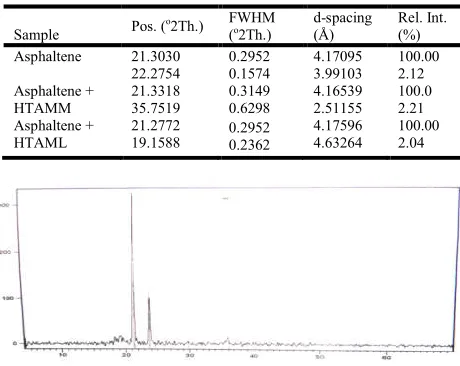
Where d is the mean particle diameter, B is Scherer constant (0.89), λ is wave length of the x- ray beam = 1.5405Å, β is full – width half maximum FWHM of diffraction lines, and θ is the diffraction angle. The computed values of particle size (Table 4) showed increasing the order of asphaltene with 2000 ppm of HTAMM = 2.19 < asphaltene with 2000 ppm of HTAML= 5.89 < Asphaltene = 8.88. The PPD additives are considered to be well in the primitive molecular orientating and nucleating process. HTAMM is considered more efficient than HTAML. Figure 3 represent the XRD spectrogram for HTAMM additives. The PPD molecules will get into the lattice part of wax crystal cells causing change in the surface properties of the wax crystals. It will also bring the n-alkane molecules to deposit on the surface of the wax crystals. Adsorption can also decrease the plane density, but the changes of the surface properties of the wax crystal are different than those with co- crystallization.
Fig. 3. XRD spectra for asphaltene in presence of 200 ppm from HTAMM
Conclusions
The conclusion of this work can be addressed in the following points:
Synthesis hexatriethanolamine monomyristate (HTAMM) and hexatriethanolamine monolaurate (HTAML) have been prepared by the reaction of hexatriethanol amine with myristic acid / laurate acid.
Surface properties were discussed and show that the CMC increase with increasing the hydrophobicity, while it decrease with increasing the temperature.
Surface excess calculated and found to be increased with temperature.
HTAMM achieved the preferred pour point depression for the crude oil (∆PP1000ppm = 21oC ) than the additive HTAML
(∆PP1000ppm = 15oC).
It was found that the efficiency of the prepared compound as PPD increases with increasing the concentration of the prepared additive.
Study X-Ray diffraction of asphaltene and asphaltene with different additives.
REFERENCES
Aiyejina, A.; Chakrabarti, D. P.; Pilgrim, A. and Sastry, M. K. S. 2011. Wax formation in oil pipeline. International Journal of Multiphase Flow 37: 671-694.
Al-Sabagh, A.M. 1998. Surface and thermodynamic properties of p-alkylbenzene polyethoxylated and glycerated sulfonate derivative surfactants. Colloids Surf. A: Physicochem. Eng. Asp. 134: 313-320.
Alxandridis, P.; Holzwarth, J.F.; Hatton, T.A. 1994. Micellization of Poly (ethylene oxide)-Poly (propylene oxide)-Poly (ethylene oxide) Tri block Copolymers in Aqueous Solutions: Thermodynamics of Copolymer Association. Macromol. 27: 2414-2425.
Andre, L.C., Machado, A.B., Elizabete, F., Lucas, A. and Gaspar GonZalez, B. 2001. Poly(ethylene-co-vinyl acetate) (EVA) as Wax Inhibitor of a Brazilian Crude Oil: Oil Viscosity, Pour Point and Phase Behavior of Organic Solutions. J. petrol. Sci. Eng. 32:159.
Burczyk, B.; Wilk, K.A.; Sokolowski, A.; Syper, L. 2001. Synthesis and Surface Properties of N-Alkyl-N-methylgluconamides and N-Alkyl-N-methyllactobionamides. J. Colloid Interf. Sci. 240: 552-558.
Chatterjee, A.; Maiti, S.; Sanyal, S.K.; Moulik, S.P. 2002. Micellization and Related Behaviors of N-Cetyl-N-ethanolyl-N, N-dimethyl and N-Cetyl-N, N-diethanolyl-N-methyl Ammonium Bromide. Langmuir 18: 2998-3004.
Chen, W. H.; Zhang, X. D.; Zhao, Z. C. and Yin, C. Y. 2009. Unique model for wax solution with pour point depressant. Fluid Phase Equilib. 280: 9-15.
Chen, W.; Zhao, Z. and Yin, C. 2010. The interaction of waxes with pour point depressants. Fuel 89: 1127-1132.
Clint, J.H. 1991. Surfactant aggregation. Chapman and Hall, New York.
Cullity, X.B.D. 1967. Element of X-Ray Diffraction 3rd ed., Addison – Wesley, 1967.
Deshmukh, S. and Bharambe, D. P. 2008. Synthesis of polymeric pour point depressants for Nada crude oil (Gujarat, India) and its impact on oil rheology. Fuel Process. Technol. 89: 227-233. El-Feky, A.A.; Shalaby, M.N.; El-Shamy, O.A.A.; Selim, S.A. 2010.
Adsorption of some surfactants onto polyvinyl alcohol as hydrophobic polymer surface. J. Disp. Sci. and Technol. 31: 1091-1099.
El-Gazawy, R.A. 2005. Surface and thermodynamic properties for some polyoxyylated trimethylolopropane monoester surfactants. Colloids and Surf. A: Physicochem. Eng. Asp. 260: 1-6. El-Shamy O.A.A. 2008. Study of Some Physicochemical Properties
for Surfactant Polymer Systems and Their Application as
Table 4. X-Ray Diffraction results of the asphaltene in absence and presence of additive
Sample Pos. (
o
2Th.) FWHM (o
2Th.)
d-spacing (Å)
Rel. Int. (%) Asphaltene 21.3030
22.2754
0.2952 0.1574
4.17095 3.99103
100.00 2.12 Asphaltene +
HTAMM
21.3318 35.7519
0.3149 0.6298
4.16539 2.51155
100.0 2.21 Asphaltene +
HTAML
21.2772 19.1588
0.2952 0.2362
4.17596 4.63264
[image:4.612.63.293.538.721.2]Remidial Agents for Water, PhD thesis, Faculty of Science, Ain Shams Univ. Egypt
El-Shamy, O.A.A.; Khidr, T.T.; Doheim, M.M. 2011. Effect of Ethoxlate chain length on the pour point deprresant of middle distillate fuel oil. J. Disp. Sci. and Technol. 32: 654-658. Hafiz, A.A.; Abdou, M.I. 2003. Synthesis and evaluation of
polytriethanolamine monooleate for oil-based muds. J. Surfactants Deterg. 6: 243-251.
Hafiz, A.A.; Khidr, T.T. 2007. Hexa-triethanolamine oleate esters as pour point depressant for waxy crude oils. J. of Petroleum Sci. and Eng. 56: 296-302.
Lashkarbolooki, M., Esmaeilzadeh, F. and Mowla, D. 2011. J. Mitigation of wax deposition by wax-crystal modifier for Kermanshah crude oil. Disp. Sci. and Technol.; 32: 975-985. Mcclaflin, G.G. 1983. Process Integration, Modeling and decrease in
production, and various mechanical problems. SPE 12204 presented at 58th Annual Conference of SPE, San Francisco, CA, October.
Misra, S., Baruah, S., and Singh, K. 2004. Crude oil production and transportation: a review. Soc. Pet. Eng., 10: 50-54
Moulik, S.P. 1996. Micelles self-organized surfactant assemblies. Corr. Sci. 71: 368-375.
Nyvlt, J. and Veverka, F. 1997. Scale formation on cooling surfaces in crystallizers. Ceyst. Res. Technol., 32: 773-781.
Osman, M.M.; El-Ghazawy, R.A.; Al-Sabagh, A.M. 2003. Corrosion inhibitor of some surfactants derived from maleic-oleic acid adduct on mild steel in 1 M H2SO4. Mat. Chem. Phys. 80: 55-62.
Rosen, M.J. 1976. The relationship of structure to properties in surfactants IV. Effectiveness in surface or interfacial tension reaction. J. Colloid and Interf. Sci. 56: 320-327.
Rosen, M.J. 1978. Surfactants and Interfacial phenomena. John Wiley & Sons, New York.
Sugihara, G.; Arakawa, Y.; Tanaka, K.; Lee, S.; Moroi, Y. 1995.
Micelle Formation and Counterion Binding of
Dodecylammonium Alkanesulfonates in Water at Different Temperatures. J. Colliod Interf. Sci. 170: 399-406.
Voicu, A.; Elian, M.; Balcan, M.; Anghel, D.F. 1994. Synthesis and micellar properties of some homogeneously ethoxylated nonyl- phenols. Tenside Surf Det 31: 120–122.
Zhang, J., Wu, C., Li, W., Wang, Y. and Cao, H. 2004. DFT and MM Calculation: The Performance Mechanism of Pour Point Depressants Study. Fuel 83: 315-326.
Zuo, Y.Y.; Ding, M.; Bateni, A.; hoorfar, M.; Neumann, A.W. 2004. Improvement of interfacial tension measurement using a captive bubble in conjunction with axisymmetric drop shape analysis. Colloids and Surf. A: Physicochem. Eng. Asp. 250: 233-246.