Proceedings of the 2019 Conference on Empirical Methods in Natural Language Processing and the 9th International Joint Conference on Natural Language Processing, pages 3304–3313,
3304
Domain Adaptive Text Style Transfer
Dianqi Li1, Yizhe Zhang2, Zhe Gan2, Yu Cheng2, Chris Brockett2, Ming-Ting Sun1, Bill Dolan2 1University of Washington 2Microsoft Corporation
{dianqili,mts}@uw.edu
{Yizhe.Zhang,Zhe.Gan,Yu.Cheng,Chris.Brockett,billdol}@microsoft.com
Abstract
Text style transfer without parallel data has achieved some practical success. However, in the scenario where less data is available, these methods may yield poor performance. In this paper, we examine domain adaptation for text style transfer to leverage massively available data from other domains. These data may demonstrate domain shift, which impedes the benefits of utilizing such data for training. To address this challenge, we propose simple yet effective domain adaptive text style trans-fer models, enabling domain-adaptive infor-mation exchange. The proposed models pre-sumably learn from the source domain to: (i) distinguish stylized information and generic content information; (ii) maximally preserve content information; and (iii) adaptively trans-fer the styles in a domain-aware manner. We evaluate the proposed models on two style transfer tasks (sentiment and formality) over multiple target domains where only limited non-parallel data is available. Extensive ex-periments demonstrate the effectiveness of the proposed model compared to the baselines.
1 Introduction
Text style transfer, which aims to edit an input sentence with the desired style while preserving style-irrelevant content, has received increasing at-tention in recent years. It has been applied suc-cessfully to stylized image captioning (Gan et al.,
2017), personalized conversational response gen-eration (Zhang et al., 2018a), formalized writ-ing (Rao and Tetreault, 2018), offensive to non-offensive language transfer (dos Santos et al.,
2018), and other stylized text generation tasks (Akama et al.,2017;Zhang et al.,2019).
Text style transfer has been explored as a sequence-to-sequence learning task using parallel datasets (Jhamtani et al., 2017). However, par-allel datasets are often not available, and
hand-annotating sentences in different styles is expen-sive. The recent surge of deep generative mod-els (Kingma and Welling,2013;Goodfellow et al.,
2014) has spurred progress in text style trans-fer without parallel data by learning disentangle-ment (Hu et al.,2017;Shen et al.,2017;Fu et al.,
2018;Li et al., 2018; Prabhumoye et al., 2018). These methods typically require massive amounts of data (Subramanian et al.,2018), and may per-form poorly in limited data scenarios.
A natural solution to the data-scarcity issue is to resort to massive data from other domains. However, directly leveraging abundant data from other domains is problematic due to the discrep-ancies in data distribution on different domains. Different domains generally manifest themselves
in domain-specific lexica. For example,
senti-ment adjectives such as “delicious”, “tasty”, and “disgusting” in restaurant reviews might be out of place in movie reviews, where the sentiment words such as “imaginative”, “hilarious”, and “dramatic” are more typical. Domain shift ( Gret-ton et al.,2009) is thus apt to result in feature mis-alignment.
In this work, we take up the problem of domain adaptation in scenarios where the target domain data is scarce and misaligned with the distribution in the source domain. Our goal is to achieve suc-cessful style transfer into the target domain, with the help of the source domain, while the trans-ferred sentences carry relevant characteristics in the target domain.
We present two first-of-their-kind domain adap-tive text style transfer models that facilitate domain-adaptive information exchange between
the source and target domains. These models
fa-cilitates better content preservation on the target
domain. Meanwhile, domain-specific
informa-tion, implicitly imposed by domain vectors and domain-specific style classifiers, underpins the transferred sentences by generating target-specific lexical terms.
Our contributions in this paper are threefold:
(i) We explore a challenging domain
adapta-tion problem for text style transfer by leverag-ing massively-available data from other domains. (ii) We introduce simple text style transfer mod-els that preserve content and meanwhile trans-late text adaptively into target-domain-specific
terms. (iii) We demonstrate through
exten-sive experiments the robustness of these meth-ods for style transfer tasks (sentiment and formal-ity) on multiple target domains where only lim-ited non-parallel data is available. Our
implemen-tation is available at https://github.com/
cookielee77/DAST.
2 Related Work
Text Style Transfer. Text style transfer using neural networks has been widely studied in the past few years. A common paradigm is to first dis-entangle latent space as content and style features, and then generate stylistic sentences by tweak-ing the style-relevant features and passtweak-ing through a decoder. Hu et al. (2017); Fu et al. (2018);
Shen et al.(2017);Yang et al.(2018);Gong et al.
(2019);Lin et al.(2017) explored this direction by assuming the disentanglement can be achieved in an auto-encoding procedure with a suitable style regularization, implemented by either adversarial discriminators or style classifiers. Li et al.(2018);
Xu et al.(2018);Zhang et al.(2018c) achieved dis-entanglement by filtering the stylistic words of in-put sentences. Recently,Prabhumoye et al.(2018) has proposed to use back-translation for text style transfer with a de-noising auto-encoding objec-tive (Logeswaran et al.,2018;Subramanian et al.,
2018). Our work differs in that we leverage do-main adaptation to deal with limited target dodo-main data, whereas previous methods require massive target domain style-labelled samples.
Domain Adaptation. Domain adaptation has been studied in various natural language process-ing tasks, such as sentiment classification (Qu et al.,2019), dialogue system (Wen et al.,2016), abstractive summarization (Hua and Wang,2017;
Zhang et al.,2018b), machine translation (Koehn
and Schroeder, 2007; Axelrod et al., 2011; Sen-nrich et al.,2016b;Michel and Neubig,2018), etc. However, little or no work explores domain adap-tation on text style transfer. To the best of our knowledge, we are the first to explore the adapta-tion of text style transfer models to a new domain with limited non-parallel data available. The task requires both style transfer and domain-specific generation on the target domain. To differenti-ate different domains,Sennrich et al.(2016a);Chu et al.(2017) appended domain tokens to the input sentences. Our model uses learnable domain vec-tors combining domain-specific style classifiers, which force the model to learn distinct stylized in-formation in each domain.
3 Preliminary
We first describe a standard text style transfer ap-proach, which only considers data in the target domain. We limit our discussion to the scenario where only non-parallel data is available, since large amounts of parallel data is typically not fea-sible.
Given a set of style-labelled sentences T =
{(xi, li)}Ni=1 in the target domain, the goal is to
transfer sentencexi with styleli to a sentenceexi with another styleeli, whereeli 6= li. li,eli belong to a set of style labels lT in the target domain:
li,eli ∈ lT. Typically, an encoder encodes the input xi to a semantic representation ci, while a decoder controls or modifies the stylistic property and decodes the sentencexei based on ci and the pre-specific styleeli.
Specifically, we denote an encoder-decoder model as(E, D). The semantic representationci of sentencexi is extracted by the encoderE, i.e., ci =E(xi). The decoderDaims to learn a condi-tional distribution ofxei given the semantic repre-sentationciand styleeli:
pD(exi|ci,eli) =
T
Y
t=1 pD(xe
t i|xe
<t
i , ci,eli), (1)
wherexe
t
iis thetthtoken ofexi, andxe
<t
i is the prefix ofexiup to thet
thtoken.
Directly estimating Eqn. (1) is impractical dur-ing traindur-ing due to a lack of parallel data(xi,xei). Alternatively, the original sentencexishould have high probability under the conditional distribution
reconstruc-tion loss could be formulated as:
LTae=− E xi∼T
logpD(xi|ci, li). (2)
Note that we assume that the decoderDrecovers
xi’s original stylistic property as accurate as pos-sible when given the style labelli. To achieve text style transfer, the decoder manipulates the style of generated sentences by replacingli with a de-sired styleeli. Specifically, the generated sentence
e
xi is sampled from exi ∼ pD(xei|ci,eli). How-ever, by directly optimizing Eqn. (2), the encoder-decoder model tends to ignoring the style labels and collapses to a reconstruction model, which might simply copy the input sentence, hence fails to transfer the style. To force the model to learn meaningful style properties,Hu et al.(2017,2018) apply a style classifier for the style regularization. The style classifier ensures the encoder-decoder model to transferexiwith its correct style labeleli:
LTstyle=− E
e
xi∼pD(exi|ci,eli)
logPCT(eli| e
xi), (3)
whereCT is the style classifier pretrained on the target domain. The overall training objective for text style transfer within the target domain T is written as:
LT =LTae+LTstyle. (4)
4 Domain Adaptive Text Style Transfer
In this section, we present Domain Adaptive Style Transfer (DAST) models to perform style transfer on a target domain by borrowing the strength from a source domain, while maintaining the transfer to be domain-specific.
4.1 Problem Definition
Suppose we have two sets of style-labelled sen-tences S = {(x0i, li0)}N0
i=1, T = {(xi, li)}Ni=1 in
the source domainSand the target domainT, re-spectively. x0i denotes theith source sentence. li0
denotes the corresponding style label, which be-longs to a source style label set: l0i ∈ lS (e.g., positive/negative).l0ican be available or unknown. Likewise, pair(xi, li)represents the sentence and style label in the target domain, whereli ∈lT.
We consider domain adaptation in two settings: (i) the source stylelS is unknown, e.g., we may have a large corpus, such as Yahoo! Answers, but the underlying style for each sample is not avail-able; (ii) the source styles are available, and are
the same as the target styles, i.e., lT = lS, e.g., both IMDB movie reviews and Yelp restaurant re-views have the same style classes (negative and positive sentiments).
In both scenarios, we assume that the target
do-mainT only has limited non-parallel data. With
the help of source domain data S, the goal is to transfer (xi, li) to (xei,eli) in the target domain. The transferred sentencexeishould simultaneously hold:(i)the main content withxi,(ii)a different styleeli fromli, and(iii) domain-specific charac-teristics of the target data distributionT.
4.2 DAST with unknown-stylized source data
In this section, we investigate the case that the
source style lS is unknown. We first examine a
drawback of limited target data to motivate our method. With limited target data, Eqn. (4) may yield an undesirable transferred text, where the generated text tends to use the most discriminative words that the target style prefers while ignoring the content. This is because the classifierCT typi-cally requires less data to train than a sequence au-toencoder(E, D). The classifier objectiveLTstyle
thus dominates Eqn. (4), rendering the generator to bias the sentences with most representative styl-ized (e.g., positive or negative) words rather than preserving the contents (see Table5for examples). We consider alleviating this issue by leverag-ing massive source domain data to enhance the content-preserving ability, though the underlying
styles in the source domain are unknown. By
jointly training an auto-encoder on both the source and target domain data, the learned generic con-tent information enables the model to yield better content preservation on the target domain.
To utilize the source data, we consider that lS
only contains a special unknown-style label lu,
separated from the target style lT. We assume
the semantic representation of the source data c0i
is encoded by the encoder, i.e.,c0i = E(x0i). The decoder takesc0i with stylelu to generate the sen-tences on the source domain. The auto-encoding reconstruction objective of the source domain is:
LSae=− E x0
i∼S
logpD(x0i|c0i, lu), (5)
where the encoder-decoder model (E, D) is
shared in both domains. Therefore, the
corre-sponding objective can be written as:
Encoder Decoder
Shared Shared
Source domain
Encoder Decoder
Target domain
Encoder Decoder
Shared Shared
Source domain
Encoder Decoder
[image:4.595.72.522.63.158.2]Target domain
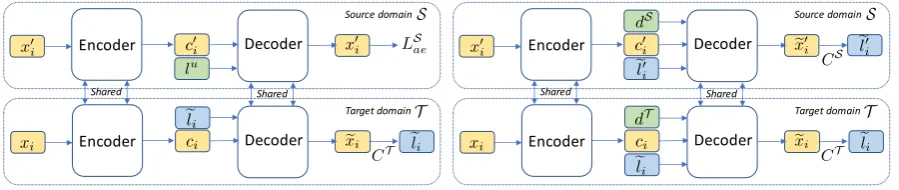
Figure 1: Illustration of the proposedDAST-C(left) andDAST(right) model. DAST-C learns the generic content information throughLSaeon massive source domain data with unknown stylelu. For DAST,dT, dS andCT, CS
denote domain vectors and domain-specific style classifiers, respectively. Better looked in color.
This can be perceived as combining the source do-main data with the target dodo-main data to train a better encoder-decoder framework, while target-specific style information on the target domain is learned throughLTstyle.
Note that LTae and LSae are conditional on domain-specific styles labels: lT and lu, which implicitly encourages the model to learn domain-specific features. The decoder could thus generate target sentences adaptively withlT, while achiev-ing favorable content preservation with the generic content information modeled byLSae. We refer this model, which is illustrated in Figure1(left), as Do-main Adaptive Style Transfer with generic Content preservation (DAST-C).
4.3 DAST with stylized source data
We further explore the scenario wherelS =lT. In this case, besides the generic content information, there is much style information from the source domain that could be leveraged, e.g., generic styl-ized expressions like “fantastic” and “terrible” for sentiment transfer can be applied to both restau-rant and movie reviews. We thus consider to bor-row the full strength of the source data, by sharing learned knowledge on both the generic content and style information.
A straightforward way to achieve this is to train Eqn. (4) on both domains. However, simply mix-ing the two domains together will lead to unde-sirable style transfers, where the transfer is not domain-specific. For example, when adapting the IMDB movie reviews to the Yelp restaurant re-views, directly sharing the style transfer model without specifying the domain will inevitably re-sult in generations like“The pizza is dramatic!”.
To alleviate this problem, we introduce addi-tional domain vectors, encouraging the model to perform style transfer in a domain-aware manner. The proposed DAST model is illustrated in
Fig-ure1(right). Consider two domain vectors:dSfor the source domain anddT for the target domain, respectively. We rewrite the auto-encoding loss as:
LSae,T =− E x0
i∼S
logpD(x0i|c0i, dS, l0i)
− E
xi∼T
logpD(xi|ci, dT, li), (7)
where the encoder-decoder model (E, D) is
shared across domains. The domain vectors,dS,
dT, learned from the model, implicitly guide
the decoder to generate sentences with domain-specific characteristics. Note that li and l0i are shared, i.e., lT = lS. This enables the model to learn generic style information from both do-mains. On the other hand, explicitly learning pre-cise stylized information within each domain is crucial to generate domain-specific styles. Thus, two domain-specific style classifiers ensure the model to learn the corresponding styles by condi-tioning on(dS,eli0)in the source domain or(dT,eli) in the target domain:
LSstyle,T =− E
e x0
i∼pD(ex
0
i|c0i,dS,el0i)
logPCS(eli0|ex0i)
− E
e
xi∼pD(exi|ci,d
T,
eli)
logPCT(eli| e
xi), (8)
wherexe
0
i,exiare the transferred sentences with pre-specific styles el0i,eli in the source and target
do-mains, respectively. The domain-specific style
classifiers,CT andCS, are trained separately on
each domain. The signals from classifiers
en-courage the model to learn domain-specific styles combining with the domain vectors and style la-bels. The overall training objective of the pro-posed DAST model is:
LDAST=LSae,T +L S,T
style. (9)
conditioning on(dS,eli0) or(dT,eli), which in turn controls the model to generate sentences with domain-specific words. The model can thus dis-tinguish domain-specific features, and adaptively transfer the styles in a domain-aware manner.
5 Experiments
We evaluate our proposed models on two
tasks: sentiment transfer (positive-to-negative
and negative-to-positive), and formality transfer (informal-to-formal). In both tasks, we make com-parisons with previous approaches over multiple target domains. All experiments are conducted on one Nvidia GTX 1080Ti GPU.
5.1 Dataset
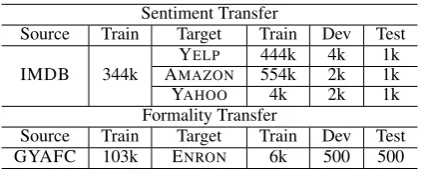
A statistics for the source and target corpora used in the experiments is summarized in Table1.
Sentiment Transfer
Source Train Target Train Dev Test
IMDB 344k
YELP 444k 4k 1k
AMAZON 554k 2k 1k
YAHOO 4k 2k 1k
Formality Transfer
Source Train Target Train Dev Test
[image:5.595.75.287.319.405.2]GYAFC 103k ENRON 6k 500 500
Table 1: Statistics of source and target datasets.
Sentiment Transfer. For the source domain, we
use IMDB movie review corpus (Diao et al.,
2014) by following the filtering and preprocessing pipelines fromShen et al.(2017). This results in 344ktraining samples with sentiment labels. For the target domain, both the Yelp restaurant review dataset and the Amazon product review dataset are fromLi et al.(2018). For the test sets, we evaluate
our methods by using1k human-transferred
sen-tences, annotated byLi et al.(2018), on both Yelp and Amazon datasets. In addition to the two stan-dard sentiment datasets, we manually collected a Yahoo sentimental question dataset - 7kquestion samples with sentiments from Yahoo! Answers dataset (Zhang et al.,2015). We split the7k sen-timental questions into4k/2k/1kfor train/dev/test sets, respectively. Note that the Yahoo sentiment dataset only consists of questions, which have different domain characteristics with the IMDB dataset. In all the sentiment experiments, we con-sider both transfer directions (positive-to-negative and negative-to-positive).
Formality Transfer. We use Grammarly’s
Ya-hoo Answers Formality Corpus (GYAFC) (Rao
and Tetreault, 2018) as the source dataset. The publicly released version of GYAFC only cov-ers two topics (Entertainment & Musicand Fam-ily & Relationships), where each topic contains 50kpaired informal and formal sentences written by humans. For the target domain, we use En-ron email conversation dataset1, which covers sev-eral different fields like Business, Politics, Daily Life, etc. We manually labeled 7k non-parallel
sentences written in either the formal or informal style. We split the Enron dataset into6k,500,500 samples for training, validation and testing, re-spectively. Both the validation and test set consist of mere informal sentences, where the correspond-ing formal references are annotated by us from a crowd-sourcing platform for evaluation. We only assess the informal-to-formal transfer direction in the formality transfer experiment.
5.2 Evaluation
Automatic Metrics. We evaluate the effective-ness of our DAST models based on three auto-matic metrics:
(i) Content Preservation. We assess the
con-tent preservation according to n-gram statistics, by measuring the BLEU scores (Papineni et al.,
2002) between generated sentences and human
references on the target domain, refered as
hu-manBLEU (hBLEU). When no human reference
is available (e.g., Yahoo), we compute the BLEU scores with respect to the input sentences.
(ii) Style Control. We generate samples from the model and measure the style accuracy with a style classifier that is pre-trained on the target domain. We refer the style accuracy as S-acc.
(iii) Domain Control. To validate whether the
generated sentences hold the characteristics of the target domain, we adopt a pre-trained domain clas-sifier to measure the percentage of generated sen-tences that belong to the target domain. We refer the domain accuracy as D-acc.
All the pre-trained classifiers are implemented by TextCNN (Kim,2014;Zhang et al.,2017). The test accuracy of all these classifiers used for evalu-ation are reported in AppendixA.1. FollowingXu et al. (2018), we also evaluate all methods using a single unified metric called G-score, which cal-culates the geometric mean of style accuracy and
hBLEU.
Yelp Amazon
Model (100% target data) D-acc S-acc hBLEU G-score D-acc S-acc hBLEU G-score
CrossAlign (Shen et al.,2017) - 85.0 3.7 8.3 - 23.0 34.1 18.0
Delete&Retrieve (Li et al.,2018) - 90.6 14.8 17.9 - 50.9 30.3 25.7
CycleRL (Xu et al.,2018) - 88.7 12.3 16.4 - 68.7 14.2 15.5
SMAE (Zhang et al.,2018c) - 85.1 12.1 15.5 - 71.1 12.9 14.9
ControlGen (Hu et al.,2018) 91.5 25.5 27.4 - 79.0 31.1 30.5
Finetune 96.1 91.3 25.6 27.8 97.4 79.2 34.1 34.3
DAST-C (ours) 93.8 91.7 25.7 27.5 96.7 81.9 35.7 35.0
DAST (ours) 95.8 92.3 26.3 28.9 96.9 83.0 35.9 35.1
Model (1% target data) D-acc S-acc hBLEU G-score D-acc S-acc hBLEU G-score
CrossAlign (Shen et al.,2017) - 76.3 4.8 8.5 - 83.2 2.0 5.9
Delete&Retrieve (Li et al.,2018) - 82.1 4.1 7.6 - 63.0 6.9 9.3
CycleRL (Xu et al.,2018) - 86.6 1.4 5.2 - 79.5 0.7 3.8
SMAE (Zhang et al.,2018c) - 96.0 1.2 4.8 - 87.2 0.4 3.2
ControlGen (Hu et al.,2018) - 98.5 3.7 8.6 - 83.2 1.9 5.8
Finetune 98.1 96.7 13.9 18.5 96.0 89.2 11.3 14.4
DAST-C (ours) 96.9 90.3 17.8 19.3 94.8 78.2 20.1 21.6
[image:6.595.88.511.62.280.2]DAST (ours) 97.0 92.6 20.1 23.1 94.6 82.7 21.0 23.1
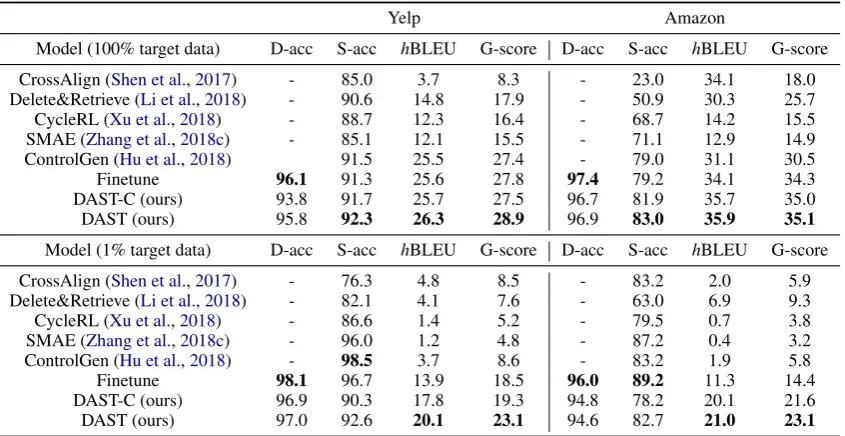
Table 2: Automatic evaluation results on Yelp and Amazon test sets. D-acc and S-acc denote domain accuracy and style accuracy, respectively. G-score is the geometric mean of S-acc andhBLEU.
Human Evaluation. To assess the quality of transferred sentences, we conduct human
evalu-ations based on the facets of content
preserva-tion,style controlandfluency, followingMir et al.
(2019). Previous works (Subramanian et al.,
2018; Gong et al., 2019) ask workers to evalu-ate the quality via a numerical score, however, we found that this empirically leads to high-variance
results. Instead, we pair transferred sentences
from two different models, and ask workers to
choose the sentence they prefer when compared
to the input on each evaluation aspect. We pro-vide a “No Preference” option to choose when the workers think the qualities of the two sentences are indistinguishable. Details of the human eval-uation instruction are included in Appendix A.3. For each testing, we randomly sample 100 sen-tences from the corresponding test set and collect three human responses for each pair on every eval-uation aspect, resulting in 2700 responses in total.
5.3 Experimental Setup
The encoder E and the decoder D are
imple-mented by one-layer GRU (Cho et al.,2014) with hidden dimensions 500 and 700, respectively. The domain-vector dimension is set to 50. The style labels are represented by learnable vectors with 150 dimensions. The decoder is initialized by a concatenation of representations of content, style, and domain vectors. If domain vectors are not used, the dimension of style labels is set to 200;
accordingly, the initialization of the decoder is a concatenation of content and style
representa-tions. TextCNN (Kim, 2014) is employed for
the domain-specific style classifiers pre-trained on corresponding domains. After pre-training, the pa-rameters of the classifiers are fixed. We use the hard-sampling trick (Logeswaran et al., 2018) to back-propagate the loss through discrete tokens from the classifier to the encoder-decoder model. During training, we assign each mini-batch the same amount of source and target data to balance the training.
We make an extensive comparison with
five state-of-the-art text style transfer
models: CrossAlign (Shen et al., 2017),
Delete&Retrieve (Li et al., 2018), CycleRL (Xu et al., 2018), SMAE (Zhang et al., 2018c) and ControlGen (Hu et al.,2018). We also experiment a simple and effective domain adaptation baseline - Finetune, which is trained with Eqn. (4) on the source domain and then fine-tuned on the target domain.
5.4 Results
0.1% 1.0% 10.0% 100.0% Percentage
80 85 90 95 100
Domain Accuracy(%) Finetune DASTC DAST
0.1% 1.0% 10.0% 100.0% Percentage
80 85 90 95 100
Style Accuracy(%) ControlGen Finetune DASTC DAST
0.1% 1.0% 10.0% 100.0% Percentage
0 5 10 15 20 25 30
BLEU
ControlGen Finetune DASTC DAST
0.1% 1.0% 10.0% 100.0% Percentage
0 5 10 15 20 25 30
Gscore
[image:7.595.74.524.61.179.2]ControlGen Finetune DASTC DAST
Figure 2: Results on Yelp test set in terms of different percentage of target domain data.0.1%≈400samples.
Style Control (Yelp1%data) Content Preservation (Yelp1%data) Fluency (Yelp1%data)
Our Model Neutral Comparison Our Model Neutral Comparison Our Model Neutral Comparison
DAST 56.2% 30.5% 13.3% ControlGen DAST 47.0% 48.4% 4.6% ControlGen DAST 47.1% 40.8% 12.0% ControlGen DAST 40.5% 42.3% 17.2% DAST-C DAST 22.4% 65.7% 11.9% DAST-C DAST 29.1% 55.8% 15.1% DAST-C DAST 17.9% 18.5% 63.6% Human DAST 17.7% 47.4% 34.9% Human DAST 10.1% 30.4% 59.5% Human
Style Control (Enron) Content Preservation (Enron) Fluency (Enron)
Our Model Neutral Comparison Our Model Neutral Comparison Our Model Neutral Comparison
[image:7.595.82.518.215.330.2]DAST 74.2% 19.8% 6% ControlGen DAST 80.8% 14.8% 4.4% ControlGen DAST 73.8% 20.6% 5.6% ControlGen DAST 28.4% 50.2% 21.4% DAST-C DAST 26.8% 48.8% 24.4% DAST-C DAST 26.9% 51.6% 21.5% DAST-C DAST 17.6% 30.5% 51.9% Human DAST 15.3% 36.9% 47.8% Human DAST 11.6% 36.5% 51.9% Human
Table 3: Results ofHuman Evaluationfor style control, content preservation and fluency, showing preferences (%) for DAST model vis-a-vis baseline or other comparison systems. Evaluation results of theoverall transfer qualityare provided in AppendixA.3.
Yahoo Sentiment Transfer
Model D-acc S-acc BLEU
ControlGen - 99.1 9.7
Finetune 97.8 98.8 31.4
DAST-C 90.7 98.8 35.9
DAST 90.8 99.2 39.2
Table 4: Results on Yahoo sentiment transfer task.
baselines on the sentiment transfer tasks in both the Yelp and Amazon domains.
Notably, when the target domain has limited data (1%), all baselines trained only on the target domain fail completely on content preservation. Finetune preserves better content but experiences the catastrophic forgetting problem (Goodfellow et al.,2013) to the source domain information. As a result, the overall style transfer performance is still nonoptimal. By contrast, with the help of the source domain, DAST obtains considerable con-tent preservation performance improvement when compared with other baselines. Our model also at-tains favorable performance in terms of style trans-ferring accuracy (S-acc), resulting in a good over-all G-score. In general, we observe that DAST-C is able to better preserve content information, while DAST further improves both content preser-vation and style control abilities. Additionally,
both DAST-C and DAST can adapt to the target domain, as evidenced by the high domain accuracy (D-acc). The human evaluation results (Table 3) show a strong preference of DAST over DAST-C as well as ControlGen in terms of style control, content preservation and fluency.
Finally, we evaluate our models on Yahoo senti-ment transfer task. As can be seen in Table4, both DAST and DAST-C achieve successful style trans-fer even if the target data is formed as questions which have a large discrepancy with the source IMDB domain. The samples of Yelp and Yahoo sentiment transfer are shown in Table5. We also investigate the effect of different source domain data, included in AppendixA.2.
[image:7.595.104.257.397.459.2]Yelp (positive-to-negative) Yelp (negative-to-positive)
Input the service was great , food delicious , and the value impeccable . and the pizza was cold , greasy , and generally quite awful . ControlGen the service washorrible,service,the service and very frustrated. and thefoodwasdelicious, delicious , and freaking tasty ,delicious.
Finetune the service waspoor, food..., and theexperience were. and the pizza was professional , friendly , and always havegreat. DAST-C the service washorrible, foodhorrible, and theslowsparse . and the pizza wasfresh, greasy , and generallyquite cool.
DAST the service washorrible, foodbland, and the valuelousy. and the pizza wastasty,juicy, and definitelyquite amazing. Human service was poor and the food expensive and weak tasting . the pizza was warm , not greasy , and generally tasted great .
Yahoo (positive-to-negative) Yahoo (negative-to-positive)
Input who is more romantic ? man or woman ? why do stupid questions constantly receive intelligent answers ? ControlGen whichis more stupid ?and or why? mendo fantastic questions constantly receive intelligentbound!
Finetune theis moreexpensive? man or woman ? why dogreatquestionsread more entertaininganswers ? DAST-C who is moreugly? man or woman ? why doimportantquestions constantly receive intelligent answers ?
DAST who is morecrazy? man or woman ? why donicequestions constantly receive intelligent answers ? Enron (informal-to-formal) Enron (informal-to-formal)
Input ya ’ll need to come visit us in austin . are n’t you suppose to be teaching some kids or something ? ControlGen could we need to look on saturday in enpower . are you notsupposed to bedisloyalsome kids or something ?
Finetune you willneed to goin bed with him. are you notto be able to be some manor something ? DAST-C you willneed to visittown. are not you supposed to be teaching some kids or something ?
[image:8.595.75.524.60.225.2]DAST yes , you willneed to visit us in austin . are you notsupposed to be teaching somechildrenor something ? Human all of you should come visit us in austin . are you not supposed to be instructing children ?
Table 5: Transferred sentences on Yelp (1%data), Yahoo and Enron datasets, wherereddenotes successful style transfers,bluedenotes content losses, andorangedenotes grammar errors. Better looked in color.
Model D-acc S-acc hBLEU G-score
DAST 97.0 92.6 20.1 23.1
w/o d-spec attributes 83.9 90.9 20.0 22.7
w/o d-spec classifiers 91.4 83.8 19.0 20.8
w/o both 73.8 80.6 18.7 19.9
Setup D-acc S-acc hBLEU G-score
IMDB+Yelp 97.0 92.6 20.1 23.1
Finetune 98.1 96.7 13.9 18.5
IMDB 62.8 59.3 21.4 12.2
Yelp 96.8 98.5 3.7 8.6
Table 6: Ablation study on Yelp (1%) dataset with help from IMDB dataset. The results are evaluated on Yelp test set.d-specis short fordomain-specific.
can easily exhibit the correct style while retain-ing barely any content similar to the input. Fine-tune improves content preservation but still suf-fers the same problem with less target data. Note that DAST-C is not comparable to Finetune as the former does not use the style information in the source domain.
Both DAST models bring substantial improve-ments to content preservation, and can still suc-cessfully manipulate the styles, resulting in con-sistently higher G-scores. This is presumably be-cause our models adapt the content information as well as the style information from the source do-main to consistently sustain the style transfer on the target domain. By learning both generic and domain-specific stylized information, DAST out-performs DAST-C in terms of content preservation and style control. Even with0.1%target domain data (400 samples), DAST was able to attain a rea-sonable degree of text style transfer, whereas the model trained on the target data generated entirely nonsensical sentences. Meanwhile, DAST suc-ceeded in transferring the sentences in a
domain-Enron Formality Transfer
Model D-acc S-acc hBLEU
ControlGen - 81.2 4.74
Finetune 91.3 81.6 14.7
DAST-C 87.6 89.2 15.5
DAST 88.4 91.6 16.4
Table 7: Results on Enron formality transfer tasks.
aware manner, achieving consistently high domain accuracy.
Ablation Study. To investigate the effect of in-dividual components and training setup on the overall performance, we conduct an ablation study in Table6. The domain vectors enable the model to transfer sentences in a domain-aware manner, and thus give the largest boost on domain accu-racy. Without domain-specific style classifiers, the model mixes the style information on both do-mains, resulting in worse style control and content preservation. Additionally, simply increasing the number of training examples (i.e., the row “w/o both”) improves content preserving, while intro-ducing a data distribution discrepancy between the training (Yelp+IMDB) and test data (Yelp), as ev-idenced by the lower S-acc and D-acc scores.
In terms of the training setup, the source domain IMDB mostly helps content preservation, while accurate style information is mainly learned from the target domain Yelp. Finetune gives higher
S-acc and D-S-acc and lower hBLEU due to
[image:8.595.336.497.279.341.2]Non-parallel Style Transfer with Parallel Source Data. Finally, to verify the versatility of our proposed models in different scenarios, we investigate another domain adaptation setting, where the source domain data (GYAFC) is parallel but the target domain data (Enron) is non-parallel. Since parallel data is available in the source do-main, we are able to simply add a sequence-to-sequence loss LSs2s on source domain data in Eqn. (6) and Eqn. (9) to help the target domain without parallel data. The training objectives can be written as:LTae+LTstyle+LSae+LSs2sandLSae,T+
LSstyle,T +LSs2s, respectively. Results are
summa-rized in Table7. DAST outperforms other
meth-ods on both style control and content preserva-tion while keeping the transferred sentences with target-specific characteristics (D-acc). A strong human preference for DAST can be observed in Table3when compared to the baselines. Qualita-tive samples are provided in Table5.
6 Conclusion
We present two simple yet effective domain adap-tive text style transfer models that leverage mas-sively available data from other domains to facil-itate the transfer task in the target domain. The proposed models achieve better content preserva-tion with the generic informapreserva-tion learned from the source domain and simultaneously distinguish the domain-specific information, which enables the models to transfer text in a domain-adaptive manner. Extensive experiments demonstrate the robustness and applicability on various scenarios where the target data is limited.
Acknowledgments
We would like to thank the reviewers for their con-structive comments. We thank NVIDIA Corpora-tion for the donaCorpora-tion of the GPU used for this re-search. We also thank Hao Peng and Tianyi Zhou for their helpful discussions.
References
Reina Akama, Kazuaki Inada, Naoya Inoue, Sosuke Kobayashi, and Kentaro Inui. 2017. Generating stylistically consistent dialog responses with trans-fer learning. InIJCNLP.
Amittai Axelrod, Xiaodong He, and Jianfeng Gao. 2011. Domain adaptation via pseudo in-domain data selection. InEMNLP.
Kyunghyun Cho, Bart van Merrienboer, Caglar Gul-cehre, Dzmitry Bahdanau, Fethi Bougares, Holger Schwenk, and Yoshua Bengio. 2014. Learning phrase representations using rnn encoder–decoder for statistical machine translation. InEMNLP.
Chenhui Chu, Raj Dabre, and Sadao Kurohashi. 2017. An empirical comparison of simple domain adapta-tion methods for neural machine translaadapta-tion. arXiv preprint arXiv:1701.03214.
Qiming Diao, Minghui Qiu, Chao-Yuan Wu, Alexan-der J Smola, Jing Jiang, and Chong Wang. 2014. Jointly modeling aspects, ratings and sentiments for movie recommendation (jmars). InSIGKDD.
Zhenxin Fu, Xiaoye Tan, Nanyun Peng, Dongyan Zhao, and Rui Yan. 2018. Style transfer in text: Ex-ploration and evaluation. InAAAI.
Chuang Gan, Zhe Gan, Xiaodong He, Jianfeng Gao, and Li Deng. 2017. Stylenet: Generating attractive visual captions with styles. InCVPR.
Hongyu Gong, Suma Bhat, Lingfei Wu, Jinjun Xiong, and Wen-mei Hwu. 2019. Reinforcement learning based text style transfer without parallel training cor-pus. arXiv preprint arXiv:1903.10671.
Ian Goodfellow, Jean Pouget-Abadie, Mehdi Mirza, Bing Xu, David Warde-Farley, Sherjil Ozair, Aaron Courville, and Yoshua Bengio. 2014. Generative ad-versarial nets. InNeurIPS.
Ian J Goodfellow, Mehdi Mirza, Da Xiao, Aaron Courville, and Yoshua Bengio. 2013. An em-pirical investigation of catastrophic forgetting in gradient-based neural networks. arXiv preprint arXiv:1312.6211.
Arthur Gretton, AJ. Smola, Jiayuan Huang, Mar-cel Schmittfull, Karsten Borgwardt, and Bernhard Sch¨olkopf. 2009. Covariate shift and local learning by distribution matching. MIT Press.
Zhiting Hu, Haoran Shi, Zichao Yang, Bowen Tan, Tiancheng Zhao, Junxian He, Wentao Wang, Lian-hui Qin, Di Wang, et al. 2018. Texar: A modular-ized, versatile, and extensible toolkit for text gener-ation.arXiv preprint arXiv:1809.00794.
Zhiting Hu, Zichao Yang, Xiaodan Liang, Ruslan Salakhutdinov, and Eric P Xing. 2017. Toward con-trolled generation of text. InICML.
Xinyu Hua and Lu Wang. 2017. A pilot study of do-main adaptation effect for neural abstractive summa-rization. In Proceedings of the Workshop on New Frontiers in Summarization.
Yoon Kim. 2014. Convolutional neural networks for sentence classification. InEMNLP.
Diederik P Kingma and Max Welling. 2013. Auto-encoding variational bayes. arXiv preprint arXiv:1312.6114.
Philipp Koehn and Josh Schroeder. 2007. Experiments in domain adaptation for statistical machine trans-lation. InProceedings of the second workshop on statistical machine translation.
Juncen Li, Robin Jia, He He, and Percy Liang. 2018. Delete, retrieve, generate: a simple approach to sen-timent and style transfer. InNAACL.
Kevin Lin, Dianqi Li, Xiaodong He, Zhengyou Zhang, and Ming-Ting Sun. 2017. Adversarial ranking for language generation. InNeurIPS.
Lajanugen Logeswaran, Honglak Lee, and Samy Ben-gio. 2018. Content preserving text generation with attribute controls. InNeurIPS.
Paul Michel and Graham Neubig. 2018. Extreme adap-tation for personalized neural machine translation. InACL.
Remi Mir, Bjarke Felbo, Nick Obradovich, and Iyad Rahwan. 2019. Evaluating style transfer for text.
arXiv preprint arXiv:1904.02295.
Kishore Papineni, Salim Roukos, Todd Ward, and Wei-Jing Zhu. 2002. Bleu: a method for automatic eval-uation of machine translation. InACL.
Shrimai Prabhumoye, Yulia Tsvetkov, Ruslan Salakhutdinov, and Alan W Black. 2018. Style transfer through back-translation. InACL.
Xiaoye Qu, Zhikang Zou, Yu Cheng, Yang Yang, and Pan Zhou. 2019. Adversarial category alignment network for cross-domain sentiment classification. InNAACL.
Sudha Rao and Joel Tetreault. 2018. Dear sir or madam, may i introduce the gyafc dataset: Corpus, benchmarks and metrics for formality style transfer. InNAACL.
Cicero Nogueira dos Santos, Igor Melnyk, and Inkit Padhi. 2018. Fighting offensive language on social media with unsupervised text style transfer. InACL.
Rico Sennrich, Barry Haddow, and Alexandra Birch. 2016a. Controlling politeness in neural machine translation via side constraints. InNAACL.
Rico Sennrich, Barry Haddow, and Alexandra Birch. 2016b. Improving neural machine translation mod-els with monolingual data. InACL.
Tianxiao Shen, Tao Lei, Regina Barzilay, and Tommi Jaakkola. 2017. Style transfer from non-parallel text by cross-alignment. InNeurIPS.
Sandeep Subramanian, Guillaume Lample, Eric Michael Smith, Ludovic Denoyer, Marc’Aurelio Ranzato, and Y-Lan Boureau. 2018. Multiple-attribute text style transfer. arXiv preprint arXiv:1811.00552.
Tsung-Hsien Wen, Milica Gaˇsi´c, Nikola Mrkˇsi´c, Lina M Rojas-Barahona, Pei-Hao Su, David Vandyke, and Steve Young. 2016. Multi-domain neural network language generation for spoken di-alogue systems. InNAACL.
Jingjing Xu, Sun Xu, Qi Zeng, Xiaodong Zhang, Xu-ancheng Ren, Houfeng Wang, and Wenjie Li. 2018. Unpaired sentiment-to-sentiment translation: A cy-cled reinforcement learning approach. InACL.
Zichao Yang, Zhiting Hu, Chris Dyer, Eric P Xing, and Taylor Berg-Kirkpatrick. 2018. Unsupervised text style transfer using language models as discrimina-tors. InNeurIPS.
Saizheng Zhang, Emily Dinan, Jack Urbanek, Arthur Szlam, Douwe Kiela, and Jason Weston. 2018a. Personalizing dialogue agents: I have a dog, do you have pets too? InACL.
Xiang Zhang, Junbo Zhao, and Yann LeCun. 2015. Character-level convolutional networks for text clas-sification. InNeurIPS.
Ye Zhang, Nan Ding, and Radu Soricut. 2018b. Shaped: Shared-private encoder-decoder for text style adaptation. InNAACL.
Yi Zhang, Jingjing Xu, Pengcheng Yang, and Xu Sun. 2018c. Learning sentiment memories for sentiment modification without parallel data. InEMNLP.
Yizhe Zhang, Xiang Gao, Sungjin Lee, Chris Brockett, Michel Galley, Jianfeng Gao, and Bill Dolan. 2019. Consistent dialogue generation with self-supervised feature learning. arXiv preprint arXiv:1903.05759.
Yizhe Zhang, Dinghan Shen, Guoyin Wang, Zhe Gan, Ricardo Henao, and Lawrence Carin. 2017. De-convolutional paragraph representation learning. In