Robust Training under Linguistic Adversity
Yitong Li and Trevor Cohn and Timothy Baldwin
Department of Computing and Information Systems The University of Melbourne, Australia
[email protected], {tcohn,tbaldwin}@unimelb.edu.au
Abstract
Deep neural networks have achieved re-markable results across many language processing tasks, however they have been shown to be susceptible to overfitting and highly sensitive to noise, including ad-versarial attacks. In this work, we pro-pose a linguistically-motivated approach for training robust models based on ex-posing the model to corrupted text exam-ples at training time. We consider sev-eral flavours of linguistically plausible cor-ruption, include lexical semantic and syn-tactic methods. Empirically, we evaluate our method with a convolutional neural model across a range of sentiment analy-sis datasets. Compared with a baseline and the dropout method, our method achieves better overall performance.
1 Introduction
Deep learning has achieved state-of-the-art results across a range of computer vision (Krizhevsky et al., 2012), speech recognition (Graves et al., 2013), and natural language processing tasks (Bahdanau et al., 2015; Kalchbrenner et al., 2014; Bitvai and Cohn, 2015). However, deep mod-els tend to be overconfident in their predictions over noisy test instances, including adversarial ex-amples (Szegedy et al., 2014; Goodfellow et al., 2015). A range of methods have been proposed to train models to be more robust, such as injecting noise into the data and hidden layers (Jiang et al., 2009), dropout (Srivastava et al., 2014), and the incorporation of explicit regularization terms into the training objective (Ng, 2004; Li et al., 2016).
In this work, we propose a linguistically-motivated method customised to text applications, based on injecting different kinds of word- and
20 40 60 80
0 1 2 3 4
Noise [%]
Test
Accurac
y
[image:1.595.310.514.225.363.2][%]
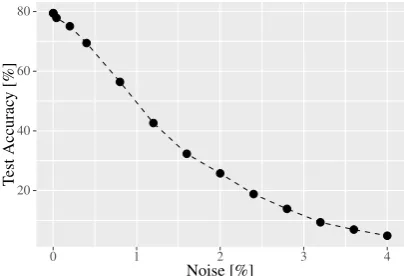
Figure 1: Accuracy (%) drops as we increase ad-versarial noise to word embeddings, as evaluated on binary classification datasetMR.
sentence-level linguistic noise into the input text, inspired by adversarial examples (Goodfellow et al., 2015). Our method has its origins in computer vision, where it has been shown that small pixel perturbations indiscernible to humans can signif-icantly distort the predictions of state-of-the-art deep models (Szegedy et al., 2014; Nguyen et al., 2015), an observation that has been harnessed in recent work on adversarial training (Goodfellow et al., 2015). This kind of noise is cheap to generate for images and is transferable between different models, but it is less clear how to generate analo-gous textual noise while preserving the fidelity of the training data, due to text being discrete and se-quential in nature, with latent syntactic structure. Based on the same linguistic intuition, adversarial evaluation for natural language processing mod-els was proposed by Smith (2012). Also, adver-sarial learning for text, such as perceptron learn-ing (Søgaard, 2013) and unsupervised estimation methods (Smith and Eisner, 2005), have been stud-ied in the language area.
Word embeddings learned from WORD2VEC
(Mikolov et al., 2013) and GLOVE (Pennington et al., 2014) are now widely used as input to lan-guage processing models, however these represen-tations are highly susceptible to noise. For ex-ample, Figure 1 shows that as we add adversarial noiseη = ∇xLoss(x, y, θ) toWORD2VEC
rep-resentations, classification accuracy for a convolu-tional model (Kim, 2014) over a sentiment classi-fication task (Pang and Lee, 2008) drops apprecia-bly, such that with only1%perturbations, a state-of-the-art model drops to the level of a random classifier.
Word embeddings are not an intuitive represen-tation of human language, and it is not immedi-ately clear how to generate adversarial noise over the raw text input without affecting the fidelity of the data. In human-to-human textual communi-cation such as chat and microblogs, humans are remarkably resilient to “noise”, in terms of typos, lexical and syntactic disfluencies, and the large va-riety of semantically-equivalent ways of express-ing the same content (Han and Baldwin, 2011; Eisenstein, 2013; Baldwin et al., 2013; Pavlick and Callison-Burch, 2016). These observations are the inspiration for this work, in proposing a training strategy based on the explicit generation of linguistic corruption over the source training in-stances, to train robust text models. Empirically, we demonstrate the effectiveness of our method over a range of sentiment analysis datasets us-ing a state-of-the-art convolutional neural network model (Kim, 2014). In this, we show that our method is superior to a baseline and dropout (Sri-vastava et al., 2014) using MAP training.1
2 Generating Text Noise
Our method involves the explicit generation of several kinds of linguistic corruption, to train more robust deep models. The first question is how to generate the linguistic noise, focusing on English for the purposes of this paper. We focus on the generation of two classes of text noise: (1) syntac-tic noise; and (2) semansyntac-tic noise.2
Syntactic Noise The first class of linguistic noise is syntactic, focusing on the syntactic struc-1The implementation is freely available at https://
github.com/lrank/Linguistic_adversity. 2We also experimented with a method which generates lexical noise, but for the purposes of our experiments here, as the vast majority of the generated candidates are OOV words, it is largely equivalent to word dropout, and omitted from this paper.
ture of the input, either through explicit parsing and generation using a deep linguistic parser, or sentence compression.
For the deep linguistic parser, we use the LinGO English Resource Grammar (“ERG”: Copestake and Flickinger (2000)) with the ACE parser, based on pyDelphin.3 The ERG supports both pars-ing and generation, via the semantic formalism of Minimal Recursion Semantics (“MRS”: Copes-take et al. (2005)). To generate paraphrases with the ERG, we simply parse a given input, select the preferred parse using a pretrained parse selec-tion model (Oepen et al., 2002), and exhaustively generate from the resultant MRS. We then use uni-form random sampling to select from the genera-tor outputs, which potentially numbers in the thou-sands of variants. To handle unknown words dur-ing parsdur-ing and generation, we use POS mappdur-ing and introduce a unique relation for each unknown word, which we use to substitute the unknown word back in to the generation output. In practice, the primary sources of “noise” introduced by the ERG are due to topicalisation, adjective ordering, fronting of adverbial phrases, and relativisation of modifiers.
The second approach to syntactic noise is based on sentence compression (“COMP”: Knight and Marcu (2000)), which aims to “trim” an input of peripheral content, while maintaining grammati-cality, and also the syntax of the original as much as possible. While the state-of-the-art in sentence compression is based on deep learning methods such as recurrent neural networks (Filippova et al., 2015), we implement a simple parser-based model, due to the lack of large-scale annotated data for training and the fact that a relative lack of precision in the output may ultimately help our method. First, we parse the sentence using the Stanford CoreNLP constituency parser (Chen and Manning, 2014). Next, we model the conditional probability of deleting a sub-tree C with label S
given its parent node with labelRbyp(C|S, R) =
p(C,S,R)
ΣCp(C,S,R), trained on the sentence compression corpora of Clarke and Lapata (2006),4made up of a few hundred labelled instances.
Semantic Noise The second class of linguistic noise is semantic noise. Semantic noise is more subtle than syntactic noise, as we must be careful 3https://github.com/delph-in/pydelphin 4http://jamesclarke.net/research/
not to impact on the fidelity of the original labels, which can readily occur with full paraphrasing or abstractive summarisation. As such, we focus on lexical substitution of near-synonyms of words in the original text, and experiment with two methods for generating near-synonyms.
Our approach to generating semantic noise pro-ceeds as follows. First, we apply filters to iden-tify words which should not be candidates for lex-ical substitution, namely words which are parts of named entities or function words. As such, we use the Stanford CoreNLP POS tagger and named entity recogniser (Finkel et al., 2005; Chen and Manning, 2014), and identify “substitutable words” as those which are nouns, verbs, adjectives or adverbs, and not part of a named entity. For each substitutable wordw, we generate the set of substitution candidatess(w). For each candidate
wi∈ {w} ∪s(w)we allow the original word to be
preserved withp(wi) = α, and share the
remain-ing1−αproportional to the language model score based on substitutingwiinto the original text. For
this, we use the pre-trained US English language model from the CMU Sphinx Speech Recognition toolkit.5 Finally, we sample from the probability distribution{p(wi) : wi ∈ {w} ∪s(w)}for each
substitutable word w to generate a semantically-corrupted version of the original.
We experiment with two approaches to gen-erating the substitution candidates. The first is based on Princeton WordNet (“WN”: Miller et al. (1990)), over all synsets that a given substi-tutable word occurs in, using the NLTK API (Bird, 2006). The second is based on the “counter-fitting” method of Mrkˇsi´c et al. (2016) (“CFIT”), whereby word embeddings from WORD2VECare projected based on a supervised objective func-tion which penalises similarity between antonym pairs, and rewards similarity between synonym pairs, as trained on 10k English news sentences from WMT14 (Bojar et al., 2014).
Word Dropout As a standard approach to train-ing robust models, we use word dropout (Srivas-tava et al., 2014; Pham et al., 2014). Dropout can be viewed as a method for zeroing out noise, and is first-order equivalent to an`2regularizer applied after feature scaling (Wager et al., 2013).
5https://sourceforge.net/projects/
cmusphinx/
Method Example
Original The cat sat on the mat . ERG On the mat sat the cat .
COMP The cat sat onmat
[image:3.595.313.518.63.156.2]WN The:::kat sat on the:::::::flatness . CFIT The:::pet :::::stood onto the mat .::::
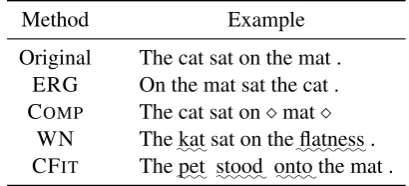
Table 1: Examples of generated sentences across four proposed methods. Modified words are marked by “underwave” and omitted words are de-::::::::: noted with a “”.
Table 1 shows an example sentence and sample corrupted outputs after applying each type of lin-guistic noise. The ERG seldom changes words, and instead tends to reorder the words based on syntactic alternation. COMP performs like word dropout in that it tends to remove tokens with low semantic content and to generate complete sen-tences. WN and CFITboth only modify the text at the word level, based on near-synonyms and words with similar semantic function, respectively.
3 Models and Training
We evaluate our methods on several sentence clas-sification tasks, using a convolutional neural net-work (“CNN”) model (Kim, 2014). Note that our method corrupts the input directly, and is thus eas-ily transferrable to other classes of models (e.g., other deep learning or linear models).
Convolutional Neural Network The CNN op-erates at the sentence level by first embedding each word using a lookup table which is stacked into the sentence matrixES. A 1d convolutional layer is then applied to ES, which applies a se-ries of filters over each window oft words, with each filter employing a rectifier transform func-tion. MaxPoolingis applied over each set of fil-ter outputs to result in a fixed-size sentence repre-sentation.6 The sentence vector is fed into a final
Softmax layer to generate a probability distribu-tion over classificadistribu-tion labels.
batch size of 128. We initialise the embedding with dimension m = 300 Google pre-trained WORD2VEC word embeddings (Mikolov et al., 2013). Words not in the pre-trained vocabulary are initialized randomly using a uniform distribution
U([−0.25,0.25)m).
Injecting Noise during Training Our proposed method involves corrupting the training input with adversarial noise of various kinds. All the meth-ods are non-deterministic, involving random sam-pling. They are applied afresh every epoch, such that each time an instance is processed, it will have a different input form.7 The two semantic approaches (WN and CFIT) support configurable noise rates in terms of the proportion of substi-tutable words that are corrupted. Accordingly, we experiment with two thresholds on the random variable for substitution of each word: low (“lo”;
α = 0.5) and high (“hi”; α = 0). Besides the above methods which employ a single type noise, we experiment with a combination (COMB) of the four different noise types (ERG + COMP+ WNlo + CFITlo), by uniformly randomly choosing one of the four methods for noise generation each time we process a training instance.
Datasets We experiment on the following datasets:
• MR: sentence polarity dataset from movie re-views (Pang and Lee, 2008)8
• CR: customer review dataset (Hu and Liu, 2004)9
• Subj: subjectivity dataset (Pang and Lee, 2005)8
• SST: Stanford Sentiment Treebank, using the 2-class configuration (Socher et al., 2013)10
We evaluate using classification accuracy, based on both in-domain evaluation11 and a cross-domain setting, in which we evaluate a model trained onMRand tested onCR, and vice versa. This last setting characterises a realistic applica-7Using a single application of noise is less effective, but still yields improvements over baseline methods including dropout.
8https://www.cs.cornell.edu/people/
pabo/movie-review-data/
9http://www.cs.uic.edu/˜liub/FBS/
sentiment-analysis.html
10http://nlp.stanford.edu/sentiment/ 11Where there is no pre-defined training/test split for a given dataset, we use 10-fold cross validation. See Kim (2014) for more details on the datasets and evaluation set-tings.
tion scenario, where robustness to vocabulary shift and other differences in the input is paramount.
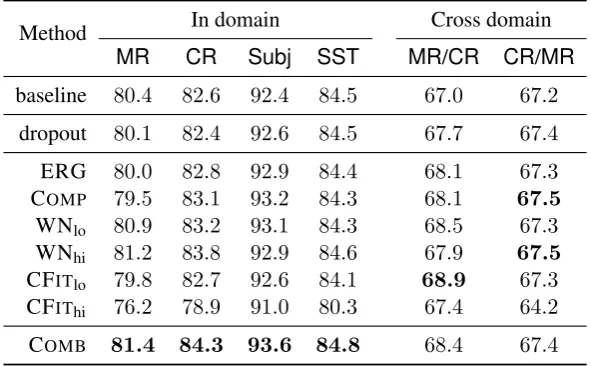
4 Experimental Results and Analysis Table 2 presents the results of training with dif-ferent sources of linguistic corruption in the in-domain and cross-in-domain settings. In general, the proposed methods perform better than the base-line and dropout, and semantic noise using WN achieves consistent improvements across all set-tings. The COMB method uniformly outperforms the other methods for all in-domain evaluations, indicating that the improvements from training with different types of noise are orthogonal. Note that improvements are smaller on SST and MR
than CR and Subj for all methods. Almost ev-ery method improves over word dropout, except counter-fitting at a high noise level. Also surpris-ing is the fact that dropout shows no improvement over standard training, and is overall mildly detri-mental.
Our intuition behind why WN consistently out-performs the baseline methods and other single sources of noise is it sometimes performs sim-ilarity to dropout, in replacing common words with rare ones, and sometimes substitutes frequent words for frequent words, leading to better gen-eralisation in the word embeddings. To test this hypothesis, we computed nearest neighbours in the word embedding space for both the baseline method and the WN method. For example, the top-3 nearest neighbours for superior in CRare
exceptional, excellent and unmatched for WN,
while for the baseline, they are inferior, excep-tional andexcellent. That is, similar to the intu-ition behind counter-fitting, the methods appears to learn to differentiate between synonyms and antonyms, in a manner which is sensitised to the target domain.
Although similar in function to WN, the counter-fitting based method performs unexpect-edly poorly. This appears to be a consequence of the training of these embeddings, namely that the corpus was much smaller than that used for the WORD2VEC training, and consequently coverage on our corpora was substantially lower, leading to the approach making inappropriate substitutions and not aiding model robustness.
Method In domain Cross domain
MR CR Subj SST MR/CR CR/MR
baseline 80.4 82.6 92.4 84.5 67.0 67.2
dropout 80.1 82.4 92.6 84.5 67.7 67.4
ERG 80.0 82.8 92.9 84.4 68.1 67.3
[image:5.595.151.447.63.246.2]COMP 79.5 83.1 93.2 84.3 68.1 67.5 WNlo 80.9 83.2 93.1 84.3 68.5 67.3 WNhi 81.2 83.8 92.9 84.6 67.9 67.5 CFITlo 79.8 82.7 92.6 84.1 68.9 67.3 CFIThi 76.2 78.9 91.0 80.3 67.4 64.2 COMB 81.4 84.3 93.6 84.8 68.4 67.4
Table 2: Accuracy (%) of the CNN, in four in-domain settings, and two cross-domain settings, with word dropout (“dropout”), or linguistic corruption based on different sources of syntactic and semantic corruption. The best result for each dataset is indicated inbold.
as Alias seasons 1 and season 2 is compressed
intohas a problem with dual-layer dvdwhich pre-serves the key information that we expect to be useful for model learning. This allows the model to better learn the components of the input that are predictive of sentiment.
Syntactic paraphrasing (ERG) tends to primar-ily corrupt the word order, with fewer lexical sub-stitutions. Thus, the model is less prone to over-fitting to local n-gram features, and focuses on learning words and phrases that are genuinely pre-dictive of sentiment.
5 Conclusions
In this paper, we present a training method that corrupts training examples with linguistic noise, in order to learn more robust models. Based on evaluation over several sentiment analysis datasets with convolutional neural networks, we show that this method outperforms standard training and dropout, both for in-domain and out-of-domain application. Our approach has wide-spread po-tential to also benefit other types of discriminative model and in a range of other language processing tasks.
Acknowledgments
We are grateful to the anonymous reviewers for their helpful feedback and suggestions, and to Ned Letcher for assistance in running the ERG. This research was supported in part by the Australian Research Council.
References
Dzmitry Bahdanau, Kyunghyun Cho, and Yoshua Ben-gio. 2015. Neural machine translation by jointly learning to align and translate. In Proceedings of the International Conference on Learning Represen-tations, San Diego, USA.
Timothy Baldwin, Paul Cook, Marco Lui, Andrew MacKinlay, and Li Wang. 2013. How noisy social media text, how diffrnt social media sources? In
Proceedings of the Sixth International Joint Confer-ence on Natural Language Processing, pages 356– 364, Nagoya, Japan.
Steven Bird. 2006. NLTK: The natural language toolkit. In Proceedings of the COLING/ACL 2006 Interactive Presentation Sessions, pages 69–72, Sydney, Australia.
Zsolt Bitvai and Trevor Cohn. 2015. Non-linear text regression with a deep convolutional neural network. In Proceedings of the 53rd Annual Meeting of the Association for Computational Linguistics and the 7th International Joint Conference on Natural Lan-guage Processing (Volume 2: Short Papers), pages 180–185, Beijing, China.
Ondrej Bojar, Christian Buck, Christian Federmann, Barry Haddow, Philipp Koehn, Johannes Leveling, Christof Monz, Pavel Pecina, Matt Post, Herve Saint-Amand, Radu Soricut, Lucia Specia, and Aleˇs Tamchyna. 2014. Findings of the 2014 Workshop on Statistical Machine Translation. InProceedings of the Ninth Workshop on Statistical Machine Trans-lation, pages 12–58, Baltimore, USA.
James Clarke and Mirella Lapata. 2006. Models for sentence compression: A comparison across do-mains, training requirements and evaluation mea-sures. InProceedings of the 21st International Con-ference on Computational Linguistics and 44th An-nual Meeting of the Association for Computational Linguistics, pages 377–384, Sydney, Australia. Ann Copestake and Dan Flickinger. 2000. An
open source grammar development environment and broad-coverage english grammar using HPSG. In
Proceedings of the Second International Conference on Language Resources and Evaluation, Athens, Greece.
Ann Copestake, Dan Flickinger, Ivan A. Sag, and Carl Pollard. 2005. Minimal recursion semantics: An introduction. Journal of Research on Language and Computation, 3(2–3):281–332.
Jacob Eisenstein. 2013. What to do about bad lan-guage on the internet. In Proceedings of the 2013 Conference of the North American Chapter of the Association for Computational Linguistics: Human Language Technologies, pages 359–369, Atlanta, USA.
Katja Filippova, Enrique Alfonseca, A. Carlos Col-menares, Lukasz Kaiser, and Oriol Vinyals. 2015. Sentence compression by deletion with LSTMs. In
Proceedings of the 2015 Conference on Empirical Methods in Natural Language Processing, pages 360–368, Lisbon, Portugal.
Rose Jenny Finkel, Trond Grenager, and Christopher Manning. 2005. Incorporating non-local informa-tion into informainforma-tion extracinforma-tion systems by Gibbs sampling. InProceedings of the 43rd Annual Meet-ing of the Association for Computational LMeet-inguis- Linguis-tics, pages 363–370, Ann Arbor, USA.
Ian J. Goodfellow, Jonathon Shlens, and Christian Szegedy. 2015. Explaining and harnessing ad-versarial examples. InProceedings of the Interna-tional Conference on Learning Representations, San Diego, USA.
Alan Graves, Abdel-rahman Mohamed, and Geoffrey Hinton. 2013. Speech recognition with deep recur-rent neural networks. In Proceedings of the IEEE International Conference on Acoustics, Speech and Signal Processing, pages 6645–6649, Vancouver, Canada.
Bo Han and Timothy Baldwin. 2011. Lexical normal-isation of short text messages: Makn sens a #twit-ter. InProceedings of the 49th Annual Meeting of the Association for Computational Linguistics: Hu-man Language Technologies, pages 368–378, Port-land, USA.
Minqing Hu and Bing Liu. 2004. Mining and summa-rizing customer reviews. InProceedings of the Tenth ACM SIGKDD International Conference on Knowl-edge Discovery and Data Mining, pages 168–177, Seattle, USA.
Yulei Jiang, Richard M. Zur, Lorenzo L. Pesce, and Karen Drukker. 2009. A study of the effect of noise injection on the training of artificial neural net-works. InInternational Joint Conference on Neural Networks, pages 1428–1432, Atlanta, USA. Nal Kalchbrenner, Edward Grefenstette, and Phil
Blun-som. 2014. A convolutional neural network for modelling sentences. In Proceedings of the 52nd Annual Meeting of the Association for Computa-tional Linguistics (Volume 1: Long Papers), pages 655–665, Baltimore, USA.
Yoon Kim. 2014. Convolutional neural networks for sentence classification. InProceedings of the 2014 Conference on Empirical Methods in Natural Lan-guage Processing, pages 1746–1751, Doha, Qatar. Diederik P. Kingma and Jimmy Ba. 2015. Adam: A
method for stochastic optimization. InProceedings of the International Conference on Learning Repre-sentations, San Diego, USA.
Kevin Knight and Daniel Marcu. 2000. Statistics-based summarization-step one: Sentence compres-sion. InProceedings of the 18th Annual Conference on Artificial Intelligence, pages 703–710, Austin, USA.
Alex Krizhevsky, Ilya Sutskever, and Geoffrey E. Hin-ton. 2012. ImageNet classification with deep con-volutional neural networks. In Advances in Neu-ral Information Processing Systems 25, pages 1097– 1105, Lake Tahoe, USA.
Yitong Li, Trevor Cohn, and Timothy Baldwin. 2016. Learning robust representations of text. In Proceed-ings of the 2016 Conference on Empirical Methods in Natural Language Processing, pages 1979–1985, Austin, USA.
Tomas Mikolov, Ilya Sutskever, Kai Chen, Greg S. Cor-rado, and Jeff Dean. 2013. Distributed representa-tions of words and phrases and their compositional-ity. InAdvances in Neural Information Processing Systems 26, pages 3111–3119, Lake Tahoe, USA. George A. Miller, Richard Beckwith, Christiane
Fell-baum, Derek Gross, and Katherine J. Miller. 1990. Introduction to WordNet: an on-line lexical database. International Journal of Lexicography, 3(4):235–244.
Nikola Mrkˇsi´c, Diarmuid ´O S´eaghdha, Blaise Thom-son, Milica Gaˇsi´c, Lina M. Rojas-Barahona, Pei-Hao Su, David Vandyke, Tsung-Hsien Wen, and Steve Young. 2016. Counter-fitting word vectors to linguistic constraints. InProceedings of the 2016 Conference of the North American Chapter of the Association for Computational Linguistics: Human Language Technologies, pages 142–148, San Diego, USA.
Anh Nguyen, Jason Yosinski, and Jeff Clune. 2015. Deep neural networks are easily fooled: High con-fidence predictions for unrecognizable images. In
Proceedings of the IEEE Conference on Computer Vision and Pattern Recognition, pages 427–436, Boston, USA.
Stephan Oepen, Kristina Toutanova, Stuart Shieber, Christopher Manning, Dan Flickinger, and Thorsten Brants. 2002. The LinGO Redwoods Tree-bank: Motivation and preliminary applications. In
Proceedings of the 19th International Conference on Computational Linguistics, pages 1253–1257, Taipei, Taiwan.
Bo Pang and Lillian Lee. 2005. Seeing stars: Exploit-ing class relationships for sentiment categorization with respect to rating scales. InProceedings of the 43rd Annual Meeting of the Association for Com-putational Linguistics, pages 115–124, Ann Arbor, USA.
Bo Pang and Lillian Lee. 2008. Opinion mining and sentiment analysis. Foundations and Trends in In-formation Retrieval, 2(1-2):1–135.
Ellie Pavlick and Chris Callison-Burch. 2016. Simple PPDB: A paraphrase database for simplification. In
Proceedings of the 54th Annual Meeting of the As-sociation for Computational Linguistics (Volume 2: Short Papers), pages 143–148, Berlin, Germany. Jeffrey Pennington, Richard Socher, and Christopher
Manning. 2014. GloVe: Global vectors for word representation. In Proceedings of the 2014 Con-ference on Empirical Methods in Natural Language Processing, pages 1532–1543, Doha, Qatar. Vu Pham, Th´eodore Bluche, Christopher Kermorvant,
and J´erˆome Louradour. 2014. Dropout improves recurrent neural networks for handwriting recogni-tion. In14th International Conference on Frontiers in Handwriting Recognition, pages 285–290, Crete, Greece.
Noah A. Smith and Jason Eisner. 2005. Contrastive estimation: Training log-linear models on unlabeled data. In Proceedings of the 43rd Annual Meeting of the Association for Computational Linguistics, pages 354–362, Ann Arbor, USA.
Noah A. Smith. 2012. Adversarial evaluation for models of natural language. arXiv preprint arXiv:1207.0245.
Richard Socher, Alex Perelygin, Jean Wu, Jason Chuang, Christopher D. Manning, Andrew Ng, and Christopher Potts. 2013. Recursive deep models for semantic compositionality over a sentiment tree-bank. In Proceedings of the 2013 Conference on Empirical Methods in Natural Language Process-ing, pages 1631–1642, Seattle, USA.
Anders Søgaard. 2013. Part-of-speech tagging with antagonistic adversaries. InProceedings of the 51st
Annual Meeting of the Association for Computa-tional Linguistics (Volume 2: Short Papers), pages 640–644, Sofia, Bulgaria.
Nitish Srivastava, Geoffrey Hinton, Alex Krizhevsky, Ilya Sutskever, and Ruslan Salakhutdinov. 2014. Dropout: A simple way to prevent neural networks from overfitting. Journal of Machine Learning Re-search, 15:1929–1958.
Christian Szegedy, Wojciech Zaremba, Ilya Sutskever, Joan Bruna, Dumitru Erhan, Ian Goodfellow, and Rob Fergus. 2014. Intriguing properties of neu-ral networks. In Proceedings of the International Conference on Learning Representations, Banff, Canada.