Internal branding: In search for
employee commitment and brand
supportive behavior
Research in a laboratory organization how internal branding
enhances the delivery of the brand promise by employees
Matthijs Oude Vrielink
[email protected]
University of Twente
│
Enschede
2
Internal branding: In search for employee commitment and
brand supportive behavior
Research in a laboratory organization how internal branding enhances the
delivery of the brand promise by employees
Master thesis
Hengelo, 06-03-2019Author
Matthijs Oude Vrielink
Supervisors
1st : Dr. S. Janssen2nd : Prof. Dr. M.D.T. de Jong
University of Twente
Faculty of Behavioural Sciences Communication studies
3
Abstract
Employees deliver the brand promise to customers when they have a high level of brand commitment and demonstrate brand supportive behavior, especially those with customer contact. Internal branding has a positive relationship with brand commitment and brand supportive behavior. In order to investigate the relationship of internal branding on brand commitment and brand supportive behavior, a correlational study was conducted. The research was conducted among 142 employees working in a laboratory organization who have customer contact. Opposing to previous studies regarding internal branding, this study embraces the broader framework of brand commitment including affective, continuance, and normative commitment, instead of solely affective commitment. In addition, this study distinguished internal branding in four aspects based on corporate identity management: adequacy of internal communication, internal communication climate, visual symbolism, and corporate behavior, where other studies have not based internal branding on corporate identity management. Three of four internal branding aspects (adequacy of internal communication, internal communication climate, and organizational behavior) seemed to explain a significant part of the variance of affective commitment, normative commitment, and brand supportive behavior. Brand fit plays a mediation role. Results suggest that in order to strengthen employees’ brand commitment and brand supportive behavior, organizations should align their internal branding aspects, internal communication and organizational behavior. No focus is needed for visual symbolism, as no relationship with the employee-related outcomes was found. Although the role of the internal branding aspects varied, organizations implementing internal branding may benefit via employees showing brand supportive behavior and being committed to the brand, which leads to satisfying customers through proper delivering of the brand promises.
4
Table of contents
1. Introduction ... 5
2. Theoretical framework ... 7
2.1 Brand commitment ... 7
2.2 Brand supportive behavior ... 7
2.3 Internal branding ... 8
2.3.1 Internal communication ... 9
2.3.2 Visual symbolism ... 10
2.3.2 Organizational behavior ... 11
2.4 Brand fit ... 12
3. Methods ... 14
3.1 Research design ... 14
3.2 Sample ... 14
3.3 Procedure ... 15
3.4 Measurements ... 15
3.5 Pre-test ... 16
3.6 Data analysis ... 17
4. Results ... 18
4.1 Descriptive results ... 18
4.2 Correlations ... 18
4.3 Multiple regression... 19
4.4 Mediation effect of brand fit ... 21
4.4.1 Mediating effect brand fit with adequacy internal communication ... 22
4.4.2 Mediating effect brand fit with internal communication climate ... 23
4.4.3 Mediating effect brand fit with organizational behavior ... 24
4.5 Overview of results of tested hypothesis ... 26
5. Discussion ... 27
5.1 Main findings ... 27
5.2 Practical implications ... 29
5.3 Limitations and future research directions ... 30
6. Conclusion ... 31
References ... 32
Appendix A: Survey ... 40
5
1.
Introduction
Service organizations are an important part of the current economy. Within those organizations employees play a considerable role in achieving a competitive advantage: they are the brand ambassadors and represent the brand in front of customers (e.g., Harris & de Chernatony, 2001; King & Grace, 2008; Santos-Vijande, del Río-Lanza, Suárez-Álvarez, & Díaz-Martín, 2013).It is important for organizations that employees get familiar with the brand. Employees are not just part of an organization. Instead, they are important brand representatives (Harris & de Chernatony, 2001). According to Kärreman and Rylander (2008); branding, could be used to influence employees’ organizational identity, but the linkages of branding aspects (e.g. social discourse and marketing) on employee-related outcomes still needs more insight (Vallaster & Lindgreen, 2013).
Where corporate branding could be used to influence stakeholders in general, internal branding focusses specifically on employees. Foster, Punjaisri, and Cheng (2010) state that internal branding mainly focusses “on the adoption of the branding concept inside an organization to ensure that employees deliver the brand promise to the external stakeholders” (p. 401).
Internal branding has a positive effect on employees’ brand commitment (Punjaisri & Wilson, 2007) and the behavior of employees (Ozçelik & Findikli, 2014). Brand commitment and brand supportive behavior of employees are required to turn employees in brand representatives which leads to an increased level of customer satisfaction (e.g., Burmann & Zeplin, 2005; Kimpakorn & Tocquer, 2010; Testa, 2001). Therefore, there is a need to implement branding activities that focus on increasing the compatibility between employee commitment plus brand supportive behavior and organizational goals and values (e.g., Liu, Ko, & Chapleo, 2017; Punjaisri, Evanschitzky, & Wilson, 2008). While the amount of research concerning internal branding the past years has increased (e.g., Punjaisri & Wilson, 2007; Punjaisri & Wilson, 2011; Tsang, Lee, & Li, 2011), there are still important gaps in existing academic literature. Piehler, Grace, and Burmann (2018) conducted a literature review regarding internal branding where they highlight these gaps. One gap mentioned is that most studies were conducted in business-to-consumer organizations operating in the financial services industry (e.g., Buil, Catalán, & Martínez, 2016; Löhndorf & Diamantopoulos, 2014; Papasolomou & Vrontis, 2006) or the hospitality industry (e.g., Punjaisri, Evanschitzky, & Wilson, 2009; Xiong, & King, 2015; King, 2010). This study will focus on a laboratory organization, acting in a business-to-business setting. Therefore, this study expands current knowledge considering possible different relationships with internal branding and employee-related outcomes caused by a different organizational setting and consequently a different type of customers.
Additionally, recent studies regarding internal branding focus on affective commitment or identification of employees as employee-related outcomes (e.g., King, 2010; King & Grace, 2010; Walden, Jung, & Westerman, 2017), where both outcomes are closely related. However, commitment is a broader concept than just affective commitment. This study includes the broader commitment concept (i.e. affective, continuance, and normative commitment) in line with Allen and Meyer (1990). This way, more refined insights in employee-related outcomes are gathered.
Furthermore, Piehler, Grace, and Burmann (2018) suggest more understandings of specific internal branding aspects are needed to help managerial implications get more efficient. Internal branding is derived from corporate identity management (CIM), which exists of three characteristics: communication, symbolism, and behavior. This study investigates several internal branding instruments based on the characteristics of CIM. Most other studies relating internal branding measure only fragmented aspects of internal branding, or relate this to very limited employee-related outcomes, for example one commitment characteristic (Kimpakorn & Tocquer, 2010) or solely behavior (Chang, Chiang, & Han, 2012).
6 Research question:
To what extent has communication, visual symbolism, and organizational behavior as part of internal branding a positive relationship with brand commitment and brand supportive behavior of employees?
7
2.
Theoretical framework
In this section the theoretical basis for this paper is described. First, the dependent variables, brand commitment and brand supportive behavior are discussed. Hereafter, internal branding is explained. Additionally, the aspects of internal branding, internal communication, visual symbolism, and organizational behavior are elucidated. Furthermore, the expected mediating variable, brand fit, is discussed. Besides a description of the separate variables, the hypotheses are mentioned. At last, a conceptual research model is presented.
2.1 Brand commitment
Brand commitment is described as “the extent of psychological attachment of employees to the brand, which influences their willingness to exert extra effort towards reaching the brand goals” (Burmann & Zeplin, 2005, p. 284). Brand commitment as the authors propose, is almost identical to organizational commitment. Extra effort or dedication of employees to deliver the brand promise and satisfy customers can be seen as a form of commitment (Testa, 2001). Porter, Steers, Mowday, and Boulian (1974) made a unidimensional framework of organizational commitment. Cook and Wall (1980) followed their concept of organizational commitment as a unidimensional framework. However, many scholars disagree with the unidimensional view of commitment. Scholars (e.g., Meyer & Allen, 1984; Mowday, Porter, & Steers, 1982) view organizational commitment as a two component construct, including affective and continuance commitment. Their view of affective commitment was the same as the unidimensional view of commitment proposed by Porter et al. (1974). Affective commitment is defined as “the emotional attachment to, identification with, and involvement in the organization” (Meyer & Alan, 1984, p. 375). Continuance commitment is described as the perceived costs related to leaving the organization (Meyer & Alan, 1984.) Later, Allen and Meyer (1990) added normative commitment as a third component of organizational commitment. Normative commitment refers to the obligation to remain at the organization as perceived by employees.
Recently, there has been disagreement if organizational or brand commitment should be measured by affective commitment only or with the addition of continuance commitment and normative commitment. Some scholars use the affective commitment construct to measure brand commitment (Backhaus & Tikoo, 2004; Kimpakorn & Tocquer, 2010; Yang, Wan, & Wu, 2015), or to measure brand attitudes (e.g., Punjaisri, Evanschitzky, & Wilson, 2009; Sharma & Kamalanbhan, 2014) as outcomes of internal branding. However, other scholars have used the three commitment constructs to measure commitment (e.g., Caruana & Calleya, 1998; Falkenburg & Schyns, 2007; Malhotra & Mukherjee 2004; Rafiq & Ahmed, 2000). Yet, the studies using the three commitment constructs did not investigate internal branding but focused on marketing. It is suggested that affective commitment is the most important factor for delivering the brand promise (Bloemer & Odekerken-Schröder, 2006 as cited in Mehta, Singh, Bhakar, & Sinha, 2010). However, the three commitment constructs all refer to the willingness to stay at the organization. An increase in retention of employees is positive associated with profits of an organization (Mohamad et al., 2017). Commitment is also strongly related with the job performance of employees (Meyer et al., 2002). It affects employees’ competence to deliver the proper service to the needs of customers (Punjaisri, Evanschitzky, & Wilson, 2009). In this study, in line with Allen and Meyer (1990), three commitment constructs (i.e. affective, continuance, and normative commitment) are included because it gives a more complete overview of perceived commitment of employees.
2.2 Brand supportive behavior
8 Burmann & Zeplin, 2005; Chiang, Chang, & Han, 2012; Xie et al., 2014). Xiong and King (2015) found that when employees think their job is important, this will have a positive effect on their behavior. According to King (2010) brand supportive behavior of employees is key for organizations. Correspondingly, brand supportive behavior of employees forms a substantial part of how customers evaluate the service of the company since these employees are the brand ambassadors towards customers. Punjaisri and Wilson (2007) state that organizations should strive to align the attitudes and responding behaviors of employees because in this way external stakeholders will get a consistent view. This could be achieved by internal branding. This consistent view which is distributed by the employees, has a positive influence on customer satisfaction, loyalty, (Backhaus & Tikoo, 2004; Punjaisri & Wilson, 2007) brand trust by customers (Xie, Peng, & Huan, 2014) and, turnover (Ryan, Schmitt, & Johnson, 1996).
2.3 Internal branding
Internal branding activities are a part of corporate identity management (CIM) (Foster, Punjaisri, & Cheng, 2010; Simoes, Dibb, & Fisk, 2005). CIM is derived from the corporate identity mix framework as proposed by Van Riel and Balmer (1997). They based their framework of the corporate identity mix on the literature of Olins (1978) and Birkigt and Stadler (1980) regarding corporate identity. Van Riel and Balmer (1997) state that the corporate identity mix exists out of three components (i.e. communications, behavior, and symbolism) that will influence the internal and external stakeholders’ view of organizational identity. For instance, this could influence the tendency to work for the organization or the willingness to buy products (Van Riel & Balmer, 1997). Simoes, Dibb, and Fisk (2005) have used CIM with an internal focus on “managers’ internal control and implementation of corporate identity aspects” (p. 157).
Organizations can use three forms of branding: (1) corporate branding, (2) internal branding, and (3) employee branding, which are all closely related. Corporate branding focusses on the brand promises of organizations direct relationship to customers. Employee branding focusses on the recruitment of employees whose values are similar to the organizational values. Internal branding concentrates on existing employees and increasing their cognitive and emotional connection to the brand (e.g., Foster, Punjaisri, & Cheng, 2010; Mahnert & Torres, 2007; Punjaisri, Evanschitzky, & Wilson, 2009). However, some other scholars, for example Miles and Mangold (2004, p. 68) state that employee branding is “the process by which employees internalize the desired brand image and are motivated to project the image to customers and other organizational constituents”, which is almost similar to the previous shown definition of internal branding from other scholars. So, the concepts of internal branding and employee branding are occasionally both used in the literature to address the same topic. In academic literature is the well-known term internal marketing also very closely related. It is defined by Rafiq and Ahmed (2000) as “planned effort using a marketing-like approach to overcome organizational resistance to change and to align, motivate and inter-functionally co-ordinate and integrate employees towards the effective implementation of corporate and functional strategies in order to deliver customer satisfaction through a process of creating motivated and customer orientated employees” (p. 454). In this study, the term and definition of internal branding will be used.
9 improved service towards customers and satisfy the expectations of customers regarding the brand (King & Grace, 2008; Santos-Vijande et al., 2013).
According to several scholars (e.g., Löhndorf & Diamantopoulos, 2014; Papasolomou & Vrontis, 2006; Punjaisri, Evanschitzky, & Wilson, 2009) the key aspect of internal branding is that the behavior of employees is consistent and aligned with the brand during moments of contact with customers. Having employees with knowledge of the brand and the capacity and dedication to send the brand promise is a real strength for organizations. Without this aspect, the expected brand vision would not be perceived by customers in the way as it is proposed to (King & Grace, 2008; Miles & Mangold 2004). Internal branding contributes to brand-oriented behavior and stimulates brand commitment of employees when executing their regular work activities (Özçelik & Findikli, 2014). A study conducted by King and Grace (2008), showed that in general (but not all), experienced employees did know in various degrees (varying from low to high) what their organization brand stands for. Therefore it can be concluded that there is a need for internal branding, even for organizations with experienced employees.
The moment to start an internal branding program is important for the success rate. Points when organizations make some fundamental changes are seen as proper moments to employ internal branding tools (Mitchell, 2002).
2.3.1 Internal communication
As mentioned previous, internal branding is derived from CIM. In line with CIM, internal branding involves internal communication in a wide spectrum of marketing, management and human resource management (HRM) (Karaosmanoglu & Melewar, 2006; Punjaisri & Wilson, 2007). Some scholars place HRM under communication channels (e.g., Miles & Mangold, 2004; Mitchell, 2002), where others see HRM as separate part of internal branding (e.g., Burmann & Zeplin, 2005; de Chernatony, Drury, & Segal-Horn, 2004) or as part of organizational behavior (Turker, 2009; Rode & Vallaster, 2005). In summary, academic literature has no consensus of what is considered as a HRM channel or a communication channel. In this research HRM will be seen as part of organizational behavior (i.e. as part of corporate social responsibility or CSR to employees) in line with Turker (2009). Internal communication aimed at employees is considered as a construct with multiple characteristics. However, Smidts, Pruyn, and Van Riel (2001) mention that two components are salient for internal employee communication.
The first component is described as adequacy of internal communication, which refers to the degree of appropriate information a corporate message contains. Information adequacy is defined as “the degree to which employees believe they are receiving the amount of information that is necessary to do their jobs in the short-term and to make long-term decisions about their employment” (Walden, Jung, & Westerman, 2017, p. 80). A study conducted by Walden, Jung, and Westerman (2017) showed that the adequacy of information influences the organizational commitment of employees, however their commitment construct only showed similarities with the affective commitment construct. Ng, Butts, Vandenberg, DeJoy, and Wilson (2006) showed that communication about organization-related information has a positive influence on organizational commitment. In fact, when employees do not receive important and accurate information on time, they view the management probably as less reliable (Thomas, Zolin, & Hartman, 2009). Nevertheless, employees must understand what the purpose of the message is, and how this could be beneficial for them, in order to be effective (King & Grace, 2008).
10 The communication climate also has a positive effect on the organizational commitment of employees (Walden, Jung, & Westerman, 2017). According to Meyer and Allen (1997) open and honest communication increases the organizational commitment among employees. In addition, Baker, Rapp, Meyer, & Mullins (2014) showed that internal communication contributes to brand supportive behavior. Besides, the satisfaction of personal communication between employees has an effect in the brand supportive behavior (Kandlousi, Ali, & Abdollahi, 2010). Based on the previous mentioned literature the following hypotheses are conducted:
H1A: The adequacy of internal communication has a positive relationship with employees’ affective commitment.
H1B: The adequacy of internal communication has a positive relationship with employees’ continuance commitment.
H1C: The adequacy of internal communication has a positive relationship with employees’ normative commitment.
H1D: The adequacy of internal communication has a positive relationship with employees’ brand supportive behavior.
H2A: Internal communication climate has a positive relationship with employees’ affective commitment
H2B: Internal communication climate has a positive relationship with employees’ continuance commitment.
H2C: Internal communication climate has a positive relationship with employees’ normative commitment.
H2D: Internal communication climate has a positive relationship with employees’ brand supportive behavior.
2.3.2 Visual symbolism
The other aspect mentioned in CIM is symbolism. Symbolism was originally used to increase the organizational visibility to internal and external stakeholders. Research has shown that usage of symbolic brands effect customers in sales setting (Mazudier & Merunka, 2014). The term organizational symbolism is used to describe verbal symbolism, action symbolism, and material symbolism. Verbal symbols are described as corporate stories or corporate legends. For example, regarding to turning points in the organization. Action symbolism is defined as organizational rites and acts. Material symbolism is portrayed by visual representations of the organizations image (Dandridge, Mitroff, & Joyce, 1980). Later, the use of symbolism was used to represent the corporate branding, strategy, and communication (Van Riel & Balmer, 1997). Symbolism is one of the visual cues which reflects the organization (Balmer, 2001; Karaosmanoglu & Melewar, 2006) and differentiates it from other organizations (Hatch & Schultz, 2003). It plays an important role in corporate messages. Symbolism within marketing is used to let people identify themselves with the brand by showing cues portraying values, roles, and relationships (Morhart, Malär, Guevremont, Girardin, & Grohmann, 2015). As part of CIM, it is supposed to influence the corporate identity (Van Riel & Balmer, 1997). Examples of symbolism in corporate settings which were discovered are the use of logos, slogans, design, and day-to-day symbols as clothing or behavior at organizational and employee level (Hatch and Schultz, 2003).
11 Jong, & Van den Bosch, 2018; Simoes, Dibb, & Fisk, 2005). Sharma and Kamalanabhan (2014) included corporate visual identity symbols in their study concerning internal corporate communication (ICC) in Indian IT companies, although corporate infrastructure was also part of visual identity which is not a part of the definition of symbolism used in this study. The study of Sharma and Kamalanabhan (2014) showed that corporate visual identity has a relationship with employees’ brand attitudes. Buil, Catalán, and Martínez (2016) conducted a study where they linked visual identity towards employees perceived attractiveness of a company. In their study a dimension corporate visual identity (e.g. the brand name, logo, and slogan) was included. In summary, visual identity propagated by visual symbolism reflects the underlying organizational idiosyncrasy. Consequently is proposed that:
H3A: The use of visual symbolism has a positive relationship with employees’ affective commitment. H3B: The use of visual symbolism has a positive relationship with employees’ continuance commitment.
H3C: The use of visual symbolism has a positive relationship with employees’ normative commitment. H3D: The use of visual symbolism has a positive relationship with employees’ brand supportive behavior.
2.3.2 Organizational behavior
The final aspect of internal branding, based on CIM is behavior. In the framework as proposed by Van Riel and Balmer (1997) the behavior characteristic referred to the behavior of the organizational members. Melewar and Jenkins (2002) state that behavior in principle is “the non-verbal and intangible part of communication, including all the actions undertaken by the company and its employees” (p. 81). Scholars have used the term corporate or organizational behavior also to describe the management communication plus the behavior of the organization (e.g., Karaosmanoglu & Melewar, 2006; Melewar & Jenkins, 2002) or just the behavior of the organization (Rode & Vallaster, 2004). Management communication refers to the behavior of the management plus the behavior of employees of the organization (Karaosmanoglu & Melewar, 2006; Melewar & Jenkins, 2002). Since this definition has a strong overlap with the communication variable of this study, management communication will further not be included within the organizational behavior variable.
Organizational behavior describes the organizational actions “about environmental, ethical, and recruitment issues” (Karaosmanoglu & Melewar, 2006, p. 201). According to Lingenfelder and Spitzer (1987) corporate behavior is basically human resource activities assisting employees (cf. Rode and Vallaster, 2005). This behavior should be in line with the other characteristics (e.g., marketing or communication) of the organizations (Rode & Vallaster, 2005; Terglav, Ruzzier, & Kaše, 2016).
Organizational behavior could be linked to corporate social responsibility (CSR). CSR is defined as the level “business meet economic, legal, discretional, and ethical responsibilities placed on them by their various stakeholders” (Maigan, Ferrel, & Hult, 1999, p. 457). The CSR construct proposed by Turker (2009) includes CSR to employees, customers, government and social and non-social stakeholders. Besides, Lai and Hsu (2015) included employer oriented CSR as a form of internal branding in their research. In this study the term organizational behavior will be used to address the CSR construct in line with Turker (2009).
12 to employees, in line with Turker (2009), has a lot of similarities with HRM (e.g. training). According to Lai and Hsu (2015) this has a positive relationship with employee behavior. CSR to employees could lead to a more consistent service towards customers (King & Grace, 2008; Miles & Mangold 2004; Papasolomou & Vrontis, 2006). Research has shown that organizational actions which are perceived by employees as commitment of the organization to them, improves the attitudes of employees (Chew & Chan, 2008). Furthermore, it is a helpful tool to transmit brand values (De Chernatony, Cottam, & Segal-Horn, 2006). Based on the literature regarding organizational behavior, the following hypotheses are conducted:
H4A: Organizational behavior has positive relationship with employees’ affective commitment. H4B: Organizational behavior has positive relationship with employees’ continuance commitment. H4C: Organizational behavior has positive relationship with employees’ normative commitment. H4D: Organizational behavior has a positive relationship with employees’ brand supportive behavior.
2.4 Brand fit
The behavior of employees, especially those who have customer contact, should be harmonized with the brand promise (King, 2010). Employees should have a fit with the organizational values or brand values. The theoretical base of brand fit lies in the person-organization fit (PO fit) theory, which is defined by Chatman (1989) as “the congruence between the norms and values of organizations and the values of persons” (p. 339). Chatman (1989) proposes that being part of an organization can shape the values of employees. However, with a low PO fit not just individual values could change, but also the organizational values. Furthermore, it can cause a person to leave. Later, research has confirmed that a high PO fit increases the commitment and job satisfaction among employees (O'Reilly, Chatman, & Caldwell, 1991).
Different studies have shown that the PO fit, or brand fit have a positive influence on the behavior and commitment of employees (Özçelik & Findikli, 2014; Xiong & King, 2015). Although it was expected that there is a relationship between PO fit and internal branding, Özçelik and Findikli (2014) could not find such relationship. However, they measured internal branding only by internal communication content, HRM, and training, which is not the complete scope according to CIM. On the other hand, Matanda and Ndubisi (2013) did find a relationship between internal branding and PO fit. Values that are part of the job (achieved through work or because of the work) affects the perceived brand fit of employees (King, Murillo, & Lee, 2017). The degree organizational values and employees values are matched, effects the attitudes and behavior of employees (Hoffmann & Woehr, 2006) influences citizenship behavior among employees (King, Murillo, & Lee, 2017; Vilela, González, & Ferrín, 2008).Therefore it is expected that:
H5: The positive relationship of the adequacy of internal communication on (A) affective commitment, (B) continuance commitment, (C) normative commitment, and (D) brand supportive behavior, as posited in hypothesis 1, is mediated by brand fit.
H6: The positive relationship of the internal communication climate on (A) affective commitment, (B) continuance commitment, (C) normative commitment, and (D) brand supportive behavior, as posited in hypothesis 2, is mediated by brand fit.
H7: The positive relationship of visual symbolism by employees on (A) affective commitment, (B) continuance commitment, (C) normative commitment, and (D) brand supportive behavior, as posited in hypothesis 3, is mediated by brand fit.
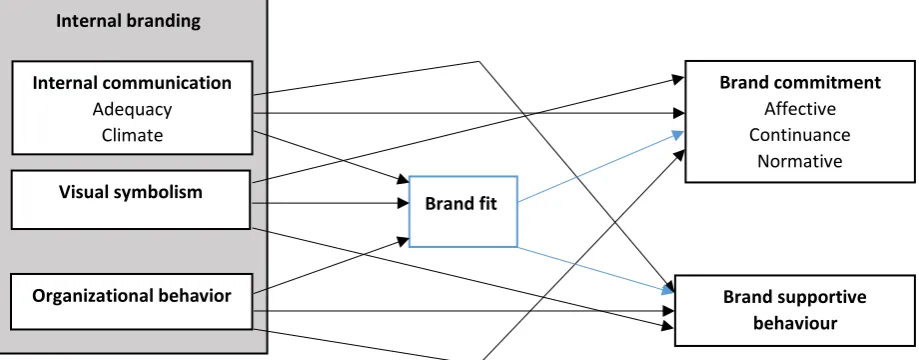
13 Answering the hypotheses above leads up to research question being:‘To what extent have internal communication, visual symbolism and organizational behavior as part of internal branding
[image:13.595.65.525.154.334.2]an positive relationship on employees’ brand commitment and brand supportive behavior towards the brand?’ All described hypotheses are represented in the research model which can be found in Figure 1.
Internal branding
Internal communication
Adequacy Climate
Brand commitment
Affective Continuance
Normative
Visual symbolism
Organizational behavior
Brand fit
Brand supportive behaviour
14
3.
Methods
3.1 Research design
This research is a correlational study. The study examined the relationship between internal branding components (i.e. internal communication, organizational behavior, and visual symbolism) and employees’ affective, continuance, normative brand commitment, and brand supportive behavior. Data to measure the constructs were collected with the use of an online cross-sectional survey. This type of data collection is considered most appropriate since it gives a good overview of the existence and strength of the relationships in one timeframe (Pinsonneault & Kraemer, 1993).
The software program Qualtrics was used to let the respondents fill in the survey. This program also gave the opportunity to let the respondents fill in the survey anonymously. Because respondents are able to fill in the survey anonymously, it is expected the social desirability bias will decrease (Joinson, 1999). Respondents were able to fill in the survey at any place and time.
3.2 Sample
The sample was composed with the use of convenience sampling. The research was conducted on a specific part of a worldwide laboratory organization. This laboratory organization operates in a business-to-business setting. Customers of the department where the research was conducted, derive from the industry, hospitability industry, commerce, and government.
Currently, the organization applies internal branding by different ways. One way is that the organizations’ vision, strategy, and values is visually presented in different places. In addition, upcoming projects are presented in the canteen. Furthermore, a new strategy was communicated through meetings. A member of the board plus a manager presented this strategy. Employees were given the opportunity to ask questions regarding the strategy. At last, newsletters are distributed every two weeks, were an update about the progress concerning the new strategy is given.
The sample was taken from executive employees who have customer contact working in the Netherlands. The respondents had been at least one year at their company, in order to ensure they have sufficient knowledge of the company and the brand. Executive employees of this company are likely to have the most contact with customers, and therefore form the sample. The attitude of executive employees of customer service companies has a great influence on the brand delivery to customers. Thus, customers’ view of a brand is often affected by the attitude and behavior of executive employees (Chiang, Chang, & Han, 2012; Punjairsi & Wilson, 2009).
A liaison within the organization distributed the link to the survey by corporate e-mail and made sure the right employers were contacted. Some employees were given the opportunity by the researcher to fill in the survey on a tablet. The researcher visited three locations of the organization across the Netherlands. In this way it was expected the response rate would increase. Unfortunately, this did not give a satisfactory amount of response, and therefore a second e-mail was sent out by the liaison within the organization. In total, the survey was distributed among 600 employees. The data collection lasted from mid-September to mid-November and yielded 142 usable surveys (N = 142). 17 surveys were excluded because respondents did not provide enough data. This was a response rate of 24%.
15
3.3 Procedure
Data collection of this research exists out of four phases. First, a short introduction with the aim of the study was provided. Hereafter, respondents were asked if they want to fill in the survey on a voluntary base. Respondents were informed that participation is strictly confidential.
The third phase contained the first section of the actual survey regarding several demographic questions (i.e. gender, age, level of education, employment in years, and amount of hours work per week) to get a view of the respondents. This was followed by the last phase; statements about the different constructs. Because the survey was distributed among employees working in the Netherlands, the survey was provided in Dutch. The survey can be found in Appendix A.
3.4 Measurements
Apart from the demographic questions, the survey exits of seven topics: brand commitment, brand supportive behavior, adequacy of internal communication, internal communication climate, visual symbolism, and organizational behavior. A factor analysis was executed to check if the items measured the opposed constructs. The results of the factor analysis are shown in Appendix B. Brand commitment
The brand commitment of employees consists of three characteristics (i.e. affective, continuance, and normative commitment). This construct is measured by 24 item organizational commitment scale from Allen and Meyer (1990). Their scale contains 8 items for each characteristic.
A sample item for affective commitment is: ‘I would be happy to spend the rest of my career with this organization’ (α = .70). To increase the reliability of the scale the item ‘I think I could be become attached to another organization as I am with this one’ is discarded. As a result, 7 items remained (α = .76). An example item for continuance commitment is (α = .77): ‘I am not afraid to what might happen if I quit my job without having another one lined up’. An example item for normative commitment is: ‘I think that people these days move from company to company too often’ (α = .68). To increase the Cronbachs’ alpha concerning normative commitment, the item ‘I do not believe that people must always be loyal to his or her organization’ is removed. This led to a more appropriate reliability (α = .70).
Brand supportive behavior
The brand supported behavior expressed by employees is measured by five item scale (α = .68) adapted from King (2010). This scale is derived from the BCB scale by Burmann and Zeplin (2005). An example item of brand supportive behavior scale is: ‘I take responsibility for tasks outside own area if necessary’.
Adequacy internal communication
16 Internal communication climate
The communication climate within the organization is measured by a self-developed six item scale (α = .81). The items are based on Smidts, Pruyn, and Van Riel (2001) characteristics of the internal communication climate. An example item is: ‘Co-workers are open and honest towards me’.
Visual symbolism
Visual symbolism is measured by five point semantic scale adapted from Bolhuis, De Jong, and Van den Bosch (2018). Respondents are represented with statements about the visual design of the brand. The semantic differentials comprised the following adjectives: appealing, attractive, distinctive, beautiful, recognizable, and conspicuous (α = .87).
Organizational behavior
The construct organizational behavior is measured by CSR. This is measured by 17 items of a scale of Turker (2009), which measures originally four characteristics. Five items measured (internal) CSR to employees, an example item is: ‘Our company supports employees who want to acquire additional education’. Three items measured CSR to customers perceived by employees, where an example items is: ‘Our company provides full and accurate information about its products to its customers’. Seven items measured CSR to social and non-social stakeholders, perceived by employees. An example item is: ‘Our company implements special programs to minimize its negative impact on the natural environment’. In the original scale of Turker (2009) the remaining two items measured CSR to government. However, during the pre-test the two questions turned out to be too difficult to answer for most employees. Therefore, CSR to government is excluded which lead to the survey measuring three characteristics and containing 15 items (α = .85).
Brand fit
The fit between employees and the brand is measured by a brand fit five item scale (α = .86) of King, Murillo, and Lee (2017). The items in their scale are based on internalization items (congruence between individual and organizational values) of O’Reilly and Chatman (1986) and PO fit theory. An example item of the scale adapted from King, Murillo, and Lee (2017) is: ‘What our brand stands for is important to me’.
3.5 Pre-test
17
3.6 Data analysis
18
4.
Results
4.1 Descriptive results
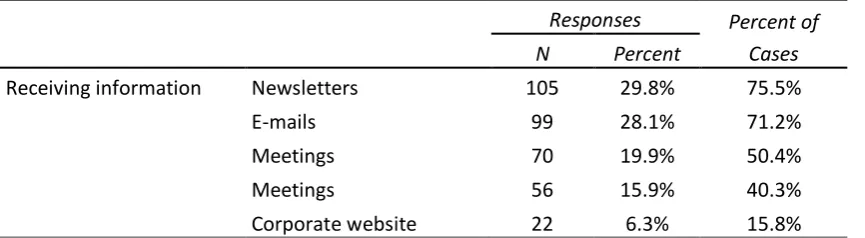
[image:18.595.71.313.316.478.2]In Table 1, an overview of the mean scores and the standard deviations is given. The mean scores appear to be placed around the middle of the Likert scale, with the scale ranging for 1 to 5. With the use of a one sample t-test it is checked if the mean scores of the constructs significantly differ from 3 which is the center of the scale. It came into view that the mean scores of continuance commitment and corporate behavior do not significantly differ from the mean (p = >.05). Noticeable differences above the mean are the scores of brand supportive behavior (3.69, p = <.001), and internal communication climate (3.52, p = <.001). On the other hand, the mean score of visual symbolism (2.56, p = <.001) tends to be low. The other constructs do significantly differ from the means score 3, but the differences are relatively small. Table 2 provides an overview of how the respondents gather important information related to the brand. Noticeable is that most respondents claim they receive the most important brand related information by mail and (online) newsletters.
Table 1: Mean scores of all variables
N Mean SD
Affective commitment 140 3.27 0.59 Continuance commitment 140 2.94 0.65 Normative commitment 140 2.76 0.52 Brand supportive behavior 138 3.69 0.49 Internal communication climate 141 3.52 0.57 Adequacy internal communication 141 3.22 0.58
Visual symbolism 141 2.56 0.55
Organizational behavior 139 3.02 0.47
Brand fit 142 3.12 0.67
Note: all variables were measured on a 5 point Likert scale. Table 2: Receiving important brand information
Responses Percent of
Cases
N Percent
Receiving information Newsletters 105 29.8% 75.5%
E-mails 99 28.1% 71.2%
Meetings 70 19.9% 50.4%
Meetings 56 15.9% 40.3%
Corporate website 22 6.3% 15.8%
4.2 Correlations
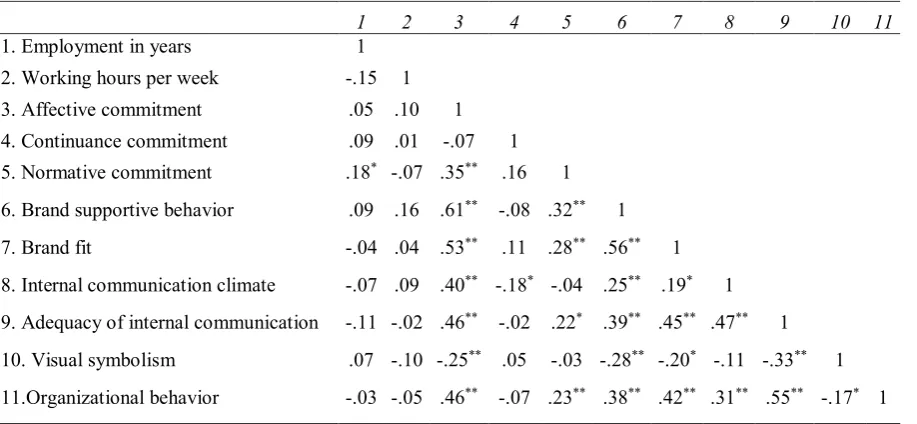
A Pearson correlation test was executed to measure the strength of the correlations between the variables. Table 3 shows an overview of the correlations between the variables. In the ensuing text, only noticeable results are mentioned.
[image:18.595.71.504.517.636.2]19 commitment, whereas continuance commitment has the fewest. Besides, brand supportive behavior shows a lot of relationships with the internal branding aspects. A medium correlation exists between the communication variables and affective commitment: internal communication climate (r = .40, p = <.01) and adequacy of internal communication (r = .46, p = <.01). A medium relationship exists between adequacy of internal communication and brand supportive behavior (r = .39, p = <.01). Internal communication climate exposes a small relationship with continuance commitment (r = .18, p = <.05) and normative commitment (r = .22, p = <.01), and brand supportive behavior (r = .25, p = <.01). Organizational behavior also shows a medium relationship with affective commitment (r = .46, p = <.01) and brand supportive behavior (r = .38, p = <.01), while it shows a small correlation with normative commitment (r = .23, p = <.01).
Table 3: Pearson correlations of the constructs
1 2 3 4 5 6 7 8 9 10 11
1. Employment in years 1
2. Working hours per week -.15 1
3. Affective commitment .05 .10 1
4. Continuance commitment .09 .01 -.07 1
5. Normative commitment .18* -.07 .35** .16 1
6. Brand supportive behavior .09 .16 .61** -.08 .32** 1
7. Brand fit -.04 .04 .53** .11 .28** .56** 1
8. Internal communication climate -.07 .09 .40** -.18* -.04 .25** .19* 1 9. Adequacy of internal communication -.11 -.02 .46** -.02 .22* .39** .45** .47** 1 10. Visual symbolism .07 -.10 -.25** .05 -.03 -.28** -.20* -.11 -.33** 1 11.Organizational behavior -.03 -.05 .46** -.07 .23** .38** .42** .31** .55** -.17* 1
Note:* p = <.05 level, ** = <.001.
4.3 Multiple regression
To test the significance of the relationship between the independent variables and the dependent variables which is necessary for conducting a mediation effect, a hierarchical multiple regression was conducted. VanVoorhis and Morgan (2007), mention different approaches to determine the minimum sample size to conduct a multiple regression analysis. One rule is that sample size must be at least 50. The other approaches are determined by the amount of independent variables: a sample size of 50 plus 8 per variable or 10 samples per predictor. The sample size of this research is sufficient (N = 142). Hereafter the assumptions of normality continuous measurements, normality, independence, and linearity are checked. These assumptions must also be met before calculating the mediation effect. The predicted probability plots showed a normal distribution. The scatterplots showed a rectangular shape, so the assumption of homoscedasticity is approved. Additionally, the variance inflation factor (VIF) is analyzed to check for multicollinearity. The VIF for the independent variables were all <2, which is below the critical value of 10 that could indicate multicollinearity (Robinson & Schumacker, 2009).
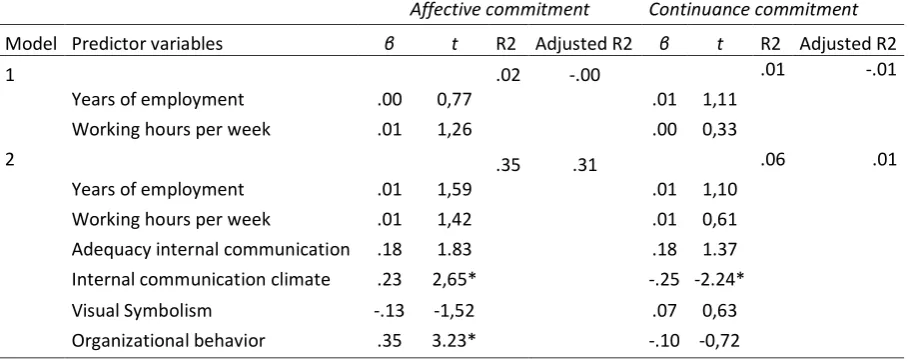
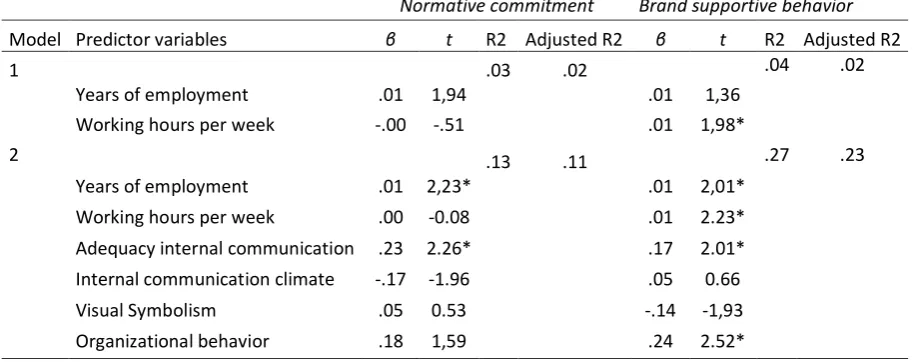
20 commitment (F(6, 126) = 11.01, p = <.001), 6% of the variance regarding continuance commitment (F(6, 126) = 1.22, p = >.05) , 13% of the variance regarding normative commitment (F(6, 126) = 3.14, p = <.05), and 27% of the variance regarding brand supportive behaviour (F(6, 125) = 7.65, p = <.001).
The regression analyses showed that three out of the four independent variables had a significant relationship with affective commitment, continuance commitment, normative commitment, and/or brand supportive behavior. Internal communication climate (β = .23, p = <.05) and organizational behavior (β = .35, p = <.05) significantly contributed to affective commitment. Furthermore, internal communication climate (β = -.25, p = <.05) significantly contributed to continuance commitment. In addition, adequacy of internal communication (β = .23, p = <.05) significantly contributed to normative commitment. At last, adequacy of internal communication (β = .17, p = <.05) and organizational behavior (β = -.14, p = <.05) significantly contributed to brand supportive behavior. Consequently, H1C, H1D, H2A, H2B, H4A, and H4D are supported.
Visual symbolism did not show a significant relation with the independent variables. Additionally, adequacy of internal communication did not significantly contribute to affective commitment and continuance commitment. Internal communication climate did not significantly contribute to normative commitment and brand supportive behavior. Organizational behavior did not significantly contribute to continuance commitment and normative commitment. Therefore, H1A,
[image:20.595.72.527.370.552.2]H1B, H2C, H2D, H3A, H3B, H3C, H3D, H4B, and H4C are rejected.
Table 4: Overview of multiple regression analysis regarding affective and continuance commitment.
Affective commitment Continuance commitment
Model Predictor variables β t R2 Adjusted R2 β t R2 Adjusted R2
1 .02 -.00 .01 -.01
Years of employment .00 0,77 .01 1,11
Working hours per week .01 1,26 .00 0,33
2 .35 .31 .06 .01
Years of employment .01 1,59 .01 1,10
Working hours per week .01 1,42 .01 0,61
Adequacy internal communication .18 1.83 .18 1.37
Internal communication climate .23 2,65* -.25 -2.24*
Visual Symbolism -.13 -1,52 .07 0,63
Organizational behavior .35 3.23* -.10 -0,72
21 Table 5: Overview of multiple regression analysis regarding normative commitment and brand supportive behavior
Normative commitment Brand supportive behavior
Model Predictor variables β t R2 Adjusted R2 β t R2 Adjusted R2
1 .03 .02 .04 .02
Years of employment .01 1,94 .01 1,36
Working hours per week -.00 -.51 .01 1,98*
2 .13 .11 .27 .23
Years of employment .01 2,23* .01 2,01*
Working hours per week .00 -0.08 .01 2.23*
Adequacy internal communication .23 2.26* .17 2.01*
Internal communication climate -.17 -1.96 .05 0.66
Visual Symbolism .05 0.53 -.14 -1,93
Organizational behavior .18 1,59 .24 2.52*
Note: *p = <.05, ** p = <.001
4.4 Mediation effect of brand fit
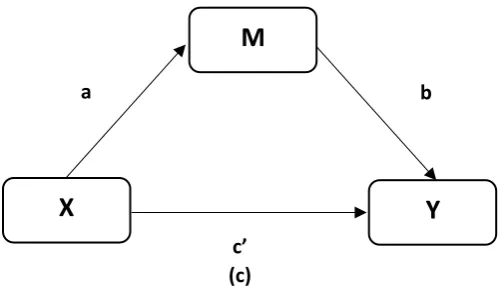
Simple mediation model was used to test the mediating role of brand fit. For each set of variables a model is calculated by using PROCESS v.3.2, a computational tool used in combination with SPSS (Hayes, 2012). These mediation models are calculated by performing bootstrap.
Bootstrap has an advantage compared to other analysis that estimate statistical inferences. Bootstrap generates more accurate outcomes, while it is simpler to derive compared to more conventional analysis (Wood, 2005). Preacher and Hayes (2004) mention that the minimum sample size to perform bootstrap is 25, although such a small sample size most likely lack statistical power. Since this research has a larger sample size (N = 142) it is considered to be sufficient. The bootstrap was set at 5000 as recommend in literature (Hayes, 2009).
After calculating the simple mediation models, it can be concluded if brand fit acts as a mediator between internal branding (by the use of adequacy of internal communication, internal communication climate, and organizational behavior), and affective, continuance, and normative commitment and brand supportive behavior of employees.
[image:21.595.70.532.113.294.2]22 Figure 2: Schematic simple mediation model
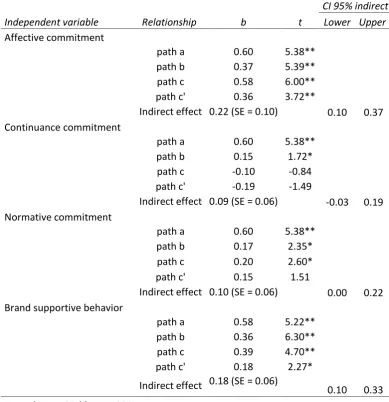
The simple mediation models show the (in)significance and the coefficients of the different sets of variables with brand fit as a mediator. For reasons of completeness, it should be mentioned that mediation effects of brand fit is hypothesized for visual symbolism. However, the Pearson correlation and the multiple regression analysis showed no significant positive relationship. Therefore, it is concluded that H7 cannot be supported. Hence, the following mediation models are limited to adequacy of internal communication (Table 6), internal communication climate (Table 7), and organizational behavior (Table 8), where brand fit acts as a possible mediator.
4.4.1 Mediating effect brand fit with adequacy internal communication
Adequacy of internal communication was hypothesized to have a positive relationship with the employee-related outcomes, while brand fit acts as a mediator. As Table 6 shows, there is an indirect effect of adequacy of internal communication and affective commitment, continuance commitment, normative commitment, and brand supportive in presence of brand fit. Consequently,
H5 is supported.
X
Y
a b
c’
(c)
23 Table 6: Mediation with adequacy internal communication and brand fit as a mediator
b t
CI 95% indirect
Independent variable Relationship Lower Upper
Affective commitment
path a 0.52 5.94**
path b 0.36 5.29**
path c 0.47 6.06**
path c' 0.28 3.52*
Indirect effect 0.19 (SE = 0.06) 0.09 0.31 Continuance commitment
path a 0.52 5.94**
path b 0.14 1.49
path c 0.02 0.19
path c' 0.09 0.84
Indirect effect 0.07 (SE = 0.05) 0.03 0.16 Normative commitment
path a 0.52 5.94**
path b 0.18 2.47*
path c 0.20 2.60*
path c' 0.10 1.25
Indirect effect 0.09 (SE = 0.05) 0.01 0.20 Brand supportive behavior
path a 0,50 5.77**
path b 0.35 6.08**
path c 0.33 4.99**
path c' 0.15 2.31*
Indirect effect 0.18 (SE = 0.04) 0.10 0.27
Note: * p = <.05 ** p = <.001
4.4.2 Mediating effect brand fit with internal communication climate
24 Table 7: Mediation with internal communication climate and brand fit as a mediator
b t
CI 95% indirect
Independent variable Relationship Lower Upper
Affective commitment
path a 0.23 2,40*
path b 0.42 6,88**
path c 0.42 5,17**
path c' 0.33 4,52**
Indirect effect 0.10 (SE = 0.06) -0.00 0.22 Continuance commitment
path a 0.23 2,40*
path b 0.14 1,72
path c -0.21 -2,12*
path c' -0.24 -2,43*
Indirect effect 0.03 (SE = 0.10) -0.02 0.15 Normative commitment
path a 0.23 2,40*
path b 0.23 3,56*
path c -0.03 -0,44
path c' -0.09 -1,14
Indirect effect 0.05 (SE = 0.04) -0.00 0.29 Brand supportive behavior
path a 0.22 2,22*
path b 0.39 7,37**
path c 0.21 2,99*
path c' 0.13 2,09*
Indirect effect 0.09 (SE = 0.05) -0.01 0.19
Note: * p = <.05 ** p = <.001
4.4.3 Mediating effect brand fit with organizational behavior
25 Table 8: Regression analysis with organizational behavior and brand fit as a mediator
b t
CI 95% indirect
Independent variable Relationship Lower Upper
Affective commitment
path a 0.60 5.38**
path b 0.37 5.39**
path c 0.58 6.00**
path c' 0.36 3.72**
Indirect effect 0.22 (SE = 0.10) 0.10 0.37 Continuance commitment
path a 0.60 5.38**
path b 0.15 1.72*
path c -0.10 -0.84
path c' -0.19 -1.49
Indirect effect 0.09 (SE = 0.06) -0.03 0.19 Normative commitment
path a 0.60 5.38**
path b 0.17 2.35*
path c 0.20 2.60*
path c' 0.15 1.51
Indirect effect 0.10 (SE = 0.06) 0.00 0.22 Brand supportive behavior
path a 0.58 5.22**
path b 0.36 6.30**
path c 0.39 4.70**
path c' 0.18 2.27*
Indirect effect 0.18 (SE = 0.06) 0.10 0.33
Note: * p = <.05 ** p = <.001
26
4.5 Overview of results of tested hypothesis
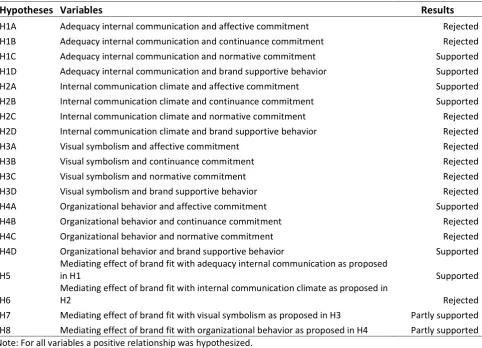
[image:26.595.75.558.139.487.2]Following the analyses of the results, a summary of the tested hypotheses and the outcomes of the analyses is provided in Table 8.
Table 9: Summary of hypothesis testing
Hypotheses Variables Results
H1A Adequacy internal communication and affective commitment Rejected
H1B Adequacy internal communication and continuance commitment Rejected
H1C Adequacy internal communication and normative commitment Supported
H1D Adequacy internal communication and brand supportive behavior Supported
H2A Internal communication climate and affective commitment Supported
H2B Internal communication climate and continuance commitment Supported
H2C Internal communication climate and normative commitment Rejected
H2D Internal communication climate and brand supportive behavior Rejected
H3A Visual symbolism and affective commitment Rejected
H3B Visual symbolism and continuance commitment Rejected
H3C Visual symbolism and normative commitment Rejected
H3D Visual symbolism and brand supportive behavior Rejected
H4A Organizational behavior and affective commitment Supported
H4B Organizational behavior and continuance commitment Rejected
H4C Organizational behavior and normative commitment Rejected
H4D Organizational behavior and brand supportive behavior Supported
H5
Mediating effect of brand fit with adequacy internal communication as proposed
in H1 Supported
H6
Mediating effect of brand fit with internal communication climate as proposed in
H2 Rejected
H7 Mediating effect of brand fit with visual symbolism as proposed in H3 Partly supported
H8 Mediating effect of brand fit with organizational behavior as proposed in H4 Partly supported
27
5.
Discussion
5.1 Main findings
Within service organizations, just as the laboratory organization is in this research, employees play a huge role to achieve a competitive advantage. Employees are the brand representatives of the company (e.g., Harris & de Chernatony, 2001; King & Grace, 2008; Santos-Vijande et al., 2013). It is important for employees in this type of organization to act in line with the company values. Minor mistakes could have a serious impact, for the employer, as well as for the customer. Brand commitment is linked to the degree employees want to incorporate the brand promise and satisfy customers (Testa, 2001). Brand supportive behavior of employees is key for customers when forming an evaluation about the service of an organization (King, 2010). Aligned attitudes and behavior of employees towards customers also leads to a better perceived brand promise and customer satisfaction (Punjaisri & Wilson, 2007). Internal branding contributes to an increased level of brand commitment and aligned brand supportive behavior among employees (e.g., Backhaus & Tikoo, 2004; Mahnert & Torres, 2007). In this study, commitment is divided in affective, continuance and normative commitment as proposed by Allen and Meyer (1990). In addition, internal branding is split in corporate communication (i.e. adequacy of internal communication and internal communication climate), visual symbolism, and organizational behavior.
This study investigated how aspects of internal branding contribute to delivering the brand promise by employees working for a laboratory organization. The general question for this research was: ‘To what extent has communication, visual symbolism, and organizational behavior as part of internal branding a positive relationship with brand commitment and brand supportive behavior of employees?’. The hypothesized contributions were analyzed through exploring the relationships between different aspects of internal branding and brand commitment plus brand supportive behavior among employees. The next step was assessing if brand fit had a mediating role.
Although this study hypothesized that all three brand commitment variables had a positive relationship with internal branding, the study showed that this is only true for two variables. Even though the commitment variables are connected, there are differences. Ko, Price, and Mueller (1997) found that job alternatives, which is included in the scale of Allen and Meyer (1990) as a part of continuance commitment construct, is actually a possible determinant of continuance commitment and therefore could give different results. In addition, continuance commitment refers to the cost and effects when leaving the organization with an external focus, where affective and normative commitment are referring to identification with the organization and perceived obligation to stay at the organization. Therefore, continuance commitment is less related to personal interest in the brand compared to affective and normative commitment. Consequently, continuance commitment is perhaps explained by external factors outside the organization. For example, the change to find a similar job or the financial dependence of the salary. This could be a reason why internal branding did not contribute to continuance commitment.
28 First, adequacy of internal communication has a significant relationship with normative commitment and brand supportive behavior. Besides, in the presence of brand fit, there is an indirect effect for all dependent variables, including affective commitment, continuance commitment, normative commitment, and brand supportive behavior. It was found that more information about the brand increases normative commitment and brand supportive behavior. Where other studies found a significant relationship between affective commitment and the content of internal communication (e.g., Postmes, Tanis, & De Wit, 2001; Van Vuuren, De Jong, & Seydel, 2007; Walden, Jung, & Westerman, 2017), this study found a significant relationship with normative commitment. The mediating effect of brand fit is in line with Ozçelik and Findikli (2015), although this study more specified the brand information aspect. The content of communication to employees, of which they believe is necessary to do their job (short-term), and to make long-term decisions about their employment, is most likely to be send by the organization itself, or by the management in name of the company (Robichaud, Giroux, & Taylor, 2004), which could explain the link with normative commitment. However, employees must perceive this brand-related information as appropriate. Proper information about the brand therefore is not only connected to the employee identification with the brand mediated by brand fit, but also to the willingness to stay working for the brand and brand supportive behavior.
Second, internal communication climate showed a significant positive relationship with affective commitment and a negative relationship with continuance commitment. No mediating effect of brand fit regarding internal communication climate was found. The result regarding affective commitment is in line with the outcomes of a study conducted by Güney, Diker, Güney, Ayranci, and Solmaz (2012). They state that open communication within an organization leads to an increased work commitment, which is described as identification by employees with their work and career. Unexpected was the negative significant relationship regarding internal communication climate and continuance commitment. A possible explanation for this relationship could be found in research conducted by Fonner and Roloff (2010). They revealed that an increased level of communication could lead to an overload of information, hinder during work, and stress. This has a negative effect on the satisfaction and dedication of employees regarding their job. The absence of a significant relationship between internal communication climate and brand supportive behavior could also be explained by the outcomes of Fonner and Roloff (2010). An example could be that communication takes too much time, and therefore employees do not have the time to employ extra work related behavior.
29 concepts are connected (Burmann & Zeplin, 2005). The absence of a significant relationship between visual symbolism and continuance and normative commitment
Fourth, organizational behavior showed significant relationships with affective commitment and brand supportive behavior. This result is in line with the research of Chew and Chan (2008), which showed that organizational behavior plays an important role in internal branding. In addition, this study also showed that brand fit mediates the relationship affective commitment and brand supportive behavior. Besides, with the mediator brand fit, organizational behavior shows an indirect effect with normative commitment.
5.2 Practical implications
In literature, the importance of delivering the brand promise to customers is widely recognized. Employees are a key factor in this (e.g., King & Grace, 2008; Punjaisri & Wilson, 2007). Drivers in delivering the brand promise are brand commitment (i.e. affective commitment, continuance commitment, and normative commitment) and brand supportive behavior. Internal branding makes a contribution to these drivers. Nevertheless, the aspects of internal branding (i.e. adequacy internal communication, internal communication climate, visual symbolism, and organizational behavior) do not make an equal contribution. Based on the results of this study, organizations’ main focus should be on adequacy of internal communication, internal communication climate, and organizational behavior.
Internal branding, due to adequacy of internal communication, internal communication climate, and organizational behavior, have a positive relationship with the mentioned drivers of brand delivery, with the exception of continuance commitment. This is achieved directly or through brand fit. Therefore, is it crucial for service organizations to the use appropriate tools in order to propagate their brand values, and by this way shape their employees into superb brand ambassadors. Points when organizations make some fundamental changes are seen as proper moments to employ internal branding tools (Mitchell, 2002).
First, organizations should have an overall view of the employees’ level of brand commitment. This could fluctuate by different factors over time. Besides, it should be checked if employees feel appreciated by the organization and if there are possibilities for personal development. Giving employees the opportunity for personal development is considered as a part of organizational behavior. Organizational actions which are perceived by employees as organizations’ commitment to them, are likely to improve the attitudes of employees (Chew & Chan, 2008). Furthermore, organizational behavior is a helpful tool to transmit brand values, example by training (e.g., King & Grace, 2007; Punjairsi & Wilson, 2007).
Second, colleagues or managers could acts as role models for other employees, therefore it is important that they live the brand (Miles & Mangold, 2004). A way to implement this via organizational behavior and internal communication is by storytelling (Baker, et al., 2014). This creates and strengthens employees’ internalization of the brand values (Gill, 2011). Consequently, organizations must behave in line of their own brand values (Terglav, Ruzzier, & Kaše, 2016). In addition, when communicating about the brand, there must be space for employees to make suggestions. Because, an open communication climate increases affective commitment and brand supportive behavior. For this specific laboratory organization used in the research, it turned out that employees receive most important brand related information by email or a newsletter. However when this is done by a more personal way, it is easier for employees to make suggestions.
30 of the brand values could be personalized with cooperation of employees, which is suggested to increase affective commitment (Baker, et al., 2014).
5.3 Limitations and future research directions
While the results give some good insights of the effect of internal branding on employees, there are some limitations in this research. The most salient limitation is the result of the factor analysis, which is presented in Appendix B. The outcome revealed that several items correspond to components unintendedly. This issue was unbridgeable regarding the case for items of affective commitment and organizational behavior (which could be traced to CSR to employees). A possible explanation could be that both constructs have an overlap. CSR to employees includes the possibility of personal development within the organization, where affective commitment includes the involvement in the organization which could be linked. Although some other items also had an ambiguous loading, future research could exclude these items to prevent any issues. However, because the issue regarding items of affective commitment and organizational behavior could not be solved, the results of the factor analysis were not taken into account during this study. Yet, items regarding different constructs loading on the same component, are a risk for the divergent validity of the research instrument. For future research, it is recommended that these variables be more distinguished to increase the divergent validity and to check if the outcomes still hold.
Second, the research is conducted within a specific part of a laboratory organization within one geographical region. Therefore, the results may not be generalizable for other regions, sectors or even other parts of the organization, even though employees participated in this research worked at different locations. Although this research contributes to the overall understandability of internal branding, different samples require new research.
31
6. Conclusion
This study investigated how internal branding (i.e. adequacy of internal communication, internal communication climate, visual symbolism, and organizational behavior) has a positive relationship with brand commitment and brand supportive behavior for employees working in a laboratory organization, although the relationship varied.
As a result of this study, it can be concluded that internal communication and organizational behavior play a crucial role in the employee-related outcomes. Employees are more committed (i.e. affective and normative) to the brand and show more brand supportive behavior due to internal branding. Brand commitment and brand supportive behavior are positively associated with the delivery of the brand promise to customers. Therefore, it is important for organizations to pay attention to the adequacy of internal communication, the internal communication climate, and the organizational behavior. The other investigated internal branding aspect, visual symbolism, showed no significant relationship with brand commitment or brand supportive behavior. Accordingly, organizations should focus on the other internal branding aspects.