Corresponding author: [email protected] Received 30/5/2019; Accepted 10/7/2019
DOI: 10.21608/ejss.2019.13349.1277
Introduction Rice (Oryza sativa L.) is a very essential cereal crop of the world, grown in wide scope of climatic zones. It is a staple food for nearly half of the world’s population, most of whom live in developing countries. The crop occupies one-third of the world’s total area planted to cereals and provides 35 to 60% of the calories consumed by 2.7 billion people. (Mandana et al., 2014). The production of an economic crop of rice without high rates of mineral fertilizers suitable for new varieties of rice distinguished in the high yield in the soil is poor content of organic matter is one of the most important challenges faced by researchers, especially in Egypt. Compost is a mixture from crop wastes, leaves, grass chippings, plant stems, grapes, weeds, twigs and branches it’s a very good alternative which proved helpful
in many countries all over the world, compost application has not merely been used to improve soil organic matter and refine it with different nutrients but also to render the environmental pollution from trash (Kuepper, 2003). Compost tested greatly useful in enhancing the yield of the rice crop and N-P-K-uptake (Jeyabal and Kuppuswamy, 2001; Satyanarayana et al., 2002 and Khafagy et al. 2017).
In higher plants, Zn is either required for or at least mod ulates, the activity of a large number of various types of enzymes, including
dehydrogenases, aldolases, isomer ases,
transphosphorylases and RNA and DNA polymer-ases. Some examples are given below (Broadley et al., 2012). Globally, more than 30 % of soils are poor in plant-available Zn (Hacisalihoglu and Kochian, 2003 and Alloway 2008). Egyptian soil
Z
INC deficiency is the most widespread challenge in rice cultivation, as well as the shortage of agricultural soil in organic matter, especially in Egypt. So, there was an experimentation for compost treatment (12 t ha-1) and in-soil zinc applications at three rates (0, 8 and 16 kg ZnSO4.7H2O ha-1), on growth, yield, total nitrogen uptake, agronomic nitrogen efficiency and nitrogen recovery efficiency of rice crop (Oryza sativa), variety Giza 178. Using organic fertilization as compost has recorded the highest values of plant height, dry weight, grain yield, straw yield, total nitrogen uptake, agronomic nitrogen efficiency and nitrogen recovery efficiency. In addition, in-soil zinc application rates are increasingly applied to the previous parameters. The increase in rice grain and straw yield by applying 12 t compost ha-1 was 13.4% and 7.14%, respectively, while applying 16 kg ZnSO4.7H2O ha-1 increased the rice grain yield by 12.31% and 17.55% increase in rice straw yield. Remarkable results have been registered when examining 16 kg Zn ha-1 with 12 t compost ha-1 on total nitrogen uptake and nitrogen recovery efficiency have been enhanced even under saline soil conditions.Keywords: Rice, Organic, Mineral. Zinc, Nitrogen, Uptake, Efficiency.
Influence of
Integrated In-soil Zinc Application and Organic
Fertilization on Yield, Nitrogen Uptake and Nitrogen Use E
fficiency
of
Rice
Ibrahim S. M. Mosaad
Soil Fertility and Plant Nutrition, Soil, Water and Environment Research Institute, Agriculture Research Center, Giza, 12619, Egypt,
Egyptian Journal of Soil Science
is considered to be among the soils are poor in zinc (Alloway, 2008 and Khafagy et al., 2017). In general, cereals such as rice are more exposed to Zn deficiency leading to a serious decline in grain yield and nutritional quality, compared with legumes (Cakmak et al., 1999). Zinc deficiency causes severe yield reduction in rice, so the application of Zn such as foliar or soil application caused significant improvement in growth and yield attributes and yield of rice (Suman and Sheeja, 2018). Moreover, a constancy of Zn lack is higher in rice than other crops, with more than 50 % of the yield worldwide prone to this nutritional mess. In addition, Paddy soil conditions are usually not supportive for attainable zinc, therefore, zinc insufficiency has been announced countrywide in rice soils (Dobermann and Fairhurst 2000; Fageria et al. 2002; Quijano-Guerta et al. 2002 and El-Hissewy et al. 2016).
In-soil zinc application is the principal method and a simple and effective solution for Zn supply in rice production systems (Naik & Das 2007 and Ghasal et al., 2016). Zinc fertilizer had a decisive influence on rice growth features, e.g dry matter creation, leaf area indicator and yield traits, i.e. panicle number/hill, plant height, panicle length, panicle weight, filled grains/panicle, 1000-grain weight, straw and grain yields under saline soil condition (El-Hadidi et al. 2016 and Khafagy et al., 2017). In additions, Bharat (2006) stated that zinc employment had raised rice grain and straw yields and harvest index under saline sodic conditions. A lot of investigators announced that escalated zinc rates expanded grain yield and its properties (Tariq et al., 2007; Metwally, 2011 and El-Hissewy et al., 2016).
Therefore, our experiments were conducted to study the interaction effect between organic fertilization as compost and in-soil zinc application
as ZnSO4.7H2O on rice in saline soils in the northern
Delta of Egypt. The hypotheses were: (i) zinc deficiency is the most widespread micronutrients disorder in rice cultivation in the northern Delta of Egypt (ii) also, the poverty of the soil in organic
matter, therefore (iii) the use of organic fertilization in the form of compost on saline soils and the
use of in-soil zinc application as ZnSO4.7H2O
can increase rice production by improving the efficiency of nitrogen use, which at the same time helps to protect the natural environment.
Materials and Methods Preparation and experimental design
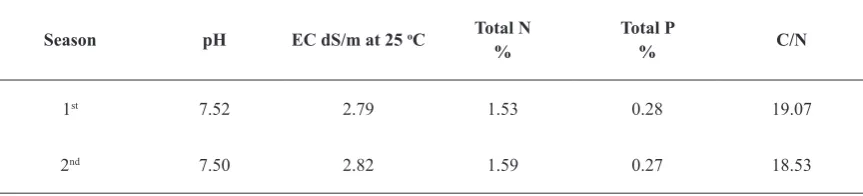
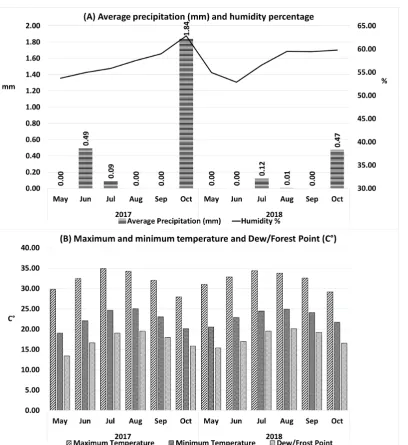
Field experiments were conducted for two seasons (2017-2018) on a clayey soil at the experimental farm of El-Serw Agriculture Research Station, Agriculture Research Center, Damietta governorate (31°14′N and 31°48′E) in the northern Egypt. The region has a sub-tropical climate with hot, dry summers and cool wet winters. The weather conditions (Average precipitation, humidity percentage, maximum and minimum temperature and Dew/Forest Point) at the experimental location during rice growing seasons were quite variable in the two years of experimentation (Fig. 1 A and B). The experimental design is a split plot with four replications. The main scheme is planned to study the effect of compost application, at 2 rates 0 (unfertilized control) and recommended dose at 12 t ha-1 of compost on rice (Oryza sativa L.) variety Giza 178, growth and nutrients uptake. The chemical analysis of the compost is shown in Table 1. When the subplot deals with testing the consequences of applying in-soil zinc application
at three zinc levels (0, 8 and 16 kg Zn ha-1 as
ZnSO4.7H2O) on rice (Oryza sativa L.) growth
and nutrients uptake.
Before rice transplanting mineral zinc fertilizer treatments were added to the dry soil. Moreover, equable application of superphosphate (15% P2O5) at the rate of 240 Kg ha-1 was applied too as basal of each plot. All agronomic practices in rice such as, land preparation, fertilization and irrigation were done as recommended (nitrogen fertilizer at 140 kg N ha-1 and applied as urea 46.5% N) in three equal doses after sowing.
TABLE 1. Analysis of compost at 2017 and the 2018 seasons
Season pH EC dS/m at 25 oC Total N
% Total P% C/N
1st 7.52 2.79 1.53 0.28 19.07
Egypt. J. Soil. Sci. Vol. 59
The 2017 summer season, rice nurseries were planted on 14th May when their transplanting was on 21th June and their harvest was on 8th October. While rice nurseries in the second season were planted on 16th May and they were transplanted on 24th June and their harvest was on 9th October,2018.
Mature compost (rice straw and farmyard manure) (12 t of compost ha-1) were added to the soil and mixed with the upper layer (30 cm) after transplanting.
Soil analysis
The surface soil (0–30 cm) layer at the initiation of experiments was saline (electrical
conductivity 5 dS m-1) with pH 8.1 and contained
7.6 kg-1 Walkley-Black carbon, 7.94 mg kg-1 0.5M
NaHCO3-extractable P (Olsen et al. 1954) and
479 mg kg-1 1N NH
4OAc-extractable K (Jackson,
1967). Irrigation from El-Serw drainage from a point away from the start of the drainage about 20
km (EC 3.2:3.3 ds m-1, SAR 10.5:11.3), therefore
it’s considered to cause increase salinity problems (Tagour and Mosaad 2017).
Plant analysis
At harvest stage, rice plant representative samples had randomly taken from each experimental plot. Plant height growth parameters, dry weight of plant and grain and straw yield were
acquired by (cm), (g plant-1) and (t ha-1), orderly.
plant samples were oven dried at 70oC till constant
weight. N (%) in plant were Chemically analyzed according to Mertens (2005a, b) methods and Agrilasa (2002).
Nitrogen uptake and use efficiencies
Nitrogen uptake in rice grains and straw are calculated by the following equation:
Nutrient element uptake (kg ha-1) = (nutrient
element% × yield (kg ha-1)) / 100.
Agronomic efficiency AE kg grain/kg N applied, and apparent recovery efficiency (RE), of added fertilizer N were calculated as:
AE = (grain yield in plot) / (quantity of N fertilizer applied in plot)
RE (%) = [(total N uptake in plot) / (quantity of N fertilizer applied in plot)] × 100
Statistical analysis
Data were collected for statistical analysis according to Snedecor and Cochran (1981). Mean values were compared, at a level of P<0.05 by
using the Least Significance Difference (LSD) test. CoStat (v. 6.400 CoHort software., California, USA) was used for statistical analysis for data. Results Rice growth parameters
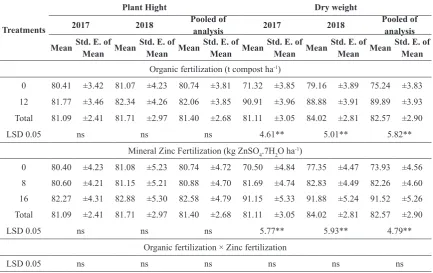
Table 2 showed rice plant height and dry
weight as affected by organic fertilization as compost, soil mineral Zn fertilization treatments and their interactions.
Applying organic fertilization has insignificant effect (p<0.05) on rice plant height apart from rice dry weight which was significantly influenced in both seasons as well as in the pooled analysis. The
highest values were obtained by using 12 t ha-1
compost ha-1 under saline soil condition.
Also, data in Table 2 showed that rice plant height was non-significantly increased (p<0.05) by applying mineral Zn fertilization in both seasons as well as in the pooled analysis, but the dry weight of rice was very significant (p<0.01) in both seasons as well as in the pooled analysis. The highest values of these
parameters are obtained by 16 kg of ZnSO4.7H2O.
In line with data, there is an interaction resulted from organic fertilization as compost and in-soil zinc application. Its outcome was non-significant on rice plant height and dry weight in both seasons as well as in the polled analysis.
TABLE 2. Effect of organic fertilization as compost, soil mineral Zn fertilization and their interaction on rice plant height (cm) and dry weight (g)
Treatments
Plant Hight Dry weight
2017 2018 Pooled of analysis 2017 2018 Pooled of analysis
MeanStd. E. of Mean MeanStd. E. of Mean MeanStd. E. of Mean MeanStd. E. of Mean MeanStd. E. of Mean MeanStd. E. of Mean
Organic fertilization (t compost ha-1)
0 80.41 ±3.42 81.07 ±4.23 80.74 ±3.81 71.32 ±3.85 79.16 ±3.89 75.24 ±3.83 12 81.77 ±3.46 82.34 ±4.26 82.06 ±3.85 90.91 ±3.96 88.88 ±3.91 89.89 ±3.93 Total 81.09 ±2.41 81.71 ±2.97 81.40 ±2.68 81.11 ±3.05 84.02 ±2.81 82.57 ±2.90
LSD 0.05 ns ns ns 4.61** 5.01** 5.82**
Mineral Zinc Fertilization (kg ZnSO4.7H2O ha-1)
0 80.40 ±4.23 81.08 ±5.23 80.74 ±4.72 70.50 ±4.84 77.35 ±4.47 73.93 ±4.56 8 80.60 ±4.21 81.15 ±5.21 80.88 ±4.70 81.69 ±4.74 82.83 ±4.49 82.26 ±4.60 16 82.27 ±4.31 82.88 ±5.30 82.58 ±4.79 91.15 ±5.33 91.88 ±5.24 91.52 ±5.26 Total 81.09 ±2.41 81.71 ±2.97 81.40 ±2.68 81.11 ±3.05 84.02 ±2.81 82.57 ±2.90
LSD 0.05 ns ns ns 5.77** 5.93** 4.79**
Organic fertilization × Zinc fertilization
Egypt. J. Soil. Sci. Vol. 59
Rice grain and straw yield ton ha-1
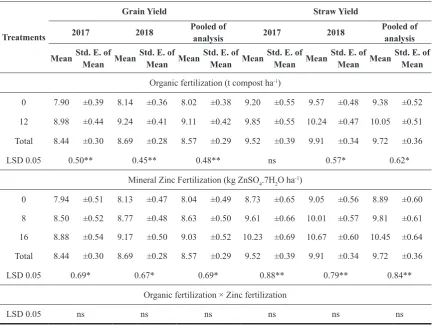
ANOVA in Table 3 showed that the interaction effect between compost application and in-soil zinc application was insignificant (p<0.05) on rice grain and straw yield in both seasons and pooled analysis. While rice grain yield was significant (p<0.05) and rice straw yield was very significant (p<0.01) by employing mineral Zn fertilization parameter. On the other hand, the effect of organic fertilization was highly significantly (p<0.01) on rice grain yield in both seasons and pooled analysis, while the effect of organic fertilization on rice straw yield was non-significant (p<0.05)
in the 1st season and significant (p<0.05) in the 2nd
season and in the pooled analysis.
Furthermore, data in Table 3 pointed that
applying of 16 kg ZnSO4.7H2O ha-1 gave the
highest rice grain and straw yield in both season and pooled analysis. Applying 8 and 16 kg
ZnSO4.7H2O ha-1 increased the rice grain yield by
(7.34 and 12.31%, respectively) and (10.35 and 17.55%, respectively) increasing in rice straw yield. The highest rice grain and straw yield were obtained with applying organic fertilization at 12 t
compost ha-1. The increase in rice grain and straw
yield by applying 12 t compost ha-1 was 13.4%
and 7.14%, respectively in pooled analysis. Total nitrogen uptake in rice
According to the data in Table 4, the interaction effect between organic fertilization and in-soil zinc application was significant (p<0.05) on total N-uptake in rice in both seasons and pooled analysis. While the effect of organic fertilization and in-soil zinc application factors separately were very significant (p<0.01) on total N-uptake in rice in both seasons and pooled analysis. The highest values were obtained when 12 t compost
ha-1 and 16 kg ZnSO
4.7H2O ha-1 treatments were
used separately in both seasons.
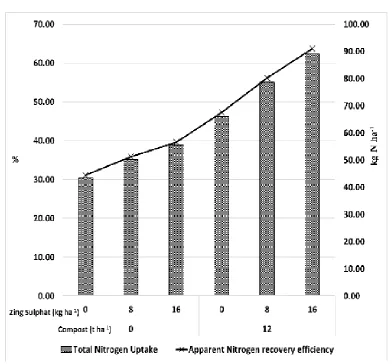
Moreover, total nitrogen uptake in rice affected by the interaction between organic fertilization and in-soil zinc application was explaining in Figure 2. The highest values of total nitrogen uptake in
rice were obtained by applying 12 t compost ha-1
with 16 kg ZnSO4.7H2O ha-1 followed by 12 t
compost ha-1 with 8 kg ZnSO
4.7H2O ha-1 and 12
t compost ha-1 without in-soil zinc application,
respectively (Fig. 2).
TABLE 3. Effect of organic fertilization as compost, soil mineral Zn fertilization and their interaction on rice grain and straw yield (t ha-1)
Treatments
Grain Yield Straw Yield
2017 2018 Pooled of analysis 2017 2018 Pooled of analysis
MeanStd. E. of Mean MeanStd. E. of Mean MeanStd. E. of Mean MeanStd. E. of Mean MeanStd. E. of Mean MeanStd. E. of Mean
Organic fertilization (t compost ha-1)
0 7.90 ±0.39 8.14 ±0.36 8.02 ±0.38 9.20 ±0.55 9.57 ±0.48 9.38 ±0.52 12 8.98 ±0.44 9.24 ±0.41 9.11 ±0.42 9.85 ±0.55 10.24 ±0.47 10.05 ±0.51 Total 8.44 ±0.30 8.69 ±0.28 8.57 ±0.29 9.52 ±0.39 9.91 ±0.34 9.72 ±0.36
LSD 0.05 0.50** 0.45** 0.48** ns 0.57* 0.62*
Mineral Zinc Fertilization (kg ZnSO4.7H2O ha-1)
0 7.94 ±0.51 8.13 ±0.47 8.04 ±0.49 8.73 ±0.65 9.05 ±0.56 8.89 ±0.60 8 8.50 ±0.52 8.77 ±0.48 8.63 ±0.50 9.61 ±0.66 10.01 ±0.57 9.81 ±0.61 16 8.88 ±0.54 9.17 ±0.50 9.03 ±0.52 10.23 ±0.69 10.67 ±0.60 10.45 ±0.64 Total 8.44 ±0.30 8.69 ±0.28 8.57 ±0.29 9.52 ±0.39 9.91 ±0.34 9.72 ±0.36
LSD 0.05 0.69* 0.67* 0.69* 0.88** 0.79** 0.84**
Organic fertilization × Zinc fertilization
TABLE 4. Effect of organic fertiliz ation as compost, soil mineral Zn fertilization and their interaction on total nitr ogen uptake (kg N ha-1), agr onomy nitr ogen efficiency (kg
grain/ kg N applied) and appar
ent nitr
ogen r
ecovery efficiency (%)
Tr
eatments
Total N Uptake
AE
RE%
2017
2018
Pooled of analysis
2017
2018
Pooled of analysis
2017
2018
Pooled of analysis
Mean
Std. E. of Mean
Mean
Std. E. of Mean
Mean
Std. E. of Mean
Mean
Std. E. of Mean
Mean
Std. E. of Mean
Mean
Std. E. of Mean
Mean
Std. E. of Mean
Mean
Std. E. of Mean
Mean
Std. E. of Mean
Or
ganic fertilization (t compost ha
-1) 0 48.51 ±1.34 51.01 ±1.43 49.76 ±1.38 23.71 ±1.18 24.43 ±1.08 24.07 ±1.13 34.65 ±0.96 36.43 ±1.02 35.54 ±0.99 12 76.43 ±2.08 79.57 ±2.19 78.00 ±2.13 26.93 ±1.31 27.71 ±1.22 27.32 ±1.27 54.59 ±1.48 56.84 ±1.56 55.72 ±1.52 Total 62.47 ±2.28 65.29 ±2.35 63.88 ±2.31 25.32 ±0.90 26.07 ±0.84 25.70 ±0.87 44.62 ±1.63 46.63 ±1.68 45.63 ±1.65 LSD 0.05 2.86** 2.99** 2.92** 1.51** 1.39** 1.44** 2.04** 2.14** 2.09**
Mineral Zinc Fertilization (kg ZnSO
4 .7H 2 O ha -1) 0 53.79 ±2.92 55.92 ±2.98 54.86 ±2.95 23.83 ±1.53 24.39 ±1.40 24.1 1 ±1.46 38.42 ±2.09 39.94 ±2.13 39.18 ±2.1 1 8 62.87 ±3.62 65.98 ±3.73 64.43 ±3.68 25.49 ±1.56 26.31 ±1.44 25.90 ±1.50 44.91 ±2.59 47.13 ±2.67 46.02 ±2.63 16 70.75 ±4.28 73.96 ±4.39 72.35 ±4.33 26.64 ±1.62 27.51 ±1.50 27.08 ±1.56 50.54 ±3.06 52.83 ±3.13 51.68 ±3.10 Total 62.47 ±2.28 65.29 ±2.35 63.88 ±2.31 25.32 ±0.90 26.07 ±0.84 25.70 ±0.87 44.62 ±1.63 46.63 ±1.68 45.63 ±1.65 LSD 0.05 0.55** 0.59** 0.57** 2.09* 2.03* 2.05* 0.39** 0.42** 0.41** Or
ganic fertilization × Zinc fertilization
LSD 0.05 * * * ns ns ns * * * AE =
Agronomy nitrogen efficiency
Egypt. J. Soil. Sci. Vol. 59
Nitrogen use efficiency
Data in Table 5 showed that there was a very significant (p<0.01) increment in agronomic efficiency (AE kg grain/kg N applied) and recovery efficiency RE% in both seasons and pooled analysis by compost. Applying 12 t
compost ha-1 gave the highest values of AE and
RE% in both seasons and pooled analysis. Pooled analysis an increase of 13.5% in agronomic nitrogen efficiency and 56.8% in recovery nitrogen efficiency of rice when applying 12 t
compost ha-1.
While the effect of in-soil zinc application was a significant (p<0.05) on AE and highly significant (p<0.01) on RE% in both seasons and pooled analysis. The highest values of AE and
RE% were obtained with 16 kg ZnSO4.7H2O
ha-1 followed by 8 kg ZnSO
4.7H2O ha-1. When
applying of 16 kg ZnSO4.7H2O ha-1 increased of
AE and RE) by 12.3% and 31.9%, respectively.
While the increasing in AE and RE% when used
8 kg ZnSO4.7H2O ha-1 was 7.4% and 17.5%,
respectively.
Also, ANOVA in Table 5 showed that there was non-significant (p<0.05) increment in AE in both seasons and pooled analysis by the interaction effect between organic fertilization and in-soil zinc application, while this effect was a significant (p<0.05) on RE% in both seasons and pooled analysis.
Moreover, RE% of rice affected by the interaction between organic fertilization and in-soil zinc application was explained in Fig. 2. Where the diagram shows that the highest values of RE% were obtained by applying 12 t compost
ha-1 with 16 kg ZnSO
4.7H2O ha-1 followed by 12
t compost ha-1 with 8 kg ZnSO
4.7H2O ha-1 and 12
t compost ha-1 without in-soil zinc application,
respectively (Fig. 2).
Discussion Our result reported that using 12 t compost
ha-1 resulted in the highest plant height, dry
weight (Table 2), yield (Table 3), total N-uptake and nitrogen efficiencies (Table 4) of rice in both seasons and pooled analysis. Where, the increase in rice grain and straw yield by applying 12 t
compost ha-1 was 13.4% and 7.14%, respectively
in pooled analysis (Table 3). While, pooled analysis in table 4 shows an increase of 13.5% in agronomic nitrogen efficiency and 56.8% in recovery nitrogen efficiency of rice when
applying 12 t compost ha-1. This results may be
attributed that a compost tested greatly useful in enhancing the yield of the rice crop and N-P-K-uptake (Jeyabal and Kuppuswamy, 2001 and Satyanarayana et al., 2002). This explanation is also supported by (Liang et al., 2012) who reported that the application of organic fertilization to all the soils improved the uptake of nitrogen (N) which was significantly enhanced by nutrient amendments. Kafagy et al. (2017) found that the
use 12 t ha-1 of organic matter as a compost gave
the highest values of rice plant height, dry weight yield and nitrogen uptake in rice grain and straw. While Kalaivanan and Hattab (2016) reported that
1.25 t ha-1 of enriched pressmud compost gave
the highest values of growth, yield and nitrogen efficiency parameters of rice where, enriched pressmud compost was prepared from raw press mud using windrow composting technique and enriched by adding rock phosphate, gypsum,
ZnSO4, MgSO4, Azospirillum, Pseudomonas,
Phosphobacteria and cow dung slurry.
Also, our result indicated that applying of 16 kg
ZnSO4.7H2O ha-1 gave the highest values of plant
height, dry weight (Table 2), yield (Table 3), total N-uptake and nitrogen efficiencies (Table 4) of rice in both seasons and pooled analysis. On the other hands, data in Table 3 shows that applying
8 and 16 kg ZnSO4.7H2O ha-1 increased the rice
grain yield by (7.34 and 12.31%, respectively) and (10.35 and 17.55%, respectively) increasing in rice
straw yield. When applying of 16 kg ZnSO4.7H2O
ha-1 increased of AE and RE% by 12.3% and
31.9%, respectively, while the increasing in AE
and RE% when used 8 kg ZnSO4.7H2O ha-1 was
7.4% and 17.5%, respectively (Table 4). This effect is due to the large role played by the zinc element in supporting the growth and yield of crops, especially rice, this role is increased when enriched with the zinc element, especially in the poor soil of this element, as in most of the Egyptian
soils. Ali et al (2016) reported that zinc deficiency is a barrier in achieving higher rice yield when they found that the highest rice growth parameters and yield were obtained with applying 14 kg
ZnSO4.7H2O ha-1, this result is close to (Farooq
et al. 2016) who reported that all Zn application methods increased grain yield of rice by around 30% compared with the control (no added Zn), while (Suman and Sheeja 2018) have recognized that zinc deficiency causes severe yield reduction in rice, so the application of Zn such as foliar or soil application caused significant improvement in growth and yield attributes and yield of rice.
Moreover, total nitrogen uptake and recovery nitrogen efficiency RE% in rice affected by the interaction between compost and in-soil zinc application and the highest values of total nitrogen uptake in rice were obtained by applying 12 t
compost ha-1 with 16 kg ZnSO
4.7H2O ha-1 followed
by 12 t compost ha-1 with 8 kg ZnSO
4.7H2O
ha-1 and 12 t compost ha-1 without in-soil zinc
application, respectively (Fig. 2). These results can be attributed to the combined and effective effect of organic fertilization and soil zinc fertilization on the support of the nitrogen nutrient in the rice plant nutrition and supplying the plant with the necessary nitrogen nutrient at the time needed and in the appropriate quantities. Previous research has shown the importance of organic fertilization and zinc enrichment in the growth and nitrogen uptake of rice, but individually. Compost application has not merely been used to improve soil organic matter and refine it with different nutrients but also to render the environmental pollution from trash (Kuepper 2003). Compost tested greatly useful in enhancing the yield of the rice crop and N uptake (Satyanarayana et al. 2002; Khafagy et al. 2017). While (Suman and Sheeja 2018) have recognized that zinc deficiency causes severe yield reduction in rice, so the application of Zn such as foliar or soil application caused significant improvement in growth and yield attributes and yield of rice. Also, El-Hadidi et al (2016) and Kafagy et al (2017) who found that zinc fertilizer had a positive effect on rice dry matter production, plant height yield and nitrogen uptake.
Conclusion
Using compost at 12 t ha-1 with in-soil 16 kg
ZnSO4.7H2O ha-1 produced the highest rice crop,
as well as increase the efficiency of nitrogen use under the saline soil in North Delta. The increase in rice grain and straw yield by applying 12 t
Egypt. J. Soil. Sci. Vol. 59
while applying 16 kg ZnSO4.7H2O ha-1 increased
the rice grain yield by 12.31% and 17.55% increasing in rice straw yield.
Acknowledgements Dr Ali Seada and Mr. Mohamed El-Anos, helped with the field experiments. This study was financially supported by Soils, Water and Environment Research Institute, Agricultural Research Center, Egypt.
References
Agrilasa (2002) Handbook on Feeds and Plant Analyses. South Africa: AGRILASA, Pretoria. Ali, H., Hasnain, Z., Shahzad, A. N., Sarwar, N.,
Qureshi, M. K., Khaliq, S., and Qayyum, M. F. (2014) Nitrogen and Zinc Interaction Improves Yield and Quality of Submerged Basmati Rice (Oryza sativa L.). Notulae Botanicae Horti Agrobotanici Cluj-Napoca. 42. doi:10.15835/ nbha.42.2.9469.
Alloway, B.J. (2008) Zinc in Soils and Crop Nutrition. International Zinc Association, Brussels.
Bharat, S. (2006) Response of rice to nutrients in salt soil. Farm Science Journal, 15 (1),15-16.
Broadley, M., Brown, P., Cakmak, I., Rengel, Z. and Zhao, F. (2012) Function of Nutrients: Micronutrients. In: Marschner’s Mineral Nutrition of Higher Plants, by P. Marschner, 191-248. 3rd.ed. London: Academic Press.
Cakmak, I., Kalaycı, M., Ekiz, H., Braun, H., Kılınç, Y., and Yılmaz, A. (1999) Zinc deficiency as a practical problem in plant and human nutrition in Turkey: A NATO-science for stability project. Field Crops Research. 60, 175-188. doi:10.1016/s0378-4290 (98) 00139-7.
Dobermann, A., and Fairhurst, T. H. (2000) Nutrient disorders and nutrient management. Potash and Phosphate Institute, PPI of Canada and International Rice Research Institute, Singapore, 192 pp.
El-Hadidi, E.M., Mosaad, I.S., Fouda, K.F., and Gomaa, N.M.Y. (2016) Effect of Organic Manure, Zinc and Sulfur Application on Rice Yield and Some Nutrient Uptake. Journal of Soil Science and Agricultural Engineering. 7 (7), 493-499.
El-Hissewy, A. A., Mohammed, A. E., El-Tantawi, S. A., and Aamer, S. M. (2016) A study on the effect of different zinc fertilizer levels on rice grain quality traits. Journal of Sustainable Agricultural Sciences.
42, 58-70. doi:10.21608/jsas.2016.2771.
Fageria N. K., Baligar, V. C., and Clark, R. B. (2002) Micronutrients in crop production. Advances in Agronomy. 77, 185-268. doi:10.1016/S0065-2113 (02)77015-6.
Farooq M., Ullah, A., Rehman, A., Nawaz, A., Nadeem, A., Wakeel, A., Nadeem, F., and Siddique, K. H. (2018) Application of zinc improves the productivity and biofortification of fine grain aromatic rice grown in dry seeded and puddled transplanted production systems. Field Crops Research, 216, 53-62. doi:10.1016/j.fcr.2017. 11.004.
Ghasal P. C., Shivay, Y. S., Pooniya, V., Kumar, P. and Verma, R. K. (2016) Zinc fertilization enhances growth and quality parameters of aromatic rice (Oryza sativa L.). Indian Journal of Plant Physiology. 21 (3), 323-332. doi:10.1007/s40502-016-0243-2.
Hacisalihoglu G. and Kochian, L.V. (2003) How do some plants tolerate low levels of soil zinc? Mechanisms of zinc efficiency in crop plants. New Phytologist.159:341-350.doi:10.1046/j.1469-8137.2003.00826.x.
Jackson, M. L. (1967) Soil Chemical Analysis. New Delhi: Prentice-Hall of India.
Jeyabal. A., and Kuppuswamy, G. (2001) Recycling of organic wastes for the production of vermicompost and its response in rice–legume cropping system and soil fertility. European Journal of Agronomy,
15, 153-170. doi:10.1016/s1161-0301(00)00100-3. Kalaivanan, D., and Hattab, K. O. (2016) Recycling
of sugarcane industries byproducts for preparation of enriched pressmud compost and its influence on growth and yield of rice (Oryza sativa L.). International Journal of Recycling of Organic Waste in Agriculture 5, 263-272. doi:10.1007/ s40093-016-0136-4.
Khafagy E.E.E., Mosaad, I.S.M., and Seadh, A. K. (2017) Interaction effect between mineral zinc-nitrogen fertilization mixture and organic fertilization as compost on yield, nutrients uptake of rice and some soil properties. Agricultural Engineering International: CIGR Journal, 19 (5), 302-309. Kuepper G. (2003) Manures for organic crop production.
Fundamentals of Sustainable Agriculture. Appropriate technology transfer for rural areas (ATTRA). USA. Liang, Q., Chen, H., Gong, Y., Fan, M., Yang, H., Lal,
صاصتما ,لوصحم ىلع ىوضعلا ديمستلاو كنزلاب ىضرلأا ديمستلل لماكتملا مادختسلإا ريثإت
.زرلأل نيجورتينلا مادختسا ةءافكو نيجورتينلا
دعسم دمحم ديعس ميهاربإ
.رصم ,12619 ,ةزيجلا ،ةيعارزلا ثوحبلا زكرم ،ةئيبلاو هايملاو ىضارلأا ثوحب دهعم
يف ةصاخ زرلأا ةعارز يف اراشتنا لكاشملا رثكأ نم ةيوضعلا داوملا نم ةيعارزلا ةبرتلا رقفو كنزلا صقن تحت كنزلاب يضارلأا ديمستلاو 1-راتكه تسوبمك نط 12 لدعمب يوضعلا ديمستلا بيرجت مت كلذل .رصم ةءافكلا ،ىلكلا نيجورتينلا صاصتماو ،لوصحم ،ومن ىلع (1-راتكه كنز تاتيربك مجك 16و 8 ,0) تلادعم يوضعلا ديمستلا مادختسا لجس .178 ةزيج فنص زرلأل نيجورتينلا دادرتسا ةءافكو نيجورتينلل ةيلوصحملا ةءافكلا ،نيجورتينلل ىلكلا صاصتملااو ،شقلاو بوبحلا لوصحم ،فاجلا نزولا ،تابنلا عافترا يف جئاتنلا ىلعأ ميقلا ىلعأ راتكه كنز تاتيربك مجك 16 مادختسا ىدأ اضيأ .نيجورتينلا دادرتسا ةءافكو نيجورتينلل ةيلوصحملا تناك 1-راتكه تسوبمك نط 12 مادختسا دنع زرلأا شقو بوبح لوصحم يف ةدايزلا .ةقباسلا تاسايقلا يف لوصحم يف ةدايز ىلإ 1-راتكه كنز تاتيربك مجك 16 مادختسا ىدأ امنيب ،يلاوتلا ىلع %7.14و %13.4 مجك 16 مادختسا دنع ةظوحلم جئاتن ليجست مت .شقلا لوصحم يف ةدايز %17.55و %12.31 ـب بوبحلا دادرتسا ةءافكو نيجورتينلل ىلكلا صاصتملاا ىلع راتكه تسوبمك نط 12 عم راتكه ىضرأ كنز تاتيربك .ةيحلملا يضارلأا فورظ تحت انسحت كانه ناك ثيح نيجورتينلا carbon fractions in a wheat-maize system in the North
China Plain. Nutrient Cycling in Agroecosystems.
92, 21-33. doi:10.1007/s10705-011-9469-6.
Mandana, T., Akif, G., Ebrahim, A., and Azin, N. Z. (2014) Effect of nitrogen on rice yield, yield components and quality parameters. African Journal of Biotechnology. 13, 91–105. doi:10.5897/ajb11.2298.
Mertens, D. (2005a) Plants Preparation of Laboratuary Sample. AOAC official method 922.02. Official
Methods of Analysis, 18th ed. Maryland: North Frederick Avenue, Gaitherburg.
Mertens, D. (2005b) Metal in Plants and Pet Foods. AOAC Official method 975.03. Official Methods
of Analysis, 18th ed. Maryland: North Frederick Avenue, Gaitherburg.
Metwally, T. F. (2011) Performance of Egyptian hybrid rice under different rates, time and methods of zinc application. Kafer El- Sheikh University: Journal of Agriculture Research, 37 (4), 642-657.
Naik S. K., and Das, D. K. (2007) Effect of split application of zinc on yield of rice (Oryza sativa L.) in an Inceptisol. Archives of Agronomy and Soil Science, 53, 305-313. doi:10.1080/03650340701311398.
Olsen S. R., Cole, C. V., Waternabe, F. S., and Dean, L. A. (1954) Estimation of available phosphorous in soil by extraction with sodium bicarbonate. USDA Cir. 939, 919.
Quijano-Guerta, C., Kirk, G., Portugal, A., Bartolome, V., and Mclaren, G. (2002) Tolerance of rice germplasm to zinc deficiency. Field Crops Research.
76, 123-130. doi:10.1016/s0378-4290(02)00034-5.
Satyanarayana, V., Prasad, P. V. V., Murthy, V. R., and Boote, K. J. (2002) Influence of integrated use of farmyard manure and inorganic fertilizers on yield and yield components of irrigated lowland rice. Journal of Plant Nutrition. 25 2081-2090. doi:10.1081/pln-120014062.
Snedecor G. W. and Cochran, W. G. (1981) Statistical Methods.7th ed., USA: Iowa State University, Press, Am.
Suman, B. M. and Sheeja, K. R. (2018) A review on zinc and boron nutrition in rice. Journal of Applied and Natural Science, 10 (4), 1180 -1186. doi: 10.31018/jans.v10i4.1897.
Tagour R. M. H. and Mosaad, I. S. M. (2017) Effect of the foliar enrichment and herbicides on maize and associated weeds irrigated with drainage water. Annals of Agricultural Sciences. 62 (2), 183-92. doi:10.1016/j.aoas.2017.11.004.
Tariq M., Hameed, S., Malik, K. A., and Hafeez, F. Y. (2007) Plant root associated bacterial for zinc mobilization in rice. Pakistan Journal of Botany.