143
Research JournalVolume 9, No. 27, Sept. 2015, pages 143–148
DOI: 10.12913/22998624/59096 Research Article
Received: 2015.07.08 Accepted: 2015.08.05 Published: 2015.09.01
A METHOD BASED ON FUZZY SYSTEM FOR ASSESSING THE RELIABILITY
OF SOFTWARE BASED ASPECTS
Mohammad Zavvar1, Farhad Ramezani1
1 Department of Computer Engineering, Sari Branch, Islamic Azad University, Sari, Iran, e-mai: zavvar. [email protected]; [email protected]
ABSTRACT
In fact, reliability as the qualities metric is the probability success or the probability that a system or a set of tasks will work without failure for a specified constraints of time and space, as specified in the design and operating conditions specified tempera-ture, humidity, vibration and action. A relatively new methodologies for developing complex software systems engineering is an aspect oriented software systems, that provides the new methods for the separation of concerns multiple module configura-tion or intervenconfigura-tion and automatic integraconfigura-tion them with a system. In this paper, a method using fuzzy logic to measure software reliability based on the above aspects is presented. The proposed approach regarding the use of appropriate metrics and low errors in the estimation of reliability has a better performance than other methods. Keywords: measure, metric, fuzzy logic, reliability, aspect oriented software devel-opment.
INTRODUCTION
Aspect-Oriented Software Engineering pro -vides new methods for the separation of concerns of multiple module configuration or intervention and their automatic integration with a system that leads to the production and delivery of software product quality and reliable results [1].
Software reliability as the probability of fail-ure-free software operation for a specified time interval is defined in a specific environment [2]. Today, providing products with better features and higher reliability for producers is essential. Consumers expect the software required to work for a longer period of time. Therefore, to guaran -tee the reliability of products is one of the most interesting features in more detail, the evaluation of the reliability of the product, is a fundamental pillar. Software reliability is an important factor to determine the quantity of software, And with respect to the use of software applications in a va-riety of industries evaluation of reliability to re-duce health and financial risk [3]. Reliability As -sessment Software enables the developers of the
software that identify the Software quality factors f that could improve the design and coding.
This is an urgent need for software designers to know how reliable it is, and this fact highlights the importance of addressing the reliability factor.
Hence, in this article provides a method for evaluating the reliability of using fuzzy logic-based applications. To do this effectively we need metrics to assess the reliability of software-based aspects, this metric is then transferred to the phase space and the implementation of our proposed system is based on this metric. The final output of the system, the amount estimated for the reli-ability of the system is based on specific aspects.
RELATED WORKS
Figueiredo et al proposed a set of metrics and a set of rules for the assessment of products based on the aspects [4]. This aspect-oriented frame-work that allows developers to evaluated their products in design and implementation phases. The metric used for educational concerns include:
Three metric CDC, CDO and CDLOC for sepa -ration of concerns, as well as the CBC and DIT metric for adhesion or attachment or coupling and
cohesion LCOO for. Finally, a tool for the pro -posed method was produced.
Some researchers [5] provide a method for evaluating the capability of storing and re-using aspect-oriented software. This framework in-cludes a set of metrics of software features and a qualitative model. In this study, the method in-cludes metrics cohesion metrics, metrics and met-rics depend on the system size.
Dadhich and Mathur also suggest that aspect-oriented programming is a programming tech-nique that secondary operations and support busi-ness logic distinguishes the main program. A part of this program is added to the maintenance of the facility to be constructed. Apart from the operat-ing conditions, in the development of software, we should be careful about operating conditions in addition to other factors such as reliability, compatibility and performance. They determine the quantitative aspect-oriented software
reliabil-ity model ISO / IEC 9126 used.
Due to the unpredictable nature of software quality features, for improving the application used fuzzy method with multi-criteria [6].
STATEMENT OF CONCEPTS
In this section we review the basic concepts of fuzzy logic metrics and evaluation of software reliability based on the aspects described above.
Fuzzy logic
Fuzzy concept first was introduced by Profes
-sor Lotfi Aliasgharzadeh, an Iranian profes-sor at
UC Berkeley in 1965 in an article called Fuzzy sets [7].
Inability to express the quantity of classical and imprecise concepts like small, large, cheap, expensive, young, old and in each system has
specific meaning led to the theory of fuzzy sets
with a right step. This theory is a new mathemati-cal framework for formulating and analyzing the concepts and attributes.
In fact, the theory of fuzzy sets theory is a generalization and extension of conventional na-ture which agrees with the language and under-standing of human nature as well.
Definition 1. Suppose that X is an arbitrary set
of reference, the common characteristic of a
subset A of X, is defined as follows:
∉
∈
=
A
:
A
:
1
)
(
0
A
x
x
x
m
(1)According to the above definition, for each
X
∈
x , only one of the values 0 or 1 will be.
Definition 2. If the range of the function
m
A of the [1, 0] to the interval [1, 0] expand, we havea function to every member of X, the number
in the range [1, 0] assigns. The other is a set A is not normal, but what it is called a fuzzy set
(A is a fuzzy subset of X).
In the above definition, if
m
A(
x
)
∈
(
0,
1
)
, then membership of x in response to A, we face the uncertainty. In fact, here is an extended concept of membership of an element.It also represents the membership degree of
)
( ~ x
A
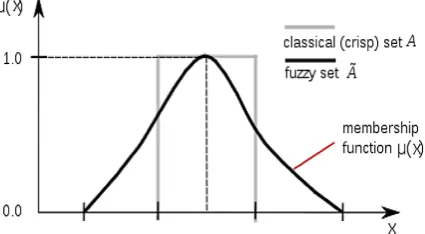
m membership in a fuzzy set is the element x. if the degree of membership of an element is set to zero, the member is fully withdrawn.[8] And if the degree of membership of a member is set to one, the member is quite a collection. If the degree of membership of a member is between zero and one, the number indicates the degree of membership is gradual. Figure 1 is an example of the membership function of a fuzzy set.
Fig. 1. Membership function of a fuzzy set
Effective metrics softwares based on reliability aspects
145
both metric and metric structure. Metrics ofcon-cern, the lowest level of aggregation is a software system being considered or functional modules that are responsible for the implementation of a concern are grouped together.
The concerned metrics are collected and ana-lyzed. The metrics considered by Ayadi, and col-leagues Sanata have been introduced below.[5]
This set of metrics to make the implementa-tion plan needs an assessor. Various techniques have been proposed to identify the source of the concern from the resource code. Methods and techniques widely accepted in general and not for concerns. Tools available to measure the metrics of concern are that researchers need to manually select the code that is linked to a concern. Also, the metric structure of aspect-oriented program-ming [9] that Ceccato and Tonella extract from known metrics CK [10].
While the level of concern for the analysis of metrics need helping of developers, structural met-ric based on the modules are already degraded.
The two sets of metrics have been already men-tioned. In this article we are going to evaluate the safety aspect-oriented software metrics using the
first group, the metric of the concerns ,And the met
-rics listed, four metric CDO, DOSC, DOSM and LOCC due to greater use of the selected channel.
The proposed approach
Next, we present the proposed method for evaluating software reliability aspect-oriented
techniques. To do this you must first transfer a
metric used to phase space and then we imple-ment the proposed system based on this metric.
In the proposed model, we use a Gaussian membership function. A Gaussian membership function can be demonstrated by the following equation:
(2)
In Table 3, we can see the metric and the lan-guage of each of the variables. In Table 4, the out-put of linguistic variables is shown.
Table 3. The range of each metric and linguistic vari-able
Range Abbreviation
DOWN = [0.2124 – 0] MIDDLE = [0.2124 – 0.5]
UP = [0.2124 – 1.003] CDO
DOSC DOSM LOCC
Table 4. The output linguistic variables Range Output
VERYDOWN = [0.1062 – 0] DOWN = [0.1062 – 0.25] MIDDLE = [0.1062 – 0.5] UP = [0.1062 – 0.7489] VERYUP = [0.1062 – 1] Reliability
Next, exponential membership functions of input and output variables of the model is
dis-played (Figs. 2–6).
General model of the proposed system is shown in Figure 7. The input variables affecting the reliability metrics are the same and the out-puts value of reliability is visible.
For defuzzification we used centroid. Cen
-troid defuzzification returns the center of area un -der the curve. If you think of the area as a plate of equal density, the centroid is the point along the x axis about which this shape would balance.
Given that the proposed model uses four metrics, and each of these metrics is also three linguistic variables, therefore, the proposed model law is 81.
Table 1. The metric of the concerns
Abbreviation Metrics
CONT Program Element Contribution
CDC Concern Diffusion over Components
CDO Concern Diffusion over Operations
DOSC Degree of Scattering across Classes
DOSM Degree of Scattering across Methods
LOCC Lines of Concern Code
Table 2. Structural metrics
Abbreviation Metrics
WOM Weighted Operations per Module
DIT Depth of Inheritance Tree
NOC Number of Children
CFA Coupling on Field Access
CMC Coupling on Method Calls
CBM Coupling between Modules
CDA Crosscutting Degree of an Aspect
CAE Coupling on Advice Execution
RFM Response for Module
146
Fig. 6. The output membership function
Fig. 7. General model of the proposed system Fig. 2. The membership function metric CDO
Fig. 3. Membership function metric DOSC
Fig. 4. Membership function metric DOSM
Fig. 5. The membership function metric LOCC
ASSESSMENT
The model proposed in this paper, based on data extracted from the aspect-oriented software projects that have been developed methodology was tested. The diagram in Figure 8 and 9 of the proposed mod-el-based software reliability aspect is displayed.
One of the criteria used to evaluate the mod -els, root mean square error between the predicted and measured. Root mean square error is a suit-able tool for comparing the prediction errors by a set of data [11]. This value is calculated using the following equation:
Figure 9. The performance of proposed model of reliability evaluation based on
the aspect oriented software
One of the criteria used to evaluate the models, root mean square error between the predicted and measured.
Root mean square erroris a suitable
tool for comparing the prediction errors by a set of data.[11] This value is calculated using the following equation:
𝑅𝑅𝑅𝑅𝑅𝑅𝑅𝑅 = √∑ (𝑦𝑦𝑖𝑖𝑁𝑁𝑖𝑖=1 𝑁𝑁−𝑦𝑦̂)2
The first indicator of individual calculate the differences observed values with the values predicted by the model and have two power. The square root of the mean and the mean number is the same as RMSE. This index is a measure of the accuracy of the model. It is generally better to match the amount of data if it is lower.
Figure 10 has shown the diagram of root mean square error.
Figure 10: The root mean square error for the model
As can be seen in Figure 10, the square root of the sum of squared errors of the proposed method is equal to 0.12503, which is a good value for the criterion.
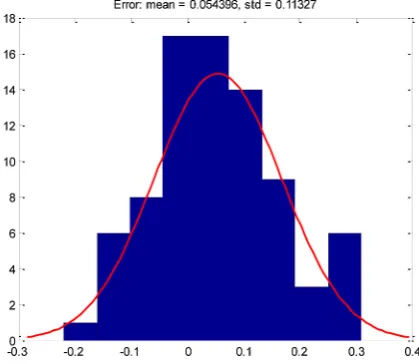
In Figure 11, the mean value and standard deviation error of the proposed model with histogram diagram is displayed.
Figure 11. The mean value and standard deviation error of the proposed model
with the diagram histfit
0 10 20 30 40 50 60 70 80 90
0.1 0.2 0.3 0.4 0.5 0.6 0.7 0.8 0.9
1 Test Data
Target Output
0 10 20 30 40 50 60 70 80 90
-0.3 -0.2 -0.1 0 0.1 0.2 0.3
0.4 RMSE = 0.12503
Error
-0.30 -0.2 -0.1 0 0.1 0.2 0.3 0.4 2
4 6 8 10 12 14 16
18 Error: mean = 0.054396, std = 0.11327
147
The first indicator of individual calculate thedifferences observed values with the values pre-dicted by the model and have two power. The square root of the mean and the mean number is
the same as RMSE. This index is a measure of
the accuracy of the model. It is generally better to match the amount of data if it is lower.
Figure 10 has shown the diagram of root mean square error. As can be seen, the square root of the sum of squared errors of the proposed method is equal to 0.12503, which is a good value for the criterion. In Figure 11, the mean value and stan-dard deviation error of the proposed model with histogram diagram is displayed.
CONCLUSION
In this paper, after reviewing the evaluation of software reliability metrics and effective ex-Fig. 8. The performance of the proposed model of reli-ability evaluation based on the aspect oriented softwares
Fig. 9. The performance of proposed model of reliabil-ity evaluation based on the aspect oriented software
Fig. 10. The root mean square error for the model
Fig. 11. The mean value and standard deviation error of the proposed model with the diagram histfit
traction, To provide a method for assessing the reliability of oriented software using fuzzy logic-based applications. The fuzzy system has four in-puts and one output. To measure the output value of 81 laws is used. In this system, the root mean square error was equal to 0.12503. Given the low error and using appropriate metrics, this method’s accuracy is better than in other methods.
REFERENCES
1. Seyster J., et al. Aspect-oriented instrumentation with GCC. In: Runtime Verification, Springer, 2010.
2. Chiu K.-C., Huang Y.-S., Lee T.-Z., A study of software reliability growth from the perspective of learning effects. Reliability Engineering & System Safety, 93(10), 2008, 1410–1421.
pre-diction by soft computing techniques. Journal of Systems and Software, 81(4), 2008, 576–583. 4. Figueiredo E., et al, Assessing aspect-oriented
arti-facts: Towards a tool-supported quantitative meth-od. 2005.
5. Sant’Anna C., et al. On the reuse and maintenance of aspect-oriented software: An assessment frame-work. In: Proceedings of Brazilian Symposium on Software Engineering, 2003.
6. Reena Dadhich B.M., Measuring reliability of an aspect oriented software using fuzzy logic ap-proach. International Journal of Engineering and Advanced Technology (IJEAT), June 2012. 7. Zadeh L.A., Fu K.-S., Tanaka K., Fuzzy sets and
their applications to cognitive and decision
pro-cesses. Proceedings of the US–Japan Seminar on Fuzzy Sets and Their Applications. Academic Press University of California, Berkeley, Califor-nia, July 1-4, 2014.
8. Ross T.J., Fuzzy logic with engineering applica-tions. Wiley, Vol. 761, 2013.
9. Ceccato M. and Tonell P., Measuring the effects of software aspectization. Workshop on Aspect Re-verse Engineering, 2004.
10. Kemerer S.R.C.A.C.F., Suite for object oriented de-sign. IEEE Trans. on Software Engineering, 20, 1994. 11. Chai T. and Draxler R., Root mean square error