International Conference on Emerging Trends in Applications of Computing ( ICETAC 2K17 )
ISSN: 2394-2231
http://www.ijctjournal.org
Page 1I
AUDTING BASED SECURE ROUTING BY DETECTING MISBEHAVING
NODE IN WIRELESS SENSOR NETWORK
DHIVYABHARATHI D JEYA SHREE AP/CSE M.KASI PANDI AP/CSE KARTHICK RAJA AP/CSE
SBM COLLEGE OF ENGG an d TECH
Abstract—We address the problem of identifying and isolating misbehaving nodes that refuse to forward packets in multi-hop ad hoc networks. We develop a comprehensive system called Audit-based Misbehavior Detection (AMD) that effectively and efficiently isolates both continuous and selective packet droppers. The AMD system integrates reputation management, trustworthy route discovery, and identification of misbehaving nodes based on behavioral audits. Compared to previous methods, AMD evaluates node behavior on a per-packet basis, without employing energy-expensive overhearing techniques or intensive acknowledgment schemes. Moreover, AMD can detect selective dropping attacks even if end-to-end traffic is encrypted and can be applied to multi-channel networks or networks consisting of nodes with directional antennas. We show via simulations that AMD successfully avoids misbehaving nodes, even when a large portion of the network refuses to forward packets.
Index Terms—Misbehavior, packet dropping, secure routing, reputation system, ad hoc networks, wireless communications
Ç
1 I
NTRODUCTIONN the absence of a supporting infrastructure, wireless ad
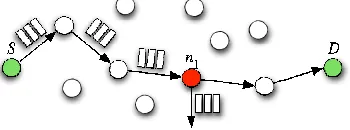
hoc networks realize end-to-end communications in a cooperative manner. Nodes rely on the establishment of multi-hop routes to overcome the limitations of their finite communication range. In this paradigm, intermediate nodes are responsible for relaying packets from the source to the destination. As an example, consider Fig. 1 depicting a source S using a multi-hop path to route data to a destina- tion D. This network model presupposes that intermediate nodes are willing to carry traffic other than their own. When ad hoc networks are deployed in hostile environ- ments (tactical networks), or consist of nodes that belong to multiple independent entities, a protocol-compliant behav- ior cannot be assumed. Unattended devices can become compromised and drop transit traffic in order to degrade the network performance. Moreover, selfish users may mis- configure their devices to refuse forwarding traffic in order to conserve energy. This type of behavior is typically termed as node misbehavior [1], [19], [21].
Existing solutions for identifying misbehaving nodes either use some form of per-packet evaluation of peer behavior [5], [19], [20], [21], or provide cooperation incentives to stimulate participation [6], [33]. Incentive-based approaches do not address the case of malicious nodes who aim at disrupting the overall network operation. On the other hand, per-packet behavior evaluation techniques are based on either transmission overhearing [5], [20], [21] or issuance of per-packet acknowledgements [2], [19]. These monitoring operations must be repeated on every hop of a multi-hop route, thus leading to high communication overhead and energy expenditure. Moreover, they fail to detect dropping
The authors are with the Department of Electrical and Computer Engineer- ing, University of Arizona, Tucson, AZ 85721.
E-mail: {yuzhang, llazos}@ece.arizona.edu, [email protected].
Manuscript received 13 Nov. 2011; accepted 23 Mar. 2012. Date of publica- tion 21 Dec. 2012; date of current version 29 June 2016.
For information on obtaining reprints of this article, please send e-mail to: [email protected], and reference the Digital Object Identifier below.
Digital Object Identifier no. 10.1109/TMC.2012.257
attacks of selective nature, since intermediate monitoring nodes may not be aware of the desired selective dropping pat- tern to be detected. Motivated by these limitations, we pro- pose a system called Audit-based Misbehavior Detection (AMD), which achieves per-packet behavior evaluation without incurring a per-packet per-hop cost. AMD is a comprehensive solution that integrates identification of misbehaving nodes, reputation management, and trustworthy route discovery in a distributed and resource-efficient manner.
Our Contributions—We develop the AMD system for detecting and isolating misbehaving nodes. Compared to state-of-the-art, AMD provides the following additional features:
AMD enables the per-packet evaluation of a node’s
behavior without incurring a per-packet overhead. AMD enables the concurrent first-hand evaluation of
the behavior of several nodes that are not necessarily one-hop neighbors. Overhearing techniques are lim- ited to one hop.
AMD can operate in multi-channel networks and in
networks with directional antennas. Current packet overhearing techniques are only applicable when transmissions can be overhead by peers operating on the same frequency band.
AMD detects selective dropping behaviors by allow-
ing the source to perform matching against any desired selective dropping patterns. This is particu- larly important when end-to-end traffic is encrypted. In the latter scenario, only the source and destination have access to the contents of the packets and can detect selective dropping.
We show that AMD can construct paths consisting of highly trusted nodes, subject to a desired path length con- straint. When paths contain misbehaving nodes, these nodes are efficiently located by a behavioral audit process. We map the problem of identifying misbehaving nodes to
the classic R enyi-Ulam game of 20 questions. The identifica-
ISSN: 2394-2231
http://www.ijctjournal.org
Page 2 Fig. 1. Misbehaving node n1 drops transit traffic from S to D.reputation. Audits are performed using storage-efficient membership structures [4].
Paper organization—The remainder of the paper is orga-nized as follows. In Section 2, we present related work. In Section 3, we state our network and adversary models and describe the AMD system architecture. In Sections 4, 5 and 6 we present the reputation, route discovery and audit mod- ules, respectively. In Section 7, we evaluate the performance of AMD via extensive simulations. Section 8, summarizes our findings.
2 R
ELATEDW
ORKPreviously proposed methods for eliminating packet drop- pers can be classified into (a) credit-based systems [6], [7], [33], (b) reputation-based systems [5], [11], [13], [15], [21], [27], and (c) acknowledgment-based systems [2], [3], [19], [22], [23], [31].
Credit-based Systems: Credit-based systems are designed to provide incentives for forwarding packets. Buttyan and Hubaux [6] proposed a system in which nodes accumulate credit for every packet they forward, and spend their credit to transmit their own packets. To ensure correctness, the credit counter is implemented in tamper-proof hardware. Zhong et al. [33] proposed Sprite, in which nodes collect receipts for the packets they forward to other nodes. When the node has a high-speed link to a Credit Clearance Service (CCS), it uploads its receipts and obtains credit. Crowcroft et al. [7] proposed a scheme that adjusts the credit reward to traffic and congestion conditions. While credit-based systems motivate selfish nodes to cooperate, they provide no incentive to malicious nodes. Such nodes have no intend to collect credit for forwarding their own traffic. Moreover, credit- based systems do not identify misbehaving nodes, thus allowing them to remain within the network indefinitely.
Reputation-based systems: Reputation-based systems use ratings for evaluating the trustworthiness of nodes in for- warding traffic. These ratings are dynamically adjusted based on the nodes’ observed behavior. In the context of ad hoc networks, Ganeriwal and Srivastava [11] developed a Bayesian model to map binary ratings to reputation metrics, using a beta probability density function. Jøsang and Ismail [15] proposed a similar ranking system that utilized direct feedback received from one-hop neighbors. Michiardi and Molva [22] proposed the CORE mechanism for computing, distributing, and updating reputation values composed from disparate sources of information.
Reputation-based systems use neighboring monitoring techniques to evaluate the behavior of nodes. Marti et al. [21] proposed a scheme which relies on two modules, the watchdog and the pathrater. The watchdog module is respon- sible for overhearing the transmission of a successor node, thus verifying the successful packet forwarding to the next hop. The pathrater module uses the accusations generated
by the watchdog module to select paths free of misbehaving nodes. Buchegger and Le Boudec [5] proposed a scheme called CONFIDANT, which extends the watchdog module to all one-hop neighbors that can monitor nearby transmis- sions (not just the predecessor node). When misbehavior is detected, monitoring nodes broadcast alarm messages in order to notify their peers of the detected misbehavior and adjust the corresponding reputation values. Similar moni- toring techniques have also been used in [13], [27].
Transmission overhearing becomes highly complex in multi-channel networks or when nodes are equipped with directional antennas. Neighboring nodes may be engaged in parallel transmissions in orthogonal channels or different sectors thus being unable to monitor their peers. Moreover, operating radios in promiscuous mode for the purpose of overhearing requires up to 0.5 times the amount of energy for transmitting a message [10]. Note that for a multi-hop route, a given packet must be overheard by multiple moni- tors and over multiple hops, thus making the monitoring opera- tion more expensive than the actual end-to-end communication. Finally, neighboring monitoring typically record coarse met- rics of misbehavior such as packet counts that are inadequate to detect highly sophisticated selective dropping attacks tai- lored to specific applications. Motivated by the inadequacy and inefficiency of transmission overhearing, the monitoring approach developed in AMD incurs overhead on a per-flow basis instead of on a per-packet basis, thus having signifi- cantly smaller energy expenditure. Moreover, it allows the full customization of the misbehavior criteria for detecting a multitude of selective dropping strategies.
Acknowledgment-based systems: Acknowledgment-based systems rely on the reception of acknowledgments to verify that a message was forwarded to the next hop. Balakrishnan et al. [3] proposed a scheme called TWOACK, where nodes explicitly send two-hop acknowledgment messages along the reverse path, verifying that the intermediate node faith- fully forwarded packets. Packets that have not yet been acknowledged remain in a cache until they expire. A value is assigned to the quantity/frequency of un-verified packets to determine misbehavior.
Liu et al. [19] improved on TWOACK by proposing 2ACK. Similar to TWOACK, nodes explicitly send two-hop acknowledgments to verify cooperation. Xue and Nahrstedt [31] proposed the Best-effort Fault-Tolerant Routing scheme, which relies on end-to-end acknowledgment messages to monitor packet delivery ratio and select routing paths which avoid misbehaving nodes. Awerbuch et al. [2] proposed an on-demand secure routing protocol (ODSBR) that identifies misbehaving links. The source probes intermediate nodes to acknowledge each packet and performs a binary search to identify the link where packets are dropped.
ACK-based systems also incur a high communication and energy overhead for behavioral monitoring. For each packet transmitted by the source, several acknowledge- ments must be transmitted and received over several hops. Moreover, they cannot detect attacks of selective nature over encrypted end-to-end flows.
3 S
YSTEMM
ODEL ANDP
ROBLEMS
TATEMENTISSN: 2394-2231
http://www.ijctjournal.org
Page 3assumed to be known to S. This is true for source routing protocols such as DSR [14]. If DSR is not used, PSD can be identified through a traceroute operation, or becomes known once the route is established. For simplicity, we
number nodes in PSD in ascending order, i.e., ni is upstream
of nj if i < j: We further assume that the source can moni-
tor the performance of PSD . This can be achieved either in
collaboration with the destination or implicitly at the trans- port layer (see Section 6).
To prevent user impersonation and message modification attacks, the integrity, authenticity, and freshness of critical control messages is verified using cryptographic methods. For example, a public key cryptosystem can be used to verify the authenticity and integrity of messages while providing confidentiality [28]. Note that such cryptosystems require the existence of a trusted certificate authority (CA) for ini- tialization (issuance of keys and certificates) as well as revo- cation of users via a certificate revocation list (CRL). Several methods have been proposed for the distributed implemen- tation of a CA (e.g., [9]). Moreover, new nodes can be added to the system after they are initialized by the CA. Every node ni is assumed to be in possession of a private/public key pair
denoted as (ski ; pki ). The public key is assumed to be known
to all participating nodes. This is achieved either at initializa- tion, or via the use of certificates. While any secure cryptosys- tem can be used for our purposes, in our work, we adopt a system that satisfies the homomorphic multiplication prop- erty such as RSA [28]. The development of a key manage- ment system for establishing trust within the network is beyond the scope of the present work.
Adversarial model–A fraction of the nodes deployed in the network is assumed to be misbehaving. This misbehavior is manifested by the dropping of transit traffic from a source to a destination. Misbehaving nodes can be continuous drop- pers, or adopt any selective dropping strategy. For a given
path PSD of length k, we assume that a set of M misbehaving
nodes, with jMj k, exist along this path. In our model, we do not consider other types of misbehavior against the rout- ing process such as advertisement of false routing informa- tion, creation of sinkholes, blackholes, wormholes, etc. [16]. Moreover, we do not attempt to detect misbehaving nodes that are unwilling to participate in routing paths. Such nodes already isolate themselves from the network and do not
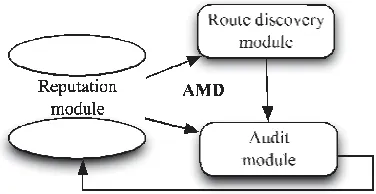
Fig. 2. The AMD system architecture.
on input received from the reputation module. We note that while several techniques have been proposed for reputation management and reputation-based route discovery, in AMD, we develop novel methods for these two functions that integrate efficiently with the per-flow behavior evalua- tion implemented by the audit module. We now describe the three modules in detail.
4 T
HER
EPUTATIONM
ODULEAMD isolates misbehaving nodes by implementing a reputa- tion-based system. Nodes with low reputation values are excluded from routing paths, thus being unable to drop tran- sit traffic. The reputation module is responsible for computing and managing the reputation of nodes. We adopt a decentral- ized approach in which each node maintains its own view of the reputation of other nodes. Such implementation alleviates the communication overhead for transmitting information to a centralized location, and readily translates to the distributed nature of ad hoc networks. Moreover, it allows nodes to hold individualized reputation metrics for their peers depending on their direct and indirect interactions.
We take into account both first-hand and second-hand information. Information is considered to be first-hand if it is obtained by direct interaction between nodes (e.g., node
ni routes information via node nj ), and is considered to be
second-hand if it is indirectly obtained based on the opin- ions of other nodes [22]. Consideration of both first-hand and second hand information has been shown to improve the reliability of reputation metrics [13], [21], [22].
4.1 Computation of Node Reputation Values
actively degrade the network performance.
The reputation module running on a node ni maintains a
3.1 The AMD System Architecture
AMD provides a comprehensive misbehavior identification and node isolation system for eliminating misbehavior from a given network. This system consists of the integration of three modules: a reputation module, a route discovery mod- ule, and an audit module. These modules closely interact to coordinate the functions of misbehavior detection, discov- ery of trustworthy routes, and evaluation of the reputation of peers. A schematic of the relationship between the three modules of AMD is shown in Fig. 2. The reputation module is responsible for managing reputation information based on the recommendations of the audit module. Reputation values are exploited by the route discovery module for establishing routes that exclude nodes with low reputations.
ISSN: 2394-2231
http://www.ijctjournal.org
Page 4i
i reputation vector Ri ðtÞ ¼ fr1 i i iðtÞ; r2 ðtÞ; . . . ; rN ðtÞg that
con-tains the reputation values rj ðtÞ of all nodes nj 2 N nfni g:
Here, N is the set of network nodes, and t denotes the cur- rent time epoch over which the reputation values are com-
puted. Reputation values rj ðtÞ are restricted to the range
ð0; 1 ; are initialized to some value (e.g, 0:5), and are updated at the end of each epoch.
ISSN: 2394-2231
http://www.ijctjournal.org
Page 5i
i
S i
k 1
i
S rj
provided a first-hand evaluation of node nj ; the reputation
value rj ðtÞ is computed as,
then distributes rj to all nodes in fn1 ; . . . ; nk gnfnj g. For
instance, node n1 will receive all reputation values
j
a rj ðt 1Þ; nj
misbehaves; (1)
rS ; ðj ¼ 2 . . . kÞ, except its own value r1 :
The reputation distribution operation implements a
i ðtÞ ¼ minfrj ðt 1Þ þ b; 1:0g; otherwise:
tradeoff between the communication cost of updating
repu-where the determination of nj ’s behavior is provided by the
audit module running on ni , when ni ¼ S and nj 2 PSD : In
(1), we have adopted the AIMD principle in order to rapidly isolate a misbehaving node from routing paths. Due to the multiplicative factor a, the reputation of a misbehaving node rapidly declines with repeated misbehavior. On the other hand, a node with a low reputation would require significant time (in epochs) until its reputation is restored, due to the additive increase factor b. The difference between the reputa- tion decrease and increase mechanism prevents a selectively misbehaving node from oscillating between periods of mis- behavior and good behavior for the purpose of dropping packets while remaining in active paths. As it shown by our simulations in Section 7, such nodes are assigned low reputa- tion values and are excluded from routing paths. Parameters a, b can be empirically tuned according to network charac- teristics such as number of alternative paths (network con- nectivity degree) and expected congestion conditions.
Second-hand information: Second-hand information is used only if first-hand information becomes stale, or is not avail- able due to the lack of prior interaction between two nodes. First-hand information is considered stale if it has not been
obtained for the last t0 epochs. Disregarding stale reputation
information implements an aging mechanism that prevents sleeper attacks wherein a node behaves for an initial period of time to gain high reputation, before exhibiting misbehav-
ior [11]. In the absence of first-hand information, a node ni
averages all second-hand information reported by other
nodes within the last t0 epochs. Let I i ðtÞ denote the set of
nodes that provided second-hand information to ni within the last t0 epochs. The reputation value is computed as,
tation values and obtaining a current view of the reputation of other nodes. Most prior methods are either limited to dis- tribution within one hop (e.g, [1]), or employ some form of flooding. We adopt a path-oriented technique that achieves a desirable tradeoff between the two approaches. By limit-
ing the propagation of second-hand information along PSD ,
information is provided to nodes that are likely to partici- pate in the same paths. Nodes located at disparate parts of the network do not often share reputation information.
Note that malicious nodes could distribute low reputa- tion values for other nodes, in order to exclude them from the network (badmouthing). However, this attack is miti- gated in our approach. Second-hand reputation is only used if first-hand reputation is not available. Moreover, the sec- ond-hand reputation value is computed via an averaging operation. A single false accusation would not be sufficient to exclude a falsely accused node from routing paths. Finally, even if a node is excluded from one path due to lies, this node could still be included in other paths, since every source holds its own reputation values. Assuming that the accused node is benign, sources in other paths provide posi- tive feedback for the falsely accused node.
5 T
HER
OUTED
ISCOVERYM
ODULEThe route discovery module is responsible for the discovery of trustworthy paths from a source to a destination. This module is invoked by the source whenever there is no cached path to the destination. To quantify the trustworthiness of a path, we define the following path reputation metric.
Definition 1 (Path reputation value). The reputation of a
path PSD ¼ fS; n1 ; n2 ; . . . ; nk ; Dg is defined as: P
j rj m2I i ðtÞ rm
ðtÞ vffiffiffiffiffiffiffiffiffiffiffiffiffiffiffiffiffiffiffiffiffiffiffiffiffiffiffiffiffiffiffiffiffiffiffiffiffiffiffiffiffiffiffiffiffiffiffi
i ðtÞ ¼ jI
i ðtÞj
: (2) u
k k !
r þ
uY
i i j
The reputation value in (2), is updated at every epoch by
discarding all second-hand information older than t0 epochs
S!D ¼ t
i¼1
rS rD Y
ri
j¼1;j¼i : (3)
and admitting all new second-hand information. If no
second-hand information is available for the last t0 epochs,
the reputation value is restored to the last known first-hand information. Also, if first-hand information becomes avail- able, it replaces the second-hand information. To simplify our notations, we eliminate the parameter t from the reputa- tion expressions, when unnecessary.
4.2 Collection of Reputation Information
When a source S establishes a route to a destination D; the audit module running on S makes evaluations on the behavior of each node along the path PSD : These evalua- tions are considered as first-hand information for S. The source propagates first-hand information to all nodes along PSD ; thus providing second-hand information. More for- mally, consider a path PSD ¼ fS; n1 ; n2 ; . . . ; nk ; Dg: Using
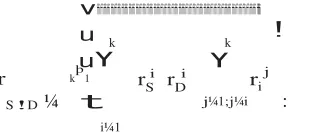
The justification for using the metric in (3) is as follows: A
path PSD can be seen as an in-series system of independent
components. The failure of one component (a node drop- ping packets) results in the failure of the entire system (path). The reliability of in-series systems is defined as the product of the reliability values of the individual compo- nents. Similarly, in (3), the trustworthiness of a path is defined as the product of the reputation values of the nodes that participate in that path. A subtlety in our definition is the fact that there is no universal reputation value for each node, but the reputation values are individual perceptions of trustworthiness of one node in regards to another. Hence, to compute the path reputation value, we multiply the repu-
tation values rj of intermediate nodes as perceived by all
the nodes participating in PSD . The calculation of rS!D on a
sample path is shown in Fig. 3.
ISSN: 2394-2231
http://www.ijctjournal.org
Page 6pro-ISSN: 2394-2231
http://www.ijctjournal.org
Page 7 iu
2 u t rFig. 3. Computing the path reputation value for PSD .
Fig. 4. Potential manipulation of the APR field. Node n2 resets the APR field to 1 by replacing it with EpkD ð1Þ in the forward direction.
the destination issues a RREP message. The RREP contains an APR field which is now encrypted with pkS . It also contains
a second copy of EpkS ðAPRD Þ and a signature sigskD ðAPRD Þ.
RREP: S jj D jj TTL jj n1 ; . . . ; nk jj EpkS ðAPRD Þ
jjEpkS ðAPRD Þ jj sigskD ðAPRD Þ:
Qk j
low reputation value cannot increase the path reputation to where, EpkS ðAPRD Þ ¼ EpkS ðAPRk Þ EpkD ð j¼1 rD Þ:
a value higher than its own reputation. A malicious node can, however, lower the reputation value of a path by lying about the reputation values of other nodes. This strategy
Step 4: An intermediate node ni receiving a RREP,
multi-plies all its own reputation values rj ; j ¼ i þ 1 . . . k; for the
nodes included in the reverse path so far. It encrypts
decreases the path reputation, leading to the exclusion of Qk j
the lying node from routing paths.
5.1 Discovery of Trustworthy Routes
To discover trustworthy routes, we modify the discovery
j¼iþ1 ri with S’s public key (pkS ) and multiplies the result
with the APR field.
RREP: S jj D jj TTL jj n1 ; . . . ; nk jj EpkS ðAPRi Þ
jj EpkS ðAPRD Þ jj sigskD ðAPRD Þ:
Q k j
phase of the DSR protocol [14]. In DSR, when S has packets where, EpkS ðAPRi Þ ¼ EpkS ðAPRiþ1 Þ EpkD ð j¼iþ1 ri Þ:
for D; it checks whether a route exists in its cache. If a route does not exist, S broadcasts a Route Request (RREQ) mes- sage. This message contains the source ID, destination ID,
and the time-to-live (TTL).1 Any intermediate node that
receives the RREQ, appends its ID to the RREQ message and rebroadcasts it while decreasing the TTL field by one unit. If a receiving node is the destination, D responds to S
Step 5: For any received RREP, the source decrypts the
APR field using its private key skS and recovers APR1 . It also
decrypts EpkS ðAPRD Þ and verifies sigskD ðAPRD Þ: Upon suc-
cessful verification, S accepts a route only if APR1 APRD .
It then computes the path reputation value as
v
ffiffiffiffiffiffiffiffiffiffiffiffiffiffiffiffiffiffiffik
ffiffiffiffiffiffiffiffiffiffi
!
ffiffiffikþ
u
1APR
1
Y
j with a route reply (RREP) message containing the entirePSD : The RREP follows the reverse path to S: In AMD, RREQ and RREP messages include the accumulated path
rep-r
S!D¼
t
r
0r
S:
j¼1
utation (APR) field for calculating rS!D . Formally, the route
discovery is as follows.
Step 1: S initializes the APR to a random r0 2 ð0; 1 . It
encrypts the APR with D’s public key, and signs it. The broadcasted RREQ is as follows (where jj represents concatenation),
RREQ: S jj D jj TTL jj EpkD ðr0 Þ jj EpkD ðr0 Þ jj sigskS ðr0 Þ:
Step 2: Intermediate node ni receiving a RREQ, updates the APR and TTL fields, appends its ID and rebroadcasts the RREQ.
RREQ: S jj D jj TTL jj n1 ; . . . ; ni jj EpkD ðAPRi Þ
jj EpkD ðr0 Þ jj sigskS ðr0 Þ;
Qi 1 j
Finally, the source selects the route with the highest rS!D :
We now explain all steps in detail. In Step 1, S initializes the APR field to a random value r0 2 ð0; 1 and encrypts it using D’s public key. Therefore, only D can decrypt the APR field. Moreover, S includes a copy of the initial encrypted APR value and signs it. This copy is used by D to
compute r^S!D which is an intermediate path reputation
value used by the destination for eliminating routes with low reputation values compared to a minimum desired rep-
utation threshold g 1 .
Parameter r0 is also used to detect a possible tion of the APR field by intermediate nodes. Such manipula-tion is possible because intermediate nodes are allowed to modify the APR field. For instance, consider the path shown
where, EpkD ðAPRi Þ ¼ EpkD ðAPRi i Þ EpkD ð j¼1 ri Þ:
Step 3: For every RREQ indicating a unique path to the source, the destination decrypts the APR field using skD . It
also recovers the initial random value r0 and verifies the sig-
nature sigskS ðr0 Þ using pkS . D rejects the route if APRk r0
(nk is the last node before D). Otherwise, it obtains an esti-
mate r^S!D of rS!D :
vffiffiffiffiffiffiffiffiffiffiffiffiffiffiffiffiffiffiffiffi k
ffiffiffiffiffiffiffiffiffi
!ffiffiffiffi
in Fig. 4. Assume that n2 is malicious. Node n2 may reset the
APR field to 1 by replacing it with EpkD ð1Þ in the forward
(backward) direction. Such a replacement will eliminate the opinions of all upstream (downstream) nodes in regards to
PSD . To mitigate this attack without employing expensive
signature aggregation techniques, the source randomizes the APR field. Because all reputations are in ð0; 1 , it is
guaranteed that APRk r0 . Without knowledge of r0 , the
kþ
u
1 APR
k Y j
malicious node n2 cannot properly manipulate the APR
r^S!D ¼
0
rD :
j¼1 field. Random guessing of r0can either lead to path rejection
For all paths of length within a factor 1 of the shortest
path (route selection factor) and with r^S!D g 1 ; g 1 2 ð0; 1 ;
ISSN: 2394-2231
http://www.ijctjournal.org
Page 8i or a route with low reputation.
In Step 2, intermediate nodes append their opinion about all nodes included in the path so far (upstream nodes). This
is done by multiplying rj values, encrypting them with pkD ,
ISSN: 2394-2231
http://www.ijctjournal.org
Page 9 Fig. 5. Example of the DSR-based route discovery, for ¼ 1:2 andg1 ¼ 0:6. The destination rejects P2 and P4 because r^P2 < g1 and jP4 j > jP2 j. Path P1 is preferred because rP1 > rP3 .
multiplicative homomorphism such as RSA or Elgamal encryp- tion [28]. An encryption method is said to be multiplica- tively homomorphic if for two plaintext values a; b, it holds
that, Epki ðaÞ Epki ðbÞ ¼ Epki ða bÞ: By performing the com-
putations of the path reputation on the ciphertext domain, intermediate nodes receiving RREQ or RREP messages do not get to know the current path reputation estimate, or the
value of r0 . Hence, the individual evaluations of intermedi-
ate nodes with respect to their peers remain secret.
In Step 3, D computes intermediate path reputations
r^S!D for all received RREQs. These intermediate path repu-
tations are used to reject all paths with r^S!D < g 1 . The min-
imum acceptable reputation g 1 is universally preset in the
network. Because of the multiplication operation applied on
invokes the audit module if it detects poor performance on PSD . The exact definition of what constitutes poor perfor- mance can be determined on the basis of a specific applica- tion running between S and D. One possible mechanism for determining the path performance is to monitor the average
end-to-end packet rate rS!D over a window of time t: If
rS!D < g 2 packets per second, the audit module is acti-
vated. The threshold g 2 is source-defined and can be statisti-
cally derived based on prior interactions of the source with other destinations, or some minimum expected network
performance. The rate rS!D can be calculated at S either by
taking into account transport layer end-to-end acknowl- edgements, or explicit feedback provided periodically by D: When poor performance is detected over PSD , the source requests from a subset of intermediate nodes to record a digest of the set of packets they forward to the next hop. We call this, the audit process. Although misbehaving nodes can lie when audited, audit replies from honest nodes lead to the identification of those lies, and eventually of the misbe-
having nodes. We map the audit process to R enyi-Ulam
searching games [25], [29].
6.1 Re nyi-Ulam Games
R enyi-Ulam games involve two players, a questioner and a
v
the APR field, paths with r^S!D < g 1 cannot have a final responder [25], [29]. The responder selects a secret value
V. The questioner attempts to
deter-path reputation value rS!D g 1 : Hence, such paths are
rejected by D, in order to reduce the communication over- head of unicasting RREPs. In addition, the destination rejects all paths that exceed the length of the shortest path by a factor of . We call this factor as the route selection factor because it determines the set of paths from which the most trustworthy path is selected. Here, controls the tradeoff between path reputation and route length.
In Step 4, RREPs travel on multiple reverse paths to S. Intermediate nodes receiving a RREP, multiply the APR value with the reputations of all the nodes located down- stream towards the destination. Similarly to the RREQ oper- ation, this multiplication occurs on the ciphertext domain using S’s public key, thus hiding the APR value from inter- mediate nodes.
On the final step, S decrypts the APR field using skS and
computes rS!D for all RREPs for which APR1 APRD : The
source then selects the path with the highest path reputa- tion, as the single routing path to D. We emphasize that sev- eral alternative selection strategies are possible. For instance, instead of selecting the most reputable path, the
source can select the shortest path with rS!D g1 . Using
this strategy, shorter routes are preferred as long as they meet a minimum reputation threshold.
An example of the route discovery process outlined in Steps 1-6 is shown in Fig. 5. After the RREQs have been for-
warded to the destination, D considers paths P1 P4 . Path
P4 is rejected because jP4 j > jP2 j, where P2 is the shortest
discovered path. Moreover, path P2 is also rejected because
r^P2 < g 1 (where g1 ¼ 0:6). D replies with a RREP over P1
and P3 . At the source, P1 is selected because rP1 > rP3 .
6 T
HEA
UDITM
ODULEThe audit module is responsible for identifying the set of
ISSN: 2394-2231
http://www.ijctjournal.org
Page 10from a finite search space
mine v by asking at most q questions to which the responder is allowed up to ‘ lies. Before starting the game, the players agree on (V, q, ‘) and the nature of their interaction. The for- mat of the questions can be classified into two categories; cut questions and membership questions. Cut questions are defined as, for some y 2 V, “Is v y?” Membership ques- tions are defined as, for some subset A V, “Is v 2 A?”
Two modes are possible for the interaction between the two players; a batch mode and an adaptive mode. In batch mode, the questioner submits all questions to the responder at the same time. The responder is therefore able to review all questions before answering. In adaptive mode, the ques- tioner asks questions one at a time. The questioner can adapt its strategy based on all previous answers. The ques- tioner wins the game if it determines v after at most q queries. Else, the responder wins. The questioner is said to have a “winning strategy” if it can find v after at most q queries, independent of how the responder lies.
6.2 Mapping to Re nyi-Ulam Games
In our mapping, the role of the questioner is assumed by S and D, while the role of the responder is assumed by the
nodes in PSD : The search space is defined as the set of nodes
in PSD , i.e., V ¼ fn1 ; . . . ; nk g. The responder selects a num-
ber v 2 f1; . . . ; kg, corresponding to the node nv which is
misbehaving. The source’s goal is to determine nv , i.e., to
locate the misbehaving node. The questions submitted by the questioner correspond to the audits performed by the source to nodes in PSD .
ISSN: 2394-2231
http://www.ijctjournal.org
Page 11i 1
¼ wi Y i
Fig. 6. (a) A generic Re nyi-Ulam game. (b) Misbehavior identification mapped to a Re nyi-Ulam game.
when in reality it drops them, or claiming to have for- warded no packets indicating they were dropped some- where upstream. The location of the misbehaving nodes in PSD is mapped to the placement of such lies by the responder. Note that since the responder is a single entity controlling the lies (i.e., location of misbehaving nodes and response to audits), our mapping implicitly assumes collu- sion. Figs. 6a and 6b show the mapping of the misbehavior
identification problem to a R enyi-Ulam game.
6.3 Re nyi-Ulam Inspired Auditing Strategies
When a node ni is audited, it provides to the source a proof
of all the packets it has received and forwarded to the next hop. Using this proof, the source constructs an audit claim
ai which is a boolean variable indicating whether a node is
believed to have received and forwarded packets sent from the source. Because the proof provided by the audited node contains information for all packets sent by the source via
ni ; the source can evaluate the node’s behavior against any
desirable selective dropping pattern. This can be achieved by classifying packets into K distinct types. The importance of each packet type with respect to the application running
on PSD is determined by associating weights wi ; i ¼ 1 . . . K
Proposition 1. At least one of the nodes incident to a misbehav-
ing link is misbehaving.
Proof. By contradiction. Assume that both nodes ni ; niþ1 of
a misbehaving link are honest. Hence, niþ1 forwards all
packets received by ni : Therefore, the two nodes make
the same audit claims. This contradicts the definition of a
misbehaving link. tu
Definition 4 (Simultaneous audit). An audit is said to be
simultaneous if two or more nodes are audited with respect to the same set of packets X.
Corollary 1. The link between two honest nodes ni ; niþ1 cannot
be identified as misbehaving, when ni ; niþ1 are simultaneously
audited.
Proof. Since ni and niþ1 are simultaneously audited and are
honest, they will indicate to have received and forwarded
the same set of packets. Hence, ai ¼ aiþ1 ; which contra-
dicts the definition of a misbehaving link. Thus, ni and niþ1 cannot be incident to a misbehaving link. Note that the converse statement to Corollary 1 is not true. Two nodes incident on a link providing the same audit claims
cannot be assumed to be honest. tu
6.3.1 Adaptive Audits with Cut Questions
We now show how the source can identify the misbehaving nodes using an adaptive strategy and cut questions. Cut questions can be implemented by auditing one node at a time. These questions are of the form, “Is the misbehaving
node upstream of ni ?”, where ni is the audited node. Assume
there exists a single continuously misbehaving node nv in
PSD : Define the set of nodes suspicious of misbehavior as V.
Initially, V ¼ fn1 ; . . . ; nk g. If ni is audited and responds with
ai ¼ 0, the source concludes that all nodes downstream of ni
are behaving, and therefore v i. This is true since either ni
with PK¼ wi ¼ 1: For an audited node ni , the corresponding is honest in which case it never received packets in X, or
ni ¼ nv : Hence, V is reduced to fn1 ; . . . ; ni g. If ni responds
audit claim is defined as follows.
Definition 2 (Audit claim). An audit claim ai for a node ni in
regards to auditing a set of packets X ¼ fX1 [ X2 [ . . . [
XK g is a claim that a set of packets Y ¼ fY1 [ Y2 [ . . . [ YK g
were forwarded to the next hop. Here, Xi denotes the set of pack-
ets of type i and Yi Xi : An audit claim ai is a boolean variable
K
with ai ¼ 1, the source concludes that all nodes upstream of
ni are behaving, and therefore v i. This is true, since if
any node upstream of ni was the misbehaving one, ni would
not have received packets in X, or ni ¼ nv : Thus,
V ¼ fni ; . . . ; nk g. We emphasize that the audited node always
remains in V, since it can lie about the forwarded packets. Pelc [24] proposed an adaptive cut question strategy in
ai ¼
1; d g 0 ; ; d
0; otherwise:
P
i¼1 j j ; (4)
PK
which the questioner wins if he determines v, or proves a lie took place. For a search space of size jVj, and a maximum
i¼1 wi jXi j
number of lies ‘, the winning strategy requires dlog2 jVjeþ
where g0 denotes a desirable threshold value below which an
audit claim is declared to indicate significant packet loss. If
d < g 0 ; then node ni claims not to have forwarded packets to
the next hop. An analysis on the selection of appropriate values
for g 0 and wi ; i ¼ 1 . . . K is presented in Appendix A, which
can be found on the Computer Society Digital Library at http://doi.ieeecomputersociety.org/10.1109/TMC.2015.257.
Using the audit claims of multiple audited nodes, the source attempts to first identify the misbehaving link.
Definition 3 (Misbehaving link). A link ðni ; niþ1 Þ is said to
be misbehaving if its two incident nodes ni ; niþ1 provide con-
ISSN: 2394-2231
http://www.ijctjournal.org
Page 12S ‘ þ 1 questions. To find v, the questioner first performs a
binary search requiring dlog 2 jVje questions to converge to a
value v0 . It then asks the responder ‘ þ 1 times if v v0 .
Since the responder is limited in lies, the questioner can
determine if v0 ¼ v or a lie occurred.
We modify the winning strategy proposed by Pelc in order to identify the misbehaving link and take into account the reputation values provided by the reputation module. The source initializes V ¼ fn1 ; . . . ; nk g: Instead of perform- ing a binary search, the source biases the search process
according to the reputation values ri ; i ¼ 1 . . . k: The
ISSN: 2394-2231
http://www.ijctjournal.org
Page 13V S
V S h 1 ah 1 ¼ 1 V ¼ fnh 1 ; . . . nk g
Fig. 7. (a) Nodes n1 ; n4 collude, with n4 dropping all packets. Audited node n2 claims misbehavior is downstream. (b) Nodes n1 ; n4 alter their behaviors, with n1 dropping all packets. Audited node n3 claims misbehavior is upstream. (c) Source simultaneously audits n2 ; n3 to verify if misbehaving link exists.
identification delay and the communication overhead by auditing those nodes that are more likely to misbehave. The
source identifies the node nh 2 PSD with the lowest reputa-
tion (i.e., h ¼ arg min ri ). It then audits node n . If
, the source reduces and immedi-
ately audits nhþ1 . If ahþ1 ¼ 0, the source reduces
V ¼ fnh 1 ; nh ; nhþ1 g and audits nh . This step concludes to
the identification of the misbehaving link, either ðnh 1 ; nh Þ
or ðnh ; nhþ1 Þ: Else, if either nh 1 or nhþ1 provide an audit
claim that excludes nh from V, the source updates V accord-
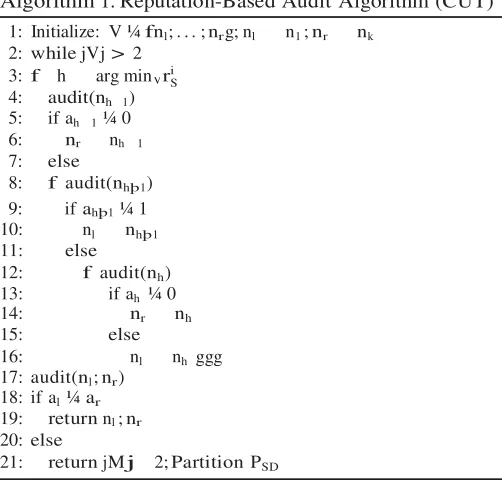
ing to the answer to the cut question and repeats the identi- fication process by selecting the (new) node in V with the lowest reputation value. The reputation-based search audit algorithm which we call CUT is shown in Algorithm 1.
Algorithm 1. Reputation-Based Audit Algorithm (CUT)
1: Initialize: V ¼ fnl ; . . . ; nr g; nl n1 ; nr nk
2: while jVj > 2 3: f h arg min ri
4: audit(nh 1 )
5: if ah 1 ¼ 0
6: nr nh 1
7: else
8: f audit(nhþ1 )
To solve this problem, we perform a simultaneous audit
on the nodes of an identified misbehaving link V ¼ fni ;
niþ1 g. If ai ¼ aiþ1 , a misbehaving link is identified. Other-
wise, the source concludes that more than one misbehaving
nodes exists in PSD . Returning to our previous example, in
Fig. 7c, n2 ; n3 are simultaneously audited. Since both nodes
are honest, they make identical audit claims ða2 ¼ a3 ¼ 0Þ
and no misbehaving link is identified. In this example, the responder has lied by changing the value of v during the
search, i.e., initially v ¼ n4 , then v ¼ n1 . However, S identi-
fies a lie occurred since n2 has switched its audit claim from one to zero.
When the source identifies a lie occurred, it can also
reach to the following conclusion: either (a) nv ¼ n2 but lied
during the simultaneous audit, or (b) jM j 2 with at least
one misbehaving node upstream of niþ1 and one downstream of
ni . Note that if jM j ¼ 1 and the misbehaving node stops misbehaving (due to the fact that it is being audited), the path performance will be restored. In such a case, the source will take two steps. First, any outstanding audits are dis- carded. Second, the search is suspended at the current state until misbehavior re-appears on PSD . When misbehavior is resumed, the source continues the search from where it left off the last time misbehavior occurred.
In the case of jM j 2, let the link identified by the audit
9: if ahþ1 ¼ 1
process be n ; n : Since the source knows that at least one
10: nl nhþ1 ð i iþ1 Þ
11: else
12: f audit(nh )
13: if ah ¼ 0
14: nr nh
15: else
16: nl nh ggg
17: audit(nl ; nr )
18: if al ¼ ar
19: return nl ; nr
20: else
21: return jM j 2; Partition PSD
The link identified via the reputation-based audit algo- rithm is guaranteed to be the misbehaving link when only
one misbehaving node exists in PSD . However, if jM j 2,
the source may converge on a link in which both nodes are behaving. This is possible if two (or more) nodes are
col-misbehaving node is upstream of niþ1 and one misbehaving
node is downstream of ni , it attempts to isolate the effect
of the misbehavior of each node by partitioning PSD into
PSni ¼ fn1 ; . . . ; ni g and Pniþ1 nk ¼ fniþ1 ; . . . ; nk g: The source
repeats the auditing strategy recursively for each path
parti-tion PSni ; Pniþ1 nk . However, note that the source can only
determine if misbehavior occurs in PSD ; not which partition. To treat each partition separately, the source considers ni as a pseudo-destination and niþ1 as a pseudo-source. In
PSni , node ni is always audited simultaneously with any
other node. Similarly node niþ1 is audited simultaneously
with any other node in Pniþ1 ;nk : Note that if ni is the misbe-
having node, it has only two strategies, (a) respond hon-
estly, or (b) lie. If ni lies by indicating that it has forwarded
all packets to the next hop while being the packet dropper,
the search on PSni will converge on link ðni 1 ; ni Þ with both
nodes claiming to be benign.
luding, as shown by the following example. In Fig. 7a, Considering partition Pni 1 n iþ1
þ k ; if n also lies by claiming
M ¼ fn1 ; n4 g; with node n4 dropping packets initially.
Assume that node n3 has the smallest reputation value and
therefore, the source audits the previous node (node n2 ).
Node n2 will make an audit claim a2 ¼ 1 thus reducing
V ¼ fn2 ; n3 ; n4 g; and removing n1 from V. The source then
audits n4 ; but n4 lies by making an audit claim of a4 ¼ 0
(Fig. 7b). At the same time, the n1 assumes the role of the
packet dropper. The source audits n3 who responds with
a3 ¼ 0, thus reducing V to fn2 ; n3 g. Hence, link ðn2 ; n3 Þ; is
ISSN: 2394-2231
http://www.ijctjournal.org
Page 14to have forwarded all packets to the next hop, link ðniþ1 ; niþ2 Þ will be identified as misbehaving, since niþ2 is honest and claims to have not received any packets. Hence, niþ1 is implicated to a misbehaving link and is removed
from the route. Node ni is subsequently removed, following
the removal process when a path contains only a single misbehaving node, after niþ1 removal.
If, on the other hand, node ni replies honestly by
claim-ing not to have forwarded any packets, the audit process on
ISSN: 2394-2231
http://www.ijctjournal.org
Page 15 12
3: f h ¼ d j
e; f1;a ¼ auditðni ; nh Þ
Fig. 8. (a) Let V 1 ¼ fn1 ; . . . ; n5 g with A ¼ fn1 ; n2 ; n3 g; B ¼ fn4 ; n5 g and nv ¼ n4 . The source audits A, concluding nv 2= A. (b) The source then audits B, concluding nv 2 B. (c) The source proceeds to stage 2 with V 2 ¼ fn4 ; n5 g. Since jV2 j ¼ 2; link fn4 ; n5 g is identified to be the misbehaving one.
ni 1 is honest and claims to have forwarded all packets to
ni . Similar arguments can be shown if niþ1 is the packet
dropper or if ni , niþ1 employ a mixed dropping strategy. For the case of jM j > 2; a similar iterative process can be employed as long as each misbehaving node is isolated on a single audited subpath.
Proposition 2. When jM j ¼ 1, S converges to the misbehaving
link in at most dlog 2 ðkÞe þ 1 audits when all node reputations
are equal and ðk 1Þ audits when all reputations are unequal.
Proof. The proof is provided in the Appendix B, available in
the online supplemental material. tu
We emphasize that the number of misbehaving nodes
removes ffj 1;a ; rf 1;b g from F and returns to stage ðj 1Þ.
The questioner then selects a different partition of Vj 1 for
stage j and repeats the questioning on each partition.
Mapping Dhagat’s questioning strategy to misbehavior
identification, the source begins from stage V1 ¼
fn1 ; . . . ; nk g: Set V1 is divided into two subsets, A ¼
fn1 ; . . . ; ni g and B ¼ fniþ1 ; . . . ; nk g with i ¼ djV je. The
source first asks “Is nv 2 A?” by simultaneously auditing
nodes n1 ; ni . If n1 and ni return conflicting audit claims, i.e.,
a1 ¼ 1; ai ¼ 0, the source knows that nv 2 A, adds f1;a to F,
and proceeds to stage two with V2 ¼ fn1 ; . . . ; ni g. If
a1 ¼ ai ¼ 1, the source questions “Is nv 2 B?” by
simulta-neously auditing nodes ni ; nk . If ni ; nk return ai ¼ ak , the
jM j on a single path is not known a priori. Hence, the source
does not know in advance how many iterations of the audit- source concludes that nv 2 B, adds ff1;a; f1;bg to F, and
pro-ing process will be necessary to identify the misbehavpro-ing nodes. As a result, the iterative application of the CUT strat- egy may yield a higher communication overhead compared to a batch strategy where all nodes of a given path are aud- ited at once.
For most realistic scenarios, it is anticipated that few mis- behaving nodes will exist in the network and that routes are likely to contain a single misbehaving node, for which case an adaptive strategy provides improved communication effi- ciency. An alternative strategy would be to initially perform the CUT strategy in order to identify the misbehaving link in a logarithmic number of steps. If the CUT strategy fails to con- verge on a single misbehaving link, thus indicating the exis- tence of multiple misbehaving nodes, the batch strategy can be employed for further identification of misbehaving links.
6.3.2 Adaptive Audits with Membership Questions
We now describe an adaptive auditing strategy based on membership questions. Such questions can be constructed by combining two cut questions, via simultaneous audit of
two nodes ni ; nj . If nodes provide audit claims such that
ai ¼ aj , then ni ; nj claim that nv 2= A, since they claim to
have seen similar traffic. Else, they claim nv 2 A. Compared
to the CUT strategy, the membership strategy converges faster to the misbehaving link(s), at the expense of perform-ing more audits.
ceeds with V2 ¼ fni ; . . . ; nk g. If ai ¼ ak , the source concludes
a lie has occurred, returns to the previous stage, and
choo-ses another partition for V1 .
In Fig. 8a, node n4 is the misbehaving node. The source
splits V1 ¼ fn1 ; . . . ; n5 g to sets A ¼ fn1 ; n2 ; n3 g; B ¼
fn4 ; n5 g; and simultaneously audits n1 ; n3 to realize the
membership question “Is nv 2 A?” Since a1 ¼ a3 ¼ 1, the
source asks “Is nv 2 B?” by simultaneously auditing n4 ; n5 ,
as shown in Fig. 8b. The outcome of the new audit is
a4 ¼ 1; a5 ¼ 0, and the the source concludes nv 2 B. Because
jV2 j ¼ 2: the source converges to misbehaving link ðn4 ; n5 Þ:
Proposition 3. When jM j ¼ 1, the source converges to the mis-
behaving link in less than 4 log2 ðkÞ þ 2 audits.
Proof. The proof is provided in the Appendix C, available
in the online supplemental material. tu
The source’s auditing strategy, which we call MEM, is presented in Algorithm 2. Now assume jM j 2. Corollary 2 states that if the source converges to a link, it must be misbehaving.
Algorithm 2. Membership Questioning Algorithm (MEM)
1: V1 ¼ fnl ; . . . ; nr g; nl S; nr D; F ¼ ;
2: while jVj j > 2 jV j
2
ai ¼ aj j
4: if
Dhagat et al. [8] proposed an adaptive questioning strat-egy which proceeds in stages. During each stage, the ques- tioner either believes the responder’s answer and places it in a trusted set F, or discards it if the answer contradicts prior answers. Suppose that Vj is the possible set containing
v at stage j, with jVj j 2, and let set F ¼ ffj 1;a ; fj 1;b g rep-
resent the answers to stage ðj 1Þ: The questioner divides Vj to two equal-sized subsets, A and B. The responder is
asked “Is v 2 A?” If the answer fj;a is “yes”, the questioner
adds ffj;a g to F and moves to the next stage with Vjþ1 ¼ A.
Else, the questioner asks “Is v 2 B?” If the answer fj;b is
“yes,” ffj;a ; fj;b g are added to F and the questioner moves
ISSN: 2394-2231
http://www.ijctjournal.org
Page 165: F ffj;a g
6: j ¼ j þ 1; Vj ¼ fnl ; . . . ; nh g
7: else
8: f fj;b ¼ auditðnh ; nk Þ
9: if ah ¼ ar
10: F ffj;a ; fj;b g
11: j ¼ j þ 1; Vj ¼ fnh ; . . . ; nr g
12: else
13: return j ¼ j 1, new partitionðVj 1 Þggg
14: return nl ; nr
Corollary 2. The source can never converge on a link consisting
ISSN: 2394-2231
http://www.ijctjournal.org
Page 17 Fig. 9. (a) Node n4 drops packets, with link ðn3 ; n4 Þ being identified as the misbehaving link, (b) PSD is split to two paths, each containing one of n3 ; n4 , and (c) node n5 is added to PSD in order to split link ðn3 ; n4 Þ.Proof. The proof is provided in the Appendix D, available
in the online supplemental material. tu
It is possible, however, that multiple neighboring collud- ing nodes delay the search indefinitely. Assume all nodes in Vj collude. Once in stage Vjþ1 , the audit claims from collud- ing nodes yield membership questions which are non- conclusive on both partitions, thus forcing the source to
return to Vj : Auditing any other partition will yield the
same results since all nodes in Vj collude. If the source has
audited all possible partitions of Vj with no progress to the
next stage, it terminates the search assuming all nodes in Vj
misbehave, and proceeds to the identification phase.
6.4 Misbehaving Node Identification
Once the source has converged to a misbehaving link
ðni ; niþ1 Þ, it can no longer proceed to identify the misbehav-
ing node. To isolate the misbehaving node, we use the ideas of path division and path expansion We first illustrate the ideas for jM j ¼ 1 and then generalize to jM j 2.
Single misbehaving node: Without loss of generality assume that the auditing process converged to a misbehav-
ing link ðnv 1; nv Þ, where nv is the misbehaving node. The
source divides PSD , into two paths such that packets are
routed through either nv or nvþ1 ; but not both, and attempts
to re-identify the misbehaving link. Instead of performing the entire audit process in each of the paths, the source con-
centrates on the nodes around nv 1 ; nv ; For example, in
Fig. 9a, the source has identified link ðn3 ; n4 Þ as the
misbehaving one. In Fig. 9b, the source splits the traffic
between two paths that bypass n3 ; n4 in turn. Path segment
fn2 ; n3 ; n4 ; n5 g is replaced by segments fn2 ; n3 ; n6 g and fn2 ; n5 ; n4 g, thus isolating the behavior of n3 and n4 . The
source simultaneously audits nodes n3 ; n6 and n5 ; n4 to
identify the misbehaving link. The source identifies link
ðn5 ; n4 Þ as misbehaving, and hence identifies node n4 as the
misbehaving node, assuming that the newly added nodes are not misbehaving.
If path division cannot be performed, we employ path
expansion to remove the misbehaving link ðni ; niþ1 Þ from
PSD : Path expansion inserts at least one node between the
suspicious nodes ni and niþ1 ; thus forcing misbehavior to
appear on a link other than ðni ; niþ1 Þ. Revisiting the scenario
of Fig. 9a, the source performs path expansion by adding
node n5 , between n3 and n4 , as shown in Fig. 9c. If the audit
of n5 returns an audit claim of a5 ¼ 1, node n4 is identified
as the misbehaving node. Otherwise, n3 is assumed to be
the packet dropper.
Multiple misbehaving nodes: Let us now assume the exis- tence of multiple misbehaving nodes in PSD , i.e., jM j 2. If the cut auditing strategy is employed, the source will split PSD to smaller paths in order to isolate the effect of each
misbehaving node. The source can then perform path divi- sion or path expansion in each subpath as in the case of a single misbehaving node and identify where misbehavior occurs. Note that, as in the case of jM j ¼ 1, the newly added nodes must not be misbehaving in order to avoid framing honest nodes. If the membership questioning strategy is
employed, the source will converge to a set Vj of neighbor-
ing misbehaving nodes with set Vj containing at most one honest node. To identify the misbehaving nodes, all nodes
in Vj must be excluded in turn from PSD according to the
path division/expansion process. If V cannot be further reduced, the audit module reports all nodes in V as misbe- having and their reputation is updated accordingly by the reputation module.
6.5 Mobility
Let us now consider the case where PSD changes during the
audit process due to mobility. Consider first a node ni being
removed from PSD : If ni 2= V, its removal has no effect on the
auditing strategy (ni was not suspicious of misbehavior). If
ni 2 V; either ni is a well-behaving node in which case
removing it is analogous to reducing V, or ni is the misbehav- ing node, in which case the performance in PSD is restored.
Let us now look at the case where a node ni is added to
PSD . If ni is added between nodes in V, then regardless of
ni ’s behavior, this is equivalent to ni being in V in the first
place and not yet been audited. Let ni be added in PSD out-
side V. If ni is an honest node, then it should have been
excluded from V anyway. If ni is a misbehaving node, then
this is equivalent to the situation in which jM j 2 and one of the misbehaving nodes has been removed from V. However, we have shown that both auditing strategies can recognize this scenario.
6.6 The Audit Mechanism
The goal of auditing a node ni is to force ni to commit to the
set of packets Y that it received and forwarded to the next
hop. To respond to an audit, ni records the packets for-
warded for a period of time using Bloom filters which pro- vide a storage-efficient way of performing membership testing [4]. Because a node itself is responsible for recording the packets it relays, no additional overhead is incurred during an audit. The communication overhead consists of a single message containing a Bloom filter, that must propa- gate from the audited node to the source. Using Bloom fil- ters, the source achieves per-packet behavior evaluation without incurring per-packet overhead. The audit process occurs in three steps: (a) sending an audit request, (b) con- structing the audit reply, and (c) computing the audit claim.
Sending an audit request: To audit ni , the source selects an
audit duration ta measured in packets, and an initial packet