Available Online at www.ijpret.com
679
INTERNATIONAL JOURNAL OF PURE AND
APPLIED RESEARCH IN ENGINEERING AND
TECHNOLOGY
A PATH FOR HORIZING YOUR INNOVATIVE WORK
BIG DATA: THE CHALLENGES, SOLUTIONS AND FUTURE SCOPE
MS. DEEPASHRI S. KHAWASE1, MR. H. R. DESHMUKH2, S. H. KUCHE3, A. S. MAHALLE3
1. M.E I Year, IBSS COE, Amravati.
2. Prof and Head, CSE, IBSS COE Amravati.
3. Asst. Prof., CSE, IBSS COE Amravati.
Accepted Date: 27/02/2014 ; Published Date: 01/05/2014
\
Abstract: Big data is the voluminous amount of unstructured and semi-structured data
including data sets with sizes beyond the ability of commonly used software tools to capture, curate, manage, and process the data within a tolerable elapsed time. Big data is referred to huge quantities of data, social media analytics, real-time data and next generation data management capabilities. Big Data today is also a business priority, having ability to affect commerce in the global integrated economy profoundly . Along with providing solutions to long-standing business challenges, big data is inspiring various ways to transform processes, organizations and even entire industries. Software frameworks such as Hadoop and MapReduce, which support distributed processing applications across relatively inexpensive commodity hardware, make it possible to mix and match data from many disparate sources. This paper includes the overview of the new challenges, existing solutions and future scope of Big Data in Business Intelligence.
Keywords: Big data, Business Intelligence, New challenges, Apache Hadoop, Map Reduce
Corresponding Author: MS. DEEPASHRI S. KHAWASE
Access Online On:
www.ijpret.com
How to Cite This Article:
Available Online at www.ijpret.com
680
INTRODUCTION
Big Data is emerging as a discipline. Notwithstanding the usual scalability, performance, and modeling concerns, Big Data signifies a radical shift in the way we can leverage data in both science and business. Big Data has the potential to revolutionize not just research, but also education .Big Data Analytics explain the efficient use of a simple model applied to volumes of huge data that would be too big for the traditional analytical environment.
Solutions are needed for big data analysis ,that is from acquiring the data and to discover new insights to make repeatable decisions and scale the associated information systems .The challenge that companies are facing today is how to analyze this massive amount of data to find those critical pieces of information that provide a competitive edge. Different techniques applied to analyze such a mass data include analyzing raw data, unlocking Big Data, Mining and Predicting and decision management. Hadoop provides the framework to handle massive amounts of data to either transform it to a more usable structure and format or analyze and extract valuable analytics from it. Big data spans four dimensions: Volume, Velocity Variety and Veracity.
I. Materials and Methods:
The 4V’s of Big Data:
The convergence of these four dimensions helps both and distinguish big data:
\
Figure 1: The 4 V’s of Big Data
Volume : The amount of data. The volume refers to the large quantities of data the
organization are trying to harness to improve the decision-making across the enterprises. Data volumes are increasing at an unprecedented rate.
Variety: Variety is managing the complexity of multiple data types that include structured,
semi-structured and unstructured data. Organizations feel the need to integrate and analyze data from a complex array of the traditional and non-traditional information sources. In awash of technology advent like sensors, smart devices and social collaboration technologies, data is
Volume
Variety Velocity
Veracity Big Data
Available Online at www.ijpret.com
681 thus being generated in countless forms, that include: text, data from web, tweets ,sensor data, audio data, video data, click streams, log files and much more.
Velocity: Data in motion. The speed at which data is being created, processed and analyzed is
continuously accelerating. Contributing to higher velocity is the real-time nature of data creation, along with the need to incorporate streaming data into business processes and decision making.
Veracity : Data uncertainty. Veracity is referred to the level of reliability that associates with
certain kind of data. Striving for high data quality is an important big data requirement and challenge, but even the best data cleansing methods cannot remove the inherent unpredictability of some data, like the weather, the economy, or a customer’s actual future buying decisions.
III. Techniques for Analyzing Big Data –
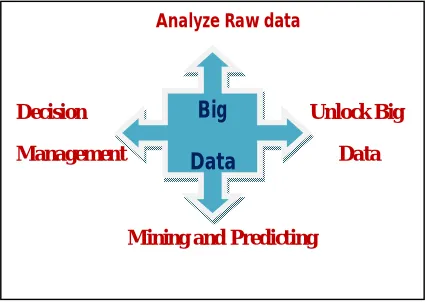
Big data analysis is making “sense” of large volumes of diverse data that in its raw form lacks a data model to define what each element means in the context of the others. The figure 2 illustrates the techniques to analyze Big Data.
Figure 2: Big Data Analyzing Techniques
The Techniques that are used for the Big Data analysis as described as below:
1. Analyze Raw Data– In many cases you don’t really know what you have and how different
data sets relate to each other. You must figure it out through a process of exploration and
discovery.
Analyze Raw data
Decision Unlock Big
Management Data
Mining and Predicting
Big
Available Online at www.ijpret.com
682 2. Unlock Big Data – Because the actual relationships are not always known in advance,
uncovering insight is often an Iterative process as you finds the answers that you seek. The
nature of iteration is that it sometimes leads you down a path that turns out to be a dead end.
3.Mining and Predicting – Big data analysis is not black and white. You don’t always know how
the various data elements relate to each other. As you mine the data to discover patterns and
relationships, predictive analytics can yield the insights that you seek.
4. Decision Management – Consider the transaction volume and velocity. If you are using big
data analytics to drive many operational decisions then you need to consider how to automate
and optimize the implementation of all those actions.
IV. Big Data –Existing Solutions:
The solutions the organizations have adopted to handle Big Data include:
1. Apache Hadoop and MapReduce
2. IBM Big Insights
3. Teradata Aster Data
4. Oracle Big Data
5. Greenplum HD(EMC)
6. SAP Hana
V. Introduction and Working Of Hadoop
Hadoop is the popular open source implementation of MapReduce, a powerful tool designed
for deep analysis and transformation of very large data sets.
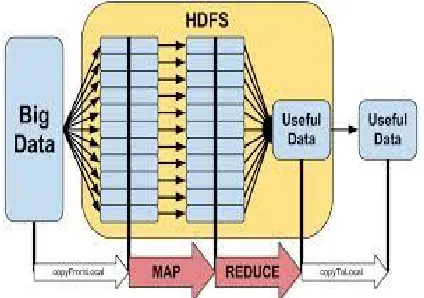
In a Hadoop cluster, data is distributed to all the nodes of the cluster as it is being loaded in.
The Hadoop Distributed File System (HDFS) as shown in (figure 3) will split large data files into
Available Online at www.ijpret.com
683 Figure 3: The Hadoop Distributed File System (HDFS)
Hadoop enables you to explore complex data, using custom analyses tailored to your
information and questions, provides storage capability through a distributed, shared-nothing
file system, and analysis capability through Map Reduce. Data is conceptually record-oriented
in the Hadoop programming framework. Individual input files are broken into lines or into other
formats specific to the application logic. Each process running on a node in the cluster then
processes a subset of these records. The Hadoop framework then schedules these processes in
proximity to the location of data/records using knowledge from the distributed file system.
Hadoop will not run just any program and distribute it across a cluster. Programs must be
written to conform to a particular programming model, named "MapReduce “.
VI. MapReduce:
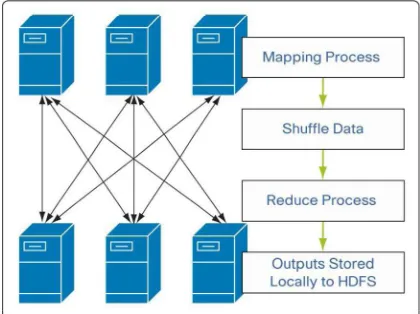
The MapReduce component of Hadoop is a framework for processing huge data sets on the
Hadoop cluster (Figure 4). MapReduce workloads can be divided into two distinct phases:
Map phase: The submitted workload is divided into smaller sub workloads and assigned to
mapper tasks. Each mapper processes one block of the input file. The output of the mapper is a
Available Online at www.ijpret.com
684
Reduce phase: The input for the reduce phase is the list of key-value pairs received from
mappers. The job of a reducer task is to analyze, condense, and merge the input to produce the
final output. The final output is written to a file in HDFS.
Individual node failures can be worked around by restarting tasks on other machines.
Figure 4: Hadoop MapReduce
The other workers continue to operate, leaving the challenging aspects of partially restarting
the program to the underlying Hadoop layer.
VII. Future Scope and Challenges:
Future Scope: Owing to the ever growing Internet and media world Big Data have a vast scope
and opportunities in near future in the following areas:
1. Non-traditional forms of media
2. Real-time information
3. Data influx from new technologies
4. Social media data
Available Online at www.ijpret.com
685 Big data introduces a great challenge for database and data analytics. The challenge is the
ability to do something meaningful with that data, cost effectively. The Challenges are:
1) Architecture: The challenge is - knowing how an optimal architecture of an analytics system
should be to deal with historic and real-time data at the same time.
2) Distributed mining: Data may be evolving over time, so it is important that the Big Data
mining techniques should be able to adapt and to detect change first.
3)Security Challenges: Data tampering at the public cloud is predictable and is a big concern. To
find a robust security mechanism for making use of the public cloud like Cloud Computing
Storage System (CCSS) is a challenging problem.
VIII. CONCLUSION:
The value from analysis on structured, transactional data is well understood and much of its
value has been realized. Forward-looking models and other analysis that benefit from larger,
more unstructured data sets not as well understood, yet experts suggest that this new frontier
of analytics holds untapped promise.
If the enterprise has an unmet business need for strategic decision making ,Analytics and
Hadoop combination offers significant opportunity to gain advantage. Big data is already a fact
of life for enterprises, but the sheer volume and massive complexity of big data can feel
overwhelming. Companies suddenly must struggle with making sense of and creating
opportunities from both data at rest and data in motion, from structured, unstructured, and
multi-structured data.
IX. REFERENCES:
1. Sam Madden Massachusetts Institute of Technology From Database to Big Data,IEEE,2012
2. P. C. Zikopoulos, C. Eaton, D. deRoos, T. Deutsch, and G. Lapis,Understanding big data –
Available Online at www.ijpret.com
686
3. Xindong Wu,,Xingquan Zhu, Gong-Qing Wu, Wei Ding, “DataMining with Big Data”,
1041-4347/13, 2013 IEEE
4. Wei Fan, Albert Bifet, “ Mining Big Data: Current Status, and Forecast to the Future”, SIGKDD
Explorations, Volume 14, Issue 2
5. Mrs. Deepali Kishor Jadhav, “Big Data: The New Challenges in Data Mining ”,International
Journal of Innovative Research in Computer Science & Technology (IJIRCST),ISSN: 2347- 5552,